Bigin vs HubSpot: The Honest Comparison for Small Teams
Stop comparing free plans. They're both bait. The real Bigin vs HubSpot question is what you'll pay six months from now when your team hits the limits - and that's where these two CRMs diverge dramatically.
30-Second Verdict
- Bigin wins if you're a team under 10 that needs a clean pipeline and nothing else. $7-$12/user/mo (billed annually), and paid plans include a free onboarding session.
- HubSpot wins if you need marketing automation baked into your CRM and can stomach $90+/seat/mo when you outgrow Starter.
What It Actually Costs
We've compared dozens of CRM pricing pages, and HubSpot's is the most deliberately opaque we've seen. Hubs, bundles, seats, marketing contacts, onboarding fees. Bigin keeps it simple.
Bigin Pricing
| Plan | Price/user/mo | Pipelines | Records | Workflow Rules |
|---|---|---|---|---|
| Free | $0 | 1 | 500 | 3 |
| Express | $7 | 3 | 50,000 | 30 |
| Premier | $12 | 5 | 100,000 | 50 |
| Bigin 360 | $18 | 15 | 1,000,000 | 100 |
All paid plans include a free onboarding session, support through phone/email/live chat, and data import assistance. Annual billing.
HubSpot Pricing
| Plan | Price/seat/mo | Contact Limit | Pipelines | Workflows |
|---|---|---|---|---|
| Free | $0 | 1,000 contacts | 1 | 0 |
| Starter | $15 | Higher limits | Multiple | Limited |
| Professional | $90-100 | Higher limits | Multiple | More automation |
| Enterprise | ~$150 | Higher limits | Multiple | Advanced automation |
On higher tiers, onboarding fees commonly run $1,500-$7,000+. That's cash out the door before a single rep logs in.
Real Cost at 5 and 10 Users
| Scenario | 5 users/mo | 10 users/mo |
|---|---|---|
| Bigin Express | $35 | $70 |
| Bigin Premier | $60 | $120 |
| HubSpot Starter | $75 | $150 |
| HubSpot Pro | $450-500 | $900-1,000 |
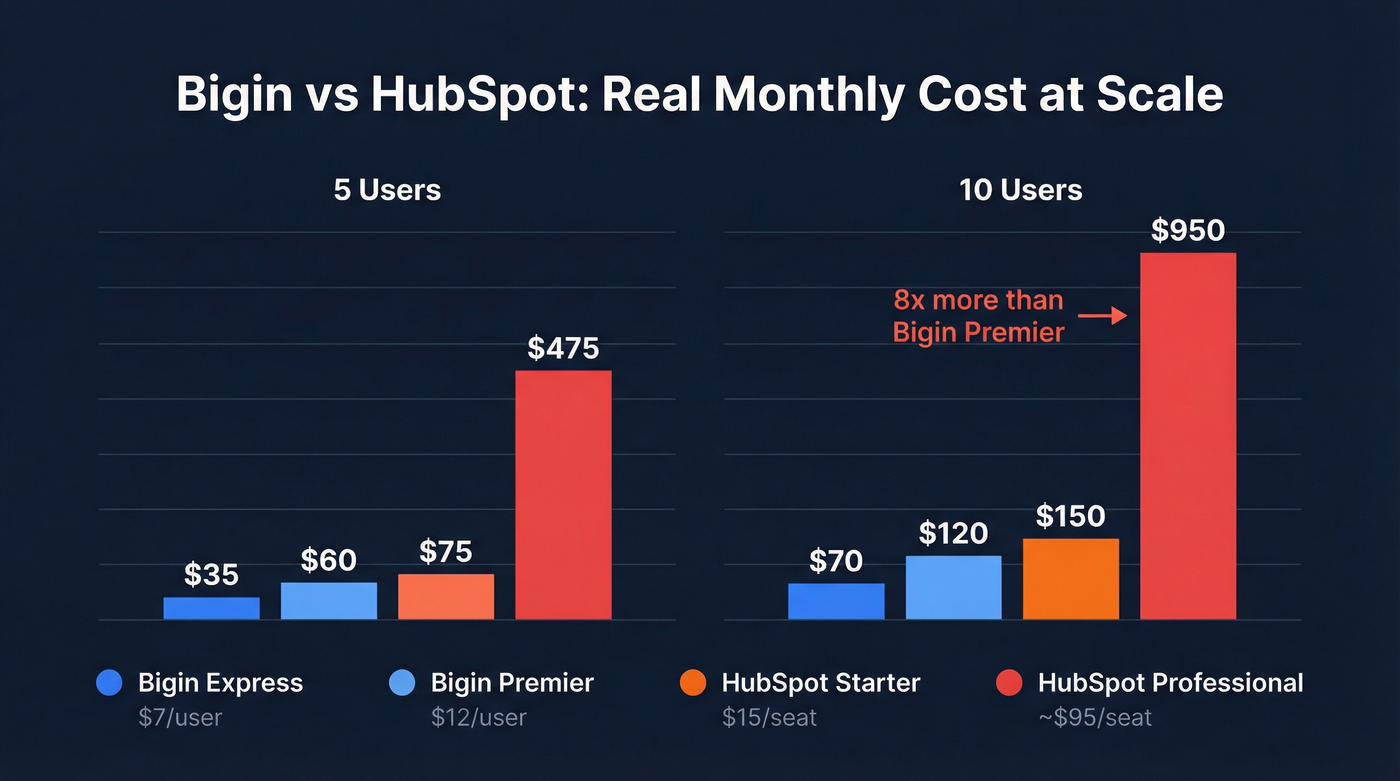
At 10 users, HubSpot Professional costs roughly 8x more than Bigin Premier. For a Series A company watching burn rate, that gap is impossible to justify unless you're genuinely using the marketing automation every week.
HubSpot's Free Plan Trap
In early 2024, HubSpot slashed the free plan's contact limit from 1 million to 1,000. One million to one thousand. That's not a trim - it's a demolition.
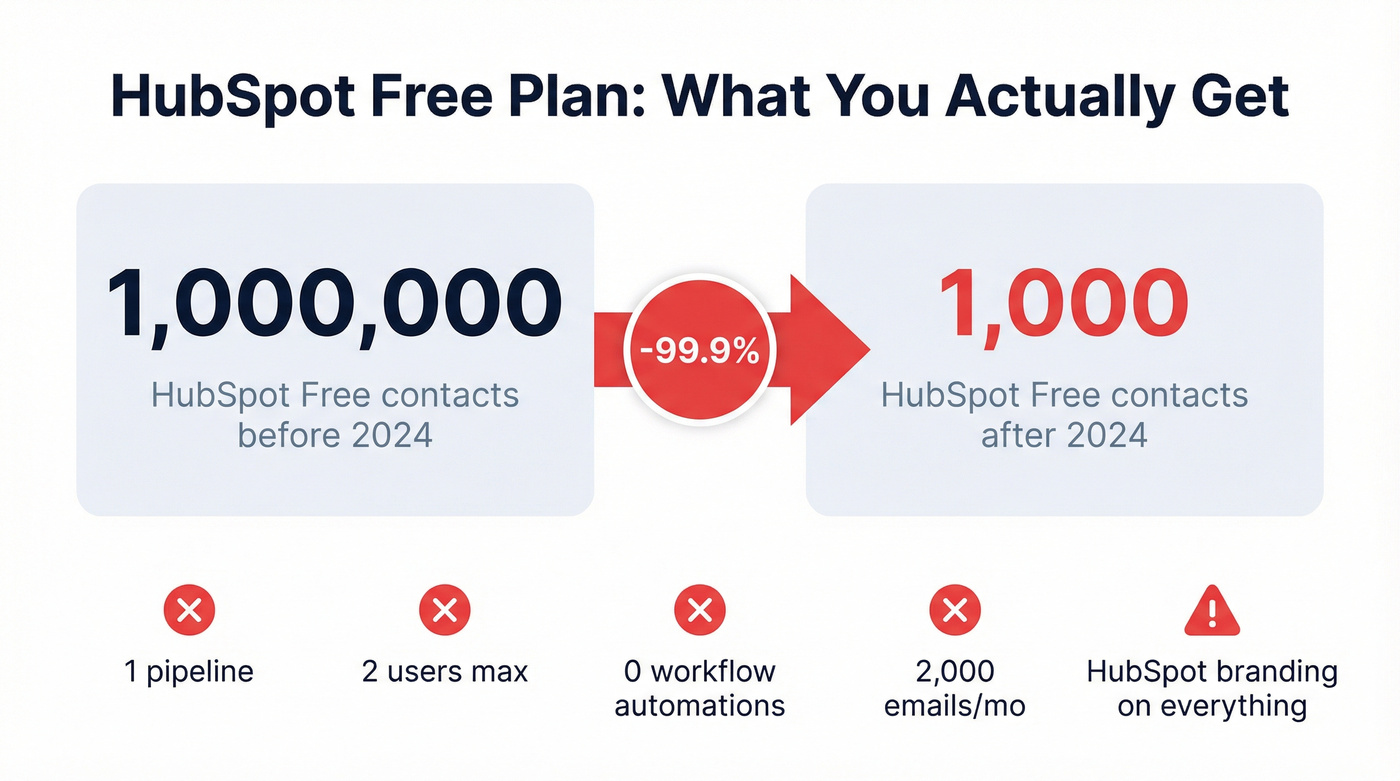
What you actually get on HubSpot Free: 1 pipeline, up to 2 users, 2,000 email sends/month, 5 email templates, 3 dashboards with up to 10 reports each, and HubSpot branding plastered on everything. Zero workflow automations. And if you want to email those stored contacts at scale, you'll hit the marketing contacts gate fast - costs climb once you need to market to a meaningful slice of your database.
The free plan works as a trial. It doesn't work as a CRM.

Bigin and HubSpot both organize contacts - neither finds them. Prospeo gives you 143M+ verified emails and 125M+ mobile numbers on a 7-day refresh cycle, so your CRM never runs on stale data. It integrates natively with HubSpot and connects to Bigin via Zapier.
Stop configuring an empty CRM. Fill it with contacts that actually connect.
Features That Matter for Small Teams
Forget the 50-row feature matrices. Here's what actually differs when you're running a lean operation.
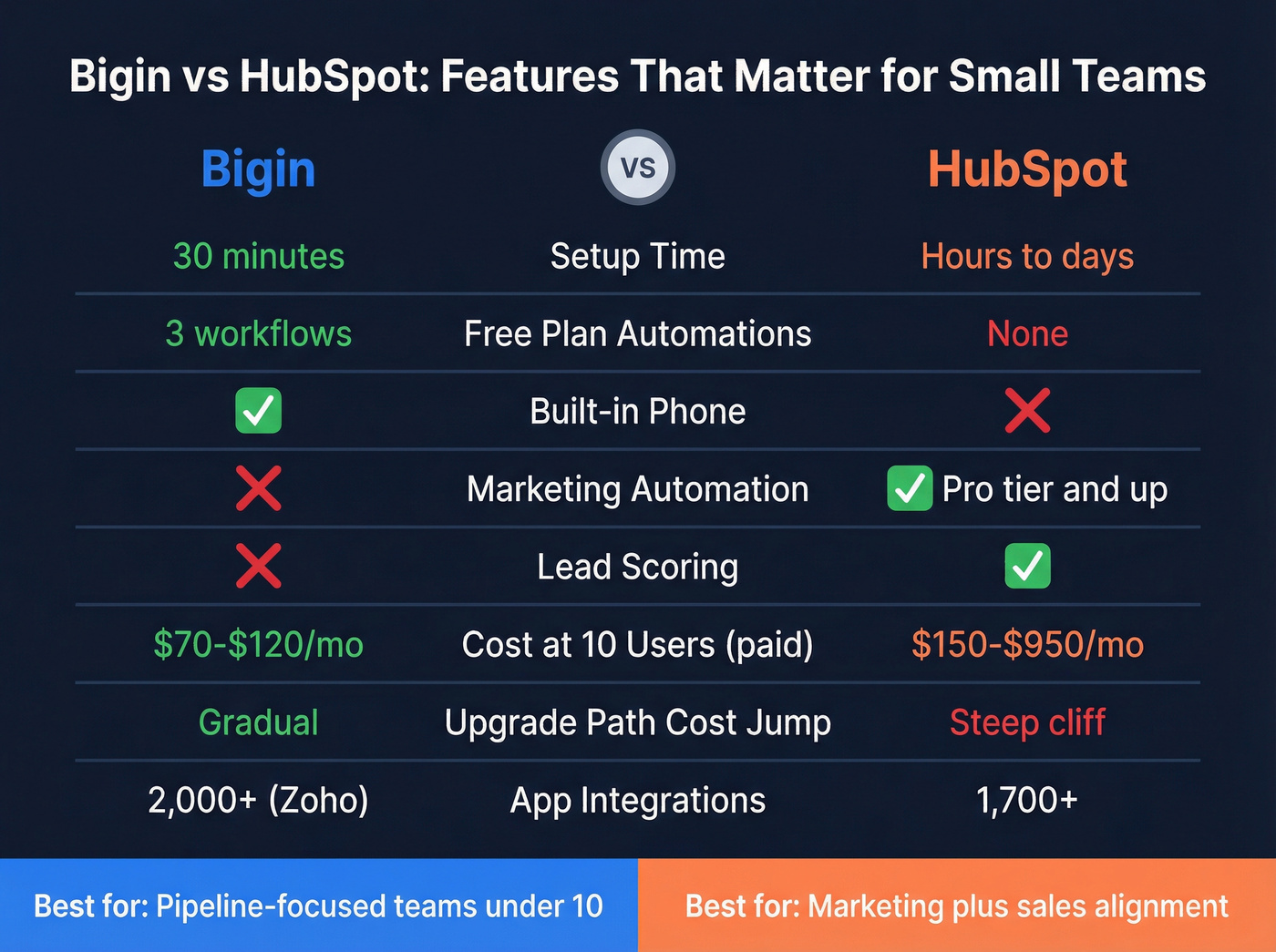
Use Bigin if you want a lightweight pipeline CRM with built-in phone on the free plan and workflow automation included even at the bottom tier (3 automations on Free). HubSpot's free CRM doesn't include workflows. Bigin can also be set up in around 30 minutes - we've watched teams go from signup to first deal tracked in a single lunch break.
Use HubSpot if you need marketing and sales under one roof. Lead scoring, nurture sequences, landing pages - that's HubSpot's territory. Bigin is a pipeline CRM, full stop.

The integration ecosystem argument is overblown. HubSpot has 1,700+ apps; Zoho's marketplace runs 2,000+. Most small teams connect five tools, maybe six. Nobody's using 1,700 integrations.
Let's talk about the real scalability question: the upgrade path. Bigin to Zoho CRM is usually a smoother cost step than HubSpot's jump from Starter to Professional. If your average deal size sits below five figures, you almost certainly don't need HubSpot Professional. Bigin Premier at $12/user will do the job.
What Users Say
On Capterra, Bigin scores 4.7/5 across 715 reviews while HubSpot scores 4.5/5 across 4,440 reviews. The sub-ratings tell a clearer story: Bigin leads on Value for Money (4.7 vs 4.3) and Ease of Use (4.7 vs 4.4). Common feedback describes HubSpot as powerful but overly complex for teams that just need pipeline management.
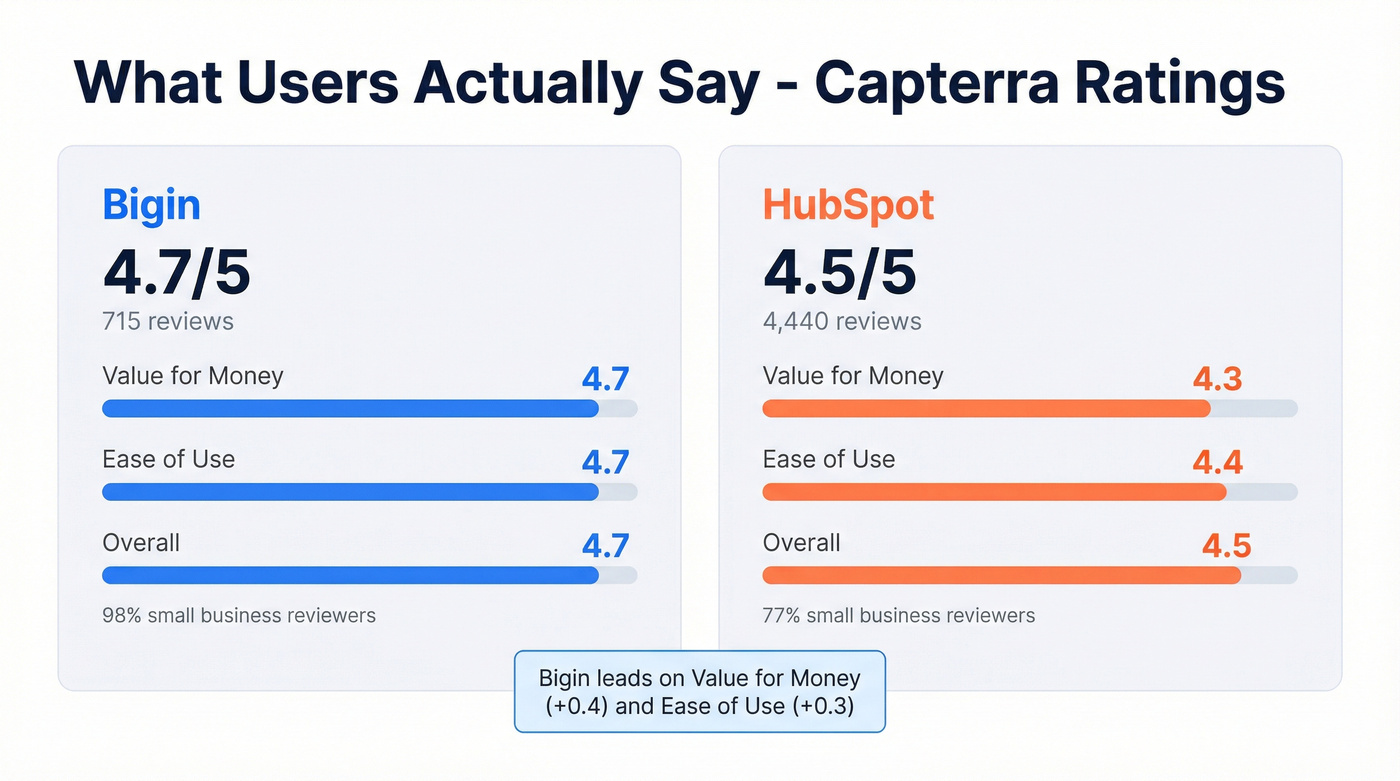
Here's the thing - 98% of Bigin's reviewers are small businesses. For HubSpot, it's 77%. That skew matters when you're reading aggregate scores.
The consensus on r/smallbusiness threads tends to echo the same pattern: HubSpot is praised for its marketing tools but criticized for the pricing cliff between Starter and Professional. Bigin barely comes up in those threads, which is both its weakness (less community support) and a signal that the people using it aren't running into problems worth posting about.
Who Should Pick What
Solopreneur or 1-3 person team: Bigin Express at $7/user/mo. Three pipelines, 50,000 records, built-in phone, WhatsApp Business integration. Done.
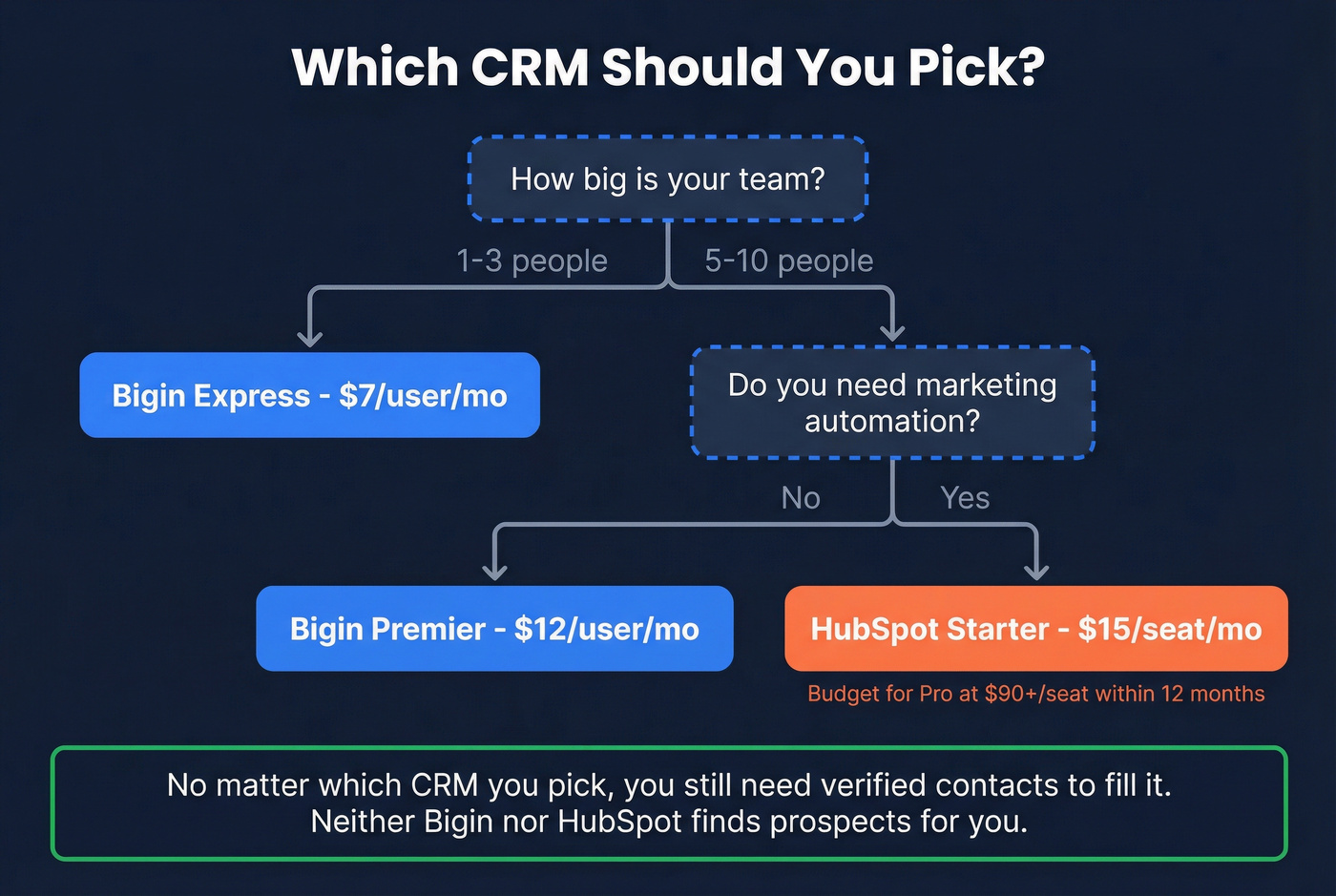
5-10 person sales team: Bigin Premier at $12/user/mo. We've seen teams run on this for years without hitting the ceiling.
Teams needing marketing + sales alignment: HubSpot Starter at $15/seat/mo, but budget for Professional within 6-12 months. Go in with eyes open on the cost curve - and maybe set aside $3,000 for that mandatory onboarding fee on Pro.
Skip both if your team already has a CRM and your actual bottleneck is finding the right people to put in it. A CRM with empty or stale records is just an expensive spreadsheet.
The Data Gap Neither Solves
A CRM organizes contacts. It doesn't find them or verify them. Neither Bigin nor HubSpot will tell you the VP of Engineering's direct email or mobile number.
That's a different problem entirely, and it's the one that actually stalls pipelines. We've talked to teams that spent weeks configuring their CRM only to realize they had 200 contacts and no way to scale prospecting without buying a separate data tool.
Prospeo fills that gap with 143M+ verified emails and 125M+ verified mobile numbers on a 7-day refresh cycle. It integrates natively with HubSpot and connects through Zapier workflows, so whichever CRM you pick, your contact data stays clean and current. The free tier gives you 75 verified emails/month with no credit card required.
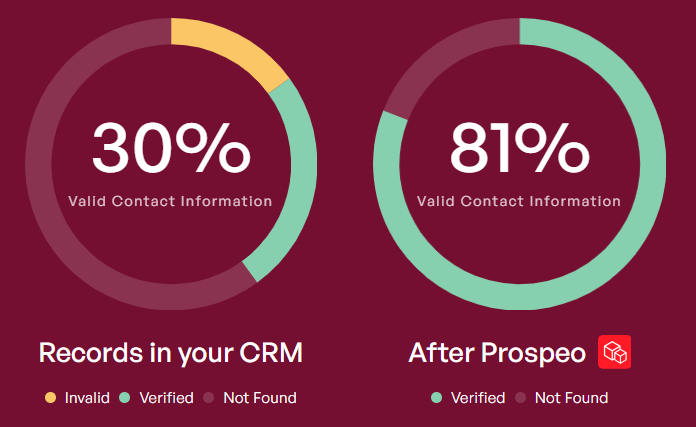
You just saved hundreds choosing Bigin over HubSpot Pro. Now spend $0.01/email to fill it with verified decision-maker contacts instead of guessing. 98% email accuracy, 30% mobile pickup rate - no contracts, no sales calls.
Redirect those CRM savings into pipeline that actually converts.
FAQ
Is Bigin really cheaper than HubSpot?
Yes. At 10 users, Bigin Premier costs $120/mo versus $150 for HubSpot Starter - and $900+ for HubSpot Professional. Even Bigin 360 at $18/user comes to $180/mo for 10 seats, still cheaper than HubSpot's entry paid tier.
Can Bigin replace HubSpot for marketing automation?
No. Bigin is a pipeline CRM with basic workflow rules, not a marketing platform. For nurture sequences, lead scoring, and landing pages, you need HubSpot Professional or a dedicated marketing tool layered on top.
How do I get verified contacts into either CRM?
Neither CRM finds contacts for you. Prospeo integrates with HubSpot natively and connects to Bigin through Zapier - 98% email accuracy across 143M+ verified addresses, with a free tier of 75 emails/month to start.
Which CRM is easier to set up?
Bigin takes roughly 30 minutes to configure with pipelines, fields, and automations. HubSpot Free is quick to start but becomes complex once you add multiple hubs, custom properties, and permission sets - expect a multi-day setup at Professional tier.