

Healthcare Cold Email Services: What Works in 2026
You send 500 emails to hospital administrators. 180 bounce. Your domain reputation tanks before you've booked a single meeting.
That's not a messaging problem - it's a data problem, and it's the reason most healthcare cold email campaigns fail before they start. General-purpose data tools routinely produce 25-35% bounce rates when targeting healthcare contacts because hospital systems recycle addresses, use catch-all domains, and run aggressive spam filters that punish senders with bad lists. Fix the data layer first, and everything else gets easier.
The Short Version
If you've got budget but no bandwidth, hire an agency like Belkins (around $5,500/mo for 10+ meetings). If you want control and lower cost, build a DIY stack with a verified data provider and a sending tool like Smartlead - roughly $100-$300/mo total. Either way, your #1 problem isn't messaging or compliance. It's data quality.
Is Cold Emailing in Healthcare Legal?
Yes, as long as your emails don't contain protected health information. Cold outreach falls under CAN-SPAM, not HIPAA - unless you're referencing patient data, diagnoses, or treatment details. The confusion between these two frameworks kills campaigns before they launch.
Here's the checklist that keeps you safe:
- No PHI in any email - not in the body, not in the subject line, not in attachments. Never reference diagnoses, medications, or patient conditions.
- Working opt-out mechanism in every email, honored within 10 business days. Best practice is 24-48 hours.
- Valid physical mailing address in the footer. (If you're unsure what qualifies, see the physical address requirement.)
- Truthful headers and subject lines - no misleading sender names or deceptive subjects.
- Record-keeping of consent and opt-out requests.
The stakes aren't abstract. The average healthcare data breach cost $9.23M in 2021, and that number has climbed since. You don't want to be the vendor who accidentally triggered one by including a patient reference in a prospecting email. Keep your outreach about your product, not their patients, and you're on solid legal ground.
Why Healthcare Deliverability Is Uniquely Hard
Healthcare organizations run some of the strictest email security in any industry - Proofpoint, Mimecast, and Microsoft's email security stack are standard in larger systems. These tools are tuned to block anything that looks remotely like spam, and a cold email from an unknown domain absolutely qualifies.
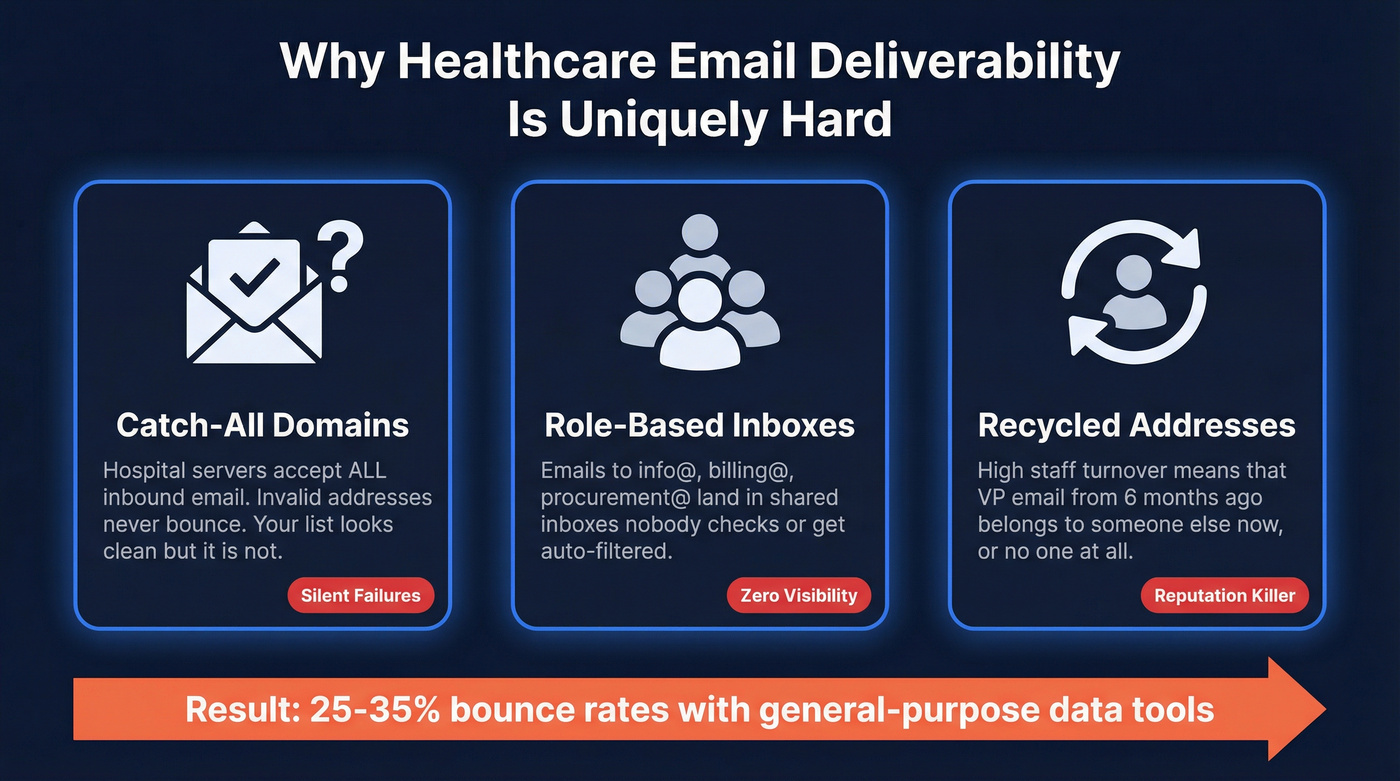
Three things make healthcare worse than other verticals:
Catch-all domains. Large hospital systems accept all inbound email at the server level, so you never get a hard bounce telling you an address is invalid. Your list looks clean. It isn't. (If you need a deeper fix, start with email verification for outreach.)
Role-based inboxes. You're emailing info@, billing@, or procurement@ - addresses that either go to a shared inbox nobody checks or get auto-filtered into oblivion.
Recycled addresses. Staff turnover in healthcare is brutal. That VP of Operations email from six months ago probably belongs to someone else now - or no one at all.
Nearly 45% of all email traffic is spam. Hospital IT teams know this, and they filter accordingly. Your sending infrastructure needs to match. Stay under 100 cold emails per day per sending address, use one address per domain, and follow this warm-up ramp before any real outbound volume:
- Day 1: 10-20 emails/day
- Days 3-7: 30-40 emails/day
- Days 8-12: 60-80 emails/day
- Day 14+: 80-100 emails/day (cap at 100 per address)
We've seen teams skip the warm-up and torch a domain in 48 hours. Don't be that team. (If you want the full playbook, use an email deliverability checklist and a proven automated email warmup process.) And in our experience, data quality - not messaging - is the real bottleneck. The most common failure mode is bounce rates above 25% when using general-purpose tools. Verification that handles catch-all domains and removes spam traps before you hit send eliminates the invisible bounces that destroy domain reputation.

Most healthcare campaigns fail because general-purpose tools can't handle catch-all domains and recycled addresses. Prospeo's 5-step verification - including catch-all handling, spam-trap removal, and honeypot filtering - delivers 98% email accuracy. That's how teams go from 35% bounce rates to under 4%.
Stop torching domains. Start with data that actually works.
Healthcare Cold Email Benchmarks
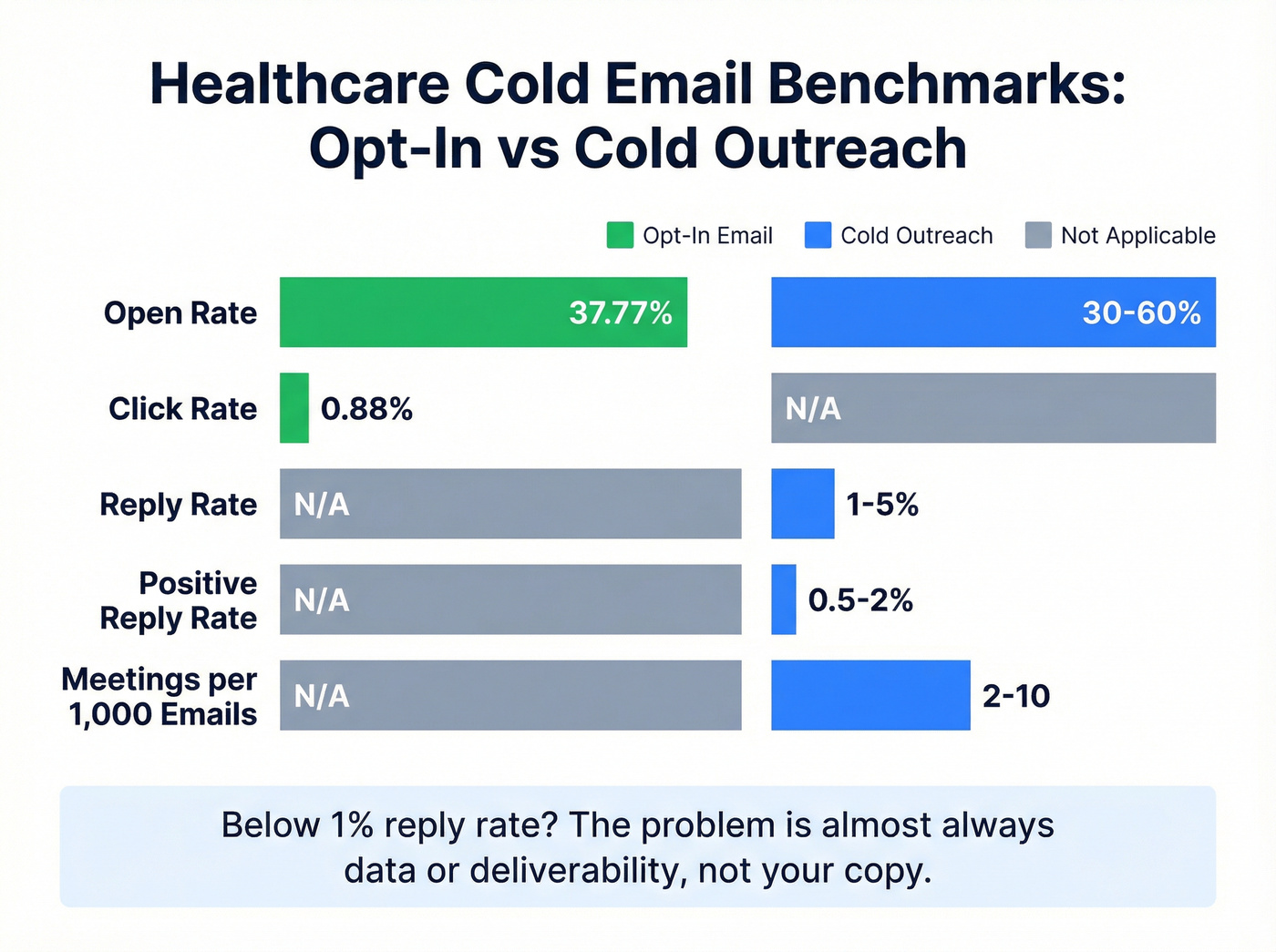
Set expectations before you launch. These numbers reflect estimated performance on properly warmed domains with verified data:
| Metric | Opt-in Email | Cold Outreach |
|---|---|---|
| Open rate | 37.77% | 30-60% |
| Click rate | 0.88% | N/A |
| Reply rate | N/A | 1-5% |
| Positive reply rate | N/A | 0.5-2% |
| Meetings per 1,000 | N/A | 2-10 |
If you're below 1% reply rate, the problem is almost always data or deliverability - not your copy. And 69% of people unsubscribe because they get too many emails, not because the content is bad. Volume discipline matters. (For volume rules that won’t wreck your domain, follow cold email volume best practices.)
Agency vs. DIY: Which Model Fits?
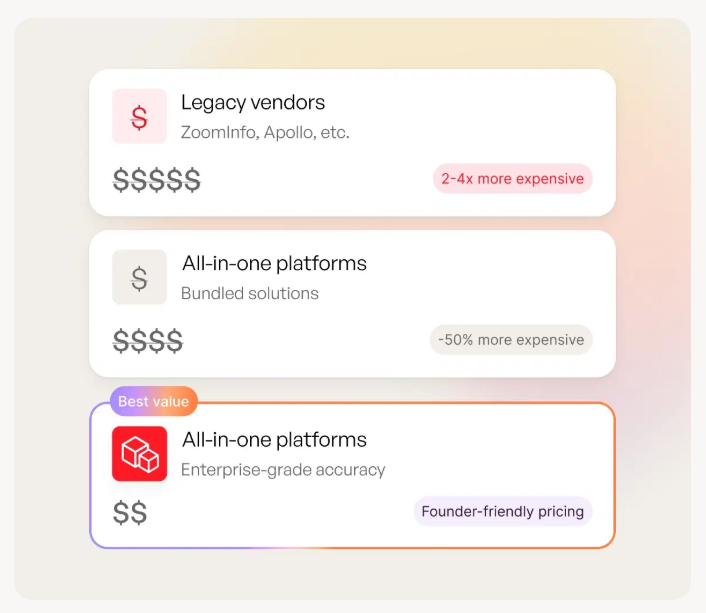
The cost gap between these two approaches is enormous, and it's the first decision you need to make.
| Factor | Agency | DIY Stack |
|---|---|---|
| Monthly cost | $5,500-$30,000 | $100-$300 |
| Cost per meeting | ~$200-$500 | ~$20-$80 |
| Time to launch | 2-4 weeks | 1-2 weeks |
| Control over targeting | Limited | Full |
| Requires in-house skill | No | Yes |
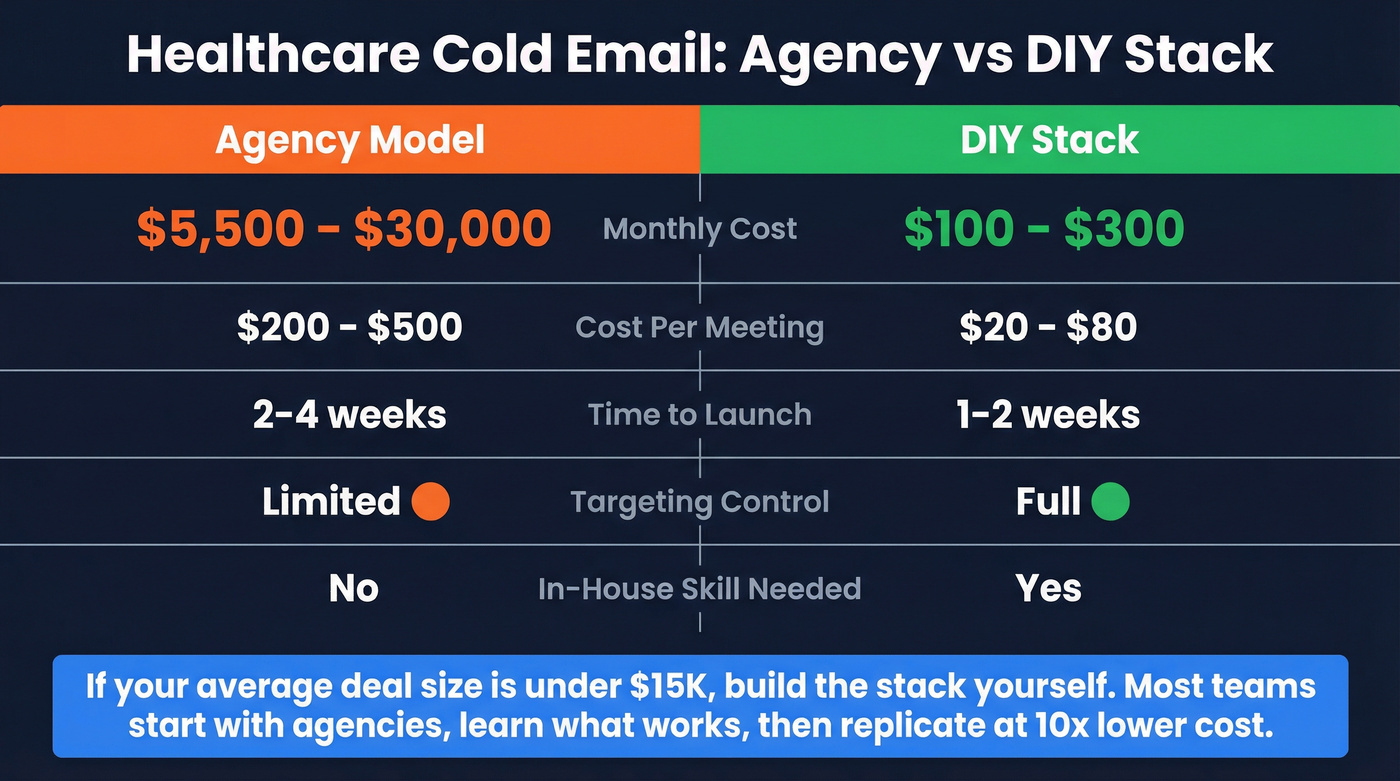
Agencies make sense when you've got budget, no internal SDR team, and need meetings fast without building infrastructure. DIY makes sense when you want full control over targeting, copy iteration, and cadence - and when you'd rather spend a couple hundred bucks a month than $5,500.
Let's be honest about what usually happens: teams start with agencies, learn what works, then bring it in-house and replicate the playbook at a tenth of the cost. If your average deal size is under ~$15K, $5.5K/month retainers get tight fast. Build the stack yourself. (If you want to compare pricing models first, see cold email agency pricing.)
Top Services for Healthcare Outreach
Belkins (Agency)
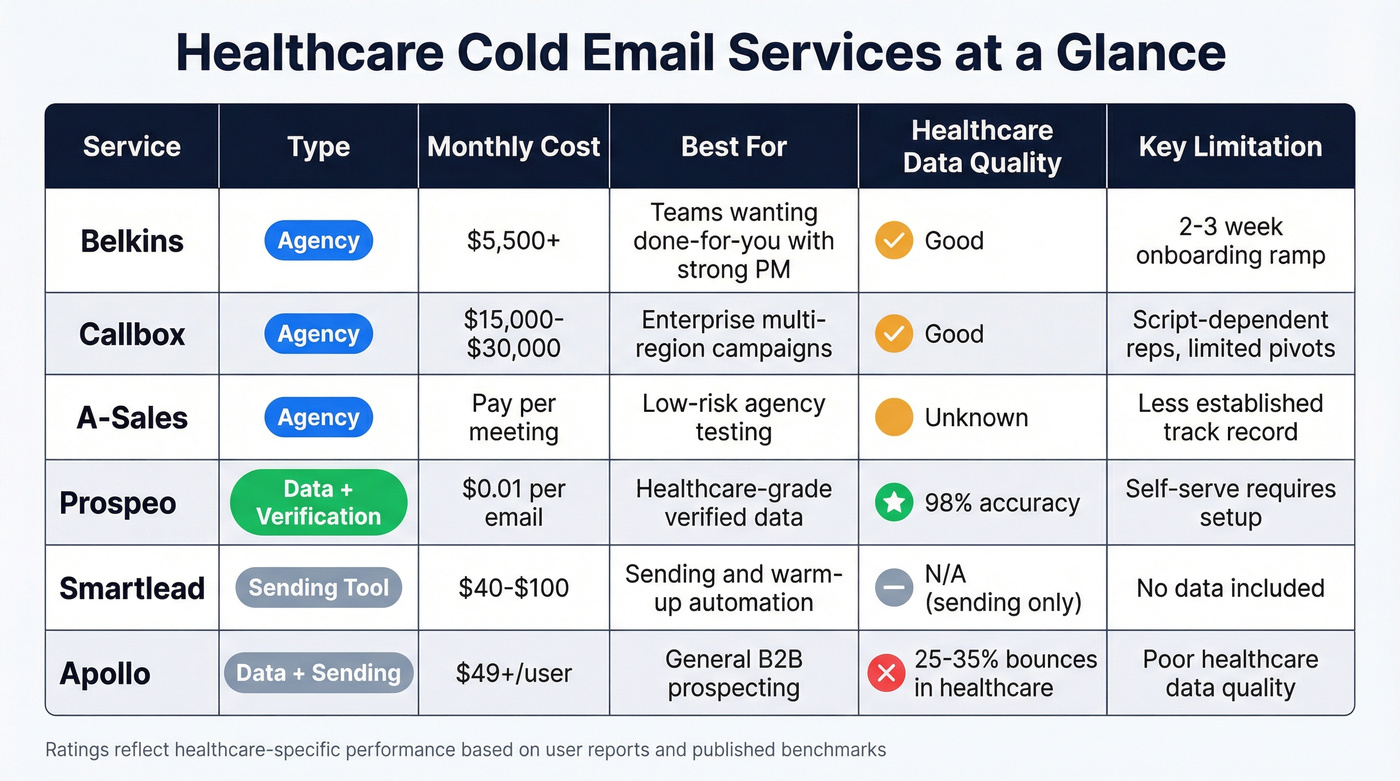
Use this if you want a proven agency with strong project management and you can commit $5,500+/mo. Belkins carries a 4.9/5 on Clutch across 230 reviews, with most projects landing in the $10K-$49K range. Clients consistently praise their communication and lead quality. Expect 2-3 weeks of onboarding before campaigns go live.
Skip this if you need results in week one or your budget is under $5K/mo. Some clients report challenges with initial campaign alignment - the first month can feel slow while they dial in your ICP and messaging. That ramp-up time is normal for agencies, but it stings when you're paying $5K+ and watching an empty calendar.
Callbox (Agency)
Callbox is the enterprise play - multichannel outreach spanning email, phone, and social with dedicated Campaign Pods. A single pod runs $15,000-$30,000 for one region, with quarterly-to-annual contracts.
The problem: at $15K+ per month, you should expect strategic adaptability, and you won't always get it. The recurring complaints are script-dependent reps, limited strategic pivots, and insights you have to specifically request rather than proactively receive. If you're spending this much, you deserve a partner that thinks ahead of you, not one that waits for instructions. Skip this unless you're running enterprise-scale campaigns across multiple regions.
A-Sales (Agency)
Worth a look for performance-based pricing - you pay per qualified meeting rather than a flat retainer. They position as HIPAA-aware and have reported 97 qualified meetings in 5 weeks for one client. The pay-per-meeting model reduces your downside risk, which makes them a lower-stakes way to test agency outreach before committing $5K+/mo elsewhere.
Prospeo (Self-Serve Data + Verification)
This is where you solve the bounce rate problem that makes healthcare campaigns fail. Prospeo's 5-step verification process handles catch-all domains, removes spam traps and honeypots, and delivers 98% email accuracy - compared to the 25-35% bounce rates teams see with general-purpose tools.
The database covers 300M+ professional profiles with 30+ search filters, including buyer intent data across 15,000 Bombora topics. For targeting, that means filtering by department headcount, funding stage, and technology stack - not just job title and location. Data refreshes every 7 days versus the 6-week industry average, and in healthcare where staff turnover is high and addresses get recycled constantly, that difference is the gap between a clean send and a reputation-killing bounce spike. (If you want more options, compare B2B data providers for healthcare.)
Real-world proof: Stack Optimize built from $0 to $1M ARR using Prospeo, maintaining 94%+ deliverability and sub-3% bounce rates across all clients with zero domain flags. The free tier gives you 75 emails per month to test, and paid plans work out to roughly $0.01 per email.
Smartlead (Self-Serve Sending)
The natural pairing for the sending layer in a DIY stack. Plans run around $40-$100/mo with unlimited email accounts and built-in warm-up. It handles rotating inboxes, warm-up sequences, and deliverability monitoring while your data tool handles verification and targeting. (If you’re evaluating options, see our roundup of cold email marketing tools.)
Apollo (Self-Serve Data)
Apollo's free plan and 210M+ contact database make it the default starting point for most teams. Paid plans start at $49/user/mo. It's fine for tech, SaaS, and most B2B verticals. But healthcare is where it breaks down - the consensus on r/sales threads is that teams regularly see 25-35% bounce rates targeting hospital systems and medical practices. For healthcare specifically, the data quality gap is too expensive to ignore.
Building a DIY healthcare outreach stack for $100-$300/mo? Prospeo gives you 300M+ profiles with 30+ filters - including job title, department headcount, and technographics - so you can target the exact hospital administrators and procurement leads you need. At $0.01 per email, you're spending less on data than on your sending tool.
Enterprise-grade healthcare data without the enterprise price tag.
Writing Copy That Gets Replies
The compliance rules above keep you legal. These keep you out of the spam folder and into replies.
Subject lines should be short, specific, and PHI-free. "Reducing readmission rates at [Hospital Name]" works. "Treatment options for diabetic patients" doesn't - it's borderline PHI and will trigger spam filters.
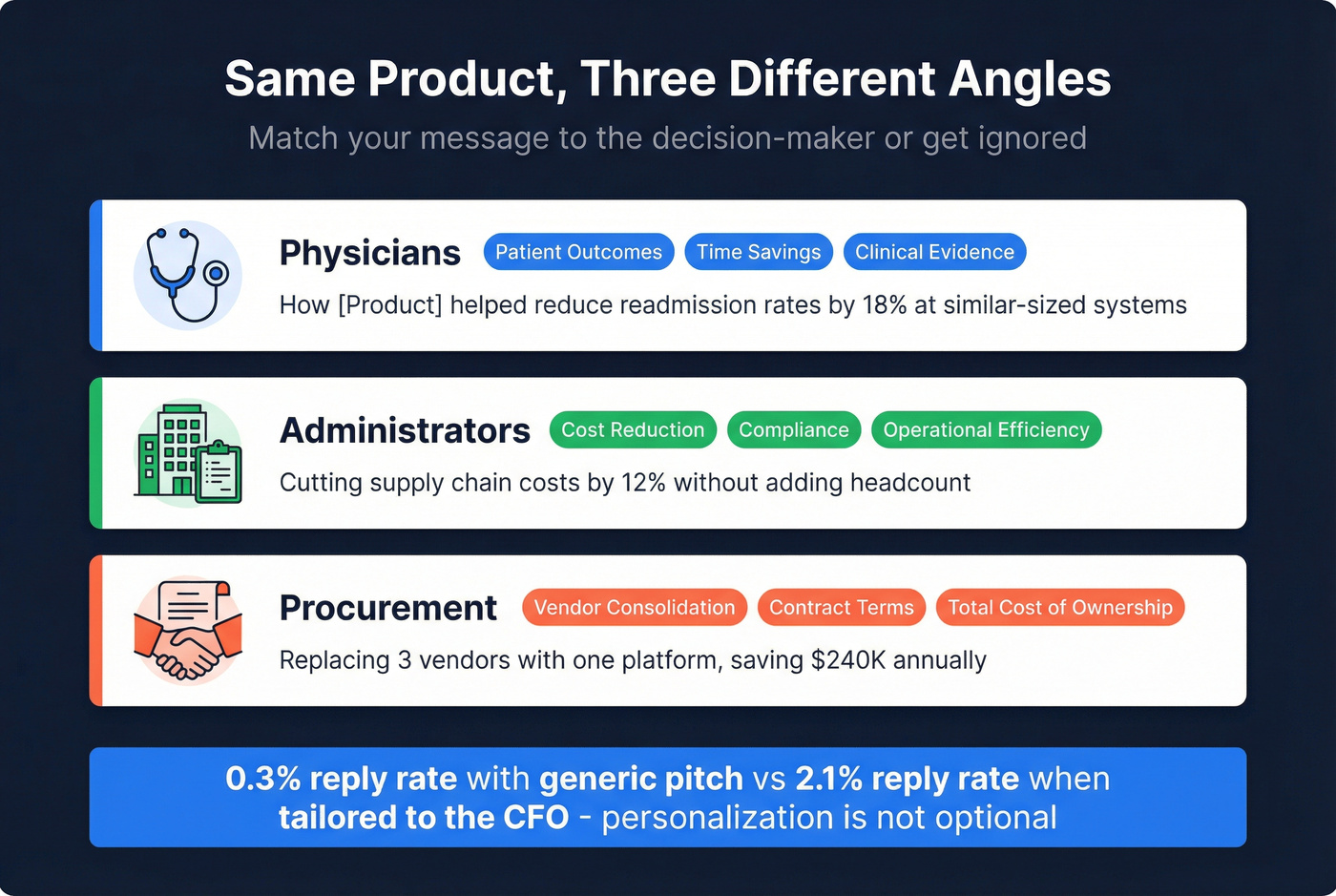
Match the decision-maker. Physicians care about patient outcomes and time savings. Administrators care about cost reduction and compliance. Procurement cares about vendor consolidation and contract terms. Same product, three completely different angles. We ran a test last year where the same offer got a 0.3% reply rate with a generic pitch and a 2.1% reply rate when tailored to the CFO's specific budget concerns. Personalization isn't optional here. (If you want frameworks, use personalization in outbound sales.)
Cadence discipline matters more than copy. Stick to 3-4 touches over 2-3 weeks. Don't be the vendor who sends 8 follow-ups in 10 days. (For ready-to-use structures, see these outreach email templates.)
Send on Tuesdays and Fridays, with peak engagement around 2pm and 5pm. Avoid Monday mornings - hospital inboxes are already buried.
Design for mobile. 41% of email views happen on phones. Front-load your ask, keep formatting simple, and cap your email at three to five sentences with one clear call to action. Healthcare professionals don't have time for a four-paragraph value proposition.
Avoid these spam trigger words that healthcare filters flag aggressively: "free consultation," "limited time," "act now," "guaranteed results," and anything with dollar signs or ALL CAPS in the subject line. Hospital-grade filters are tuned tighter than typical B2B systems - write like a peer, not a marketer.
FAQ
Is cold emailing doctors legal?
Yes, if your emails contain no protected health information and comply with CAN-SPAM - a working opt-out link, your physical address, and truthful headers. HIPAA governs health data, not the act of sending an email. Keep outreach about your product, not their patients.
What's a good reply rate for healthcare cold email?
Expect 1-5% total replies and 0.5-2% positive replies on properly warmed domains with verified data. Anything below 1% usually signals a data quality or deliverability problem, not a messaging issue. Fix the list before rewriting the copy.
How much do healthcare cold email agencies cost?
Belkins runs around $5,500/month for 10+ meetings. Callbox charges $15,000-$30,000 per Campaign Pod. Performance-based agencies like A-Sales charge per qualified meeting instead of a flat retainer, reducing upfront risk significantly.
Why is my healthcare bounce rate so high?
Hospital systems use catch-all domains, role-based inboxes, and frequently recycled addresses that general-purpose tools can't verify. Switching to verification that handles catch-all domains and removes spam traps routinely cuts bounce rates from ~35% to under 4%.
Can I run healthcare outreach without an agency?
Yes. A DIY stack - verified data plus a sending tool like Smartlead - costs $100-$300/mo and gives you full control over targeting, copy, and cadence. You'll invest time learning deliverability basics, but the cost savings are 10-20x compared to agency pricing.