

ABM Data Enrichment: Frameworks, Tools, and the 90-Day Playbook
Your SDR just launched a 200-contact sequence targeting mid-market CFOs. By Thursday, 47 emails have bounced - a 23% bounce rate, enough to torch your sender reputation and tank deliverability for the rest of the quarter. The contacts looked fine in the CRM. They weren't.
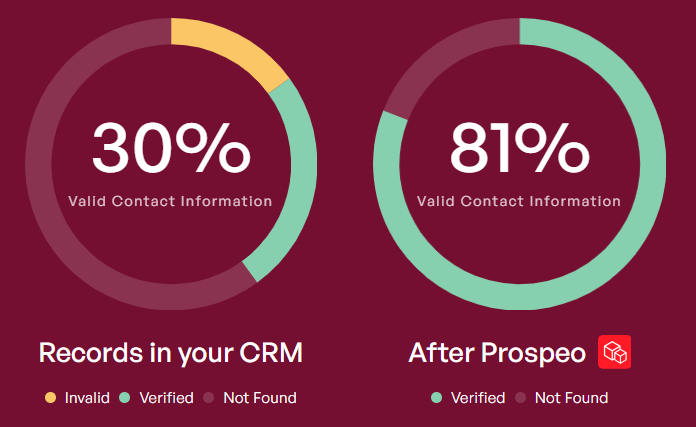
Job titles decay at roughly 66% per year. Overall B2B contact data erodes 22.5-70% annually, and Gartner pegs the cost of poor data quality at $12.9M-$15M per year for the average organization. Your ABM program isn't failing because of bad messaging or wrong ICP. It's failing because the data underneath it is rotting faster than you're refreshing it.
ABM data enrichment is the fix - but most teams either overpay for it or do it halfway. Here's what actually works.
What ABM Data Enrichment Actually Is
Most teams blur the line between data appending and data enrichment. Appending fills in missing fields - you have a CTO's name but no phone number, so you find the number. Enrichment goes deeper. It adds contextual intelligence: firmographics, technographics, intent signals, buying committee maps, and behavioral triggers that let you prioritize and personalize at the account level.
ABM isn't about hitting one contact per account with a generic email. It's about multi-threading into buying committees with relevant, timely messaging. You can't do that without rich, accurate data on every stakeholder.
The data enrichment market is projected to reach $5.48B by 2034 at a 12.0% CAGR. This isn't a niche tactic anymore. 67% of practitioners currently use ABM, and 47% have already integrated demand gen and ABM processes. Yet 42% of B2B marketers still can't do precise contact-level marketing because their data isn't good enough. That gap between ABM ambition and data reality is exactly what enrichment closes.
The Four Enrichment Layers
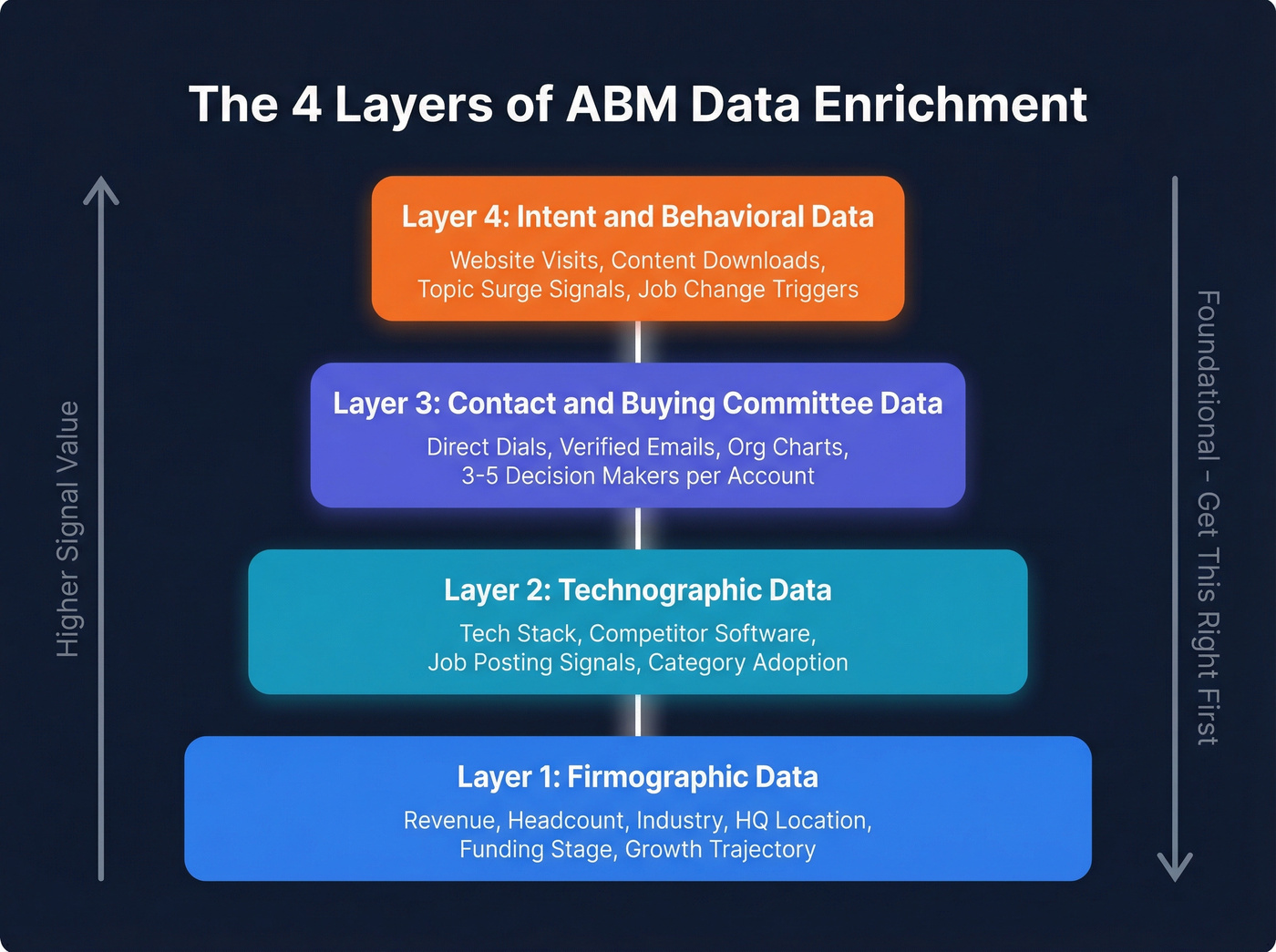
Not all enrichment data is created equal. Here's the framework we use to evaluate what you actually need on each target account.
Firmographic Data
This is the foundation. Revenue, headcount, industry vertical, HQ location, funding stage, growth trajectory. Firmographics define whether an account fits your ICP at all. If you're selling a $50K/year platform to companies with fewer than 50 employees, no amount of intent data saves that deal. Get the firmographic layer right first - it's the cheapest data to acquire and the most expensive to get wrong, because every downstream action builds on it.
Technographic Data
Tech stack signals are the most underused enrichment layer in ABM. Knowing that a target account runs a competitor's software is a prioritization trigger - it means they've already bought into the category. Detection methods include Wappalyzer-style crawling and job posting analysis. If they're hiring a "Salesforce Admin," you know what CRM they run. Technographics give you a conversation opener before you ever pick up the phone.
Contact and Buying Committee Data
This is where most enrichment efforts fall short. You need direct dials, verified emails, and org chart mapping for 3-5 decision-makers per account - not just the VP who shows up first in a search. Multi-threading is the difference between a deal that stalls and one that closes.
Intent and Behavioral Data
Intent data tells you which accounts are actively researching topics related to your solution. First-party intent - website visits, content downloads, product usage - is the most reliable signal. Third-party intent, like Bombora's topic-level surge data, casts a wider net but tends to be less precise. The payoff is real: Marketo saw a 107% increase in email open rates and 120% increase in CTR after integrating intent data into outbound.
One timing play worth stealing: target accounts within the first 90 days of a new CISO or security leader hire. New leaders reassess vendors. That window is when they're most receptive to outbound, and intent data combined with job-change signals lets you catch it.
Waterfall Enrichment: Benefits and Risks
Waterfall enrichment means querying data providers sequentially - start with your primary source, and if gaps remain, cascade to a second, third, or fourth provider until the record is complete. In theory, it maximizes coverage. In practice, it creates problems most teams don't anticipate until they're knee-deep in dirty data.
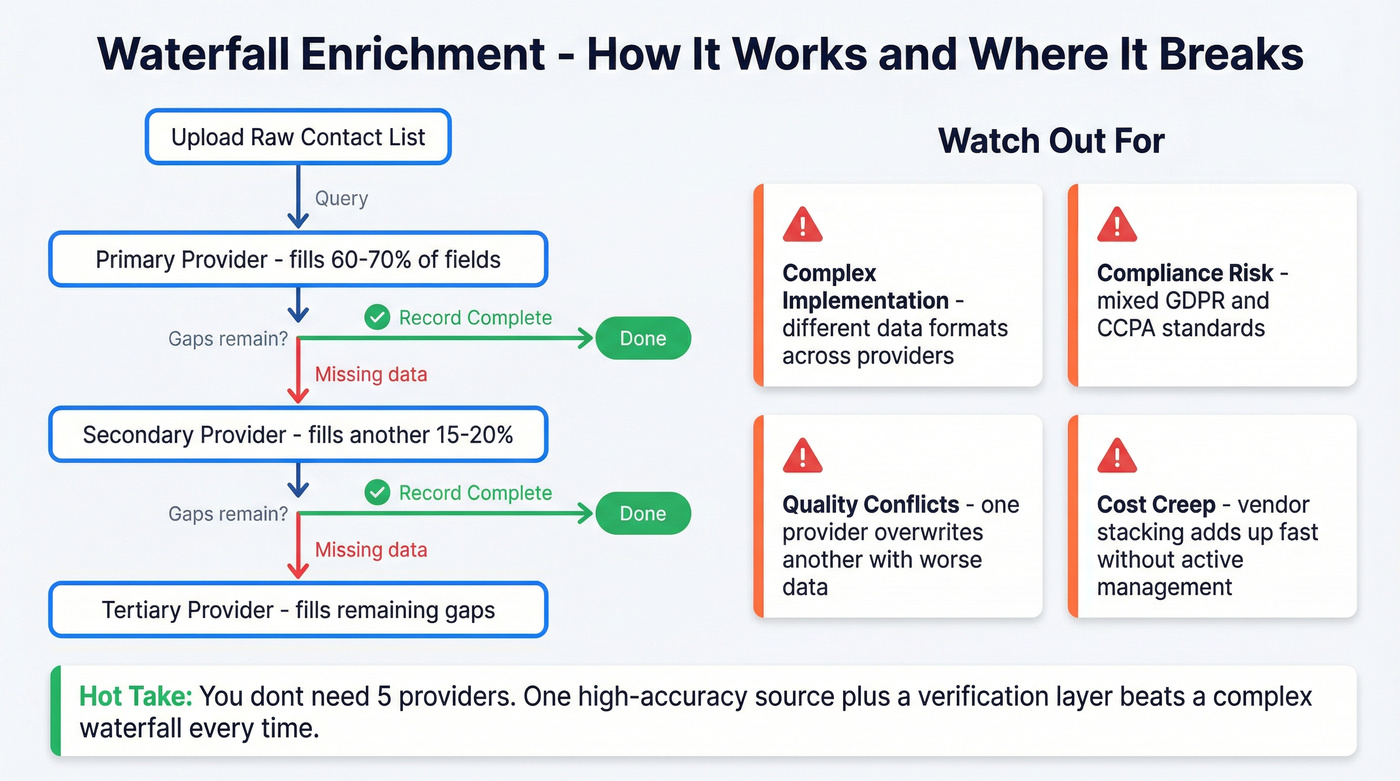
The benefits are real: better match rates, reduced gaps, and - if you're disciplined - cost control by only querying secondary providers when the primary one misses. But Cognism's analysis of waterfall risks highlights four issues we've seen play out repeatedly: complex implementation across providers with different data formats, compliance risk when mixing providers with different GDPR and CCPA standards, data quality inconsistencies where one provider overwrites another with worse data, and cost creep when vendor stacking isn't actively managed.
The opposite failure mode is over-enrichment - collecting 100+ attributes per contact when your SDRs only use five. Enrichment without activation is just an expensive database project.
Here's the thing: you don't need five providers. You need one good one and a verification layer. The teams that get the best results aren't the ones with the most complex waterfalls - they're the ones with the highest accuracy on their primary source.
Our hot take: if your average deal size is under $15K, you almost certainly don't need ZoomInfo-level data infrastructure. A single high-accuracy provider plus disciplined CRM hygiene will outperform a $40K/year platform that half your team never logs into.

Your ABM program needs all four enrichment layers - firmographics, technographics, contacts, and intent - without stitching together five vendors. Prospeo returns 50+ data points per contact at an 83% match rate, with 15,000 Bombora intent topics and 125M+ verified mobiles built in. At $0.01/email, enriching your entire target account list costs less than one bounced sequence costs your domain.
Stop rotting your pipeline with stale data. Enrich your ABM list in minutes.
Best Tools for Account-Based Data Enrichment in 2026
| Tool | Starting Price | Best For | Email Accuracy | Refresh |
|---|---|---|---|---|
| Prospeo | Free / ~$0.01/email | Verified emails + intent | 98% | 7 days |
| Apollo | Free / $59/user/mo | Self-serve prospecting | ~79% | 4-6 weeks |
| Clay | Free / $149/mo | Waterfall orchestration | Varies by provider | Varies |
| ZoomInfo | $14,995/yr | Enterprise full-stack | ~87% | 4-6 weeks |
| Cognism | ~$1K-3K/mo | GDPR-compliant EU data | Not public | Not public |
| Clearbit | $45/mo | HubSpot-native enrichment | Not public | 30 days |
| Demandbase | ~$30K+/yr | Full ABM platform | Not public | Not public |
| Lusha | Free / ~$49/user/mo | Quick contact lookups | Not public | Not public |
Prospeo
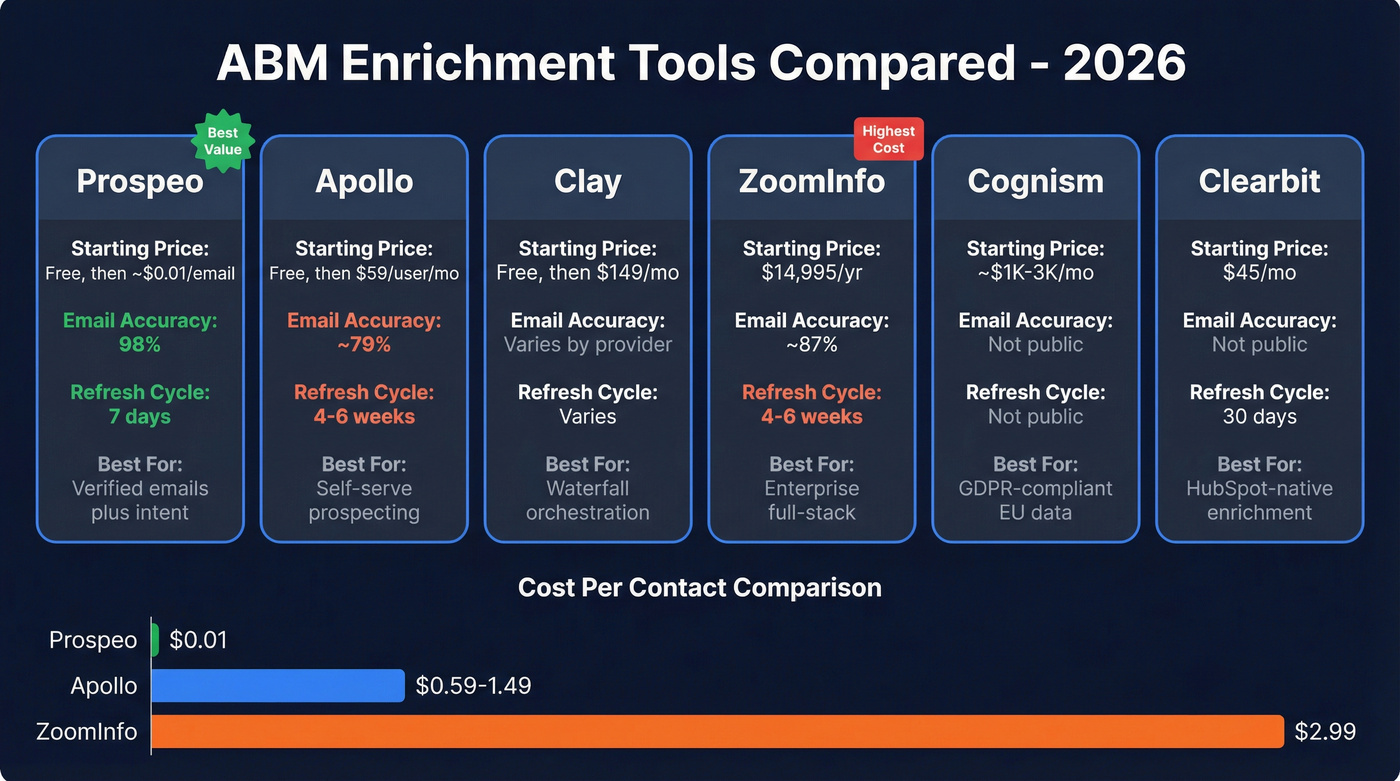
We've tested a lot of enrichment providers, and Prospeo is the one we'd start every ABM team on in 2026. Upload a target account list as a CSV and get back 50+ data points per contact at an 83% enrichment match rate, with a 7-day refresh cycle when the industry average is six weeks. Its proprietary email-finding infrastructure - not reliant on third-party providers - delivers 98% email accuracy and access to 125M+ verified mobile numbers with a 30% pickup rate.
The cost math is hard to argue with. At roughly $0.01 per email, enriching 5,000 contacts costs about $50. The same 5,000 contacts on ZoomInfo's Professional plan runs $14,995/year for 5,000 bulk credits - that's $2.99 per contact. Layer in intent data tracking 15,000 topics via Bombora, and you get in-market buyer signals without bolting on a separate vendor.
The Snyk team saw bounce rates drop from 35-40% to under 5% and AE-sourced pipeline jump 180% after adopting Prospeo across 50 AEs. Free tier gives you 75 verified emails per month to test before committing anything.
Apollo
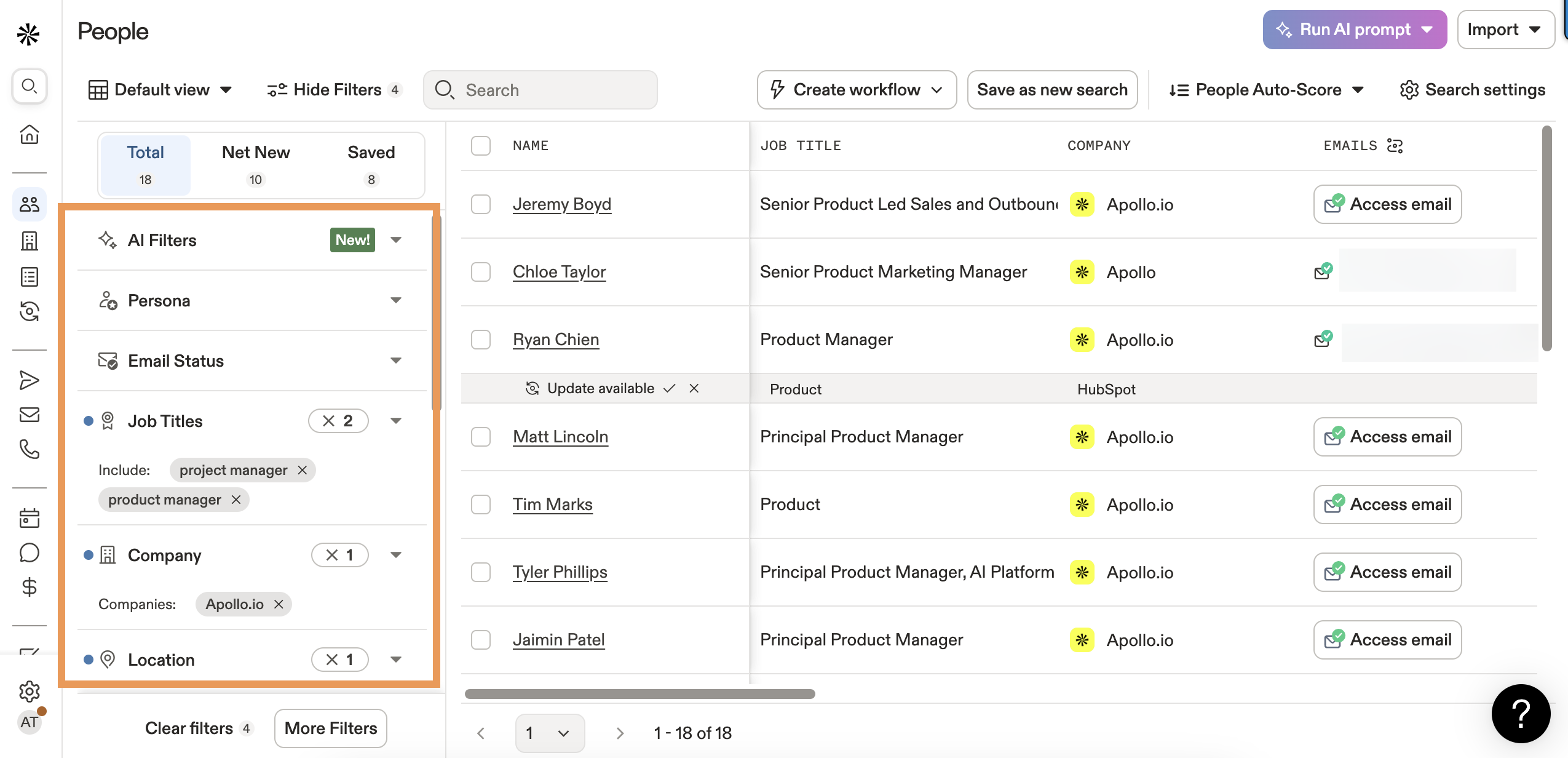
Apollo is the obvious starting point if budget is the primary constraint. The free tier gives you 75 credits per user per month, basic search filters, and a combined prospecting-plus-engagement platform. Paid plans run $59-$149/user/month. G2 ratings sit at 4.7/5 from 9,400+ reviews - strong social proof from a massive user base.
Who it's for: Early-stage teams that need prospecting and sequencing in one tool without spending a dollar upfront.
Who should skip it: Anyone running high-volume outbound where bounce rates matter. Email accuracy runs around 79%, and data freshness lags at 4-6 week refresh cycles. Use Apollo to get started, but plan to layer verification on top.
Clay
Clay isn't an enrichment provider - it's an orchestration layer that waterfalls across 100+ data providers. For technical RevOps teams who want to build custom enrichment workflows with conditional logic, it's powerful. Pricing runs from free through Starter at $149/mo, Explorer at $349/mo, and Pro at $800/mo for 50,000 credits.
Use this if you have a RevOps engineer who can configure multi-step enrichment sequences and you want maximum coverage across providers. Skip it if you want a simple upload-and-enrich workflow. Clay's power comes with real configuration overhead, and accuracy depends entirely on which underlying providers you're querying.
ZoomInfo
The enterprise default. ZoomInfo's Professional tier starts at $14,995/year for 3 users and 5,000 bulk credits. Advanced runs $24,995/year; Elite hits $39,995/year. ZoomInfo claims $250M/year in data investment, but practitioner comparisons on r/sales still flag accuracy inconsistencies and the lack of built-in email verification. The database is deep for US contacts, and the platform covers intent, engagement, and workflow in one stack.
Who it's for: Enterprise teams that need a single platform for data, engagement, and workflow - and will actually use all of it.
Who should skip it: Mid-market teams that won't activate the full suite. If you're not using the modules you're paying for, you're subsidizing features that sit idle.
Cognism
Best option for teams with EU-heavy target accounts. Cognism's GDPR compliance is genuinely strong - diamond-verified mobile numbers, DNC list checking, and a European-first data collection approach. Custom pricing typically lands at $1,000-3,000/mo for small teams. If your ABM program targets EMEA, Cognism deserves a serious look. For US-focused teams, you'll get better coverage elsewhere.
Clearbit, Demandbase, and Lusha
Clearbit by HubSpot starts at $45/mo with a 30-day refresh cycle, making it a natural pick for teams already deep in the HubSpot ecosystem - but it's enrichment-only, not a prospecting tool. Demandbase is a full ABM platform at $30,000+/year, enterprise-only, and overkill if you just need enrichment. Lusha offers quick contact lookups with a free tier and paid plans from ~$49/user/mo - lightweight and useful for one-off searches, but not built for bulk account-level enrichment.
A 23% bounce rate doesn't just kill one campaign - it tanks deliverability for the quarter. Prospeo's 7-day refresh cycle and 98% email accuracy mean your buying committee contacts stay current while competitors work off 6-week-old records. Teams using Prospeo book 26% more meetings than ZoomInfo and 35% more than Apollo.
Kill bounce rates before they kill your sender reputation.
Build Your Enrichment Engine in 90 Days
Days 1-30: Define ICP and Build Your TAL
Start by backtesting your ICP against Closed-Won and Closed-Lost data from the last 12 months. What firmographic and technographic patterns show up in your wins? What patterns predict losses? Layer in qualitative input from frontline AEs and CSMs - they know which accounts "feel right" before the data confirms it.
Apply firmographic filters and technographic filters to build a tiered target account list. Tier 1 accounts get full multi-threaded outreach. Tier 2 gets lighter-touch sequences. Tier 3 goes into nurture. This tiering prevents the classic ABM mistake of treating every account the same and spreading resources too thin.
Days 31-60: Enrich and Validate
Upload your target account list to your enrichment provider and map the buying committee - 3 to 5 contacts per account, spanning economic buyers, technical evaluators, and champions. Connect your enrichment tool to your CRM via native Salesforce or HubSpot integration and enrich in bulk. This is where database enrichment for ABM shifts from a one-time project to an ongoing operational process.
Set up automated enrichment triggers that fire on four events: new account creation, new contact creation, engagement threshold crossed, and a weekly scheduled refresh. Then layer in signal tracking across first-party signals like CRM activity and website visits, second-party signals like partner engagement and champion tracking, and third-party signals like tech-stack changes, leadership hires, and funding announcements. Centralize everything in your CRM with timestamps and build automation rules that fire when signal thresholds are met.
Days 61-90: Activate and Measure
Enriched data flows into three activation channels: outbound sequences personalized by role and intent signals, ad targeting through matched audiences on paid platforms, and sales plays triggered by signal spikes. The enrichment isn't the end - it's the infrastructure that makes every downstream motion more precise.
Look, most teams stop at enrichment and wonder why pipeline doesn't move. Enrichment without activation is a sunk cost. Measure coverage gaps weekly. Which Tier 1 accounts still have fewer than 3 enriched contacts? Which contacts bounced on first outreach? Feed gaps back into the enrichment loop and iterate.
Measuring Enrichment Performance
Track five KPIs to know whether your enrichment investment is working:
- Coverage rate - percentage of target account contacts successfully enriched. Aim for 80%+ on Tier 1 accounts.
- Accuracy rate - use bounce rate as a proxy. Under 5% is strong. Above 10% means your provider is failing you. (If you're diagnosing bounces, start with hard bounce fundamentals.)
- Decay rate - percentage of records going stale per quarter. Job titles decay fastest; track this monthly. (More benchmarks: B2B contact data decay.)
- Cost per enriched contact - this number compounds fast at scale. A 10x difference in per-contact cost across 50,000 records is the difference between a $500 line item and a $150,000 one.
- Provider ROI - pipeline influenced per dollar spent on enrichment. If you're spending $500/mo on enrichment and it's influencing $200K in pipeline, the math works.
FAQ
What's the difference between ABM data enrichment and lead enrichment?
Lead enrichment works on individual inbound leads as they arrive. ABM data enrichment targets entire buying committees at pre-selected accounts - you enrich 3-5 decision-makers per account, including roles you haven't heard from yet. That multi-threaded coverage is what separates account-based programs from standard lead-gen workflows.
How often should you re-enrich your data?
At minimum, quarterly. Job titles decay at roughly 66% annually, so a six-month-old contact list is already significantly degraded. Ideally, use a provider with automated refresh cycles - a 7-day refresh catches job changes before they torpedo your outbound sequences, versus the 4-6 week industry average.
Is waterfall enrichment worth the complexity?
For enterprise teams with dedicated RevOps resources, yes - coverage gains can reach 15-20% over a single provider. For mid-market teams without a RevOps engineer, start with one high-accuracy provider and verify everything. Stacking four or five vendors creates data conflicts and compliance gaps that typically cost more than the incremental coverage justifies.
What does account-based data enrichment cost?
It ranges from free (Apollo and Prospeo free tiers) to $40,000+/year (ZoomInfo Elite). Most mid-market teams run effective enrichment for $100-500/month. The key variable isn't the sticker price - it's cost per enriched contact. At $0.01/email, you can enrich 10,000 contacts for about $100; the same volume on enterprise platforms can exceed $10,000.