Logistics Lead Generation: A Signal-Detection Playbook for 2026
A RevOps lead we know spent $14,000 on a logistics prospect list last year. Twelve hundred contacts. By the time his SDRs worked through it, 340 emails bounced, half the phone numbers were disconnected, and the "decision-makers" included people who'd left their companies months earlier. He booked nine meetings. That's roughly $1,500 per conversation - before a single deal closed.
Logistics lead generation isn't a volume problem. It's a timing and data quality problem. The 3PL market surpassed $1.19 trillion globally, with 72,000+ companies competing in the US alone. There's no shortage of potential buyers. But logistics contracts run 12-24 months, buying committees span ops, finance, and logistics, and seasonal windows are unforgiving. Q4 peak season planning starts in Q2. If you're not in the conversation by July, you're locked out for the year.
The playbook most B2B teams run - blast 5,000 generic emails, hope for 2% reply rates - doesn't just underperform in logistics. It actively torches your domain reputation and wastes the narrow windows when buyers are actually receptive. Untargeted cold email reply rates in freight now sit below 1%. The teams still booking meetings are working triggers, not lists.
What You Need (Quick Version)
Generating quality logistics sales leads comes down to monitoring trigger events and reaching 50 accounts at the right moment - not spraying thousands of untargeted emails.
- Blended CPL benchmark: $588 (paid: $670, organic: $505)
- Touchpoints to close: 6-8, with ~4.8 just to get an initial response
- Tool stack: Prospeo for verified contact data, Bombora for intent signals, Outreach or Salesloft for cadence execution
- Timeline: Start Q4 outreach by May at the latest
- Cadence: Multi-channel (email + phone + social) over 4-6 weeks
6 Triggers That Actually Drive Logistics Sales
Trigger-based outreach pulls 15-25% response rates versus 5-10% for standard cold outreach. The key is acting fast - ideally within 48 hours of a trigger firing.
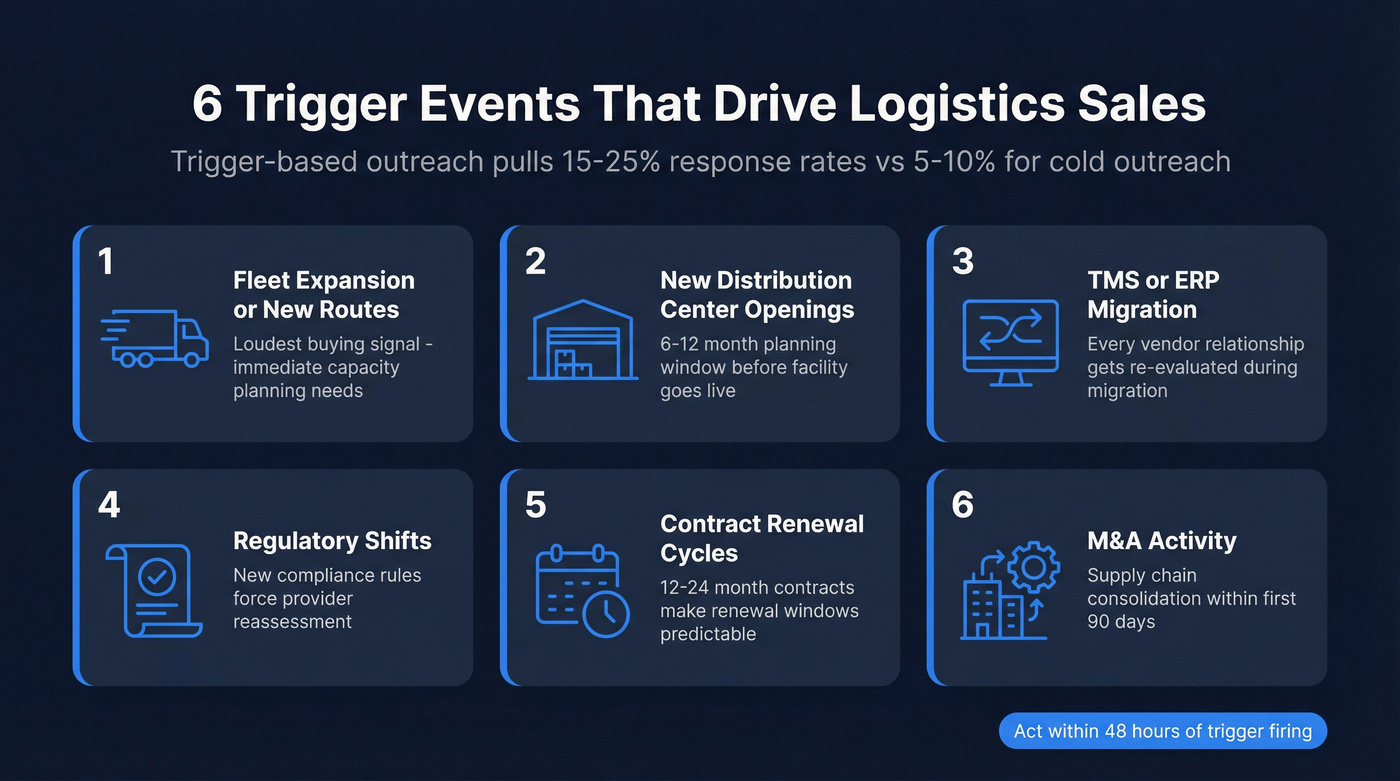
Fleet expansion or new routes. A company adding trucks or opening new lanes has immediate capacity planning needs. This is the loudest buying signal in logistics, full stop.
New distribution center openings. A new DC means new fulfillment workflows and carrier relationships. The planning window is typically 6-12 months before the facility goes live, which gives you a long runway if you catch it early.
TMS or ERP migration. When a company switches transportation management systems, every vendor relationship gets re-evaluated. These migrations create a natural reset moment for 3PL selection. We've seen entire carrier panels get rebuilt during a single TMS swap.
Regulatory shifts. New compliance requirements - emissions standards, cross-border documentation, hazmat rules - force logistics buyers to reassess provider capabilities.
Contract renewal cycles. With 12-24 month contracts being standard, renewal windows are predictable. The research phase typically starts a few months before expiration.
M&A activity. Mergers create immediate supply chain consolidation needs. The acquiring company often re-evaluates logistics partnerships within the first 90 days.
One trigger most teams overlook: conference attendance. When a VP of Logistics registers for a major industry event, they're signaling active evaluation. Track attendee lists and time your outreach to land the week before, when they're already thinking about solutions.
Building a Logistics ICP That Works
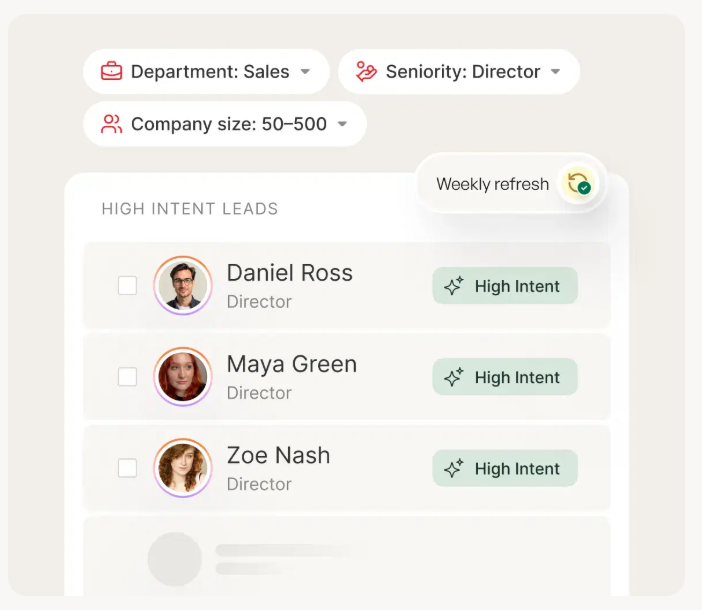
Generic firmographics won't cut it. Beyond company size and revenue, filter on fleet type - asset-based or asset-light - lane geography, shipment volume tiers, current TMS stack, and contract renewal timing. These variables separate a "logistics company" from one that might actually buy from you this quarter.
Logistics buying committees typically include 4-6 people. Here's the thing most sellers miss: the warehouse or fleet manager holds informal veto power even if they never show up to a demo. Multithreading across the COO, logistics manager, and financial controller from day one isn't optional. It's how deals actually close in this space (and why multithreading is a core outbound skill).
74% of shippers would consider switching to a 3PL with stronger AI capabilities](https://martal.ca/3pl-sales-lb/). If your offering includes route optimization, predictive analytics, or automated documentation, lead with that. It's the single strongest messaging angle in logistics right now, and almost nobody is using it in their outbound. That gap won't last.

340 bounced emails from a $14K list is a data quality problem, not a volume problem. Prospeo's 7-day refresh cycle and 98% email accuracy mean your logistics outreach hits real inboxes - not dead addresses from people who left months ago.
Stop torching your domain on stale logistics data.
The Multi-Channel Outreach Cadence
Complex logistics sales require 6-8 touchpoints to close, with an average of 4.8 touches just to earn a first response. A single email isn't a strategy.
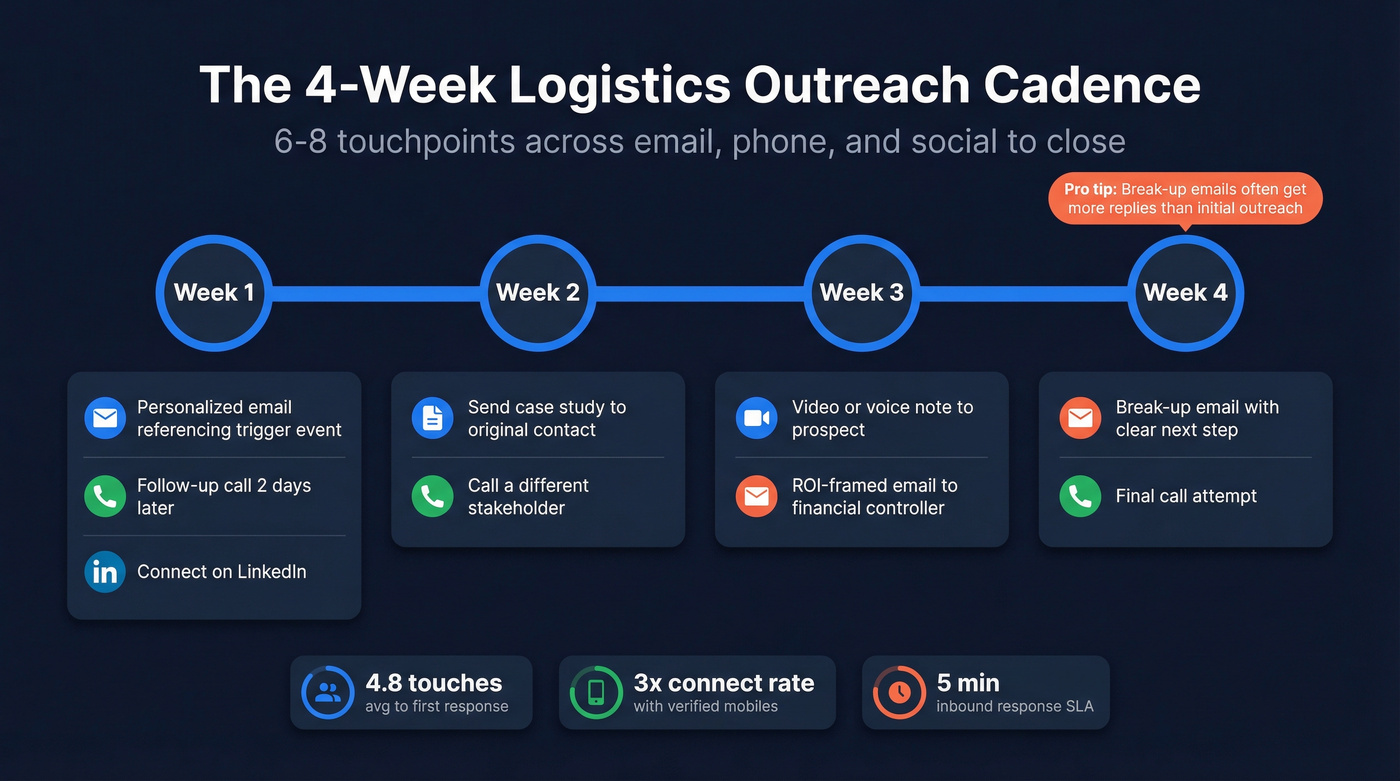
Here's the cadence that works: open with a personalized email referencing a specific trigger event, follow up by phone two days later, then connect on social. Week two, send a case study to the original contact and call a different stakeholder. Week three, shift to video or voice notes and email the financial controller with ROI framing. Week four, send a break-up email with a clear next step and make a final call attempt. The whole sequence runs 4-6 weeks across email, phone, and social.
Phone-verified mobiles deliver 3x higher connect rates, which makes the quality of your phone data a make-or-break variable (see direct dials and phone validation). In our experience, the break-up email in week four generates more replies than the initial outreach - people respond to the implied deadline.
Speed-to-lead is non-negotiable. When an inbound lead comes in, your response SLA should be 5 minutes. When an intent trigger fires, your outreach window is 48 hours. After that, the prospect is already talking to three to five other providers.
What Logistics Leads Actually Cost
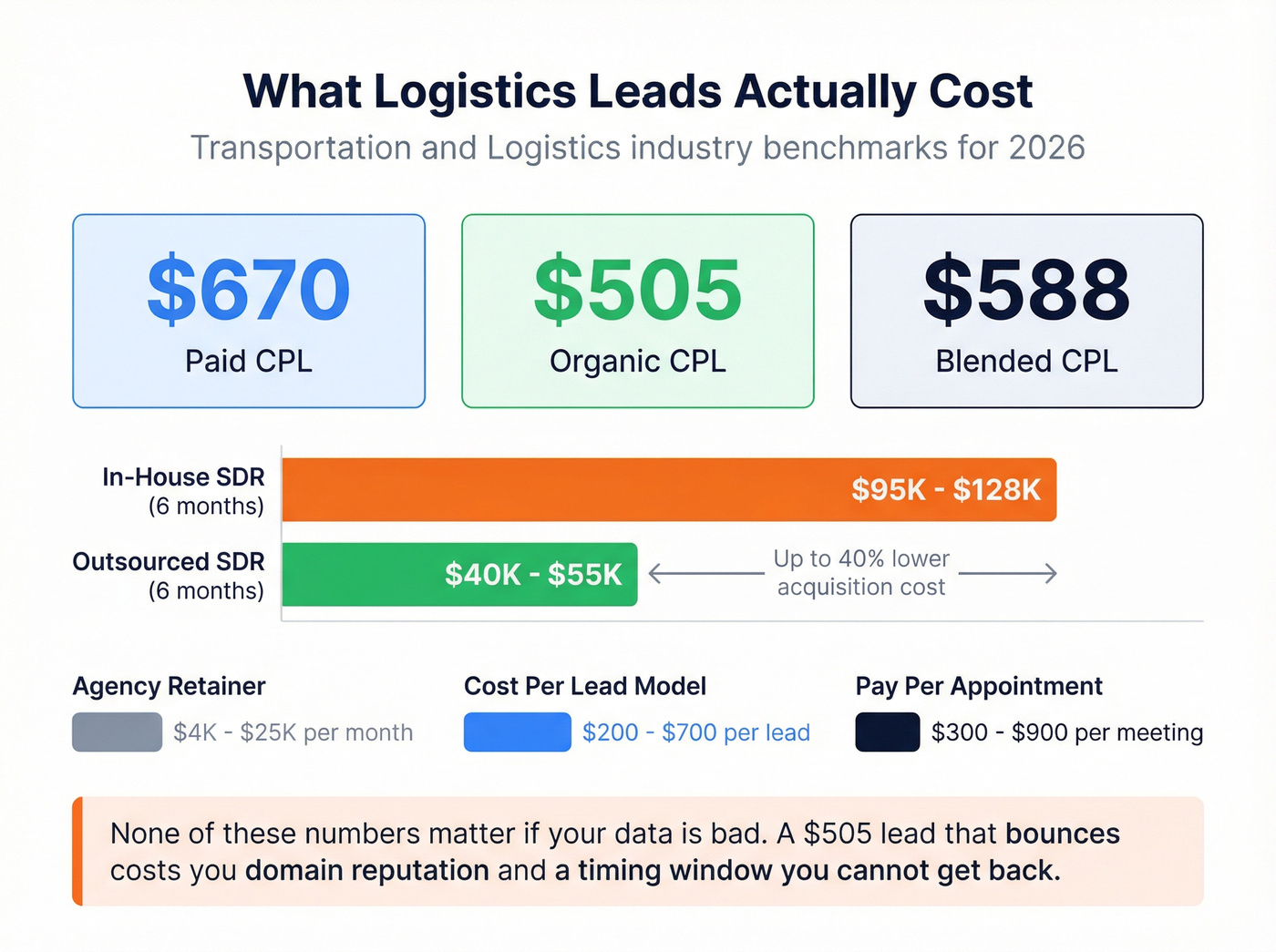
The Transportation & Logistics blended CPL is $588, with paid channels averaging $670 and organic channels averaging $505. But those are just media costs.
| Channel / Model | Typical Cost | Notes |
|---|---|---|
| Paid CPL (avg) | $670/lead | Search, display, social |
| Organic CPL (avg) | $505/lead | SEO, content, referrals |
| Blended CPL (avg) | $588/lead | Industry benchmark |
| Agency retainer | $4K-$25K/mo | Varies by scope |
| Cost-per-lead model | $200-$700/lead | Qualified leads |
| Pay-per-appointment | $300-$900/meeting | Booked meetings |
| In-house SDR (6 mo) | $95K-$128K | Fully loaded |
| Outsourced SDR (6 mo) | $40K-$55K | Managed service |
The in-house vs. outsourced gap is striking. A fully loaded in-house SDR runs $95K-$128K over six months. An outsourced team covering the same period costs $40K-$55K - and outsourcing can cut acquisition costs by up to 40%, which is why it's the default for companies entering new logistics markets.
But none of these numbers matter if your underlying data is bad. A $505 organic lead that bounces on the first email costs you domain reputation, rep time, and a timing window you can't get back.
The Data Quality Problem
Let's be honest about what's actually happening on most logistics outbound teams. Your SDR just burned through 200 dials and connected with 12 people. Eight were wrong numbers. Of the four real conversations, two were with people who left the company last quarter. That's not a productivity problem - it's a data problem masquerading as a performance problem.
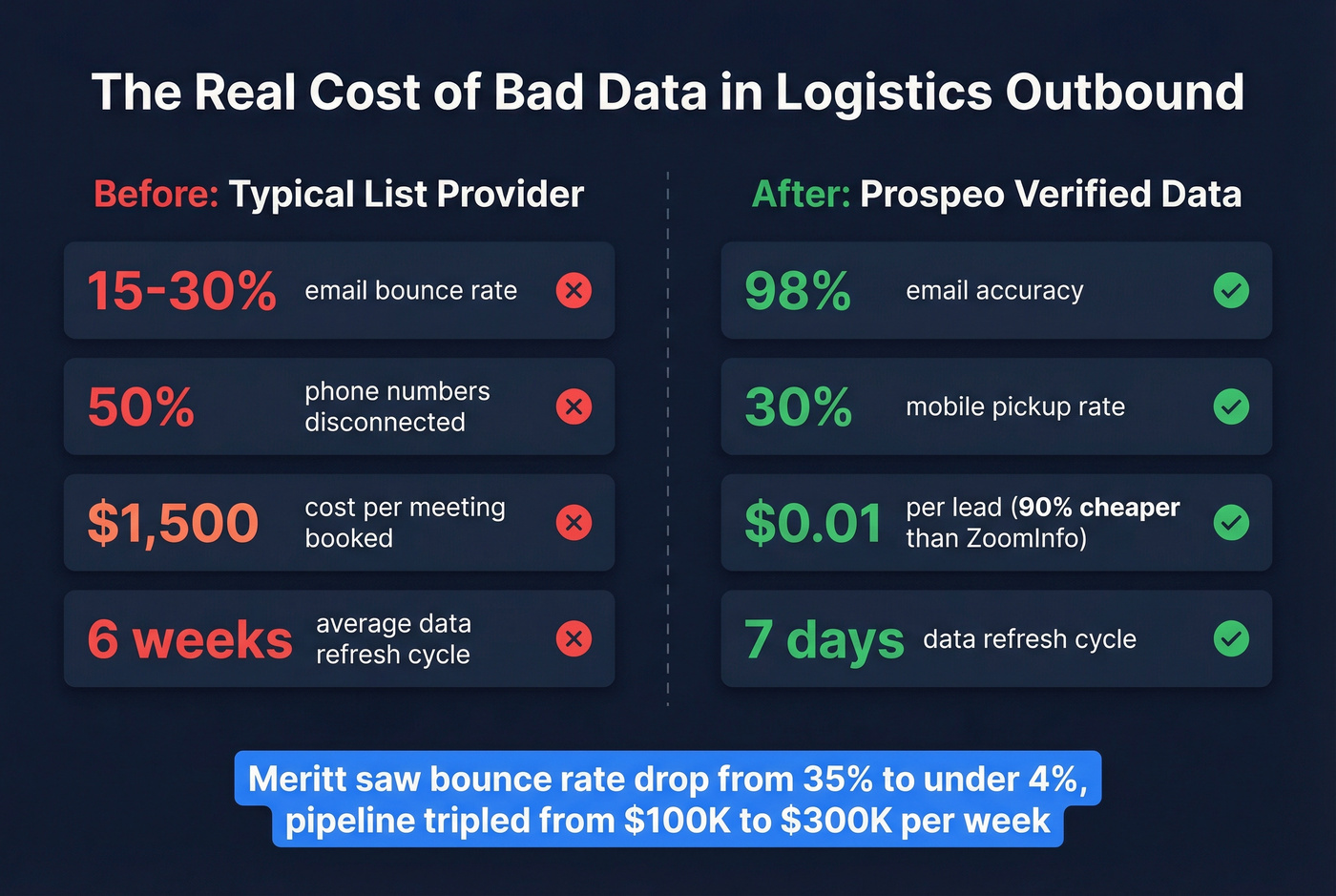
If 15-30% of your emails bounce and half your phone numbers are dead, your cadence destroys domain reputation and rep morale simultaneously. In logistics, where contract cycles mean a missed window won't reopen for 12-24 months, bad data has compounding costs that most teams never calculate. The consensus on r/sales is pretty clear: list quality matters more than list size, and it's not close.
Prospeo runs a 5-step verification process that removes spam traps, honeypots, and catch-all domains before a record ever reaches your CRM - 98% email accuracy, 30% mobile pickup rate, and a 7-day data refresh cycle versus the 6-week industry average. At roughly $0.01 per lead, that's 90% cheaper than ZoomInfo's ~$1 per lead. Meritt, a sales agency, saw their bounce rate drop from 35% to under 4% after switching, and their pipeline tripled from $100K to $300K per week (more on B2B contact data decay and data quality).
Your Tool Stack
| Layer | Tool | Approx. Cost | Why |
|---|---|---|---|
| Data platform | Prospeo | ~$0.01/lead, free tier | 98% accuracy, 7-day refresh |
| Data (enterprise) | ZoomInfo | $15K-$40K+/yr | 500M+ contacts, broad scale |
| Data (mid-market) | Apollo | Free-$99/mo/user | Good UI, 79% accuracy |
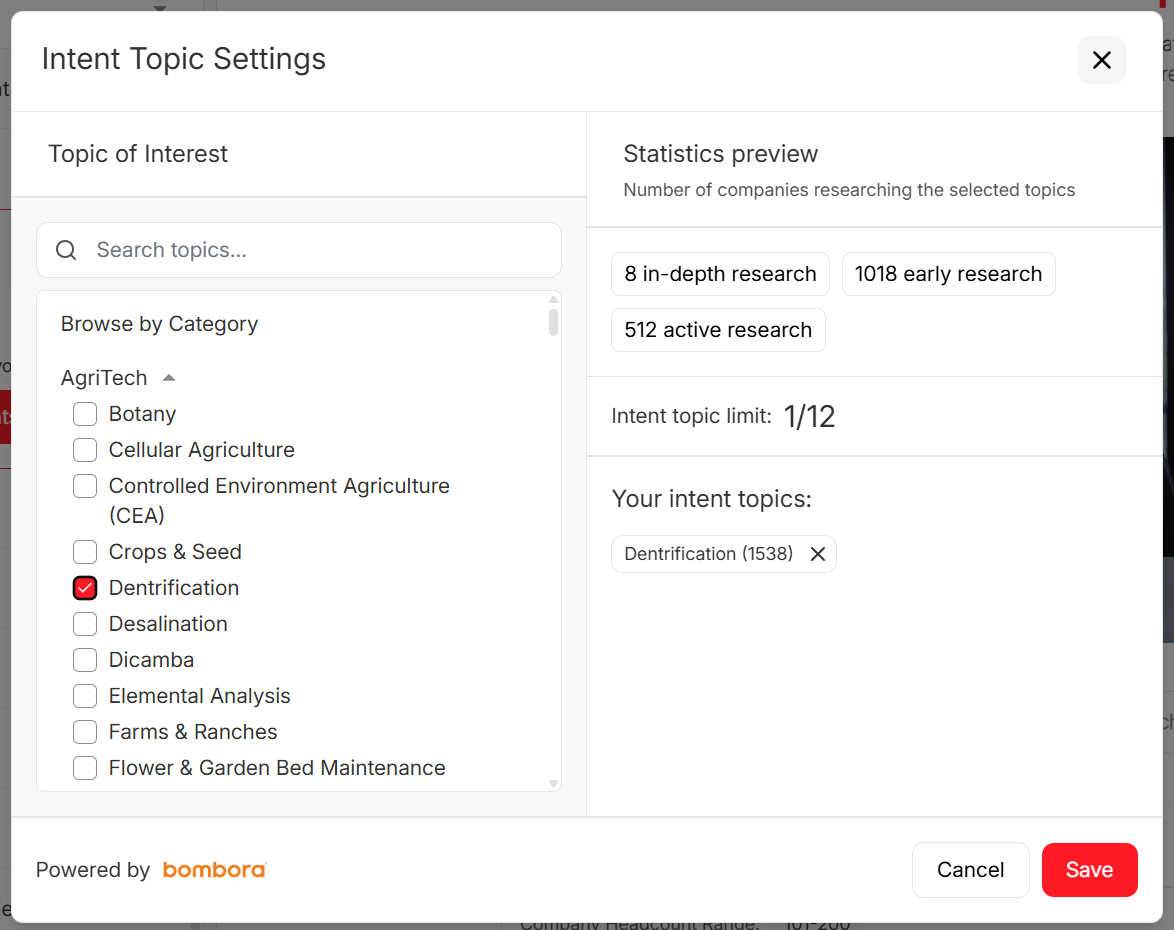
| Intent data | Bombora / 6sense | $25K-$100K+/yr | 12K intent topics |
| Cadence | Outreach / Salesloft | ~$100-$150/user/mo | Multi-channel sequencing |
| CRM | Salesforce / HubSpot | $25-$150/user/mo | Pipeline, attribution |
| Trigger monitoring | Crunchbase + Alerts | Free-$49/mo | Funding, M&A, leadership |
For most logistics sales teams under 20 reps, a verified data layer paired with intent signals and a cadence tool covers 90% of what you need. ZoomInfo makes sense at enterprise scale when you need 500M+ contacts and can absorb the cost, but smaller teams end up paying for breadth they'll never use. Skip it unless you've got 50+ reps and a six-figure data budget.
The right stack turns logistics business development from a guessing game into a repeatable system. For teams just getting started, a free Prospeo tier plus Crunchbase alerts gets you surprisingly far before you need to invest in enterprise intent data (see signal-based outbound and how to track sales triggers).
Multithreading across COOs, logistics managers, and financial controllers requires verified direct dials. Prospeo gives you 125M+ verified mobile numbers with a 30% pickup rate - 3x the connect rate your current phone data delivers.
Reach the full buying committee before your 48-hour trigger window closes.
FAQ
How many touchpoints close a logistics sale?
Most logistics sales require 6-8 touchpoints, with 4.8 touches on average just to earn a first response. Multi-channel cadences combining email, phone, and social over 4-6 weeks consistently outperform single-channel sequences by 2-3x in reply rate.
What's the average cost per lead in logistics?
The blended CPL is $588 - paid channels average $670, organic $505. Agency models range from $200-$900 per lead depending on whether you're buying raw contacts or booked meetings with qualified decision-makers.
What's the best tool for building a logistics prospect list?
For teams under 20 reps, Prospeo delivers 98% email accuracy and a 7-day data refresh at ~$0.01 per lead - with a free tier to test before committing. At enterprise scale with 50+ reps, ZoomInfo's breadth justifies the $15K-$40K+ annual cost, though accuracy drops to roughly 87%.
How do transportation companies find quality freight leads?
The highest-quality freight sales leads come from monitoring trigger events - fleet expansions, new DC openings, contract renewals - rather than purchasing static lists. Pairing intent data with verified contact information lets you focus on accounts actively evaluating providers, not contacts who were relevant six months ago.