

Director of Revenue Operations: Role, Salary, Skills & How to Get Hired
A RevOps lead we know spent three months interviewing for director of revenue operations roles last year. Every company asked the same question differently: "Can you fix our data, align our teams, and make the forecast actually mean something?" That's the job in one sentence. The title varies, but the mandate doesn't - architect of predictable revenue.
What You Need (Quick Version)
What the role is: A director of revenue operations owns the operational infrastructure - systems, data, processes, KPIs - that connects sales, marketing, and customer success into a single revenue engine. Gartner projected 75% of the highest-growth companies would run a RevOps model by 2025, and the data bore that out. Public companies with RevOps see 71% higher stock performance. This isn't a new concept anymore. It's table stakes.
What it pays: $195,668 average in the US (Feb 2026), ranging from $162K at the 10th percentile to $228K at the 90th. AI-fluent Directors command a $60K premium over generalists.
What you need: 7+ years in ops (sales ops, marketing ops, or hybrid), CRM and BI fluency, and the ability to lead cross-functional teams without direct authority over them.
What Does a RevOps Director Actually Do?
This isn't a glorified Salesforce admin role. Here's what the scope actually covers, drawn from real postings like Blumira's Director listing ($170K-$185K + equity, US remote):
- Revenue forecasting & pipeline frameworks - Build and own the models your CRO presents to the board. Not just pulling numbers; designing the methodology. (If you need a refresher, start with sales forecast fundamentals.)
- Tech stack ownership - Evaluate, implement, and integrate tools across CRM, BI, engagement, and data platforms. Blumira explicitly requires HubSpot, SQL, and Tableau fluency.
- Cross-functional alignment - Sit between sales, marketing, and CS to ensure handoffs don't leak revenue. You're the connective tissue. (This is basically revenue operations alignment in practice.)
- Data governance & CRM hygiene - Set standards for how data enters, moves through, and exits your systems. Bad data is the silent killer of every RevOps function. (Use a real CRM hygiene playbook, not vibes.)
- Attribution & lead scoring - Design models that tell marketing what's working and sales where to focus. (If you're rebuilding scoring, RevOps lead scoring is a solid framework.)
- Budget & ROI management - Justify every tool dollar. Your CFO will ask.
- Process optimization - Map the full lifecycle from MQL to Closed Won and find the friction points that cost deals. (This is where sales pipeline challenges usually show up first.)
Director vs. Manager vs. Head vs. VP
Titles vary wildly by company, but here's how scope typically breaks down:
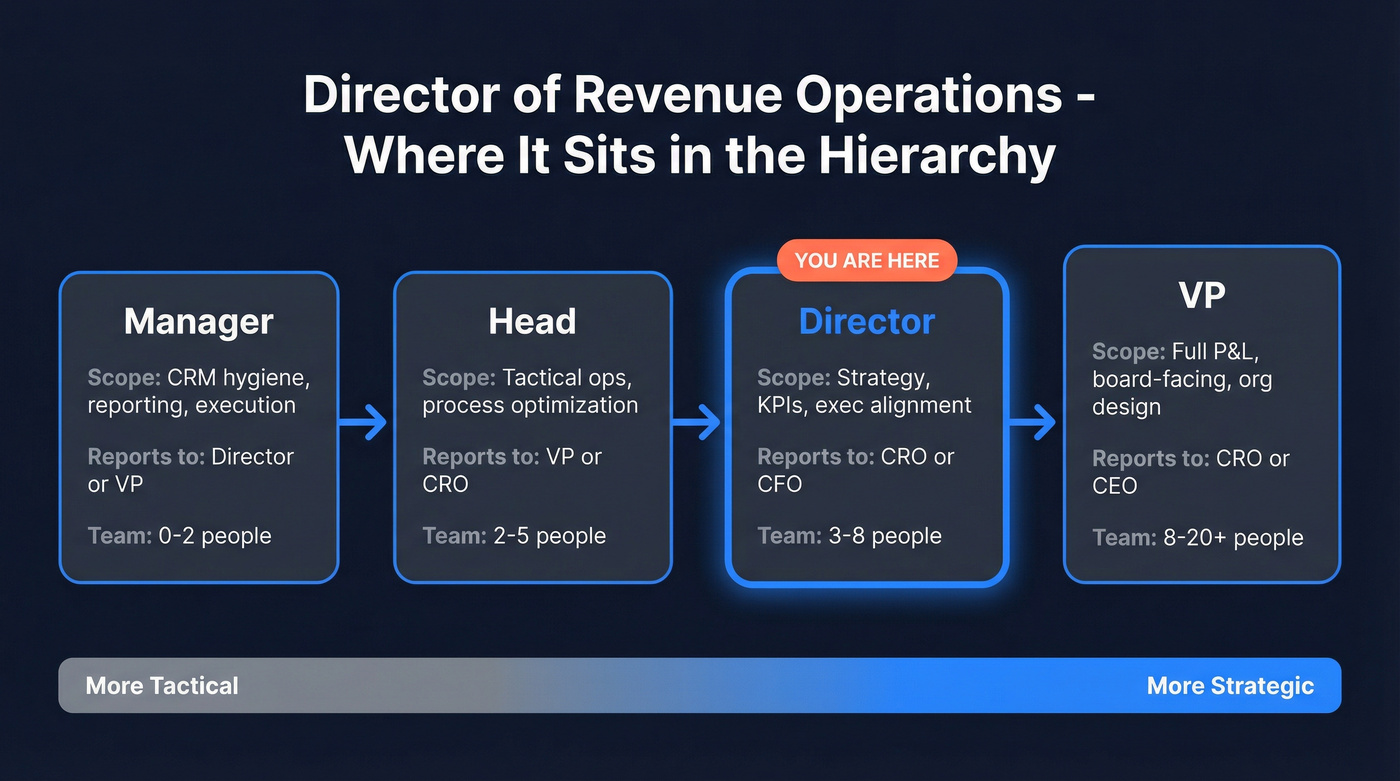
| Title | Scope | Reports To | Team Size |
|---|---|---|---|
| Manager | CRM hygiene, reporting, execution | Director or VP | 0-2 |
| Head | Tactical ops, process optimization | VP or CRO | 2-5 |
| Director | Strategy, KPIs, exec alignment | CRO or CFO | 3-8 |
| VP | Full P&L, board-facing, org design | CRO or CEO | 8-20+ |
The Head vs. Director distinction trips people up. In most orgs, "Head of RevOps" skews more operational and tactical, while "Director" carries more strategic weight and executive stakeholder management. At a 50-person startup, these titles are often interchangeable. Context matters more than the headline on your profile. (If you're mapping titles across orgs, see sales leadership titles.)
RevOps Director Salary in 2026
The national average sits at $195,668 per Salary.com's February 2026 data.
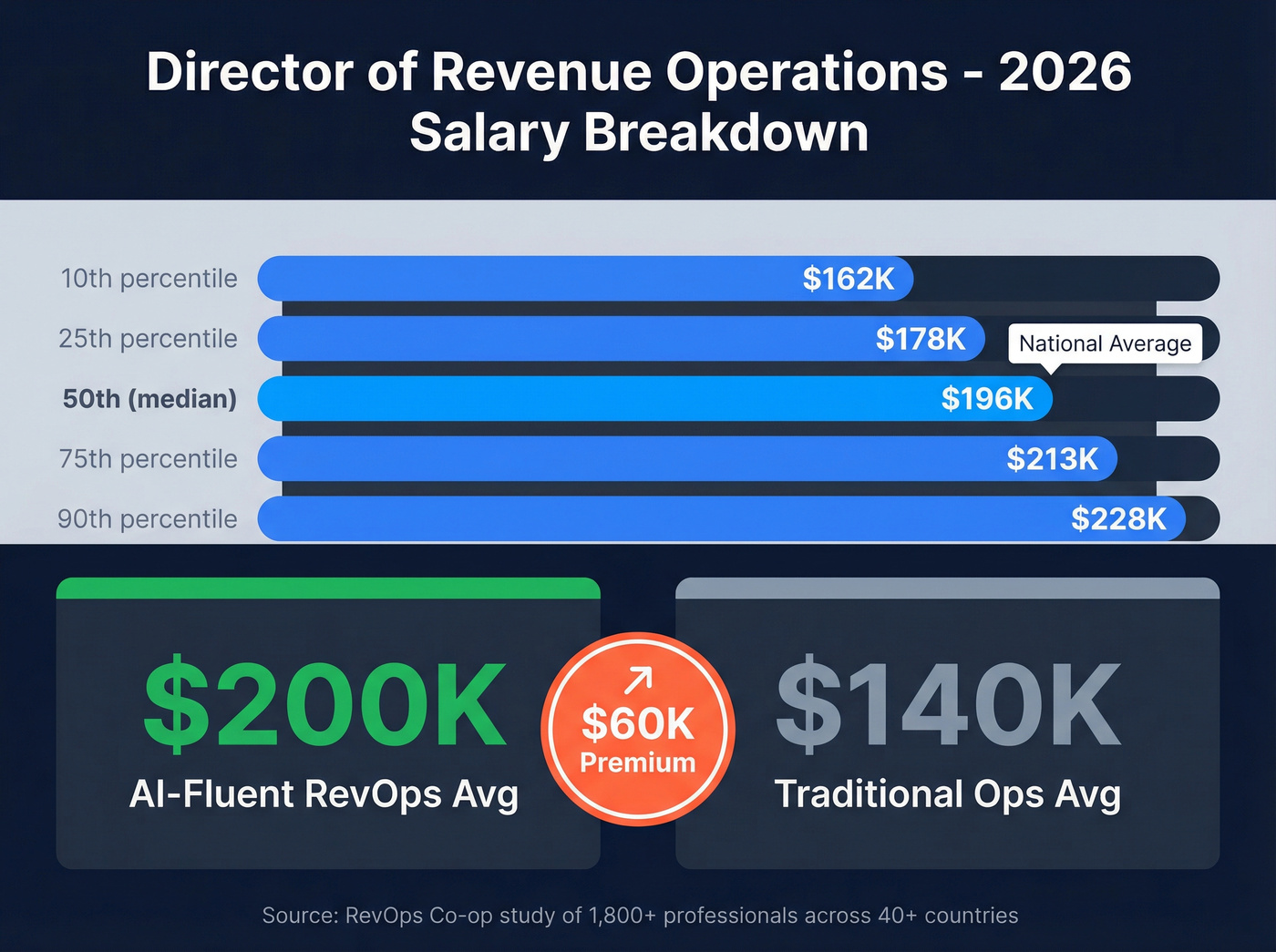
| Percentile | Base Salary |
|---|---|
| 10th | $162,373 |
| 25th | $178,240 |
| 50th (median) | $195,668 |
| 75th | $212,793 |
| 90th | $228,384 |
Company size is the biggest swing factor. At startups under 50 employees, median OTE runs around $100K. Cross the 1,000-employee threshold and that jumps to roughly $162K - a 60% increase for the same title. Meanwhile, 76% of organizations are holding headcount steady, using equity packages to attract and retain RevOps talent rather than expanding teams.
SF, NYC, and Boston still command 20-30% above national averages, but remote RevOps professionals increasingly earn hub-anchored salaries regardless of location. Companies learned that RevOps talent is scarce enough to pay market rate everywhere.
The AI premium is the story of 2026. A RevOps Co-op study of 1,800+ professionals across 40+ countries found AI-fluent RevOps professionals earn up to $60,000 more than generalists. "AI Ops" roles average around $200K versus $140K for traditional ops. That's not a nice-to-have skill. It's a $60K decision. (If you're operationalizing this, AI sales analytics is a good starting point.)
Bonuses often run 10-20%+ of base, with higher targets for senior leaders. At the senior end, total comp (base + bonus + equity) can exceed $300K.

Bad data is the silent killer of every RevOps function - you read that above. Prospeo's 98% email accuracy, 125M+ verified mobiles, and 7-day data refresh cycle give RevOps Directors the clean foundation their forecasts, attribution models, and CRM workflows depend on. At $0.01/email, rationalizing your data layer just became the fastest ROI win on your 90-day plan.
Your first quick win as RevOps Director starts with the data layer.
Skills That Get You Hired
| Hard Skills | Soft Skills |
|---|---|
| SQL (non-negotiable) | Executive communication |
| CRM admin (Salesforce/HubSpot) | Change management |
| BI tools (Tableau, Databox) | Cross-functional influence |
| Excel (yes, still) | Stakeholder alignment |
| Attribution modeling | Prioritization under ambiguity |
| API/integration fluency | Storytelling with data |
Here's the thing: roughly half of organizations still rely on Excel-based calculations and email-based approval processes. The Directors who get hired fastest aren't the ones with the fanciest tool knowledge - they're the ones who can walk into a messy spreadsheet environment and build a credible roadmap to something better. We've seen candidates lose offers because they couldn't articulate how they'd handle the transition from "everything lives in a shared Google Sheet" to a real ops infrastructure. The hardest part of the role usually isn't the tech. It's getting sales leaders to trust the data. (If you're cleaning up inputs, start with data quality.)
AI fluency is the $60K differentiator. That doesn't mean building ML models. It means knowing how to deploy AI-powered tools for forecasting, lead scoring, and workflow automation - and knowing which AI promises are vapor. (For practical workflows, see AI CRM data entry automation.)
The RevOps Tech Stack
Organizations with unified RevOps tools grow up to 19% faster than those running fragmented systems. A Director's first job is often rationalizing a bloated stack into something coherent.
| Category | Tools |
|---|---|
| CRM | Salesforce, HubSpot |
| Revenue Intelligence | Gong, Clari |
| BI & Analytics | Tableau, Databox |
| Prospecting & Data | Prospeo, Apollo, ZoomInfo |
| Engagement | Outreach, Salesloft |
| Workflow Automation | Clay, Zapier, Make |

The data layer is where most inherited stacks fall apart first. In our experience, the single fastest win for a new RevOps Director is getting contact data under control - bad emails and dead phone numbers silently destroy pipeline metrics, attribution models, and rep trust in the CRM. Prospeo's 98% email accuracy and 7-day refresh cycle mean your CRM data doesn't rot between quarters, and it integrates natively with Salesforce, HubSpot, Clay, and Zapier, so it slots into whatever stack you've inherited. (If you're evaluating vendors, compare options in email ID validators and track B2B contact data decay.)
Skip the $100K+ revenue intelligence platform if your average deal size is under $10K. Invest in clean data and a solid CRM before you buy Gong. The Directors who waste the most budget are the ones who buy enterprise tools for SMB problems.
KPIs on Your Dashboard
Your CRO asks why pipeline coverage is 2.1x when the target is 3x. You need these formulas cold.
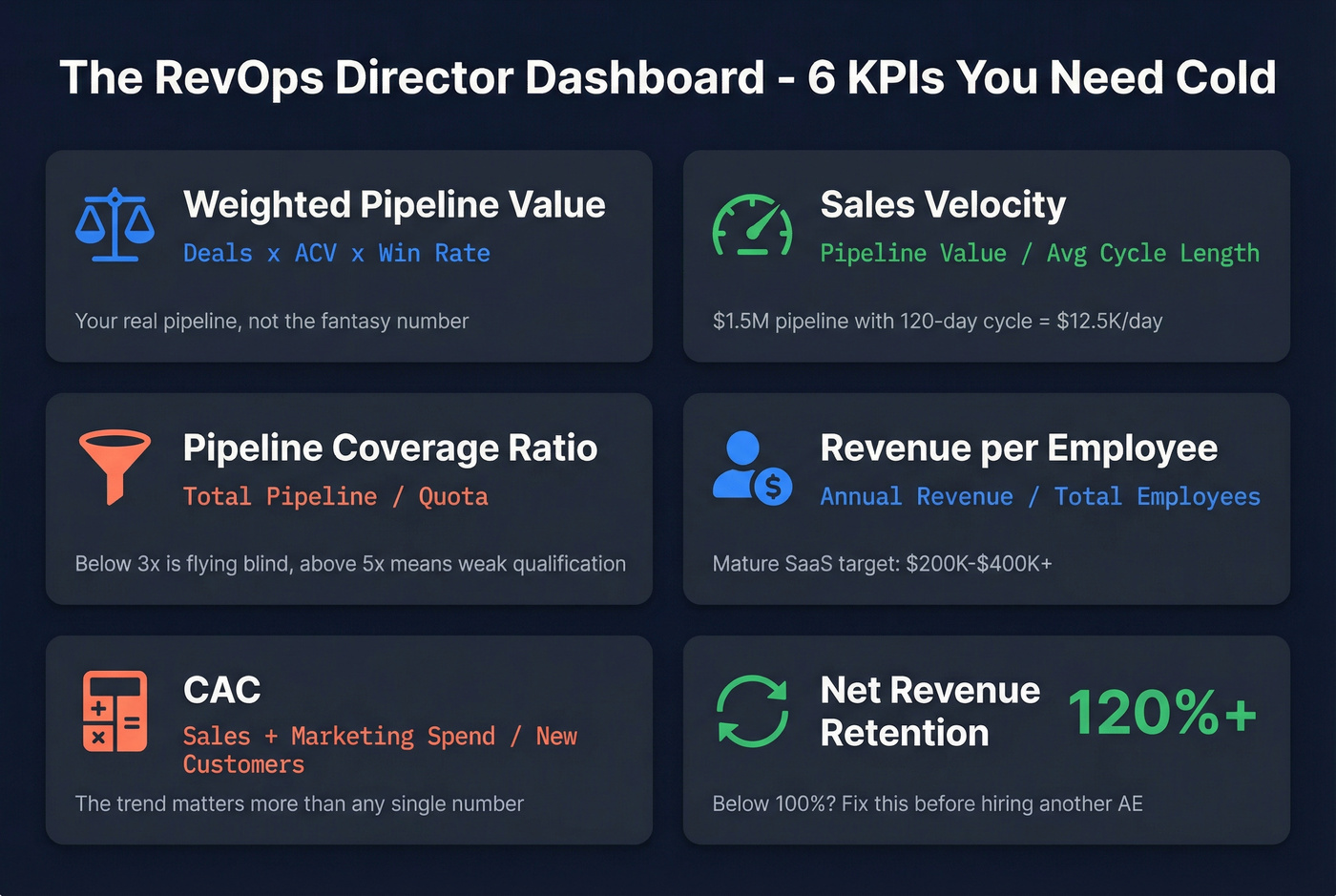
- Weighted Pipeline Value = (# of deals) x (ACV) x (win rate). This is your real pipeline, not the fantasy number reps put in Salesforce.
- Sales Velocity = Pipeline Value / Average Sales Cycle Length. Sitting on $1.5M in pipeline with a 120-day cycle? That's $12,500/day in expected revenue movement.
- Pipeline Coverage Ratio = Total pipeline / Quota. Below 3x and you're flying blind. Above 5x often signals weak qualification.
- Revenue per Employee = Annual revenue / Total employees. Mature SaaS companies run $200K-$400K+.
- CAC = Total sales + marketing spend / New customers. The trend matters more than any single number. (If you need the benchmark math, use the CAC LTV ratio framework.)
- Net Revenue Retention - Best-in-class SaaS runs 120%+. If yours is below 100%, fix that before you hire another AE.
Interview Prep & 30/60/90 Plan
Questions that come up in nearly every RevOps Director interview loop:
- Walk me through your first 90 days.
- How would you diagnose a funnel conversion issue between MQL and SQL?
- How do you forecast with imperfect data?
- You've got budget for three tools. How do you prioritize?
- Describe a CRM migration or major process change you've led.
- How do you communicate pipeline health to a board that doesn't speak ops?
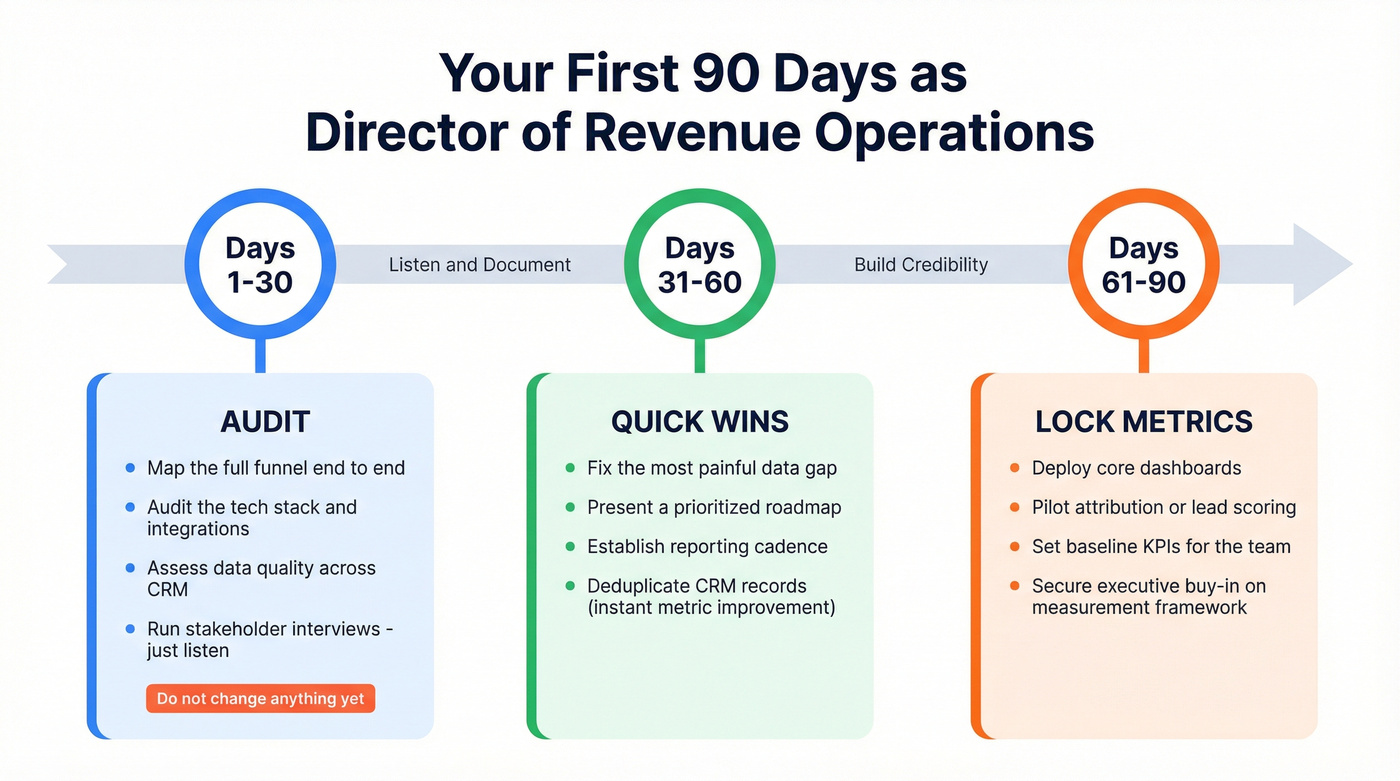
Let's break down the 30/60/90 framework they're looking for:
Days 1-30 (Audit). Map the funnel, audit the tech stack, assess data quality, run stakeholder interviews across sales, marketing, and CS. Don't change anything yet - just listen and document. The fastest way to lose credibility is to "fix" something before you understand why it exists.
Days 31-60 (Quick wins). Fix the most painful data or process gap, present a prioritized roadmap, establish a reporting cadence. One Director I spoke with said her biggest Day 45 win was simply deduplicating 40,000 CRM records - it immediately improved every metric downstream because the baseline numbers finally made sense.
Days 61-90 (Lock metrics). Deploy core dashboards, pilot attribution or lead scoring improvements, set baseline KPIs the team will be measured against going forward.
Every RevOps Director inherits a bloated tech stack with a broken data layer underneath. Prospeo replaces fragmented prospecting tools with 300M+ verified profiles, 30+ search filters including intent data and technographics, and native integrations with Salesforce, HubSpot, Clay, and your entire engagement stack. One platform, 92% enrichment match rate, zero annual contracts.
Rationalize your stack and give reps data they actually trust.
Career Path In and Out
The typical path to this role runs 6-8 years: 3-4 years in Sales Ops or Marketing Ops building your technical foundation, then 2-3 years as a RevOps Manager proving you can lead cross-functionally. AI fluency and demonstrated impact on revenue metrics can compress that timeline by a year or two.
From Director, the exits are VP of RevOps, CRO, or COO - depending on whether you lean toward strategy or operations at scale. Most JDs are wish lists. When you're interviewing, identify the ONE real problem they're hiring you to solve, and build your narrative around that. Everything else is noise.
FAQ
What does a director of revenue operations do?
A RevOps Director builds and runs the operational infrastructure - systems, data, processes, KPIs - that unifies sales, marketing, and customer success around a shared revenue goal. They own forecasting methodology, tech stack decisions, data governance, and cross-functional alignment. Think architect versus owner: one designs the engine, the other drives it.
What's the difference between this role and a CRO?
A CRO owns the revenue number and go-to-market strategy. The RevOps Director provides the operational backbone - data, systems, and processes - that makes the CRO's strategy executable. The CRO decides where to go; the Director makes sure the machine can get there.
How long does it take to reach director level in RevOps?
Most Directors have 6-8 years of experience: 3-4 years in Sales Ops or Marketing Ops, then 2-3 years as a RevOps Manager. AI fluency and cross-functional leadership can accelerate the timeline, especially at fast-growing startups where scope expands quickly.
What tools should a RevOps Director know?
At minimum: a CRM (Salesforce or HubSpot), a BI tool (Tableau or Databox), a revenue intelligence platform (Gong or Clari), and a data enrichment tool for verified emails and direct dials. Workflow automation platforms like Clay, Zapier, or Make and engagement tools like Outreach or Salesloft round out the stack. Knowing how these tools connect matters more than mastering any single one.