

The Practitioner's Guide to Email Marketing for Lead Nurturing
You spend $15,000 on a webinar campaign. Registration is strong - 800 signups. Marketing celebrates. Then nothing happens. The leads sit in your CRM, untouched for two weeks, and by the time sales reaches out, half have gone cold or signed with a competitor.
This isn't a lead gen problem. It's a nurture problem. 40.4% of B2B buyers take 6-12 months to reach a purchase decision, and 45.8% consume more than seven content pieces before they're ready to talk to sales. If you're not systematically feeding those leads relevant content over weeks and months, you're lighting pipeline on fire.
What You Need (Quick Version)
- The 80/20 content rule. 80% of your nurture emails should educate, inform, or help. 20% can sell. Flip that ratio and watch your unsubscribe rate spike.
- The 4-week cadence. Six touches over 28 days - welcome email on Day 1, helpful resource on Day 3, webinar invite on Day 7, industry insight on Day 14, case study on Day 21, direct CTA on Day 28.
- Verify your data first. None of this works if 12% of your list bounces. Companies that nail lead nurturing generate 50% more sales-ready leads at 33% lower cost - but only if those emails actually land.
What Lead Nurturing Actually Is
Lead nurturing is the process of building relationships with prospects who aren't ready to buy yet by delivering relevant, timely content that moves them closer to a decision. It's not blasting your whole list with the same monthly newsletter. It's sending the right message to the right person based on what they've done and where they are in the buying process.
The stakes are real: 73% of B2B leads aren't sales-ready at first contact. If your only play is "download whitepaper, hand to SDR," you're ignoring the vast majority of your pipeline.
One common source of confusion is the difference between drip campaigns and nurture campaigns.
| Drip Campaign | Nurture Campaign | |
|---|---|---|
| Trigger | Time-based (fixed schedule) | Behavior-based (actions) |
| Personalization | Basic (name, company) | Deeper (content, timing, tone) |
| Length | Finite (set number of emails) | Can run for months |
| Lead scoring | Rarely used | Frequently integrated |
| Funnel fit | Top/mid-funnel | Mid/bottom-funnel |
| Setup | Simpler | Requires branching logic |
A drip campaign sends email #3 on Day 7 regardless of what the lead did. A nurture campaign sends a case study because the lead clicked on your pricing page yesterday. Behavior-triggered sequences outperform time-based ones on engagement and conversion. That distinction is the whole ballgame.
Why Nurture Emails Pay for Themselves
If you need to justify the investment to leadership, the research does the talking:
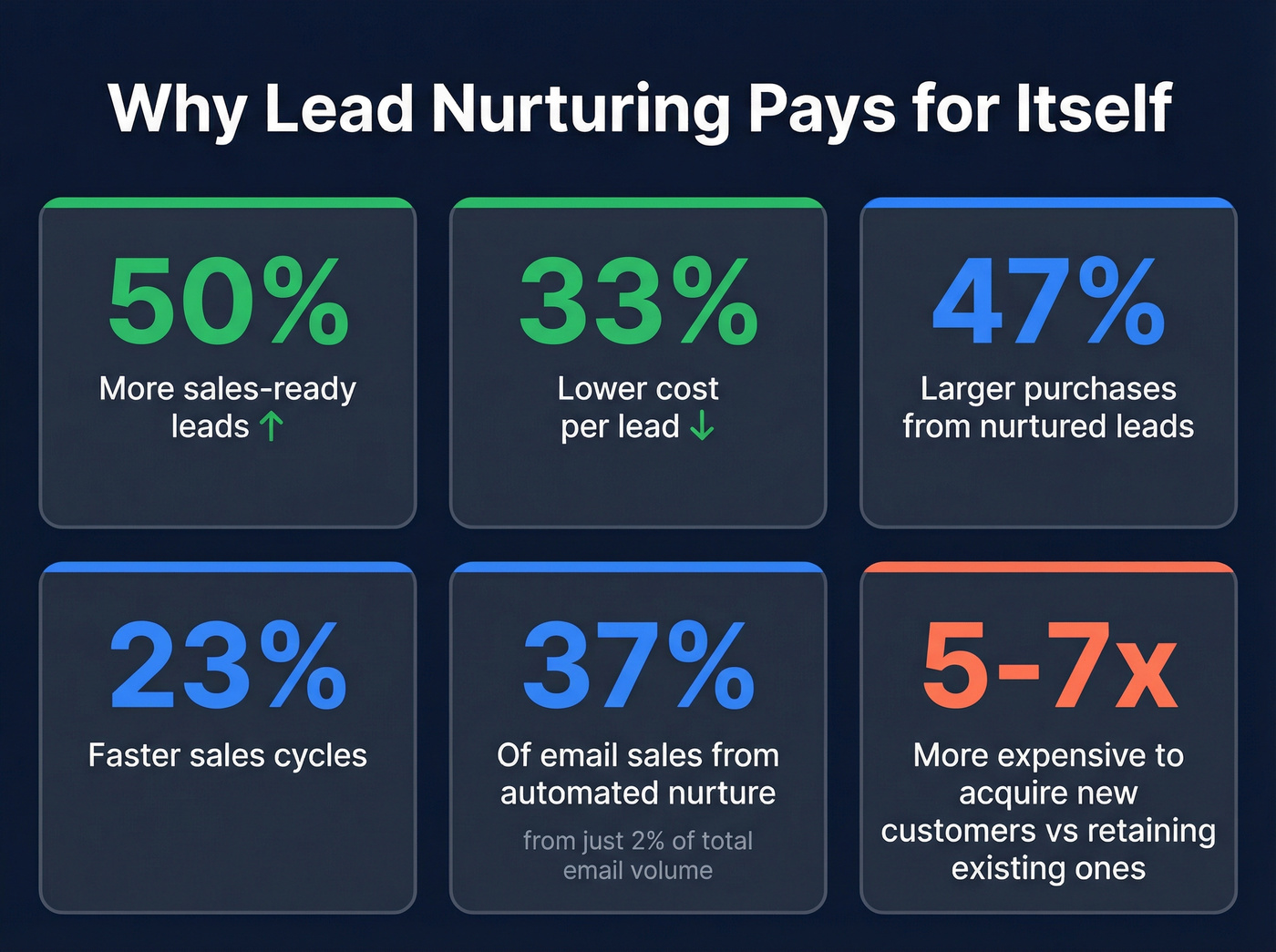
- 50% more sales-ready leads at 33% lower cost when nurturing is done well
- 47% larger purchases from nurtured leads compared to non-nurtured ones
- 23% faster sales cycles - nurtured leads move through the pipeline quicker because they've already consumed the content that answers their objections
- 20% more sales opportunities from structured nurture cadences
- Automated nurture emails drive 37% of all email-generated sales while accounting for just 2% of total email volume
- Acquiring new customers costs 5-7x more than retaining existing ones - post-sale nurture isn't optional
The problem is execution, not strategy. Most teams know they should nurture. They just don't have a concrete sequence to follow.
The 4-Week Nurture Sequence Template
You don't need a 47-email masterpiece to start. Six well-timed touches that respect the 80/20 rule will do.
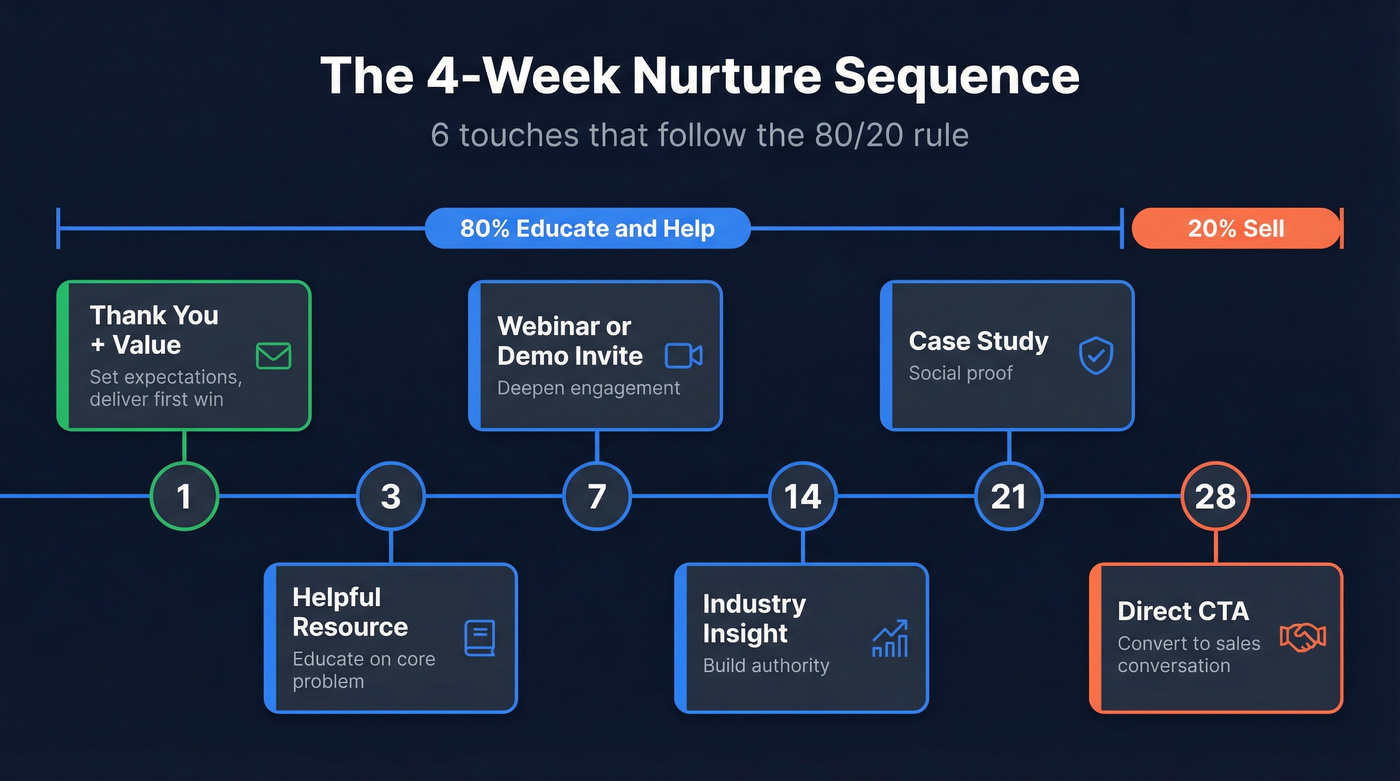
| Day | Content Type | Goal | Example Subject Line |
|---|---|---|---|
| 1 | Thank-you + value | Set expectations, deliver first win | "Here's the guide we promised" |
| 3 | Helpful resource | Educate on core problem | "3 mistakes killing your [X]" |
| 7 | Webinar/demo invite | Deepen engagement | "Live walkthrough Thursday" |
| 14 | Industry insight | Build authority | "2026 benchmark data for [X]" |
| 21 | Case study | Social proof | "How [Co] solved [problem]" |
| 28 | Direct CTA | Convert | "15 min - let's see if it fits" |
RAIN Group's research suggests it takes 8-10 marketing touchpoints to move a lead from first contact to sales-ready. This six-email sequence is your foundation - extend it based on engagement data. If leads are still opening and clicking after Day 28, keep going.
Timing That Actually Matters
Space emails 2-4 days apart during active sequences. One to two per week is the sweet spot - more than that and you're training people to ignore you. Mid-week sends (Tuesday through Thursday) outperform Monday and Friday. Start with 8-10 AM in the recipient's timezone and test from there.
For B2B sequences, if a lead goes completely quiet, wait 30-60 days before a re-engagement attempt. For B2C, compress the whole cadence: shorter intervals, more emotional triggers, faster CTAs.
Types of Nurture Emails
Not every nurture email serves the same purpose.
Welcome emails catch people at peak attention. Send one the moment someone enters your funnel, set the relationship tone, and tell them what to expect. Nurture emails generate an 8% CTR versus 3% for general sends, and welcome emails are a big reason why.
Educational content is your mid-funnel workhorse - use it for leads who need to understand the problem better, skip it for leads who've already consumed your content library. A subject line like "The data behind [pain point]" positions you as the expert without asking for anything.
Case studies and demo invites work as a pair, deployed based on buying signals:
| Email Type | Best For | Skip If | Goal |
|---|---|---|---|
| Case study / social proof | Leads evaluating options | Too early in the funnel - proof lands after problem awareness | Reduce perceived risk |
| Product demo invite | Leads showing intent (pricing page visits, multiple opens) | Cold leads - you'll just annoy them | Bridge to sales conversation |
Re-engagement and post-purchase round out the toolkit. Re-engagement targets leads who've gone dark after 30-60 days - subject line: "Still thinking about [problem]?" - to resurface interest or clean the list. Post-purchase emails are where retention starts. In our experience, the teams that skip post-purchase nurture end up spending 5-7x more on acquisition to replace the customers they could have kept.

You just read that nurture emails generate 50% more sales-ready leads at 33% lower cost - but only if those emails actually reach the inbox. Prospeo's 98% email accuracy and 7-day data refresh mean your carefully crafted 4-week sequence doesn't die on a 12% bounce rate.
Stop writing perfect nurture emails that bounce into the void.
B2B Nurturing: The Multi-Stakeholder Problem
B2B nurturing isn't just slower - it's structurally different. A Gartner study found the average B2B purchase involves 22 people. Enterprise software deals routinely stretch 12-18 months; mid-market solutions average 6-9 months.
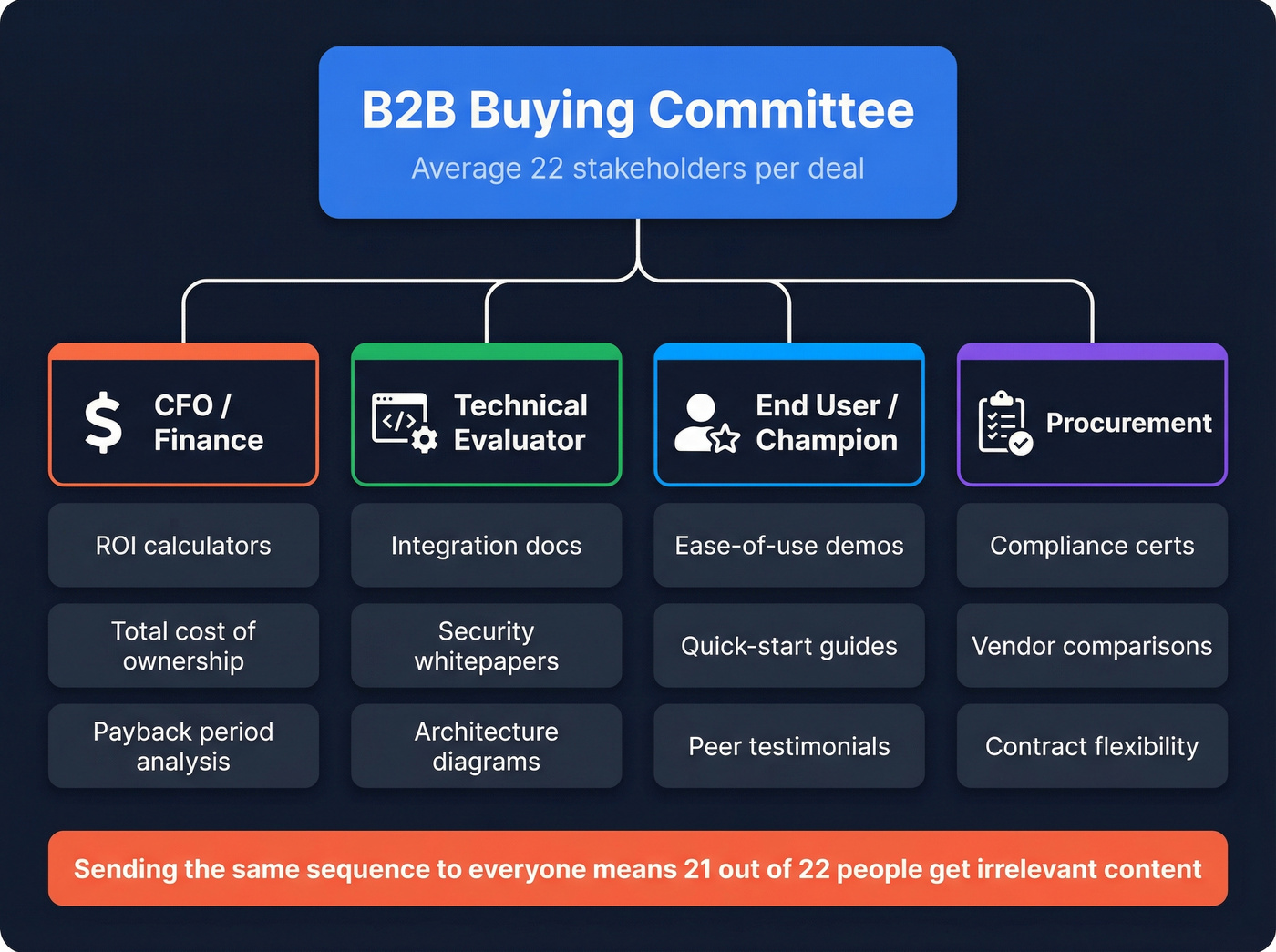
Here's the thing: the biggest pitfall we see is sending the same nurture sequence to every stakeholder. A CFO doesn't care about your API documentation. A technical evaluator doesn't care about your ROI calculator. When you send a generic sequence to a 22-person buying committee, you're sending irrelevant content to 21 of them. That's not nurturing - it's noise.
Build persona-specific tracks:
- CFO / finance: ROI content, total cost of ownership, payback period analysis
- Technical evaluator: Integration docs, security whitepapers, architecture diagrams
- End user / champion: Ease-of-use demos, quick-start guides, peer testimonials
- Procurement: Compliance certifications, vendor comparison matrices, contract flexibility
Lead Scoring and the Sales Handoff
The whole point of nurturing is to get leads sales-ready. But "sales-ready" needs a definition, not a gut feeling.
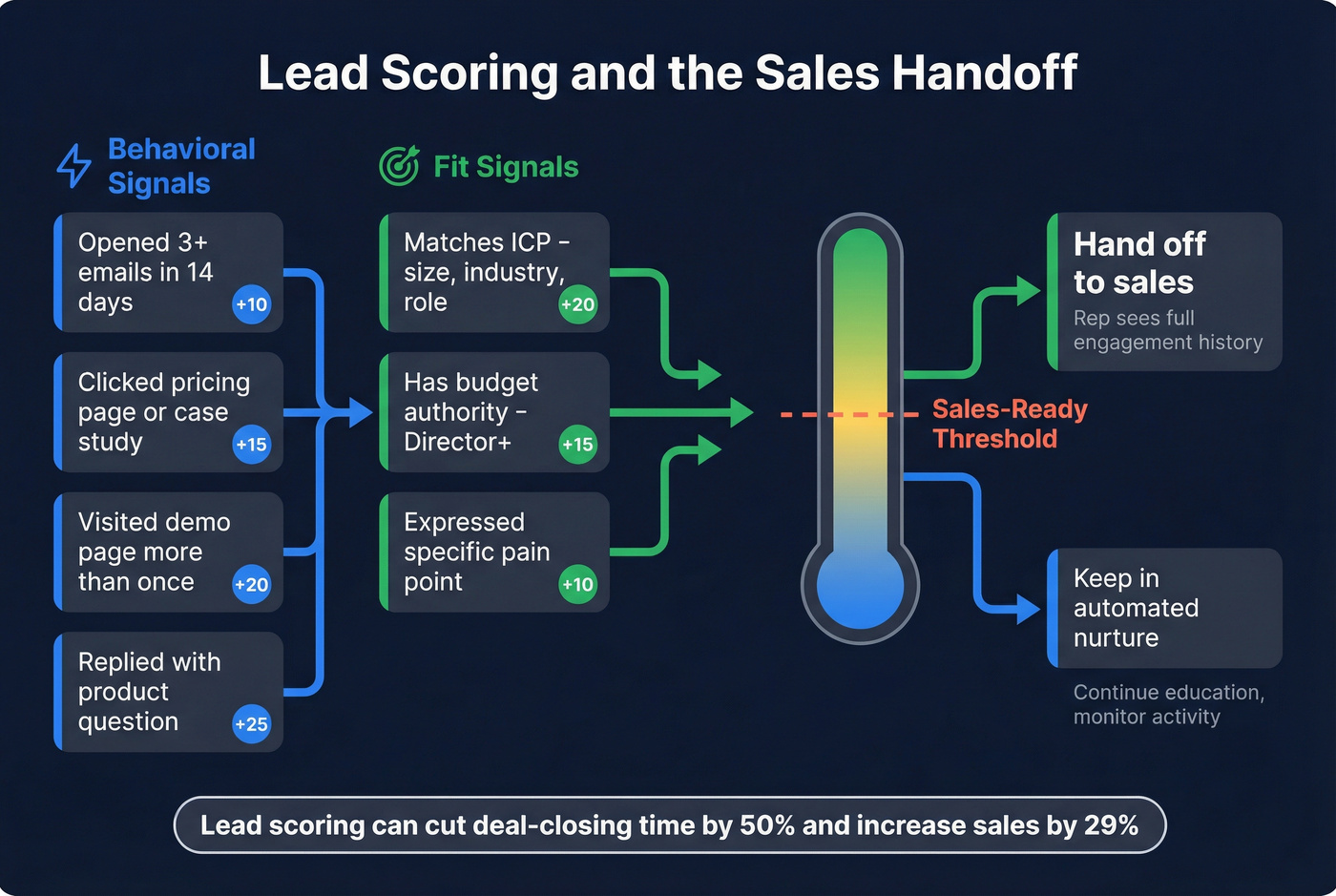
Behavioral signals tell you what they're doing: opened 3+ emails in the last 14 days, clicked a pricing page or case study link, visited the demo page more than once, replied with a product-related question. Fit signals tell you who they are: matches your ICP on company size, industry, and role; has budget authority (director+ title); expressed a specific pain point in a form fill.
Set a threshold score that combines both. When a lead crosses it, shift from automated nurture to direct sales outreach - and make sure the rep can see the full engagement history. Nothing kills a handoff faster than a rep calling someone and asking "so, what do you know about us?" when the lead has already read six of your emails and watched a demo video.
Lead scoring models can cut deal-closing time by 50% and increase sales by up to 29%. Score your leads or waste your reps' time.
2026 Email Benchmarks
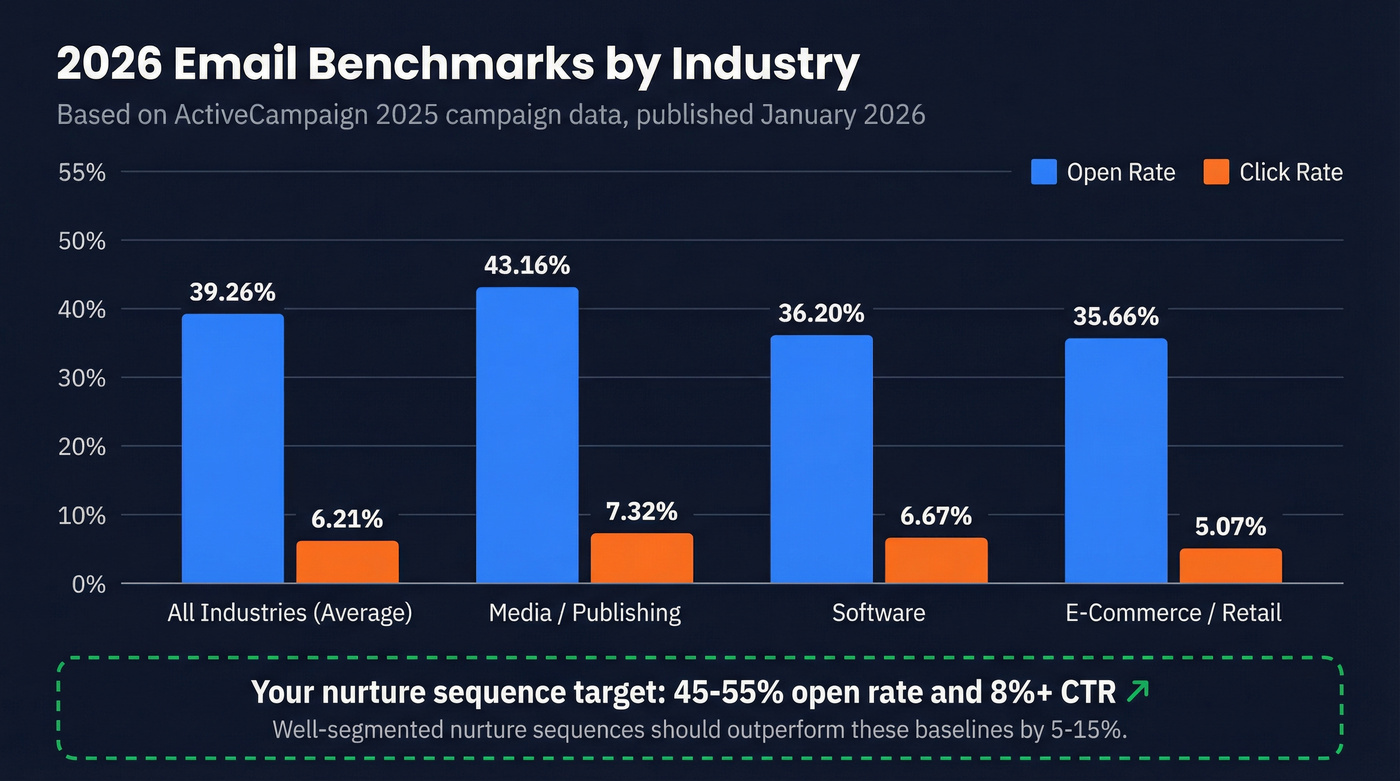
Let's ground this in current data. ActiveCampaign's analysis, based on 2025 campaign data and published January 2026, covers performance across all campaign types:
| Industry | Open Rate | Click Rate |
|---|---|---|
| All (average) | 39.26% | 6.21% |
| Media / Publishing | 43.16% | 7.32% |
| Consulting / Agency | - | 7.05% |
| Software | 36.20% | 6.67% |
| E-Commerce / Retail | 35.66% | 5.07% |
These are baselines across all email types - newsletters, promotions, transactional. Well-segmented nurture sequences often outperform these numbers by 5-15% on opens because the audience is warmer and the content is more relevant. If your nurture emails are hitting below these averages, something's broken: segmentation, subject lines, or deliverability.
Aim for 45-55% open rates and 8%+ CTR on your nurture sequences.
Mistakes That Kill Your Nurture Pipeline
Generic one-size-fits-all sequences. If every lead gets the same six emails regardless of role, industry, or behavior, you're running a drip campaign and calling it nurture. Segment or fail.
Pushing for the sale too early. Your Day 3 email shouldn't be "book a demo." That's Day 28 territory. Respect the 80/20 rule - earn the right to ask.
Wrong frequency. Too many emails and you train people to unsubscribe. Too few and they forget you exist. One to two per week during active sequences, then taper.
Stopping after the sale. Post-purchase nurture drives retention, expansion, and referrals. Don't go silent after the contract is signed.
No lead scoring or handoff criteria. Without a defined threshold, "sales-ready" means whatever the SDR feels like that morning. Build the scoring model before you build the sequence.
Ignoring data quality. This is the silent killer. You build a beautiful nurture sequence, write compelling content, nail the timing - and 12% of your list bounces on the first send. Your domain reputation tanks, ISPs start routing you to spam, and suddenly even your valid contacts aren't seeing your emails. The consensus on r/emailmarketing is that teams build elaborate nurture workflows but never verify their lists first, then wonder why deliverability craters. One Prospeo customer, Meritt, saw bounce rate drop from 35% to under 4% after cleaning their data - and pipeline tripled from $100K to $300K/week.
Never testing or iterating. Your first sequence won't be perfect. A/B test subject lines, experiment with send times, swap content types. The teams that treat nurture as a living system outperform the ones that set it and forget it.
Choosing the Right Tools
When evaluating nurture platforms, look for five things: lead scoring and segmentation, multi-channel automation, AI-powered personalization, real-time analytics, and CRM integrations. If a tool is weak on any of these, you'll hit a ceiling fast.
For CRM and automation, the main players break down by budget. HubSpot Marketing Hub starts at ~$800/mo and covers most mid-market needs. ActiveCampaign starts around $29/mo and punches above its weight for smaller teams. monday CRM starts at $9/seat/mo and works well if your automation needs are straightforward. Marketo runs $1,000-3,000+/mo for enterprise complexity. Salesforce Marketing Cloud sits in a similar enterprise tier at roughly $1,250-4,000+/mo.
I'll be blunt: the tool matters far less than the data and the strategy. We've seen teams run effective nurture sequences out of ActiveCampaign at $29/mo that outperform six-figure Marketo implementations - because they had clean data, clear segmentation, and disciplined cadences. If your average deal size is under $25k, skip the enterprise marketing automation platform. Spend the savings on better data and better content.
Your automation platform is only as good as the data feeding it. Run your contacts through Prospeo's 5-step verification before importing into your CRM - 98% email accuracy, catch-all handling and spam-trap removal, at roughly $0.01 per email. Clean data in, clean nurture out.
If you want a deeper deliverability baseline, start with an email marketing audit and then lock down your SPF/DKIM/DMARC setup.
Nurturing 22 stakeholders across a 12-month deal cycle demands clean, current contact data for every buyer in the room. Prospeo gives you 300M+ profiles with 30+ filters - layer job title, department, and buyer intent to build sequences that hit the right person with the right message.
Find every stakeholder in the deal before your competitor does.
FAQ
How many emails should a nurture sequence have?
Start with six to ten emails over 4-6 weeks. RAIN Group's research shows 8-10 touchpoints to move a lead to sales-ready. Use the 4-week template above as your foundation, then extend based on open and click engagement data.
What's a good open rate for nurture emails?
The 2026 average across all campaign types is 39.26%. Well-segmented nurture sequences typically beat that by 5-15%, so aim for 45-55% opens and 8%+ CTR. Below the general average signals a segmentation, subject line, or deliverability problem.
How do you keep nurture emails out of spam?
Verify every address before sending, authenticate your domain with SPF/DKIM/DMARC, and keep bounce rates under 2-3%. Catching bad addresses before they hit your sending infrastructure is far cheaper than rebuilding a burned domain.
Can email marketing for lead nurturing work in long B2B sales cycles?
It's built for them. With 40.4% of B2B buyers taking 6-12 months to decide, automated nurture sequences keep your brand relevant across dozens of touchpoints without manual effort. Build persona-specific tracks so each stakeholder gets content that matches their role.