How to Nurture Outbound Leads Without Burning Them
You send 500 cold emails. Three people reply. The other 497 vanish into your CRM's graveyard, never touched again.
That's not a lead gen problem - it's a nurture problem. 80% of new leads never convert into sales, and nurtured leads produce a 20% increase in sales opportunities compared to non-nurtured ones. The gap between "sent first email" and "booked a meeting" is where most outbound pipelines quietly bleed out.
The fix isn't more volume. It's outbound lead nurturing - a structured sequence that treats cold contacts like what they are: strangers who need a reason to care.
The Quick Version
- Outbound leads enter as strangers, not prospects. Your first 3-4 touches should educate, not pitch.
- Plan 10-16 touches over 3-4 weeks across email, phone, and social. Most reps quit at 3-4 touches. That's where the gap is.
- Verify your contact list before launching anything. A high bounce rate is above 5% tanks your domain reputation and kills the campaign before it starts.
- Expect 2-5% reply rates if you execute well. Most of the value comes from touches 5-15, not the first email.
Why Nurturing Outbound Leads Differs from Inbound
Here's the mistake that kills most outbound sequences: treating outbound leads like inbound leads. Inbound leads arrive with problem awareness - they've Googled something, downloaded a whitepaper, raised their hand. They enter your funnel at the Consideration stage. Outbound leads are strangers who haven't acknowledged a problem yet, let alone started evaluating solutions.
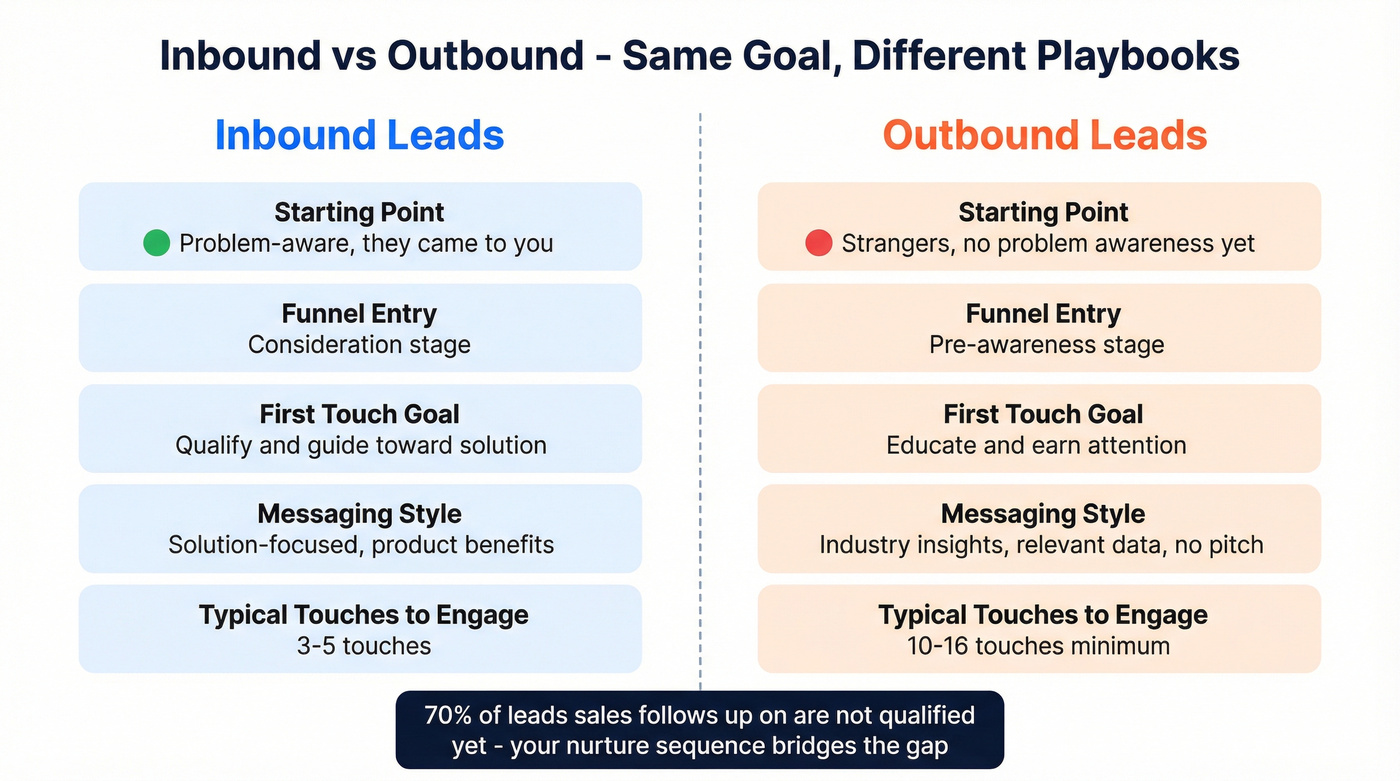
This distinction matters for messaging. Cold outbound needs education-first content - industry insights, relevant data, a reason to pay attention. Warm outbound (some pain recognition, a site visit, social engagement) can move faster, but still shouldn't open with a demo request. Of the 20% of leads sales actually follows up on, 70% aren't qualified yet. Your nurture sequence is only as good as your ICP definition - if you're nurturing the wrong people, cadence structure won't save you.
Ask any SDR who's been in the seat for more than six months and they'll tell you the same thing: the first email barely matters. The teams that blast the same "15 minutes for a quick call?" to both groups wonder why their reply rates sit below 1%.
The Multi-Touch Nurture Sequence
Before you build a single email, handle Step 0: verify your list. If your bounce rate is above 5% deliverability problems will drag the whole sequence down. Prospeo's 5-step verification delivers 98% email accuracy, so your sequence actually reaches inboxes. Five minutes of verification saves your domain reputation.
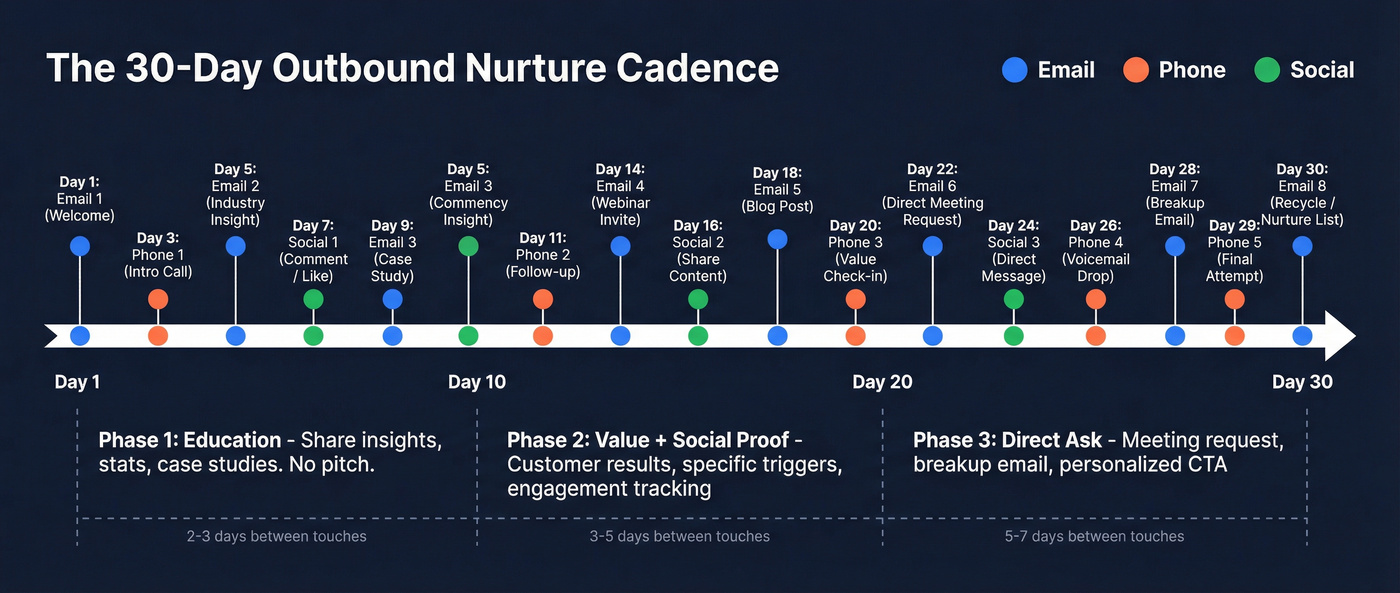
Cadence Structure (Days 1-30)
B2B buyers typically require 6-8 touchpoints to engage, and nurtured leads move through the sales cycle 23% faster. A strong outbound cadence runs 14-16 touches across channels over roughly 30 days.
Spacing matters. Start tight - 2-3 days between touches in the first week when you're top of mind, then expand to 5-7+ days as the sequence progresses. Email carries the bulk, but phone calls around days 3, 7, and 14 break the pattern. Social touches - commenting on their posts, sending a connection request - add familiarity that makes the next email feel less cold. The entire point of a multi-channel cadence is to stay top of mind without becoming noise.
During active nurture, aim for 1-2 emails per week. For leads that go quiet but haven't opted out, drop to once every two weeks.
How to Nurture Decision Makers Across the Funnel
Stop optimizing your first email. The money is in touches 5-15.
Touches 1-4 (Education): Share an industry insight, a relevant stat, or a short case study. No product pitch. You're earning the right to their attention. The goal is a micro-engagement - a click, a reply that says "interesting." If you need a starting point, use a proven outreach email template and adapt it to your ICP.
Touches 5-10 (Value + Social Proof): Now you've earned some familiarity. Introduce how companies like theirs solve the problem you've been educating on. Drop a customer result. Reference something specific - a recent funding round, a job posting that signals a pain point, a competitor move. Track engagement signals here: link clicks and replies are your basic scoring inputs for deciding which leads to advance. When you nurture decision makers with this kind of specificity, the conversation shifts from "who are you?" to "tell me more." This is also where intent signals and buying signals follow up make personalization feel effortless.
Touches 11-16 (Direct Ask): The prospect has seen your name a dozen times. The ask can be direct: "Worth a 15-minute call this week?" or a breakup email that creates urgency. Personalize based on any engagement signals from earlier touches.
After each 30-day cycle, review reply rates by touch number and cut or rewrite the underperformers.

A 16-touch nurture sequence means nothing if half your emails bounce. Prospeo's 5-step verification delivers 98% email accuracy so every touch in your cadence actually reaches an inbox. Teams using Prospeo cut bounce rates from 35%+ to under 4% - and tripled their pipeline.
Fix your data before you fix your sequence.
Outbound Nurture Benchmarks
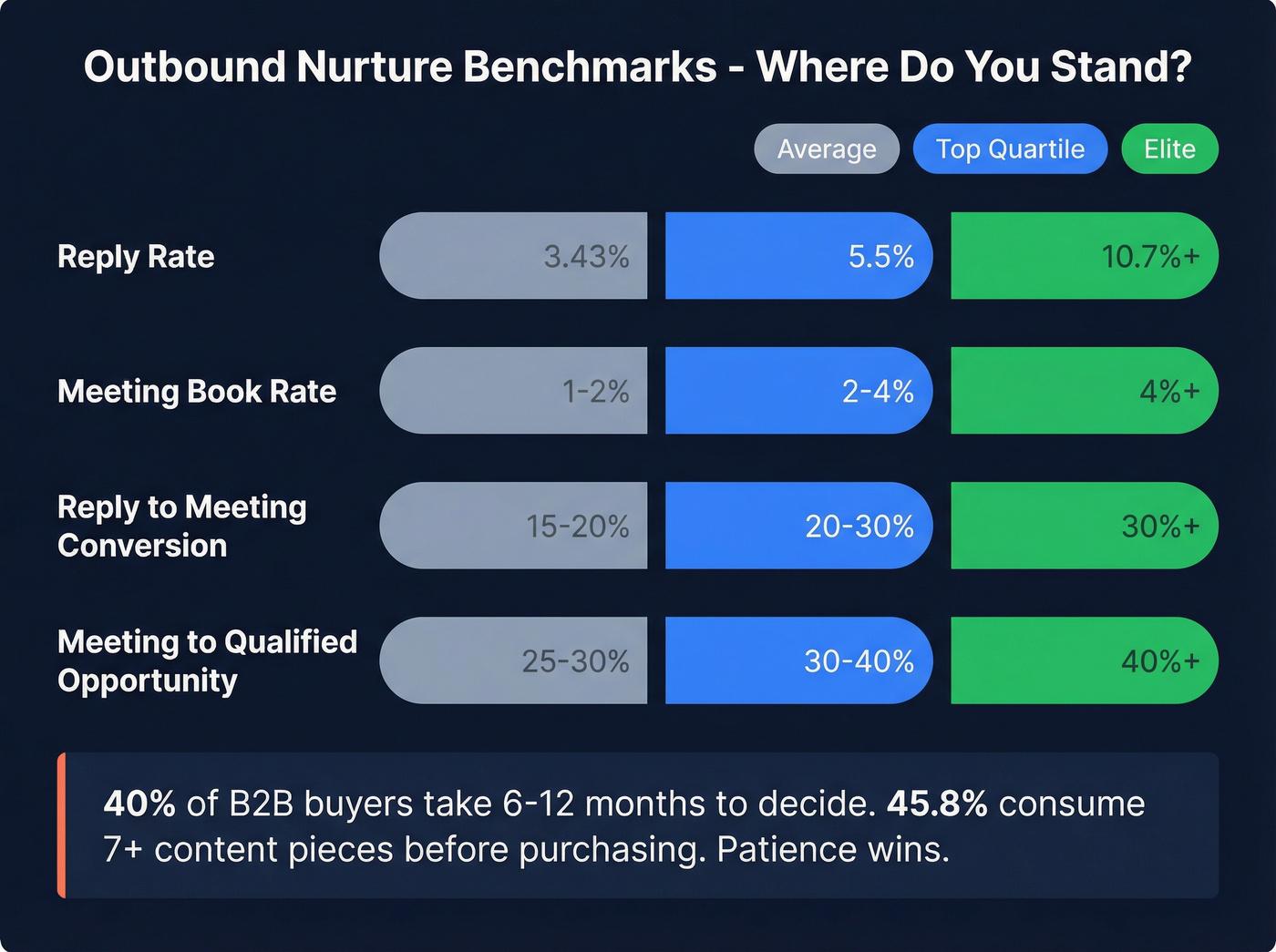
Here's what "good" looks like so you can calibrate expectations:
| Metric | Average | Top Quartile | Elite |
|---|---|---|---|
| Reply rate | 3.43% | 5.5% | 10.7%+ |
| Meeting book rate | 1-2% | 2-4% | 4%+ |
| Reply to meeting | 15-20% | 20-30% | 30%+ |
| Meeting to qualified opp | 25-30% | 30-40% | 40%+ |
The critical context behind these numbers: 40.4% of B2B buyers take 6-12 months to decide, and 15.4% take over a year. A full 45.8% consume 7+ content pieces before purchasing.
Nurture campaigns that generate 50% more sales-ready leads at 33% lower cost aren't magic - they're just patient. We've run the numbers across dozens of outbound campaigns, and the pattern holds: the teams that win aren't sending better emails. They're sending more of them to cleaner lists (and following a real email deliverability checklist).
One caveat: if your average deal size is under $15k, you probably don't need a 16-touch enterprise sequence. Eight touches over two weeks with tight personalization will outperform a bloated cadence every time. Save the 20+ touch marathons for six-figure deals with buying committees.
Mistakes That Kill Your Sequences
1. Pitching before educating. Outbound leads have zero context about your product. Leading with a feature dump or demo request is the fastest way to get archived.
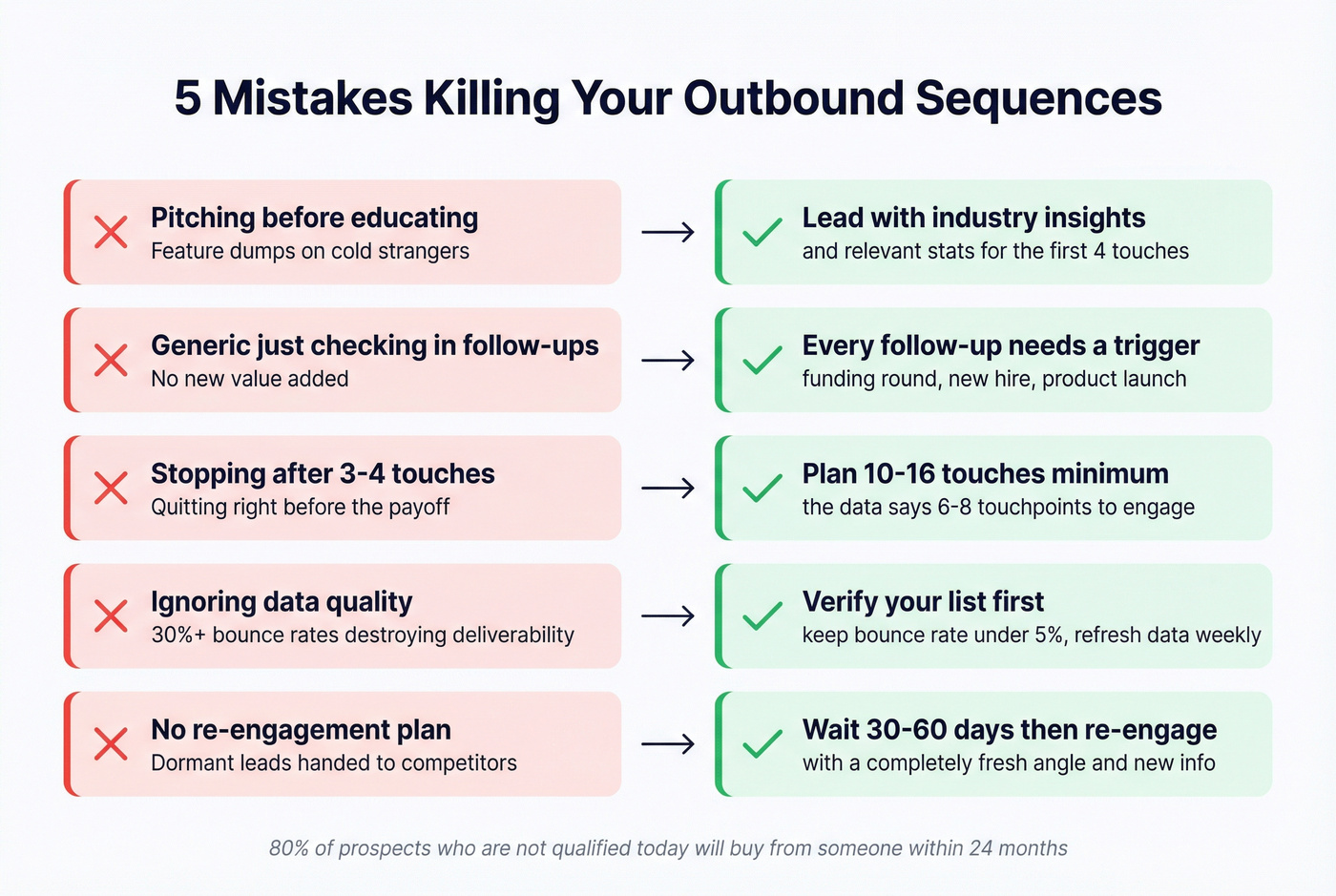
2. Generic "just checking in" follow-ups. Every follow-up needs a reason to exist. Personalize based on triggers - a funding round, a new hire, a product launch. "Checking in" is code for "I have nothing new to say," and your prospects know it. If your follow-ups are stale, steal a few patterns from these subject lines for follow-up emails.
3. Stopping after 3-4 touches. The consensus on r/sales is clear: 3-touch sequences are dead. The data says 6-8 touchpoints minimum. If your sequence is 3 emails over 10 days, you're spamming and quitting - the worst of both worlds.
4. Ignoring data quality. Look, if your bounce rate is above 5%, stop sequencing and fix your data. We've seen teams running 30%+ bounce rates wonder why their sequences "don't work." The sequences were fine. The data wasn't. Prospeo refreshes records every 7 days - the industry average is 6 weeks. If your data provider updates monthly, you're nurturing job titles that changed three weeks ago. This is exactly why B2B contact data decay and CRM hygiene matter more than another template.
5. No re-engagement plan for leads that go dark. A lead that doesn't reply in 30 days isn't dead - they're just not ready. Without a re-engagement cadence, you're handing them to the competitor who keeps showing up. SDR account nurturing should include a documented plan for cycling dormant leads back into fresh sequences, not just hoping someone remembers to follow up.
Reviving Cold Outbound Leads
Nearly 80% of leads go cold before they convert. The reasons are predictable: poor timing, irrelevant content, lack of follow-up. None of those reasons mean the lead is dead. 80% of prospects not qualified today will buy from someone within 24 months.
The question isn't whether they'll buy. It's whether they'll buy from you.
Wait 30-60 days after a lead goes dark, then re-engage with a completely fresh angle. Don't repeat the same sequence. Lead with new information - a relevant industry shift, a new case study, a trigger event at their company. If the original sequence was email-heavy, try a phone call or social touch first. The goal is to feel like a new conversation, not a recycled one. If you want a tighter system for this, build a dedicated B2B lead re-engagement track.
Let's be honest: learning how to keep in touch with prospects over long buying cycles without being annoying is the skill that separates pipeline builders from pipeline burners. One of our team's favorite moves is pairing intent data signals with re-engagement timing - when a dormant lead starts researching a relevant topic, that's your window, not an arbitrary 60-day calendar reminder.
Skip the re-engagement sequence entirely if the lead explicitly opted out or told you to stop. Respect the "no" and move on. Burning a relationship for one more touch isn't worth it.
Touches 5-15 drive the most replies - but only when you can personalize with real signals. Prospeo gives you 30+ filters including buyer intent, job changes, and funding data so every follow-up has a reason to exist. At $0.01 per email, a 500-lead nurture campaign costs less than your morning coffee.
Stop "just checking in." Start reaching the right people with the right context.
FAQ
How many touches should an outbound nurture sequence have?
Plan for 10-16 touches across email, phone, and social over 3-4 weeks. Enterprise deals often require 20-70 interactions. Most reps stop at 3-4 - that's exactly where the opportunity gap lives.
How is nurturing outbound leads different from inbound?
Inbound leads arrive with problem awareness. Outbound leads are strangers who need education before they'll even acknowledge a problem. Same end goal, fundamentally different starting points and messaging strategies.
What's the best way to follow up after the first sequence ends?
Move unconverted leads into a long-term nurture track - one touch every two to three weeks with genuinely useful content. Reps who maintain relationships over months, not days, close deals when timing finally aligns. Over 80% of prospects buy within 24 months.