How to Follow Up With Prospects Without Wasting Everyone's Time
You ran a perfect demo on Monday. Sent a thoughtful recap by Tuesday morning. By Wednesday - silence. By Friday, you're drafting a "just checking in" email you already know won't work.
Across 16.5M cold emails analyzed by Belkins, the highest reply rate - 8.4% - came from a single email. Every additional message after that drops the number. So the question isn't how to follow up with prospects more. It's how to do it without torching your reply rates, your sender reputation, and your prospect's patience.
The short version: you need 8-12 touchpoints over 17-21 days across email, phone, and social, each one adding real value, built on verified contact data so your emails actually land.
Why Most Prospect Follow-Ups Fail
Three things kill most sequences before they have a chance.
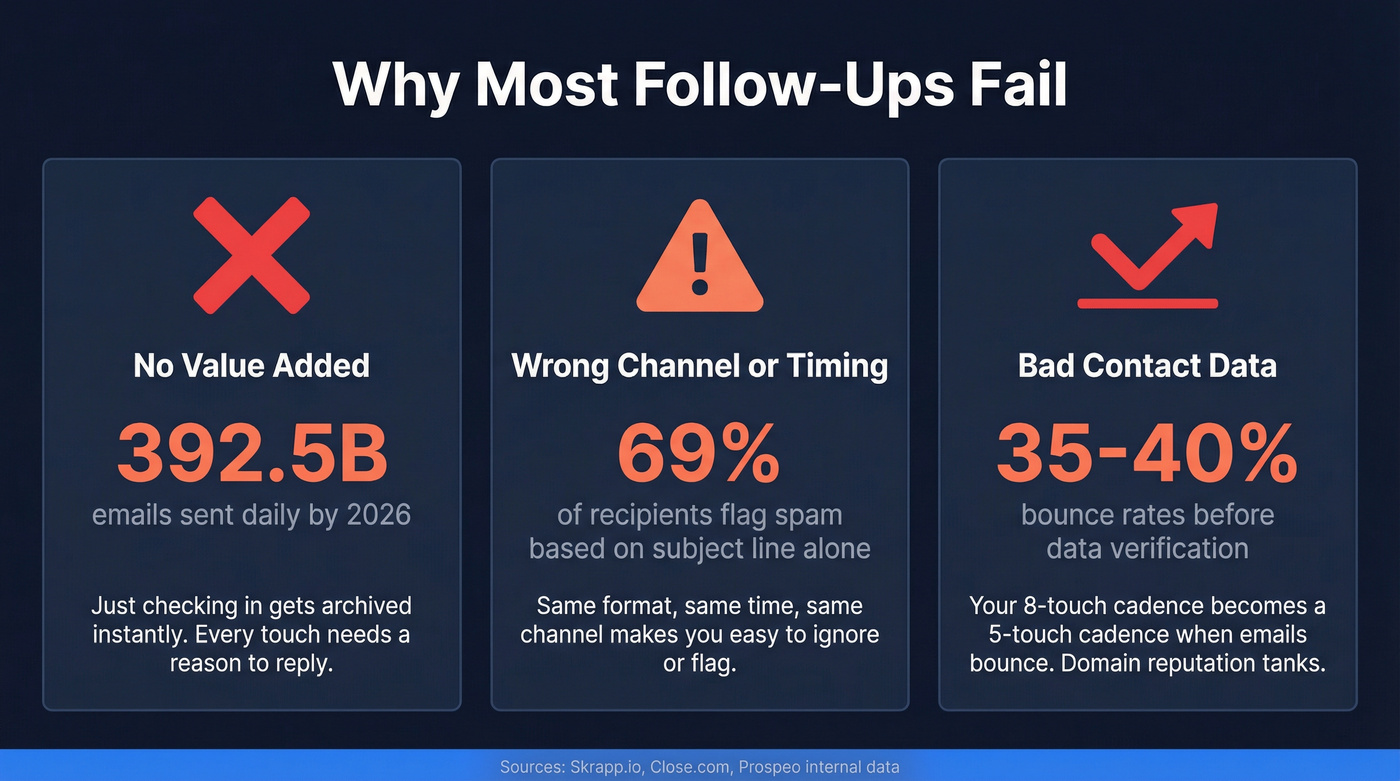
No value added. "Just wanted to circle back" tells the prospect nothing new. "Just checking in" is the fastest way to get archived. With 392.5B emails sent daily by 2026, your message competes with hundreds of others for a few seconds of attention - and a content-free nudge doesn't earn those seconds.
Wrong channel or bad timing. 69% of recipients report emails as spam based on the subject line alone. If you're sending the same format at the same time on the same channel, you're making it easy to ignore or flag. (If you need better angles, start with these subject line patterns.)
Bad contact data. Here's the thing: if a big chunk of your emails bounce, your carefully designed 8-touch cadence is actually a 5-touch cadence. Those bounces aren't just wasted effort - they actively damage your domain reputation, making future emails less likely to land even when the address is correct. (If you're seeing this, fix hard bounce issues and run an email validity check before you touch copy.)
The Follow-Up Cadence That Works
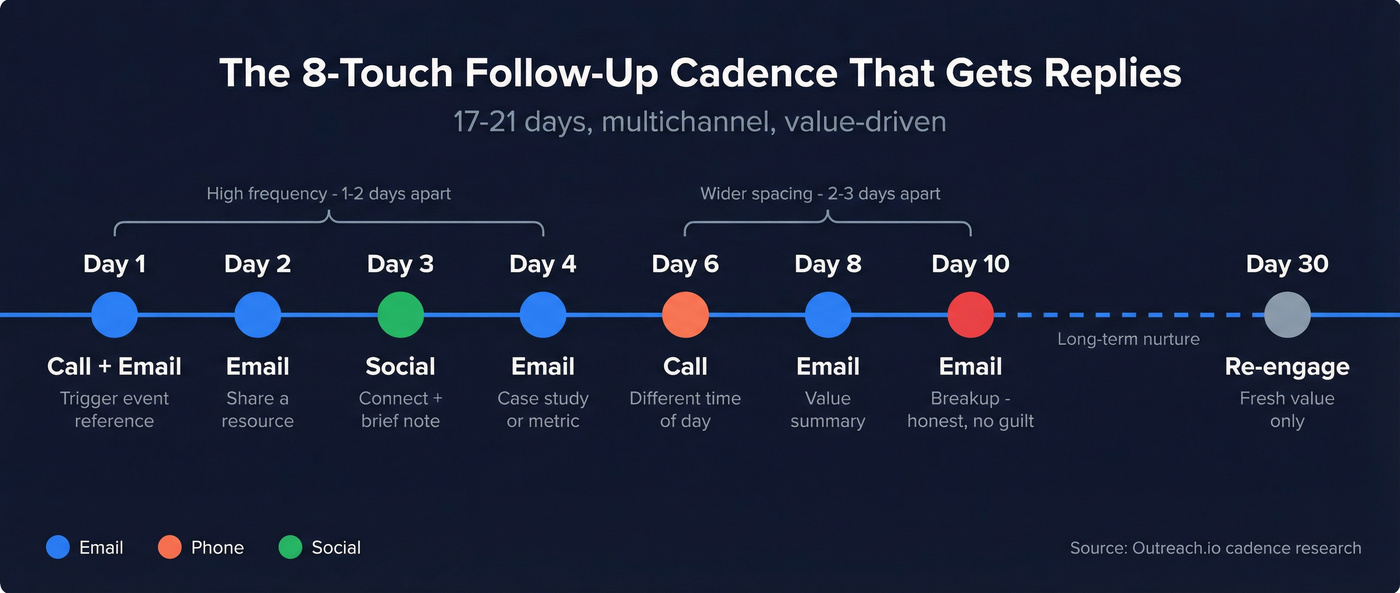
The sweet spot is 17-21 days with 8-12 touchpoints. Most reps quit around touch 4 or 5, which is exactly when persistence starts paying off. Start with 1-2 days between early touches, then expand to 3+ days to reduce fatigue. Cap outreach at roughly 30 emails per hour to avoid triggering spam filters. (More examples: sales cadence example.)
Channel Mix
McKinsey's B2B Pulse found buyers engage across an average of 10 channels during their journey. Your follow-up should meet them where they already are. (If you're building this out, use an AI multi-channel prospecting workflow.)
| Channel | % of Touches | Best For |
|---|---|---|
| 40-50% | Detailed value, proof points | |
| Phone | 20-30% | Urgency, live conversation |
| Social | 15-25% | Credibility, relationship |
| Video | 5-10% | Personality, differentiation |
Phone calls generate disproportionate response rates despite being only 20-30% of touches. Don't skip them just because they're uncomfortable. We've seen teams double their connect rates simply by layering a call the same day as an email - each touch reinforces the last, and the combination shortens sales cycles in ways that single-channel sequences can't match. (More on the benefits of cold calling and a practical outbound calling strategy.)
Sample Day-by-Day Sequence
Adapted from Highspot's cadence research and what we've seen work across mid-market outbound teams:
- Day 1: Call + personalized email referencing the trigger event
- Day 2: Follow-up email with a specific resource
- Day 3: Social connect with a brief note
- Day 4: Proof-point email - case study or metric
- Day 6: Call at a different time of day than Day 1
- Day 8: Value summary email - what they'd gain, not what you sell
- Day 10: Breakup email - honest, no guilt
- Day 30: Re-engagement with fresh value (use these re-engagement email subject lines)
The "Schedule the Next Event" Rule
Every interaction should end with a committed next step. Avoma calls this "Scheduled Next Events" - the simplest discipline that separates reps who close from reps who chase. If the prospect won't commit to a next step, that's not a follow-up problem. That's a qualification signal. (Tighten this with a real account qualification process.)
Psychology Behind Effective Follow-Ups
Zeigarnik Effect. People remember unfinished tasks more than completed ones. Your follow-up should resurface an open loop, not guilt-trip. Run demos like movie teasers, not training sessions - leave something unresolved that makes the next conversation feel necessary.
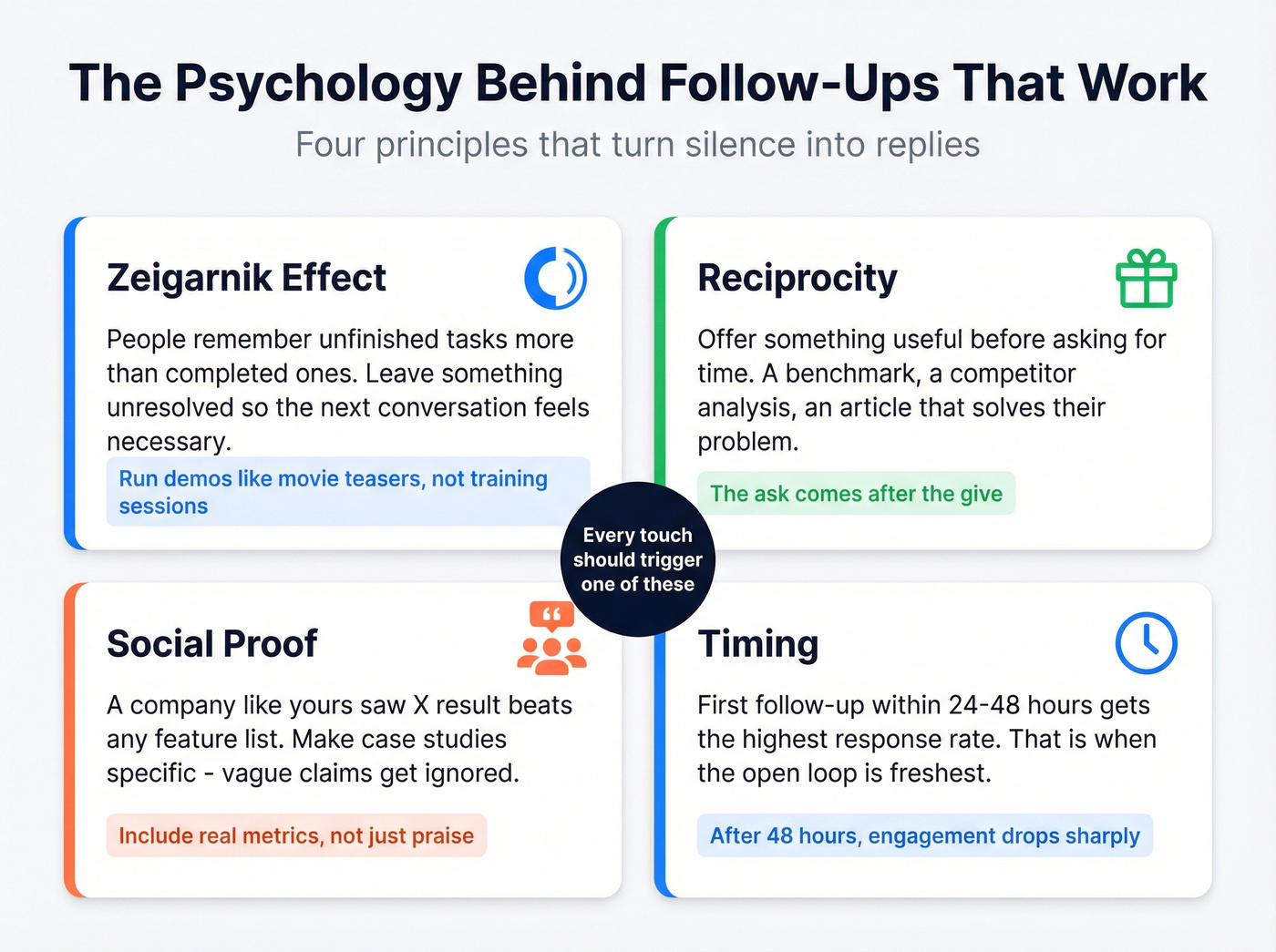
Reciprocity. Offer something useful before asking for time. A relevant benchmark, a competitor analysis, an article that solves a problem they mentioned. The ask comes after the give.
Social proof. "A company like yours saw X result" is more persuasive than any feature list. Include a relevant case study or testimonial, and make it specific - vague claims get ignored.
Timing. First follow-up within 24-48 hours of initial contact gets the highest response rates. That's when the open loop is freshest.

Your follow-up cadence is only as good as the data behind it. Bounced emails kill domain reputation and shrink your 8-touch sequence to 5 real touches. Prospeo delivers 98% email accuracy with a 7-day refresh cycle - so every touchpoint in your cadence actually reaches a real inbox.
Stop following up with dead addresses. Start with verified contacts.
Three Templates You Can Steal
47% of email opens are driven by the subject line alone, so each template leads with one. Use the same thread for continuity with warm prospects; start a new thread when you're changing the angle. (If you want more options, pull from these outreach email templates.)
Template 1: Value-Add Follow-Up
Subject: Resource on [specific challenge they mentioned]
Hi [Name], I came across [resource] and thought of our conversation about [challenge]. Figured it'd be useful regardless of where things stand with us. Worth a look?
Template 2: Proof-Point Follow-Up
Subject: How [similar company] solved [problem]
Hi [Name], [Company] was dealing with [same challenge you discussed]. They [specific result with metric]. Happy to walk through what they did differently - 15 minutes this week?
Template 3: Breakup Email
Subject: Closing the loop
Hi [Name], I've reached out a few times and haven't heard back - totally understand if the timing isn't right. I'll stop following up, but if [problem] comes back on the radar, I'm here.
Let's be honest about the breakup email: it works because it removes pressure. The consensus on r/sales is that breakup emails often get the highest reply rates of any touch in the sequence - people respond when they feel the window closing.
When to Stop Following Up
More follow-ups aren't always better. Belkins' data shows that 4+ emails in a sequence more than triples unsubscribe and spam complaint rates. Going from 1 to 5+ emails cuts reply rate by more than half.
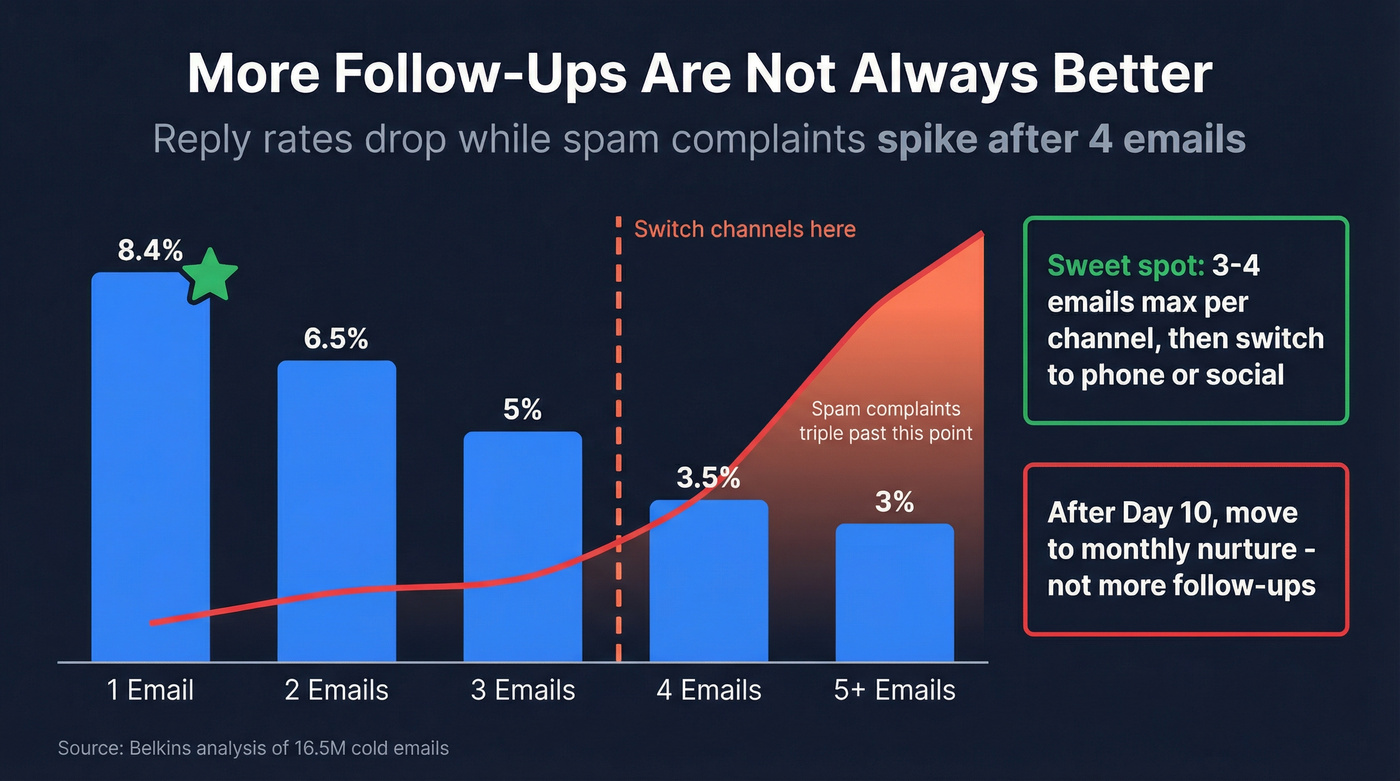
If your average deal size sits below five figures, you probably don't need an 8-touch sequence at all. Three high-quality touches with real value will outperform eight lazy ones every time. Enterprise prospects ghost faster than SMBs - they have more gatekeepers and less patience for persistent outreach. The breakup email on Day 10 is your last active touch. After that, move to long-term nurture: monthly value drops, not follow-ups. (For a full system, see lead nurturing emails.)
Skip the extended cadence entirely for inbound leads who've gone cold after a demo. They already know what you do. A single "closing the loop" email after a week of silence tells you everything you need to know about their intent.
Fix Your Data Before You Follow Up
Every cadence tip above assumes your emails actually reach inboxes. If they don't, none of it matters.
We've seen this pattern repeatedly: a team builds a sophisticated 8-touch sequence, launches it, and watches reply rates flatline. The problem isn't the copy or the cadence - it's that a third of the emails are bouncing. Snyk's 50-person AE team dropped from 35-40% bounces to under 5% after switching to Prospeo, and AE-sourced pipeline jumped 180%.

Check your bounce rate before you rewrite a single follow-up email. If it's above 5%, your cadence isn't the problem - your data is. Prospeo's 5-step verification process, including catch-all handling, spam-trap removal, and honeypot filtering, delivers 98% email accuracy on 143M+ verified addresses refreshed every 7 days. (If you're auditing this, start with an email deliverability checklist and a proper email checker tool.)
Layering calls with emails doubles connect rates - but only if you have real phone numbers. Prospeo gives you 125M+ verified mobile numbers with a 30% pickup rate, so that Day 1 call + email combo actually works.
Turn your multichannel cadence from theory into booked meetings.
Tools Worth Using
HubSpot Sales Hub is the obvious choice if you're already in HubSpot's ecosystem - sequences plus CRM in one platform. Starter plans start around $20/month, and startups can get up to 90% off.
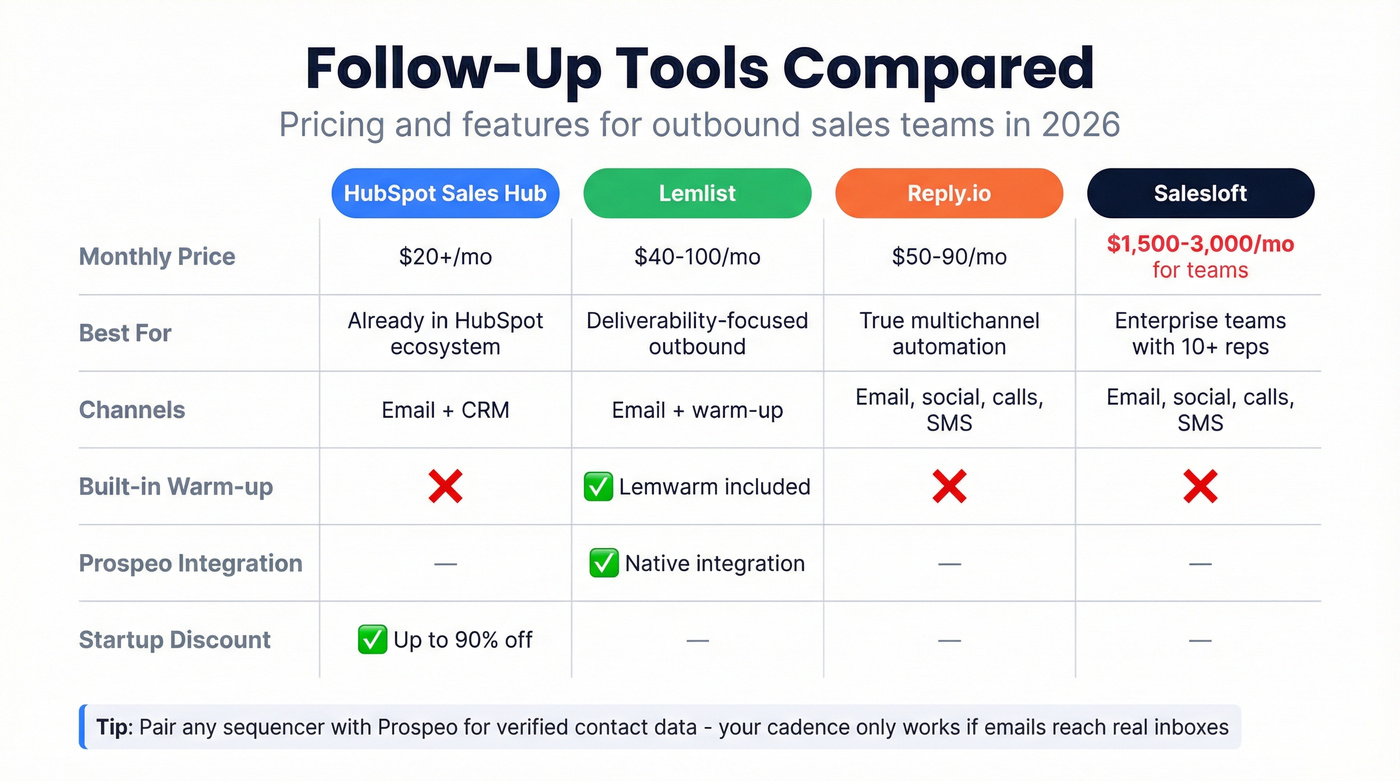
Lemlist pairs outbound sequences with built-in warm-up through Lemwarm, which solves the deliverability problem most standalone sequencers ignore. Expect roughly $40-$100/month per user depending on tier. It also integrates natively with Prospeo if you want verified contacts flowing directly into sequences.
For teams that need true multichannel automation across email, social tasks, calls, and SMS, Reply.io covers the most ground at roughly $50-$90/month per user. Salesloft does similar work but targets enterprise buyers - expect roughly $1,500-$3,000/month for small teams on annual contracts. Unless you're running 10+ reps and need enterprise-grade analytics, it's hard to justify that price gap.
FAQ
How many follow-ups should I send before giving up?
Plan 8-12 touchpoints across channels over 17-21 days. After 4+ emails on a single channel, spam complaints triple. Switch to phone or social before that threshold, then move to monthly nurture after Day 10.
What's the best time to send a follow-up email?
Between 8 AM and 3 PM in the prospect's local time zone. Send your first follow-up within 24-48 hours of initial contact - that window consistently produces the highest response rates across Belkins' 16.5M-email dataset.
How do I follow up without being annoying?
Add value every touch - a resource, a case study, a specific insight. Each message should be a standalone reason to reply, not just a reminder you exist. If you've got nothing new to offer, wait until you do.
What if my follow-up emails aren't getting replies at all?
Check your bounce rate first. If it's above 5%, your messages aren't reaching inboxes - no amount of copywriting fixes that. Verify a sample of your list before launching any sequence so you know deliverability isn't the bottleneck.