

AI Multi-Channel Prospecting: Build a Stack That Books Meetings in 2026
Your SDR manager pulls up the campaign dashboard. The first sequence went out to 2,000 contacts yesterday - 47% bounced. The domain's already flagged, the sequencer's paused, and three weeks of list-building just evaporated.
Multi-channel prospecting campaigns using three or more channels achieve 287% higher purchase rates than single-channel outreach. But the gap between campaigns that book meetings and campaigns that tank your domain comes down to one thing: data quality at the foundation. Get that wrong and no amount of AI orchestration saves you.
What You Need (Quick Version)
Multi-channel prospecting fails when the data is bad, not when the automation is wrong. Start with verified contact data, pick one sequencing tool, and run a 10-day cadence across email, phone, and social.
Mid-market stack: Prospeo (paid plan) + Reply.io ($89/mo for true multichannel) + HubSpot CRM
Enterprise stack: Outreach or Salesloft + ZoomInfo or Cognism + Gong for conversation intelligence
What AI-Powered Prospecting Actually Is
Rule-based automation fires emails on a schedule: Day 1 send, Day 3 follow-up, Day 7 breakup. It doesn't adapt.
AI-powered prospecting uses buying signals, behavioral data, and engagement patterns to decide which channel to use, when to reach out, and what to say. If a prospect opens your email twice but doesn't reply, an AI system routes them to a phone task instead of sending email #3. Someone visits your pricing page? The system bumps them to the top of the call queue.
The core channels haven't changed - email, phone, social, and occasionally video. What's changed is the orchestration layer that decides how those channels interact. The best cross-channel prospecting tools in 2026 treat channels as a coordinated system, not four separate campaigns running in parallel.
The Numbers That Matter
| Metric | Benchmark |
|---|---|
| Cold email reply rate | 1-5% |
| Cold call success rate | ~2.3% |
| LinkedIn response rate | ~10.3% |
| Multi-channel lift | 287% vs single-channel |
| Deals needing 5+ touches | 80% |
| Reps who quit after 1 touch | 44% |
| Email sweet spot | 50-125 words |
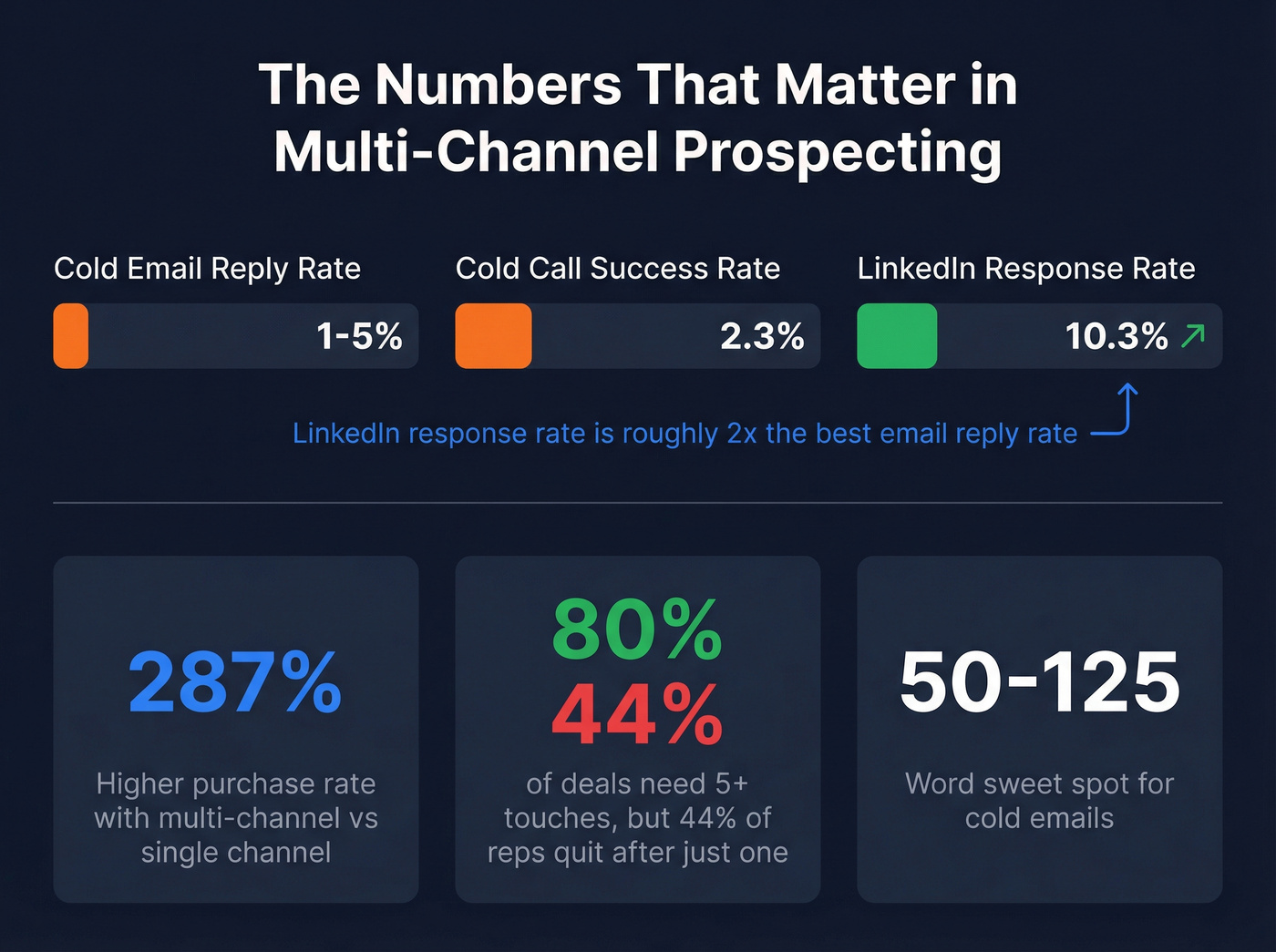
The 287% lift is the headline, but the persistence gap is the real story. 80% of deals require five or more touches, yet 44% of reps give up after one. Coordinated outreach across channels isn't about using more surfaces - it's about creating enough touchpoints that you're still in the conversation when the prospect is ready.
LinkedIn's ~10.3% response rate is roughly double the best-case email reply rate. That's why every serious cadence now includes social touches alongside email. We've seen teams using automated social engagement with email and phone consistently outperform those relying on a single channel.
The #1 Mistake: Automation Before Intelligence
Here's the thing: 86-90% of sales emails contain zero personalization, and most are sent to the wrong addresses. Quotas rose 37% in 2024 while SDR quota attainment sat just above 50%. 70% of B2B reps missed quota that year, and the trend hasn't reversed.
The pattern r/sales describes over and over: teams buy the sequencer first, load it with unverified data, and wonder why deliverability craters within two weeks. Contact data loses roughly 30% of its accuracy within a year - people change jobs, companies get acquired, email servers rotate. Gartner pegs the cost of poor data quality at $12.9M annually for the average organization.
You need intelligence before outreach. Verified data, enriched profiles, and intent signals should come before you pick a sequencer. When Meritt switched their data layer, bounce rates dropped from 35% to under 4% and pipeline tripled. Stack Optimize built to $1M ARR running client campaigns with 94%+ deliverability and zero domain flags across every client.
If your average deal size is under $10k, you probably don't need ZoomInfo-level data. But you absolutely need verified data. The difference between a $99/month data tool and a $2,000/month one isn't accuracy - it's breadth of features most teams never touch.
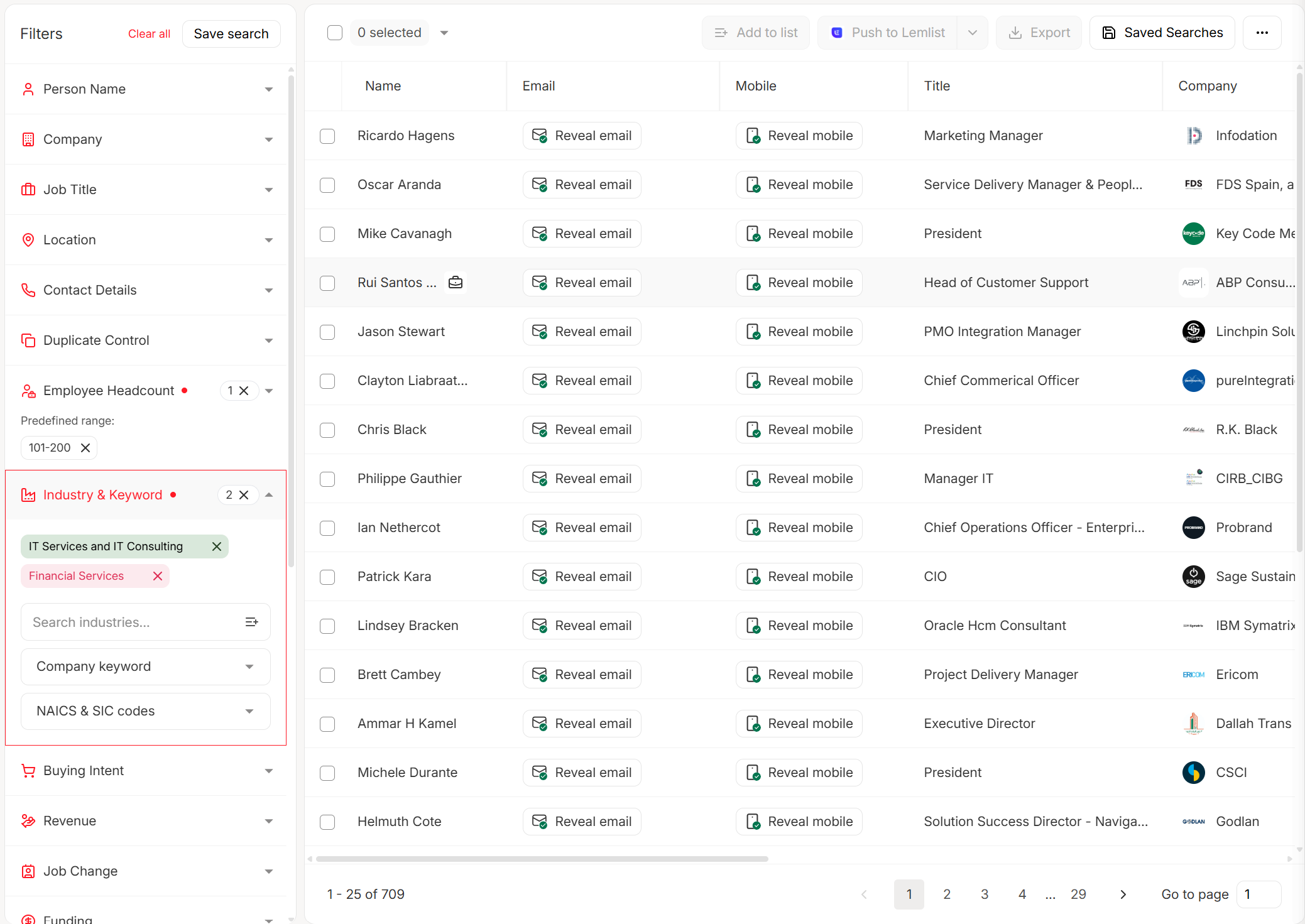
Buy your data layer first. Verify it. Then pick your sequencer. Getting this backwards is the most expensive mistake in outbound.

Multi-channel prospecting at 287% higher purchase rates means nothing if 47% of your emails bounce. Prospeo's 98% email accuracy and 7-day data refresh cycle ensure every channel in your stack fires at a real person - not a dead inbox. At $0.01 per email, fixing your data layer costs less than one bounced campaign.
Fix the foundation before you automate. Start with data that actually connects.
How to Build Your Prospecting Stack
You don't need 13 tools. You need three, maybe four, organized into a clear architecture.
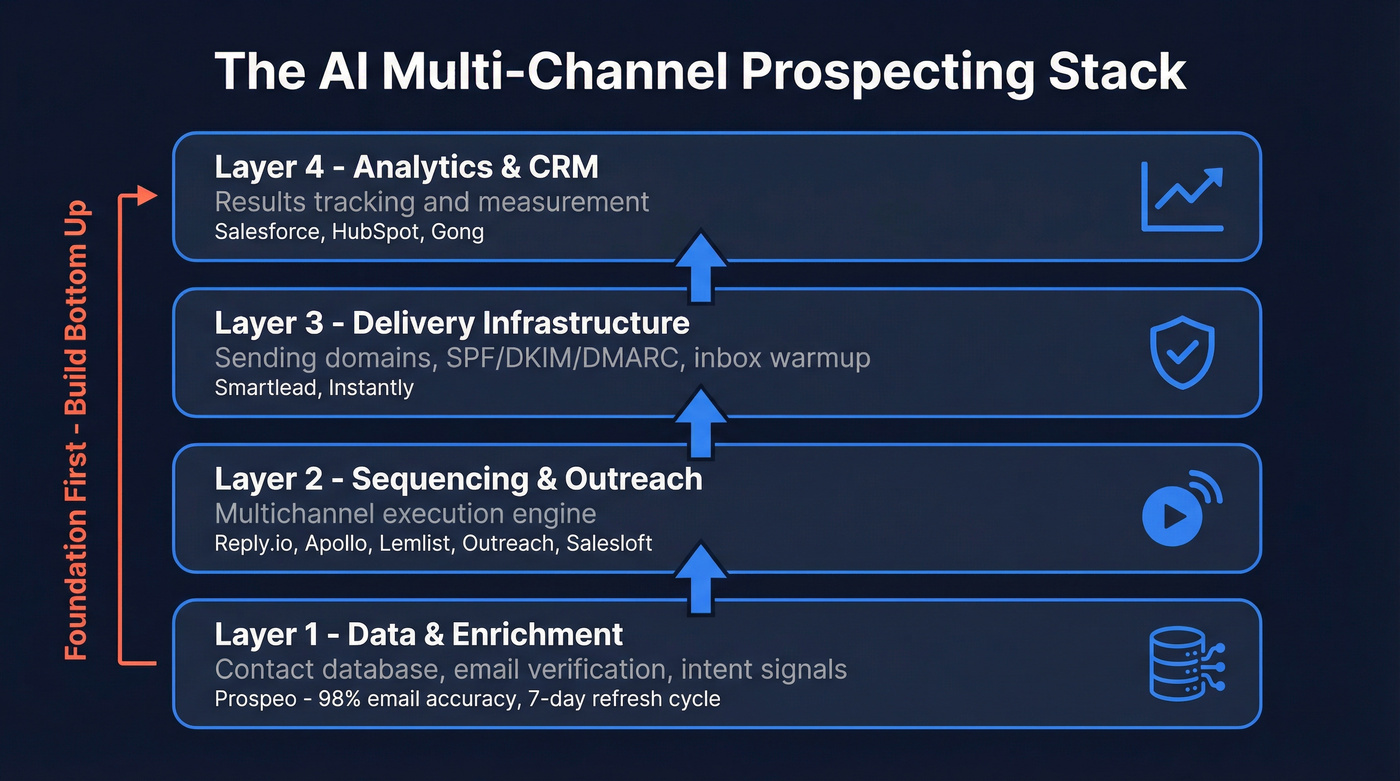
Layer 1 - Data & Enrichment. Your contact database, email verification, and intent signals. This layer powers the rest of the stack. Prospeo fits here, with 98% email accuracy and a 7-day data refresh cycle that keeps contacts current while competitors update every 4-6 weeks.
Layer 2 - Sequencing & Outreach. Your multichannel execution engine. Reply.io, Apollo, Lemlist, Outreach, or Salesloft. This layer orchestrates the cadence across email, phone, and social.
Layer 3 - Delivery Infrastructure. Dedicated sending domains, SPF/DKIM/DMARC, inbox warmup, rotation. Smartlead or Instantly handle this for email. For social, you're managing account health directly.
Layer 4 - Analytics & CRM. Salesforce, HubSpot, or Gong. Where results land and where you measure what's working.
Dust's framework breaks integration models into three patterns: point-to-point integrations where data moves between tools without unified intelligence, native platform ecosystems that work well inside their walls but poorly outside, and AI agent orchestration where a single layer queries and acts across your entire stack. Most teams in 2026 are still in point-to-point territory. That's fine - just make sure your data layer connects natively to your sequencer.
One proven combination from the field: a signal tool feeding HeyReach for social, Smartlead for email, and Make as the glue - all syncing to a central tracker. The specific tools matter less than the architecture.
The 10-Day Multi-Channel Sprint
A copy-paste cadence for new logo outbound. Stretch to 21-30 days with 12-18 touches for enterprise deals.
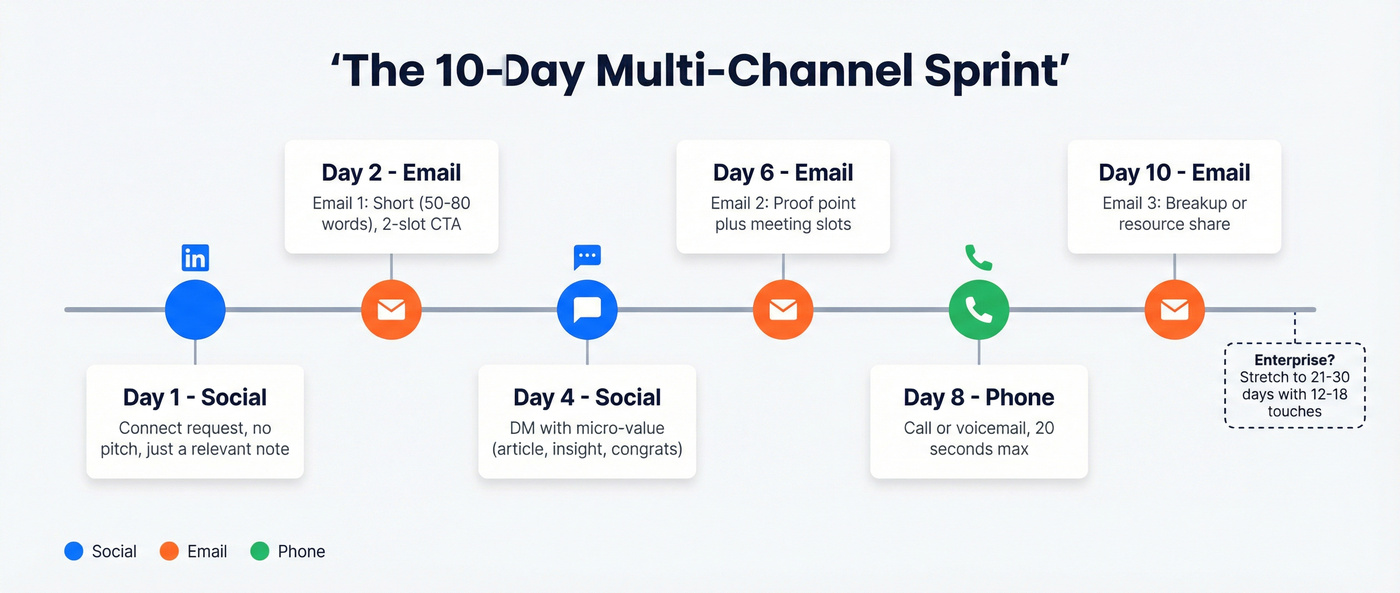
| Day | Channel | Action |
|---|---|---|
| 1 | Social | Connect request - no pitch, just a relevant note |
| 2 | Email #1: short (50-80 words), 2-slot CTA | |
| 4 | Social | DM with micro-value (article, insight, congrats) |
| 6 | Email #2: proof point + meeting slots | |
| 8 | Phone | Call/voicemail - 20 seconds max |
| 10 | Email #3: breakup or resource share |
For B2B, "social" almost always means LinkedIn. If your ICP is active on X, add it as a secondary channel.
Channel priority by persona:
| Persona | Primary Channels | Notes |
|---|---|---|
| CTO / Technical | Phone + Email | Rarely active on social; direct outreach wins |
| VP Marketing | Social + Email | High social engagement; lead with value |
| Ops / RevOps | Email-heavy | Process-oriented; data and ROI in subject lines |
Pause all channels the moment someone replies. If they say "not now," snooze for 60-90 days and re-enter. Opt-out means global suppress - across every channel, every campaign.
Use a dedicated sending domain, not your primary. Set up SPF, DKIM, and DMARC before sending a single email. Ramp slowly - 15-30 new contacts per day per inbox before scaling. First email: one link maximum, no images. These aren't suggestions. Skip any of them and your domain reputation will suffer within days.
Compliance basics: Honor opt-outs globally across all channels, include a physical address in emails per CAN-SPAM, and ensure your data provider is GDPR compliant with DPAs available. Over-automation is a real risk - if your cadence feels robotic to you, it definitely feels robotic to your prospects.
Social Channel Safety Limits
Social automation is powerful but fragile. Account restrictions are real, and recovery takes weeks.
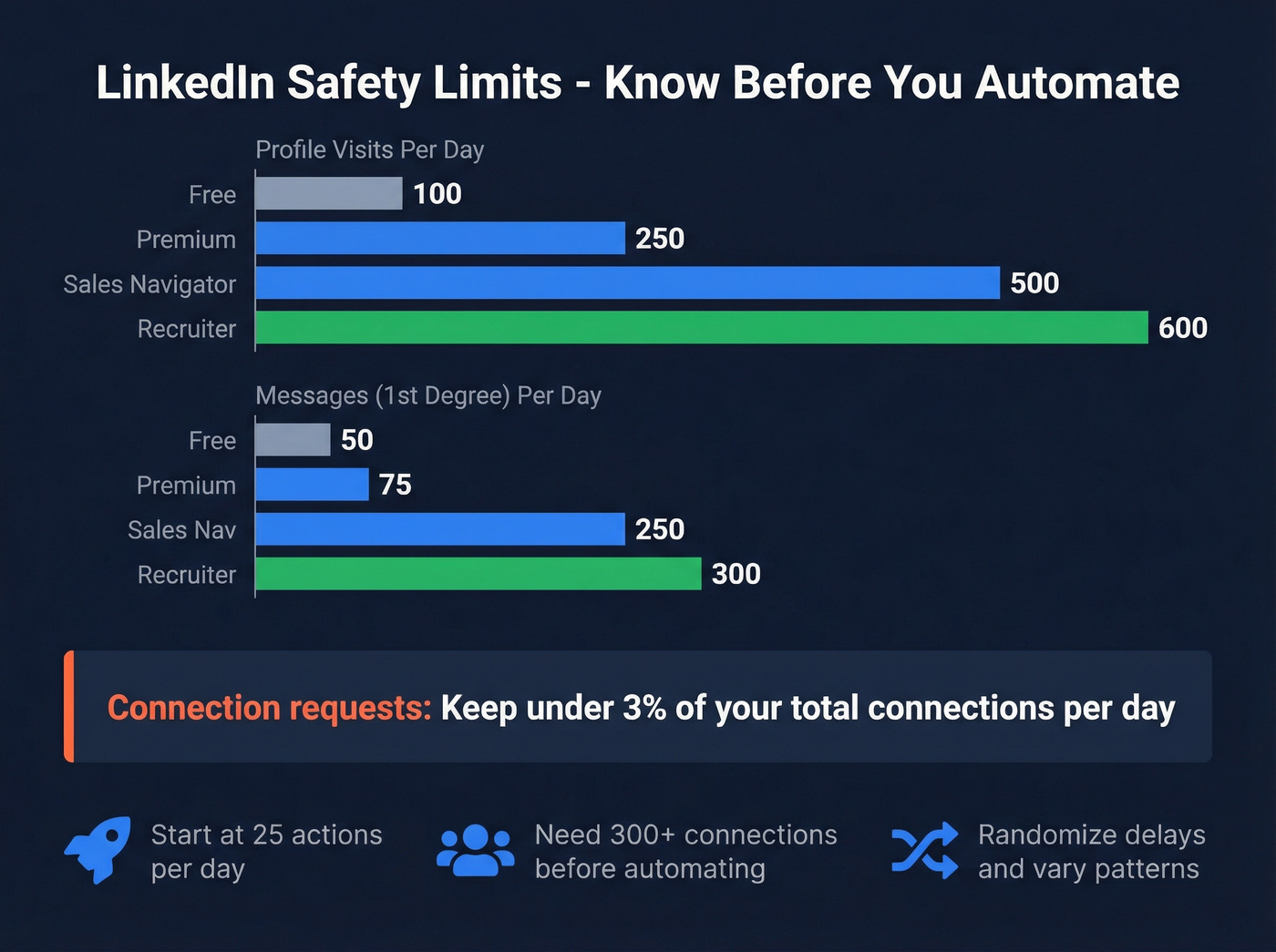
| Action | Free | Premium | Sales Nav | Recruiter |
|---|---|---|---|---|
| Profile visits/day | 100 | 250 | 500 | 600 |
| Messages (1st-degree)/day | 50 | 75 | 250 | 300 |
Connection requests: keep it under 3% of your total connections per day.
Start at roughly 25 actions per day and scale gradually. You need 300+ first-degree connections before automating anything - thin networks get flagged faster. Detection algorithms look for timing regularity, device consistency, and behavior spikes. Randomize your delays, vary your activity patterns, and don't run automation from a device you've never logged into manually.
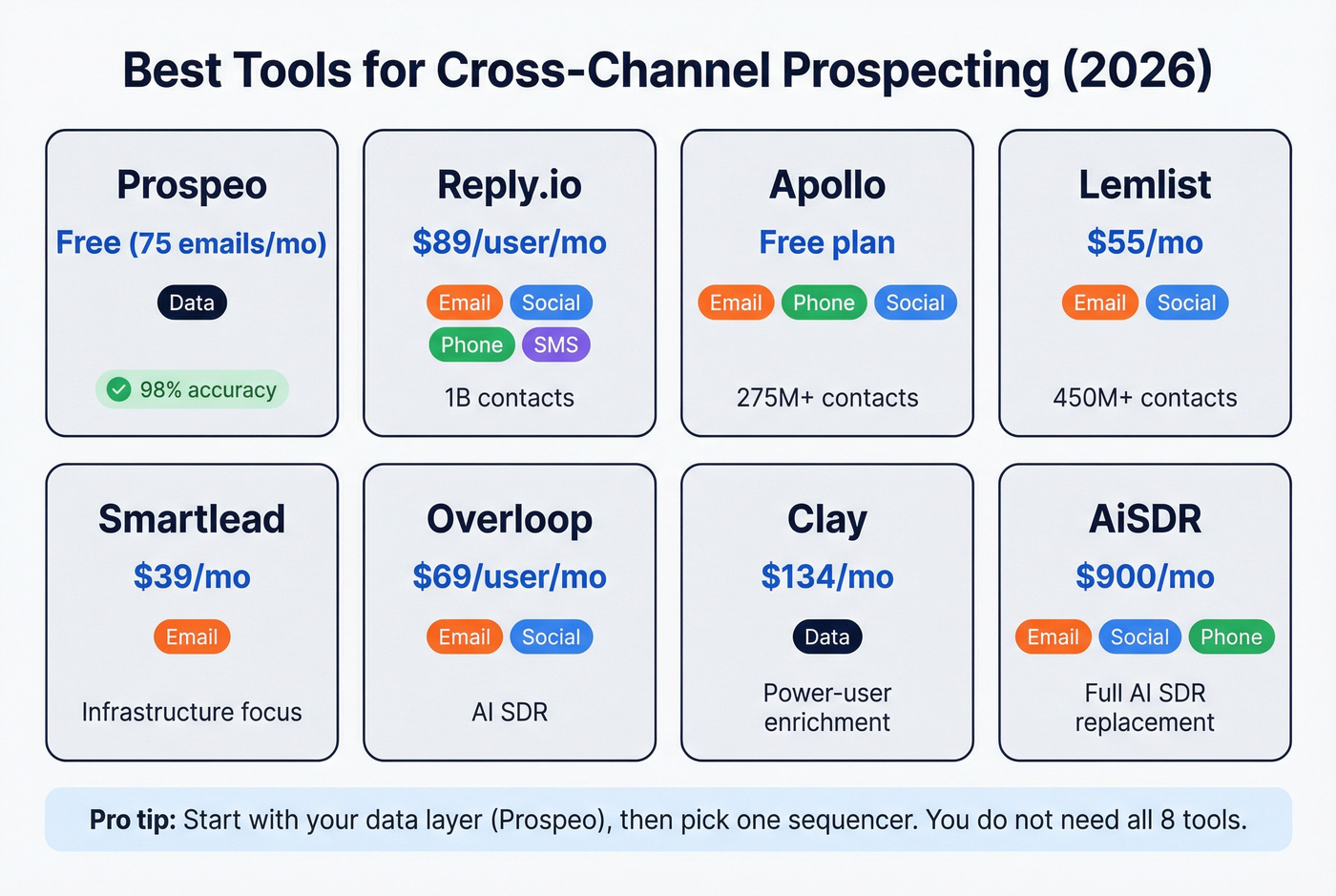
Best Tools for Cross-Channel Prospecting
| Tool | Starting Price | Channels | Database | Best For |
|---|---|---|---|---|
| Prospeo | Free (75 verified emails/mo) | Data/enrichment | 300M+ profiles | Verified data foundation |
| Reply.io | $89/user/mo | Email, social, calls, SMS, WhatsApp | 1B contacts | True multichannel |
| Apollo | Free plan | Email, calls, social | 275M+ contacts | Budget all-in-one |
| Lemlist | ~$55/mo | Email, social | 450M+ contacts | Deliverability-first teams |
| Smartlead | $39/mo | - | Email infrastructure | |
| Overloop | $69/user/mo | Email, social | 450M+ prospects | AI SDR with database |
| Clay | $134/mo | Enrichment/workflows | - | Power-user enrichment |
| AiSDR | $900/mo | Email, social, calls | 300M leads | Full AI SDR replacement |
Prospeo
Prospeo is the data quality layer that makes every other tool in this stack work. The platform covers 300M+ professional profiles with 143M+ verified emails and 125M+ verified mobile numbers, all refreshed on a 7-day cycle - compared to the 6-week industry average. Email accuracy runs 98%, and mobile numbers hit a 30% pickup rate across all regions. Intent data tracking 15,000 topics helps prioritize which prospects to contact first and on which channel.
Native integrations with Salesforce, HubSpot, Smartlead, Instantly, Lemlist, Clay, Zapier, and Make mean you push verified contacts directly into your sequencer without CSV exports. Snyk's 50-person AE team saw pipeline increase 180% after switching - bounce rates dropped from 35-40% to under 5%, generating 200+ new opportunities per month. The Chrome extension (40,000+ users) pulls verified contact data from any website or professional profile in one click. Free tier gives you 75 verified emails per month to test.
Reply.io
Reply.io is the closest thing to a true multichannel sequencer on the market. It covers email, social, calls, SMS, and WhatsApp in a single workflow builder with conditional branching - if a prospect opens but doesn't reply, the system automatically routes to a different channel.
The multichannel plan starts at $89/user/month on annual billing. Social automation is an add-on at $69/month per account, and calls/SMS run $29/month extra. The Jason AI SDR product starts at $500/month for full AI-driven outreach. Reply.io includes live data credits from a 1B-contact database, though we'd still recommend feeding it verified data from a dedicated provider rather than relying on built-in enrichment alone.
Apollo
Use this if you need an all-in-one tool that handles data, sequencing, and basic analytics without multiple subscriptions. Apollo's 275M+ contact database is strong in North America, and the workflow builder is intuitive enough that reps can self-serve. The free plan is genuinely useful for early-stage prospecting. Paid plans start at $49/user/month for Pro.
Skip this if you're sending high-volume outbound and need bulletproof deliverability. Apollo doesn't include built-in warmup, and email accuracy runs closer to 79% versus dedicated verification tools at 98%.
Lemlist
Use this if your primary concern is inbox placement. Built-in warmup via Lemwarm, spam monitoring, and domain health checks come standard. The 450M+ contact database is solid, and pricing starts at ~$55/month for Email Pro.
Skip this if you need true multichannel beyond email and social. The Multichannel Expert plan at $79/month adds social touches, but phone and SMS require separate tools.
Smartlead
The cheapest way to run serious email infrastructure. At $39/month you get inbox rotation, warmup, and multi-account management. It's email-only - no social, no calls - but it does that one thing exceptionally well. Pair it with a data provider and a social tool for the full multichannel piece.
Overloop
AI SDR with a built-in 450M+ prospect database. Starter runs $69/user/month with 250 credits, Growth hits $99/user/month with 500 credits. Handles email and social sequences with built-in warmup. Worth evaluating for teams that want fewer tools in their stack.
Clay
Clay isn't a sequencer - it's a data orchestration layer that pulls from dozens of providers and lets you build waterfall enrichment logic. Starting at $134/month for 2,000 credits, it's the glue for teams layering firmographic and technographic data from multiple sources. Power users love it. Everyone else finds the learning curve steep.
AiSDR
Full AI SDR automation at $900/month for 1,200 omnichannel messages covering email, social, and calls. Case studies report 11-16% positive reply rates at scale. Best suited for teams that want to replace SDR headcount entirely rather than augment it.
Stack Optimize built to $1M ARR with 94%+ deliverability and zero domain flags. Meritt tripled pipeline from $100K to $300K/week. The difference wasn't the sequencer - it was switching to verified data with 30+ filters for intent, technographics, and job changes. Your multichannel cadence deserves a data layer that keeps up.
Stop burning domains. Start booking meetings with contacts that are actually verified.
AI SDR vs Human SDR: The Economics
| Human SDR | AI SDR Platform | |
|---|---|---|
| Annual cost | ~$98,000 (fully loaded) | $6,000-$24,000/yr |
| Qualified opps/month | 15-20 | 40-60 |
| Cost reduction | - | ~71% (at $2,000/mo) |
The math is compelling, but expect 3-6 months to positive ROI with clean data and a defined ICP. Building processes from scratch stretches that to 6-9 months. Budget roughly 40-60 hours of data prep, segmentation, and cadence design before your first campaign launches.
Let's be honest about what we've seen: the teams that fail with AI SDRs almost always skip the data prep. The consensus on r/sales and r/salestechniques is the same - teams that invest in data quality first see 2-3x better results from their sequencers than teams that buy the automation tool first. Start with 100-200 test accounts, validate the workflow, then scale. The 71% cost savings only materialize when the foundation is solid.
FAQ
How many channels should I use?
Three is the sweet spot: email, phone, and social. Adding video helps for enterprise deals with multiple stakeholders, but it isn't necessary for most teams. The 287% lift comes from coordinating three channels, not from adding every possible touchpoint.
What's a good reply rate for multichannel outreach?
Aim for 3-8% across all channels combined. Single-channel email averages 1-5%, and cold calls convert at roughly 2.3%. Adding social and phone touches to an email cadence lifts total response rates significantly - benchmarks range from 200-287% improvement over single-channel.
How long before AI prospecting tools show ROI?
Three to six months with clean data and a defined ICP. Expect 40-60 hours of setup - data cleaning, segmentation, cadence design, domain warmup - before your first real campaign launches. Teams building from scratch should plan for 6-9 months.
Do I need a separate email verification tool?
Yes, unless your sequencer includes real-time verification at 98%+ accuracy. At roughly $0.01 per email, dedicated verification is the most cost-effective way to protect domain reputation. Built-in verification from sequencers typically runs lower accuracy and misses catch-all domains or spam traps.
What's the biggest risk of social automation?
Account restrictions. Tools that exceed platform limits get flagged within days. Stay under 3% of your total connections per day for connection requests, start at roughly 25 actions per day, and scale gradually over weeks. Having fewer than 300 first-degree connections before automating is the fastest way to get restricted.
AI multi-channel prospecting works when the data is clean and the cadence is disciplined. Start with verified contacts, run the 10-day sprint, and iterate from there.