

How to Use Social Proof in B2B: A Practitioner's Playbook
A RevOps lead we know lost a six-figure deal last quarter - not on product, not on price, but because the competitor had three case studies in the buyer's industry and they had zero. The champion couldn't sell internally without proof that someone like them had already succeeded.
The median B2B landing page converts at 6.6%. SaaS is worse at 3.8%. Meanwhile, 41% of buyers rank case studies as the single most influential content type, and peer validation makes up 90% of what buyers call "most influential" during vendor selection. The conversion lever is right in front of you. Most teams just aren't pulling it on purpose.
The Quick Version
If you're short on time, here's the highest-ROI checklist:
- Get 5+ reviews on G2 or Capterra this quarter. Five reviews can increase conversions by 270%. That's the single best effort-to-impact ratio in social proof.
- Build one industry-specific case study with quantified outcomes. One good case study beats ten vague testimonials every time.
- Add a relevant proof point to every outbound email template. 73% of B2B buyers use case studies to make purchasing decisions, yet most cold email sequences contain zero peer validation.
Most B2B companies treat social proof like decoration. Let's talk about how to turn it into a system.
The Psychology Behind It
Social proof isn't a marketing trick - it's a cognitive shortcut hardwired into decision-making. Robert Cialdini identified it as one of his core principles of influence, calling it "Consensus": when people are uncertain, they look to the behavior of similar others to determine the correct course of action.
Two conditions make it especially powerful. Uncertainty - the buyer doesn't know what the right choice is. Similarity - the proof comes from someone who looks like them. Both are almost always present in B2B purchasing, where you're asking someone to stake their reputation on a vendor decision with incomplete information.
Deutsch and Gerard's 1955 framework splits this into two flavors. Informational influence is the "need to be right" - buyers genuinely want to learn from peers who've already solved the problem. Normative influence is the "need to belong" - nobody wants to be the one who picked the vendor that failed. In a B2B buying committee with 6-11 stakeholders, that group-norm dynamic gets amplified fast. One strong case study shifts the entire committee's frame.
Seven Types That Work in B2B
Not all social proof is created equal. Here's when and where each type earns its place:
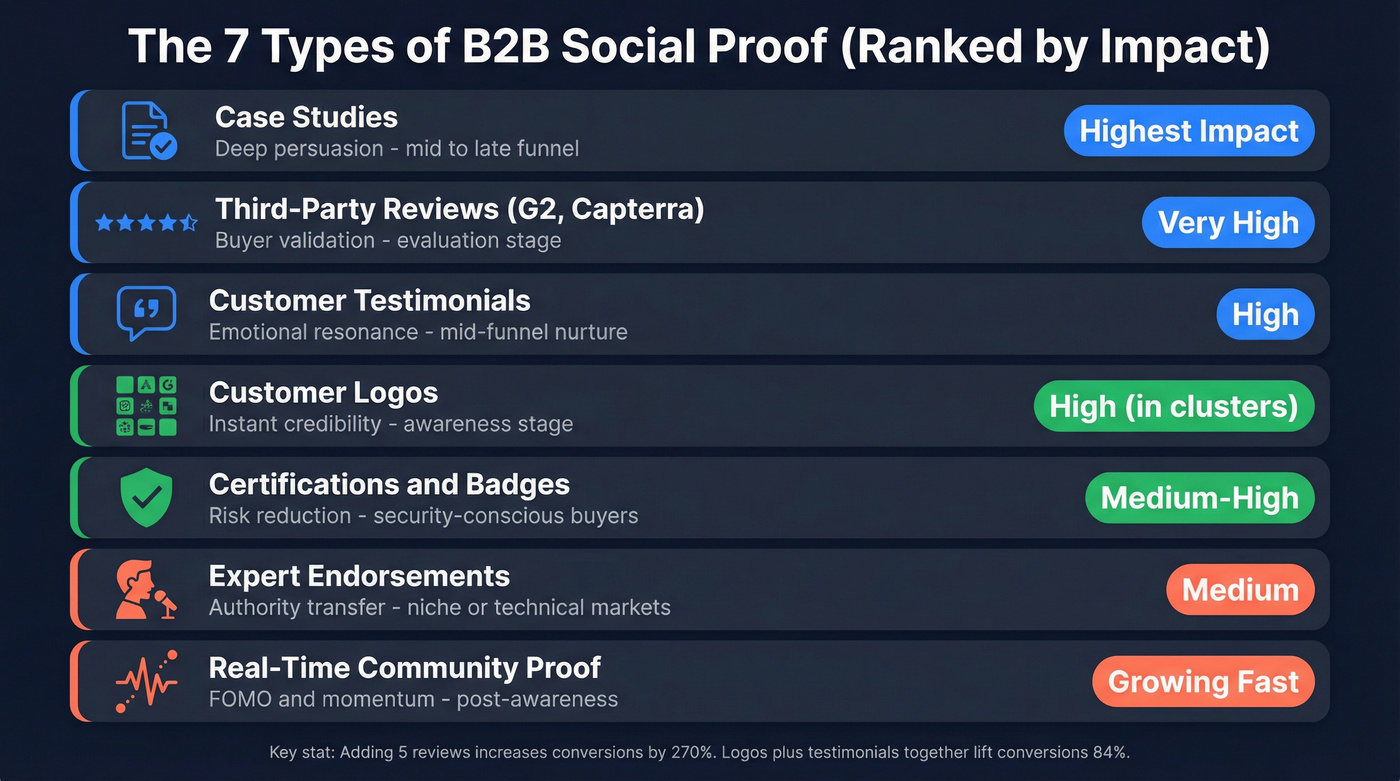
| Type | When to Use | Where to Place | Best For |
|---|---|---|---|
| Customer logos | Early awareness | Homepage, ads, email sigs | Instant credibility |
| Testimonials | Mid-funnel nurture | Landing pages, sales decks | Emotional resonance |
| Case studies | Consideration/decision | Resource hub, outbound | Deep persuasion |
| Third-party reviews | Active evaluation | Pricing page, comparison | Buyer validation |
| Certifications/badges | Security-conscious buyers | Footer, trust bar, RFPs | Risk reduction |
| Expert endorsements | Niche/technical markets | Blog, webinars, co-sells | Authority transfer |
| Real-time/community | Post-awareness engagement | Product page, social | FOMO + momentum |
89% of B2B SaaS buyers check reviews before buying - which is why third-party review sites deserve a dedicated strategy, not an afterthought. Adding just five reviews increases conversions by 270%, yet most companies treat G2 and Capterra as passive profile pages rather than active conversion channels.
Logos and testimonials work best as a cluster. Logos create the initial credibility signal, and testimonials add the emotional weight behind them. A comScore A/B test reported a 43% conversion increase when adding client logos, and an 84% increase when adding testimonials on top. Case studies then do the heavy lifting in consideration - they give your champion the internal ammunition to sell on your behalf.
Here's the thing: 92% of B2B buyers are more likely to purchase after reading a trusted review. But the key word is "trusted." A testimonial from a 5-person agency won't move an enterprise CISO. Match the proof to the audience, or it backfires.
Funnel-Stage Mapping
The biggest mistake is dumping all your proof on the homepage and calling it done.
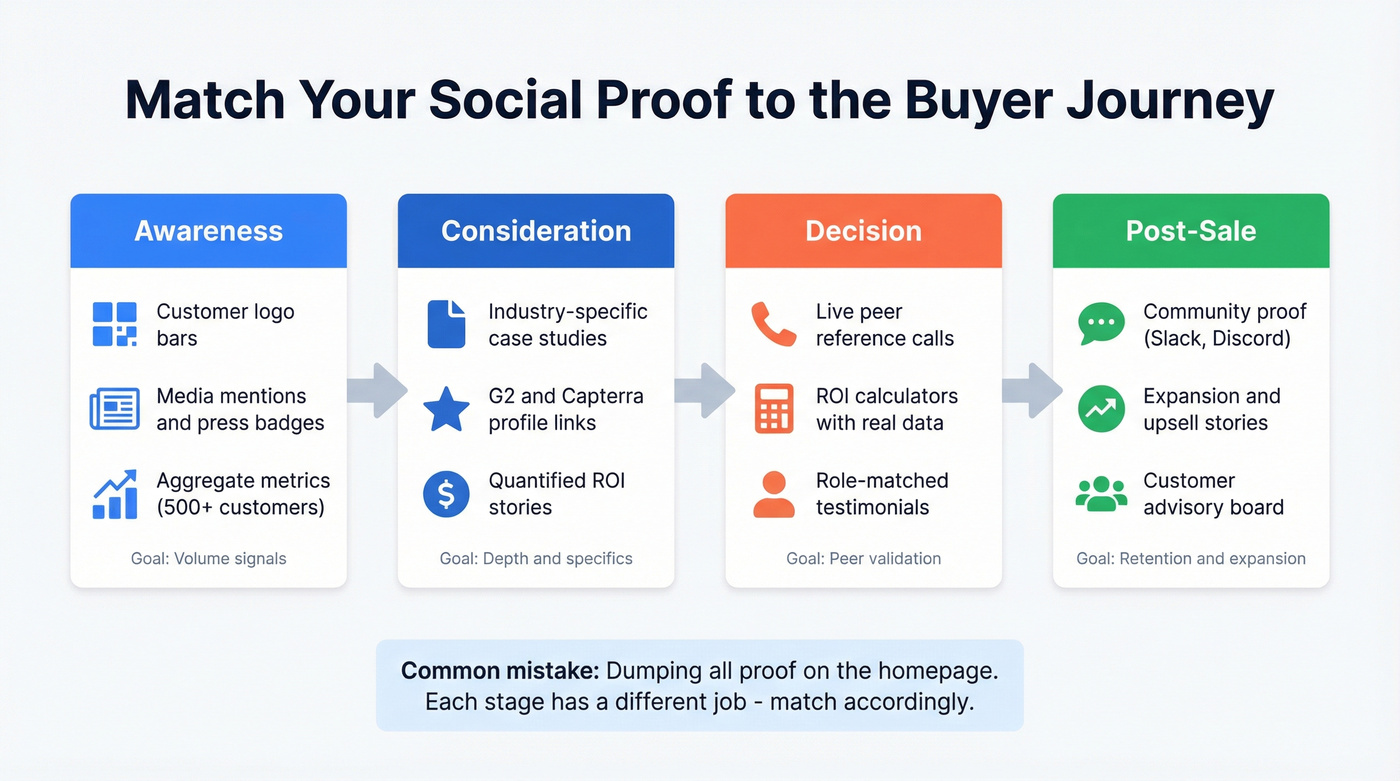
| Stage | Proof Type | Format | Example |
|---|---|---|---|
| Awareness | Logos, media mentions | Logo bar, press badges | "Trusted by 500+ SaaS companies" |
| Consideration | Case studies, reviews | PDF, G2 profile link | Industry-specific ROI story |
| Decision | Peer references, ROI data | Live call, calculator | "Talk to a customer like you" |
| Post-sale | Community proof, expansion | Slack group, upsell story | "See how Team X expanded to 3 departments" |
Awareness needs volume signals - big numbers, recognizable logos, aggregate metrics. Consideration needs depth - specific outcomes, named companies, quantified results. Decision needs peer validation - a reference call with someone in the same role at a similar company.
Don't make your homepage case study do the work of a peer reference. Each stage has a job, and forcing one proof type to cover all four stages is how you end up with a resources page that converts nobody.

Social proof only works when it reaches the right person on the buying committee. Prospeo gives you 30+ filters - including job title, department, and buyer intent - so you can match each proof point to the exact stakeholder who needs it. 98% email accuracy means your case study actually lands in the CFO's inbox.
Stop wasting your best case studies on bounced emails.
Match Proof to the Buying Committee
A single piece of proof rarely convinces an entire committee. The CEO cares about different things than the CFO, and the CIO has a completely different risk profile. 38% of buying committees include the CEO, so you can't just optimize for the end user.
If you're not sure who to prioritize, start by tightening your Ideal Customer Profile (ICP) so your proof points map cleanly to the roles that actually sign.
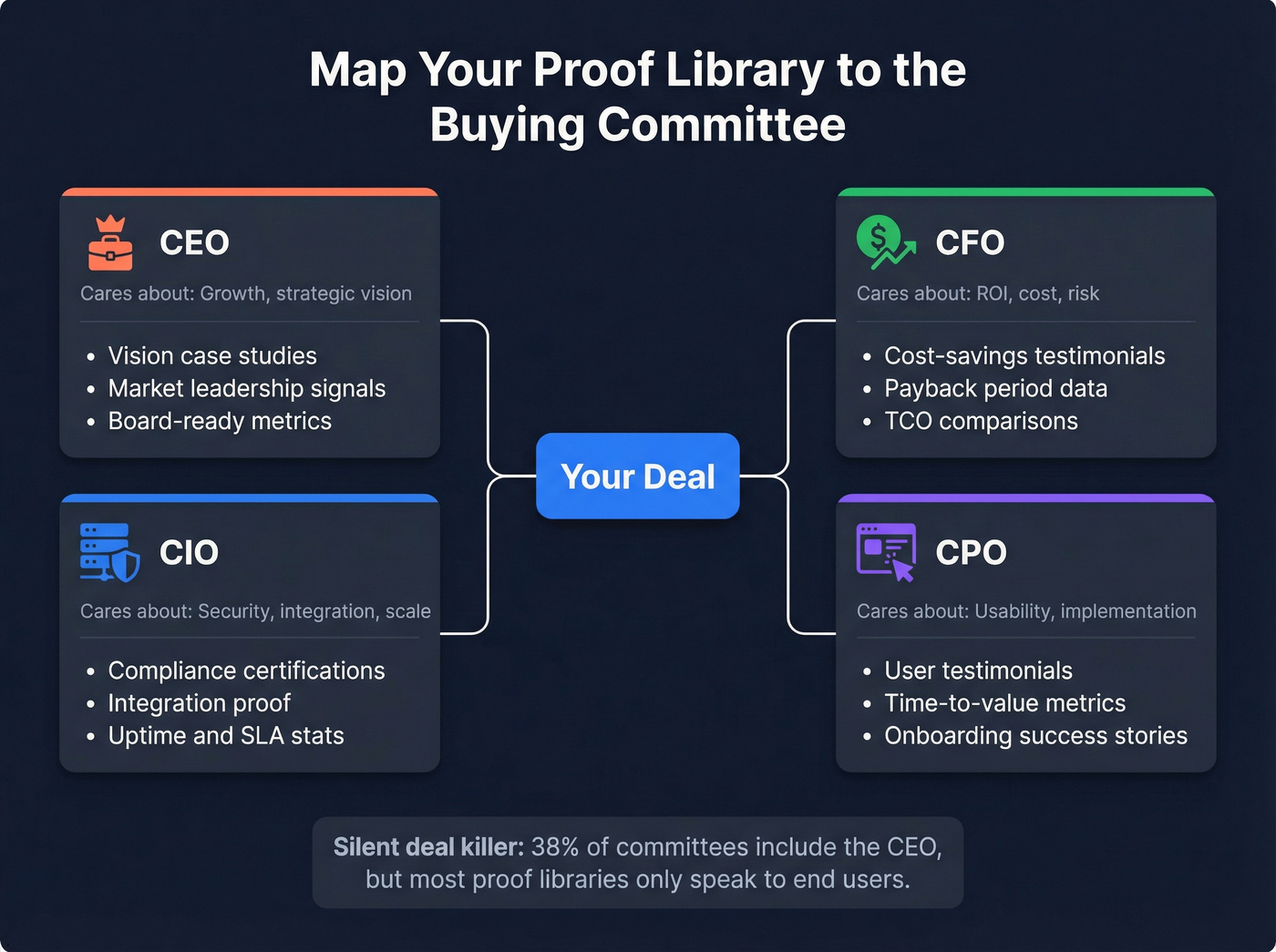
| Role | What They Care About | Proof That Persuades |
|---|---|---|
| CEO | Growth, strategic alignment | Vision case studies, market leadership signals |
| CFO | ROI, cost efficiency, risk | Cost-savings testimonials, payback period data |
| CIO | Security, integration, scale | Compliance certs, integration proof, uptime stats |
| CPO | Usability, implementation | User testimonials, time-to-value metrics |
Map your proof library against these roles. We've seen deals stall specifically because the library only spoke to end users, leaving the CFO and CIO without ammunition. That's the silent killer in committee-driven sales - not a missing feature, but a missing proof point for the person who controls the budget.
Deploying Proof in Outbound
Most B2B credibility signals live on the website and die there. The real opportunity is deploying them across every buyer touchpoint - especially outbound, where 73% of buyers already use case studies to make purchasing decisions but almost nobody includes them in email sequences.
If you need a repeatable structure, build this into your B2B sales cadence so proof shows up by design, not by accident.
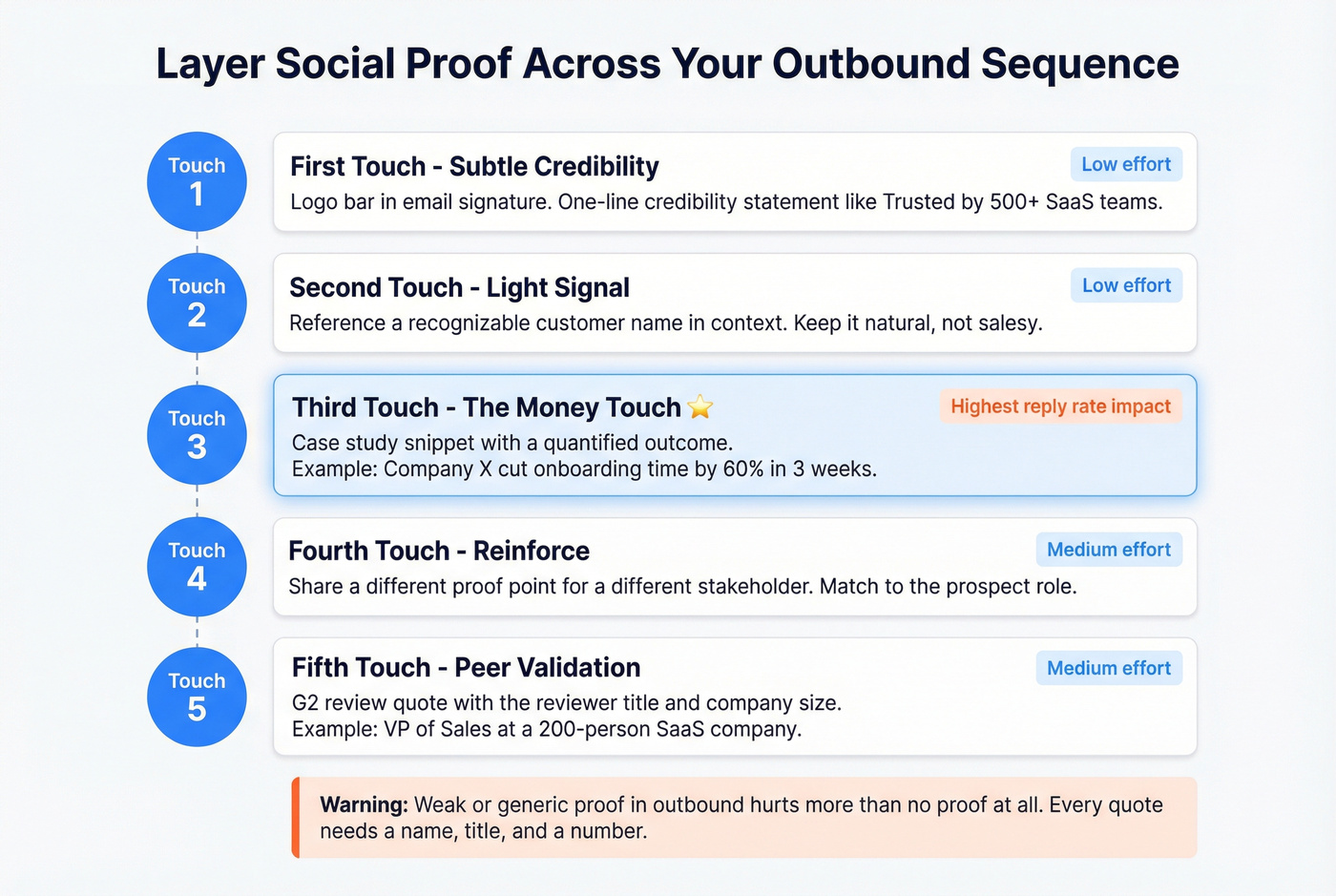
It takes roughly 5 touches to engage a prospect and 9 for executives. Each touch is a chance to layer in proof:
Touch 1: Logo bar in your email signature plus a one-line credibility statement. Keep it subtle. Touch 3: Case study snippet with a quantified outcome - in our experience, this is where proof makes the biggest difference in reply rates. Touch 5: Peer review quote from G2 with the reviewer's title and company size.
Skip this if your case studies are generic or your review quotes lack specifics. Weak proof in outbound hurts more than no proof at all - it signals that you don't have real customers worth quoting.
Sales decks: Lead with the customer story, not the feature list. Open with a 60-second case study before you show a single product slide.
Ad creative: Adding customer logos or review scores to B2B ad creative lifts CTR by 5-20% in typical CRO tests. It's the lowest-effort creative optimization most teams skip. If you're running multi-touch plays, pair this with a multi-channel outreach plan so the same proof shows up across email, ads, and calls.
All of this work is wasted if your emails bounce. You craft the perfect case study snippet for Touch 3, but if the email never lands, it doesn't exist. That's why data accuracy matters as much as the proof itself - teams using Prospeo's real-time verification saw bounce rates drop from 35% to under 4%, which meant their carefully placed proof points actually reached decision-makers instead of vanishing into the void.
If you're scaling volume, make sure you also know how to scale outbound campaigns without wrecking deliverability.
You just mapped proof to every funnel stage and committee role. Now you need verified contact data to deploy it. Prospeo's 300M+ profiles and 125M+ verified mobiles let you reach CEOs, CFOs, and CIOs directly - so every outbound touch carries the right social proof to the right person.
Turn your proof library into pipeline at $0.01 per verified email.
Five Mistakes That Kill Trust
1. Negative social proof. The Petrified Forest National Park posted signs saying "Many visitors steal wood." Theft tripled. Telling prospects "50% of companies struggle with X" normalizes the problem. Frame around positive behavior instead.
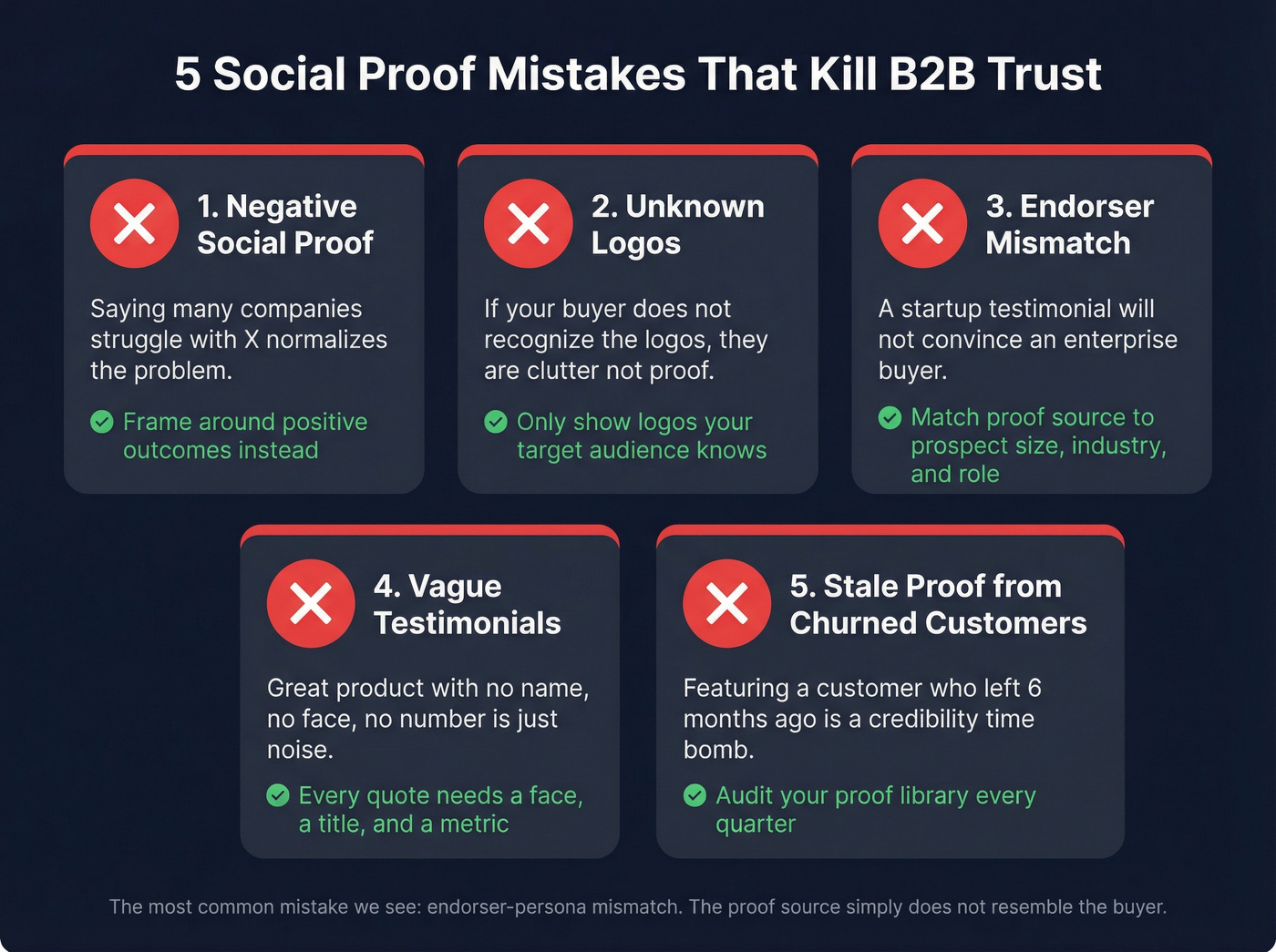
2. Unknown logos. If your target buyer doesn't recognize the logos on your homepage, they're not proof - they're clutter. No proof is better than weak proof.
3. Endorser-persona mismatch. A testimonial from a 10-person startup won't persuade an enterprise buyer. Match the proof source to the prospect's company size, industry, and role. This is the most common reason credibility signals backfire in sales cycles, and it's the one we see teams get wrong over and over - the endorser simply doesn't resemble the buyer. This is also where sales targeting discipline pays off.
4. Testimonials without specifics or faces. "Great product, highly recommend!" with no headshot, no name, no company, no outcome - that's not a testimonial, it's noise. Every quote needs a face, a title, and a number.
5. Stale proof from churned customers. If your featured case study customer churned six months ago, you've got a credibility time bomb. Audit quarterly. If you need a system, treat it like revenue team KPIs: set owners, cadences, and a definition of "fresh."
What's Changed in 2026
The biggest shift is the move from static to dynamic proof. A testimonial captured two years ago doesn't carry the same weight as a Slack screenshot from last week showing a customer celebrating a win with your product.
Real-time community proof is replacing polished case studies for top-of-funnel credibility. Screenshots from Slack and Discord channels (with permission) feel more authentic than anything a marketing team produces. The consensus on r/sales backs this up - buyers trust raw, unpolished proof far more than studio-quality testimonial videos. Industry-specific, recent proof outperforms generic testimonials every time.
Quarterly review refresh cadences are becoming standard. The best teams set calendar reminders to collect fresh G2 reviews and retire stale ones. User-created walkthroughs and hashtag campaigns are outperforming polished videos, with some teams reporting 4x engagement versus traditional ad creative.
Live customer counts and usage metrics ("12,847 teams active this week") create urgency that static logos never will. The underlying principle hasn't changed - uncertainty plus similarity still drives the decision. But if your newest testimonial is from 2024, you're already behind.
I'll say it plainly: most B2B companies don't have a social proof problem. They have a distribution problem. They've got the case studies, the logos, the reviews. They just leave them sitting on a resources page that gets 200 visits a month instead of embedding them into every outbound touch, every ad, every sales deck. The proof exists. The system doesn't. If you want a blueprint for that system, start with outbound sales best practices and then operationalize it with outbound operations.
FAQ
What's the most effective type of social proof in B2B?
Case studies - 41% of buyers rank them #1. Industry-specific case studies convert roughly 5x better than generic ones because they satisfy both the uncertainty and similarity conditions that drive B2B decisions.
How many reviews do I need to impact conversions?
Five. Adding five reviews lifts conversions by 270%. After that, focus on recency and industry relevance over raw volume - a fresh G2 review from a mid-market SaaS buyer outweighs twenty stale ones from companies that don't match your ICP.
Does social proof work in cold outbound?
Yes - embedding a case study snippet or review quote in outbound sequences lifts reply rates measurably. The prerequisite is accurate contact data so your proof actually reaches decision-makers. Bounce rates above 5% mean your best proof points are disappearing before anyone reads them.
How often should I refresh my proof library?
Quarterly minimum. Stale testimonials from churned customers actively hurt credibility. Set a recurring calendar reminder to collect fresh reviews, retire outdated quotes, and verify that featured customers are still active and happy.