

What Is B2B Sales? A Practitioner's Guide With Actual Numbers
You're a new AE staring at a named account list. Average sales cycles run 10.1 months, buying committees involve ~13 stakeholders, and the median lead-to-customer conversion rate across B2B industries is 2.9%. Nobody told you that in the interview. They talked about OTE and President's Club.
Here's the part they definitely skipped: average SDR quota attainment is ~55%, which means most reps don't actually earn the OTE number on the comp plan.
We've spent years watching teams build (and break) their outbound engines. This guide covers what B2B sales actually looks like - the benchmarks, salary data, and frameworks that most introductory articles gloss over.
What Is B2B Sales?
B2B sales - business-to-business sales - is the process of selling products or services from one company to another. That's the textbook definition. The practical one is messier: it's navigating buying committees, procurement departments, legal reviews, and budget cycles to get a deal signed. You're convincing multiple stakeholders inside an organization that your solution is worth their time, budget, and risk.
The market is enormous. Forrester projects US B2B e-commerce alone will hit $3 trillion by 2027, growing at a 10.7% CAGR. By that point, e-commerce will represent 24% of total US B2B sales, up from 16% in 2021. And that's just the digital slice.
What makes a business-to-business sale distinct isn't the size of the checks (though those help). It's the complexity. You're not convincing one person to buy a pair of shoes. You're convincing a CFO, a VP of Engineering, an IT security lead, and a procurement manager that your platform is worth a six-figure annual commitment - and any one of them can kill the deal by doing nothing.
The skills that work in B2C - urgency, emotional appeal, impulse triggers - don't translate. B2B rewards patience, process, and the ability to sell to a room where half the people don't want to be there.
Only 13% of B2B decision-makers currently see e-commerce as their primary revenue source, which means the vast majority of revenue still flows through human-led sales motions. That gap is closing, but slowly. If you're building a career in sales, B2B is where the money and the complexity live.
B2B vs B2C: The Real Differences
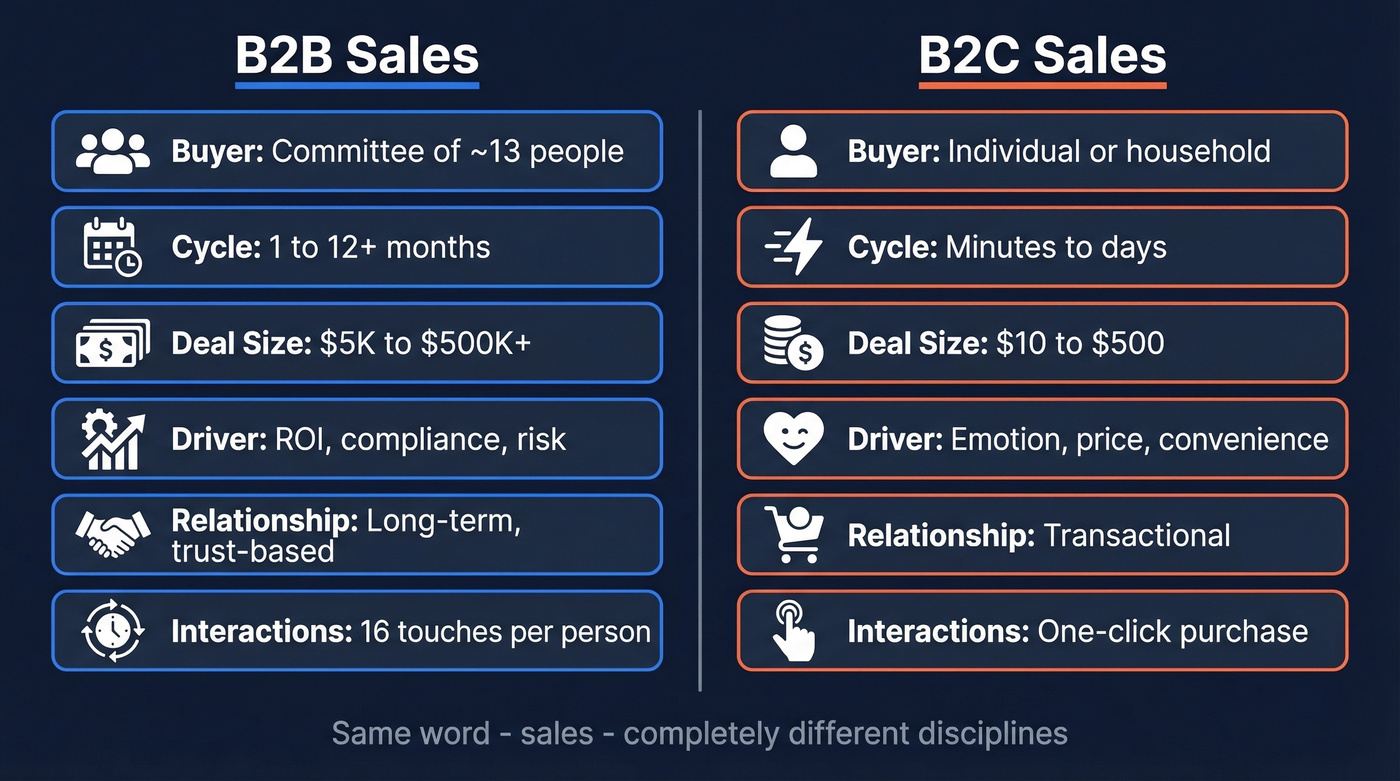
The easiest way to understand B2B sales is to contrast it with B2C. Think Salesforce selling a CRM to a 500-person company versus Nike selling running shoes to a consumer. Same word - "sales" - completely different disciplines.
| Dimension | B2B | B2C |
|---|---|---|
| Buyer | Committee (~13 people) | Individual or household |
| Cycle length | 1-12+ months | Minutes to days |
| Deal size | $5K-$500K+ | $10-$500 typical |
| Decision driver | ROI, compliance, risk | Emotion, price, convenience |
| Relationship | Long-term, trust-based | Transactional |
| Channels | Direct sales, partners | Retail, e-commerce, ads |
| Digital interaction | 80% of touchpoints | Nearly 100% |
| Post-sale | Onboarding, CS, renewal | Support, returns |
The ~13 decision-makers stat is the one that catches new reps off guard. You can have a champion who loves your product, but if you haven't mapped the economic buyer, the technical evaluator, and the person in procurement who can stall the PO for six weeks, you don't have a deal. You have a conversation.
B2C optimizes for speed and volume. B2B optimizes for depth and trust. A B2C purchase takes thirty seconds on a phone; a B2B purchase takes thirty weeks in a committee room.
Types of B2B Sales
B2B isn't monolithic. The sales motion changes dramatically depending on what you're selling and who you're selling to.
Supply and distribution is the backbone of B2B commerce - manufacturers selling raw materials or components to other manufacturers. Think a steel supplier selling to an automotive OEM. Relationships run decades, and switching costs are enormous.
Wholesale involves selling finished goods in bulk to retailers or distributors. Margins are thin, volume is everything.
SaaS and professional services is where most of the modern conversation lives. HubSpot selling marketing software to a mid-market company, or Deloitte selling consulting engagements to a Fortune 500. Recurring revenue models dominate, and the playbooks here have been refined to a science - though "science" is generous when you see how many teams still wing it.
Enterprise and solutions sales is the high-stakes end. Think SAP or Palantir selling multi-year, multi-million-dollar platform deals that require custom implementation. These cycles run 6-18 months and involve executive sponsors on both sides.
B2G (business-to-government) is a specialized subset with its own procurement rules, RFP processes, and compliance requirements. If you don't enjoy paperwork, stay away.
The B2B Sales Process, Step by Step
Every methodology boils down to roughly the same seven steps. The names change; the sequence doesn't. Here's what most guides miss: 83% of buyers define their requirements before they ever talk to a salesperson. Your "discovery call" is often a validation call - the buyer already knows what they want, and your job is to reshape how they think about it.
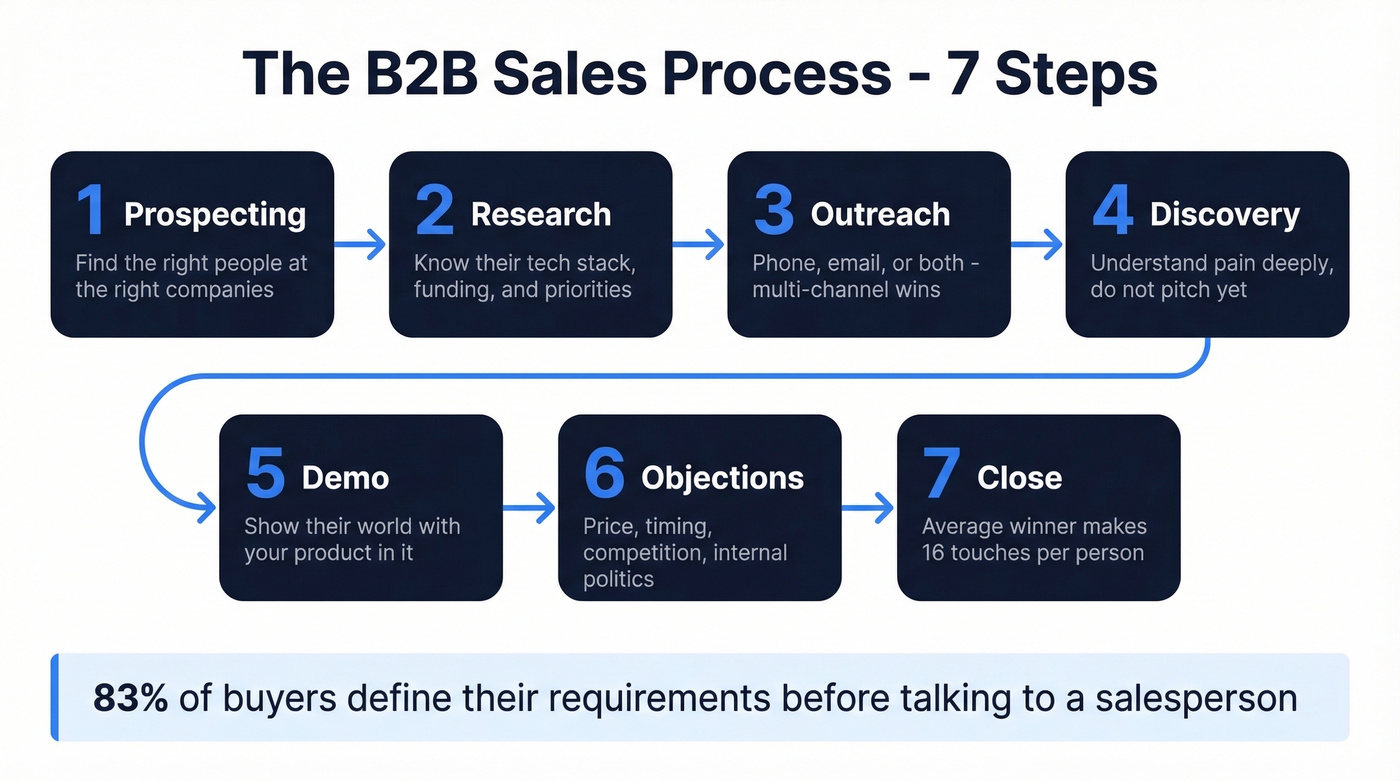
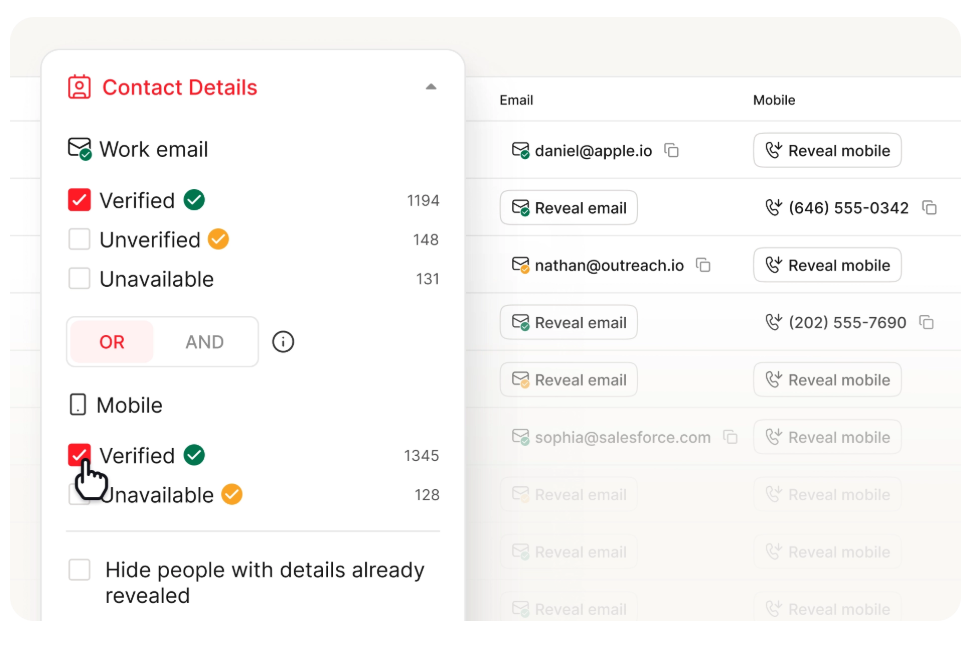
1. Prospecting. Finding the right people at the right companies. This is where most reps waste the most time - manually searching for contacts, guessing at email formats, hoping someone picks up the phone. A data platform like Prospeo can surface verified emails and direct dials across 300M+ profiles so the mechanical work of finding contacts doesn't eat your selling hours. (If you want more tactics beyond tools, see sales prospecting.)
2. Research and preparation. Before you reach out, know the company's tech stack, recent funding, hiring patterns, and competitive landscape. A cold email that references a specific initiative the prospect is running beats a generic template every time.
3. Initial outreach. Phone, email, or both. With verified numbers, SDR cold-call answer rates hit 13.3%. Without them, you're dialing into voicemail black holes. Multi-channel sequences that combine phone, email, and social touches outperform single-channel approaches by a wide margin.
4. Discovery. This is where you earn or lose the deal. The goal isn't to pitch - it's to understand the buyer's situation, pain, and decision process deeply enough to position your solution as the obvious answer. (Use a structured set of discovery questions so you don’t miss decision criteria.)
5. Presentation and demo. Tailor the demo to the pain points uncovered in discovery. Generic product tours are deal killers. Show the buyer their world with your product in it, not a feature walkthrough. (A simple product demo checklist helps keep this tight.)
6. Handling objections and negotiation. Objections aren't rejection - they're buying signals wrapped in concern. Price, timing, competitive alternatives, and internal politics are the big four. Prepare for all of them before the call. (If you want a deeper negotiation concept, see anchor in negotiation.)
7. Closing and follow-up. The winning vendor averages 16 interactions per person with the buyer. Sixteen. That's not pushy - that's the baseline. If you're following up twice and moving on, you're leaving deals on the table. (If you need copy you can actually send, use these sales follow-up templates.)
B2B Sales Funnel Benchmarks
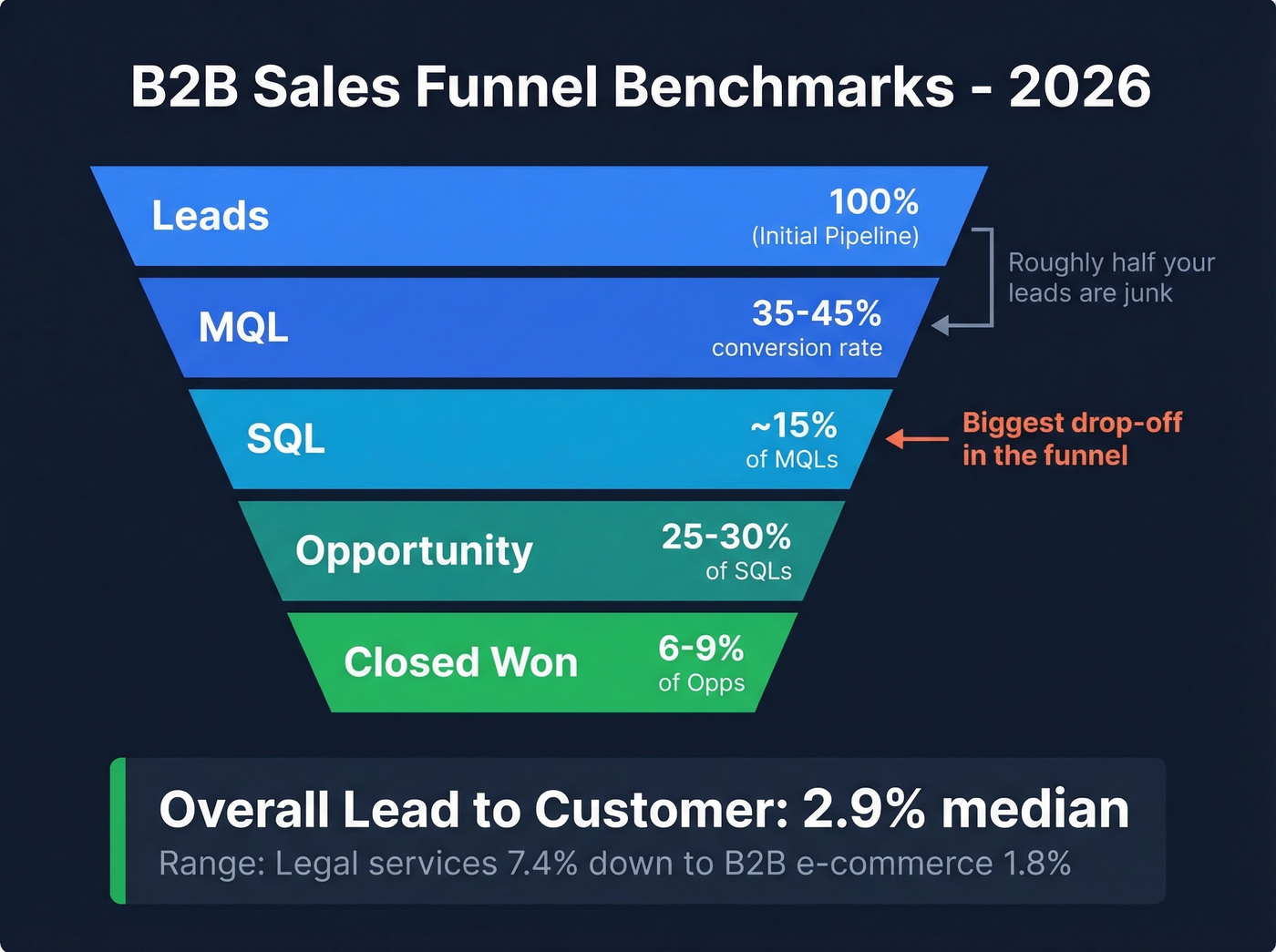
Most guides talk about the funnel conceptually. Here are the actual conversion rates - 2026 benchmarks across industries:
| Stage | Conversion Rate | What It Means |
|---|---|---|
| Lead to MQL | 35-45% | Roughly half your leads are junk |
| MQL to SQL | ~15% | The biggest drop-off in the funnel |
| SQL to Opportunity | 25-30% | Qualification matters here |
| Opp to Closed-won | 6-9% | Most opps don't close |
| Overall lead to customer | 1.5-2.5% | The real number |
The median overall conversion rate across B2B industries is 2.9%, but variance is massive. Legal services converts at 7.4%. B2B e-commerce sits at 1.8%. Your industry, deal size, and sales motion determine where you fall. (For more context, compare against the average B2B lead conversion rate.)
That MQL-to-SQL drop-off at ~15% is where most funnel problems live. Marketing generates leads that sales doesn't want to work. Sales complains about lead quality. Marketing complains about follow-up speed. We've watched this play out at a dozen companies, and the fix is almost always a shared definition of what "qualified" means - which brings us to frameworks.

You just read that reps waste most of their time on prospecting mechanics - finding contacts, guessing emails, dialing wrong numbers. Prospeo gives you 300M+ verified profiles, 98% email accuracy, and 125M+ direct dials so you can skip the busywork and start selling.
Spend your hours closing deals, not hunting for contact data.
Qualification Frameworks for 2026
Three frameworks dominate B2B qualification today. Each fits a different sales motion, and using the wrong one is worse than using none at all.
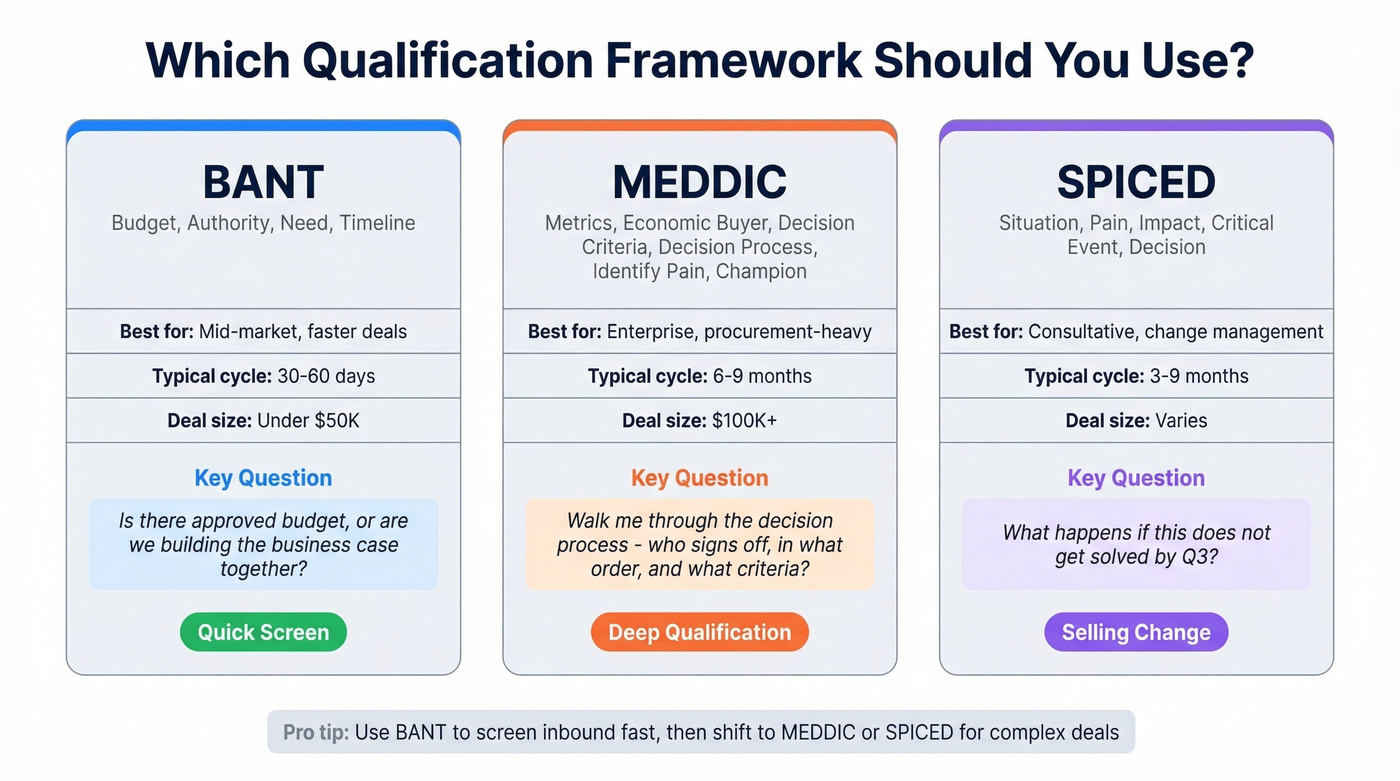
| Framework | Best For | Typical Cycle |
|---|---|---|
| BANT | Mid-market, faster deals | 30-60 days |
| MEDDIC | Enterprise, procurement-heavy | 6-9 months |
| SPICED | Consultative, change mgmt | 3-9 months |
BANT (Budget, Authority, Need, Timeline) is the oldest framework - IBM invented it decades ago - and it still works for deals under $50K with a clear budget holder. A good BANT question: "Is there approved budget for this initiative, or are we building the business case together?" That single question tells you whether you're in a 30-day cycle or a 6-month one.
MEDDIC (Metrics, Economic Buyer, Decision Criteria, Decision Process, Identify Pain, Champion) is what you need when procurement gets involved. The key question: "Walk me through the decision process - who signs off, in what order, and what criteria are they using?" If the rep can't answer that after discovery, the deal is a coin flip. We've watched reps force MEDDIC on a 3-week deal and lose it to analysis paralysis. Match the framework to the complexity. (If you want a deeper set of prompts, use these MEDDIC discovery questions.)
SPICED (Situation, Pain, Impact, Critical Event, Decision) works best when you're selling change, not software. The critical event question - "What happens if this doesn't get solved by Q3?" - ties the deal to a deadline the buyer owns, not one you invented.
The hybrid approach works well in practice: use BANT to screen inbound leads quickly, then shift to MEDDIC or SPICED for deals that survive initial qualification. Don't force a 6-element framework on a deal that'll close in three weeks.
B2B Sales Roles and Compensation
If you came here looking for salary data, you probably noticed most guides skip it. Here are the actual numbers, based on 2026 SaaS sales benchmarks:
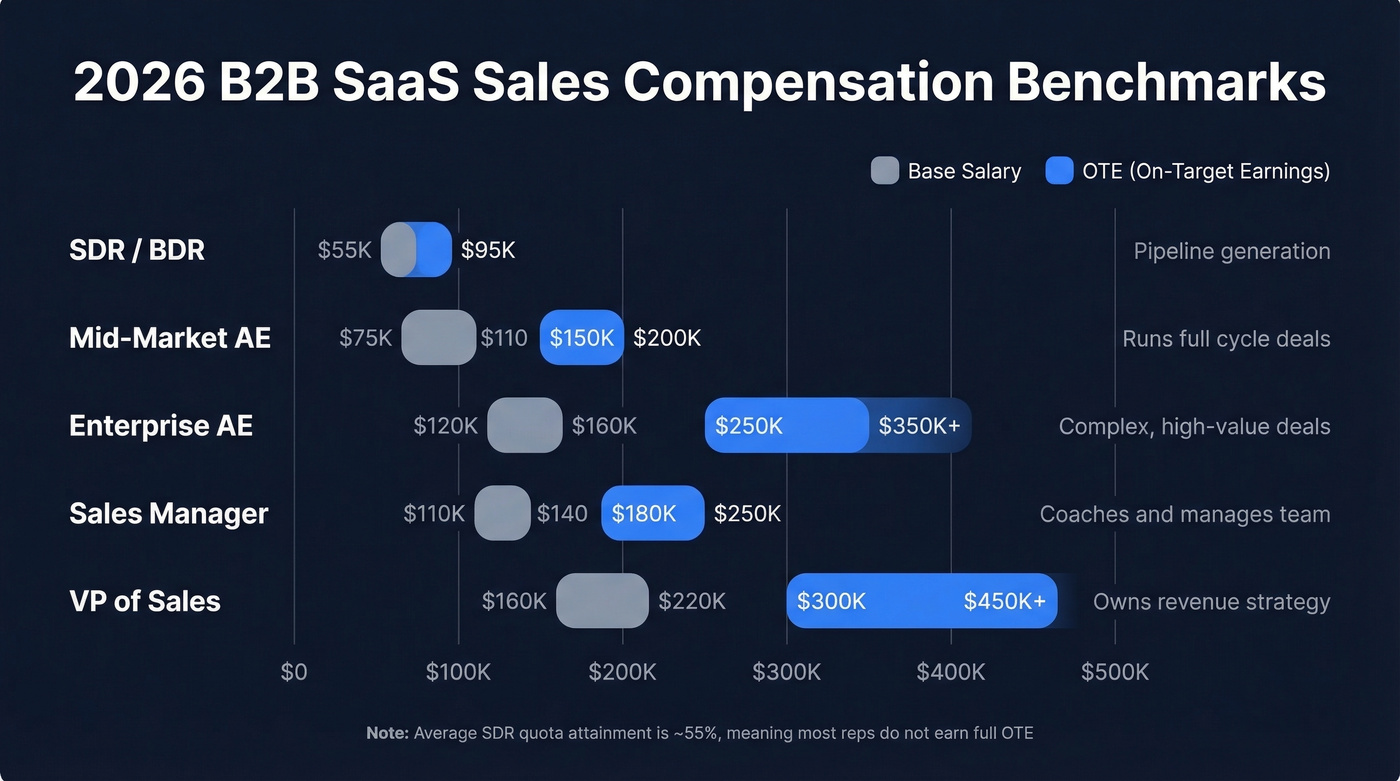
| Role | Base Range | OTE Range | One-Liner |
|---|---|---|---|
| SDR/BDR | $55K-$75K | $70K-$95K | Pipeline generation |
| Mid-Market AE | $75K-$100K | $140K-$180K | Full-cycle closer |
| Enterprise AE | $100K-$140K | $180K-$250K+ | Complex, high-value deals |
| Sales Manager | $110K-$140K | $160K-$200K+ | First-line leadership |
| Director of Sales | $140K-$180K | $200K-$250K+ | Multi-team oversight |
| VP of Sales | $180K-$220K | $250K-$350K+ | Revenue ownership |
Average quota attainment across SDR roles is roughly 55%. That means the median SDR isn't hitting OTE - they're earning somewhere between base and the published number. Comp structures typically run 60/40 base-to-variable for pipeline roles and closer to 50/50 for closing roles.
The real money kicks in above 100% quota. Most plans include 1.5-2x accelerators, meaning an enterprise AE who hits 130% of quota can earn $300K+ in a good year. That's the carrot. The stick is that roughly half the sales floor misses target in any given quarter.
The typical career path runs 12-18 months as an SDR, promotion to AE, then 3-5 years before a management track opens up. Not everyone follows this - some skip SDR entirely, and some stay as individual contributors earning more than their managers. Non-SaaS roles in industrial sales, distribution, or professional services tend to run 10-20% lower on base but can have comparable OTE through larger commission structures on bigger deal sizes.
Seven Mistakes That Kill Deals
Only 5% of B2B buyers say salespeople exceed expectations. Five percent. Let's talk about why.
1. Talking too much. The data is unambiguous. Top-closing reps speak 43% of the time on calls. Average performers talk 65%. That's not a small gap - it's the difference between listening to understand and waiting to pitch.
2. Selling to the wrong stakeholders. You can run a flawless sales process with someone who can't sign the check. In our experience, this kills more deals than any other mistake on this list. Always map the economic buyer, the technical evaluator, and the internal champion before you invest serious time. (If you want a clean mental model, see technical buyer vs economic buyer.)
3. Failing to qualify. Not every opportunity is an opportunity. No budget, no timeline, no pain? You don't have a deal - you have a friendly conversation. Qualify ruthlessly and early.
4. Leading with features, not outcomes. Nobody buys software because it has 47 integrations. They buy it because it solves a problem that's costing them money or time. Frame everything around the buyer's world.

5. Overpromising on capabilities or timelines. The fastest way to create a detractor is to sell something your product can't deliver. Implementation timelines are the most common culprit - if engineering says 8 weeks, tell the buyer 10.
6. Not preparing for objections. Every deal has the same four objections: price, timing, competition, and internal politics. If you're hearing these for the first time on the call, you didn't prepare.
7. Ignoring data quality. This is the mistake nobody talks about. You can have the best pitch, the best qualification framework, and the best follow-up cadence - and still fail because 30% of your emails bounce and your phone numbers are disconnected. When that happens, your domain reputation tanks and every subsequent campaign performs worse. The consensus on r/sales is pretty clear: bad data is the silent killer of outbound programs, and most teams don't realize it until deliverability craters. (If you’re diagnosing this, start with email bounce rate and email deliverability.)
How B2B Buying Is Changing
Buyer behavior has shifted faster in the last two years than in the previous decade.
Sales cycles compressed from 11.3 months in 2024 to 10.1 months in 2025, driven by economic pressure - 49% of buyers say tighter conditions forced faster decisions. First contact with sellers moved earlier in the journey, from 69% to 61% of the way through the buying process. That's roughly 6-7 weeks earlier than before, which means sellers have more influence on requirements than they did two years ago.
AI has changed how buyers research. 94% of B2B buyers now use LLMs during the buying process, and 89% of revenue organizations use AI in their sales workflows. But the impact on sellers is more nuanced than the headlines suggest: 93% of sales leaders expect AI to match or exceed humans at prospect research and CRM hygiene, while only 13% believe AI will handle outbound cold calling at a human level. AI handles the prep work; humans handle the conversations.
The most sobering stat: 86% of B2B purchases stall at some point in the process, and 81% of buyers end up dissatisfied with the provider they chose. Deals stall because buying committees can't align internally, not because sellers aren't following up. The best reps in 2026 aren't just selling their product - they're helping the buyer navigate their own organization's decision process.
Here's a strong opinion: if your average contract value sits below $15K, you probably don't need a 13-stakeholder enterprise sales motion. Build a self-serve funnel, add a human closer for deals that stall, and save the MEDDIC playbook for when your ACV justifies it. Most startups over-engineer their sales process before they've earned the complexity.
Essential B2B Sales Tools
You don't need 15 tools. You need four categories covered well, and everything else is optional until you've earned the complexity.
Prospecting and Data
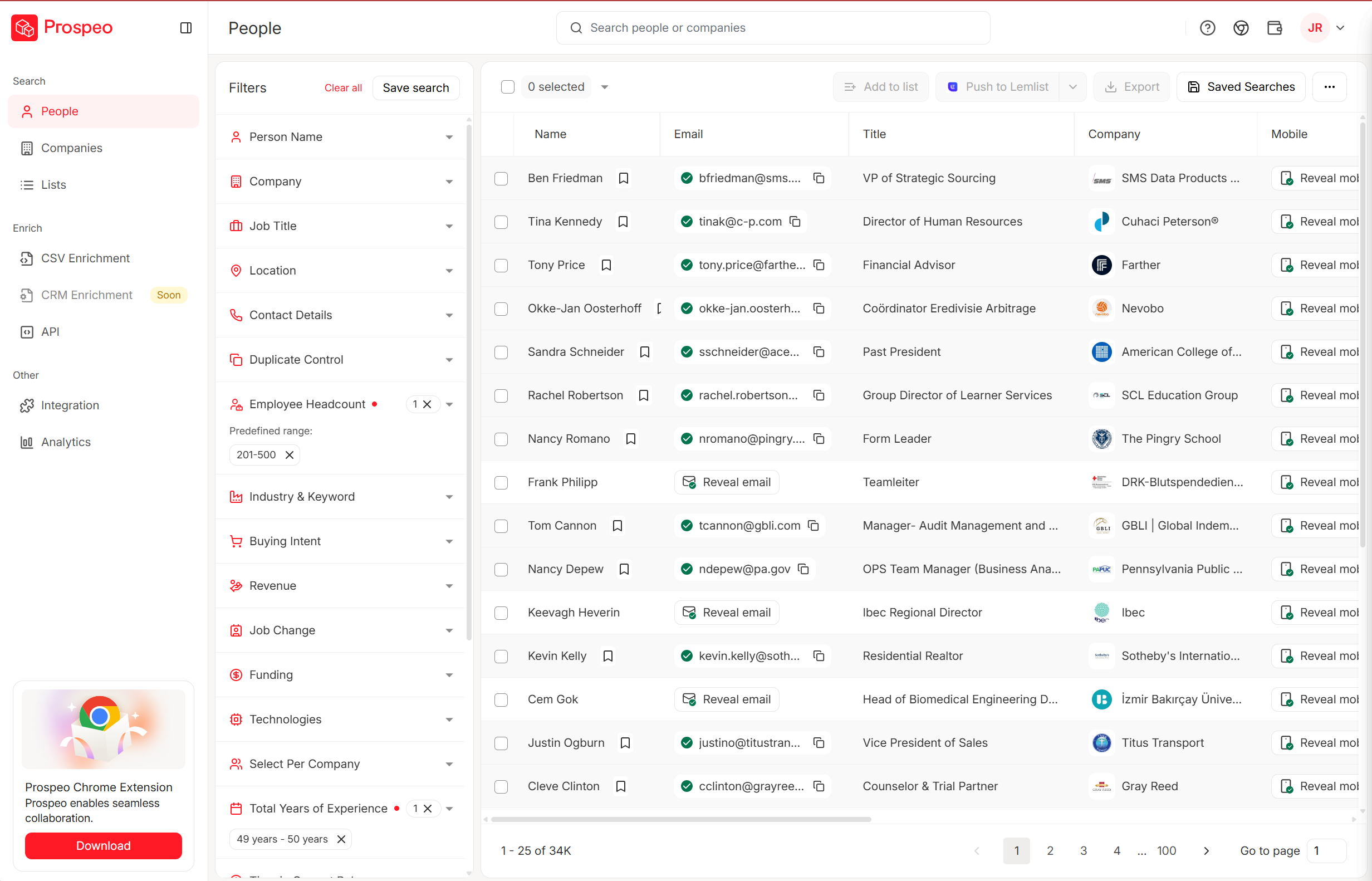
Every outbound motion starts with finding the right people and reaching them at verified contact information. Prospeo covers 300M+ professional profiles with 98% email accuracy and 125M+ verified mobile numbers. The 30+ search filters - buyer intent, technographics, job changes, headcount growth - let you build hyper-targeted lists without stitching together five different tools. Data refreshes every 7 days versus the 6-week industry average, which matters when you're prospecting into fast-moving companies where titles and roles change quarterly.
One real-world example: Meritt tripled their pipeline from $100K to $300K per week after switching, with bounce rates dropping from 35% to under 4%. The free tier gives you 75 verified emails per month to test it - skip this if your team already has a data provider you're happy with and your bounce rates are under 5%.
CRM
Salesforce is the enterprise standard at $25-$300/user/month depending on the edition. HubSpot CRM is free for basic use, with paid Sales Hub starting at $20/user/month - a strong choice for teams under 50 reps who don't need Salesforce's customization depth. (If you’re comparing options, see examples of a CRM.)
Engagement
Outreach is the established player for enterprise sequencing at ~$100-$150/user/month. For earlier-stage teams, Instantly (~$30/month) or Smartlead (~$39/month) handle cold email at a fraction of the cost.
Analytics
Your CRM's built-in reporting covers most of what you need early on. After that, tools like Gong for conversation intelligence or Clari for revenue forecasting start earning their keep - but don't add them until you've outgrown native dashboards.
The minimum viable stack: a CRM, a data platform for verified contacts, and a sequencing tool. That covers prospecting through close for under $150/month. Add analytics and intent data as you scale.
With 13 stakeholders per deal and a 2.9% lead-to-customer conversion rate, every contact you reach needs to be real. Prospeo's 5-step verification and 7-day data refresh mean you're never emailing dead addresses or calling disconnected numbers - at $0.01 per email.
Map the full buying committee with data that actually connects.
FAQ
Is B2B sales hard?
Yes. Average quota attainment is ~55%, cycles run 10+ months, and deals involve ~13 stakeholders. It rewards persistence and process, not personality alone.
How much do B2B salespeople make?
SDRs earn $70K-$95K OTE; enterprise AEs earn $180K-$250K+ OTE. Top performers earn 2x+ their base through accelerators. The median rep doesn't hit OTE - plan your finances around base salary.
How long is a typical B2B sales cycle?
The average is 10.1 months, down from 11.3 in 2024. SMB deals close in 1-3 months. Enterprise deals run 6-12+ months depending on procurement complexity.
What tools do I need to start in B2B sales?
A CRM for pipeline management, a data platform for verified emails and direct dials, and a sequencing tool for outreach automation. That three-tool stack covers prospecting through close for under $150/month.
What's the difference between B2B and B2C sales?
B2B involves longer cycles, larger deal sizes, and multi-stakeholder buying committees, while B2C targets individual consumers making faster, emotion-driven decisions. The playbooks, tools, and metrics are almost entirely different - what closes a consumer deal in minutes can stall a business deal for months.