

OTE in Sales: Definition, Formula, 2026 Benchmarks, and the Reality Gap
Only 41.2% of software reps hit quota. That means for the majority of salespeople in tech, OTE isn't a paycheck - it's a marketing number on a job listing. A 20-year sales leader on Reddit put it bluntly: "OTE is almost always bullshit." Harsh, but the data backs it up. The gap between what companies advertise and what reps actually earn is the single most misunderstood dynamic in sales compensation.
The Short Version
OTE = base salary + commission at 100% quota. It's a ceiling, not a floor. Only 41% of software reps hit quota. Before accepting any OTE offer, ask what percentage of the team actually hits it - and if they won't answer, that's your answer.
What Is OTE in Sales?
OTE stands for on-target earnings. It's the total annual compensation a salesperson receives when they hit exactly 100% of their quota:
OTE = Annual Base Salary + Annual Variable Compensation (at 100% quota)
A mid-market AE with a $90K base and a 50/50 pay mix earns $90K in variable comp at full attainment. That's $180K OTE.
On-target earnings aren't guaranteed. Your base salary is guaranteed. Everything above it depends on hitting quota - and most reps don't. Think of OTE as the theoretical maximum under normal plan terms, not a promise. Companies use it in job postings because it's the biggest number they can legally put on the listing, and your job is to figure out how realistic that number actually is.
Pay Mix by Role
Two jobs can both advertise $150K OTE and feel completely different to work. The difference is pay mix - the ratio of guaranteed base to at-risk variable compensation. A 50/50 split means half your income depends on performance. An 80/20 split means you're mostly salaried with a bonus kicker.
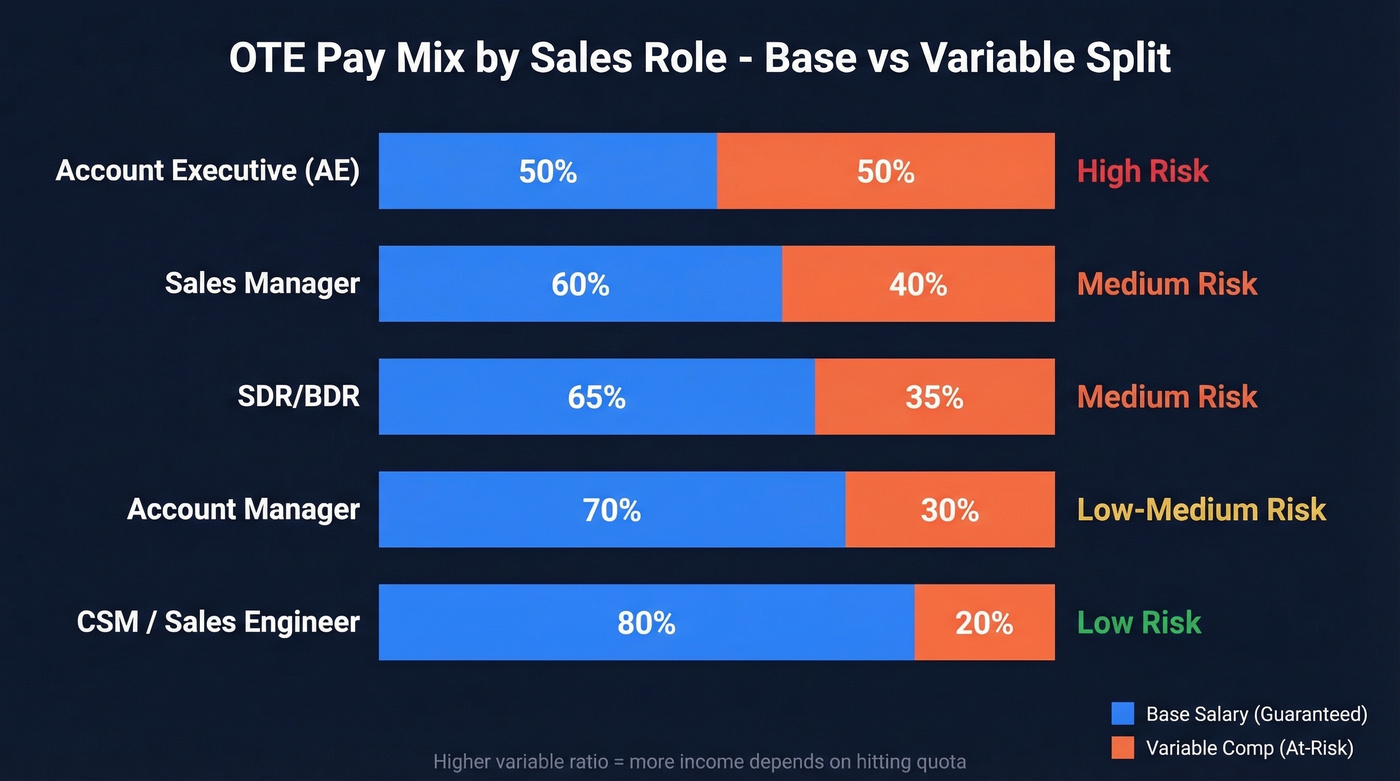
| Role | Typical Pay Mix (Base/Variable) | Risk Level |
|---|---|---|
| AE | 50/50 | High |
| Sales Manager | 60/40 | Medium |
| SDR/BDR | 65/35 | Medium |
| Account Manager | 70/30 | Low-Medium |
| CSM / Sales Engineer | 80/20 | Low |
These ratios come from standard SaaS compensation frameworks. AEs carry the most risk because they directly control revenue. CSMs and Sales Engineers typically have team-based or retention-based variable comp, which is more predictable.
Here's the thing: a $200K OTE at 50/50 means your base is $100K. Miss quota by 40%, and you're earning around $130K. That same $200K OTE at 70/30 gives you a $140K base - miss by the same margin, and you're still at $158K. Pay mix determines your downside, not just your upside. Always ask about it before you ask about total comp.
One more nuance: commissions can be capped or uncapped. Capped plans put a ceiling on what you can earn beyond quota. Uncapped plans let top performers blow past their target earnings. If a company caps commissions at 120% attainment, your upside is limited no matter how well you sell.
OTE Calculation Examples
Let's walk through three scenarios so the math is concrete.
SDR/BDR - $92K OTE
Base salary: $60,000. Pay mix: 65/35. Variable compensation: $60,000 x (35/65) = ~$32,300. OTE: $60,000 + $32,300 = $92,300. This rep's quota might be 15 qualified meetings per month or a sourced pipeline target. The variable piece is smaller, reflecting that SDRs influence but don't close deals.
Mid-Market AE - $180K OTE
Base salary: $90,000. Pay mix: 50/50. Variable compensation: $90,000. OTE: $180,000. With a standard 4x-6x quota-to-OTE ratio, this rep carries a $720K-$1.08M annual quota. At a 10% commission rate, every dollar of closed revenue earns $0.10 in commission.
Enterprise AE - $300K OTE with Accelerators
Base salary: $150,000. Pay mix: 50/50. Variable compensation: $150,000 at 100% attainment. Quota: $1.5M (a 5x ratio). Standard commission rate: 10% up to quota. Accelerator: 15% on everything above.
At 110% attainment, this rep closes $1.65M. Standard commission on the first $1.5M = $150K. Accelerator commission on the $150K overage at 15% = $22,500. Total earnings: $150K base + $150K at-quota commission + $22,500 accelerator = $322,500. Top performers at 130%+ attainment can push well past $400K - that's why enterprise AEs chase uncapped plans.
2026 OTE Benchmarks by Role
RepVue's 2026 salary guide aggregates compensation data from thousands of sales professionals. The attainment column is what makes this table useful - it tells you how many people actually earn their on-target earnings.
RepVue 2026 Benchmarks
| Role | Median Base | Median OTE | % Hitting Quota | Top Performers |
|---|---|---|---|---|
| SDR/BDR | $60,000 | $85,000 | 57.3% | $127,955 |
| SMB AE | $70,000 | $130,000 | 44.8% | $269,489 |
| Mid-Market AE | $90,000 | $175,000 | 43.9% | $391,399 |
| Enterprise AE | $135,000 | $265,000 | 40.9% | $627,527 |
| Strategic AE | $150,000 | $300,000 | 47.0% | $705,215 |
| Sales Engineer | $145,000 | $200,000 | 56.8% | $327,388 |
| Sales Manager | $150,000 | $280,000 | 51.3% | $508,044 |
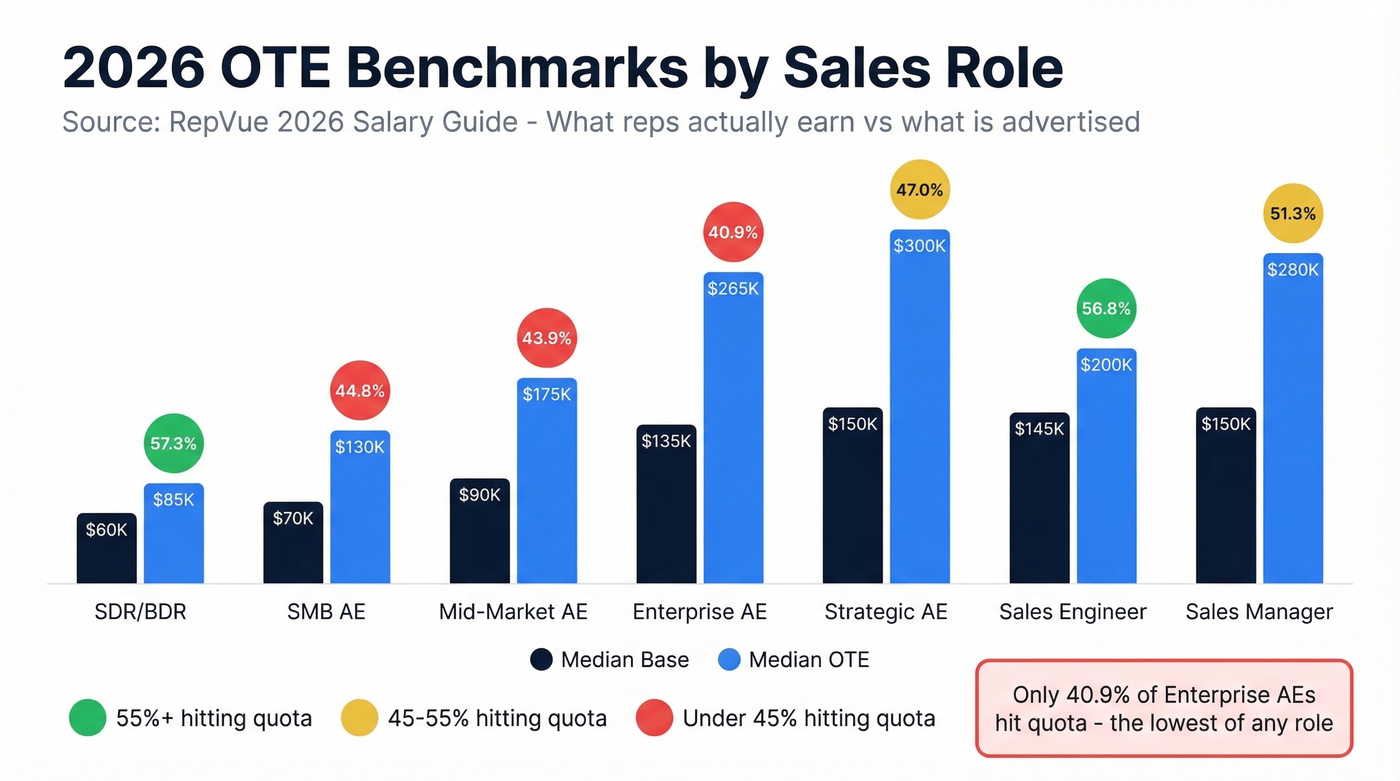
SDRs and Sales Engineers have the highest attainment rates - north of 55%. Enterprise AEs sit at the bottom with 40.9%. The top-performer column shows the ceiling is real for those who do hit: a strategic AE clearing $700K+ is exceptional but not mythical.
For enterprise roles specifically, Betts Recruiting's tech compensation data breaks things down by deal size:
| Level | Base Range | OTE Range | Typical Deal Size |
|---|---|---|---|
| Enterprise AE | $150K-$165K | $300K-$330K | $250K-$500K |
| Strategic EAE | $165K-$175K | $330K-$350K | $500K-$1M |
| Director, Enterprise | $200K-$225K | $400K-$450K | $1M-$2.5M |
| VP, Enterprise | $250K-$275K | $500K-$550K | $2.5M+ |
Quotas also scale by company stage - Betts reports enterprise AE quotas ranging from $900K at Seed/Series A to $1.35M at Series D. That's a 50% spread, so the stage of the company you join matters as much as the role title.
If a company offers you an enterprise AE role at $350K OTE but the market range is $300K-$330K for that deal size, ask hard questions about attainment. Outlier OTEs usually mean outlier quotas.
One thing these benchmarks don't capture: enterprise roles increasingly include equity or RSUs on top of OTE. At Series C+ companies, equity grants often land in the $50K-$150K/year range in vesting stock for senior AEs. Evaluate these separately from cash comp - they're valuable but illiquid.

Only 41% of software reps hit quota - and bad contact data is a silent killer. Reps who can't reach decision-makers can't close deals, no matter how good their pitch is. Prospeo gives you 98% verified emails and 125M+ direct dials with a 30% pickup rate, so every hour of prospecting actually moves pipeline.
Stop leaving OTE on the table because your data won't connect.
The OTE Reality Gap
Let's reframe on-target earnings the way a financial analyst would. If only 41.2% of software reps hit quota, then OTE isn't your expected earnings - it's your best-case scenario. A $200K OTE with 70% average attainment is actually a $170K job assuming linear commission. With decelerators, it could be even lower.
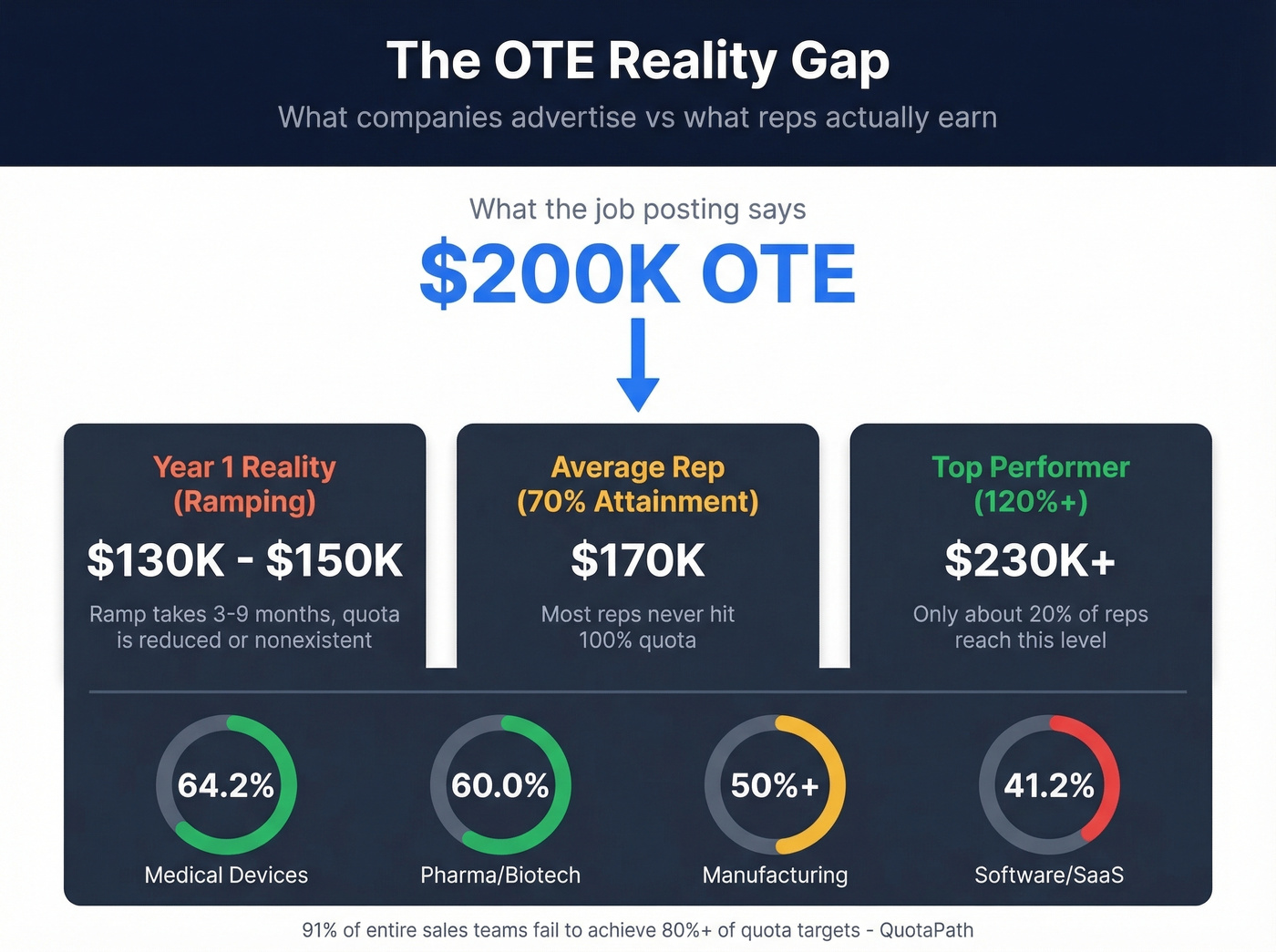
The QuotaPath survey of 450+ revenue leaders found that 91% of companies fail to achieve 80% or more of their quota targets. Not 91% of reps - 91% of entire teams. The problem is systemic, not individual.
Software sales has the worst attainment of any major industry:
| Industry | % Reps Hitting Quota |
|---|---|
| Medical Devices | 64.2% |
| Pharma/Biotech | 60.0% |
| Manufacturing | 50%+ |
| Software/SaaS | 41.2% |
And it gets worse for new hires. Ramp periods run 3 to 9 months depending on the role. Rain Group's research shows it takes 9 months to be fully productive and 15 months to become a top performer. That means your first-year earnings on a $200K OTE job might look more like $130K-$150K even if you're good - because you're spending half the year ramping.
Attainment also depends on factors outside your control: territory quality, support structure, product-market fit, and whether marketing actually generates inbound leads. We've seen this pattern over and over - a rep takes a job for the $250K OTE, earns $160K in year one during ramp, then the company restructures territories in year two. The mythical number never materializes. The expected-value calculation matters more than the headline figure.
Accelerators, Decelerators, Draws, and Clawbacks
What Helps You
Accelerators are the upside mechanism. A typical structure: 10% commission rate up to 100% quota, then 15% on everything above. If your quota is $900K and you close $1M, you earn standard commission on the first $900K and 1.5x on the remaining $100K. This is where top performers separate from the pack and why uncapped plans matter so much.
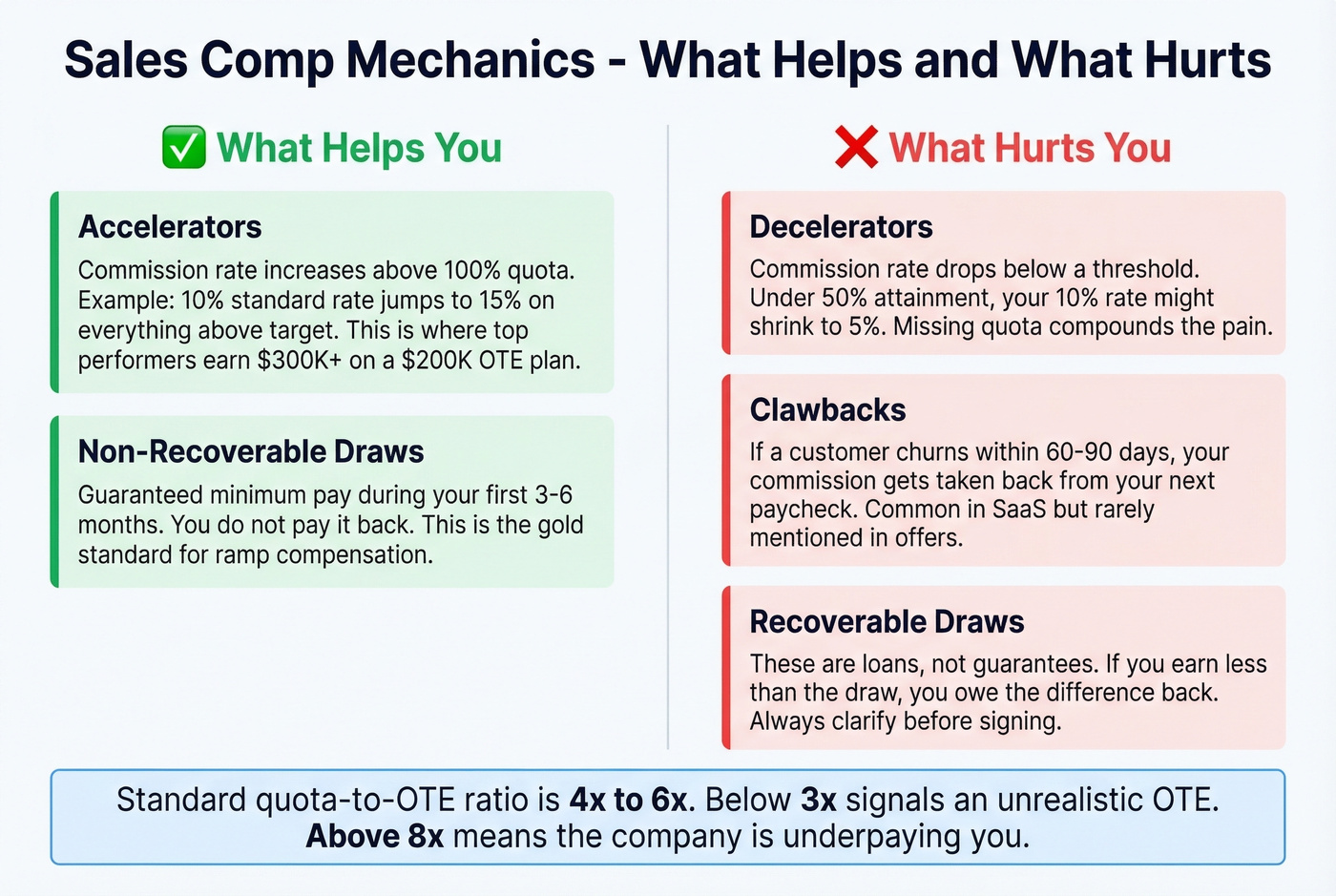
Non-recoverable draws protect you during ramp. The company guarantees a minimum payout, often close to OTE, for your first 3-6 months. You don't pay it back. This is the gold standard for ramp comp.
What Hurts You
Decelerators punish underperformance. Below 50% attainment, your commission rate might drop to 5% instead of 10%. Missing quota doesn't just reduce your variable linearly - it compounds the pain.
Clawbacks recover commission if a customer churns within a 60-to-90-day window. You close a $100K deal, earn $10K in commission, and the customer cancels two months later. That $10K comes back out of your next check. Clawbacks are common in SaaS but rarely mentioned in job offers.
Recoverable draws are loans, not guarantees. If you earn less than the draw amount during ramp, you owe the difference back. Some companies deduct it from future commissions; others expect repayment if you leave. Always clarify which type of draw you're getting before you sign anything.
The standard quota-to-OTE ratio is 4x-6x. If your OTE is $200K, expect a quota between $800K and $1.2M. Anything below 3x signals an unrealistically high OTE. Anything above 8x means the company is under-investing in comp relative to what they expect you to produce.
Spotting Unrealistic OTE Offers
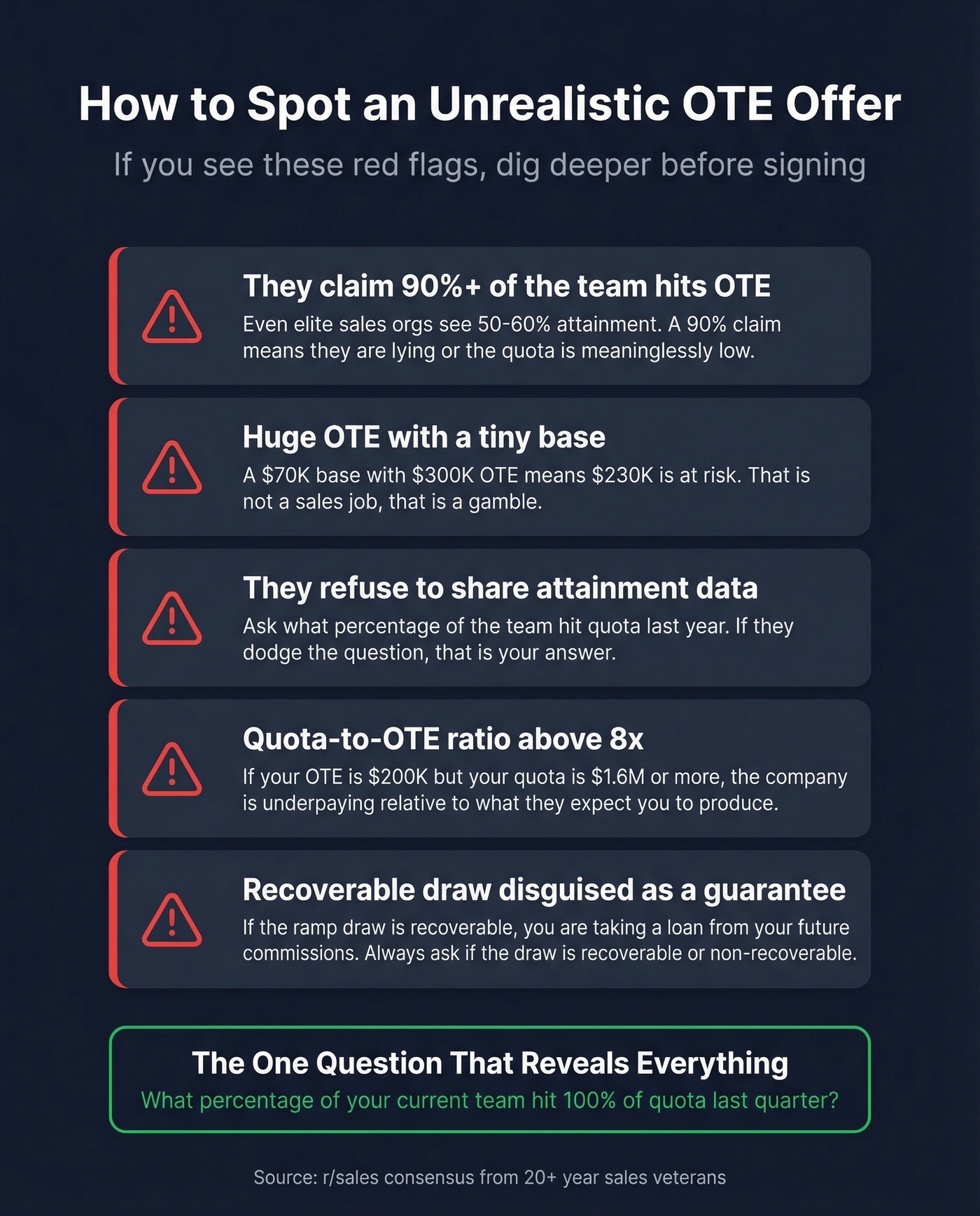
The consensus on r/sales is blunt: at least 7-8 out of 10 companies post OTE numbers with zero basis in reality. Many have rarely - or never - had a rep actually hit the number they're advertising.
Red Flags
- "90% of our team hits OTE." Even the best-run sales orgs see 50-60% attainment. A claim of 90% means they're either lying or the quota is so low the OTE is meaningless.
- Huge OTE with a tiny base. A $70K base with $300K OTE means $230K is at risk. One Reddit poster with 20 years of experience noted that in these structures, "most you'll make is $150K to $175K."
- No online footprint. No Glassdoor presence, no customer reviews, pressure to decide quickly. One candidate reported being told they'd earn "no less than $250K" with a top earner at $4.2M - but the company had zero online presence and discouraged employees from using professional networks.
- They won't share attainment data. If a hiring manager can't tell you what percentage of the team hits quota, they either don't track it or don't want you to know.
- The quota math doesn't work. If OTE is $300K and the quota is $3M (10x ratio), the company expects heroic performance for standard comp.
Questions to Ask in Every Interview
"What percentage of your salespeople hit or came close to hitting OTE last year?"
"What does the average rep - not the top performer - actually earn?"
"Can you show me examples of reps who've hit OTE, and how long it took them?"
In our experience, the companies that freely share attainment data are the ones worth working for. Transparency about comp is a proxy for how the org treats its people.
Here's the contrarian thesis: stop optimizing for the highest OTE. Optimize for the highest base-to-OTE ratio at a company where 50%+ of reps hit quota. A $180K OTE where 60% of the team hits is worth more than a $250K OTE where 30% do. For teams selling deals under $15K, you probably don't need a $300K comp package with a crushing quota - a lower target with achievable numbers will net you more money over three years.
How to Negotiate Sales Compensation
Most candidates negotiate the wrong number. They push for a higher OTE, which just inflates the variable component - the part they're least likely to fully earn. The smarter move is to negotiate base salary up, even if it means a lower total OTE.
If the company's attainment data is unclear or they won't share it, use this script from a Reddit negotiation thread:
"I want to be able to make more than X dollars by selling Y. I believe that can happen here."
Then pause. Don't fill the silence. This forces the hiring manager to either confirm the number is realistic or reveal what they've actually budgeted. Follow up with: "Is that going to be possible?"
The base-up trade works like this: if they offer $100K base / $200K OTE, counter with $120K base / $190K OTE. You're giving up $10K in theoretical upside for $20K in guaranteed income. If attainment at the company is below 60%, you'll come out ahead every time.
Frame every negotiation around base, not total comp. The company wants to advertise a big number. Let them. You want the biggest guaranteed floor you can get.
Why Data Quality Impacts Your Earnings
Here's a chain most reps never think about: OTE depends on quota attainment. Quota attainment depends on pipeline. Pipeline depends on conversations. And conversations depend on reaching the right people with accurate contact data.
When bounce rates sit around 35% and half your phone numbers are disconnected, you're losing a third of your pipeline before a single conversation starts. Most reps blame themselves or the comp plan when the real issue is dead data.
The numbers from real teams tell the story. Meritt's outbound team was running a 35% bounce rate - pipeline sat at $100K/week. After switching to verified email data, bounce rates dropped under 4% and pipeline tripled to $300K/week. Snyk had 50 AEs prospecting 4-6 hours per week with 35-40% bounce rates. With 98% email accuracy and verified mobiles, bounces fell under 5% and AE-sourced pipeline jumped 180%.
GreyScout cut rep ramp time from 8-10 weeks to 4 weeks using Prospeo's B2B database, which directly connects to the ramp economics we discussed earlier. Faster ramp means you start earning real commission sooner - and that's the difference between a frustrating first year and one where you actually approach your OTE.
If you're building pipeline from scratch, tighten up your sales prospecting techniques and your sales follow-up process so you don't waste the connects you do get.
Your on-target earnings are only as real as your pipeline, and your pipeline is only as good as your data. A $200K OTE means nothing if you're burning 35% of your outreach on invalid contacts.
If you're seeing high bounces, start with email bounce rate benchmarks and fixes, then look at email deliverability to protect your domain long-term.
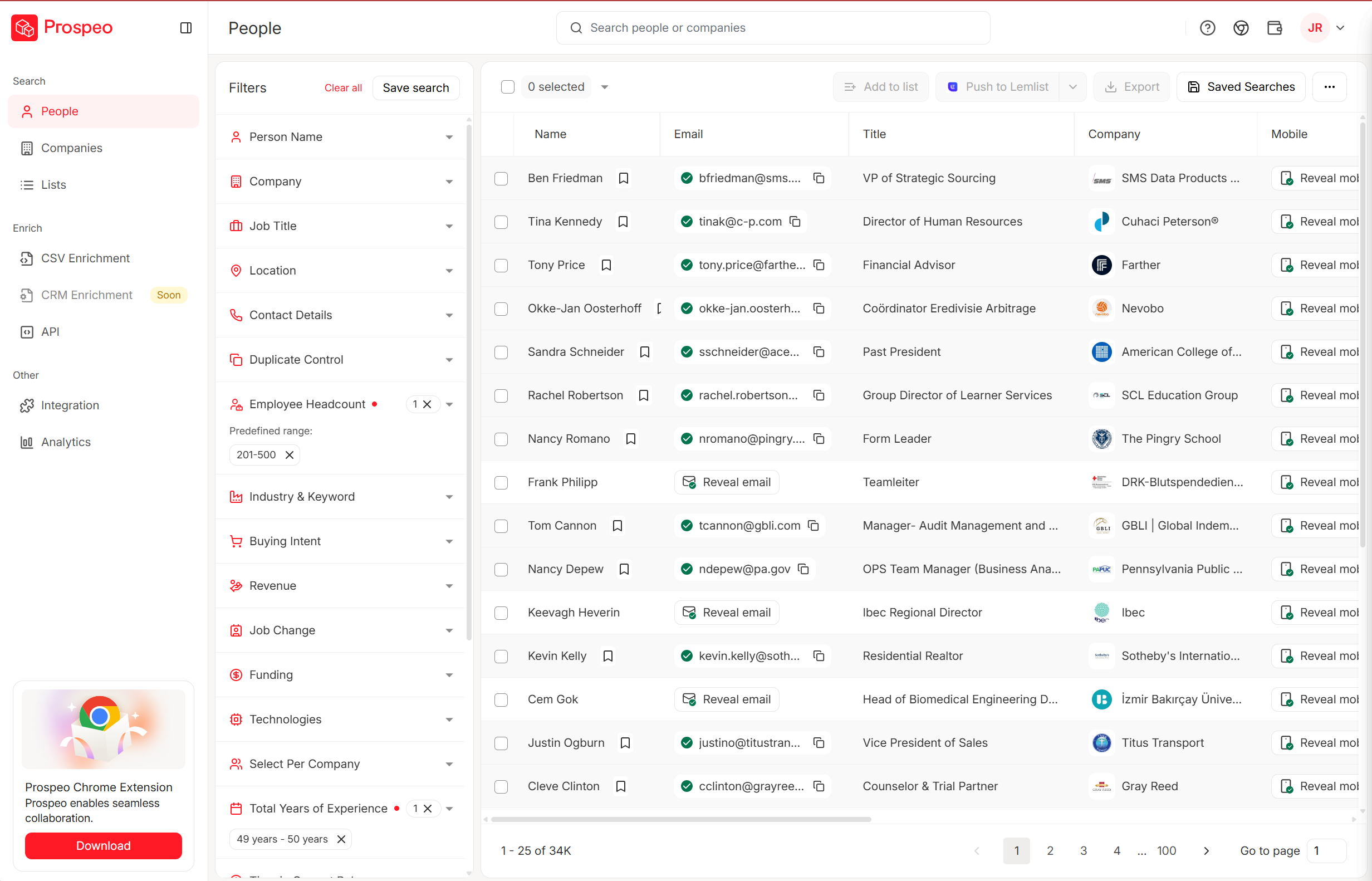
Enterprise AEs carry $900K-$1.35M quotas. At those numbers, every missed connection costs you real commission dollars. Prospeo's 300M+ profiles with 30+ filters - including buyer intent, funding, and headcount growth - let you target accounts that are actually ready to buy.
Close the gap between advertised OTE and actual earnings.
OTE Terms Glossary
OTE (On-Target Earnings): Total annual compensation at 100% quota attainment. Base + variable.
OTC (On-Target Commission): The variable/commission portion of OTE only, excluding base salary.
Fully-Ramped OTE: OTE calculated against full quota, not the reduced quota given during ramp. Your first-year earnings will be lower than fully-ramped OTE.
Pay Mix: The ratio of base salary to variable compensation. Expressed as base/variable - 50/50 or 60/40, for example.
Draw (Recoverable): A guaranteed minimum payout during ramp that you must pay back from future commissions.
Draw (Non-Recoverable): A guaranteed minimum payout during ramp that you don't repay. The better deal.
Accelerator: A higher commission rate that kicks in above 100% quota attainment.
Decelerator: A lower commission rate applied below a certain attainment threshold, typically below 50%.
Clawback: Commission recovered by the company if a customer churns within a defined period, usually 60-90 days.
Ramp Period: The initial 3-9 months where new reps have reduced quotas and/or draw-based compensation.
Quota-to-OTE Ratio: Annual quota divided by OTE. Industry norm is 4x-6x.
FAQ
Is OTE guaranteed?
No. OTE represents what you'd earn at 100% quota attainment - only your base salary is guaranteed. With just 41% of software reps hitting quota, most earn below their stated on-target earnings. Always ask for historical attainment data before accepting an offer.
What does "OTE salary" mean?
It refers to the total annual pay a salesperson can expect when they hit 100% of their assigned quota. It combines your guaranteed base with at-risk variable compensation like commissions and bonuses. The variable portion has to be earned through performance - it isn't a traditional salary.
What's a good quota-to-OTE ratio?
Industry norm is 4x-6x. If your OTE is $200K, expect a quota between $800K and $1.2M. Ratios below 3x signal inflated comp targets. Ratios above 8x mean the company is under-investing in pay relative to expected production.
How do I calculate expected earnings at partial attainment?
Multiply your variable compensation by your expected attainment percentage, then add your base. Example: $100K base + ($100K variable x 70% attainment) = $170K actual earnings on a $200K OTE. Factor in decelerators, which compound the shortfall below certain thresholds.
Can better prospecting data help me hit OTE?
Pipeline volume is the biggest lever for quota attainment. Teams using verified contact data report 3x higher connect rates and significantly lower bounce rates. GreyScout cut ramp time in half, and Snyk's AE-sourced pipeline jumped 180% after switching to 98%-accurate emails and verified mobile numbers.