

Sales Performance Management: The Data-Driven Playbook for 2026
76% of sellers missed quota in the first half of 2025. Not because they weren't working - because the systems around them were broken. Ebsta's benchmark report, covering 440,000+ opportunities and $43B in pipeline data, found that just 14% of reps generated 80% of new revenue. That's not a talent problem. That's a sales performance management problem.
The numbers have been getting worse, not better.
| Year | Quota Change | Sellers Hitting Quota | Velocity Gap |
|---|---|---|---|
| 2023 | +5% | 32% | 7x |
| 2024 | -4% | 28% | 9x |
| H1 2025 | -13% | 24% | 11x |
Even after companies slashed quotas 13% in H1 2025, three out of four reps still missed. The velocity gap - the spread between top performers and everyone else - widened to 11x. Your best rep is closing deals eleven times faster than your median rep. If that doesn't scream "systemic issue," nothing does.
SPM fixes the system, not just the symptoms.
What You Need (Quick Version)
- SPM is a system, not a tool. It connects planning, incentives, insights, and coaching into a feedback loop. Commission software is one piece, not the whole thing.
- The quota crisis is systemic. 76% of sellers missed quota in H1 2025. Hiring your way out doesn't work when win rates fall and cycles stretch.
- Start with 5-7 KPIs, not 15. Tracking everything means acting on nothing.
- Spend your first 30 days on data cleanup, not vendor calls. Every territory model, quota, and forecast is only as good as the data feeding it.
- SPM/ICM pricing spans SMB to enterprise. Expect ~$25-$60/user/month for lighter ICM tools, and ~$50K-$250K+/year for enterprise SPM suites.
What Is Sales Performance Management?
So what does SPM mean in practice? It's the operating framework for measuring, managing, and improving how your sales team converts pipeline into revenue. It connects four interdependent functions: planning, incentives, insights, and coaching.
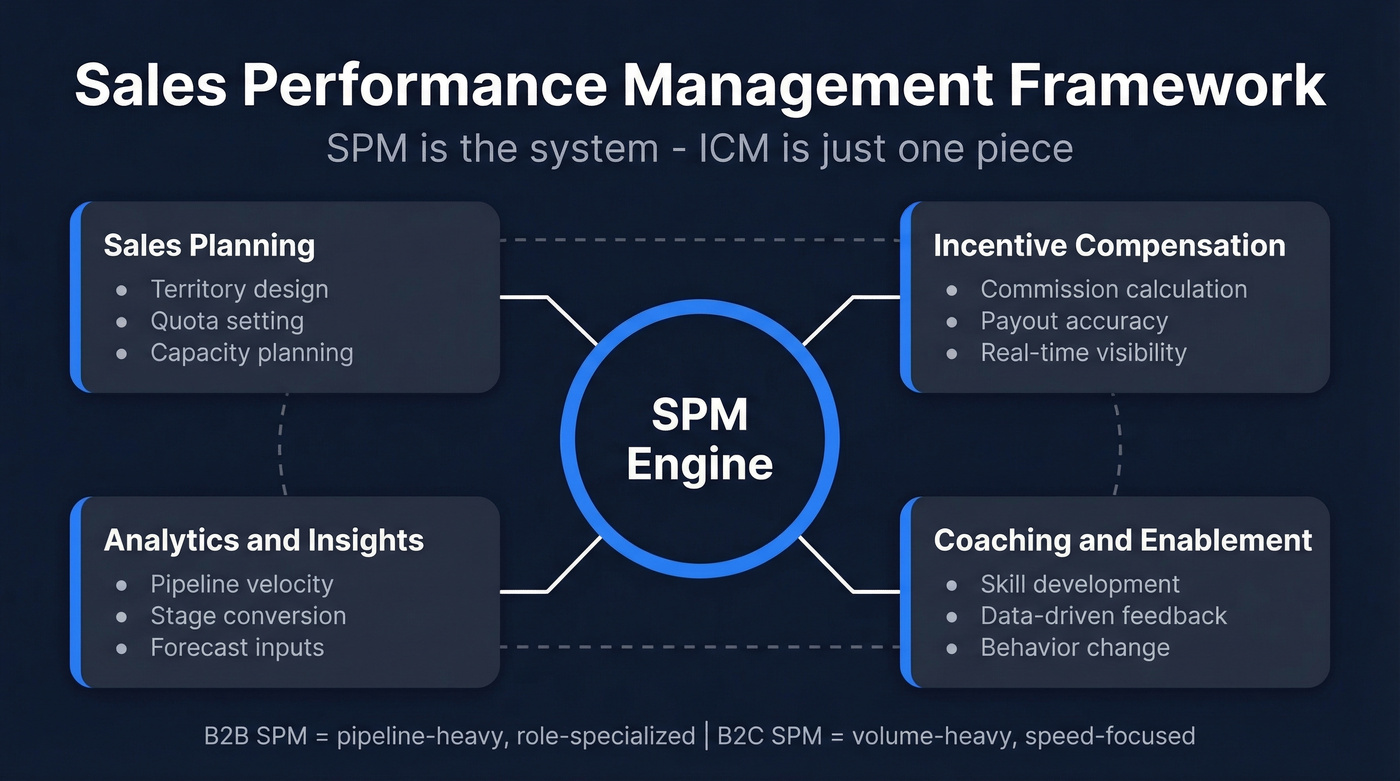
The distinction that trips people up: SPM isn't the same as ICM (incentive compensation management). ICM handles commission calculation and payout accuracy. SPM is the full engine - territory design, quota setting, capacity planning, analytics, coaching cadence, and compensation. Think of ICM as the payroll arm; SPM is the entire nervous system.
One more practical nuance worth calling out. B2B SPM is pipeline-heavy and role-specialized (SDRs, AEs, CSMs, partners), so you're managing stage conversion, deal slippage, and multi-stakeholder buying committees. B2C SPM is volume-heavy, so you're managing speed-to-lead, handle time, and high-frequency incentives. Same acronym, different physics.
McKinsey research links strong performance management to being [4.2x more likely to outperform competitors](https://www.mckinsey.com/capabilities/people-and-organizational-performance/our-insights/in-the-spotlight-performance-management-that-puts-people-first) and to materially higher revenue growth. You don't need the exact multiplier to take the point: teams that run performance like a system beat teams that run it like a vibe.
Mordor Intelligence projects the SPM market will reach [$7.6B by 2031](https://www.alliedmarketresearch.com/press-release/sales-performance-management-market.html), growing at 17% CAGR. That growth tracks reality - selling is harder, and "spreadsheet ops" collapses under modern complexity.
Why SPM Matters Now
Three trends make a structured approach to managing sales performance non-optional in 2026.
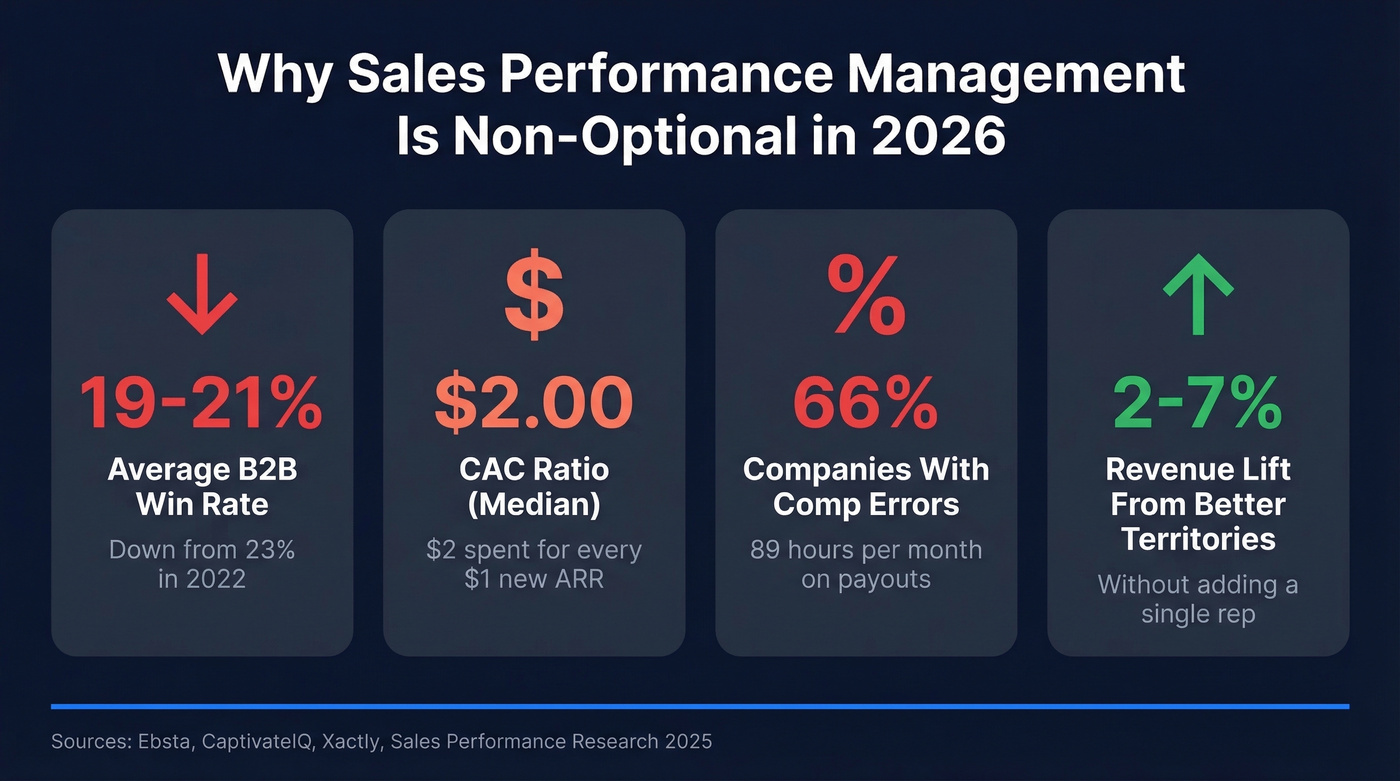
Win rates are falling. Average B2B win rates dropped from 23% in 2022 to 19-21% in 2024. Enterprise deals (ACV over $100K) sit around 17%. Sales cycles lengthened 24-32% for mid-market and up to 36% for enterprise - fewer wins, slower cash, and no sign of reversal.
Acquisition costs are rising. The median new CAC ratio hit $2.00 in 2024, meaning companies spend $2 in sales and marketing for every $1 of new ARR. When every dollar costs more, sloppy territories and misaligned incentives become expensive mistakes, not "RevOps cleanup later." (If you need a refresher on CAC math and benchmarks, see cost to acquire customer.)
Data-driven teams are pulling away. By 2026, 65% of B2B sales organizations outpace gut-instinct teams by using data-driven strategies. That's not a future prediction anymore. It's the bar.
Commission errors are bleeding cash. CaptivateIQ surveyed 200+ compensation leaders and found that [66% of companies overpaid or underpaid commissions](https://stateoficmreport.captivateiq.com/) in the past year. The average comp team spends 89 hours per month on payouts, reviews, and troubleshooting. A 3% error rate on $500M in incentive payments equals $15M in incorrect payments annually.
The ROI isn't theoretical. Effective territory realignment alone can increase revenue 2-7% without adding a single rep. Better territories feed better quotas, which feed better coaching, which feed better retention. The compounding is real.
Core Components of SPM
Understanding the components helps you diagnose which part is broken before you start buying software.
Sales Planning
Territory design, quota setting, and capacity planning form the foundation. Get these wrong and everything downstream inherits the error.
The most common failure mode is static planning. Markets shift, accounts churn, new segments emerge - and the territory map stays frozen because "we already did planning." That's how you end up with burnout territories and dead territories sitting side by side on the same team.
Planning also fails when teams ignore ICP-fit. When your pipeline is ICP-tight, selling becomes 8x more efficient and LTV is 5x higher, yet only 23% of pipeline meets ICP in many orgs. That gap is pure waste. Tighten ICP definitions, enforce them in routing and qualification, and your metrics improve before you buy a single new tool. (If you want a practical framework, use an ideal customer profile template and scoring rubric.)
Incentive Compensation
Here's the thing: if a rep can't calculate their commission on a napkin, the plan is broken. Overcomplicated comp plans don't motivate - they confuse.
Keep plans to 2-3 core components. Stress-test them against best-case, worst-case, and average scenarios before launch. Then give reps real-time visibility into earnings. If they only learn what they made after the month closes, you've already lost the behavior change you were paying for.
Most teams don't have a "comp problem." They have a trust problem. Fix payout accuracy, simplify the plan, and publish the rules in plain English - morale and performance jump fast.
Analytics and Insights
Analytics turn activity data into coaching signals and forecasting inputs. The metric that earns its keep is pipeline velocity: deal count x win rate x average deal size / cycle length. When velocity drops, you can diagnose exactly which lever is failing.
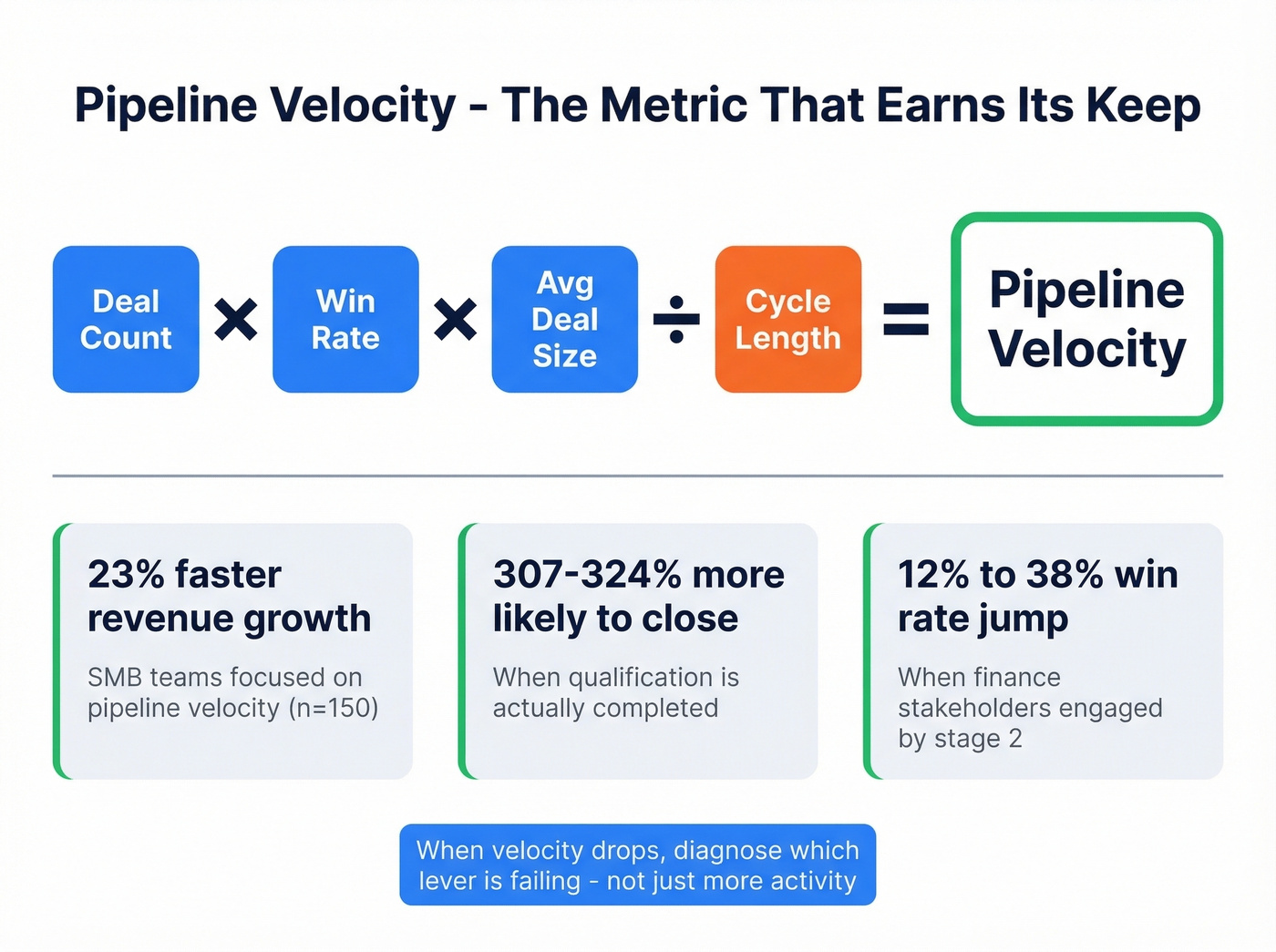
Pipeline velocity isn't just a nice dashboard. In one SMB dataset (n=150), focusing on pipeline velocity correlated with 23% faster revenue growth. That's why good SPM teams obsess over stage conversion and time-in-stage, not just "more activity." (For a deeper KPI set, see pipeline health.)
Qualification rigor is the other multiplier. When qualification is actually completed, deals become 307-324% more likely to close. That's not a rounding error - that's the difference between a forecast and a fantasy. And here's a coaching insight that changes behavior immediately: engaging finance stakeholders by stage 2 increases win rates from 12% to 38%. If your managers want one "do this every time" play, it's that.
Coaching and Enablement
Managers spend fewer than 3 hours per week coaching, and most of that time goes to deal reviews instead of skill development. A PwC survey found that only 46% of workers feel their employers invest in skill-building opportunities. In 2026, that's a self-inflicted disadvantage.
Effective SPM ties coaching to data and to specific behaviors:
- Reps who don't bring finance in early get coached on stakeholder mapping
- Reps with high slippage get coached on qualification completeness
- Reps with low stage conversion get coached on discovery and next-step control
Coaching without data turns into opinion. Data without coaching turns into dashboards nobody checks. (If you're building a manager system, pair this with sales leadership fundamentals.)
Data Quality - The Foundation
Territory assignments, quota models, and pipeline forecasts all depend on accurate CRM data. If your email bounce rate exceeds 5% or your phone connect rate sits below 15%, every SPM output is built on sand. Bad data doesn't just waste rep time - it corrupts the entire performance system.

This is where SPM implementations quietly fail. Teams spend $50K-250K on a platform, then feed it a CRM full of stale titles, dead emails, and wrong phone numbers. We've seen it happen repeatedly: a company buys Xactly or Anaplan, spends months configuring territory models, and the output is garbage because 30% of the contact records are outdated.
Tools like Prospeo fix that foundation layer. With 98% email accuracy, a 7-day data refresh cycle, and 50+ data points per enrichment, you can clean and maintain your CRM for roughly $0.01 per email - less than a single month of most SPM platform subscriptions. (If you're comparing vendors, start with data enrichment services and work backward from your CRM gaps.)

Your SPM system is only as good as the data feeding it. When 83% of enriched leads return with verified contact data and emails hit 98% accuracy, every territory model, quota, and forecast actually works. Prospeo refreshes all 300M+ profiles every 7 days - not 6 weeks.
Stop managing performance on stale data. Start with contacts that connect.
SPM Benchmarks for 2026
Benchmarks only matter if you know which tier you're in.
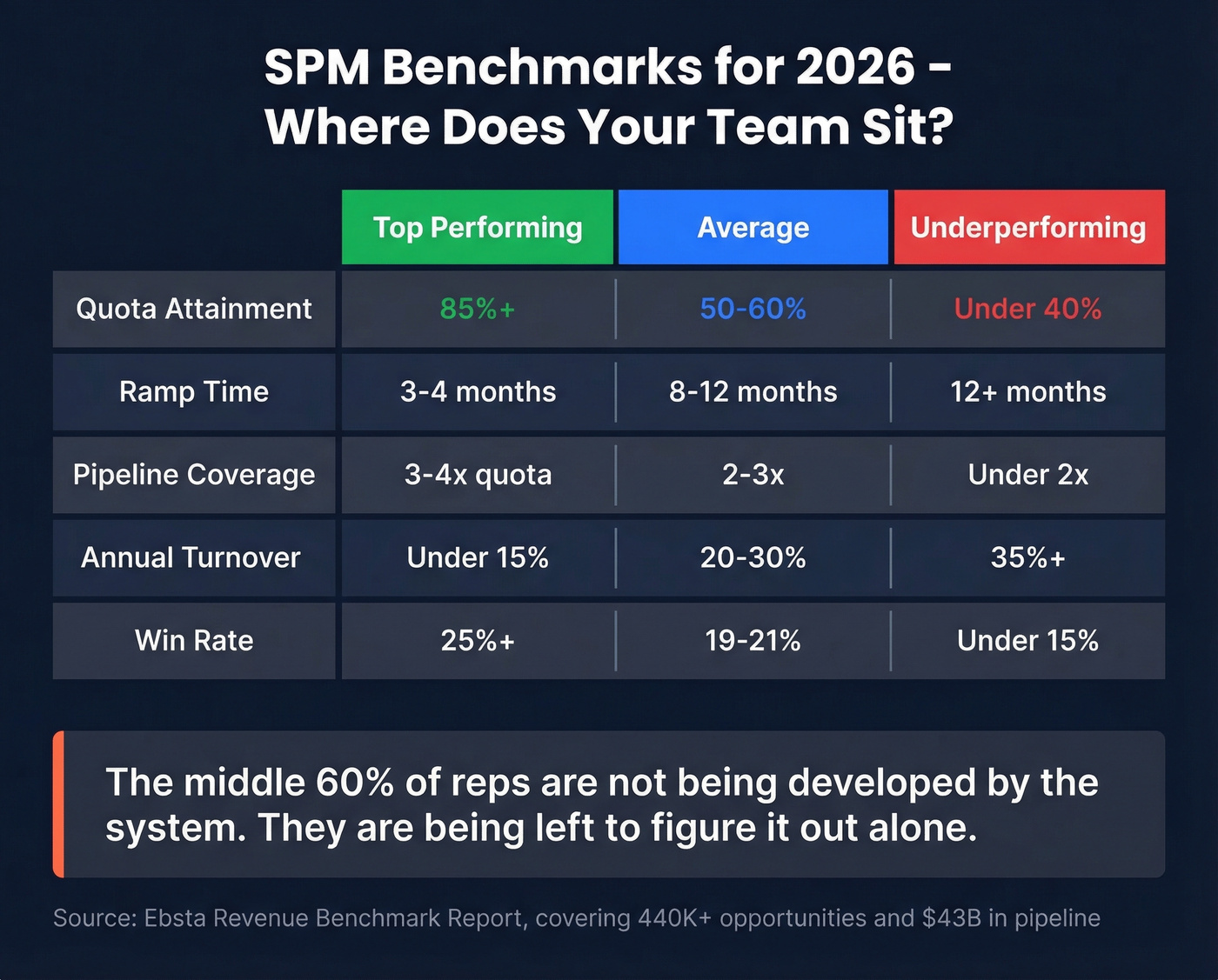
| Metric | Top-Performing | Average | Underperforming |
|---|---|---|---|
| Quota attainment | 85%+ | 50-60% | <40% |
| Ramp time | 3-4 months | 8-12 months | 12+ months |
| Pipeline coverage | 3-4x quota | 2-3x | <2x |
| Annual turnover | <15% | 20-30% | 35%+ |
| Win rate | 25%+ | 19-21% | <15% |
The trend line behind those tiers is the uncomfortable part. Ebsta's data shows quota attainment declining three years running, even as companies cut quotas. The velocity gap keeps widening.
That widening gap is your signal: the middle 60% of reps aren't being developed by the system. They're being left to figure it out on their own, and they're failing at scale.
Pick 5-7 metrics, track them monthly, and force action. If you're "average" on three or more, you have a clear SPM mandate. If you're "underperforming" on even one, that's your first fix.
Key Metrics to Track
Use four buckets so your dashboards don't turn into a junk drawer.
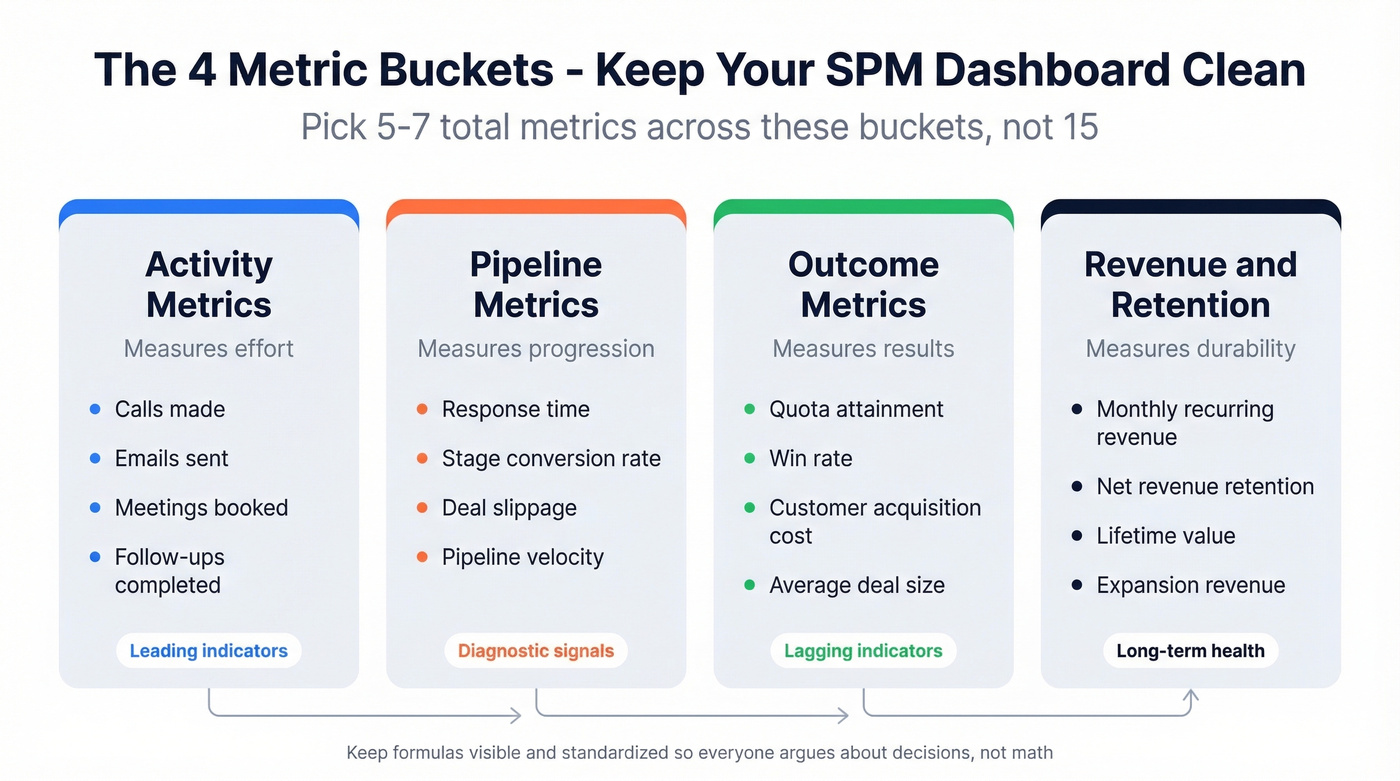
Activity metrics measure effort: calls, emails, meetings, follow-ups. Pipeline metrics measure progression: response time, stage conversion, slippage, velocity. Outcome metrics measure results: quota attainment, win rate, CAC. Revenue and retention metrics measure durability: MRR, NRR, LTV, expansion.
Keep formulas visible and standardized so everyone argues about decisions, not math.
Pipeline value
Pipeline Value = Sum(Deal Value x Probability)
Revenue growth rate
Revenue Growth = (Current Period - Previous Period) / Previous Period
Average selling price (ASP)
ASP = Total Revenue / # Deals Closed
LTV (simple SaaS version)
LTV = (ARPA x Gross Margin) / Monthly Churn
A few quick calibration benchmarks so you know if you're in the right universe:
| Benchmark | Healthy Range |
|---|---|
| B2B lead conversion | 2-5% |
| Growth-stage SaaS revenue growth | 20-30% YoY |
| Mature SMB SaaS revenue growth | 10-15% YoY |
| Early-stage SaaS MRR growth | 15-25% MoM |
If you can't pull these numbers from your CRM in under 10 minutes, you don't have a "reporting problem." You have an instrumentation problem. (To sanity-check your funnel, use funnel metrics.)
Common SPM Mistakes
The consensus on r/SaaS is brutally honest about this stuff. One practitioner described the typical dysfunction as "comp plans nobody fully understands," "quotas set by a dartboard," and finance arguing with sales about the forecast every Monday. Another summed up the tool problem perfectly: "Most just add another dashboard nobody checks."
The mistakes that keep showing up:
- One-size-fits-all comp plans. Enterprise AEs, SMB AEs, SDRs, and CSMs should not share the same incentive logic. Full stop.
- Formula soup. Complexity kills trust and behavior change.
- No stress-testing. If a hot quarter blows your comp budget, leadership will "fix it" mid-cycle and reps will never trust comp again.
- Incenting metrics you can't trust. If attribution and stages are messy, you're paying people based on fiction.
- Weak communication. A dense PDF at kickoff isn't communication. Reps need live visibility into what they're earning and why.
- No iteration cadence. Markets move; plans need quarterly review.
One more that deserves its own line: treating renewals and expansion as an afterthought. In many B2B businesses, 52% of revenue comes from existing customers. If your SPM program only optimizes net-new, you're ignoring the half of the house that's already paying you. (If you want the core KPI and improvement levers, see renewal rate.)
90-Day Implementation Roadmap
Days 0-30: Audit and Clean
Skip the demos. Start with your data and your operating rules.
Audit the current state: how territories are assigned, how quotas are set, where commission disputes come from, and which KPIs you actually use to run the week. Lock in 5-7 core KPIs and baseline them. This audit phase is the foundation of any effective framework - without it, you're automating dysfunction.
Then clean the CRM. Enrich missing fields, dedupe, and refresh stale contacts so territory and capacity decisions aren't built on junk. In our experience, this step alone takes most teams 2-3 weeks because the data debt is worse than anyone admits. Prospeo's enrichment API returns 50+ data points per contact with a 92% match rate, and its 7-day refresh cycle means you stop re-breaking the CRM every quarter.
Roles: RevOps leads the audit, sales leadership defines territory and quota logic, finance sets comp guardrails.
Days 30-60: Configure and Build
Now tooling makes sense.
Configure your ICM platform with stress-tested comp plans. Set territories and quotas using real inputs: TAM, rep capacity, historical deal data, and pipeline analytics. Build dashboards around your 5-7 KPIs, not the 47 default charts the platform ships with.
Lock dispute workflows, audit trails, and payout timing with finance. If your platform needs vendor support for routine plan changes, you picked the wrong tool.
Days 60-90: Launch and Govern
Launch with sandbox-tested plans. Train reps to read earnings dashboards and understand what drives payout. Train managers to coach from analytics, not just run deal interrogations.
Set governance that actually sticks:
- Weekly coaching accountability
- Monthly KPI review
- Quarterly comp + territory review
Governance is the difference between "we implemented SPM" and "we run SPM."
The article says tightening ICP makes selling 8x more efficient. Prospeo's 30+ filters - buyer intent, technographics, headcount growth, funding - let you build ICP-perfect lists that feed your planning, coaching, and comp models with pipeline that actually converts.
Build pipeline your SPM system can actually manage - starting at $0.01 per email.
Choosing SPM Software in 2026
Buy software for the problems you've already measured, not the problems a sales deck invents.
Non-negotiables:
- Sandbox testing for comp and quota scenarios
- Admin self-serve for most changes
- Audit trail + dispute workflow
- Real-time earnings visibility for reps
- Native CRM integration (Salesforce/HubSpot)
AI capabilities worth paying for: AI is useful when it reduces planning time and improves decisions - not when it writes fluffy call summaries. The best SPM platforms use AI for territory design, quota modeling, anomaly detection in payouts, and forecast risk signals like slippage patterns and stage stagnation. If "AI" doesn't change a decision you'd otherwise make, it's a feature tax. (If forecasting is the pain point, compare sales forecasting solutions.)
Here's a practical vendor view with ratings from Gartner Peer Insights:
| Vendor | Rating | Reviews | Category | Best For | Approx. Pricing |
|---|---|---|---|---|---|
| Everstage | 4.7 | 271 | ICM | Fast-moving RevOps teams | ~$15-40/user/mo |
| CaptivateIQ | 4.6 | 219 | ICM | Complex comp + audit needs | ~$30-50/user/mo |
| Salesforce Sales Cloud | 4.5 | 264 | CRM-native SPM | Orgs living in Salesforce | ~$25-165/user/mo |
| Anaplan | 4.3 | 183 | Full SPM (enterprise) | Enterprise planning at scale | ~$75K-250K+/yr |
| SAP SuccessFactors | 4.3 | 133 | Full SPM (enterprise) | Large HR + finance-led orgs | ~$100K-500K+/yr |
| Xactly Incent | 4.2 | 264 | Full SPM | Enterprise SPM suites | ~$30-60/user/mo |
| Varicent | 4.2 | 73 | Full SPM | Enterprise modeling + ICM | ~$50K-150K+/yr |
| QuotaPath | 4.7 | 84 | ICM (mid-market) | Startups and SMBs | $25-50/user/mo |
| Forma.ai | 4.5 | 52 | Full SPM | AI-led planning + territories | ~$30K-100K+/yr |
For coaching gamification and daily activity visibility, Ambition and SalesScreen are common add-ons. They complement ICM; they don't replace it.
Let's be direct about recommendations. If you're Series A-C, start with a strong ICM tool like Everstage or QuotaPath, pair it with CRM reporting, and build governance around it. Skip the enterprise suite if you have fewer than 50 reps and straightforward territory logic. Graduate to Anaplan or Xactly when territory complexity and comp edge cases force your hand - not before.
FAQ
What is sales performance management?
Sales performance management is the system connecting territory planning, quota setting, incentive compensation, analytics, and coaching into a unified operating model that turns pipeline into predictable revenue. SPM covers the full performance engine, while ICM - the subset most teams encounter first - focuses on commission calculation and payout accuracy.
How long does SPM implementation take?
A minimum viable program - ICM plus basic dashboards - takes 6-12 weeks. Full maturity with territory optimization, coaching cadence, and governance takes 3-6 months. The fastest teams start with data cleanup and 5-7 KPIs in the first 30 days.
What's the difference between SPM and CRM?
CRM stores customer data and tracks interactions. SPM uses that data to optimize how the sales org performs - quotas, territories, commissions, and coaching signals. SPM sits on top of your CRM; it doesn't replace it.
How do you measure SPM success?
Track quota attainment, ramp time, pipeline coverage, turnover, and commission accuracy. If quota attainment rises while turnover and payout disputes fall, your system is working. Top-performing teams hit 85%+ quota attainment with under 15% annual turnover.
Does SPM require clean data?
It absolutely does. Dirty data creates unfair territories, broken routing, and fictional forecasts. We've tested this ourselves - enriching a CRM with verified contacts before running territory analysis produces dramatically different output than working with stale records. Whatever enrichment tool you use, make sure it refreshes frequently and verifies at the email level, not just the company level.