

Sales Leadership Is a System, Not a Personality Trait
84% of reps missed quota last year. Not because they forgot how to sell - because the system around them broke down. When reps spend 60% of their week on non-selling tasks, that's not a time management problem. It's a leadership design problem.
Sales leadership is the job of building an environment where good selling happens consistently: clear standards, clean data, tight coaching loops, and fewer distractions. Personality helps, but it's not the lever that moves the number.
Here's the operating system we've built this guide around: coaching frameworks, named failure modes, measurement models, and the AI-era shifts reshaping the role right now. If you read nothing else, read the coaching allocation rule and the five mistakes section.
What Is Sales Leadership (and What Isn't It)?
Management tightens execution. Leadership chooses the direction and builds the conditions for change. Both matter, but they're different jobs.
A useful framework spans three spectrums: vision vs. execution, people vs. process, and inspiration vs. prescription. Great orgs need both ends of each. The leader's job is deciding where to lean this quarter, not picking a permanent identity.
| Spectrum | Vision End | Execution End |
|---|---|---|
| Vision vs. Execution | Set direction, define "what winning looks like" | Enforce process, inspect deals |
| People vs. Process | Develop skills, build trust | Standardize workflows, tighten systems |
| Inspiration vs. Prescription | Rally around a mission | Deliver playbooks and scripts |
Leadership also isn't tied to seniority. We've watched ICs lead by setting the quality bar on discovery calls and pulling peers up - while a "senior" manager hid behind dashboards and Slack pings.
Sales Leadership vs. Sales Management
| Dimension | Sales Manager | Sales Leader |
|---|---|---|
| Focus | Execution | Direction |
| Metric orientation | Activity & forecast | Outcomes & learning |
| Rep relationship | Accountability | Development |
| Change response | Stabilize | Adapt & transform |
| Coaching style | Inspect & correct | Diagnose & build skills |
If your org only rewards the left column, you'll get compliance - and you'll lose your best people. Meaningful leadership requires investing in the right column just as deliberately.
Coaching Is the #1 Lever
Training gives baseline knowledge. Coaching turns it into behavior under pressure.
Teams that invest in coaching see 16.7% higher revenue growth. 75% of reps say they're more likely to hit targets when they have a coach or mentor. Yet only 26% get weekly coaching, which is why "we hired good people" doesn't translate into "we hit the number." Half of all reps are considering leaving due to lack of training or development - a stat that should terrify any VP of Sales who thinks comp plans alone drive retention.
The 60/25/15 Coaching Rule
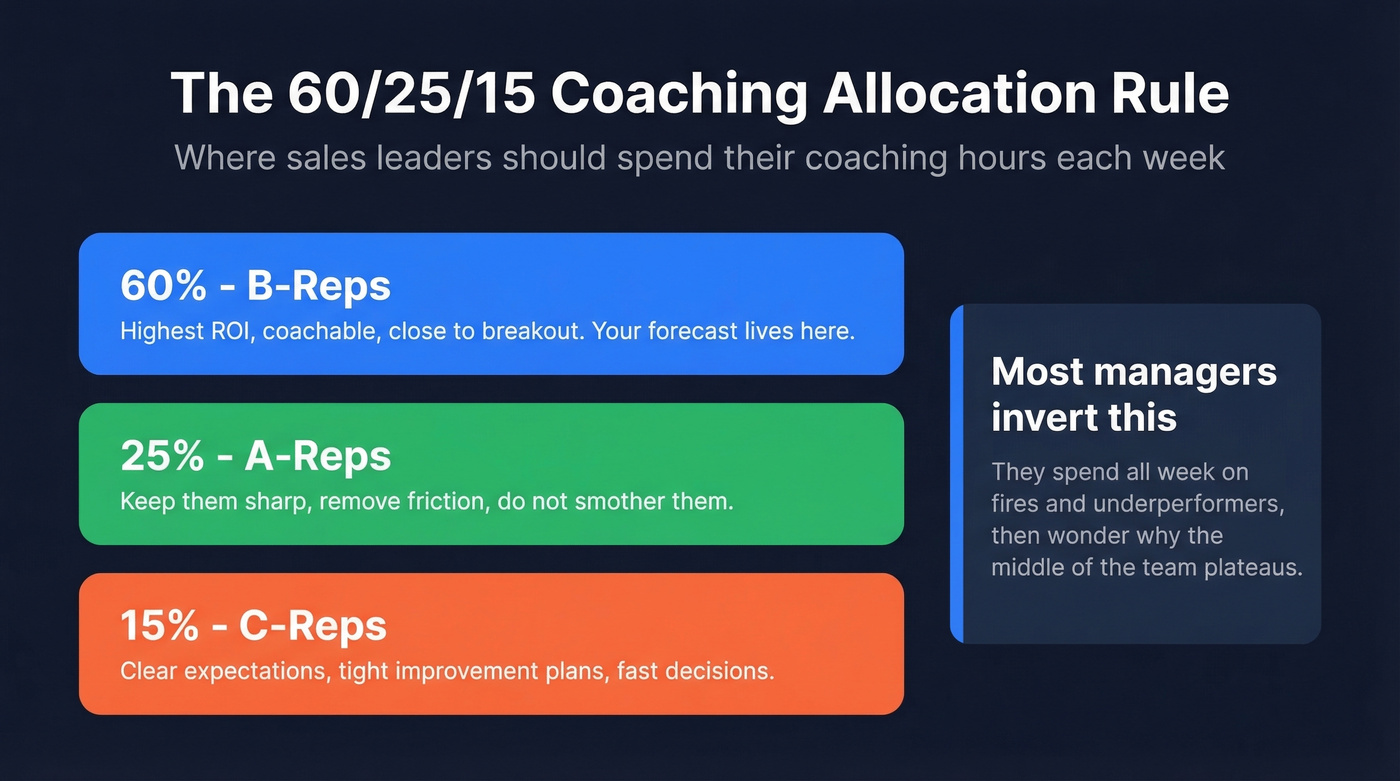
Most managers invert their coaching ROI. They spend all week on fires and underperformance, then wonder why the middle of the team plateaus.
Here's the thing: this is one of the most important rules to internalize early.
Allocate 60% of coaching time to B-reps - highest ROI, coachable, close to breakout. Give 25% to A-reps - keep them sharp, remove friction, don't smother them. Reserve 15% for C-reps - clear expectations, tight plans, fast decisions.
Your B-reps are your forecast. Treat them like it.
A Cadence That Works
We've seen this shift happen fast: a VP of Sales inherits a team missing plan, installs a weekly coaching cadence, and enforces it for a single quarter. No new hires, no new tools - just structured feedback loops. Performance moves because the system moves.
Weekly per rep: 30-45 min 1:1 coaching focused on skills and deals (not status updates), plus one or two call reviews targeting a specific skill. A good coaching 1:1 covers one deal to diagnose, one skill to improve, and one observable commitment for next week. (If you need structure, use a 1:1 coaching cadence that forces focus.)
Weekly team rhythm: Pipeline review focused on stage exit criteria and next actions - not "what's the number?"
Get this cadence right before layering on anything else.
Five Mistakes That Kill Performance
1. Sales Take-Over Syndrome
You jump on calls, "save" the deal, and feel helpful. What you're actually doing is training learned helplessness - reps stop thinking because you'll rescue them. Stay off the call unless the stakes are genuinely too high. Then debrief with a skill rubric, not a play-by-play critique.
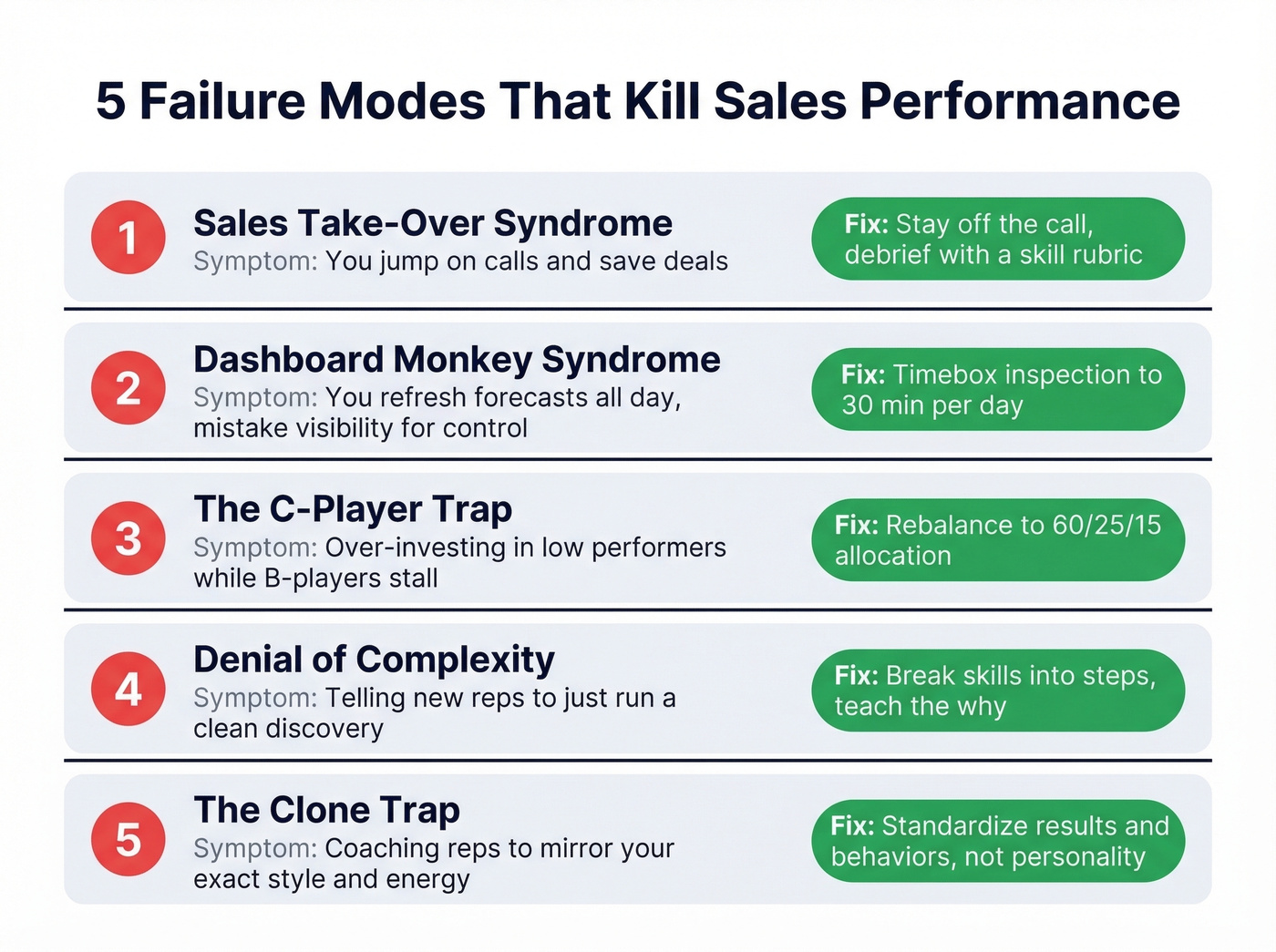
2. Dashboard Monkey Syndrome
You refresh forecasts, chase CRM fields, and mistake visibility for control. The team gets more reporting and less enablement. The fix is simple: timebox inspection to 30 minutes a day. Spend the recovered hours on call review and deal strategy.
3. The C-Player Trap
You over-invest in low performers because the pain is loud. Meanwhile, your B-players stall quietly and your A-players start taking recruiter calls. Rebalance to 60/25/15. C-reps get clear standards and fast consequences; B-reps get development.
4. Denial of Complexity
Before you tell a new rep to "just run a clean discovery," remember: fundamentals that feel obvious to you are invisible to someone who's never built a mutual action plan. Break skills into steps. Teach the "why," not just the script.
5. The Clone Trap
You coach reps to mirror your style - your cadence, your talk track, your energy. Reps who don't match your mold get labeled "not a fit." The better approach: standardize results and behaviors, not personality. Reps win in their own voice inside clear guardrails. Diversity of approach becomes a strength, not a problem to fix.
Avoiding these five failure modes is the foundation. Everything else builds on top.
The Rep-to-Leader Transition
What got you here won't get you there. The skills that make a top AE - urgency, control, personal heroics - can quietly poison your first manager role.
The player-coach trap plays out the same way every time. A top closer gets promoted, keeps taking over deals, and three months later the team's dependent. Then the best rep starts interviewing because they want a coach, not a babysitter.
Three mindset shifts are non-negotiable:
- Controller to coach. Your job is capability, not closure.
- Metrics-only to meaning-first. Numbers matter, but people need a why.
- Internal focus to external relevance. Market feedback beats internal opinions every time.
Let's be honest: hiring is the most underrated leadership skill. Assessment scores don't predict success. Ask harder questions, check for coachability over credentials, and stop hiring people who interview well but can't handle ambiguity.
First 90 Days Priority Stack
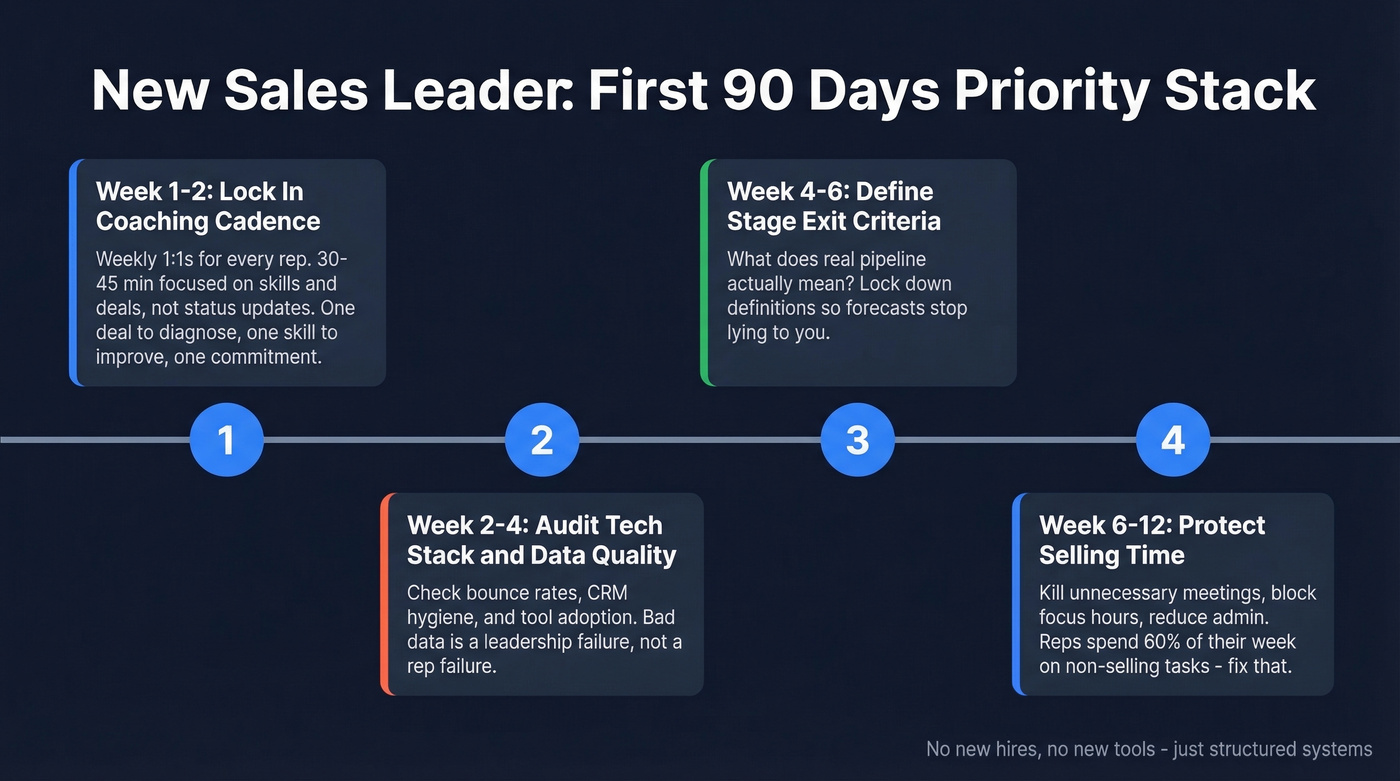
- Lock in a weekly 1:1 coaching cadence
- Audit the tech stack and data quality
- Define stage exit criteria - what "real pipeline" actually means
- Protect selling time ruthlessly (kill meetings, block focus hours, reduce admin)
One small example of what "protect selling time" looks like in practice: schedule your emails to send during business hours, not at 11pm. When leaders send late-night messages, reps feel obligated to respond, and suddenly everyone's "always on" instead of focused during selling hours.

You just read that reps spend 60% of their week on non-selling tasks. Bad data is a huge chunk of that waste - bounced emails, wrong numbers, stale contacts. Prospeo's 7-day refresh cycle and 98% email accuracy mean your reps spend time selling, not cleaning lists. That's the leadership design fix your pipeline needs.
Stop letting bad data sabotage your coaching investment.
Sales Leadership in 2026: The AI Shift
Gartner's 2026 mandate for sales leaders is clear: build an AI roadmap, transform GTM motions around buyer preferences, and maximize manager impact through role clarity. That's not a tools problem. It's an operating model problem.
AI adoption is already mainstream - 81% of sales teams use it in some form, and high performers are 1.7x more likely than underperformers to use prospecting agents. The gap in 2026 won't be "who has AI." It'll be "who has a workflow that makes AI useful."
The majority of B2B buyers now prefer rep-free experiences. Your reps earn attention differently: generic touches get ignored, relevance gets replies. That means better targeting, sharper timing, and cleaner data feeding every automated workflow. A leadership philosophy that treats data hygiene as a strategic priority - not an ops afterthought - will separate winners from everyone else.
Data Quality as a Leadership Priority
Bad contact data is a leadership failure, not a rep failure.
One of the fastest wins for a new sales leader is a contact data audit. If bounce rates are creeping up, you're burning pipeline, damaging deliverability, and wasting rep hours on dead leads. Your activity metrics are lying to you, and that cascades straight into quota misses. I've seen teams celebrate "500 emails sent per rep per week" while 35% of those emails bounced into the void - that's not productivity, it's theater. (If you want a benchmark-driven view, start with sales productivity statistics.)
At Snyk, bounce rates dropped from 35-40% to under 5% after switching to Prospeo's 7-day data refresh cycle, and AE-sourced pipeline jumped 180% with 50 AEs prospecting 4-6 hours per week. That's the kind of result that comes from treating data quality as infrastructure, not an afterthought.

Your first 90 days say to audit data quality for a reason. When Snyk's 50 AEs switched to Prospeo, bounce rates dropped from 35-40% to under 5% and AE-sourced pipeline jumped 180%. Clean data at $0.01/email is how leaders build systems that scale - not heroics.
Give your team the data infrastructure their coaching deserves.
Measuring Leadership Effectiveness
Revenue matters, but it's a lagging indicator - and it's noisy. Measure leadership like you'd measure any other system: inputs, behavior change, and outcomes over time.
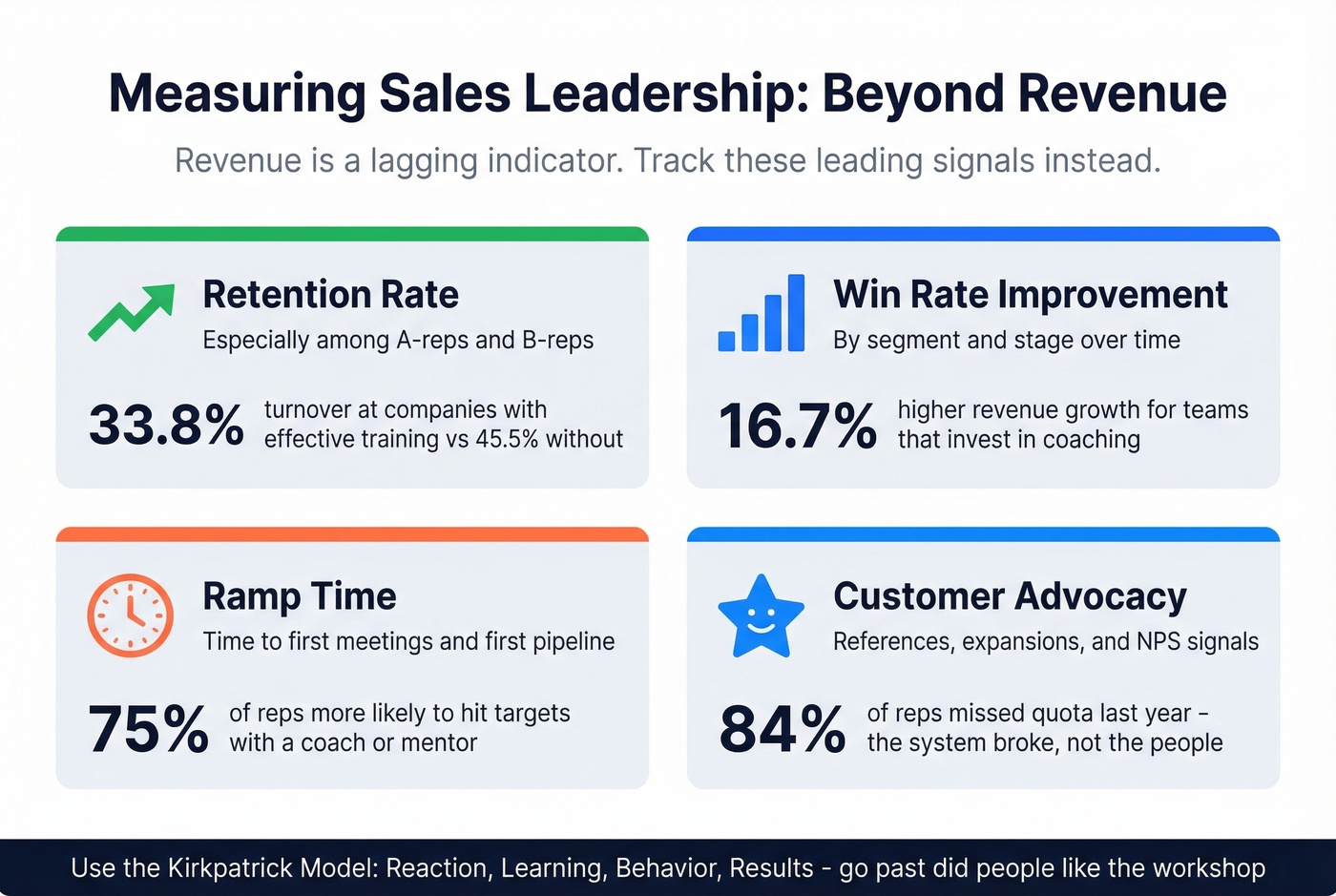
Beyond revenue, track these:
- Retention rate, especially among A- and B-reps
- Win-rate improvement by segment and stage
- Ramp time to first meetings and first pipeline
- Customer advocacy signals like references and expansions
For leadership development programs, the Kirkpatrick Model works because it forces you past "people liked the workshop" - it measures Reaction, Learning, Behavior, and Results. That matters when the world spends $366B a year on leadership development and most of it goes unmeasured.
The business case is blunt: companies with highly effective training see 33.8% turnover versus 45.5% at companies without it. Leaders who improve coaching quality see it in retention before it shows up in revenue. (To operationalize this, align on sales growth metrics and a small set of sales operations KPIs.)
Books Worth Your Time
The Qualified Sales Leader by John McMahon - Best first two-thirds of any book on leading a sales org. Skip the MEDDICC padding at the end.
The Coaching Habit by Michael Bungay Stanier - Seven questions that'll change how you run 1:1s, especially if you talk too much.
SPIN Selling by Neil Rackham - Published in 1987, still the best book on asking better questions and earning the right to pitch.
Fanatical Prospecting by Jeb Blount - The mindset book for leaders who need to rebuild pipeline discipline.
Drive by Daniel Pink - Not a sales book, but it explains why your comp plan alone won't motivate anyone for long.
Contrarian take: The Challenger Sale is hard to implement without org-wide change. This isn't just our opinion - experienced sales leaders on r/sales consistently push back on Challenger as impractical without executive buy-in. Start with coaching mechanics and pipeline standards before trying to rewire the whole org. (If you want a more tactical starting point, build a sales playbook and reinforce it with sales coaching best practices.)
Sales Leadership FAQ
What's the difference between sales leadership and sales management?
Management focuses on execution - forecasts, CRM compliance, process enforcement. Leadership focuses on vision, coaching, and building systems that make reps better over time. The failure mode is when management crowds out leadership entirely, leaving no room for skill development or strategic direction.
How much coaching time should a sales leader invest weekly?
Plan for 30-45 minutes per rep per week in 1:1 coaching, plus a weekly pipeline review. Allocate using the 60/25/15 rule: 60% on B-players, 25% on A-players, 15% on C-players. Most managers invert this and wonder why the middle of the team stalls.
What tools should a new sales leader prioritize?
Start with a CRM, a conversation intelligence tool like Gong so coaching is grounded in real calls, and a verified data platform so reps don't waste hours on bounced emails. Get the data stack right before adding more tools - otherwise you're automating bad inputs.
What's the biggest mistake first-time sales leaders make?
Sales Take-Over Syndrome - jumping on rep calls to "save" deals. It feels productive but trains learned helplessness. Reps stop thinking independently, pipeline becomes leader-dependent, and your best people leave because they want development, not a babysitter. Coach after the call, not during it.