

Coachability in Sales: A Two-Way Street Most Teams Get Wrong
In 2012, 53% of sales reps hit quota. By 2024, that number had cratered to 16%. The instinct is to blame reps - they're not hungry enough, not skilled enough, not coachable enough. But a RevOps lead we know ran a coaching audit last quarter and found the opposite. Three reps were flagged as "uncoachable." Two had never received a single structured coaching session. The third had been coached on technique while working a list where 35% of emails bounced.
The problem with coachability in sales isn't usually the reps. It's everything around them.
Three Things to Internalize
- Coachability is a behavior, not a personality trait. It can be built, measured, and improved - on both sides of the desk.
- 89% of new-hire failures are attitude, not skill. A Leadership IQ study tracking 5,247 hires confirmed this. Hire for coachability, not resume lines.
- Before labeling a rep "uncoachable," audit your own coaching. Only 40% of reps receive regular coaching. And if your reps' contact data is garbage, no amount of coaching fixes the numbers.
What Coachability Actually Means
Coachability isn't compliance. It's not nodding along in a 1:1 and then doing whatever you were going to do anyway. And it's not blind obedience - a rep who pushes back on bad advice isn't uncoachable. They might just be right.
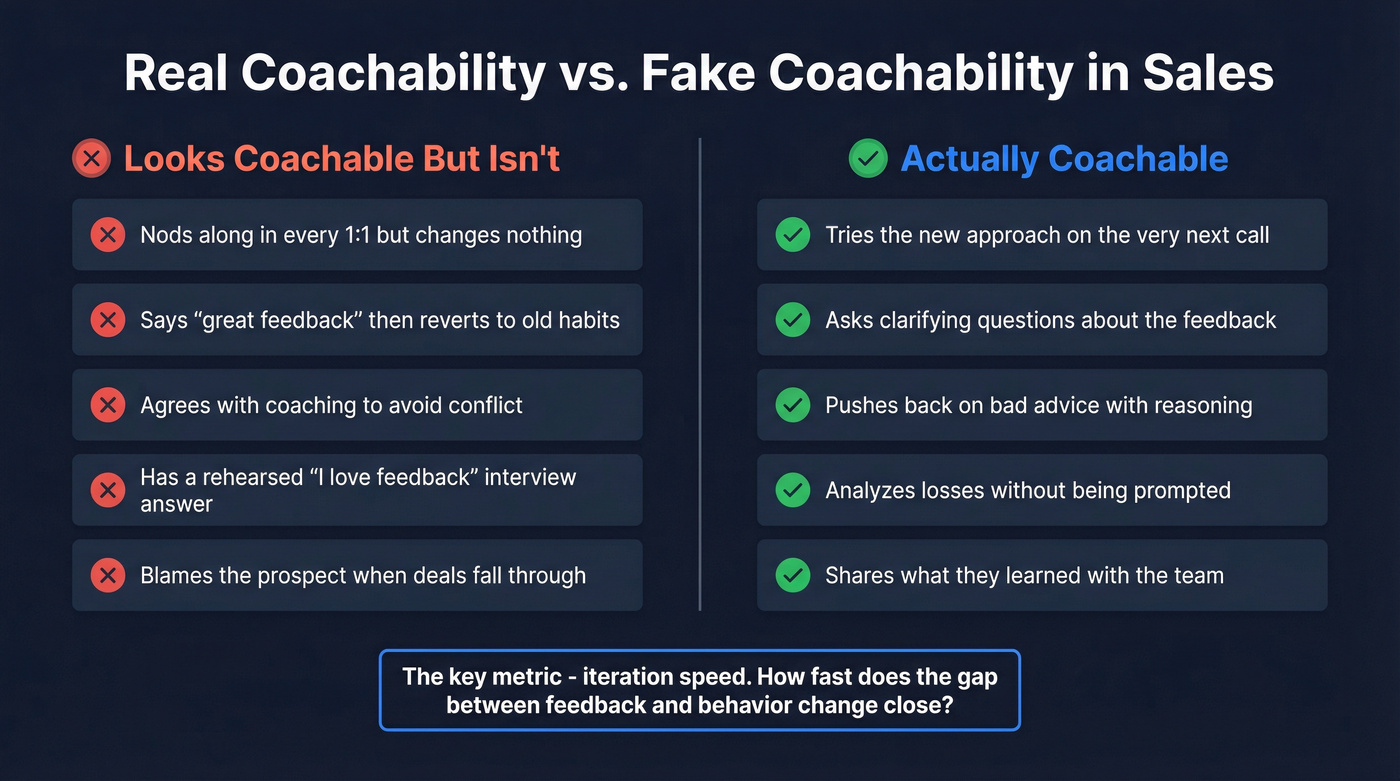
Real coachability shows up as observable behaviors: willingness to learn from both wins and losses, genuine self-reflection after calls, and the ability to accept feedback without getting defensive. Here's what to watch for:
- After a lost deal: Does the rep analyze what happened, or blame the prospect?
- After coaching: Do they try the new approach on the next call, or revert to habit?
- In team settings: Do they share what's working, or hoard playbooks?
- When challenged: Do they ask clarifying questions, or shut down?
The key distinction is iteration speed - how fast someone closes the gap between feedback and behavior change. Coachable salespeople close that gap in days. Not quarters.
Why It Matters More Than Experience
Experience depreciates fast. The average SDR tenure is 1.4 years. Voluntary turnover in tech sales hit 67% in 2021 per Xactly's research. By the time a rep masters your ICP, messaging, and tech stack, they're often already interviewing somewhere else.
That makes coaching receptiveness the highest-leverage trait you can hire for. The Sales Executive Council found that reps receiving quality coaching improved long-term performance by 19%. Companies with structured onboarding - a form of early-stage coaching - see 50% better retention and up to 34% ramp time reduction.
The math that should keep sales leaders up at night: A bad hire costs 2-3x annual salary in fully loaded costs - recruiting, onboarding, lost pipeline, team morale. CareerBuilder pegs the average at ~$17,000, and that's conservative for quota-carrying roles. Meanwhile, coaching ROI runs roughly $4.50 per $1 invested - a 353% return.
You can spend $17K replacing a rep, or you can spend a fraction of that coaching the one you already have. This isn't a close call.
The Manager's Side of the Equation
This is the part most articles skip. They frame coachability entirely as a rep problem. But those dynamics are only half the equation.
Only 40% of reps receive regular, consistent coaching. 72% say the feedback they get isn't specific or actionable. And 65% of managers admit they don't have enough time to coach effectively. Sales practitioner communities on Reddit echo this constantly: there are more bad teachers than bad students.
Look - if your "coaching" is a quarterly ride-along and a vague note to "be more consultative," you haven't earned the right to call anyone uncoachable.
Most "coachability problems" are actually management problems wearing a rep-shaped mask. The real question isn't "is this rep coachable?" It's "have we created the conditions where coaching receptiveness can actually develop?"
Manager Self-Audit
Before you label anyone uncoachable, answer these honestly:
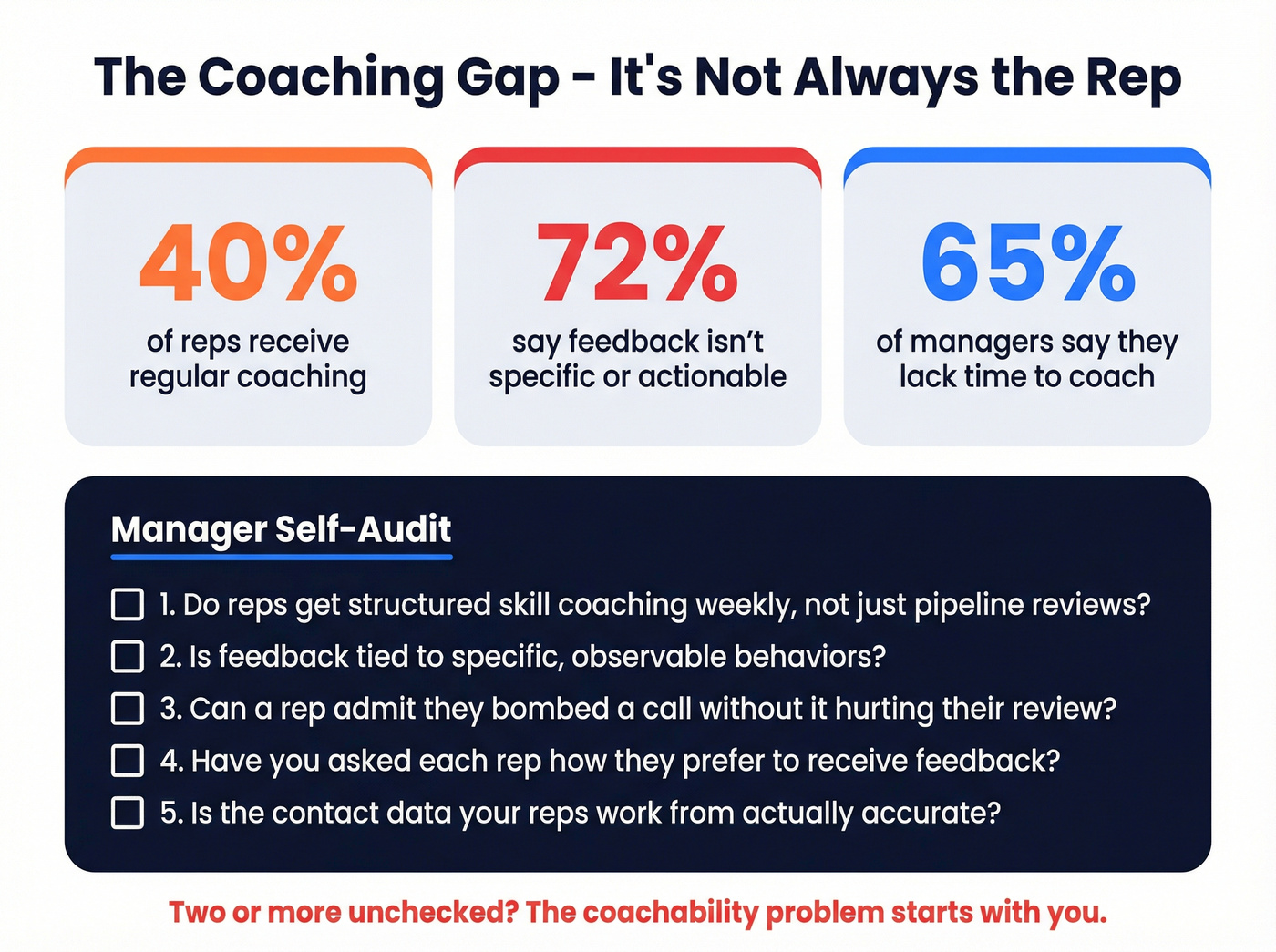
- Do your reps get structured coaching at least weekly - not pipeline reviews, actual skill coaching?
- Is your feedback tied to specific, observable behaviors with clear next steps?
- Can a rep admit they bombed a call without it showing up in their performance review?
- Have you asked each rep how they prefer to receive feedback?
- Is the data your reps work from accurate enough that technique actually matters?
Two or more "no" answers? The coachability problem starts with you.

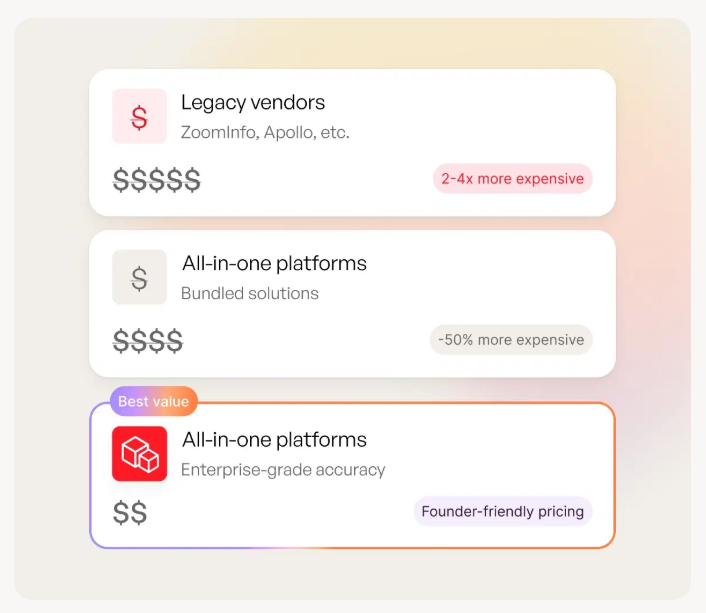
You found it - 35% of emails bouncing while managers coach technique. That's not a coachability problem, it's a data problem. Prospeo delivers 98% verified email accuracy on a 7-day refresh cycle, so when you coach a rep to try a new approach, the email actually lands.
Give your reps data worth coaching on - starting at $0.01 per email.
How to Assess Coachability in Interviews
Asking "are you coachable?" is useless. Everyone says yes. You need to create a situation where coachability either shows up or doesn't.
The Two-Stage Roleplay
Give the candidate a product sheet and five minutes to prep a 60-second pitch. Let them deliver it. Then give specific feedback: "You led with features instead of the prospect's problem. Try flipping the structure." Run it again.
A coachable candidate will visibly iterate - ask a clarifying question, restructure their approach, try something different even if it's imperfect. An uncoachable candidate will nod, then deliver essentially the same pitch with minor word swaps. We've seen this play out dozens of times, and the difference is obvious within seconds of the second attempt.
Scoring Rubric
| Dimension | 0 (Red Flag) | 1 (Neutral) | 2 (Strong Signal) |
|---|---|---|---|
| Feedback reception | Deflects or blames | Accepts but vague | Owns it, asks follow-up |
| Iteration speed | No visible change | Minor adjustment | Clear structural shift |
| Self-awareness | Can't name weaknesses | Generic answers | Specific examples |
| Curiosity | No questions asked | Surface questions | Probing, thoughtful Qs |
| Accountability | External attribution | Mixed ownership | Full ownership |
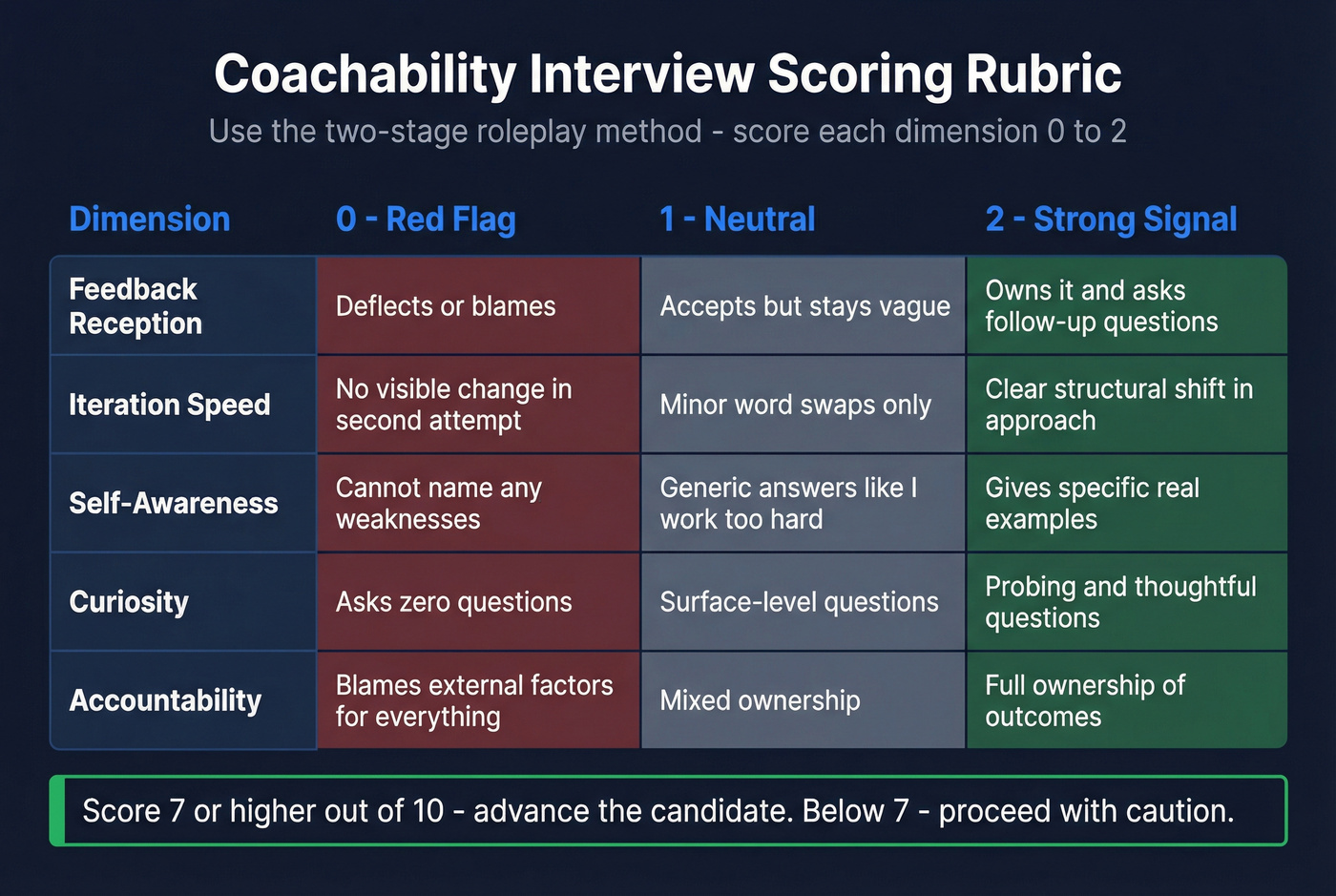
Advance candidates scoring 7+ out of 10. Below that, proceed with caution.
Questions That Actually Work
Skip "tell me about a time you received feedback." Everyone has a rehearsed answer. Try these instead:
- "What's the hardest feedback you've ever received, and what did you do with it?"
- "Describe a time you changed your sales approach based on a manager's suggestion. What happened?"
Listen for specificity. Coachable candidates give you the before, the feedback, the change, and the result. Uncoachable ones stay abstract.
Building Coachability in Your Team
Set the Coaching Cadence
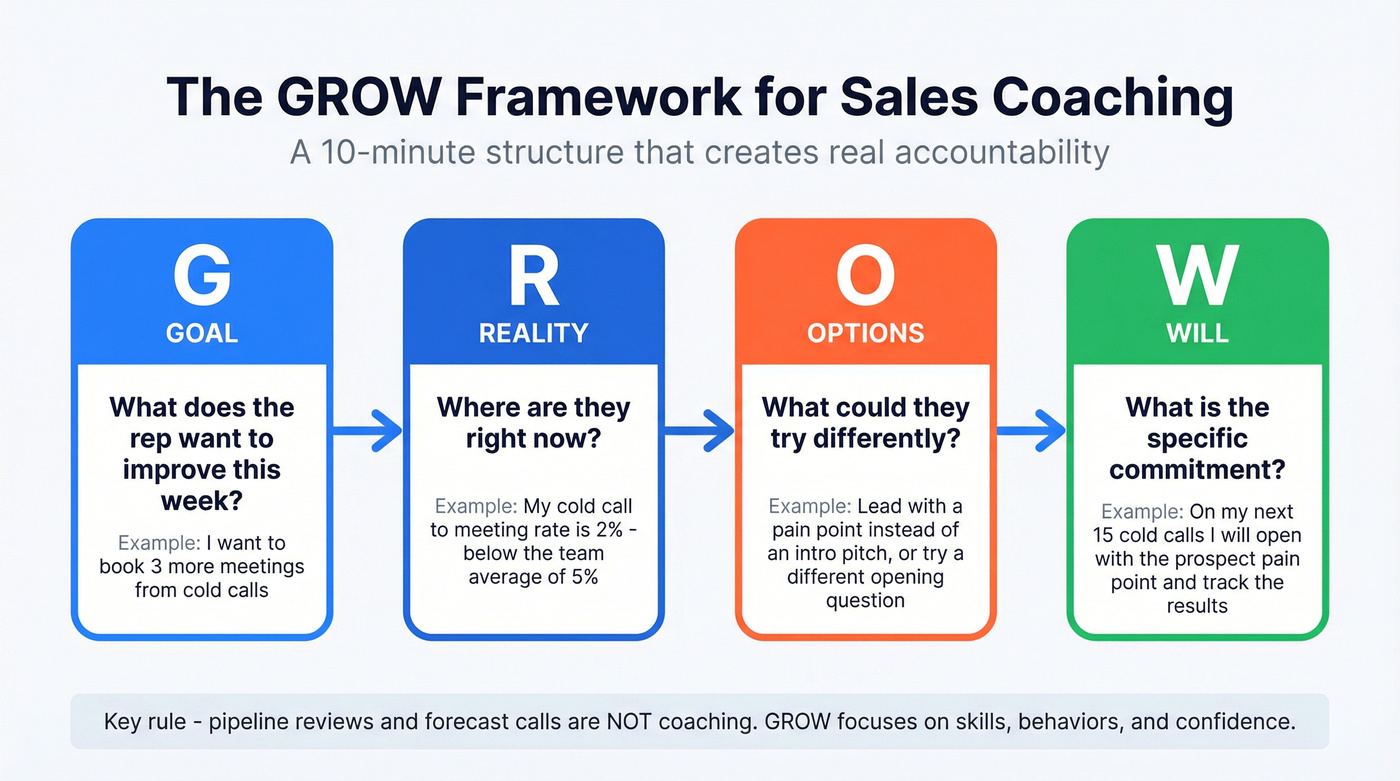
The baseline: weekly 1:1s plus one to two call reviews per week. Only 26% of reps receive weekly coaching, and the teams that do see 25% higher quota attainment and 30% more deals won. Pipeline reviews and forecast calls aren't coaching. Coaching is about skills, behaviors, and confidence - the how behind performance.
First-time managers: your job isn't to save deals. It's to enable reps to save their own deals. That mindset shift is everything.
Use the GROW Framework
The GROW model keeps coaching conversations from drifting into aimless chat. Goals - what does the rep want to improve this week? Reality - where are they now? Options - what could they try differently? Will - what's the specific commitment for the next five calls? It takes ten minutes and creates real accountability.
Coach Up or Coach Out
Coach up when the rep shows effort, asks questions, and makes measurable progress on coached behaviors. The best managers learn to spot coachable moments as they happen - a rep who just lost a deal they cared about, a call that went sideways in a surprising way, a win the rep can't fully explain. These windows of openness are when feedback lands hardest. Document the plan, set specific KPI thresholds like call-to-meeting conversion, discovery quality scores, and pipeline generation, then review weekly.
Coach out when you've delivered documented, structured coaching for 90 days and there's no measurable improvement on agreed behaviors. Not "they didn't hit quota" - that's a results problem. No improvement on coached behaviors despite consistent feedback. That's the signal.
Anything shorter than 90 days and you haven't given coaching enough time. Anything longer and you're absorbing the cost of a bad fit while demoralizing the rest of the team.
How to Become More Coachable as a Rep
If you're a rep reading this, coachability is the single fastest way to accelerate your career.
Don't take coaching personally. Your manager isn't attacking you when they say your discovery calls lack depth. They're giving you a lever to pull. The reflexive "but I always do it this way" response is the fastest way to get labeled uncoachable - even if you're right.
Tell your manager how you like to be coached. Some reps want direct, blunt feedback. Others need time to process before debriefing. Your manager isn't a mind reader. Have the conversation.
Ask questions proactively. Don't wait for your 1:1. After a tough call, ask "what would you have done differently?" Reps who seek coaching build a reputation for being hungry to improve, and that reputation compounds over months and years in ways that quota attainment alone can't match.
Coachability looks different by career stage. New hires need humility - you don't know this company's buyers yet, regardless of your track record. Tenured reps need an "always be learning" mindset, because the market shifts faster than your habits. And if you've just joined a new company, reset your assumptions completely. What worked at your last org might actively hurt you here.
Fix the Data Before You Fix the Rep
Here's a pattern we see constantly: a manager flags a rep as uncoachable because their numbers are down. More coaching sessions, more call reviews, tighter feedback loops. Nothing improves. Everyone concludes it's a coachability problem.
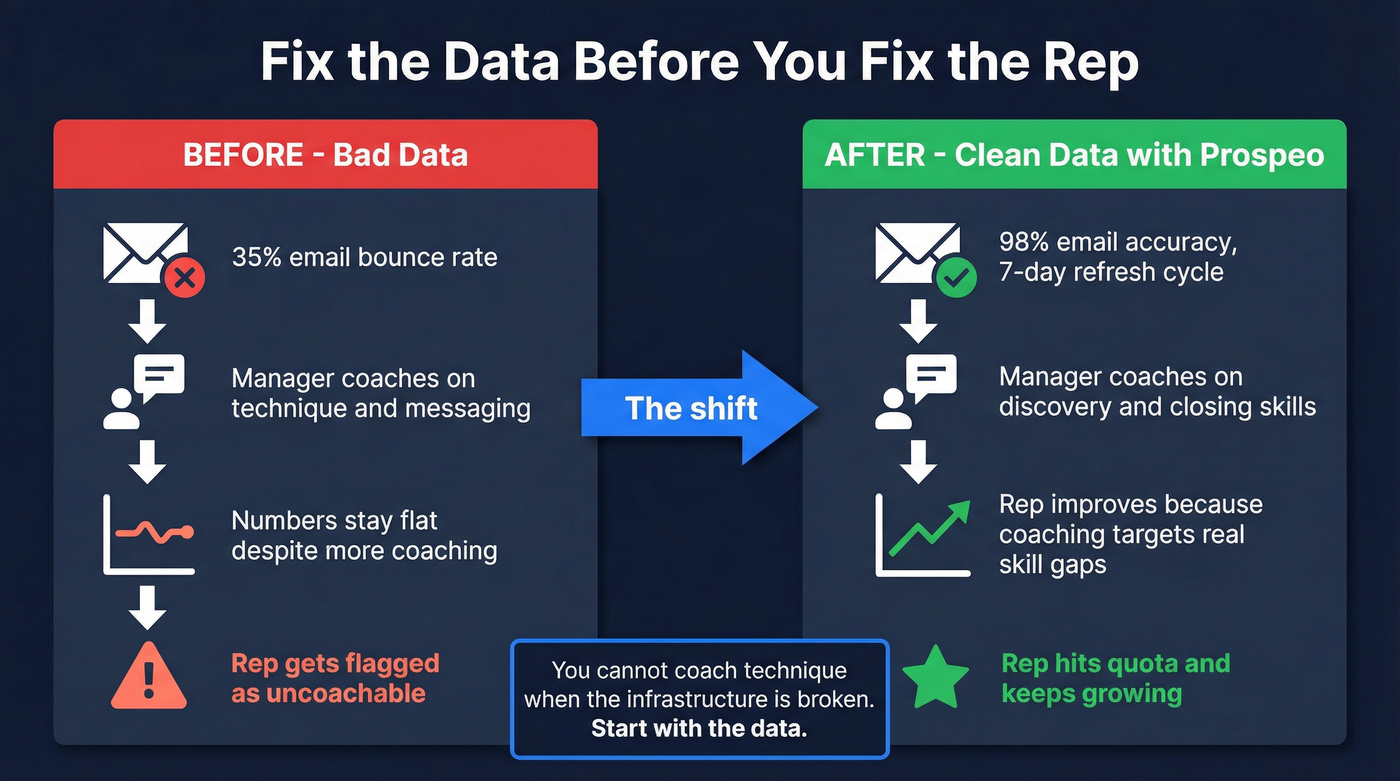
Then someone audits the rep's contact list and finds a 35% bounce rate.
You can't coach technique when the infrastructure is broken. If half a rep's emails bounce and their direct dials ring dead numbers, that's not a coaching problem - it's a data problem masquerading as one. Tools like Prospeo eliminate this upstream with 98% email accuracy and a 7-day data refresh cycle. When bounce rates drop from 35% to under 5%, coaching conversations shift from "why aren't you getting through?" to "let's sharpen how you run discovery." That's where real development happens.
One customer, Snyk, saw this firsthand: 50 AEs had been prospecting 4-6 hours per week against lists with 35-40% bounce rates. After switching, bounces dropped below 5%, AE-sourced pipeline jumped 180%, and managers could finally coach on selling skills instead of troubleshooting deliverability.

Bad data costs more than a bad hire. If your reps are working bounced emails and dead numbers, coaching ROI drops to zero. Prospeo gives your team 300M+ verified contacts with 125M+ direct dials - so every coaching session translates to real pipeline, not wasted reps.
Eliminate the #1 excuse before your next 1:1.
FAQ
Is coachability a skill or a personality trait?
It's a behavior - observable, measurable, and buildable. The Leadership IQ study showed 89% of new-hire failures stem from attitude, but attitude shifts with structured coaching and psychological safety. Treat it as a muscle you develop, not a gene you're born with.
How do you demonstrate coachability in a sales interview?
Implement feedback between roleplay rounds visibly - even imperfectly. Ask clarifying questions and reference past coaching moments with specific before-and-after outcomes. Interviewers watch for iteration speed, not perfection. Candidates who score 7+ on the rubric above almost always get advanced.
What's the biggest hidden barrier to sales coaching effectiveness?
Bad prospect data. Reps burning hours on bounced emails and dead numbers can't be coached on technique - they're fighting infrastructure. Fix the data first, then coach the skills. Even the most coachable reps plateau when the foundation is broken.
When should you coach out instead of coach up?
After 90 days of documented, structured coaching with no measurable improvement on agreed behaviors. The key word is behaviors, not results - quota misses alone aren't proof. If a rep still isn't applying feedback after three months of consistent, specific coaching, it's time to part ways.