

Lead Generation Outsourcing vs In-House: The Real Numbers Behind the Decision
Thirty percent of small businesses say lead generation is their single biggest marketing obstacle. The first fork in the road - outsource it or build it yourself - trips up even experienced revenue leaders. Most of the advice out there is useless because it's written by agencies selling outsourcing or consultants selling hiring playbooks.
We work with 15,000+ companies running both models, and we see exactly where each one breaks. So instead of pitching you a side, we're going to lay out the actual numbers, the hidden costs nobody mentions, and a framework you can score yourself against. Fifty-nine percent of companies already outsource at least some lead generation. Whether you join them or go fully in-house, the math should drive the decision - not a vendor's sales deck.
30-Second Verdict
If you want the shortcut:
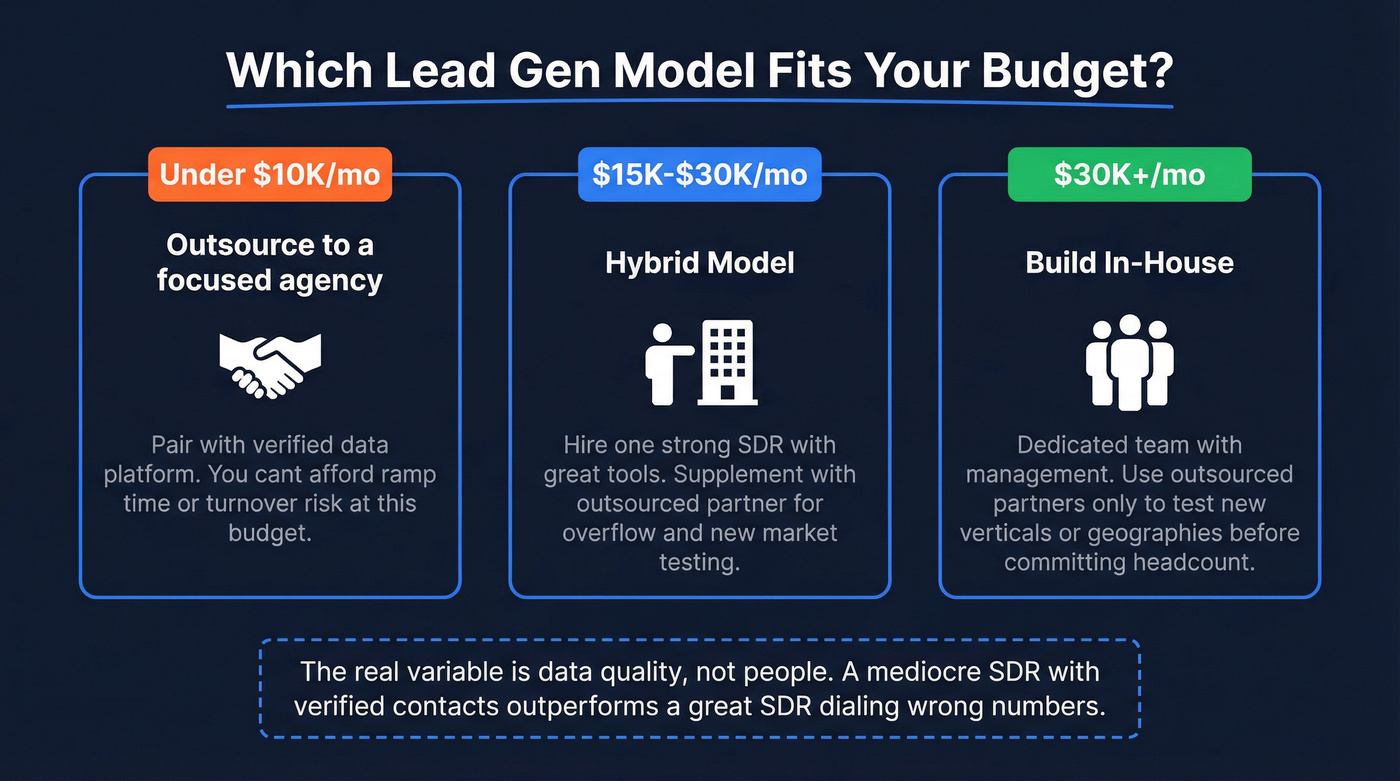
- Under $10K/month: Outsource to a focused agency and pair it with a verified data platform. You can't afford the ramp time or turnover risk of a full-time hire at this budget.
- $15K-$30K/month: Hire one strong SDR, arm them with the right tools, and supplement with an outsourced partner for overflow or new market testing.
- $30K+/month: Build in-house with dedicated management. Use outsourced partners to test new verticals or geographies before committing headcount.
Here's the thing: most companies agonize over the people decision when the real variable is data quality. A mediocre SDR with verified contacts outperforms a great SDR dialing wrong numbers. More on that below.
True Cost of In-House Lead Gen
The number on the offer letter isn't the number that matters. A $55K base salary SDR actually costs $110K-$150K/year once you add everything up:
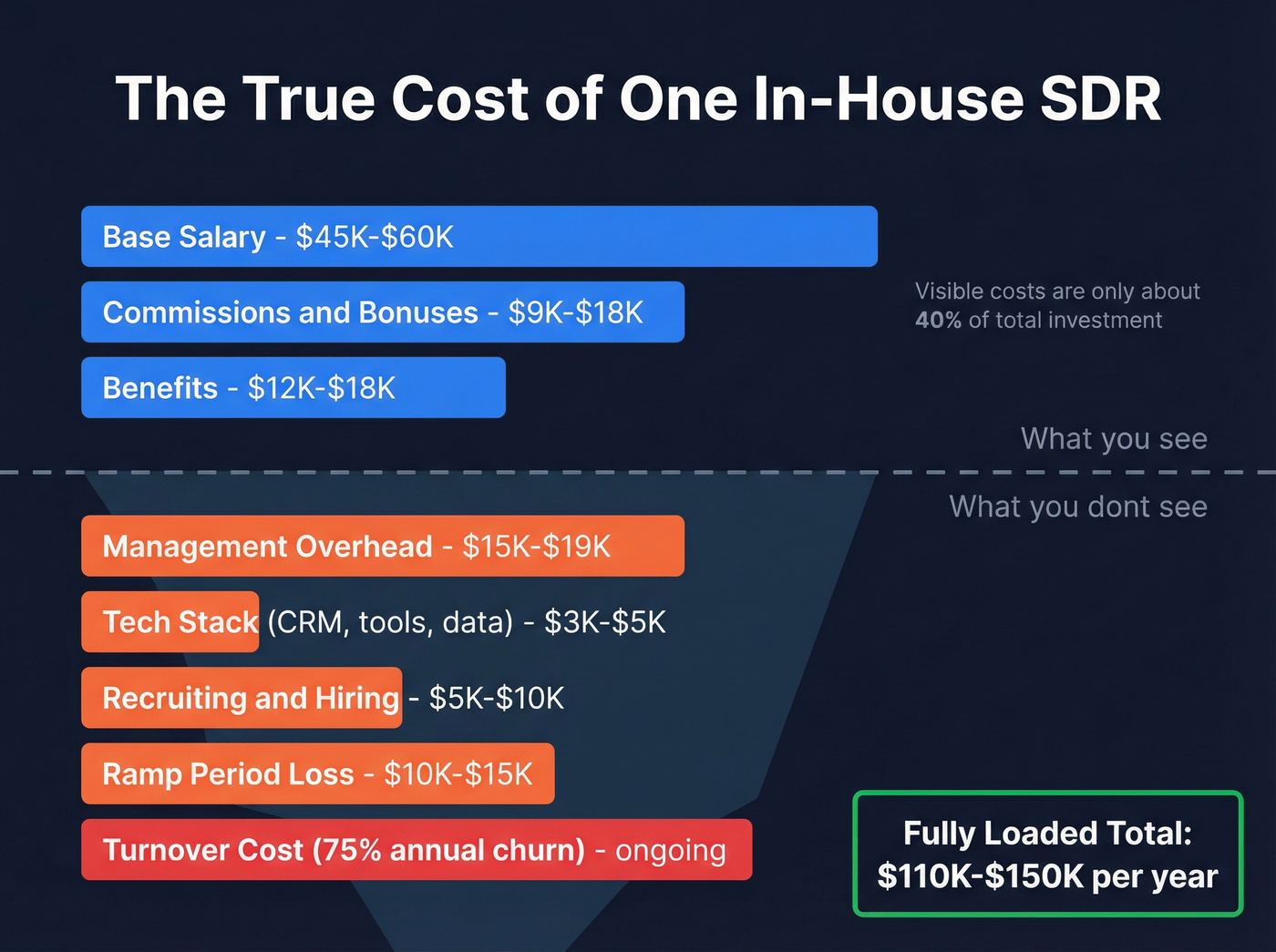
| Cost Component | Annual Range |
|---|---|
| Base salary | $45,000-$60,000 |
| Commissions/bonuses | $9,000-$18,000 |
| Benefits (health, PTO) | $12,000-$18,000 |
| Management overhead | $15,000-$18,750 |
| Tech stack | $3,000-$5,000 |
| Hiring/recruiting | $5,000-$10,000 |
| Ramp-period loss | $10,000-$15,000 |
| Fully loaded total | $110,000-$150,000 |
That management overhead line deserves attention. You need roughly one manager per 8-10 SDRs, and a fully loaded SDR manager runs $120K-$150K. Even with a small team, someone's spending 15-20% of their time coaching, reviewing calls, and running pipeline meetings.
The tech stack adds up faster than most leaders expect. Sales Navigator runs $99-$159/mo, engagement platforms like Outreach cost $100-$150/mo, and data providers add another $50-$100/mo on top of CRM costs. For teams running a full outbound stack, that number climbs toward $300-$900/mo per rep.
Visible costs represent only about 40% of your total SDR investment. The rest hides in management time, ramp loss, and turnover. Average SDR tenure is 16 months, and companies replace roughly 75% of their SDR team annually. You're perpetually hiring, training, and losing institutional knowledge. The performance variability makes it worse - top-quartile SDRs outperform bottom-quartile by 320%, and the top 20% produce 60-80% of results. You're not just betting on a hire. You're betting on getting one of the good ones.
What Outsourcing Actually Costs
Outsourced SDR agencies typically charge $4K-$12K per month per SDR-equivalent, depending on scope:
| Tier | Monthly Cost | Annual Cost | What You Get |
|---|---|---|---|
| Email-only | $3,000-$4,500 | $36K-$54K | Email sequences + lists |
| Multichannel | $5,000-$7,000 | $60K-$84K | Email, calls, social |
| Full-service | $8,000-$12,000 | $96K-$144K | All channels + strategy |
A realistic mid-tier engagement - $5K/mo retainer, $3K annual performance bonus, $2K onboarding fee - comes to roughly $65K/year. Compare that to the $125K+ fully loaded cost of an in-house SDR doing comparable work.
The math gets more dramatic at scale. Two in-house SDRs plus a manager runs $300K-$350K annually. An outsourced equivalent delivering comparable output runs $120K-$150K. That's a 40-60% cost reduction on paper - but we'll get to the caveats.
Side-by-Side Comparison
| Dimension | In-House | Outsourced | Edge |
|---|---|---|---|
| Annual cost (per SDR) | $110K-$150K | $36K-$84K | Outsourced |
| Time to first meeting | 3-6 months | 2-6 weeks | Outsourced |
| Ramp to full output | ~3.2 months | Days to weeks | Outsourced |
| Scalability | Slow (hiring cycles) | Fast (add seats) | Outsourced |
| Control over messaging | Full | Partial | In-House |
| Data quality risk | You own it | Vendor-dependent | In-House |
| Compliance risk | Manageable | Higher (less visibility) | In-House |
| Long-term asset value | High (institutional) | Low (rented) | In-House |
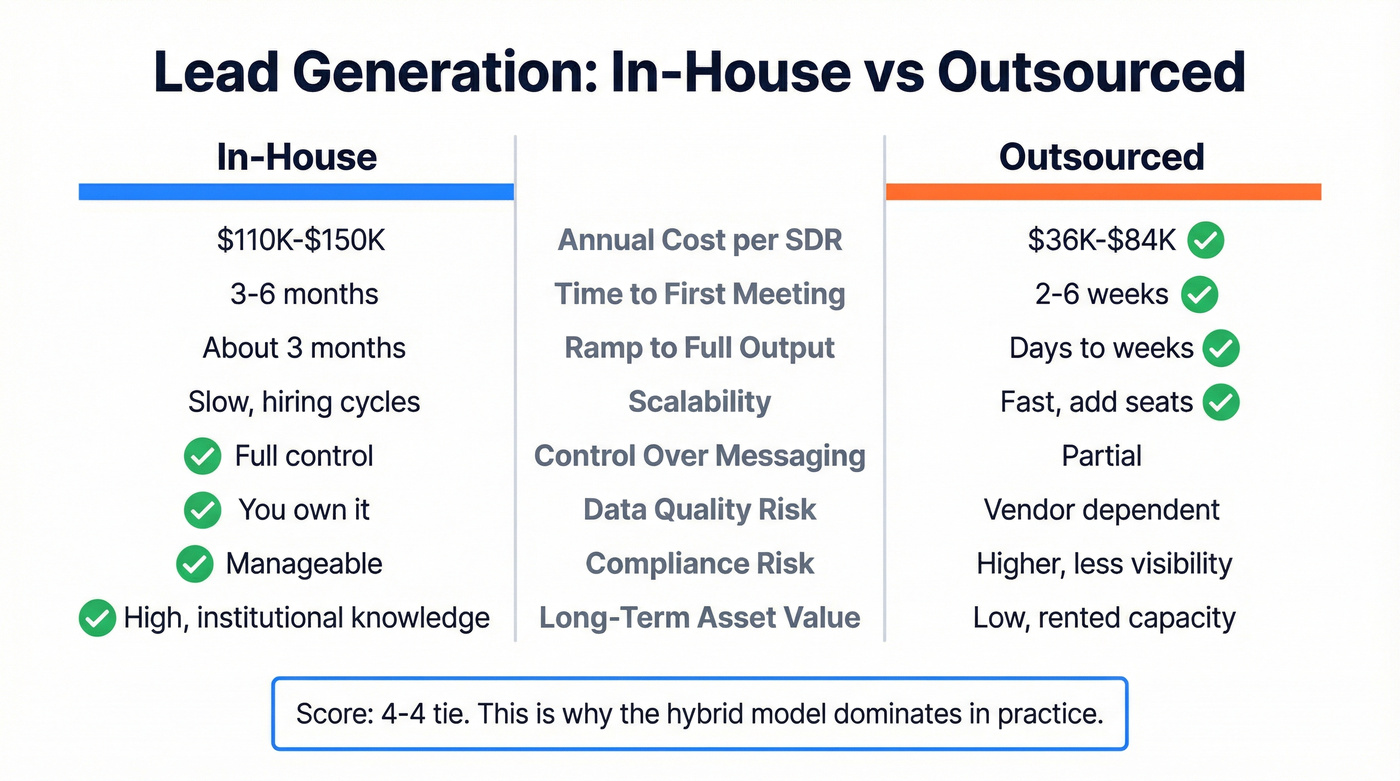
Outsourcing wins on speed, cost, and flexibility. In-house wins on control, compliance, and long-term value. The split is 4-4, which is exactly why the hybrid model dominates in practice.
The speed difference surprises people most. An outsourced team can start booking meetings within weeks. An in-house team takes an average of 3.2 months to reach full productivity - and that's after you've spent weeks recruiting. For companies that need pipeline now, that gap is enormous.
But look at the last row. When you build internally, you're building an asset: playbooks, tribal knowledge, feedback loops between SDRs and AEs. When you outsource, you're renting capacity. The moment you stop paying, the pipeline stops. In our experience working with thousands of sales teams, the companies that build the most durable pipeline eventually bring at least some of the motion in-house.

You just saw that a mediocre SDR with verified contacts outperforms a great SDR dialing wrong numbers. Prospeo gives both in-house and outsourced teams 300M+ profiles with 98% email accuracy, refreshed every 7 days - at $0.01 per email. That's 90% cheaper than ZoomInfo, with bounce rates under 4%.
Stop debating headcount. Start fixing the data underneath it.
Why Lead Gen Fails (Either Way)
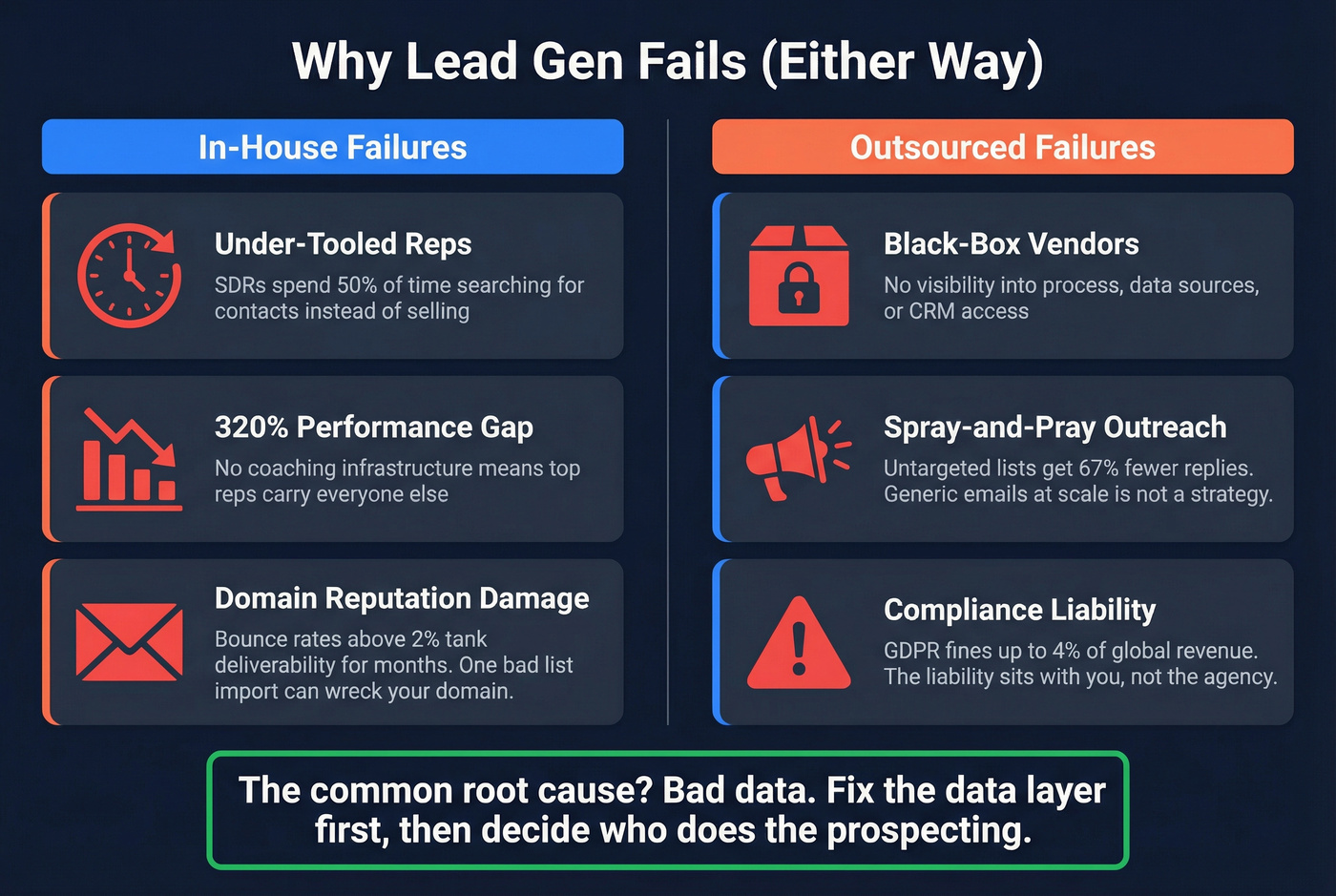
Stop comparing salary vs. retainer. Start comparing cost-per-qualified-meeting. Both models fail at roughly the same rate - just for different reasons.
When In-House Fails
The most common failure mode isn't lazy reps. It's under-tooled reps spending 50% of their time searching for contacts instead of actually selling. That's a data problem masquerading as a productivity problem.
Without coaching infrastructure, you get that 320% performance gap between top and bottom quartile - and no mechanism to close it. Most companies hire SDRs, hand them a login to a data tool, and expect results. That's not a lead generation strategy. That's hope.
Domain reputation risk is real too. If your bounce rate climbs above 2% or your spam complaint rate exceeds 0.01%, you're damaging your sender reputation for months. One bad list import can tank deliverability across your entire domain. Snyk's 50 AEs saw bounce rates drop from 35-40% to under 5% after switching to verified data - and AE-sourced pipeline jumped 180%, generating 200+ new opportunities per month. That's the difference data quality makes at scale.
When Outsourcing Fails
The most common complaint about outsourced lead gen? Black-box vendors who won't share their process, their data sources, or CRM access. If you can't see the emails going out under your domain, you've lost control of your brand.
Spray-and-pray outreach is the second killer. Emails to large untargeted lists get 67% fewer replies than smaller, targeted groups, and personalized emails achieve 14% higher open rates. Yet plenty of agencies still blast 10,000 generic emails a week and call it "scale."
Then there's compliance. GDPR fines can hit up to 4% of global annual revenue or EUR 20M, whichever is higher. If your outsourced partner is scraping contacts without consent and emailing EU prospects, that liability sits with you, not them. Skip any agency that can't explain their data sourcing and consent framework in plain language.
GreyScout learned this the hard way - their bounce rate sat at 38% before dropping to under 4% once they moved to verified contacts. Pipeline jumped 140%, and they doubled their sales team from 2 to 5 reps. The agency model wasn't the problem. The data was.
The Data Layer Nobody Talks About
Every article comparing outsourced and in-house lead generation frames this as a people decision. It's not. It's a data decision first.
When SDRs spend half their time hunting for contact information, the problem isn't headcount - it's infrastructure. When an outsourced agency burns your domain with a 15% bounce rate, the problem isn't the agency model - it's the data they're using. We've seen teams burn through $50K in agency fees before realizing the data was the bottleneck all along. The consensus on r/sales echoes this constantly: reps don't need more tools, they need tools that actually give them accurate contact info.
Before you decide who does the prospecting, make sure whoever does it has data that works. Prospeo's database covers 300M+ professional profiles with 98% email accuracy and 125M+ verified mobile numbers with a 30% pickup rate. Data refreshes every 7 days versus the 6-week industry average, so you're not emailing people who changed jobs two months ago.

For teams running lean, Prospeo starts with a free tier and scales at roughly $0.01 per email - no annual contracts, no "talk to sales" gates. Whether you're arming an in-house SDR or vetting the lists your outsourced partner sends, verified data is the foundation that makes either model work.
Calculating Cost-Per-Meeting
Every agency cites a stat about outsourcing delivering "43% better ROI." Nobody links to the original study. Let's skip the hand-waving and build a model you can actually use.
Conversion benchmarks by channel:
| Channel | Lead to Appointment | Appointment to Close |
|---|---|---|
| Cold email | 2.7% | 3.5% |
| Social outreach | 3.4% | 5.7% |
| Paid search | 4.2% | 5.7% |
| SEO/content | 47% | 6.4% |
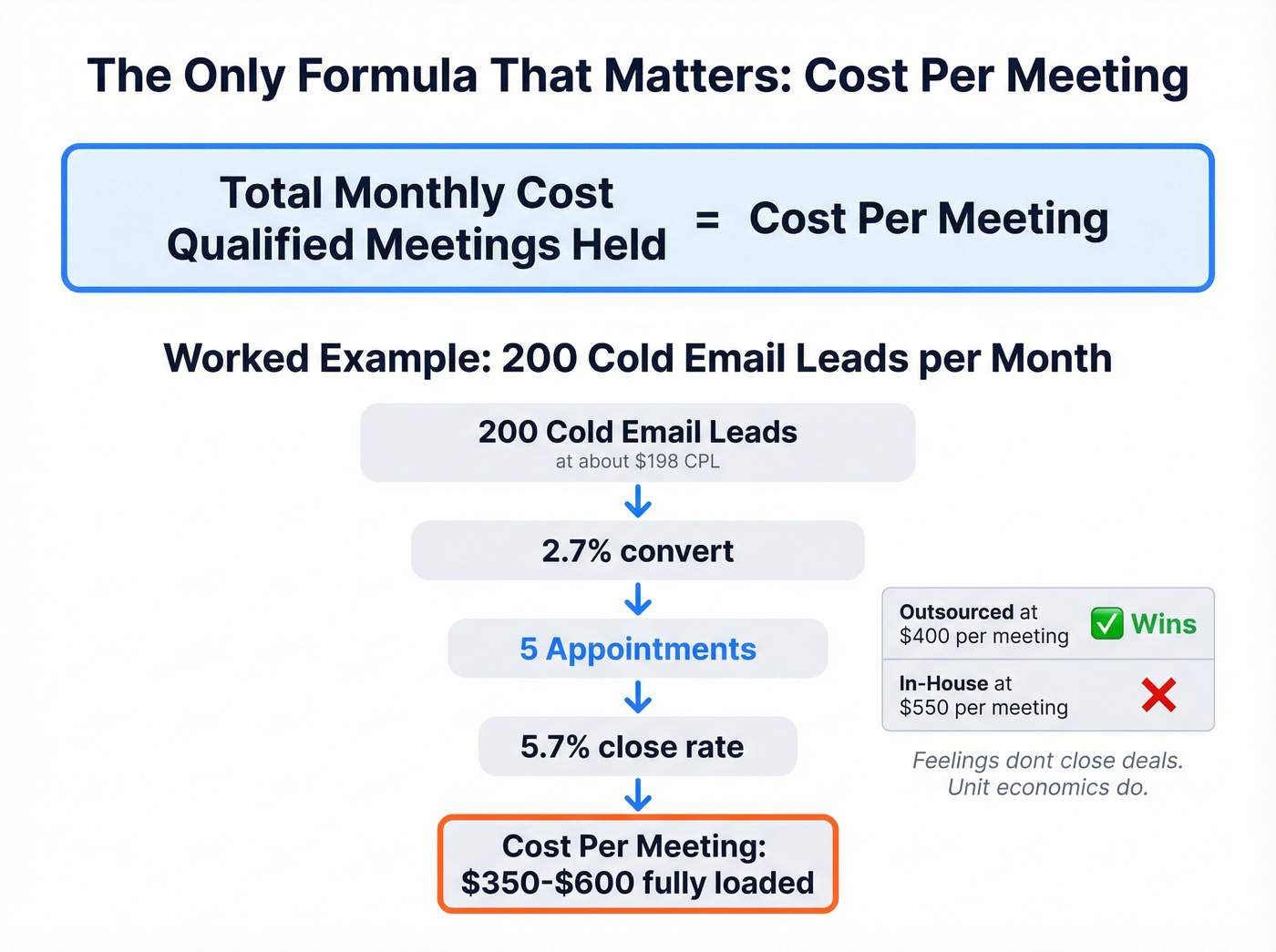
Now a worked example. Say you're generating 200 cold email leads per month at an average B2B CPL of ~$198:
- 200 leads x 2.7% lead-to-appointment = ~5 appointments
- 5 appointments x 5.7% appointment-to-close = ~0.3 closed deals (roughly 1 deal per quarter)
- Total monthly spend: ~$39.6K in lead costs + SDR/agency costs
- Cost per meeting (fully loaded): $350-$600
The formula that actually matters: total monthly cost / qualified meetings held = cost per meeting. That's the number you compare across models. Not salary vs. retainer. Not headcount vs. agency fee.
If your outsourced partner delivers meetings at $400 each and your in-house team delivers them at $550, the outsourced model wins - even if the in-house team "feels" more controlled. If the numbers flip, bring it in-house. Feelings don't close deals. Unit economics do.
Decision Framework
Score your situation against this matrix:
| Criterion | Outsource | Hybrid | In-House |
|---|---|---|---|
| Monthly budget | Under $10K | $10K-$30K | $30K+ |
| Time to first meetings | Need them in weeks | 1-2 months OK | 3-6 months OK |
| ICP complexity | Simple/well-defined | Moderate | Complex/evolving |
| Existing sales infra | Minimal | Some tools/process | Full stack + mgmt |
| Growth stage | Early/seed | Series A-B | Series C+ / scaled |
Three or more checks in the "outsource" column? Start there. Split between hybrid and in-house? Use customer acquisition cost as the tiebreaker: calculate your CAC including time, tools, labor, ad spend, and opportunity cost. The model with the lower CAC wins, regardless of which one feels more "strategic."
The hybrid model is where most growing companies land - and honestly, it's the smartest path for the majority of Series A-B teams. Outsource to validate your ICP and messaging, build the playbook, then hire in-house once you know what works. You don't have to pick one path forever. The best revenue teams treat this as a portfolio decision, not a binary choice.
Snyk's 50 AEs cut bounce rates from 35% to under 5% and generated 200+ new opportunities per month - because the data actually connected them to real buyers. Whether you run lead gen in-house or outsource it, Prospeo's 5-step verification and 7-day refresh cycle eliminate the #1 reason both models fail.
Your SDR model is only as good as the numbers they're dialing.
FAQ
Is this decision really just about cost?
Per-SDR, outsourcing runs roughly $65K/year versus $125K+ in-house. But compare cost-per-qualified-meeting instead - the cheaper model is whichever produces qualified pipeline more efficiently for your specific motion and ICP.
How fast does outsourced lead gen produce results?
Outsourced teams typically book first meetings within 2-4 weeks versus 3-6 months for a new in-house hire. Expect the first 30 days focused on onboarding and messaging iteration, with consistent pipeline kicking in around month two.
What's the biggest risk of outsourcing?
Black-box vendors using unverified data under your domain. Demand CRM access, review every email template, and insist on seeing bounce and reply rate data weekly. If they won't share, walk away - your sender reputation is on the line.
Can I start outsourced and move in-house later?
Yes - this hybrid playbook is the smartest path for most growing companies. Outsource to validate your ICP and messaging, then hire SDRs who can execute a proven process. Pair them with verified data to maintain the deliverability standards your agency established.
How does data quality affect results?
Bad data is the silent killer of both models. GreyScout's bounce rate dropped from 38% to under 4% after switching to verified contacts, and pipeline jumped 140%. Weekly-refresh data eliminates stale contacts regardless of who runs your outbound.