

1:1 Meeting Template Guide: 7 Agendas, 50 Questions, Zero Status Updates
It's Tuesday morning. You've got four back-to-back 1:1s, no agenda for any of them, and your best engineer just Slacked you "can we talk about my career?" with zero context. You're about to wing it - again.
You're not alone. A solid 1:1 meeting template changes everything, yet most managers don't use one. In a study of nearly 15,000 employees, only 16% said their last conversation with their manager was "extremely meaningful." That's 84% of manager conversations that aren't cutting it. The fix isn't more meetings - it's better structure.
Below you'll find 7 copy-paste templates (weekly, new hire, monthly deep-dive, remote, skip-level, difficult conversation, peer), 50 categorized questions, a timeboxed agenda, and the 5 mistakes that turn 1:1s into status updates.
Why 1:1 Meetings Matter
Managers aren't just participants in engagement - they're the engine. Managers drive 70% of the variance in team engagement. Not culture decks, not perks, not the CEO's all-hands energy. The manager.
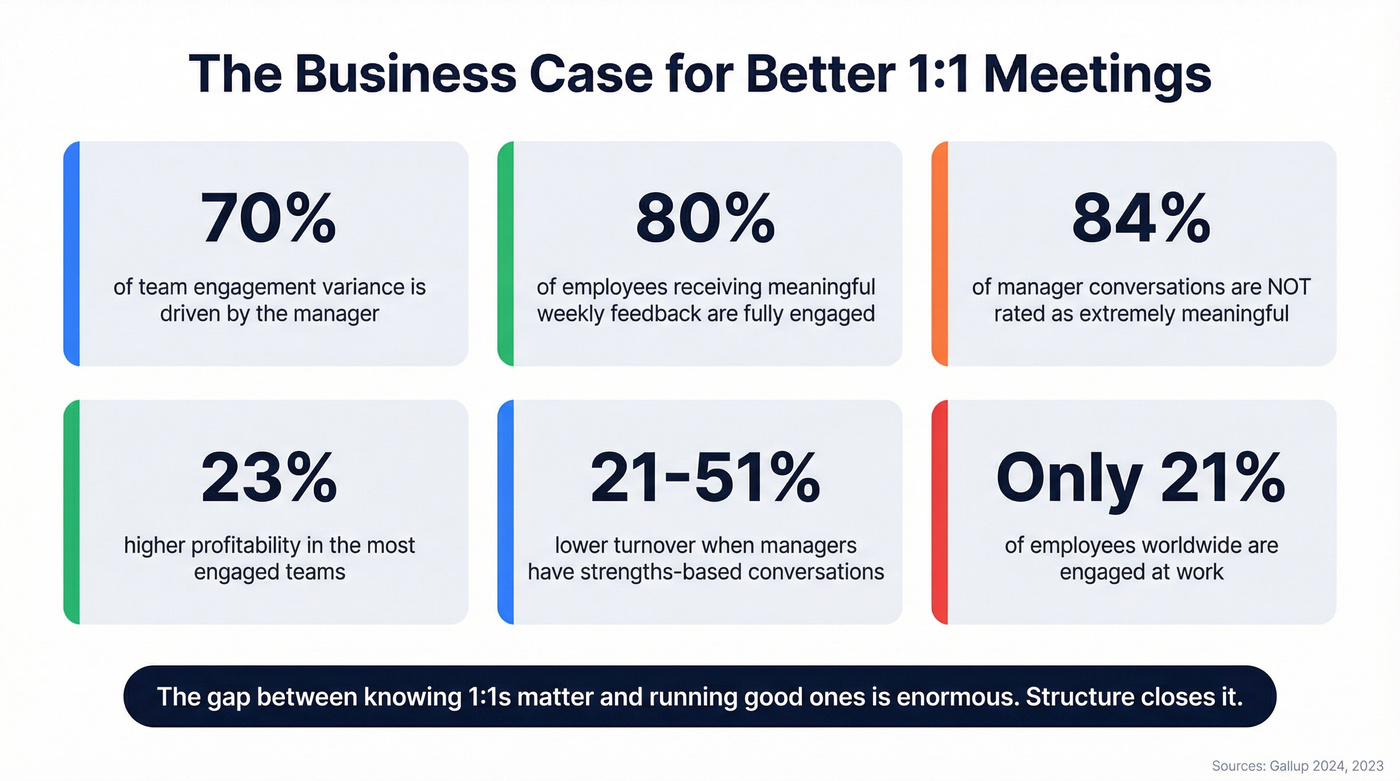
The lever that matters most? Meaningful weekly conversations. Employees who receive meaningful feedback in the past week are 80% fully engaged - regardless of whether they work from home or the office. That's four times the lift compared to getting the right number of in-office days.
A meta-analysis of 17 studies covering 14,774 participants found that strengths-based manager conversations led to 10-22% higher manager engagement, 8-18% higher team engagement, and 21-28% lower turnover within 9-18 months. The most engaged teams see 23% higher profitability, 78% less absenteeism, and turnover drops of 21-51% depending on the industry. Yet globally, only 21% of employees are engaged. The gap between knowing 1:1s matter and actually running good ones is enormous - and it's a gap that structured agendas close.
This is especially true for sales coaching meetings, where consistency directly impacts quota attainment.
How to Structure a 1:1 Meeting
Three phases, one timeboxed agenda, and a framework worth knowing.
Before the meeting: Share a doc both of you can edit. The employee adds their items first - blockers, wins, questions. You add yours after. This takes a few minutes and prevents the "so... what do you want to talk about?" dead air.
During the meeting: The employee drives. You listen, coach, and redirect. Research on meaningful conversations identified five characteristics that matter most: recognition and appreciation, collaboration and relationships, current goals and priorities, appropriate length (15-30 minutes is enough if frequent), and a focus on employee strengths.
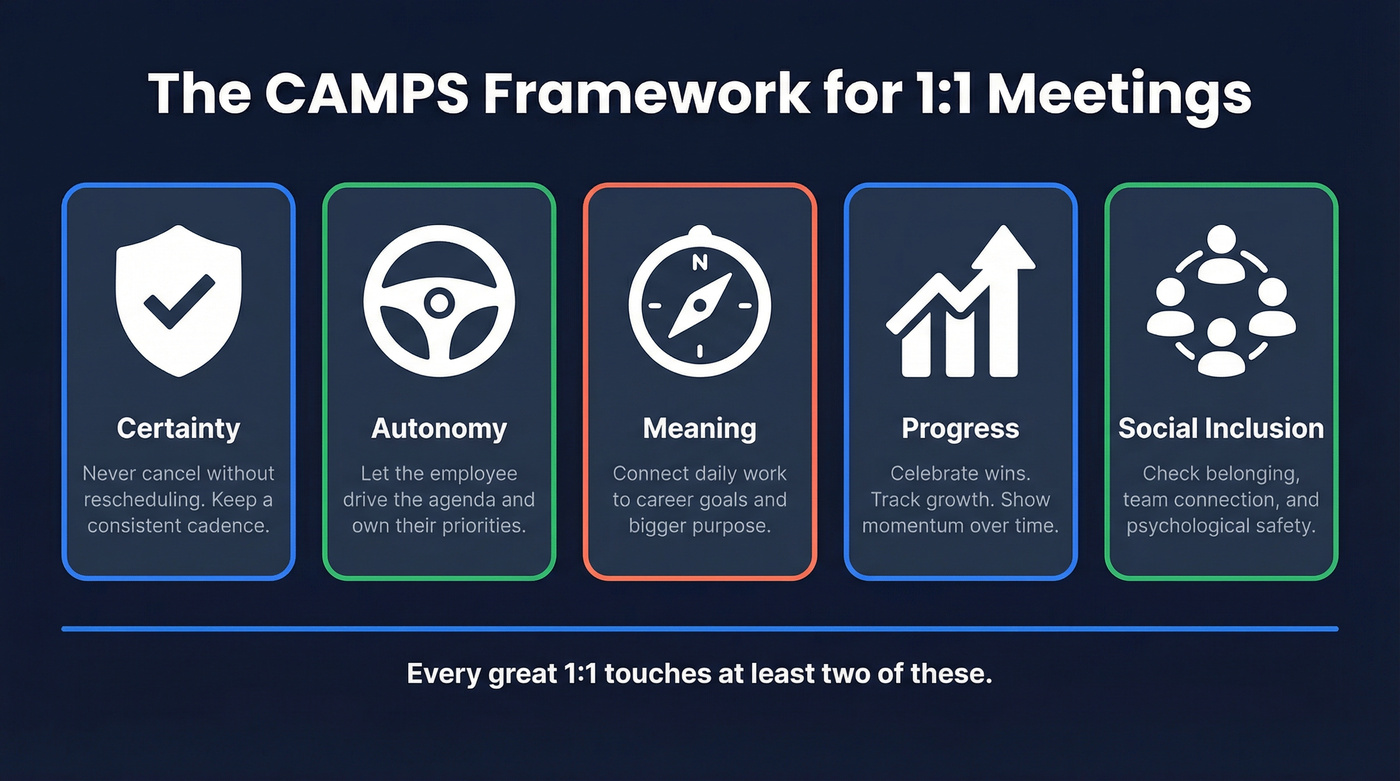
A useful mental model here is the CAMPS framework - Certainty, Autonomy, Meaning, Progress, and Social Inclusion. Every good one-on-one touches at least two of these. When you cancel a meeting, you violate Certainty. When you dictate the agenda, you undermine Autonomy. When you skip career conversations, you starve Meaning. Keep CAMPS in the back of your mind and you'll naturally cover what matters.
After the meeting: Write down action items before you close the doc. Follow up on last week's items at the start of next week's meeting. This is where most managers fail - and where trust erodes fastest.
If a live meeting isn't possible: Don't just skip the week. A written async check-in - even a 5-minute Loom video or a shared doc exchange - preserves continuity. It's not as good as a real conversation, but it's infinitely better than silence.
The 30-Minute Agenda
| Time | Focus | Owner |
|---|---|---|
| 0-5 min | Wins + check-in | Employee |
| 5-15 min | Blockers + priorities | Employee |
| 15-25 min | Growth + feedback | Both |
| 25-30 min | Action items | Both |
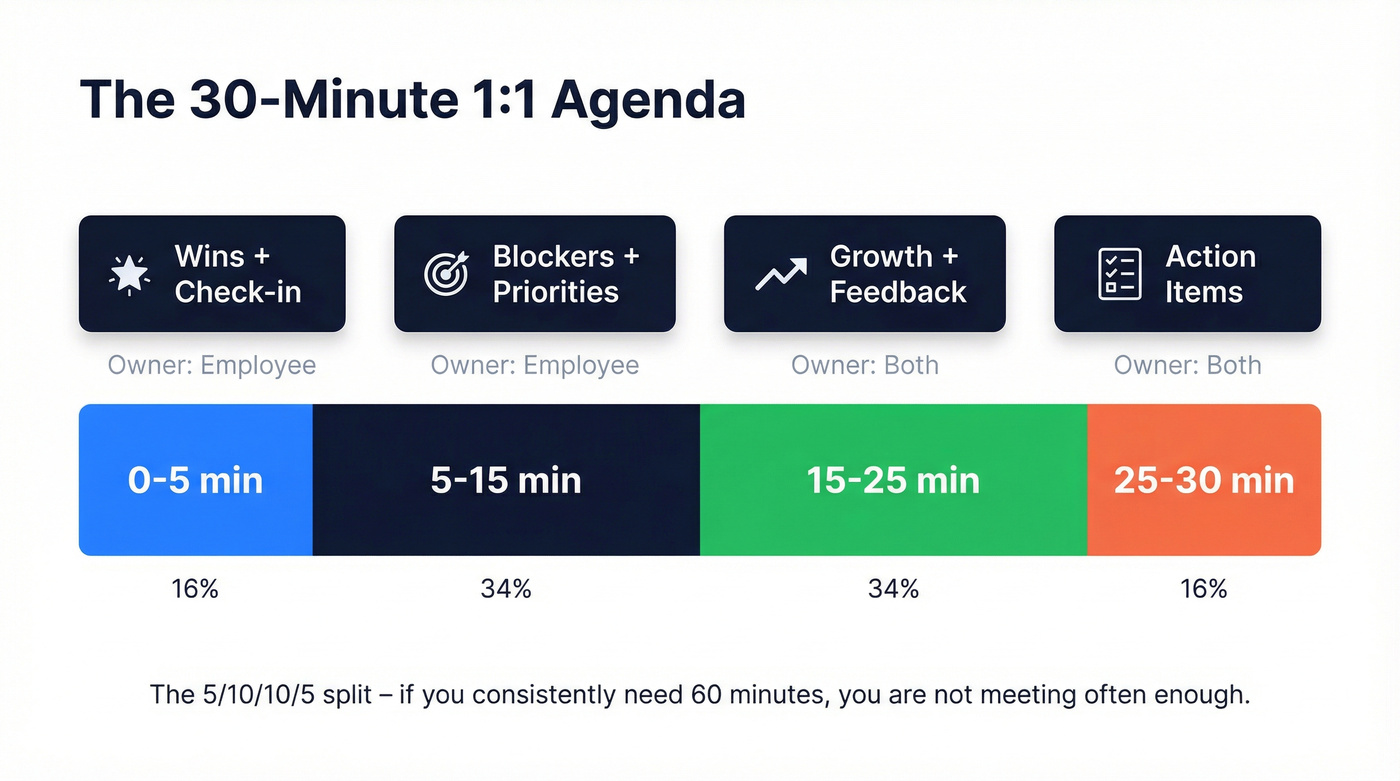
This 5/10/10/5 split keeps the conversation moving without feeling rushed. If you consistently need 60 minutes, you're either not meeting often enough or you're letting status updates creep in.
7 Ready-to-Use 1:1 Meeting Templates
Don't use the same template for every meeting. A weekly check-in with a tenured engineer needs a different structure than a first meeting with a new hire. And when your best performer says they're "thinking about what's next," you need a career deep-dive agenda - not a blockers-and-priorities rundown.
Here are seven templates, each copy-paste ready.
Weekly Check-In
If you only use one template, use this one. Start with a quick pulse: "On a scale of 1-10, how's your week?" It gives you a baseline without requiring a long answer, and it tracks trends over time.
Agenda:
- Wins (5 min): What went well this week? Anything worth celebrating?
- Blockers & priorities (10 min): What's slowing you down? What are your top 2-3 priorities for next week?
- Feedback exchange (10 min): What feedback do you have for me? Here's something I noticed this week...
- Action items (5 min): What are we each committing to before next week?
Keep status updates out of this meeting. Project progress belongs in standups or async channels. The one-on-one is for the stuff that doesn't fit anywhere else.
First 1:1 With a New Hire
The first one-on-one sets the tone for the entire relationship. Don't waste it on logistics they already got in onboarding.
Agenda:
- Get to know each other (10 min): What's your working style? How do you prefer to receive feedback - direct, written, in-the-moment?
- Expectations alignment (10 min): Here's what success looks like in the first 30/60/90 days. What questions do you have about your role?
- Communication preferences (5 min): How should we handle urgent issues? How often do you want to meet?
- Open floor (5 min): What's one thing I can do to help you ramp faster?
Monthly Career Deep-Dive
Run this once a month in place of one of your regular check-ins. 76% of Gen Z employees want more opportunities to learn and apply new skills - and they're not the only ones.
Agenda:
- Reflection (5 min): What's the most interesting work you did this month? What drained you?
- Career trajectory (10 min): Where do you want to be in 12 months? What skills are you building toward that? What's missing?
- Skill development (10 min): Is there a project, stretch assignment, or training that would help? What can I unblock?
- Action items (5 min): One concrete development step for next month.
Remote / Hybrid 1:1
With 79% of remote-capable employees working from home at least part-time, most managers need a remote-specific agenda. Remote meetings require more intentional rapport-building - there's no hallway chat to fall back on, and isolation is a real risk.
Agenda:
- Personal check-in (8 min): How are you actually doing? Feeling connected to the team? Any work-life boundary issues creeping in?
- Priorities & blockers (10 min): What's on your plate? Anything stuck because of communication gaps or async delays?
- Feedback & growth (7 min): What feedback do you have? Anything I'm missing because we're not in the same room?
- Action items (5 min): Commitments + when we'll follow up.
Decide on cameras intentionally - don't default to always-on. Some conversations are better with cameras off, especially wellbeing check-ins. Lattice's remote 1:1 framework gets this right: surface disconnection and burnout through direct questions rather than hoping people volunteer it.
Skip-Level 1:1
A skip-level is between a senior leader and someone who reports to them through a middle manager. Run these quarterly with rotating team members.
Pre-work (send 48 hours ahead): Share the agenda in advance. Explicitly state there are no negative consequences for honesty. This step is non-negotiable - without it, you'll get polished non-answers.
Live agenda:
- Rapport (5 min): What are you working on that excites you?
- Team health (10 min): How's the team functioning? What's working well? What would you change?
- Organizational clarity (10 min): Do you understand the company's direction? What feels unclear?
- Open floor (5 min): Anything you want leadership to know?
A critical failure mode: undermining the line manager. Never use skip-levels to assess a manager's performance or relay specific complaints back without permission. This is about organizational listening, not surveillance.
Difficult Conversation
When performance needs to change, winging it makes things worse. Here's the flow.
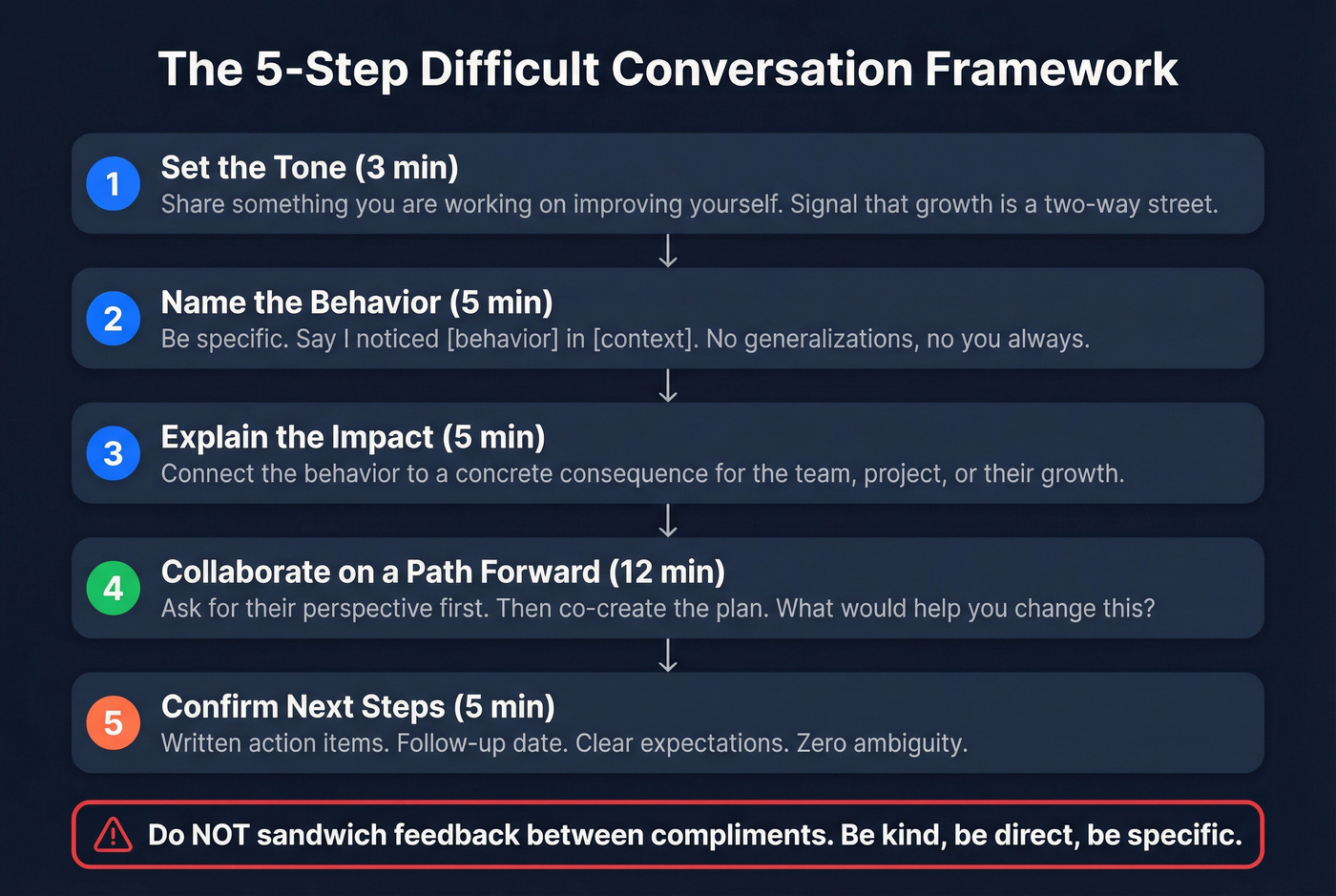
Step 1 - Set the tone (3 min). Start by sharing something you're working on improving yourself. This builds psychological safety and signals that growth is a two-way street.
Step 2 - Name the behavior (5 min). Be specific: "I've noticed [specific behavior] in [specific context]." No generalizations. No "you always."
Step 3 - Explain the impact (5 min). Connect the behavior to a concrete consequence: "The impact is [X] for the team / project / your growth."
Step 4 - Collaborate on a path forward (12 min). Ask for their perspective first. Then work together: "What would help you change this? Here's what I'd like to see by [date]."
Step 5 - Confirm next steps (5 min). Written action items. Follow-up date. Clear expectations. No ambiguity.
The biggest mistake managers make with difficult conversations is sandwiching the feedback between compliments. Don't. Be kind, be direct, and be specific. Your report will respect you more for it.
Peer 1:1 (Cross-Functional)
This isn't a manager-report meeting - it's two peers aligning on shared work. We've seen these quietly cut down the "can you jump on a quick call?" interruptions between teams. The format works best as a mutual prep exercise.
| Your Prep (before the meeting) | Their Prep (before the meeting) |
|---|---|
| What do I need from their team this sprint? | What do they need from my team? |
| What handoff is stuck on my side? | What handoff is stuck on their side? |
| What's coming in 2-4 weeks that affects them? | What's coming that affects me? |
Live meeting (30 min):
- Relationship check (5 min): How's collaboration going? Anything frustrating?
- Shared blockers (10 min): Walk through your prep lists. Resolve what you can.
- Upcoming dependencies (10 min): Flag anything new.
- Action items (5 min): Who owns what, and by when?
Which Template Fits Your Scenario?
| Scenario | Template | Cadence |
|---|---|---|
| New hire (first 90 days) | First 1:1 | Weekly |
| Experienced report | Weekly Check-In | Weekly or bi-weekly |
| Remote/hybrid employee | Remote 1:1 | Weekly |
| Senior leader + skip report | Skip-Level | Quarterly |
| Performance concern | Difficult Conversation | As needed |
| Career development focus | Monthly Deep-Dive | Monthly |
| Cross-team collaboration | Peer 1:1 | Bi-weekly or monthly |
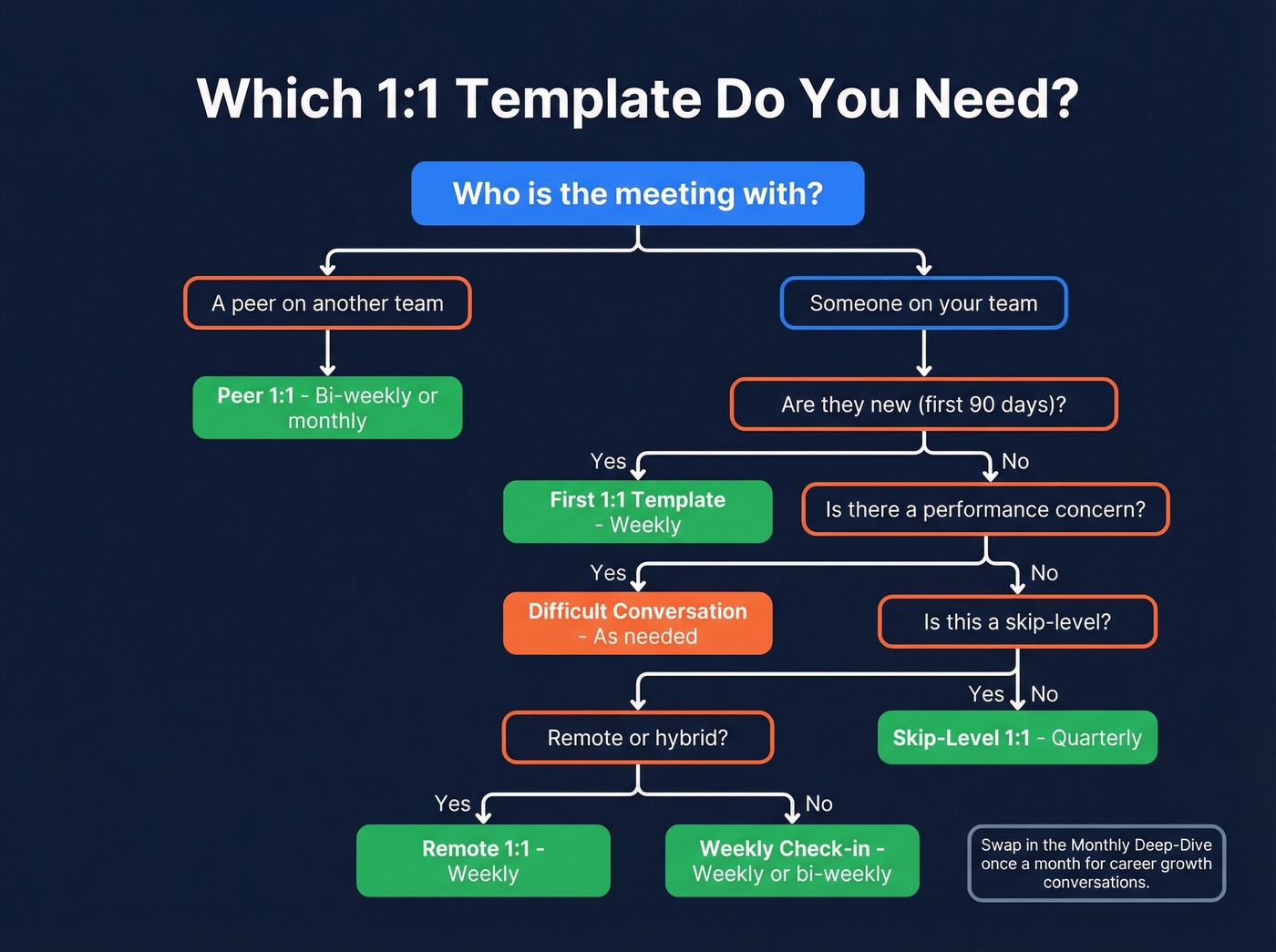
For tenured, high-performing reports, bi-weekly works - but only after trust is established. Default to weekly until you've built that foundation.

Great 1:1s uncover blockers - bad prospect data is usually the biggest one. Prospeo gives your reps 300M+ verified contacts at 98% email accuracy so coaching conversations focus on strategy, not data complaints.
Give your reps data worth coaching around.
50 Questions for Your 1:1 Agenda
Pick 3-5 per meeting. And remind your direct reports that they should bring questions too - this isn't an interrogation.
Rapport & Check-In
- How are you doing - really?
- What's one thing that went well this week?
- What's something outside of work you're excited about?
- On a scale of 1-10, how's your energy level?
- What's been on your mind lately?
- Is there anything you wish we talked about more?
- How are you feeling about the team right now?
- What's one thing I could do differently as your manager?
Priorities & Blockers
- What are your top three priorities this week?
- What's slowing you down?
- Is anything unclear about what you should be working on?
- What decision are you stuck on?
- Do you have everything you need to do your best work?
- What would you delegate if you could?
- Is any meeting or process wasting your time?
- What's one thing we should stop doing as a team?
Feedback (Both Directions)
- What feedback do you have for me?
- How could I support you better?
- Here's something I noticed this week - [specific observation].
- Is there feedback you've been hesitant to share?
- What's one thing the team does well that we should do more of?
- How do you feel about the feedback you're getting from peers?
- What's the most useful feedback you've received recently?
- Is there a way I give feedback that doesn't work for you?
Career Growth
- Where do you want to be in 12 months?
- What skills are you actively building?
- What kind of work energizes you most?
- Is there a project or role you'd love to try?
- Do you feel like you're growing here?
- What's one skill gap you'd like to close this quarter?
- Who in the company do you want to learn from?
- What would make this role your dream job?
Wellbeing & Energy
- How's your workload - sustainable or stretched?
- Are you taking enough time off?
- What's draining your energy right now?
- Do you feel like you can disconnect after work?
- Is anything about our work environment stressing you out?
- How connected do you feel to the team?
- What recharges you during the workday?
- Is there anything personal affecting your work that I should know about?
Team Dynamics
- How's collaboration within the team?
- Is there anyone you'd like to work with more closely?
- Are there any interpersonal tensions I should know about?
- Do you feel like your contributions are recognized by the team?
- What would improve our team meetings?
- Is information flowing well, or are there gaps?
- How could we make onboarding better for the next new hire?
- If you could change one thing about how we work together, what would it be?
- Do you feel safe disagreeing with the team?
- What's one thing we should celebrate that we haven't?
5 Mistakes That Ruin 1:1s
1. Treating 1:1s as status updates. This is the most common failure mode. If you're spending 25 minutes reviewing Jira tickets, you're having a standup, not a 1:1. Status belongs in async updates or team syncs. The one-on-one is for the human stuff - blockers, growth, feedback, trust.
2. No shared agenda. As Julie Zhuo puts it: "It's rare that an amazing conversation springs forth when nobody has a plan for what to talk about." A shared doc takes a few minutes to prep and transforms the meeting.
3. Skipping or canceling regularly. Every time you cancel a 1:1, you violate Certainty in the CAMPS framework - people need to know the meeting will happen. Reschedule if you must, but never just drop it. Your calendar is a statement of priorities, and your reports read it that way.
4. Letting action items slip. If you commit to unblocking something and don't follow through, your direct report stops bringing up blockers. Trust erodes one missed action item at a time.
5. Same format every time. A weekly check-in template works for 80% of meetings. But when someone's struggling, or exploring a career change, or dealing with a team conflict, you need a different structure. Stanford researchers found that walking boosts divergent thinking by roughly 60% - sometimes changing the format is the intervention. Here's the thing: the best managers I've worked with rotate between at least three of the templates above. They treat the format as a tool, not a habit.
Best Practices
Beyond avoiding mistakes, here are the habits that separate great managers from average ones.
Protect the cadence. A weekly one-on-one with sales reps or engineers should be the last meeting you cancel, not the first. Consistency builds psychological safety faster than any single conversation.
Separate coaching from evaluation. Sales coaching works best when reps feel safe sharing what's not working. If every meeting feels like a performance review, they'll stop being honest. We've seen this pattern repeatedly on our team - the moment reps trust that a 1:1 isn't a judgment call, the quality of information they share goes through the roof.
Rotate the format. Use the weekly check-in as your default, swap in a career deep-dive monthly, and pull the difficult conversation template when needed. Variety keeps both sides engaged.
End with energy. Close on a win, a commitment, or something the person is looking forward to. The last 60 seconds shape how the entire meeting is remembered.
Tools for Better 1:1s
You don't need dedicated software. A shared Google Doc with a running agenda is better than 90% of dedicated tools - because the tool isn't the problem. The conversation is.
| Tool | Price | Best For |
|---|---|---|
| Google Docs | Free | Simplest option |
| Notion | Free / ~$10-20/user/mo | Flexible templates |
| Fellow | $7/user/mo | Dedicated 1:1 workflows |
| Echometer | Free (2 or fewer employees) | Team health focus |
| Lattice | ~$10-25+/user/mo | Full performance suite |
Let's be honest about tool selection: on Reddit, especially in r/ITManagers, the consensus is that dedicated 1:1 tools often feel overbuilt. Smaller teams usually do fine with Google Docs; larger orgs get more value from Fellow or Lattice.
Sales managers, a specific note: if your weekly 1:1s with reps keep surfacing data quality complaints - bounced emails, wrong numbers, outdated contacts - the fix isn't a better meeting template. It's better data. Tools like Prospeo verify emails at 98% accuracy with a 7-day refresh cycle, so pipeline reviews focus on strategy instead of cleanup.
If you're rebuilding your outbound motion, pair these 1:1s with a clear 30/60/90 plan and a consistent set of sales activities to coach against.
Your monthly deep-dives will sound different when reps aren't blaming bounce rates. Prospeo keeps data refreshed every 7 days - not 6 weeks - so pipeline reviews stay focused on growth, not cleanup.
Stop coaching around bad data. Start coaching around closed deals.
FAQ
How often should you have 1:1 meetings?
Weekly for new hires and anyone working through performance challenges. Bi-weekly for experienced, high-performing reports - but default to weekly until trust is established. For sales teams, weekly cadence is especially important during ramp-up and quota transitions.
How long should a 1:1 be?
Thirty minutes is enough if both sides prepare. If you consistently need 60 minutes, you're either not meeting often enough or you're letting status updates creep in.
Who should set the agenda?
The employee owns the agenda. The manager adds items but lets the direct report drive. A shared doc - even a simple Google Doc - eliminates dead air and keeps both sides accountable.
What's the difference between a 1:1 and a skip-level?
A 1:1 is between a manager and their direct report, typically weekly. A skip-level is between a senior leader and someone two levels down - run quarterly, always with the agenda sent 48 hours in advance.
What's the best 1:1 meeting template for sales teams?
Start with the weekly check-in and replace "blockers & priorities" with deal-specific coaching: which opportunities are stuck, what's the next step on your top three deals, and where do you need help. Prioritize skill development and deal strategy over activity metrics - that's what separates coaching from a pipeline review.