

How to Build a Sales Playbook That Actually Gets Used
A RevOps lead on r/SalesOperations spent two months building a sales playbook - competitive intel, objection handling, buyer personas, the works. It was outdated within six weeks. Messaging changed, product shipped new features, a competitor adjusted pricing. Reps started getting different answers depending on whether they asked Product Marketing, CS, or leadership. Buyers noticed the inconsistency.
That's the reality: 87% of sales training is forgotten within weeks. The document that took a quarter to build became shelfware before the quarter ended.
This guide builds the playbook that doesn't collect dust.
What You Need (Quick Version)
A sales playbook is a living system, not a PDF - if managers don't use it in coaching, reps won't use it in selling. Focus on plays covering 80% of your common sales motions and skip the encyclopedia approach. Pick a methodology that fits your motion: SPIN for complex discovery, MEDDIC for enterprise qualification, Challenger for commoditized markets. Use a dynamic platform (Guru, Dock, or Highspot) instead of a static doc, and standardize your data tools so every rep pulls from the same verified source. The template outline below will get you started today.
What Is a Sales Playbook?
A sales playbook is the collection of policies and situational strategies organized into plays that move buyers from one stage to the next. Think of it as the operating system for your revenue team.
The distinction that matters: a play is a single repeatable motion for a specific scenario - competitive displacement, inbound demo follow-up, expansion upsell. A playbook is the system that houses all your plays, plus the process, methodology, personas, messaging, and tools that connect them. One play tells a rep what to do when a competitor comes up on a discovery call. The playbook tells them how to sell.
These resources come in several flavors: sales process, product launch, competitive, onboarding, and coaching playbooks. This guide focuses on the core sales process playbook, but the architecture applies to all of them. Alexander Group separates dynamic playbooks (updated continuously, adapted to real-time data) from static ones (rigid, rarely changed). Every playbook in this guide is dynamic by design.
Why Playbooks Drive Revenue
Four out of every five B2B deals are lost during the sales process - not because the product was wrong, but because the selling motion broke down. Companies with a defined sales process are 33% more likely to be high performers, with win rates exceeding 50%. Without one, you're relying on individual talent. And talent is unevenly distributed: 17% of sellers deliver 83% of revenue.
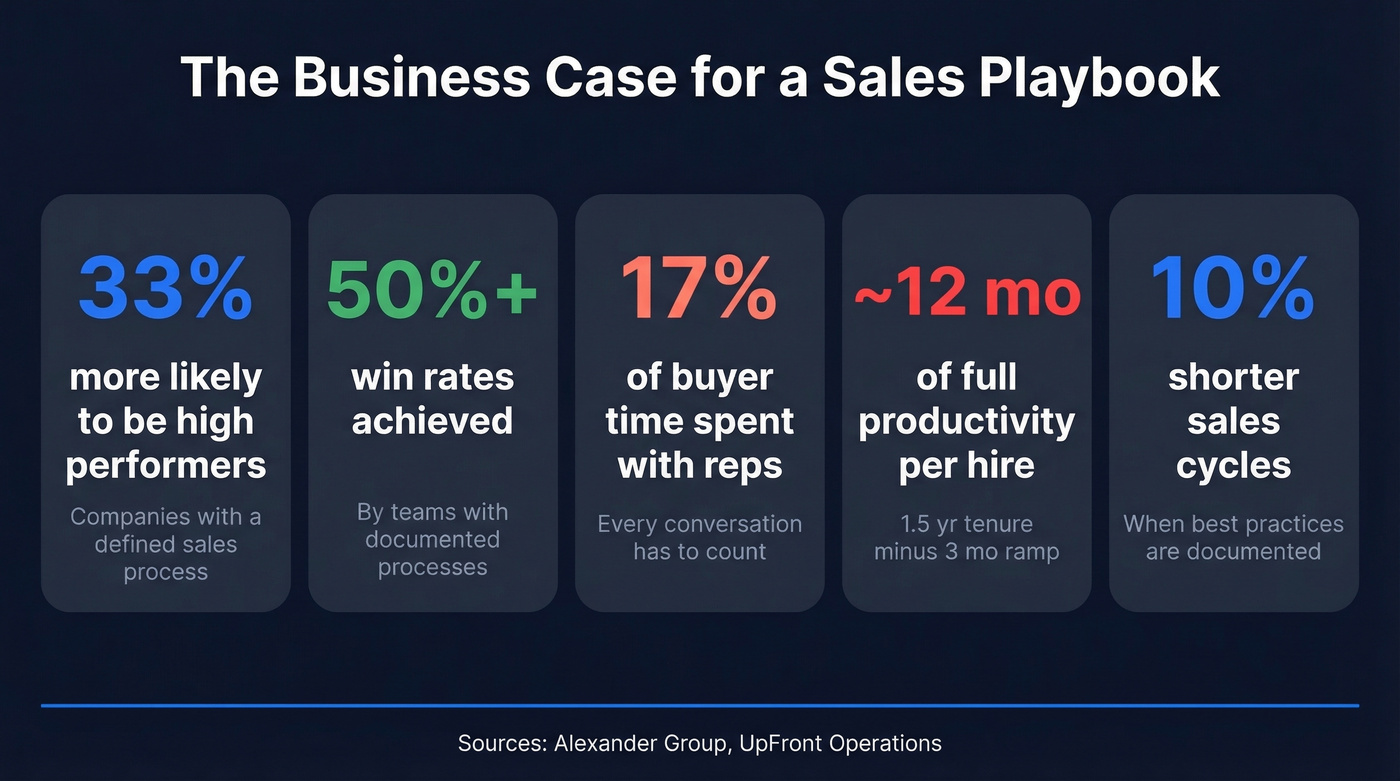
Buyers spend just 17% of their time talking to sales reps. When they do engage, your team needs to deliver a consistent, high-impact message - not a different story depending on who picks up the phone.
The math gets worse when you factor in turnover. Average rep tenure runs about 1.5 years. Factor in a 3-month ramp, and you're getting roughly 12 months of full productivity per hire. A playbook is your fastest onboarding tool - instead of shadowing for weeks, new reps get the complete selling motion on day one. Companies that document and distribute high-performer best practices see 10% shorter sales cycles, 4% higher quota attainment, and 7.9% better revenue growth versus peers. The benefits extend beyond onboarding - a playbook captures institutional knowledge before it walks out the door.
Why Most Playbooks Fail
Building a playbook isn't the hard part. Building one that reps actually open is. Three failure modes kill playbooks before they gain traction.
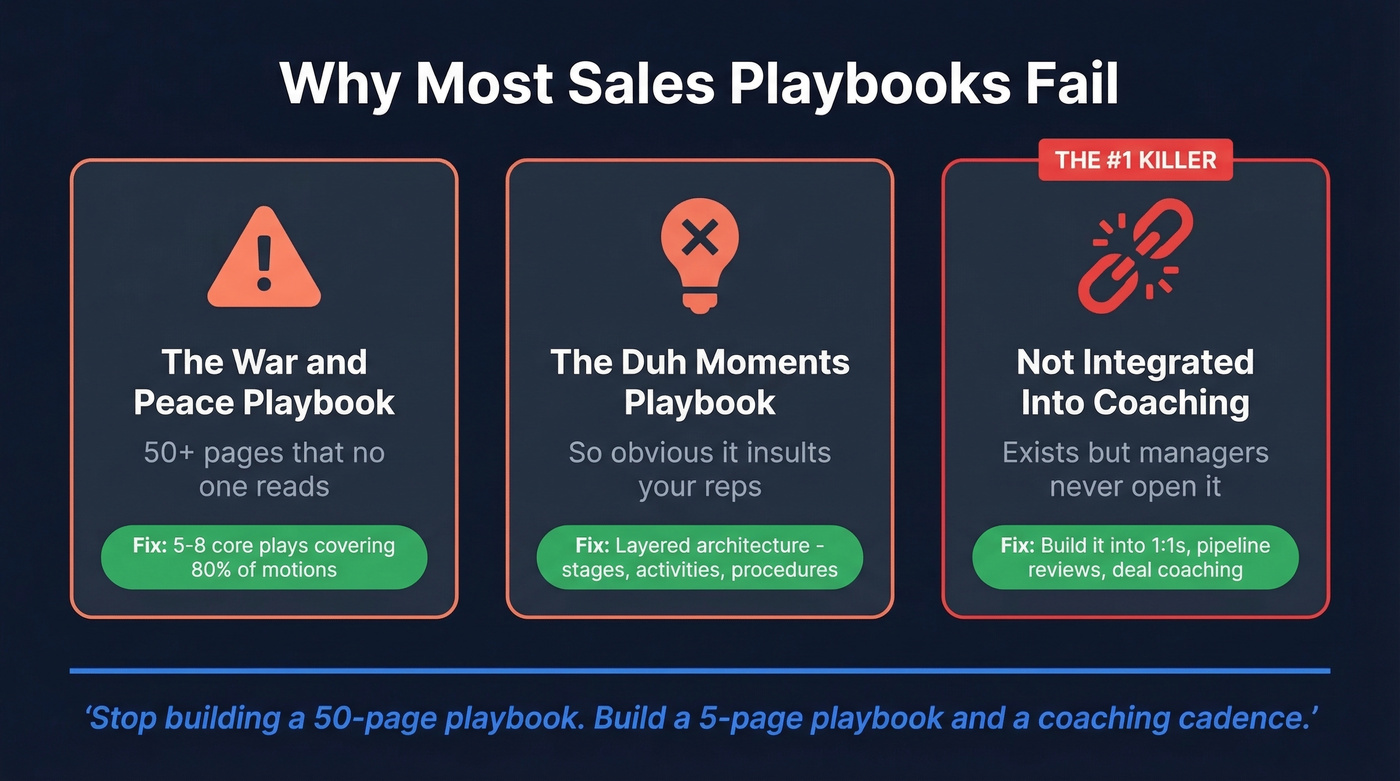
1. The "War and Peace" playbook. Design sessions explode in scope. Every stakeholder adds their section. You end up with a 50-page document that covers everything and helps no one. Salesforce even suggests a "really great" playbook might be 50-80 pages long. That's how you build shelfware, not a selling tool. Reps can't consume it. Managers can't coach from it. Focus instead on plays covering 80% of your common sales motions - five to eight core plays, not thirty.
2. The "duh moments" playbook. The opposite extreme - so narrow it only states the obvious. "Ask about the prospect's budget." "Confirm decision-makers." This triggers what enablement teams call Bright Shiny Object Syndrome: leadership loses faith in the playbook concept and starts chasing new tools instead. The fix is a layered architecture. Level 1 covers stages. Level 2 covers the most important activities at each stage. Level 3 reserves detailed procedures for genuinely complex scenarios.
3. Not integrated into coaching. Here's the thing - this is the #1 failure mode, and we've seen it kill more playbooks than bad content ever has. The playbook exists, but managers never open it with reps. It's not part of 1:1s, pipeline reviews, or deal coaching. A playbook that isn't built into a routine coaching cadence is just a document. Benchmark data shows an effective playbook can improve productivity by as much as 15%, but only when it's actively used, not passively available.
Stop building a 50-page playbook. Build a 5-page playbook and a coaching cadence.
What to Include
The best playbooks share a common anatomy. Here are the 12 components that matter, grouped by function.
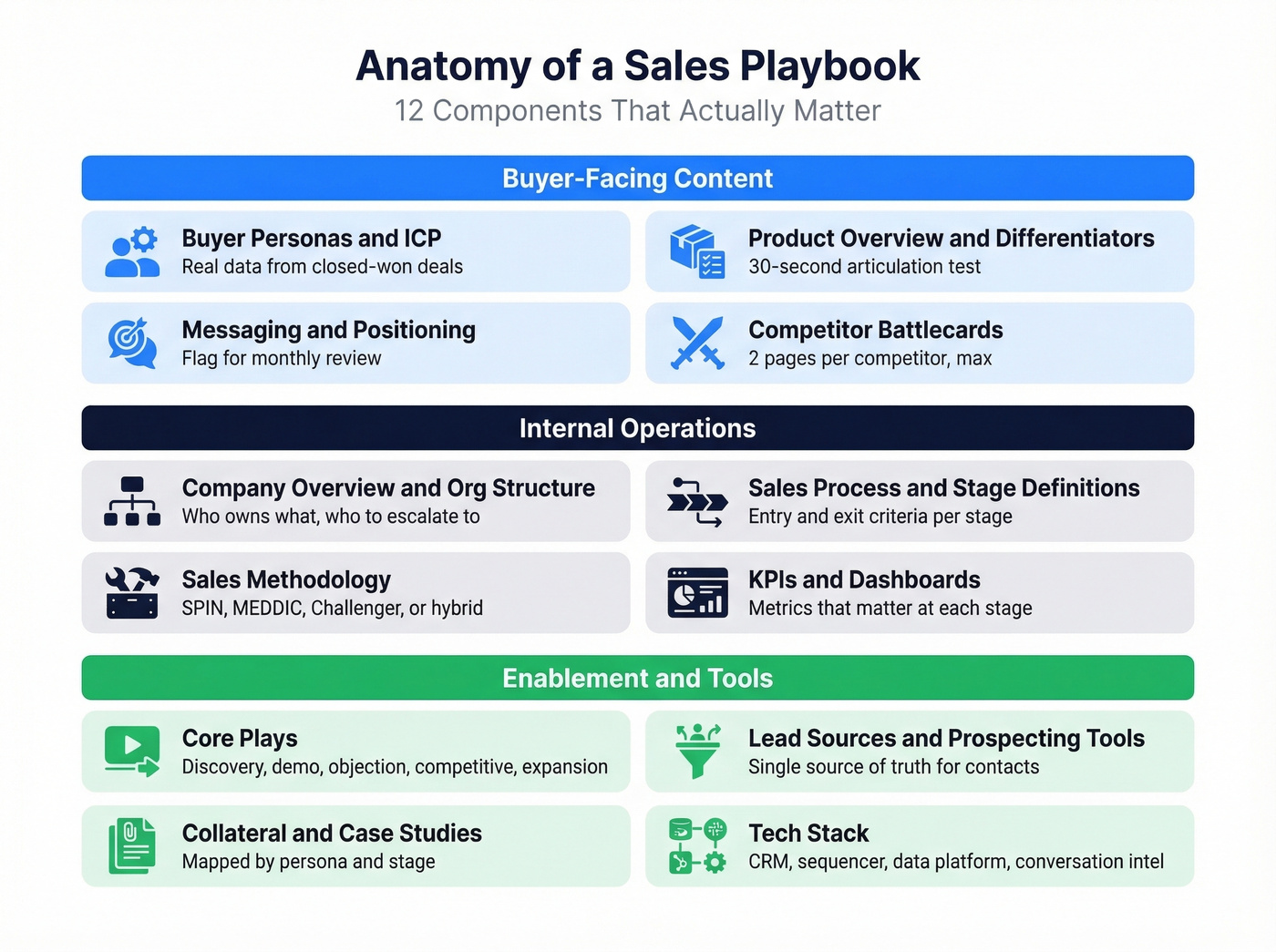
Buyer-Facing Content
Buyer personas and ICP. Real data, not fictional "Marketing Mary" profiles. Pull from closed-won deals: titles, company size, industry, pain points, buying triggers. Review quarterly at minimum - and update faster if your market shifts. (If you need a starting point, use an Ideal Customer Profile Template.)
Product overview and differentiators. What you sell, how it's different, and why it wins. If a rep can't articulate your differentiators in 30 seconds, the section is too long.
Messaging and positioning. The narrative reps use with buyers - elevator pitches, value propositions by persona, email and call templates. This section goes stale fastest, so flag it for monthly review. If you want examples, steal from these sample elevator pitches.
Competitor battlecards. Two pages per competitor, max. Strengths, weaknesses, landmines to plant, traps to avoid. Include what the competitor says about you. (More structure: Sales Battle Cards.)
Internal Operations
Company overview and org structure. Not a mission statement. An org chart showing who owns what, who to escalate to, and who handles common cross-functional questions. New reps need this on day one.
Sales process and stage definitions. Map every stage from first touch to closed-won. Define exit criteria so reps and managers agree on what "Stage 3" actually means. Enterprise cycles need multi-threading, procurement, and legal review stages that simpler B2C motions don't require - if you're wondering how a B2B sales playbook differs from a general one, the difference lives right here in the process map.
Sales methodology. SPIN, Challenger, MEDDIC, or your own hybrid. Document the framework and how it maps to your stages.
KPIs and dashboards. Define the metrics that matter at each stage and connect them to the plays - if the discovery play is working, what numbers should move? (Related: Sales Operations Metrics.)
Enablement and Tools
Your core plays are the heart of this cluster: discovery, demo, objection handling, competitive displacement, and expansion. Each play should include the trigger (when to run it), the steps, and the expected outcome.
Beyond plays, document your lead sources and prospecting tools - where leads come from, how reps find new ones, and which data platform they pull from. Standardize on a single source of truth so every rep works from the same verified contacts. Then map your collateral and case studies by persona and stage (not by marketing campaign), and document the full tech stack - CRM, sequencer, data platform, conversation intelligence - so new reps aren't spending their first week figuring out which tools to use. (If you’re rebuilding your outbound motion, start with these sales prospecting techniques.)
Optional additions for teams that want a fully self-contained resource: commission structure and time management guidelines.

A playbook standardizes the motion. Prospeo standardizes the data. Give every rep the same 98% accurate emails, 125M+ verified mobiles, and 30+ filters to build lists that match your ICP - so the plays you design actually reach real buyers.
Stop building plays on bad data. Start with contacts that connect.
Choose Your Methodology
Every methodology boils down to the same fundamentals: need, budget, stakeholders, timeline. A popular thread on r/sales makes this point bluntly - teach fundamentals first, then layer a framework. That said, frameworks give teams a shared language, and shared language scales.
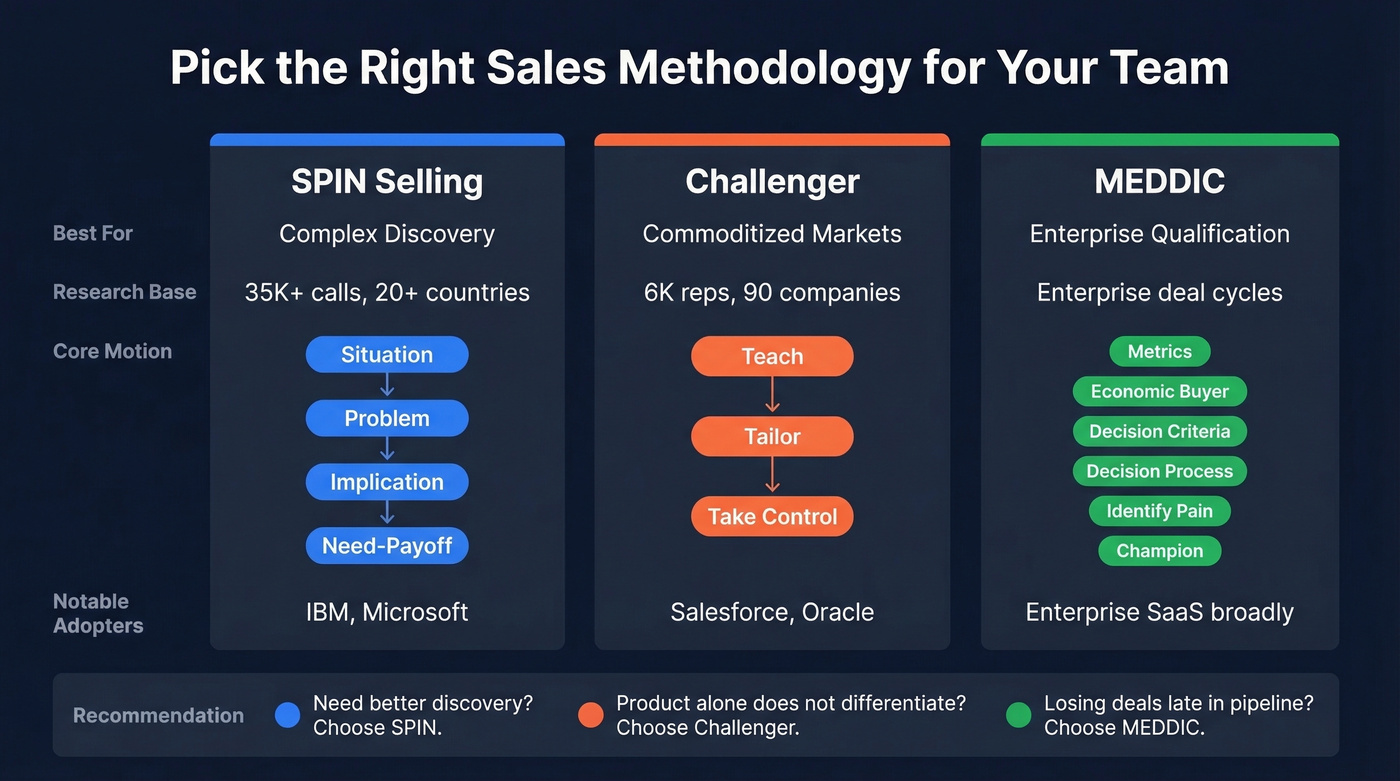
| SPIN | Challenger | MEDDIC | |
|---|---|---|---|
| Best for | Complex discovery | Commoditized markets | Enterprise qualification |
| Research base | 35K+ calls, 20+ countries | 6K reps, 90 companies | Enterprise deal cycles |
| Core sequence | Situation → Problem → Implication → Need-payoff | Teach → Tailor → Take Control | Qualification framework |
| Notable adopters | IBM, Microsoft | Salesforce, Oracle | Enterprise SaaS broadly |
Our recommendation: SPIN for teams that need better discovery conversations, MEDDIC for enterprise teams that need tighter qualification, and Challenger for experienced reps in markets where the product alone doesn't differentiate. Don't pick a methodology because it sounds impressive. Pick one because it solves a specific gap in how your team sells today.
How to Build Yours Step by Step
It's Q2, your new SDR class just started. They're asking where the call scripts are, what the ICP looks like, which competitors come up most. Your top AE gives one answer. Your VP gives another. Product Marketing has a deck from last quarter that contradicts both.
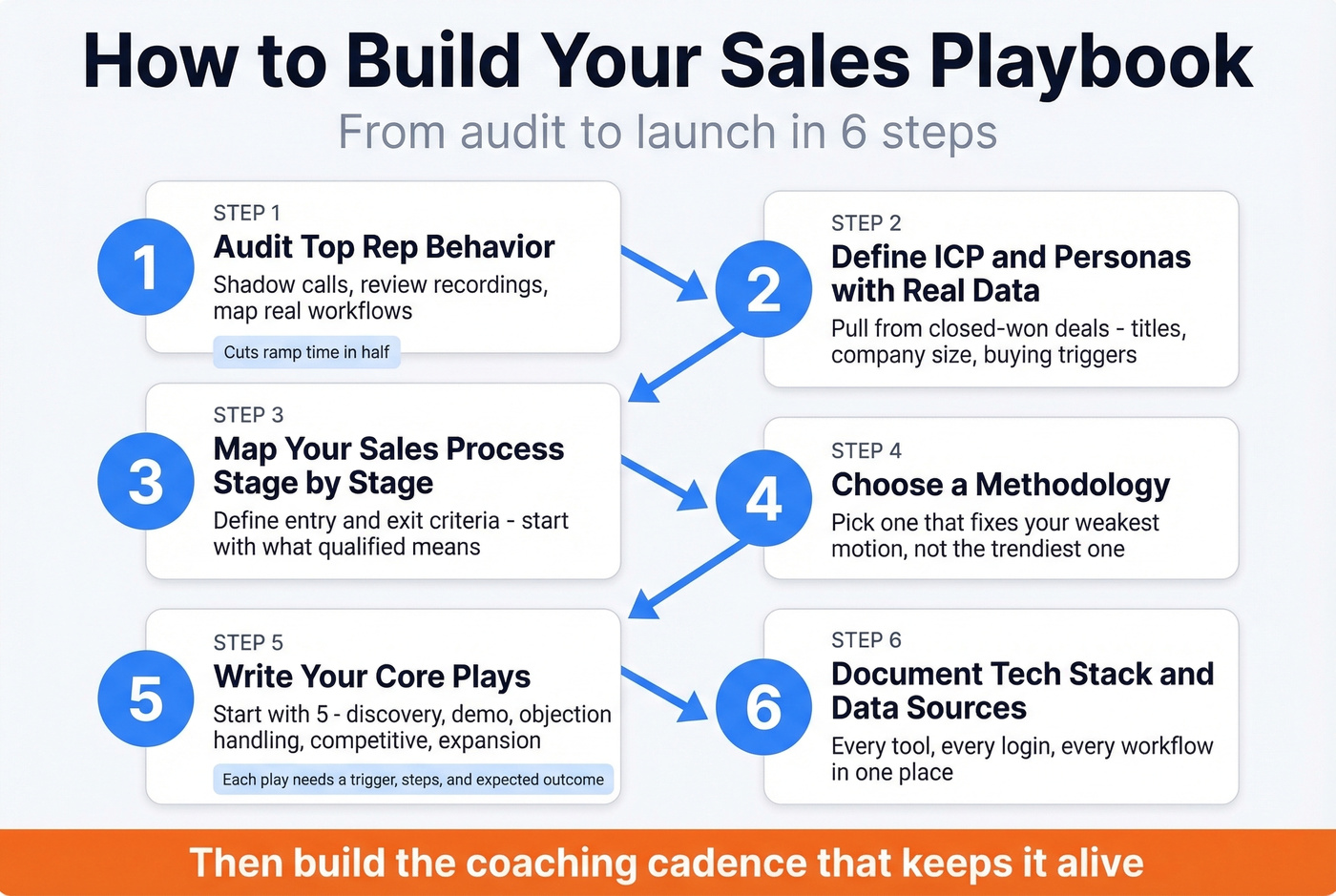
Here's how to fix it.
Audit what your top reps actually do. Shadow calls, review recordings, map their real workflows. We've seen teams cut ramp time in half just by documenting what their top three reps do differently from everyone else.
Define your ICP and buyer personas with real data. Pull from closed-won deals. Which titles signed? What company size? What triggered the buying cycle?
Map your sales process stage by stage. Define entry and exit criteria. If your team can't agree on what "qualified" means, start there.
Choose a methodology. Pick one that addresses your team's weakest motion and layer it onto your process map.
Write your core plays. Start with five: discovery, demo, objection handling, competitive, and expansion. Each play gets a trigger, steps, and expected outcome. (For the demo play, a simple checklist helps: Product Demo Checklist.)
Document your tech stack and data sources. Every tool, every login, every workflow. Skip this if your team is under five reps and everyone already knows the stack - you can add it later.
Build a coaching cadence around the playbook. This is non-negotiable. Weekly 1:1s should reference specific plays. Pipeline reviews should use playbook language. Modern selling teams live or die based on whether managers actively coach from their documented plays.
Set a monthly review cycle. Messaging, competitors, and product features change faster than quarterly cadences can track. Assign owners to each section and hold them accountable.
The Modern Playbook Tech Stack
The enablement market consolidated fast. Seismic and Highspot announced a merger in February 2026. Showpad merged with Bigtincan in late 2025. Gong expanded into full revenue enablement in early 2026. Fewer vendors, bigger platforms, and a real question about whether you need an all-in-one suite or a focused stack.
| Tool | Category | Typical cost |
|---|---|---|
| Seismic/Highspot | Enterprise enablement | $30K-$100K+/yr |
| Gong | Conversation intel + forecasting | $15K-$50K+/yr |
| Mindtickle | Rep readiness + AI roleplay | $1K-$5K/mo |
| Guru | Knowledge management | $10-$15/user/mo |
| Dock | Mid-market deal rooms | $500-$2K/mo |
Let's be honest about something most playbook guides won't say: the enablement platform matters far less than the data underneath it. The best objection-handling script doesn't help if the rep is calling a disconnected number or emailing a bounced address. When GreyScout standardized their prospecting data through Prospeo, rep ramp dropped from 8-10 weeks to 4 weeks. Bounce rates went from 38% to under 4%, and pipeline grew 140%. That's the layer most guides ignore - 98% email accuracy, 7-day data refresh, and a free tier starting at $0.01 per email.
You just read that 17% of sellers drive 83% of revenue. The gap isn't talent - it's consistency. Prospeo's 7-day data refresh means every rep works from the same accurate contact data, not stale records that bounce at 35%.
Equip your entire team with data your top reps would trust.
How AI Changes Playbooks in 2026
The AI shift reshaping playbooks right now is generative versus agentic. Generative AI handles content creation - drafting emails, summarizing calls, building persona descriptions. It's useful but passive. Agentic AI operates with context during live selling: surfacing objection responses mid-call, recommending next steps by deal stage, scoring leads in real time based on engagement signals.
The biggest wins come when AI improves both productivity and accuracy at the same time. Automating CRM entry, enriching contact records on the fly, flagging at-risk deals before the forecast call - these compound quickly. Start there. Integrate AI into existing workflows rather than bolting on a separate tool reps need to learn. Unified platforms reduce splintered AI investments and keep your playbook's data layer consistent across marketing, enablement, and RevOps.
Copy-This Playbook Template
Copy this into your platform of choice and fill in the blanks. Suggested owners are included - adjust for your org.
- Company Overview & Org Chart - Who does what. Escalation paths. Key contacts by function. Owner: RevOps.
- ICP & Buyer Personas - Data-backed profiles. Titles, company size, industry, pain points, buying triggers. Owner: Product Marketing.
- Product Overview & Differentiators - What you sell, why it's different, and the 30-second pitch. Owner: Product Marketing.
- Sales Process & Stage Definitions - Every stage from first touch to closed-won with entry/exit criteria. Owner: RevOps.
- Sales Methodology - Your chosen framework mapped to your stages. Owner: Sales Leadership.
- Core Plays - Discovery, demo, objection handling, competitive displacement, expansion. Trigger → steps → outcome. Owner: Sales Leadership + Enablement.
- Messaging & Positioning - Elevator pitches, value props by persona, email and call templates. Owner: Product Marketing.
- Competitor Battlecards - Two pages per competitor. Strengths, weaknesses, landmines, traps. Owner: Competitive Intel or Product Marketing.
- Lead Sources & Prospecting Tools - Where leads come from, how to find new ones, which data platform to use. Owner: RevOps.
- Collateral & Case Studies - Organized by persona and stage, not by campaign. Owner: Content Marketing.
- Tech Stack & Data Sources - Every tool, login, and workflow documented. Owner: RevOps.
- KPIs & Dashboards - Metrics by stage, connected to plays. Owner: RevOps.
- Coaching Cadence & Review Schedule - Monthly review owners. Weekly 1:1 integration plan. Quarterly deep refresh. Owner: Sales Leadership.
That's your skeleton. The plays are the muscle. The coaching cadence is the heartbeat. Build all three.
FAQ
What is a sales playbook?
A sales playbook is the complete system - process, methodology, personas, tools, messaging, and coaching cadence - that gives every rep a repeatable framework for moving deals forward. It houses all your plays and connects them to the broader selling motion so reps aren't improvising on every call.
How is a playbook different from a play?
A play is a single repeatable motion for a specific scenario, like competitive displacement or inbound demo follow-up. The playbook is the full system that houses all plays and connects them to your process, methodology, and tools.
How long should a playbook be?
Most effective playbooks run 5-15 pages of core content covering 80% of common selling scenarios. The 50-page document nobody reads isn't a playbook - it's a liability. Build lean, then add depth only where complexity demands it.
How often should you update it?
Monthly at minimum for fast-moving teams. Messaging, competitors, and product features shift faster than quarterly cadences can track. Use a dynamic platform like Guru or Highspot instead of a static doc, and assign section owners who are accountable for keeping content current.
What's the best free tool for prospecting data in a playbook?
Prospeo offers 75 free email credits per month with 98% accuracy and a 7-day data refresh - enough for small teams to validate their prospecting plays before committing budget. Alternatives like Apollo and Hunter have free tiers too, but bounce rates under 4% and a proprietary verification layer make Prospeo the strongest option for teams that care about deliverability.