

25+ Sample Elevator Pitches You Can Steal and Customize Today
Someone asks "so, what do you do?" at a networking event, and your brain goes blank. You mumble something about your job title, toss in a company name, and watch their eyes glaze over. That 30-second window just closed - and you didn't say anything memorable.
That's why you need sample elevator pitches you can actually customize, not more generic advice about "being authentic."
The Bureau of Labor Statistics estimates 70% of jobs are found through networking, and your elevator pitch is the first impression in every one of those conversations. A LinkedIn poll of 7,000+ professionals found that 77% prefer pitches of 30-45 seconds. That's not a lot of runway. But it's enough if you know the structure. Below you'll find 25+ pitches organized by scenario, a five-step formula for writing your own, and the mistakes that make hiring managers and investors tune out before you finish your second sentence.
5 Pitches You Can Use Right Now
Customize the details, keep the structure.
| Scenario | Pitch Script | Best For |
|---|---|---|
| Student | "I'm a junior at [University] studying data science. Last semester I built a predictive model for a local nonprofit that helped them allocate donor outreach 40% more efficiently. I'm looking for internships where I can apply machine learning to real business problems - what does your team's data stack look like?" | Career fairs, info interviews |
| Job Seeker | "I've spent six years in B2B marketing, most recently leading demand gen at a Series B SaaS company where we grew pipeline 3x in 18 months. I'm looking for a head-of-marketing role at a company that's ready to scale outbound. What's your biggest pipeline challenge right now?" | Interviews, networking |
| Career Changer | "I spent eight years as a registered nurse managing patient care teams. That taught me how to triage priorities, communicate under pressure, and lead cross-functional groups. Now I'm transitioning into healthcare operations - I'd love to hear how your team handles workflow design." | Networking, informational interviews |
| Sales Pro | "I help mid-market SaaS companies cut their customer acquisition cost by 20-30% by fixing their outbound targeting. My last client went from 2% reply rates to 11% in one quarter. Are you running outbound right now, or mostly inbound?" | Cold calls, events, client meetings |
| Entrepreneur | "We're building an AI-powered scheduling tool for field service companies. Think of it as the dispatch brain that routes technicians 35% faster than manual scheduling. We've got 40 paying customers and just closed our seed round - I'd love to tell you more about where we're headed." | Investor meetings, conferences |
What Makes a Great Pitch Work
Think of your elevator pitch like an email's subject line plus preview text. The goal isn't to close the deal - it's to get the listener to "open" the conversation and want more. Emmanuel College's career center nails this analogy: your pitch is the hook, not the whole story.
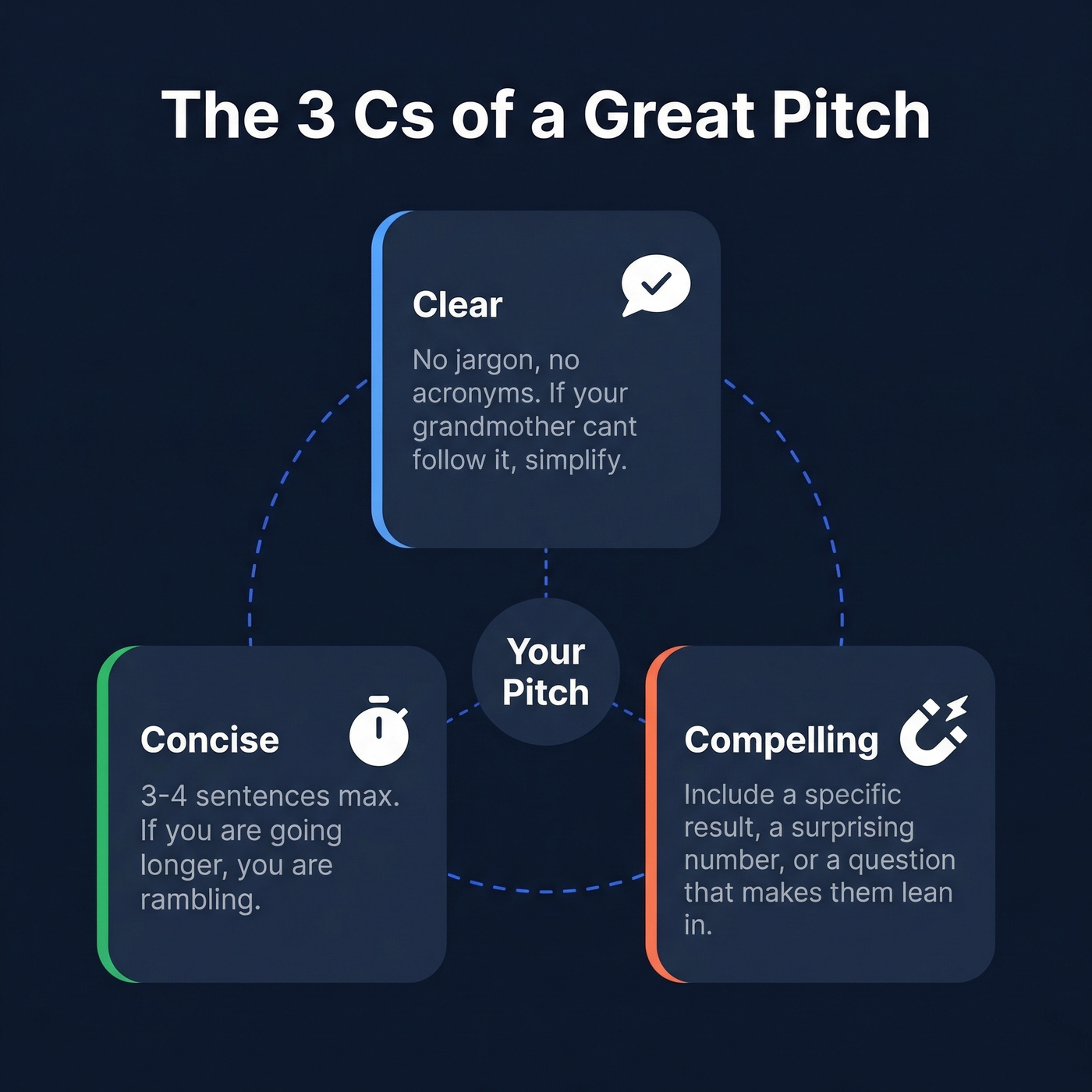
Every strong pitch shares three qualities - often called the 3 C's:
- Clear: No jargon, no acronyms, no insider language. If your grandmother can't follow it, simplify.
- Concise: Three to four sentences. That's it. Going longer means you're rambling.
- Compelling: Include a specific result, a surprising number, or a question that makes the listener lean in. "I do marketing" isn't compelling. "I helped a startup triple their pipeline in six months" is.
Write your pitch down and limit it to four sentences. If you can't explain what you do and why it matters in four sentences, you don't understand it well enough yet.
How Long Should Your Pitch Be?
Short answer: 30-45 seconds for most situations. But context shifts the target.
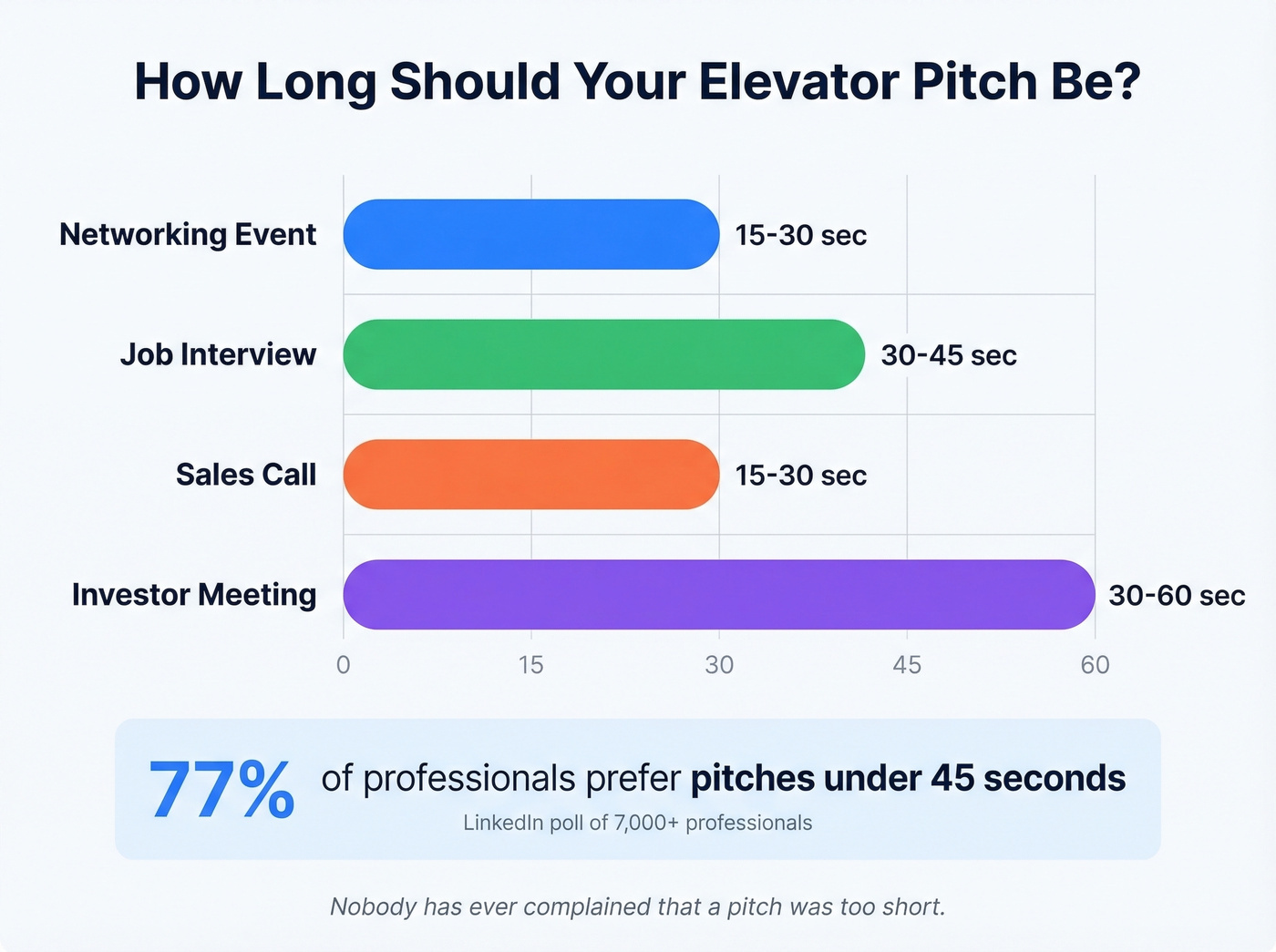
| Context | Target Length | Why |
|---|---|---|
| Networking event | 15-30 seconds | People are circulating. |
| Job interview | 30-45 seconds | Attention earned; don't monologue. |
| Sales call | 15-30 seconds | Lead with their problem, not your bio. |
| Investor meeting | 30-60 seconds | More runway, but still a teaser. |
That LinkedIn poll backs this up: 46% prefer a 30-second pitch, 31% prefer 45 seconds, and only 8% want anything longer. Salesforce's guidance suggests creating multiple versions at different lengths so you can adapt on the fly. A career fair demands a tighter pitch than a one-on-one coffee meeting.
Nobody has ever complained that a pitch was too short.
How to Write Your Pitch in 5 Steps
Don't start from a blank page. Use this five-step structure, adapted from Wave Connect's framework, and fill in the blanks:
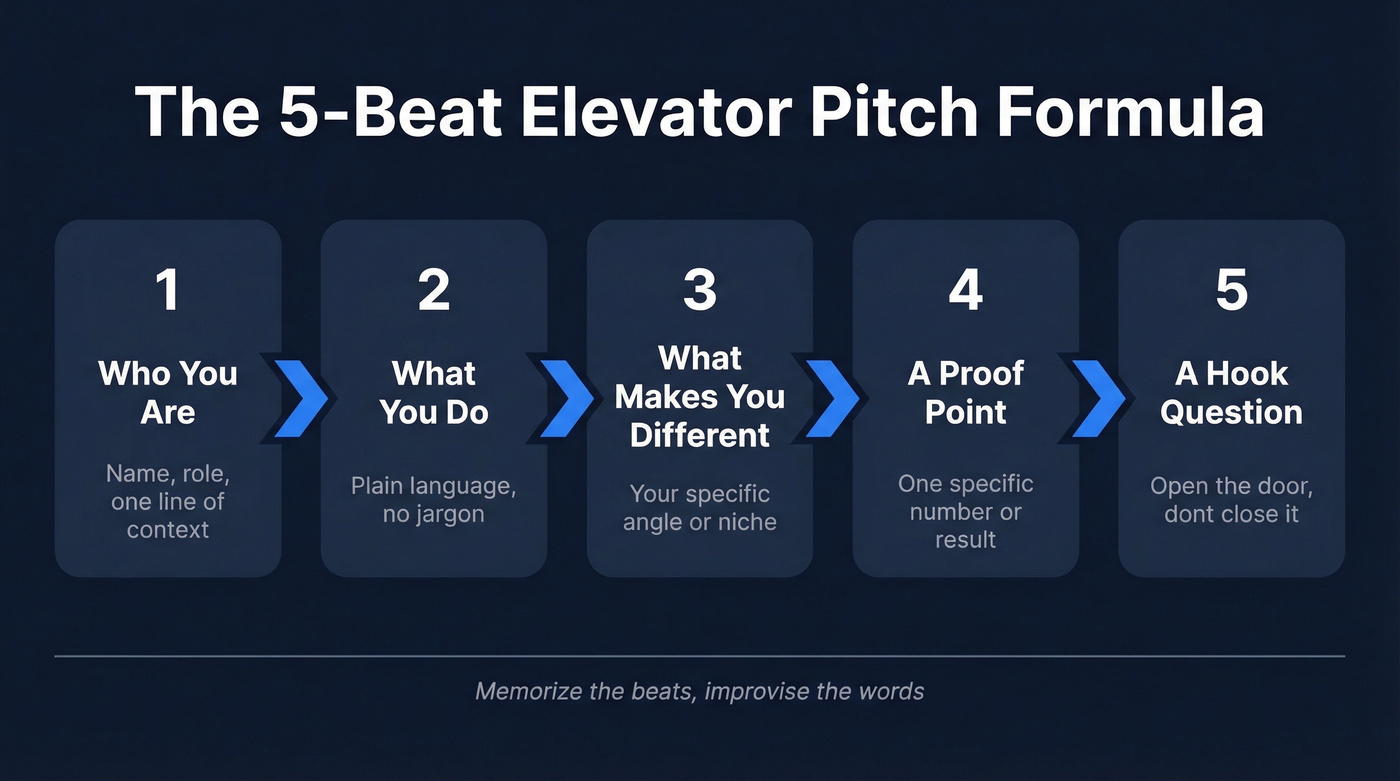
Who you are. Name, role, one line of context. Keep it to one sentence. "I'm Sarah, a product designer at a healthcare startup" - done.
What you do in plain language. Describe your work the way you'd explain it to a smart friend outside your industry. "I redesign patient intake workflows so clinics can see 20% more patients without adding staff."
What makes you different. This is where most pitches fall flat. Everyone "helps companies grow." What's your specific angle? A methodology, a niche, a contrarian approach - something that separates you from the other 50 people at this event with the same job title.
A proof point. One specific number or result. "We saved our last client $140K in the first year" hits harder than "we help companies save money." In our experience, quantified outcomes are the single biggest upgrade you can make to any pitch.
A hook question. End with a question, not a statement. "Have a great day" is a conversation ender. "What's your team's biggest challenge with X?" is a conversation starter. The pitch should open a door, not close one.
Here's the thing: don't memorize your pitch word-for-word. Memorize the five beats and improvise the words. You'll sound human instead of rehearsed, and you'll adapt naturally to whoever you're talking to.

A great elevator pitch opens the door. But after the handshake, you need the right contact data to follow up. Prospeo gives you 98% accurate emails and 125M+ verified mobile numbers so every networking connection turns into a real conversation.
Stop losing warm leads to bad contact data.
25+ Elevator Pitch Examples by Scenario
For Students
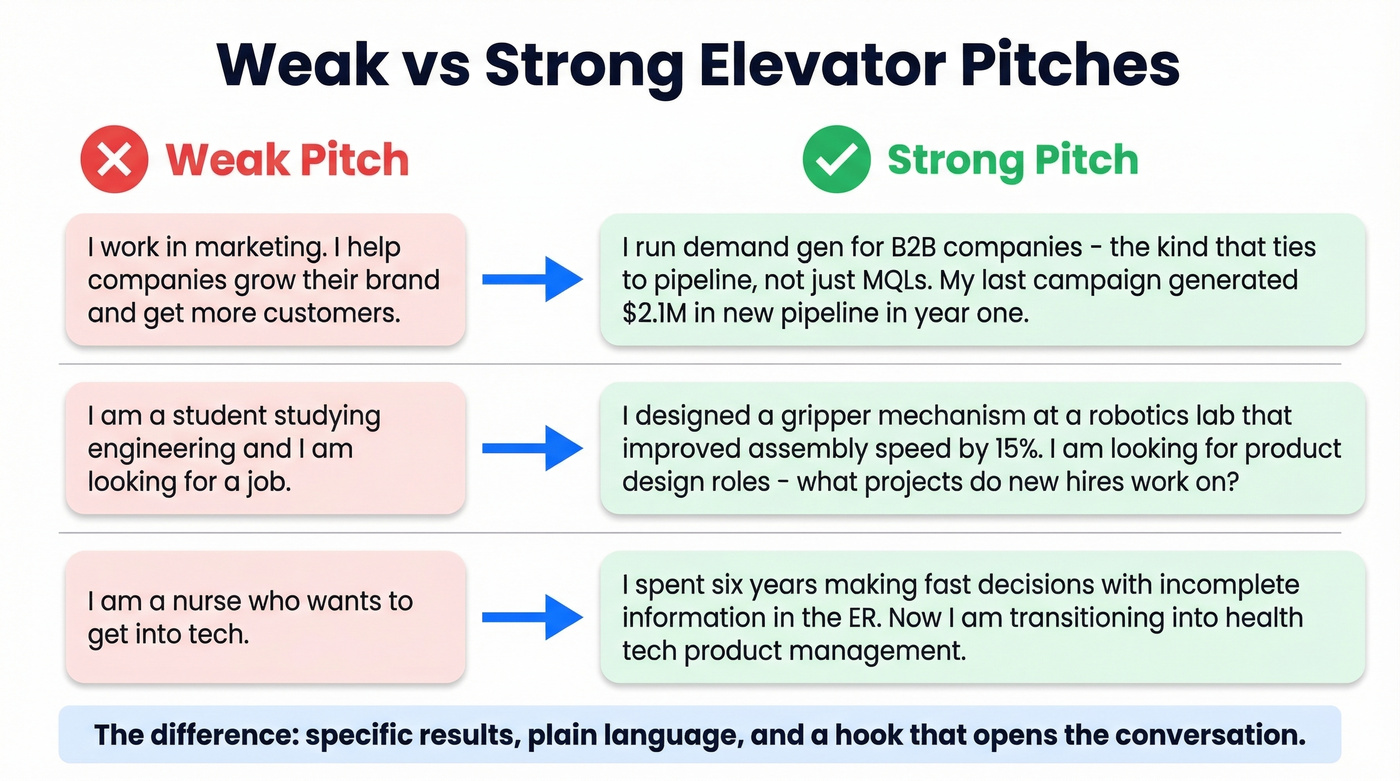
At a career fair: "Hi, I'm Marcus - I'm a senior studying mechanical engineering at [University]. This past summer I interned at a robotics lab where I designed a gripper mechanism that improved assembly speed by 15%. I'm looking for full-time roles in product design or manufacturing engineering. What types of projects does your team work on for new hires?"
At a networking event: "I'm Priya, a junior studying finance with a minor in computer science. I just finished a project where I built a Python model that predicted quarterly revenue for a local SaaS company within 5% accuracy. I'm fascinated by the intersection of data and financial strategy - how does your team use data in investment decisions?"
At an informational interview: "I'm studying public health at [University] and I've been volunteering with a community health organization where I helped design a contact tracing workflow that cut response time from 48 hours to 12. I'm exploring careers in health tech - I'd love to hear how your company approaches public health data challenges."
The UMich career center template provides a solid baseline structure for students: intro, education, relevant experience, and a question. The upgrade is adding a quantified result and ending with genuine curiosity about the listener's work.
For Job Seekers
Interview - "Tell me about yourself": "I've spent seven years in customer success, most recently as a team lead at a mid-market SaaS company where I managed a $4M book of business and reduced churn by 18% year over year. I'm looking for a director-level role where I can build a CS function from the ground up. What does your retention strategy look like today?"
Networking event: "I run demand gen campaigns for B2B companies - the kind that actually tie to pipeline, not just MQLs. My last role, I built an outbound engine that generated $2.1M in new pipeline in its first year. I'm exploring my next move and would love to hear what marketing challenges you're seeing at [Company]."
Cold outreach via email or message: "Quick context: I led product marketing at [Company] through their Series B, including a rebrand and a 3x increase in enterprise pipeline. I noticed your team just launched a new product line - I'd love to chat about how I could help with go-to-market. Worth a 15-minute call?"
Relocating: "I'm a project manager with five years in commercial construction, relocating to Denver from Chicago. I managed a $12M mixed-use development from permitting through occupancy, on time and under budget. I'm looking for a PM role with a firm that's growing its Colorado portfolio - what's your team's pipeline looking like?"
The STAR method works well as a mental framework here. Even in a 30-second pitch, you can compress it: situation in one clause, result in one number.
For Career Changers
General Assembly's four-step career-change structure is the best framework we've found for this: introduce yourself, reference your previous experience, connect the dots to transferable skills, then clearly state the change you're pursuing.
Healthcare to tech: "I spent six years as an ER nurse managing high-acuity patient care. That taught me how to make fast decisions with incomplete information, communicate across disciplines, and stay calm when everything's on fire. I'm now transitioning into product management for health tech companies - I'd love to hear how your team incorporates clinical perspectives into product decisions."
Teaching to corporate training: "I taught high school chemistry for eight years, which means I can explain complex concepts to an audience that really doesn't want to listen. I've designed curriculum for 200+ students per year and consistently hit top-10% evaluation scores. I'm moving into corporate L&D - what does your onboarding program look like right now?"
Finance to sustainability: "I spent a decade in investment banking analyzing risk and building financial models. Now I'm applying that analytical lens to climate finance - specifically, helping companies quantify the ROI of sustainability initiatives. I just completed a certificate in ESG strategy. How is your firm thinking about sustainability reporting?"
Best Pitches for Sales Professionals
57% of salespeople say competition has gotten harder in the past year, and reps spend only 30% of their time actually selling. Your pitch needs to grab attention immediately. The best sales pitches lead with the prospect's pain, not the rep's product.
Cold call opener: "Hi [Name], this is Alex from [Company]. I'll be quick - we help mid-market e-commerce brands cut their shipping costs by 20-30% without changing carriers. I just helped a company your size save $180K last year. Is that something worth a 10-minute conversation?"
Networking event: "I sell cybersecurity solutions to financial services companies. Most of my clients come to me after their third failed audit - I help them get compliant in 90 days instead of 12 months. What's your company's biggest compliance headache right now?"
Client meeting intro: "Thanks for making time. Here's what I know about your situation: you're scaling your sales team from 10 to 25 reps this year, and your current CRM can't handle the workflow complexity. We've helped three companies at your stage make that transition without losing pipeline data. Let me show you exactly how."
SDR outreach: "[Name], I noticed your team just posted four new AE roles - congrats on the growth. Companies scaling that fast usually hit a wall with lead quality around month three. We built a prospecting engine that keeps reply rates above 8% even at 5x volume. Worth a quick chat about how?"
End every sales pitch with a question, not a sign-off. "Does that resonate?" or "Is that a priority for you right now?" keeps the conversation alive. "Let me know if you're interested" is a dead end.
A perfect cold call opener is worthless if you're calling a dead number, and a brilliant cold email bounces if the address is stale. Prospeo verifies emails at 98% accuracy and maintains 125M+ verified mobile numbers, so your 30-second pitch actually reaches the person you wrote it for.
For Entrepreneurs and Founders
Antler's framework for startup pitches requires five elements: who you are, what you do, how you do it, who it's for, and why now. The "why now" is what most founders forget - and it's what investors care about most.
Investor pitch: "You know how every restaurant owner dreads the Sunday night inventory count? It takes three hours and it's wrong half the time. We built an AI-powered inventory system that uses existing POS data to predict stock needs with 94% accuracy. We've got 40 restaurants on the platform, $22K in MRR, and we're raising a $1.5M seed round to expand into grocery. Our team includes two ex-Toast engineers and a former restaurant operator."
Customer pitch: "We make hiring software for construction companies. Right now, your project managers are probably spending 10 hours a week on scheduling and crew coordination. Our platform automates crew matching based on certifications, availability, and location - most customers cut that time by 60%. Want me to show you a demo with your actual crew data?"
Conference intro: "I'm the co-founder of [Company]. We're building the Stripe for B2B payments in Latin America - right now, cross-border invoicing takes 14 days and costs 4-6% in fees. We've cut that to same-day settlement at 1.2%. We just closed our first 50 enterprise customers. I'd love to connect if you're working in fintech or LatAm markets."
For Written Formats
Your elevator pitch isn't just for face-to-face moments - it belongs in your profile summary, cold emails, and follow-ups. Written pitches need to be even tighter because readers skim.
Professional profile summary: "Product marketer with 8 years in B2B SaaS. I've launched 12 products, built go-to-market playbooks that generated $15M+ in pipeline, and led positioning for two successful acquisitions. I specialize in turning complex technical products into stories that sales teams can actually use. Currently exploring senior PMM roles at growth-stage companies."
Cold email opener: "Hi [Name] - I noticed [Company] just expanded into the DACH region. We help SaaS companies localize their sales motion for European markets. Our last client grew EMEA pipeline 4x in six months. Worth 15 minutes to see if we can do the same for you?"
Networking follow-up email: "Great meeting you at [Event] yesterday. You mentioned your team's struggling with outbound reply rates - that's exactly what we solve. We built a targeting framework that helped [similar company] go from 2% to 9% reply rates in one quarter. I'd love to share the playbook over a quick call. How's Thursday?"
Weak vs. Strong: Before-and-After Rewrites
Seeing what's wrong is often more useful than seeing what's right. Here are three real rewrites.
Rewrite 1: Jargon to Plain English
❌ "I work on nanotechnology to deliver medical therapies to targeted cells."
✅ "We're using the manufacturing techniques of the computer industry to make better vaccines."
This example from Antler's pitch guide is the gold standard for simplification. The first version sounds impressive to exactly three people in the room. The second makes everyone lean in.
Rewrite 2: Generic to Specific with Proof
❌ "I'm a marketing professional with experience helping companies grow their online presence."
✅ "I run paid acquisition for e-commerce brands. My last campaign turned $40K in ad spend into $380K in revenue in 90 days. I specialize in scaling Facebook and Google campaigns past the $100K/month mark without tanking ROAS."
The first version describes anyone with a profile online. The second makes you memorable. Replace vague descriptors with one specific result and one specific niche.
Rewrite 3: Feature Dump to Problem-First
❌ "Our platform uses machine learning and natural language processing to analyze customer feedback across multiple channels in real time."
✅ "Most product teams find out about customer complaints weeks after they happen. We surface the patterns in real time - one client caught a billing bug that was costing them $50K/month within 24 hours of going live."
The first version describes technology. The second describes a problem and a result. Lead with the pain, follow with the outcome, let the technology be implied. That problem-first structure is what separates a pitch people remember from one they immediately forget.
Fill-in-the-Blank Templates
These templates follow the five-step formula. Fill in the brackets, read it out loud, and trim anything that feels forced.
Student template: "I'm [Name], a [year] studying [major] at [University]. Recently, I [specific project or experience] where I [quantified result]. I'm looking for [type of opportunity] in [field/industry]. [Question about the listener's work or company]?"
Professional template: "I [what you do] for [type of company/client]. In my current role at [Company], I [specific achievement with a number]. I specialize in [your niche or differentiator]. [Question about the listener's challenge or priorities]?"
Entrepreneur template: "You know how [relatable problem the customer faces]? [One-sentence description of your solution]. We've [traction metric - customers, revenue, growth rate]. We're [current stage - raising, scaling, launching]. [Question or specific ask]?"
Let's be honest about these templates: they won't hand you the perfect pitch on a silver platter. But they give you the skeleton that makes building one far easier. Read your completed pitch out loud - if any sentence makes you cringe or stumble, rewrite it. Your mouth knows what sounds natural before your brain does.
8 Mistakes That Kill Your Pitch
Starting with your name and company. "Hi, I'm John from Acme Corp" gives the listener zero reason to care. Lead with a hook or a problem instead. Your name comes after you've earned their attention.
Talking about the technology, not the value. Nobody cares about your tech stack. They care about what it does for them. "We use machine learning" means nothing. "We cut your analysis time from two weeks to two hours" means everything.
Talking too fast. Speed-talking signals nervousness and makes your pitch impossible to follow. If you can't deliver it calmly in 30 seconds, it's too long. Cut words, don't add speed.
Rambling without a point. If you can't articulate your value in three sentences, you haven't done the work. Rambling isn't thoroughness - it's a lack of preparation.
Leading with features instead of problems. Start with the pain your audience feels, then present your solution. Features without context are just a spec sheet.
Forgetting WIIFM. "What's in it for me?" is the only question running through your listener's head. If your pitch is all about you and never addresses what the listener gains, you've lost them.
Sounding desperate. Desperation repels. Confidence attracts. If your pitch sounds like you need the listener more than they need you, recalibrate.
Getting lost in jargon. If your pitch requires a glossary, you've already lost. Use the words your listener uses, not the words your industry uses.
Delivery Tips That Actually Help
Memorize the beats, not the words. Know your five steps cold. Let the exact phrasing shift based on who you're talking to. General Assembly's advice is spot-on here: internalize the structure, then let the words flow naturally each time.
Practice with a timer. Set a 30-second timer and deliver your pitch. If you're not done, cut. If you finish at 20 seconds, you've got room to breathe.
Record yourself. We've seen people transform their delivery in under a week just by recording themselves on their phone daily. You'll catch filler words and nervous habits you never notice in real time. Your phone's voice memo app is the cheapest pitch coach available.
Adapt in real time. If the listener's eyes light up at your proof point, expand on it. If they look confused at your differentiator, simplify. A pitch is a conversation starter, not a monologue.
End with silence. After your hook question, stop talking. The pause gives the listener space to respond. Most people fill the silence with more talking - don't. That silence is doing work for you.
Your pitch says you 'grew pipeline 3x' or 'cut acquisition costs by 30%.' Now prove it at scale. Prospeo's 300M+ profiles with 30+ filters let you find exactly the decision-makers worth pitching - before you ever step into the room.
Know who's in the room before you walk in.
FAQ
How long should an elevator pitch be?
Thirty to forty-five seconds covers most situations. A LinkedIn poll of 7,000+ professionals found 46% prefer 30 seconds and 31% prefer 45 seconds - only 8% want anything longer. For networking events aim shorter; for investor meetings you can stretch toward 60 seconds.
Can I use the same pitch everywhere?
No - customize for context every time. A career fair pitch emphasizes education and goals. A sales pitch leads with the prospect's pain point. A founder pitch highlights traction and market timing. Same five-step structure, different details for each audience.
Should I memorize my pitch word-for-word?
Memorize the five beats (who, what, different, proof, hook question) and improvise the words each time. Word-for-word memorization makes you sound robotic and leaves you stranded if the conversation shifts unexpectedly.
How do I pitch effectively over email or cold outreach?
Keep it to two or three sentences. Lead with the recipient's problem, include one specific proof point, and end with a clear ask. Verify the email address first - a bounced message wastes your best material.
What makes the best elevator pitch for sales?
The best sales pitch opens with the prospect's pain, not your product. State the problem they likely face, share one specific result from a similar company, and close with a question that invites dialogue. Review the sample elevator pitches in the sales section above and swap in your own numbers and niche.