

MEDDIC Discovery Questions: The 2026 Playbook
Your pipeline review is tomorrow morning, and half the deals on your board don't have a confirmed economic buyer. You're not alone - a Gartner study of 632 B2B buying teams found that 74% experience "unhealthy conflict" during the decision process, and buying groups that reach internal consensus are 2.5x more likely to close high-quality deals.
Reps waste 56% of their time on unqualified leads. MEDDIC discovery questions exist to fix that. Created at PTC in 1996, MEDDIC was John McMahon's sales brain codified - Dick Dunkel was the first to write it down and spread it internally. The framework drives a 10-30% win-rate lift when it's implemented with real discipline, not just lip service.
Compass, Not Script
Acronym order isn't conversation order. If you march through Metrics, Economic Buyer, Decision Criteria like a checklist, you'll sound like a CRM form with a headset.
The pattern you'll see across r/sales and r/techsales threads is consistent: the framework works best when you internalize it and stop trying to "run the acronym" live. As Chris Orlob has emphasized in discovery call breakdowns, the best reps treat frameworks as mental models rather than rigid scripts. You're gathering deal-critical intel across multiple conversations, not interrogating a prospect in one sitting. Qualification is continuous - re-score every element after every meaningful interaction, from first call to contract signature.
Questions Organized by Element
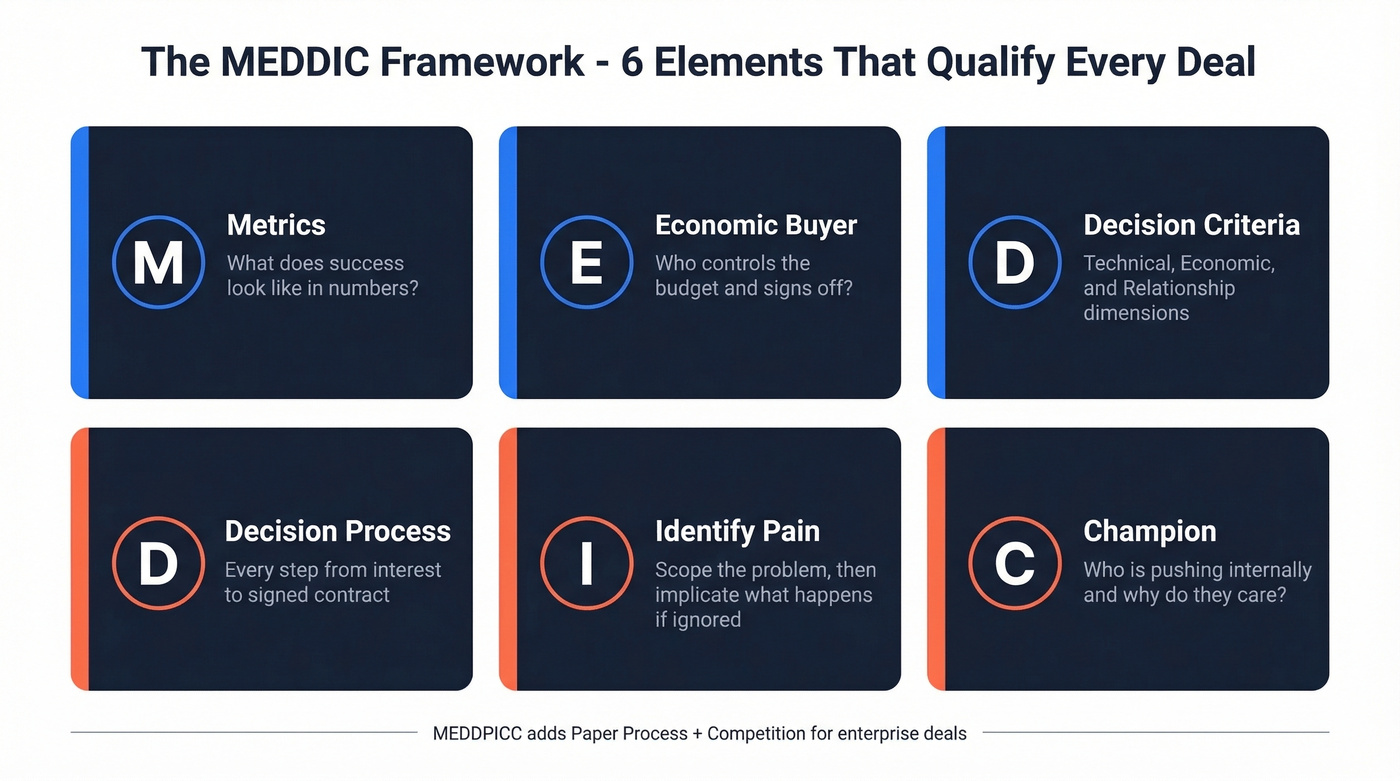
These are battle-tested prompts organized by the six MEDDIC elements, plus the two MEDDPICC additions. A good operating rule: 5-8 questions per session across 2-3 elements. Never all six at once.
Metrics
- "What does success look like in numbers - revenue target, cost reduction, time saved?"
- "If we solved this completely, what changes on your dashboard next quarter?"
- "How are you measuring the cost of doing nothing right now?"
Dig deeper: "Who owns that number, and how often do they report on it?"
Economic Buyer
Most deals don't die because the product failed. They die because the rep never reached the person who controls the budget.
Start here: "Who signs off on a purchase of this size - and is that the same person who controls the budget?" Then follow with: "Has this budget already been allocated, or does it need to be carved out of something else?" and "What's the economic buyer's top priority this quarter - how does this project connect to it?"
Once you've identified the economic buyer, you need their verified contact info to multi-thread - not a gatekept main number. Prospeo surfaces verified emails and direct dials for 300M+ professionals, so you can reach decision-makers directly instead of waiting on your champion to schedule an intro that never happens. (If you need a quick refresher on technical buyer vs economic buyer, it helps here.)
Decision Criteria
Here's the thing most reps miss: decision criteria have three dimensions, not one. Technical (does it work?), Economic (does the ROI justify it?), and Relationship (do we trust this vendor?). Your job isn't just to discover these criteria - it's to co-create them so they favor your strengths.
- "What are the three things this solution must do to get a 'yes'?"
- "Are those criteria weighted - is security more important than ease of use?"
- "Is there a formal scorecard, or is this more of a gut-feel decision?"
Dig deeper: "Who defined those criteria - your team, procurement, or the executive sponsor?"
Decision Process
- "Walk me through what happens between 'we like this' and 'we've signed.' Every step."
- "What's your target timeline for having a solution in place?"
- "Have you ever had a deal like this stall internally? What caused it?"
Dig deeper: "Is there a formal procurement review, or does the budget owner have signing authority?" This question alone has saved us from at least a dozen forecast surprises.
Identify Pain
Some teams now split this into three moves: Identify the pain, Indicate its scope, and Implicate what happens if it's ignored. That third move is where urgency lives.
- "What's the biggest problem this project is supposed to solve?"
- "How long has this been a problem, and what's changed that makes it urgent now?"
- "What happens to your team - or your number - if this doesn't get solved this quarter?"
Dig deeper: "On a scale of 1-10, how painful is this today? What would make it a 10?" This closed-ended question forces specificity and prevents vague answers like "it's pretty bad."
Champion
The single best champion-test question we've found comes from a practitioner on r/sales: "What happened the last time you bought something like my solution?" One question. It reveals whether your contact has actually driven a purchase before. If they haven't, that's a major red flag.
- "Who internally is pushing for this - and why do they care personally?"
- "If I weren't in the room, would you still be advocating for this? Why?"
- "What's the biggest internal objection you expect, and how would you handle it?"
Paper Process + Competition (MEDDPICC)
MEDDPICC adds two elements where deals actually die in practice.
Paper Process: "What does your contract review timeline look like?" / "Who owns legal review - do they have bandwidth right now?" / "Has a deal ever died in legal at your company?"
Competition: "Who else are you evaluating?" / "What would make you choose them over us - honestly?" / "Is 'do nothing' a real option, or has the team committed to solving this?"
Best Sequencing for Discovery
| Outbound Sequence | Inbound Sequence |
|---|---|
| Pain | Metrics |
| Champion | Pain |
| Metrics | Decision Criteria |
| Decision Process | Decision Process |
| Economic Buyer | Economic Buyer |
| Paper Process | Champion |
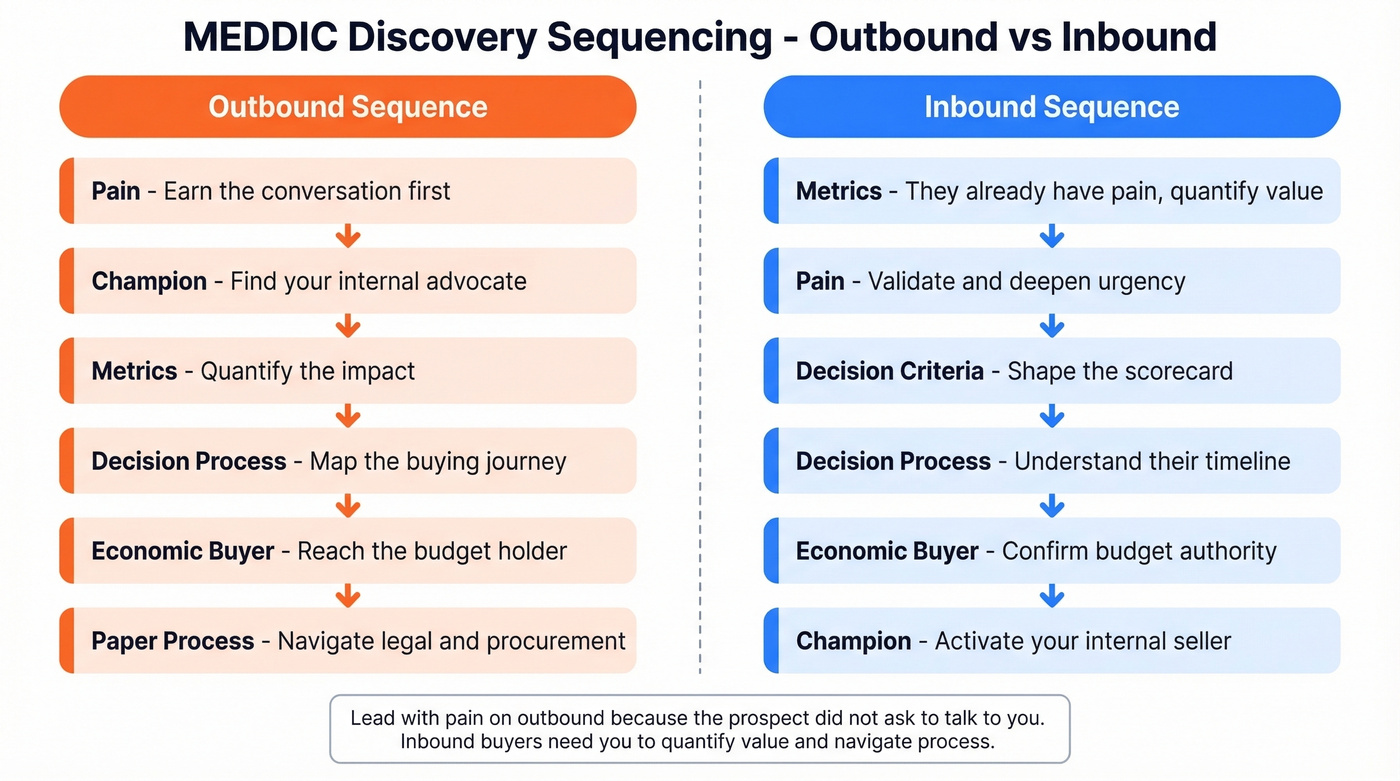
Lead with pain on outbound because the prospect didn't ask to talk to you - earn the conversation by proving you understand their problem. Inbound buyers already have pain; they need you to quantify value and navigate their process. If you're building this into a repeatable motion, pair it with sales prospecting techniques so discovery starts with better-fit accounts.

You identified the economic buyer. Now reach them. Prospeo gives you 98% accurate emails and verified direct dials for 300M+ professionals - so you can multi-thread into the C-suite without waiting on your champion to forward an email.
Stop qualifying deals you can't close because you never reached the budget holder.
Score Your Discovery
If you can't score each element 1-10, you don't have a qualified pipeline. You have a hope list.
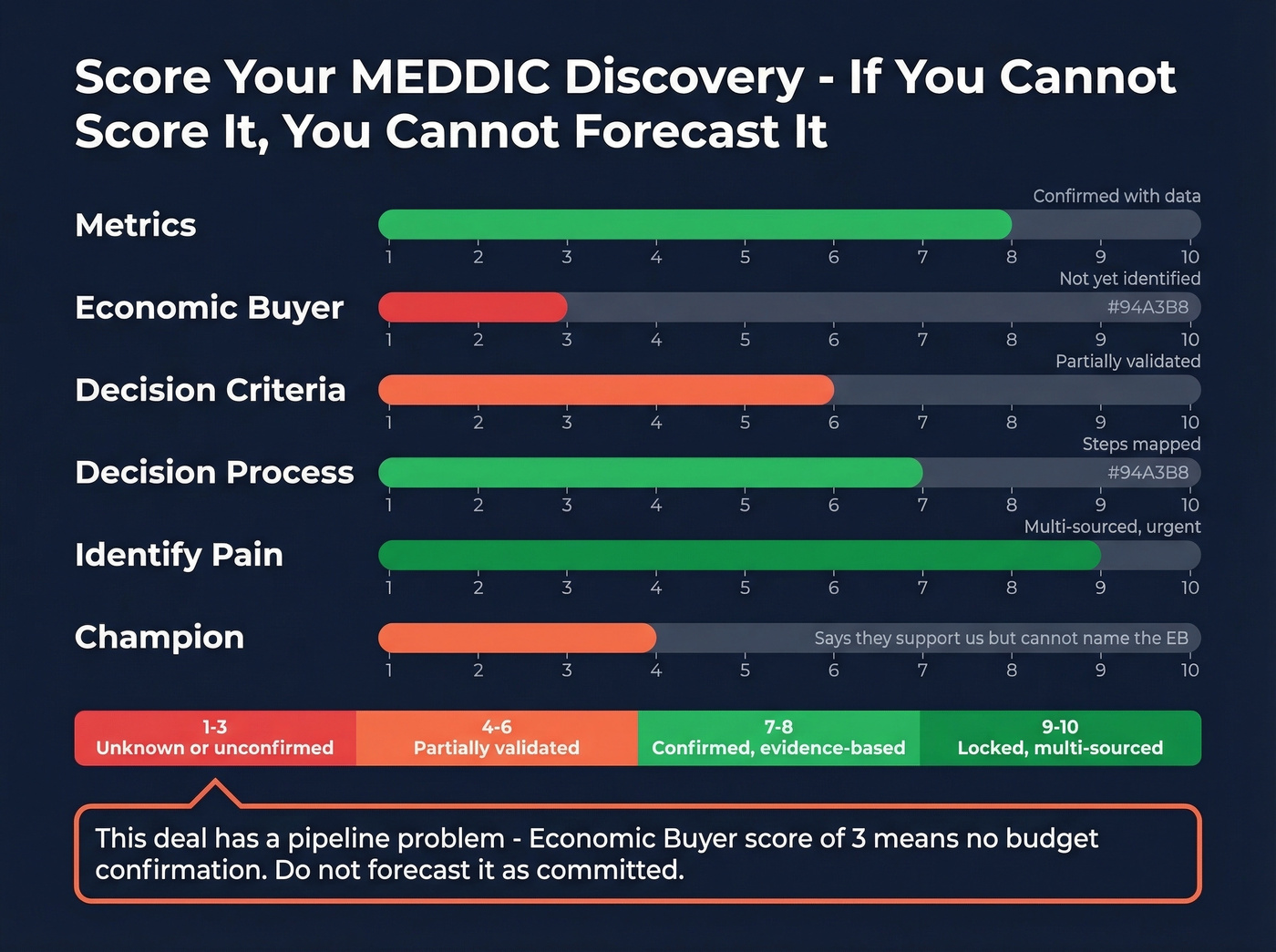
| Score | Color | Meaning |
|---|---|---|
| 1-3 | Red | Unknown or unconfirmed |
| 4-6 | Orange | Partially validated |
| 7-8 | Light Green | Confirmed, evidence-based |
| 9-10 | Dark Green | Locked, multi-sourced |
A Champion score of "3" means your contact says they support the project but can't name the economic buyer. An "8" means your champion has already presented your business case internally and scheduled you a meeting with the CFO. In our experience, most deals stall because the Champion score sits below 5 and nobody notices until the forecast call. This is also where pipeline health metrics keep you honest.
MEDDIC vs BANT vs SPICED
| Framework | Best For | When to Use |
|---|---|---|
| BANT | Transactional, fast filter | Quick-close deals under $10k |
| MEDDIC | Complex, multi-stakeholder | $100k+ deals with procurement |
| SPICED | Consultative, transformation | Change mgmt, new category |
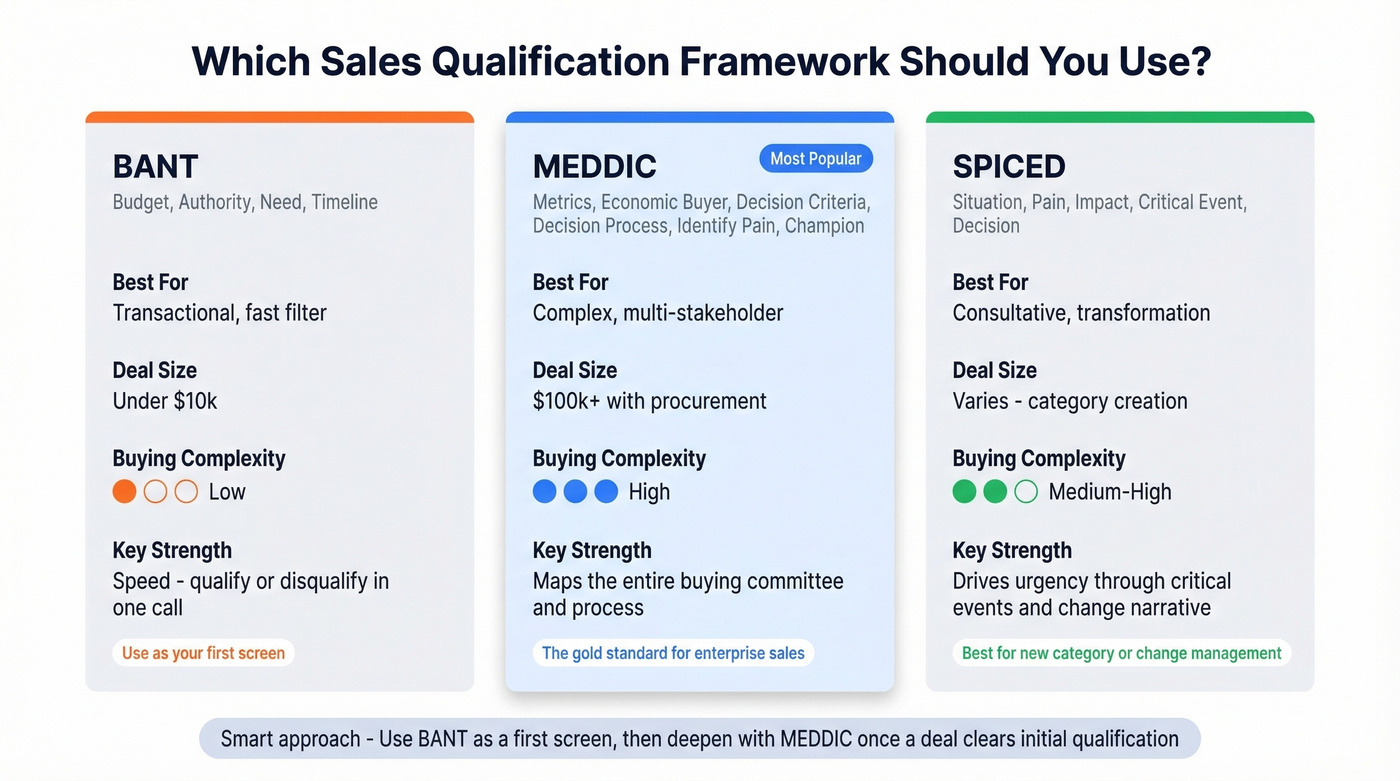
Let's be honest: MEDDIC is overkill for a $500/mo SaaS deal, and most teams apply it too early. The smartest approach we've seen is using BANT as a first screen, then deepening with MEDDIC once a deal clears initial qualification. Skip MEDDIC entirely for transactional, single-buyer motions - you'll just slow things down.
Common Mistakes
CRM checkbox syndrome. Adding MEDDIC fields to Salesforce and calling it "implementation." If you don't teach reps how to create metrics, validate champions, and map decision processes, you've built a reporting framework, not a qualification framework. We've watched teams spend six figures on MEDDIC training only to have reps fill in the CRM fields with one-word answers and move on. If you're trying to operationalize this, a lightweight lead scoring model can reinforce what “qualified” actually means.
Interrogation-style delivery. Following the acronym in order turns discovery into a deposition. Mix elements naturally based on where the conversation goes. The best reps use follow-up questions that build on what the prospect just said, rather than jumping to the next item on their list.
Skipping the demo. Many reps treat the demo as a product walkthrough instead of a continuation of discovery. Prepare demo questions that tie features directly back to the pain and metrics you've already uncovered. Use a product demo checklist so the demo stays tied to qualification.
Treating qualification as a one-time event. The SDR says "qualified," the AE takes the meeting, and nobody re-qualifies until the deal slips. Re-score after every call. Every single one. Tight sales process optimization makes this a habit, not a reminder.
A dark-green Champion score means nothing if your contact data bounces. Prospeo refreshes every 7 days - not 6 weeks - so the direct dial you pull for the CFO actually connects. 125M+ verified mobiles, 30% pickup rate.
Turn your MEDDIC scorecard green with data that actually connects.
FAQ
How many questions should I ask per discovery call?
Aim for five to eight questions per call, spread across 2-3 MEDDIC elements. Going beyond ten in a single conversation risks turning the call into an interrogation. Spread qualification across multiple calls and re-score after each interaction.
What's the difference between MEDDIC and MEDDPICC?
MEDDPICC adds Paper Process and Competition to the original six elements. Use MEDDPICC for enterprise deals with formal procurement stages and multiple competing vendors in the evaluation.
How do I reach the economic buyer once I've identified them?
Use an email finder to get verified direct contact info. Multi-thread into the executive suite without waiting on your champion to schedule an intro - deals move faster when you can reach the budget holder on your own timeline.
Do self-discovery questions work better than direct qualification?
Yes. Questions like "What happens to your team if this doesn't get solved?" let the buyer articulate their own pain and its impact. Prospects who self-diagnose urgency close at higher rates than those who are told what's broken, because they own the narrative internally when it's time to build consensus.