

How to Build a B2B Sales Cadence That Actually Books Meetings
Deals closed within 50 days show a 47% win rate. After that window, win rates crater to 20%.
Most reps quit around touch 4 or 5 - right when persistence starts paying off. The gap between a strong B2B sales cadence and no cadence isn't incremental. It's the difference between a pipeline that compounds and one that flatlines.
The Short Version
- 8-12 touchpoints across email, phone, and social over 17-21 days. That's the research-backed baseline for most outbound sequences.
- Segment by deal size. SMB gets 4-6 fast touches. Enterprise gets 12-20+ over months.
- Verify your contact data first. Bad emails and dead numbers silently kill every cadence. Run your list through a verification layer before you send a single touchpoint.
What the Research Says
RAIN Group's prospecting study - 489 sellers, 488 buyers, $4.2B in purchases - found it takes an average of 8 touchpoints to book an initial meeting. Top performers do it in 5 and convert 52 out of every 100 targets into meetings, compared to 19 for everyone else. That's 2.7x more meetings from the same list.
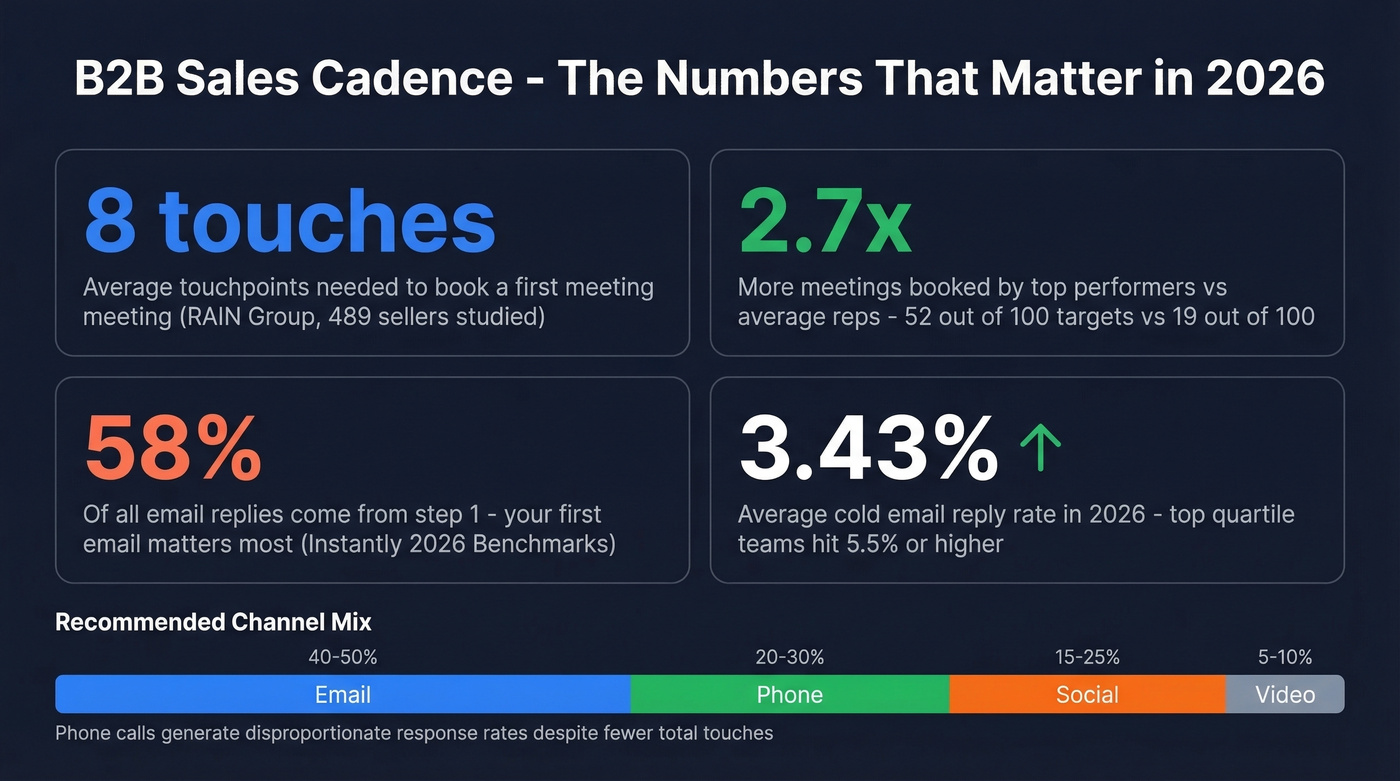
On the email side, Instantly's 2026 benchmark report puts the average cold email reply rate at 3.43%, with top-quartile teams hitting 5.5%+. The number that should shape your cadence: 58% of all replies come from step 1. Follow-ups contribute the remaining 42%, but each step yields less. The sweet spot for email-only sequences is 4-7 touchpoints. (If you need a full sequence build, start with a B2B cold email sequence framework.)
For channel mix, practitioner consensus points toward email carrying 40-50% of touches, phone at 20-30%, social at 15-25%, and video at 5-10%. Phone calls punch above their weight - Outreach's data shows they generate disproportionate response rates despite being a minority of total touches. Don't skip them just because they're uncomfortable. If calls are a core part of your motion, build a repeatable cold calling system and train for cold call rejection.
A Proven 17-Day Cadence Template
This 8-touch structure is adapted from Flowd's framework, refined across 31,251+ booked meetings. We've used a similar structure on our own outbound and found the spacing holds up well, though you'll want to adjust timing based on what gets responses in your market.
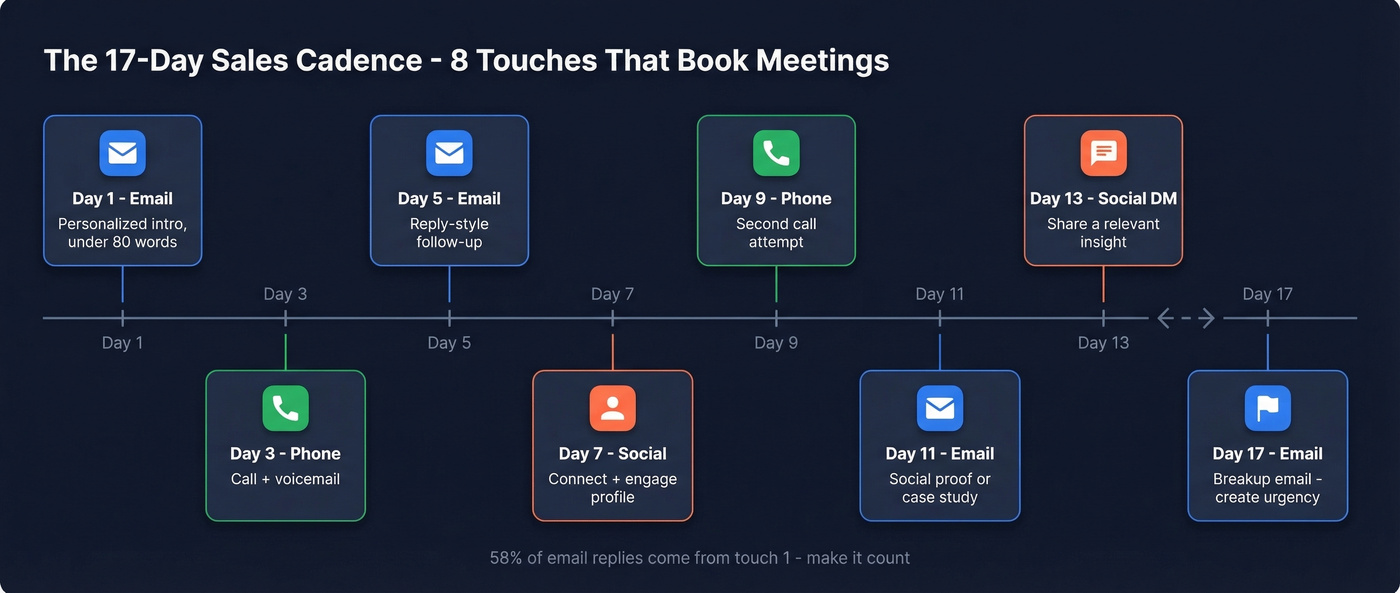
| Day | Channel | Action | Why |
|---|---|---|---|
| 1 | Personalized intro, under 80 words | Drives 58% of all replies | |
| 3 | Phone | Call + voicemail | Builds familiarity before email #2 |
| 5 | Reply-style follow-up | Reply-style emails outperform formal follow-ups by ~30% | |
| 7 | Social | Connect + profile engagement | Warms a second channel |
| 9 | Phone | Second call attempt | You're entering the touches 4-7 window where most replies happen |
| 11 | Social proof - case study, metric | Shifts to "why should I care" | |
| 13 | Social | DM with a relevant insight | Third channel, new angle |
| 17 | Breakup email | Creates urgency and triggers late replies |
Keep emails under 80 words and space touches 3-4 days apart after the initial burst. The breakup email isn't optional. Without a defined exit, prospects linger in limbo and reps waste energy on dead leads. For copy you can plug in, use these sales follow-up templates and cold email follow-up templates.
Adjust by Deal Size
Here's the thing: a cadence built for $50K enterprise deals will waste time on SMB, and an SMB cadence will barely scratch the surface of enterprise buying committees. Jason Lemkin puts it bluntly - the skills and sequences for a $100 deal and a $100K deal have nothing in common. (If you're selling upmarket, align your cadence with enterprise B2B sales realities.)
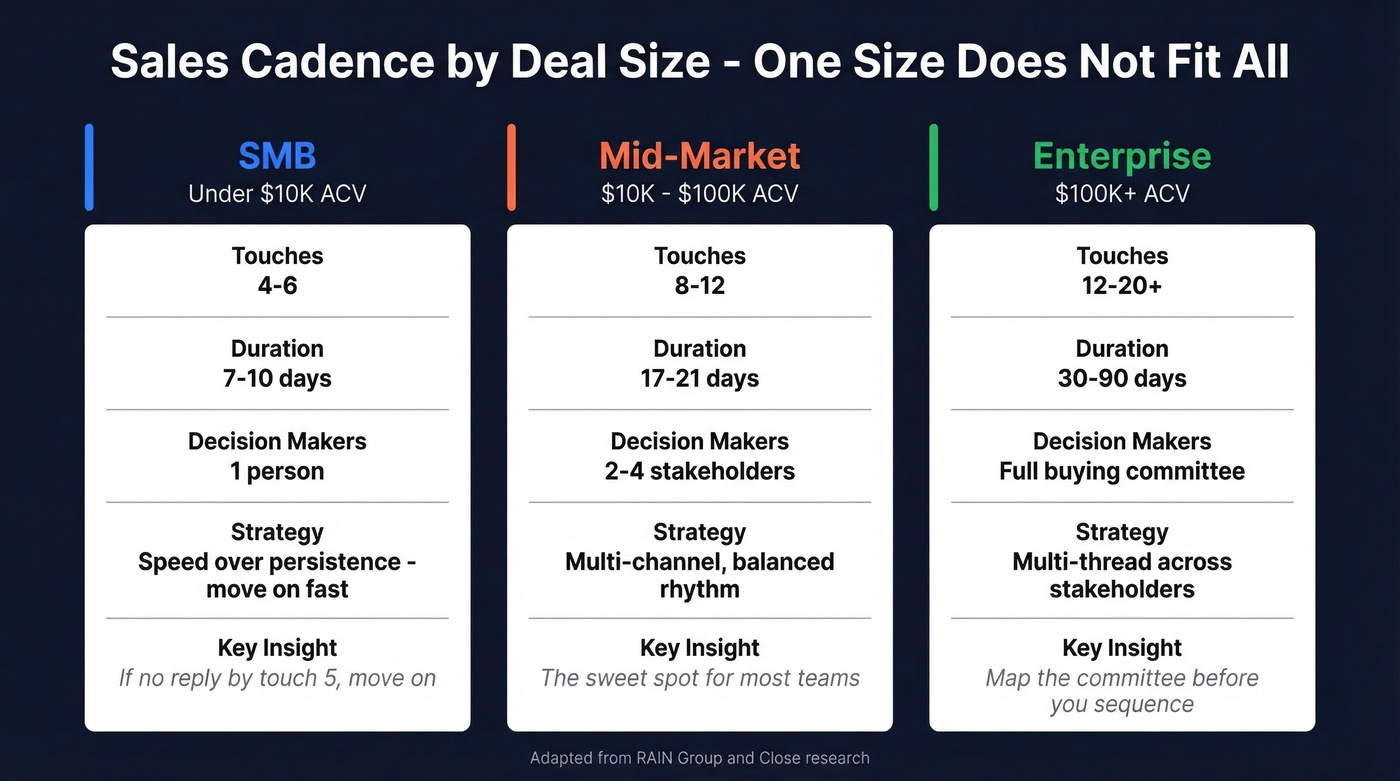
SMB (under $10K ACV): 4-6 touches over 7-10 days. Single decision-maker, moves fast or doesn't move at all. Efficiency over persistence. If they haven't responded by touch 5, move on.
Mid-Market ($10K-$100K): The 8-12 touch, 17-21 day framework above. Multiple stakeholders, but buying still happens in weeks. This is where the template shines.
Enterprise ($100K+): 12-20+ touches over 30-90 days. Close's research notes cycles up to 18 months. You're multi-threading across multiple stakeholders, each needing their own rhythm - and you'll need to map the buying committee before you even start sequencing.
If your average deal is a few thousand dollars, you probably don't need a 12-touch cadence. You need 4 great touches and a faster list. Most teams over-engineer cadences for deals that should close in a week.

Every touch in your cadence burns time and reputation if it hits a dead email or disconnected number. Prospeo gives you 98% verified emails and 125M+ direct dials - refreshed every 7 days - so your 8-12 touch sequence actually reaches real buyers.
Fix your data layer before you optimize another touchpoint.
Regional Adjustments
Your cadence can't be geography-blind. What works in the US will feel aggressive in Germany.
| Region | Touches | Channel Emphasis | Notes |
|---|---|---|---|
| US | 10-12 | Phone-heavy, multi-channel | Push harder here |
| EMEA | 6-8 | Email-first, social second | Fewer touches, more relevance |
| DACH | 5-7 | Email + social | Avoid Day 1 triple-touch - it reads as intrusive |
| APAC | 6-8 | Email-first | Time zones matter more than channel mix |
For DACH specifically, we've heard from SDR teams that even a phone call on Day 1 can feel too aggressive. Lead with email, earn the right to call.
Bad Data Kills Every Cadence
Every cadence guide talks about touchpoints and timing. Almost none address the thing that actually breaks sequences: bad data. If 30% of your emails bounce and half your phone numbers are disconnected, it doesn't matter whether you're running 8 touches or 18. (To diagnose the damage, track your email bounce rate and fix deliverability at the source with an email deliverability guide.)
Teams build the perfect sequence, then feed it stale data from lists that haven't been refreshed in weeks. Prospeo refreshes every 7 days and delivers 98% email accuracy. One customer, Meritt, dropped their bounce rate from 35% to under 4% after switching - and tripled their pipeline from $100K to $300K per week. That's not a cadence optimization. It's the prerequisite that makes cadence optimization possible.

Segmenting cadences by deal size only works when you have accurate contact data for every tier. Prospeo's 30+ filters let you build SMB, mid-market, and enterprise lists in minutes - with verified emails at ~$0.01 each and direct dials that hit a 30% pickup rate.
One customer tripled pipeline to $300K/week after switching their data source.
Tools to Run Your Outbound Sequence
You need two layers: a data layer for verified contacts and an engagement layer for sequences and tracking. In our experience, the stack that gives the best results per dollar depends entirely on team size. If you're evaluating options, start with a shortlist of SDR tools and compare providers for B2B company data.
| Tool | What It Does | Starting Price | Best For |
|---|---|---|---|
| Prospeo | Verified emails + direct dials | Free (75 emails/mo) | Data quality layer |
| Apollo.io | Database + sequences | $49/user/mo | All-in-one on a budget |
| Outreach | Enterprise engagement | ~$1,200/user/yr | Scaling past 10 reps |
| Salesloft | Mid-market engagement | ~$1,000/user/yr | Mid-market teams |
| Instantly | Budget cold email | $30/mo | Solo founders |
| HubSpot Sales Hub | CRM + sequences | $50/user/mo | Teams already on HubSpot |
Teams of 5 or fewer? Start with a verification tool plus Instantly. Scaling past 10 reps? Outreach is the go-to for enterprise sales engagement.
Apollo is a strong pick for database and sequences in one tool, but its email accuracy trails dedicated verification tools - 98% for Prospeo vs. 79% for Apollo - so you'll still want a verification step regardless. Skip this if you're already on a data provider you trust and just need the sequencing layer.
Mistakes That Kill Cadences
No segmentation within your ICP. A 20-person startup and a 200-person company shouldn't get the same message. The consensus on r/Entrepreneur flags this as one of the most common outbound mistakes, and we'd agree - it's the one we see teams make over and over. If you need a tighter definition, use an ideal customer profile template and scoring rubric.
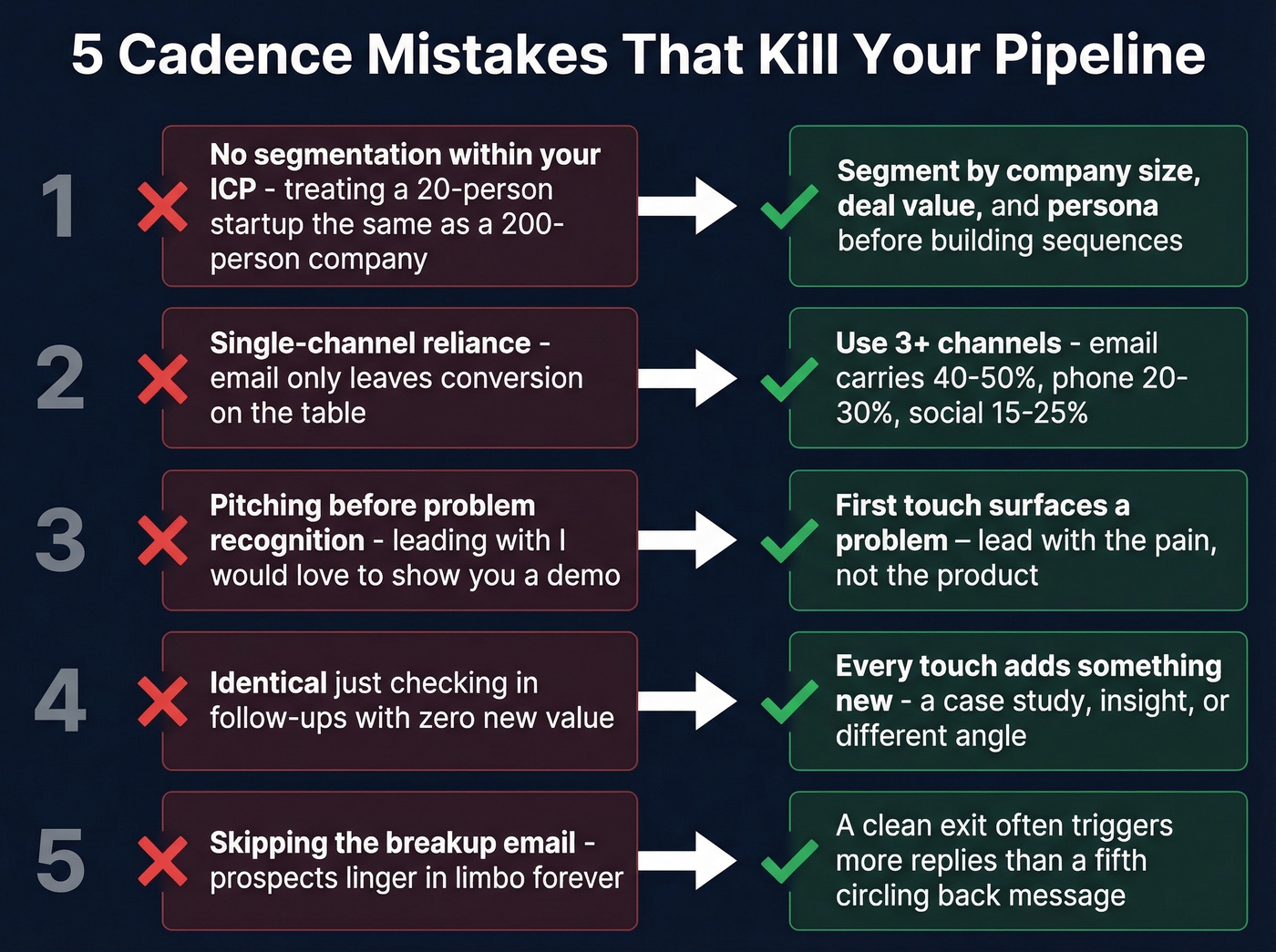
Single-channel reliance. Email-only cadences leave conversion on the table. Multi-channel isn't optional in 2026.
Pitching before problem recognition. Your first touch should surface a problem, not demo a solution. Reps who lead with "I'd love to show you a demo" get ignored because the prospect hasn't agreed they have a problem worth solving yet. Lead with the pain, not the product.
Identical "just checking in" follow-ups. Every touch needs new value - a case study, a relevant insight, a different angle. If your follow-up doesn't add something the previous email didn't, don't send it. (If you're stuck, here are better ways to say just checking in professionally.)
Skipping the breakup email. This leaves prospects in limbo and wastes rep energy on dead leads. Let's be honest: a clean exit often triggers more replies than a fifth "circling back" message ever will.
FAQ
How many touchpoints should a B2B sales cadence have?
8-12 touchpoints over 17-21 days for mid-market deals. SMB sequences need fewer - 4-6 over 7-10 days - while enterprise requires 12-20+ touches spread across 30-90 days. Segment by deal size. A one-size-fits-all approach underperforms in every segment.
What's a good cold email reply rate in 2026?
The 2026 average is 3.43%, and top-quartile teams hit 5.5%+. Since 58% of replies come from email #1, invest your best writing there. Verified contact data matters too - fewer bounces mean better deliverability, which means more of your emails actually land in inboxes.
What tools do you need to run a sales cadence?
You need a data verification tool for clean contacts and an engagement platform for sequences. For the data layer, look for 98%+ email accuracy and frequent refresh cycles. For sequencing, tools like Apollo, Outreach, or Salesloft handle the engagement side. Budget teams can get started for under $60/month total by pairing a verification tool with Instantly.