

Cold Email Follow-Up Templates (Plus the Infrastructure That Makes Them Work)
A RevOps lead we work with rebuilt their entire cold email stack last quarter. Same templates, same offer, same ICP. The only changes? Verified list, more domains, lower daily send caps. Bounce rate dropped from 11% to under 2%. Reply rate doubled from 3% to 6%. The templates didn't change - the plumbing did.
That's the dirty secret about cold email follow-up templates in 2026. 70% of cold email chains stop after the first message, and 48% of reps never send a second email at all. But the bigger problem is that the reps who do follow up are often sending into the void - spam folders, invalid addresses, burned domains. Let's fix both.
The Short Version
Your follow-ups probably aren't failing because of bad copy. They're failing because they land in spam. Fix infrastructure and data quality first, templates second.
Send 2-3 follow-ups max, not 7. Belkins' 16.5M-email dataset shows that once you hit 4+ emails in a sequence, unsubscribe and spam complaint rates more than triple. Below you'll find 7 follow-up templates, the exact timing sequence, and the deliverability checklist that makes it all work.
2026 Benchmarks Worth Knowing
Most teams overestimate open rates and underestimate how many emails never reach the inbox. Roughly 17% of cold emails never arrive at all.
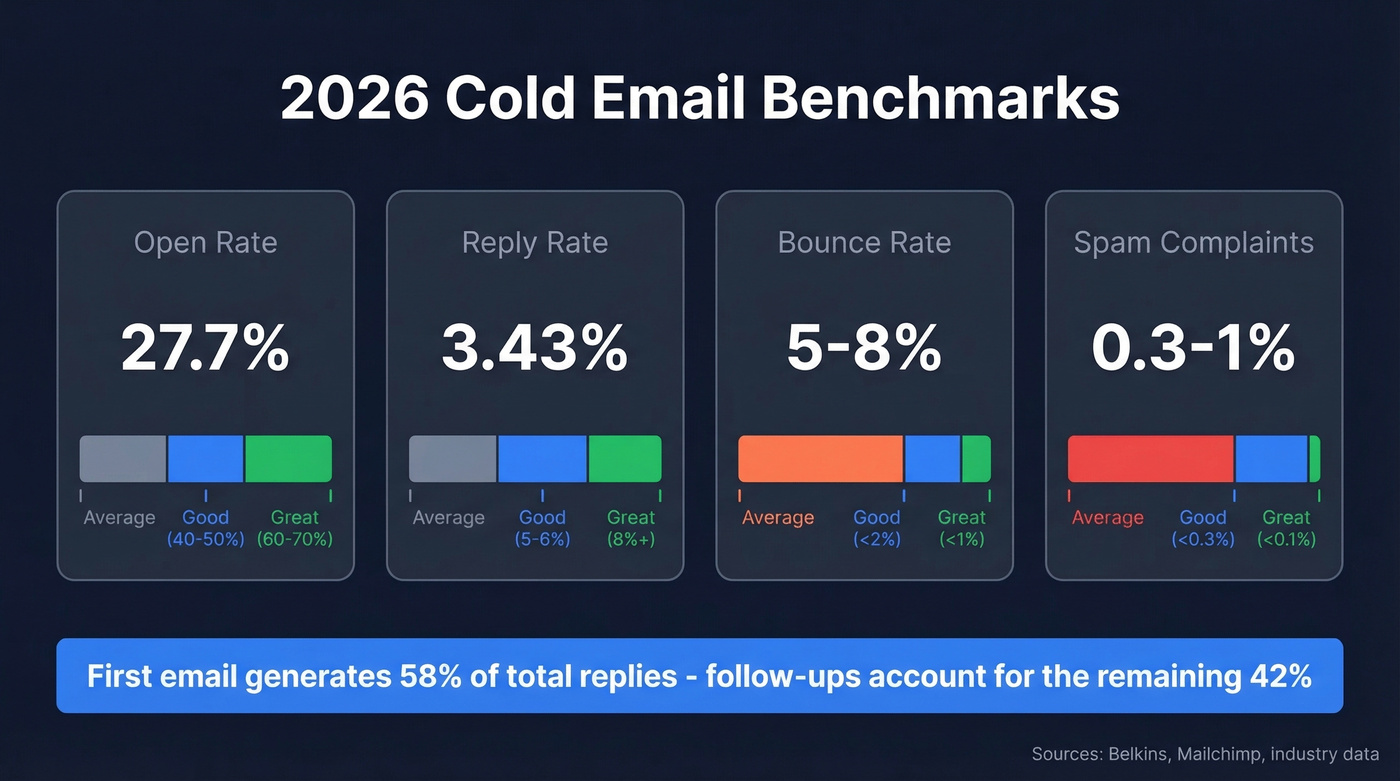
| Metric | Industry Average | Good Campaign | Great Campaign |
|---|---|---|---|
| Open rate | 27.7% | 40-50% | 60-70% |
| Reply rate | 3.43% | 5-6% | 8%+ |
| Bounce rate | ~5-8% | <2% | <1% |
| Spam complaints | 0.3-1% | <0.3% | <0.1% |
A 2-4% reply rate at scale is solid. Above 6% puts you in the top tier. Below 1%? The problem almost certainly isn't your copy - it's deliverability.
Your first email generates roughly 58% of total replies. Follow-ups account for the remaining 42%, but only if they actually reach the inbox.
Before You Write: The Infrastructure Checklist
No template survives a burned domain. Run through this before you touch a single follow-up draft.
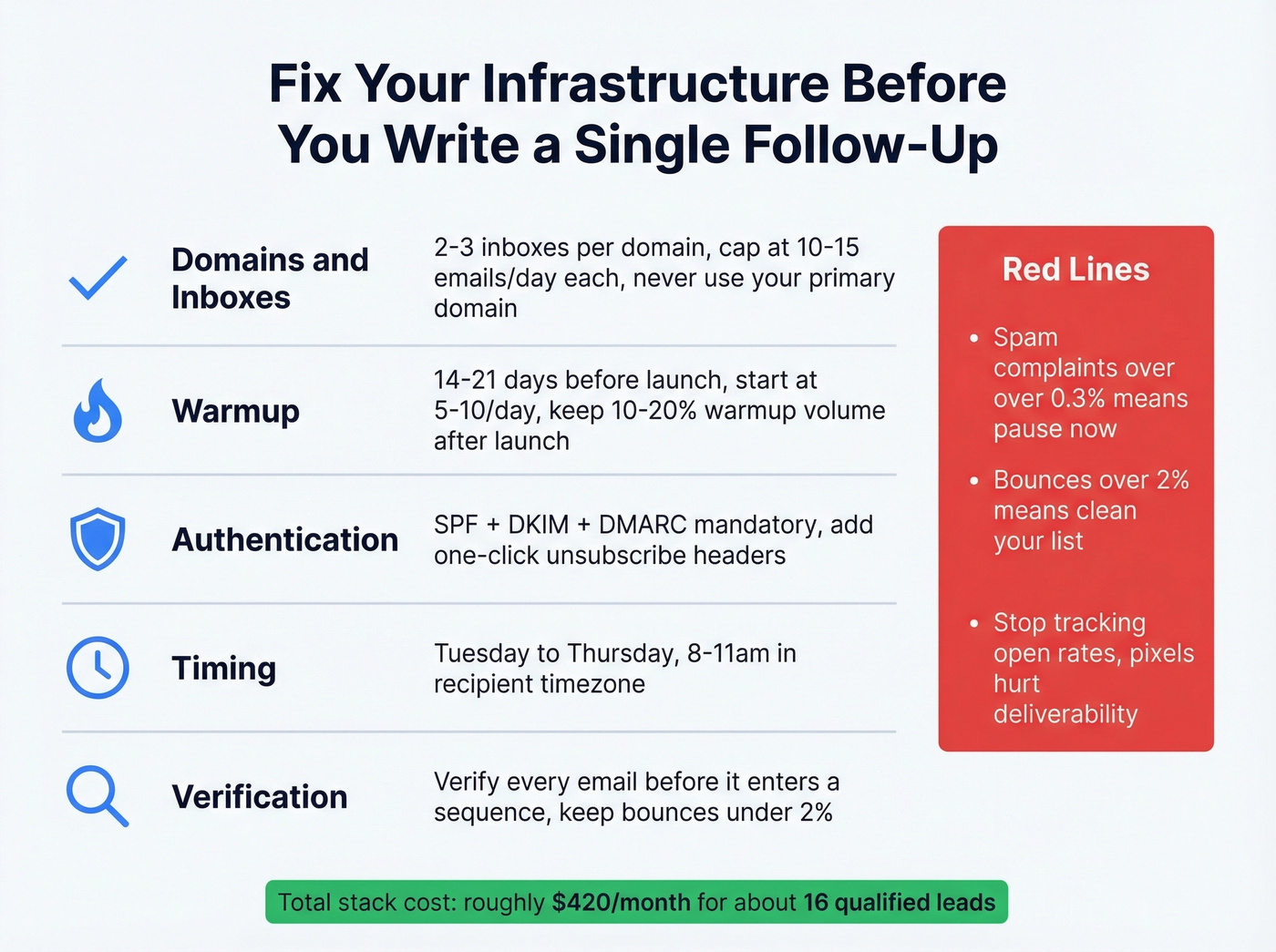
Domains and inboxes. Buy 2-3 inboxes per domain. Cap each inbox at 10-15 emails per day. For 400 sends per day, you need roughly 10-12 domains. Never send from your primary business domain - use secondary lookalikes like tryacme.com or acme-team.com. One operator we spoke with went from 3 domains to 7 and capped volume at 26 emails/day per domain to protect deliverability.
Warmup. New domains need 14-21 days of warmup before launch. Start at 5-10 emails per day and ramp slowly. Keep warmup running after launch, dedicating 10-20% of daily volume to engagement maintenance.
Authentication. SPF, DKIM, and DMARC are mandatory. If you haven't set these up, stop reading and go do it now. Google, Yahoo, and Microsoft all enforce these for bulk senders. Add RFC 8058 one-click unsubscribe headers - yes, even for cold email.
Timing. Send Tuesday through Thursday, 8-11am in the recipient's timezone. One practitioner saw opens improve by 16% from this change alone. (If you want a deeper timing breakdown, see best time to send cold emails.)
Thresholds to monitor. Spam complaints must stay under 0.3%. Gmail Postmaster Tools is notoriously unforgiving - 0.1% is a practical ceiling. Bounces must stay under 2%; if you're above that, pause and clean your list immediately. And stop tracking open rates. Tracking pixels are increasingly flagged by spam filters. Belkins stopped tracking opens entirely because the pixels were hurting deliverability. Focus on replies. (More on this in our email deliverability guide.)
What this costs. One practitioner runs their entire cold email stack - domains, sending tools, and verification - for roughly $420/month and generates about 16 qualified leads monthly. That's the real math of cold outbound in 2026.
Verify Your List or Burn Your Domain
Bad data is the silent killer of follow-up sequences. You can nail every template, warm up every domain, and still watch your sender reputation crater because 11% of your list bounces. We've seen it happen repeatedly.
The fix is simple: verify every email before it enters a sequence. Prospeo's 5-step verification process catches invalid addresses, handles catch-all domains, and removes spam traps and honeypots - delivering 98% email accuracy and keeping bounce rates under 2%. Stack Optimize built their agency to $1M ARR using Prospeo for client campaigns and maintained 94%+ deliverability with zero domain flags across all clients. (If you're comparing vendors, start with data enrichment services and email list providers.)
The 7-day data refresh cycle means the list you verified last week is still accurate this week. Most providers refresh around every 6 weeks, which is an eternity in B2B data. Upload a CSV, get results in minutes, and push clean contacts straight to Instantly, Smartlead, or Lemlist via native integrations. (If you're building lists from scratch, see how to generate an email list.)

Every follow-up you send to an invalid address chips away at your sender reputation. Prospeo's 5-step verification catches bad emails, spam traps, and honeypots before they torch your domain - delivering 98% accuracy on a 7-day refresh cycle. At ~$0.01/email, cleaning your list costs less than a single burned domain.
Verify your list before you send follow-up #1.
The Follow-Up Sequence Blueprint
Most guides tell you to send 7+ follow-ups. The data says otherwise.
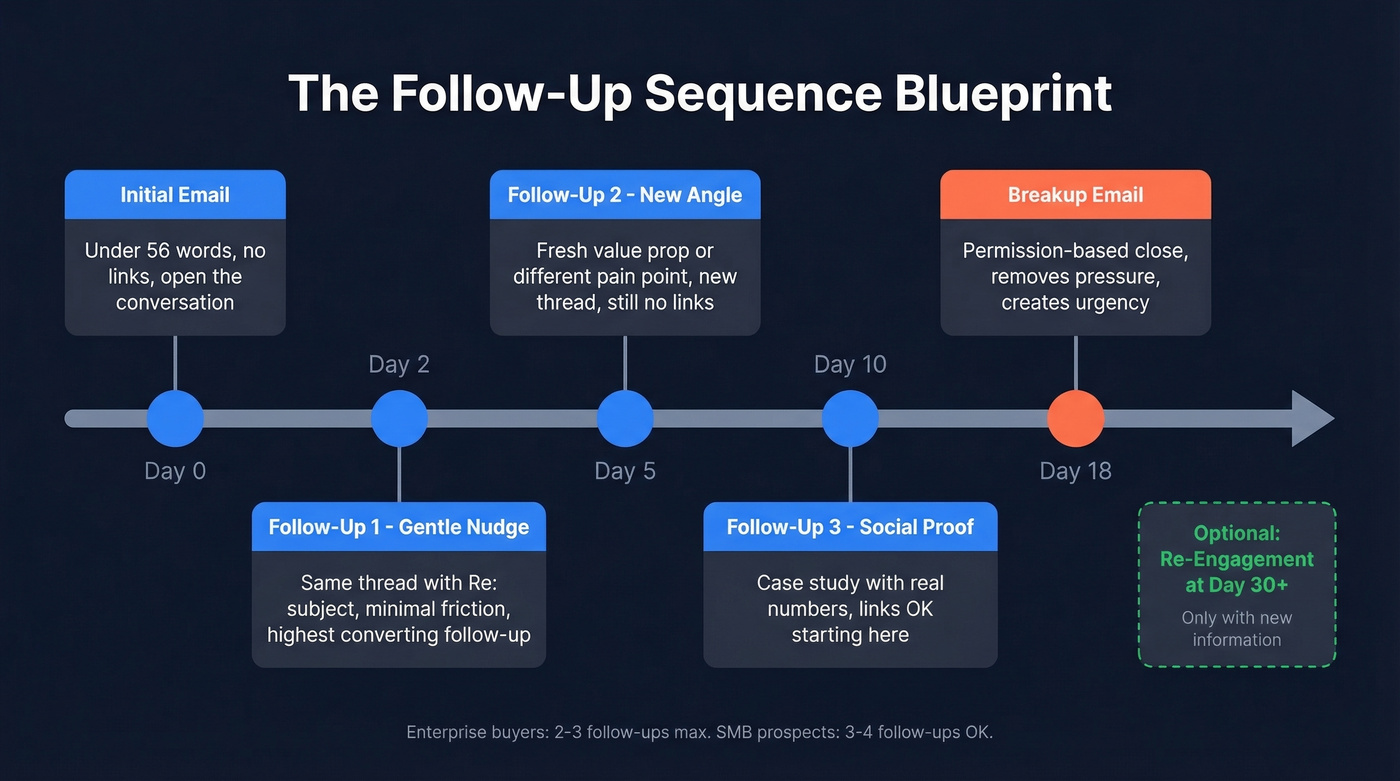
| Step | Day | Purpose | Notes |
|---|---|---|---|
| Initial email | 0 | Open the conversation | Under 56 words. No links. |
| Follow-up #1 | 2 | Gentle nudge | "Re:" subject line. Same thread. |
| Follow-up #2 | 5 | New angle | Fresh value prop or different pain point. |
| Follow-up #3 | 10 | Social proof | Case study or specific result. |
| Breakup | 18 | Close the loop | Permission-based close. No guilt trips. |
Keep follow-up #1 in the same email thread - the "Re:" subject line lifts opens because it looks like a real reply. For follow-ups #2 and beyond, test a fresh thread with a new angle. No links until email 3 at the earliest; links in early emails trigger spam filters.
Adjust by persona. Enterprise buyers usually punish persistence faster, so keep it to 2-3 follow-ups. SMB prospects tolerate 3-4. If you're selling to C-suite at companies over 500 employees, your window is shorter than you think. (For more sequencing strategy, see B2B cold email sequence.)
Open rates of 60-70% signal healthy deliverability. Below 20%? That's not a copy problem - go back to the checklist. (If you're troubleshooting, start with how to improve sender reputation.)
Great follow-up templates need great data underneath. Prospeo gives you 300M+ verified contacts with 30+ filters - buyer intent, job changes, technographics - so every sequence hits real inboxes. Stack Optimize built a $1M agency on Prospeo data with zero domain flags and sub-3% bounce rates across all clients.
Build sequences on data that actually connects you to buyers.
7 Follow-Up Templates That Earn Replies
Every template below is designed to stay under 56 words in the body. Short emails look like real emails. Long emails look like marketing. Customize the variables for your ICP before sending. (If you want broader options beyond cold outbound, see sales follow-up templates.)
Follow-Up #1: The Gentle Nudge (Day 2)
Subject: Re: [original subject]
Hi {{firstName}}, Just bumping this to the top of your inbox. We help {{companyType}} teams {{specific outcome}} - figured it might be relevant given {{trigger}}. Worth a 15-minute call this week?
Same thread, minimal friction. You're not pitching again - you're surfacing the original pitch. This is the highest-converting follow-up in most sequences because it rides the context of your first email.
Follow-Up #2: The New Angle (Day 5)
Here's the thing: the most common mistake with email #2 is repeating the same pitch with different words. Don't. Each follow-up must earn its existence by adding something the previous email didn't.
Subject: {{painPoint}} at {{company}}?
Hi {{firstName}}, Different angle: {{specific problem}} costs most {{industry}} teams {{X hours/dollars}} per month. We cut that by {{percentage}} for {{similar company}}. Is this on your radar right now?
Follow-Up #3: The Social Proof (Day 10)
Subject: How {{similar company}} solved {{problem}}
Hi {{firstName}}, {{Similar company}} had the same {{problem}}. After switching to {{solution}}, they {{specific result with number}}. Want me to send the 3-bullet summary?
Third-party proof is more persuasive than anything you can say about yourself. Use a real customer result with a real number - vague claims like "improved efficiency" convince nobody.
The Breakup Email (Day 18)
This is the template most reps resist sending. They shouldn't. The breakup email consistently outperforms aggressive follow-ups because it removes pressure, which paradoxically creates urgency.
Subject: Should I close your file?
Hi {{firstName}}, I've reached out a few times and haven't heard back - totally fine. I'll close this out for now. If you want to revisit later, just reply "later" and I'll circle back.
The Re-Engagement Email (30+ Days)
Subject: {{firstName}}, quick update
Hi {{firstName}}, Quick update since we last reached out: {{new development - product update, case study, or relevant news}}. If it changes the math for {{company}}, open to a quick chat?
New information justifies the re-engagement. Without it, you're just "checking in" - the #1 follow-up mistake.
The Value-Add Resource (Day 7 Alternative)
Before (bad): "Just following up on my last email. Any thoughts?"
After (good):
Subject: {{relevant topic}} data for {{company}}
Hi {{firstName}}, We just published a breakdown of {{relevant metric}} across {{industry}} - the {{specific insight}} surprised us. Here's the link if you want it: {{URL}}.
This works as a standalone touchpoint or a replacement for follow-up #2 or #3. You can adapt the framework for any service - SEO, paid media, web design, fractional CMO. The structure stays the same; swap the metric and result.
Agency/SaaS Follow-Up (Day 5 Variant)
Subject: {{metric}} improvement for {{company}}
Hi {{firstName}}, We ran {{service}} for {{similar company}} and generated {{specific result}} in {{timeframe}}. Their {{metric}} went from {{before}} to {{after}}. Want the playbook?
Subject Lines That Actually Matter
Subject lines matter less than deliverability, but they still move the needle once your emails are landing. (If you need more ideas, see email subject line examples.)
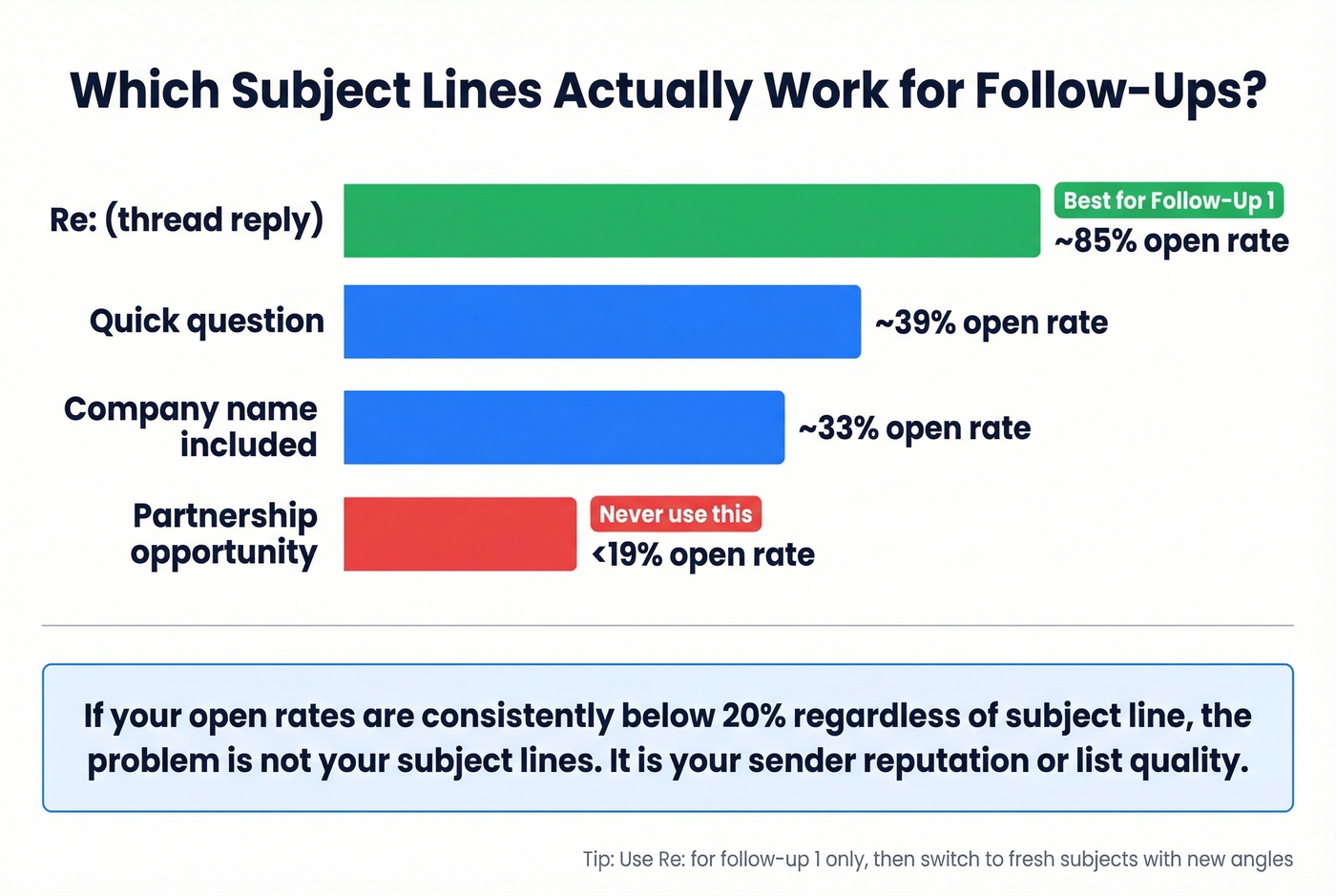
| Subject Line Type | Approx. Open Rate | When to Use |
|---|---|---|
| "Quick question" | ~39% | Follow-up #1 or #2 |
| Company name included | ~33% | Any follow-up |
| "Re:" (thread reply) | Highest for FU #1 | Follow-up #1 only |
| "Partnership opportunity" | <19% | Never |
The "Re:" subject line works for follow-up #1 because it mimics a real reply thread. For later follow-ups, a fresh subject with a new angle performs better - it signals new information rather than another bump on the same thread. If your open rates are consistently below 20% regardless of subject line, the problem isn't your subject lines. It's your sender reputation or list quality.
How Many Follow-Ups? The Data Is Clear.
The conventional wisdom says "follow up until they say no." The data says that's a great way to destroy your domain.
A study of 16.5M cold emails across 93 domains found the highest reply rate - 8.4% - came from campaigns with just one email. That doesn't mean you should only send one email. It means the first email does the heavy lifting, and each follow-up faces diminishing returns. By the fourth email, unsubscribe and spam complaint rates more than tripled.
The founder persona data is revealing: response rates held steady through the second follow-up (6.64% to 6.66% to 6.94%) then dropped sharply to 5.75% on the third and 3.01% on the fourth. You get two or three shots before recipients start punishing you.
Let's be honest about something the "send 12 follow-ups" crowd won't tell you: if you're closing deals under $10K, you probably don't need more than 2 follow-ups. The math doesn't support burning domain reputation to book a meeting on a small contract. Save the aggressive sequences for enterprise accounts where one meeting justifies the risk.
5 Follow-Up Mistakes That Kill Replies
1. Sending to unverified data. Verify your list before launching any sequence. Everything below is irrelevant if half your emails bounce. (Related: email bounce rate.)
2. "Just checking in" with no new information. Bad: "Hi, just following up on my last email. Any thoughts?" Good: "Hi {{firstName}}, since my last note, we published a case study on {{relevant topic}} - thought you'd find the {{specific metric}} interesting." (More options: how to say just checking in professionally.)
3. Every follow-up repeats the same pitch. Each email needs a new angle, new proof point, or new resource. If you can't think of something new to say, you've sent enough emails.
4. HTML-heavy formatting. Rich formatting, images, and fancy signatures trigger spam filters. Plain text emails that look like real 1:1 replies outperform designed templates consistently.
5. Sending 5+ follow-ups without switching channels. After follow-up #3, pick up the phone or send a social message. The email channel has diminishing returns - other channels don't carry the same spam risk. The consensus on r/sales backs this up: most experienced reps cap email sequences at 3 touches and layer in calls and social after that. (If you're building a calling motion, see cold calling system.)
When Email Isn't Enough: Go Multi-Channel
The best follow-up strategy isn't just email. Omnichannel outreach can boost results by up to 287% compared to single-channel campaigns. Test with 100-300 lead batches before scaling.
| Channel | Day 1 | Day 3 | Day 5 | Day 7 | Day 10 |
|---|---|---|---|---|---|
| Initial | New angle | - | Social proof | Breakup | |
| Phone | Call | Call + VM | Call | - | - |
| Social | Connect | Follow-up | - | Soft reminder | - |
The performance differences are significant. In one practitioner's test, cold calling hit 17% reply rates and 6.5% meeting rates - far above email's 8% reply and 2.33% meeting rate. Social came in at 6% reply and 2% meeting rate. Separately, social nurture actions can lift reply rates from 1.07% to over 5% with just 3-5 touchpoints, and the message-plus-profile-visit combo hit 11.87% reply rates. After your second or third email, switching to a different channel isn't giving up on email - it's playing the odds.
Skip multi-channel if you're running a tiny list under 50 contacts. The operational overhead isn't worth it at that scale. Just nail your email sequence and move on.
FAQ
How long should I wait before following up?
Wait 2-3 days before your first follow-up, then expand the spacing. The Day 2/5/10/18 framework gives prospects breathing room while keeping you top of mind. Sending the next day feels pushy; waiting a week risks losing momentum entirely.
How many follow-up emails is too many?
Data from 16.5M emails analyzed by Belkins shows that 4+ emails in a sequence more than triples unsubscribe and spam complaint rates. Stick to 2-3 follow-ups, then switch to phone or social. SMB prospects tolerate slightly more persistence, but the principle holds.
What's a good reply rate for follow-ups?
A 2-4% reply rate at scale is solid in 2026. Above 6% is exceptional and usually indicates strong targeting plus clean infrastructure. Below 1% means you should focus on deliverability and list quality before tweaking templates.
Should I send follow-ups in the same thread?
Yes for follow-up #1 - use a "Re:" subject line to keep it in the same thread, which lifts open rates. For follow-ups #2 and beyond, test a fresh thread with a new subject line and angle. New information deserves a new thread.
What about email verification tools?
Prospeo offers 75 free email verifications per month with no credit card required - enough to test a small campaign. For teams running real outbound, 98% accuracy and catch-all handling prevent the bounces that destroy sender reputation. Hunter gives 25 free searches monthly but caps enrichment and doesn't handle catch-all domains the same way.