How to Generate an Email List: The Data-Backed Playbook for 2026
You launched six months ago. You've got 47 subscribers - most are friends and family. Your lead magnet's been downloaded twice, and one of those was you testing the link.
Here's the uncomfortable truth about how to generate an email list that actually grows: you don't need 15 tactics. You need three, executed well, with the right tools behind them. This is the playbook I wish someone had handed me before I wasted a year on sidebar forms and "subscribe to our newsletter" CTAs that converted at basically zero.
What You Need (Quick Version)
- Inbound: Pick one lead magnet + one high-converting popup type + one traffic source. Master those three before adding complexity.
- Tools: Brevo (budget), Klaviyo (ecommerce), or MailerLite (simplicity) for email marketing. OptinMonster (from $7/mo) for popups.
Why Your Email List Is Your Most Valuable Marketing Asset
Current benchmarks put email marketing ROI around $36 for every $1 spent. No other channel comes close. Not paid social. Not SEO. Not influencer partnerships. Average email conversion rates sit at 2.8% for B2C and 2.4% for B2B - modest-sounding numbers that compound into serious revenue when you're emailing thousands of engaged subscribers weekly. (If you want the benchmarks and a calculator, see email marketing ROI.)

There are an estimated 4.73 billion global email users in 2026. That's over 56% of the world's population. Email isn't dying. It's the cockroach of marketing channels - it survives everything.
HubSpot's State of Marketing Report ranked email as the #1 ROI channel for B2C brands. For B2B, website/blog/SEO takes the top spot, but email is the mechanism that converts that traffic into pipeline. Without a list, your blog traffic is just... traffic. People visit, read, leave, and never come back.
Here's what makes the math uncomfortable: the average email list grew just 4% in 2024, down from 6% in 2023. List growth is getting harder. Inboxes are more crowded - 376.4 billion emails were sent daily in 2025, projected to hit 392.5 billion in 2026. And 71% of customers now expect personalized interactions, with 76% getting frustrated when they don't get them. Generic blasts don't cut it anymore.
That means the teams winning at list building aren't doing more things. They're doing fewer things better. A single well-optimized popup can outperform ten mediocre tactics combined. One lead magnet that genuinely solves a problem will outpull a dozen generic ebooks.
The rest of this guide is built on that principle: fewer tactics, better execution, real numbers.
Choose the Right Email Marketing Platform
Before you build a single form, you need somewhere to send emails from. The tool you pick matters less than you think at the start - and more than you think at 10,000 subscribers when migration becomes painful.
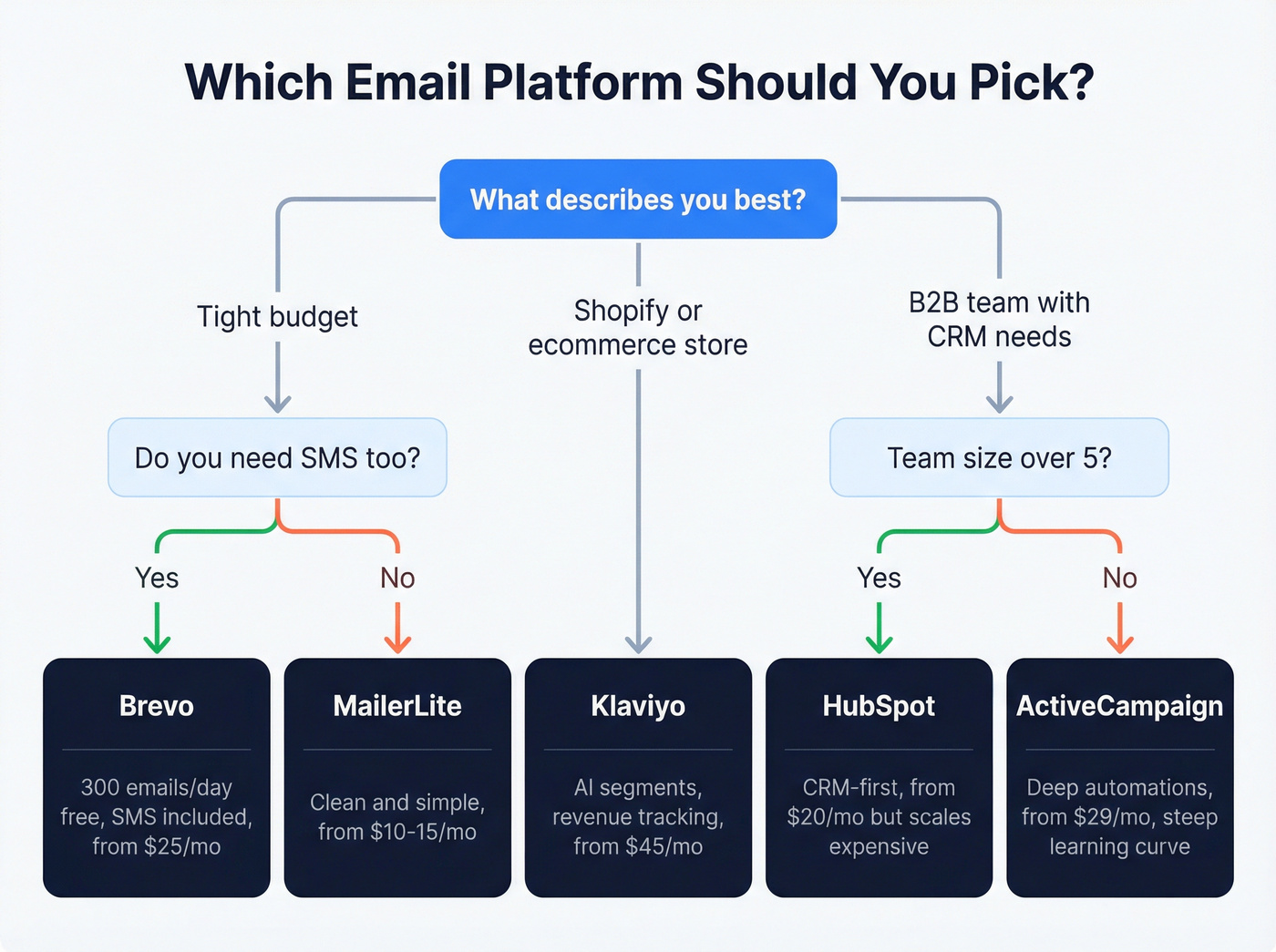
Here's the honest breakdown:
| Tool | Best For | Free Tier | Paid From | Key Strength | Key Weakness |
|---|---|---|---|---|---|
| Mailchimp | First-time email marketers | 500 contacts | ~$13/mo | Easy drag-and-drop | Free automations limited |
| Brevo | Cash-strapped startups | 300 emails/day | ~$25/mo | Free tier + SMS | Basic templates |
| Klaviyo | Shopify/DTC brands | 500 sends | ~$45/mo | Ecommerce AI segments | Overpriced outside ecom |
| MailerLite | Solo creators who hate bloat | Yes | ~$10-15/mo | Clean, no bloat | Fewer integrations |
| ActiveCampaign | Mid-size B2B teams | No | ~$29/mo | Deep automations | Steep learning curve |
| HubSpot | CRM-first teams | Barebones | ~$20/mo | CRM integration | Scales expensive fast |
Mailchimp vs. Brevo - the budget showdown. Mailchimp is the default recommendation everywhere, and the drag-and-drop editor is genuinely good. But the free tier caps at 500 contacts with limited automations, and pricing ramps quickly. Brevo is the sleeper pick. The free tier gives you 300 emails per day, not contacts. That's a meaningful distinction.
You can have 5,000 contacts on Brevo and still send for free if you pace it. Paid plans start around $25/mo and include SMS, which most competitors charge extra for.
Klaviyo is the answer if you're running a Shopify store. The killer integration delivers predictive analytics, AI segmentation, and revenue attribution per email. If you're in ecommerce and not using Klaviyo, you're leaving money on the table. Outside ecommerce? Skip it - overpriced for what you get.
MailerLite is the tool Reddit keeps recommending with the same phrase: "clean, cheap, no bloat." It does email well without trying to be a CRM, a landing page builder, and a project management tool. Paid plans start around $10-15/mo. Hard to beat for simplicity.
Skip ActiveCampaign if you're a small team or solo operator. The learning curve is brutal, and pricing ramps fast past the base tier. But if you need conditional workflows, lead scoring, and CRM pipelines - and you'll actually use them - it's the best mid-market option at ~$29/mo.
HubSpot makes sense only if your team already lives in HubSpot's CRM. The Starter plan at $20/mo is reasonable, but Marketing Hub pricing can jump fast - often $800+/mo once you add seats and advanced features.
Here's the thing: every platform claims to be "all-in-one." None of them are. You'll probably end up using a dedicated popup tool alongside your ESP - and that's fine. Better to use two tools that each do their job well than one tool that does everything poorly.
Create a Lead Magnet People Actually Want
"Subscribe to our newsletter" isn't a lead magnet. It's a request with no value proposition. Over 50% of marketers report higher conversion rates when they use actual lead magnets - something tangible in exchange for an email address.
The formats that convert best aren't the ones that take the longest to create. Quick-win formats crush long-form PDFs because people want instant gratification.
Quick-Win Formats (Create This Week)
- Templates & swipe files - Ready-to-use, highest perceived value. A cold email template library, a social media content calendar, a financial model spreadsheet. People download these because they can use them immediately. (If you’re building templates for outreach, pair them with a proven cold email sequence.)
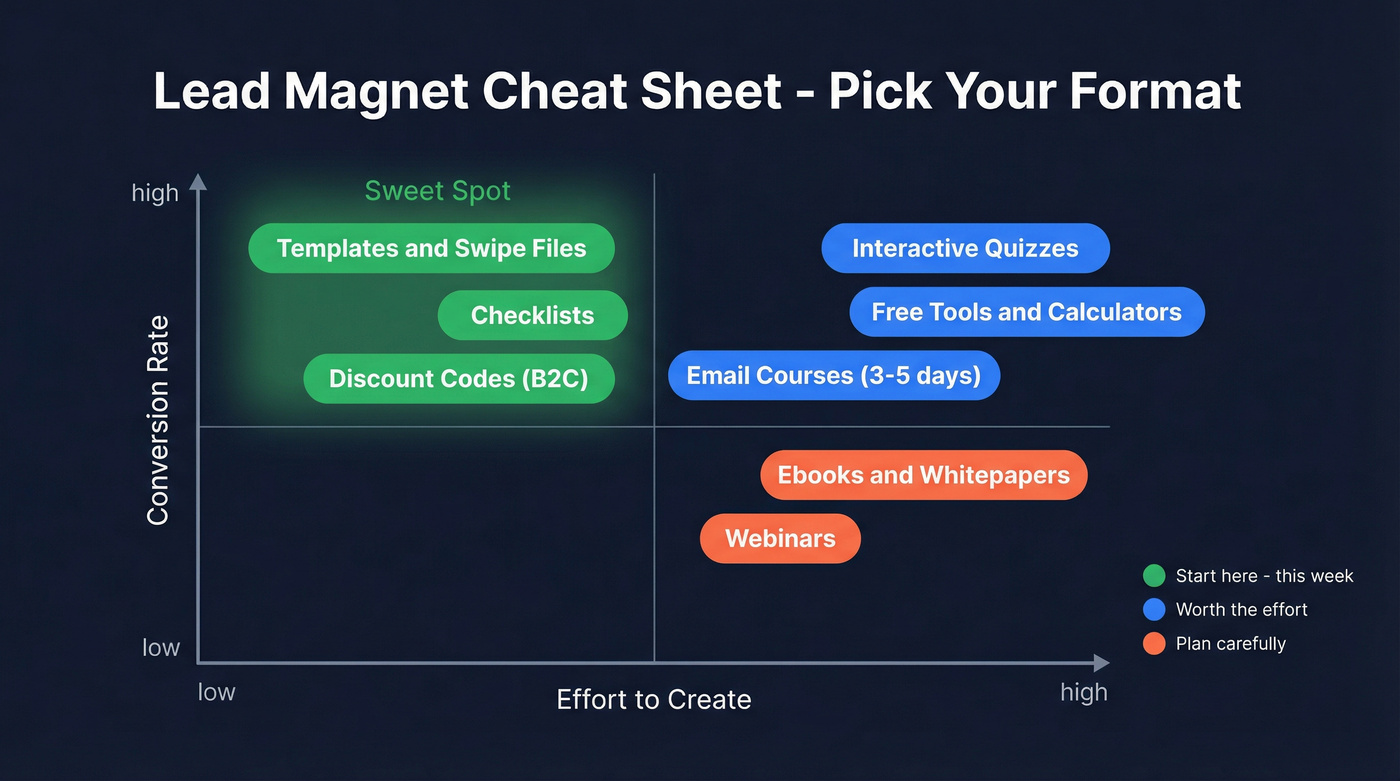
Checklists & cheat sheets - Quick, actionable, low friction. A "launch checklist" or "SEO audit cheat sheet" takes 30 minutes to create and converts better than a 40-page ebook.
Interactive quizzes - Personalized results drive completion. "What's your marketing maturity score?" or "Which pricing model fits your SaaS?" People love learning about themselves.
Discount codes (B2C/ecommerce) - Immediate incentive. A 10-15% discount popup on an ecommerce site is the simplest lead magnet that works. Not creative, but effective.
Free tools & calculators - Ongoing utility keeps your brand top of mind. An ROI calculator, a headline analyzer, a shipping cost estimator. These generate repeat visits.
High-Commitment Formats (Plan for Next Month)
Email courses (3-5 days) - Builds the habit of opening your emails. "5 days to better cold emails" trains subscribers to expect and open your messages. Brilliant for engagement.
Webinars & video tutorials (B2B) - Positions you as an expert. Higher commitment from the subscriber, which means higher quality leads. Works best for complex, high-ticket products.
Ebooks & whitepapers (B2B) - Still work for complex topics, but completion rates are lower than any format above. Most people download them and never read past page three.
B2B vs. B2C: Different Magnets for Different Buyers
B2C leads with discounts, quizzes, and contests. B2B leads with templates, calculators, gated reports, and webinars. (If you need examples of what “good” looks like, start with buyer persona examples.)
A 10% discount popup won't get a VP of Marketing to hand over their work email. A benchmarking report will. A "spin the wheel" gamification popup works for a DTC skincare brand. It'd be embarrassing on an enterprise SaaS site.
Content upgrades - lead magnets embedded directly within a relevant blog post - convert at 5-15%. That's often multiple times higher than a generic site-wide popup because the offer matches the reader's current intent. If someone's reading your post about email deliverability, offer them a deliverability checklist. Not your general newsletter. Not an unrelated ebook. (For the inbox-side mechanics, see email deliverability.)
The best lead magnet is the one you can create this week and test this month. Don't spend three months building a course. Start with a checklist, measure conversion, iterate.

Lead magnets grow your list slowly. What if you could skip the wait? Prospeo gives you instant access to 143M+ verified emails with 98% accuracy - at $0.01 per lead. Build targeted email lists in minutes, not months.
Stop waiting for subscribers. Go find them.
Build High-Converting Opt-In Forms
The difference between a 3% conversion rate and a 35% conversion rate comes down to form type, trigger timing, and offer quality. Not traffic volume.
Popup Types and What They Actually Convert
The average popup converts at ~3%. A well-designed gamified popup converts at 30-40%. That's a 10x difference from the same traffic.
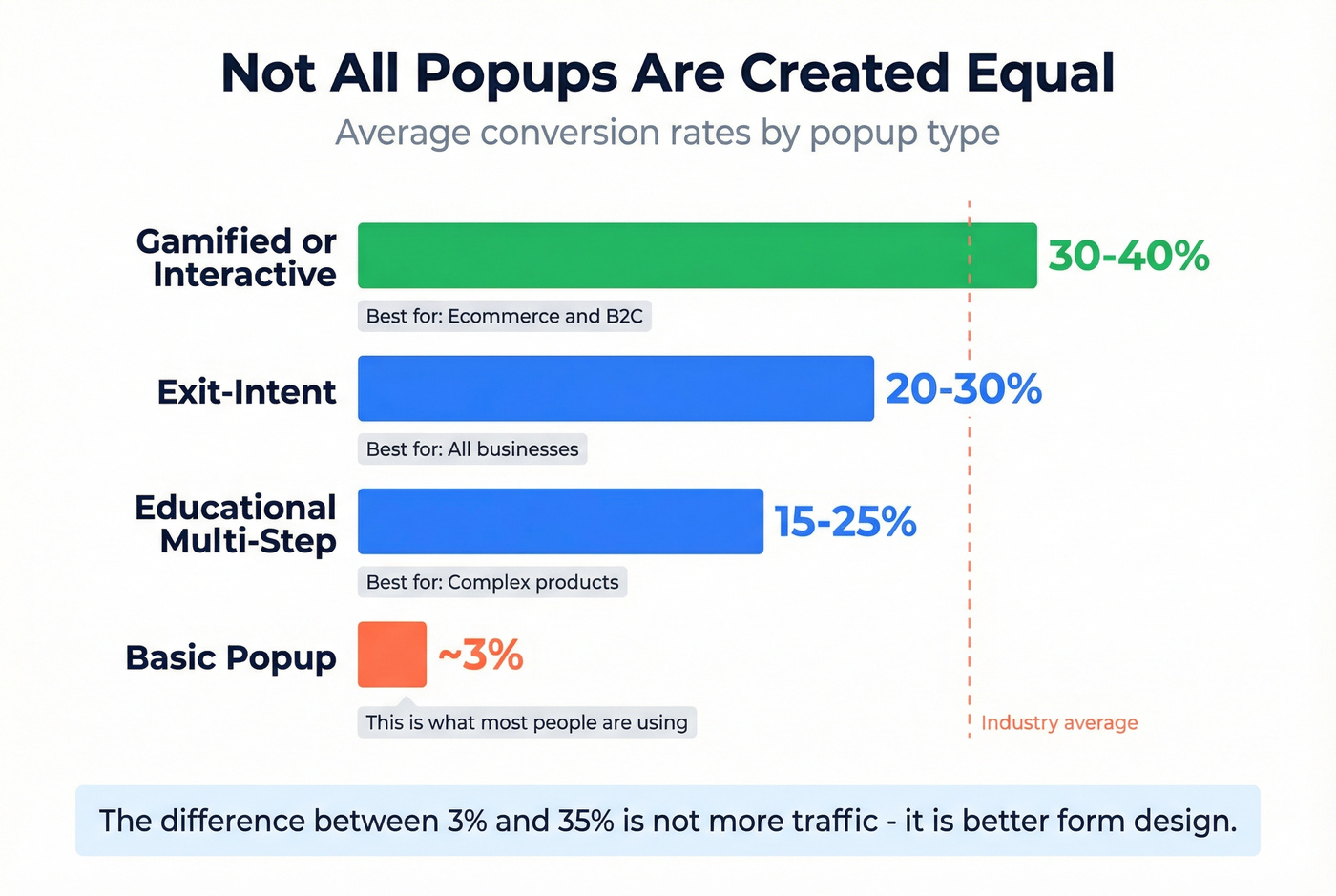
| Popup Type | Avg Conversion | Best For | Example Trigger |
|---|---|---|---|
| Gamified/Interactive | 30-40% | Ecommerce, B2C | Scroll 50%+ or 30s delay |
| Exit-Intent | 20-30% | All businesses | Mouse moves to close tab |
| Educational (multi-step) | 15-25% | Complex products | Scroll 60-70% |
| Average/basic popup | ~3% | Basic list building | Time delay 30-60s |
The optimal triggers: exit-intent captures people who are already leaving (you've got nothing to lose), scroll depth of 50-70% catches engaged readers, and time-based delays of 30-60 seconds filter out bouncers. Combine triggers for best results - exit-intent on desktop, scroll-depth on mobile where there's no "exit" cursor movement.
The fact that most guides still recommend "add a signup form to your sidebar" as a primary strategy tells you how outdated this advice is. Sidebar forms convert at around 1-3%. That's not a strategy - it's a participation trophy.
Real Brand Case Studies (With Numbers)
These aren't hypothetical. These are documented results:

Patrick Ta Beauty redesigned their popup to auto-apply a discount code (no extra step for the customer). Result: 167% increase in email signups - from 9,000 to 24,000 new subscribers per month. The lesson? Reduce friction. Every extra click costs you signups.
Nakie (outdoor gear) replaced their standard popup with a multi-screen educational popup that taught visitors something before asking for the email. Conversion jumped from 5-6% to 35%. That's not a marginal improvement - that's a different business.
Gardencup (meal subscription) added a mystery discount gamification element - spin-to-reveal your discount. Result: 22.4% email opt-in rate and a 124% increase in net new email subscribers.
Essence Vault (fragrance) implemented a gender-targeted popup - different offers for men's vs. women's fragrances. Signup rate jumped from 11% to 33%. Personalization at the popup level, not just the email level.
Firebelly Tea built a three-lesson educational journey into their popup flow - teaching visitors about tea sourcing before asking for the email. Purchase rate jumped from 14% to 36%.
The pattern across all five: they didn't just add a popup. They made the popup itself valuable, relevant, or entertaining.
What 10,000 Forms Taught Us
Typeform analyzed 10,000+ lead capture forms and found patterns that most marketers ignore:
Don't put a question on the welcome screen. Forms that opened with a question saw a 5% decrease in completion rate. Lead with context, not interrogation.
Use exclusivity language. Phrases like "join 5,000 marketers" or "exclusive access" increased form completion by 10.6%. People want to feel like they're getting into something, not just handing over data.
Hidden fields boost completion by 4.8%. Pre-populating data (UTM source, referring page, device type) means fewer fields for the user to fill out. Less friction, more completions.
The minimum viable form: email address only. Every additional field you add drops conversion. Name? Optional. Company? Skip it unless you're qualifying leads. Phone number? You'll lose 30-50% of completions.
Subject line benchmarks worth knowing: 6-10 words hit the highest open rate at 21%. Questions in subject lines boost opens by 50%. Subject lines with numbers get 17% higher open rates. Personalized subject lines get 26% more opens. These small optimizations compound across thousands of subscribers. (If you want a bigger swipe file, see cold email subject lines.)
Compliance: Don't Skip This
GDPR requires explicit consent for EU subscribers - pre-checked boxes don't count. CAN-SPAM requires a physical mailing address and a working unsubscribe link in every email. Violating these isn't just unethical - it's expensive. GDPR fines can reach EUR 20M or 4% of annual revenue. Build compliance into your forms from day one: clear opt-in language, easy unsubscribe, and a privacy policy link. (More detail here: GDPR for Sales and Marketing.)
Popup Tools Worth Your Money
- OptinMonster - from $7/mo, best value in the category. Strongest targeting controls, works with any ESP. This is where most teams should start.
- OptiMonk - $29/mo, built for ecommerce. Gamified campaigns, smart product recommendations, solid A/B testing.
- Wisepops - $49/mo, the premium option. 14-day free trial. Better design flexibility, but you're paying for polish.
Driving Traffic to Your Opt-In Pages
You've got a lead magnet. You've got a high-converting popup. Now you need people to actually see it.
Content Marketing - The Autopilot List Builder
This is the most underrated strategy for growing a subscriber base, and it's the one we've seen produce the most consistent results over time. Every guide talks about popups and social media. Almost none mention that a single well-optimized blog post with a content upgrade can capture new subscribers on autopilot for years.
Here's the flywheel: write a blog post targeting a keyword with search volume, rank in Google, organic traffic arrives, reader hits a content upgrade CTA relevant to the post, they exchange their email for the resource, welcome sequence nurtures them, repeat. (For the site-side mechanics, see website lead generation.)
HubSpot's 2026 data confirms website/blog/SEO is the #1 ROI-generating channel for B2B marketers. And unlike paid ads - where every competitor pays roughly the same per click - content marketing has a snowball effect. Each additional piece of evergreen content compounds your traffic and subscriber growth over time.
The key is content upgrades, not generic popups. A blog post about "cold email subject lines" with a downloadable "50 proven subject line templates" PDF will convert at 5-15%. The same post with a generic "subscribe to our newsletter" sidebar? Maybe 1-2%.
I've seen teams generate 200-300 subscribers per month from a single blog post that ranks well and has a strong content upgrade. That's not a fantasy - it's the math of consistent organic traffic plus a relevant offer.
Social Media That Actually Works
The #1 complaint from B2B founders is blunt: "Just posting on social media isn't cutting it." And they're right. Organic social reach is dying. Groups will ban you for promotional activity. Follow-for-follow strategies are a waste of time.
What does work:
- Pin your lead magnet offer to your profile. Every profile visit becomes a potential conversion.
- Run giveaways with email entry. Meta giveaway ads designed to capture emails can drive low CPL in many niches.
- Collaborate with aligned creators. Guest on podcasts, co-host webinars, do newsletter swaps. You're borrowing someone else's audience - and their trust.
- Use TikTok Lead Gen ads. In-app lead gen forms can capture emails without sending people to your site first. If your audience skews under 35, test it.
Social media is a distribution channel for your lead magnet, not a list-building strategy on its own. The email capture happens on your site, not on the platform. (If social is part of your mix, use this social selling playbook to stay pipeline-first.)
SMS Text-to-Join
If you have a physical presence - retail store, event booth, conference - SMS text-to-join is underused and effective. "Text JOIN to 55555 to get our free guide" captures emails from people who'd never visit your website. Brevo and Klaviyo both support SMS alongside email, which makes multi-channel capture straightforward.
Paid Amplification
Facebook and Instagram lead ads let people submit their email without leaving the platform. Friction is minimal, and for ecommerce brands, cost per lead often lands at $1-3 per email. B2B typically runs $5-15 per lead depending on targeting.
Google Ads work for high-intent keywords. Someone searching "email deliverability checklist" is already looking for exactly what your lead magnet offers. Bid on those terms, send traffic to a dedicated landing page, and capture emails.
Frame paid as an accelerant, not a replacement for organic. Paid gets you to 1,000 subscribers faster. Content marketing keeps you growing after you turn the ads off.
Set Up a Welcome Sequence That Retains Subscribers
2,000 subscribers, 12% open rate, unsubscribes climbing. Sound familiar?
You don't have a list-building problem - you have a list-quality problem. And it usually starts with what happens (or doesn't happen) in the first 10 days.
Welcome emails have an 80% average open rate. That's the highest open rate you'll ever see from any email type. If you're not sending a welcome sequence, you're wasting the moment when subscribers are most engaged.
Here's the framework:
Email 1 (immediate): Deliver the lead magnet. Set expectations - what you'll send, how often, and why it's worth opening. Keep it short. One CTA: download the thing they signed up for.
Email 2 (day 2): Share your single best piece of content or a quick win. Something that makes them think "I'm glad I subscribed." No selling.
Email 3 (day 4): Tell your story. Why you started this. What you believe. People buy from people they trust, and trust starts with authenticity.
Email 4 (day 7): Soft pitch or product introduction. "Here's what we built and why." Not a hard sell - a bridge between value and offer.
Email 5 (day 10): Social proof + clear CTA. Customer results, testimonials, case studies. Then one clear action: try the product, book a call, visit the page.
Single-CTA emails increase click-through rates by 371%. That's not a small optimization - it's the difference between a sequence that converts and one that gets ignored. And embedding video in your emails can boost click-through rates by 65%, so consider a short Loom or product demo in Email 4.
Build a B2B Prospect List (The Outbound Approach)
Everything above assumes inbound: create content, attract visitors, convert them into subscribers. That works. But if you're selling B2B - especially to a defined ICP - you can't wait for 500 CMOs to find your blog and sign up for a checklist. (If you want the ops benchmarks, see B2B lead capture.)
This is the section no other list-building guide covers, and it's the one that matters most for B2B teams.
The frustration is real. I've talked to B2B SaaS founders who spent months posting on social, got banned from groups for being promotional, watched subscribers actively opt out. The inbound-only approach just doesn't scale fast enough when you know exactly who you need to reach.
The answer isn't buying an email list. That'll tank your sender reputation instantly. Bought lists are full of spam traps, dead addresses, and people who never consented to hear from you. Your domain gets flagged, your deliverability craters, and you spend months recovering.
The answer is building your own verified list. That means using a B2B data platform to find the specific people you want to reach, verify their email addresses before sending, and only contact people with valid, deliverable addresses. (If you need the SOP, use this email verification workflow.)

Prospeo's B2B database covers 300M+ professional profiles and 143M+ verified emails with 30+ search filters - job title, industry, company size, technographics, buyer intent, funding stage, headcount growth. You build a list of exactly who you want to reach, and every email is verified before export. 98% email accuracy, 7-day data refresh cycle, and you only pay for valid addresses at roughly $0.01 per email. The free tier gives you 75 emails and 100 Chrome extension credits per month - enough to test the workflow before committing.
The workflow: define your ICP, search the database with filters, export verified contacts, push to your sequencer (native integrations with Smartlead, Instantly, Lemlist, and others), run your outbound sequence. You've got a targeted, verified list in minutes instead of months of waiting for inbound to compound. (Need a broader stack view? See B2B sales stack.)
Average list growth dropped to 4% last year. Teams using Prospeo skip the grind entirely - 300M+ profiles, 30+ filters, and a 7-day data refresh cycle so every email you pull is fresh. No popups needed.
Generate a targeted email list of thousands in one search.
Grow and Maintain Your Email List Over Time
Building a list is step one. Keeping it healthy and growing is the ongoing work that separates amateurs from professionals.
Referral Programs
The Hustle grew to over 1.5 million subscribers, and their referral program was a major engine of that growth. The mechanics were simple: share a unique link, earn rewards at milestones (stickers at 5 referrals, a t-shirt at 25, etc.). The rewards were cheap. The growth was exponential.
You don't need custom software. SparkLoop (from ~$100/mo for paid newsletters) or ReferralHero (free tier for up to 1,000 subscribers, paid from ~$49/mo) plug into most ESPs. The implementation steps:
- Create a unique referral link for each subscriber (most referral tools handle this automatically).
- Set reward tiers - start small. A bonus resource at 3 referrals, a discount at 10.
- Remind subscribers about the program in your welcome sequence and periodically in regular emails.
- Track and fulfill rewards promptly. Nothing kills a referral program faster than broken promises.
The key insight: people refer when the content is genuinely worth sharing. Fix your content quality first, then add the referral mechanics.
List Hygiene - The Growth Strategy Nobody Talks About
Email lists decay 22-25% per year through job changes, abandoned email addresses, and disengagement. If you're not actively cleaning your list, a quarter of it is dead weight dragging down your deliverability.
Clean every 3-6 months. Here's the process:
- Identify subscribers who haven't opened or clicked in 6-12 months.
- Run a re-engagement campaign: "Still want to hear from us?" with a clear CTA to stay subscribed.
- Anyone who doesn't engage within 2-3 emails gets removed.
Deleting subscribers feels uncomfortable. I get it. You worked hard to get those emails. But a smaller, engaged list outperforms a bloated, dead one every time. Your open rates improve, your deliverability improves, and your ESP costs go down (most charge by contact count).
Segmentation and Sending Frequency
Segment by behavior and purchase history, not just demographics. Someone who downloaded your pricing PDF is in a different stage than someone who read a blog post once. Treat them differently. Set up an email preference center so subscribers can choose what they receive - it reduces unsubscribes and gives you segmentation data for free. (If you want a step-by-step, see how to segment your email list.)
| Business Type | Optimal Frequency | Notes |
|---|---|---|
| B2B SaaS/Services | 2-4/month | Quality over quantity |
| B2C Retail | 4-8/month | Promotions drive opens |
| Ecommerce | 4-5/week | Only if segmented well |
| Service Businesses | 2-3/month | Educational content |
Remember: 69% of people unsubscribe because of too many emails. When in doubt, send less. One great email per week beats five mediocre ones.
Mobile optimization isn't optional. 78% of emails are opened on mobile devices. 75% of users delete emails that aren't optimized for mobile viewing. Minimum button size: 44x44 pixels. Subject lines under 50 characters to prevent cutoff. Preview text that complements (not repeats) the subject line.
Hot take: 81% of marketers now use generative AI for email creation. Most of them are using it wrong - generating entire emails instead of using it for subject line variations, send-time optimization, and segmentation logic. AI-written body copy reads like AI-written body copy. Use the tools for the boring stuff and write the actual emails yourself.
Mistakes That Will Kill Your Email List
These aren't theoretical. They're the patterns I see repeatedly in teams that can't figure out why their list isn't growing - or worse, why it's shrinking.
1. Buying email lists. You'll tank your sender reputation instantly. Bought lists are full of spam traps and dead addresses. Your bounce rate spikes, ISPs flag your domain, and legitimate subscribers stop receiving your emails. Build your own verified list instead - the B2B section above shows you how. (If you need a deeper framework, start with B2B email marketing lists.)
2. Using no-reply email addresses. "noreply@yourcompany.com" tells subscribers you don't care about their responses. It also hurts deliverability - replies signal to ISPs that your emails are wanted. Use a real person's name and let people respond.
3. Over-sending. 69% of users unsubscribe specifically because they receive too many emails. If you're emailing daily and your open rates are declining, the problem isn't your subject lines. It's your frequency.
4. No segmentation. Sending the same generic email to your entire list is lazy and expensive. A first-time subscriber and a repeat customer need different messages. Personalized CTAs convert 202% better than default ones - that stat alone justifies the effort.
5. Ignoring mobile. 78% of emails open on mobile. If your emails look broken on a phone, 75% of recipients will delete them. Test every email on mobile before sending.
6. Letting your list go stale. If people haven't heard from you in months, they won't remember signing up. When you finally email them, they'll mark you as spam. Consistency matters more than frequency.
7. No welcome sequence. Welcome emails get 80% open rates. If you're not sending one, you're wasting the single highest-engagement moment in the subscriber relationship. Set up a 3-5 email sequence before you do anything else.
That's the playbook. One lead magnet, one optimized popup, one traffic source - master those three before adding complexity. The teams that figure out how to generate an email list fastest aren't doing more. They're doing less, better.
FAQ
How long does it take to build an email list of 1,000 subscribers?
Expect 3-6 months with active lead magnets, a high-converting popup, and moderate traffic. Brand-new sites with no existing audience typically need 6-12 months. Teams that publish weekly and optimize monthly get there faster than those chasing viral moments.
What's a good email list conversion rate?
Average popups convert at ~3%, well-optimized exit-intent popups hit 20-30%, and gamified popups reach 30-40%. If you're below 3%, test a stronger lead magnet before redesigning the popup itself - the offer matters more than the design.
Should I use single opt-in or double opt-in?
Double opt-in produces a cleaner, more engaged list and satisfies GDPR-grade consent requirements. Single opt-in grows faster but attracts more junk signups and bots. For most businesses, double opt-in is worth the tradeoff - you lose some volume but gain deliverability and engagement.
What's the fastest way to generate an email list from scratch?
Combine a high-value lead magnet (template or checklist) with an exit-intent popup and drive traffic through one channel you already have traction on - SEO, social media, or paid ads. For B2B teams, adding outbound prospecting with a verified data platform lets you build a targeted list in days rather than months.
How often should I clean my email list?
Every 3-6 months. Remove subscribers who haven't engaged in 6-12 months after running a re-engagement campaign. Lists decay 22-25% per year through job changes and abandoned addresses, so regular cleaning improves deliverability and reduces ESP costs.