How to Send Gifts to Prospects Without Wasting Money
You just spent $500 sending gifts to 25 prospects. Five went to people who've already left the company. Three more landed on the desk of someone who doesn't handle purchasing decisions. That's $160 in the trash - and you didn't even pick bad gifts. 40% of all corporate gifts end up in the trash, per market researcher Arizent. Sending gifts to prospects is one of the most effective pattern interrupts in B2B sales, but most of that waste isn't about what you send. It's about who you send it to, when you send it, and whether you checked your data first.
The Short Version
- Verify your prospect data before you ship anything. That 40% waste rate? A huge chunk is gifts going to the wrong person at the wrong address. (If you’re fighting list rot, see B2B Contact Data Decay.)
- Start at $15. A personalized coffee card tied to a specific sales moment outperforms a $200 generic gift basket every time.
- Gift the 20% of prospects who represent 80% of your pipeline. Everyone else gets a great email. Gifting is a precision tool, not a spray-and-pray channel.
Why Gifting Works in Sales
Gifting isn't a nice gesture - it's a pattern interrupt in a world where 73% of B2B buyers actively avoid sellers who send irrelevant outreach. A physical gift lands on a desk, not in a spam folder. That distinction matters more every year, especially as 57% of sales professionals say the sales cycle is getting longer. (If you’re mapping stages and handoffs, use these B2B sales best practices.)
83% of recipients say a corporate gift made them feel closer to the sender. Personalized gifting lifts deal close rates by 22%, and direct mail requires 21% less cognitive effort to process than digital outreach. Anaplan ran a single Sendoso holiday campaign that generated $65M in pipeline and $30M in recognized revenue.
Tangible objects create stronger memory markers than pixels on a screen. When a prospect holds something you sent, reciprocity kicks in - they're more likely to take your call, reply to your email, or show up to the demo. Here's the flip side most gifting vendors won't tell you, though: sending a gift to a cold prospect who hasn't engaged with you at all can feel presumptuous and actually lower your response rate. Gifting amplifies existing momentum. It doesn't create it from nothing. (For the email side of the mix, see Personalization in Outbound Sales.)
When to Send - Timing by Stage
Timing matters more than the gift itself. A $15 coffee card at the right moment beats a $150 gift box sent randomly. Deals closed within 50 days show a 47% win rate versus 20% for deals that drag past 50 days, and gifting can accelerate that timeline when placed at friction points. (If you’re trying to shorten cycles systematically, use a sales cycle acceleration framework.)
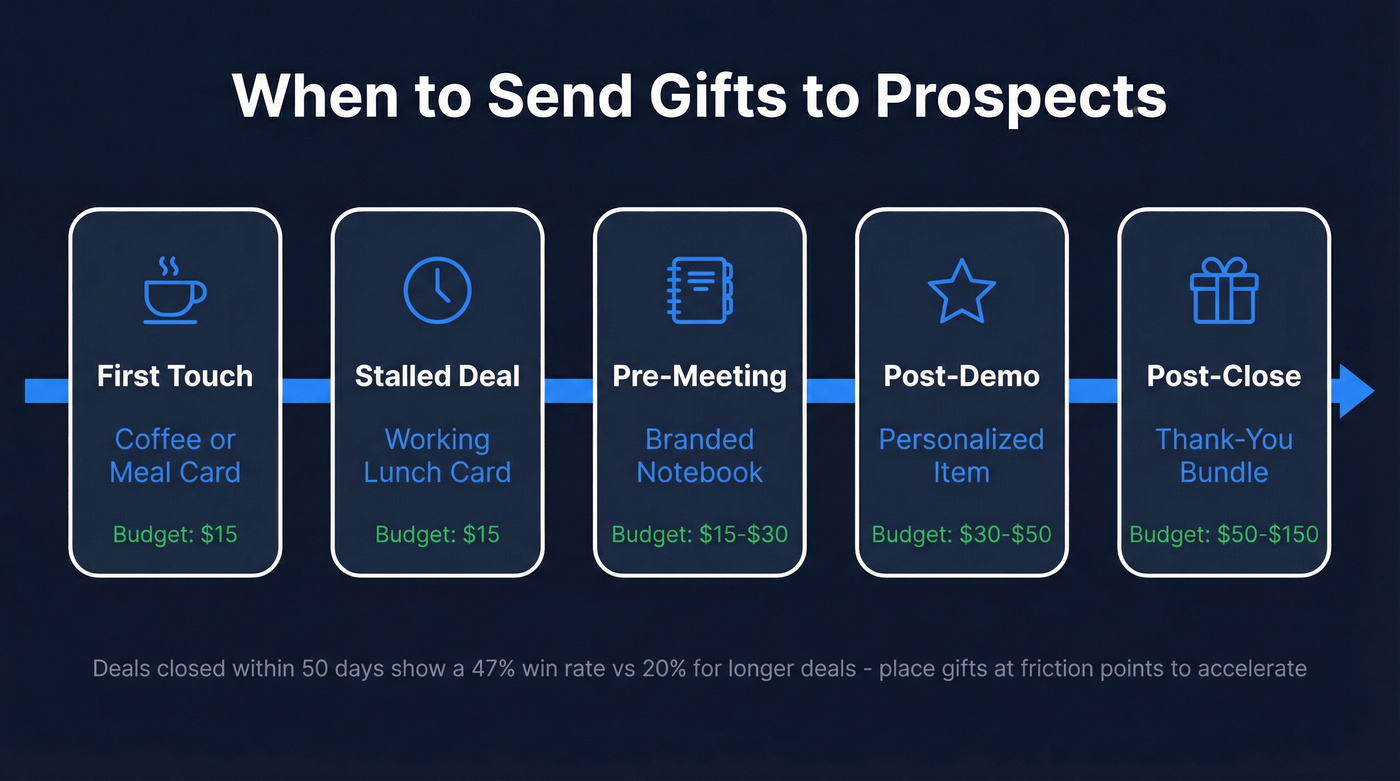
| Sales Stage | Gift Type | Budget | Example |
|---|---|---|---|
| First touch | Coffee/meal card | $15 | Starbucks card + note |
| Stalled deal | Working lunch | $15 | DoorDash card + calendar invite |
| Pre-meeting | Branded notebook | $15-$30 | Premium notebook + pen |
| Post-demo | Personalized item | $30-$50 | Item tied to their interest |
| Post-close | Thank-you bundle | $50-$150 | Curated gift set |
The $15 coffee card is a classic for a reason: low-friction, easy to personalize, easy for the recipient to use. One SDR on our team sent a $15 Starbucks card to a VP of Product with a handwritten note referencing a podcast episode the VP had appeared on. The VP replied within two hours and booked a demo that week. The RevSend playbook confirms this pattern - send the card with a personalized note, then follow up referencing the gift. For stalled deals, a $15 DoorDash card framed as a "working lunch" to unblock next steps is surprisingly effective. (Need better follow-up mechanics? Use a prospect follow up cadence.)
Gift Ideas by Budget Tier
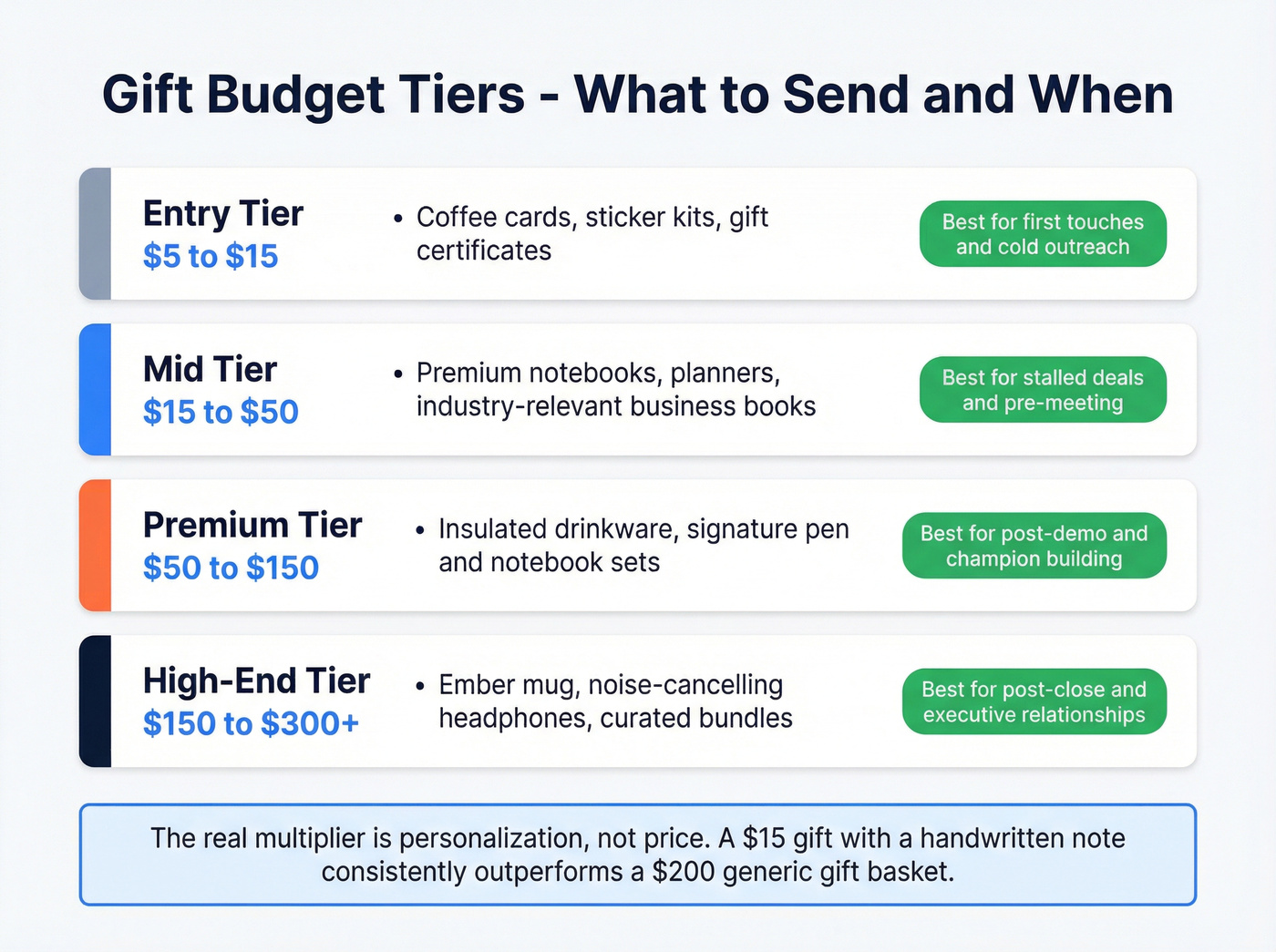
Not every prospect warrants the same spend. Here's how to tier it, based on MOO's budget framework:
| Tier | Range | Examples |
|---|---|---|
| Entry | $5-$15 | Coffee cards, sticker kits, gift certificates |
| Mid | $15-$50 | Premium notebooks, planners, business books relevant to their industry |
| Premium | $50-$150 | Insulated drinkware, signature pen + notebook sets |
| High-end | $150-$300+ | Ember mug, noise-cancelling headphones, curated bundles |
Let's be honest: a $15 gift with a personalized, handwritten note consistently outperforms a $200 generic gift basket. Personalization is the multiplier, not price. Research the prospect's interests in your CRM before you pick anything. (If your CRM is messy, start with CRM hygiene.) A business book about their specific industry vertical - say, a SaaS leader getting a copy of Obviously Awesome - signals that you actually pay attention. That's worth more than any branded swag.

You wouldn't mail a $50 gift without checking the address. So why send it without checking the contact? Prospeo verifies emails with 98% accuracy on a 7-day refresh cycle - so every gift you send reaches someone who still works there. At $0.01 per verified email, one check costs less than the stamp.
Verify every prospect before you waste a single dollar on gifting.
Using Swag to Book Meetings
Some teams treat gifting as a brand awareness play. That's a mistake.
The real ROI comes from tying every gift to a specific calendar action. The $15 coffee card works best when the note says "I'd love to buy you a coffee while we walk through X" and includes a scheduling link. The gift isn't the goal; the meeting is. This framing also helps you measure results - track gift-to-meeting conversion rates the same way you'd track email reply rates. (If you want templates for the ask, see how to ask for a meeting via email.) In our experience, teams that tie every send to a CTA consistently see 2-3x the booking rate compared to teams that send gifts with vague "just wanted to say hi" messaging.
Verify Before You Ship
We've seen this play out dozens of times: an SDR sends a $50 gift to a VP of Engineering who left the company three months ago. The gift sits in a mailroom. The follow-up email bounces. The entire sequence is wasted - not because the gift was wrong, but because the data was stale.
Sales reps already spend 60% of their time on non-selling tasks. Shipping gifts to ghosts makes that worse. Before you spend $50 on a gift, spend a penny to confirm the person still works there. (Here’s a deeper guide to prospect data accuracy.) Prospeo verifies emails in real time with 98% accuracy on a 7-day refresh cycle, so you're not gifting someone who moved to a different company last quarter. At roughly $0.01 per verified email, one verified contact costs less than a single coffee card - and it prevents the entire gift from being wasted.

Compliance - Don't Get Prospects in Trouble
A thoughtful gift can backfire fast if it violates the recipient's corporate policy. Most of this is common sense, but the penalties for getting it wrong aren't.
Federal law defines bribery as offering "anything of value" to a public official to influence an official act (18 U.S.C. ss 201(b)). The FCPA extends this to foreign officials. Regulated industries add extra layers - the Sunshine Act requires pharma manufacturers to report gifts to physicians, and financial services firms often have SEC/FINRA-driven policies restricting what professionals can accept.
Corporate policies commonly cap acceptable gifts around $25-$100. When in doubt, check the recipient's company gift policy before you ship. Avoid anything political, religious, or potentially controversial, and account for dietary restrictions with food gifts. Also plan ahead: gift suppliers often need 4-6 weeks' lead time to execute properly, especially during holidays.
One strong opinion from our team: if your average deal size is under $10k, you probably don't need to gift at all. A well-timed, personalized email with verified contact data will outperform a $15 coffee card at that price point. Save gifting for the deals where the ROI math actually works.
Mistakes That Waste Your Budget
Skip these:
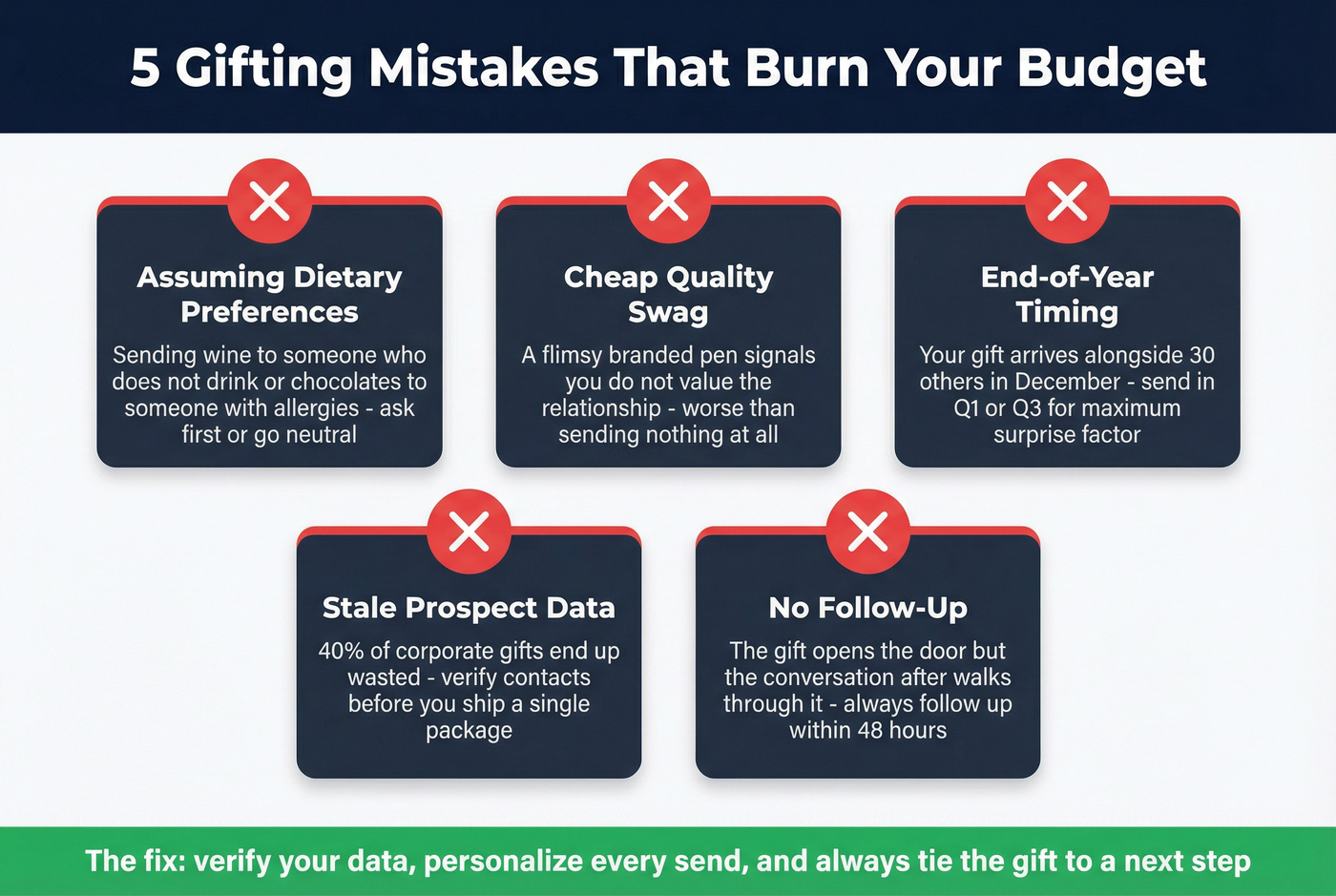
- Assuming dietary preferences. Sending wine to someone who doesn't drink, or chocolates to someone with allergies. Ask or go neutral.
- Cheap quality. A flimsy branded pen is worse than no gift. It signals you don't value the relationship.
- End-of-year timing. Your gift arrives alongside 30 others in December. Surprise matters - send in Q1 or Q3 instead.
- Stale prospect data. Verify contacts before you ship. One bounced email means one wasted gift. (If you need a process, use CRM verify.)
- No follow-up. The gift isn't the play - the conversation after is. We've learned this the hard way: always follow up within 48 hours of delivery. The gift opens the door; the follow-up walks through it.
The article says it clearly: gifting the wrong person is the #1 budget killer. Prospeo's 300M+ profile database with 30+ filters lets you confirm job titles, company tenure, and direct contact details before you spend on a single coffee card. Stop gifting ghosts - build a verified gift list in minutes.
Spend $0.01 on data so you don't waste $50 on a gift to nobody.
Tools for Gifting at Scale
Once you're gifting more than a handful of prospects per month, you need a platform. Here are four worth evaluating.
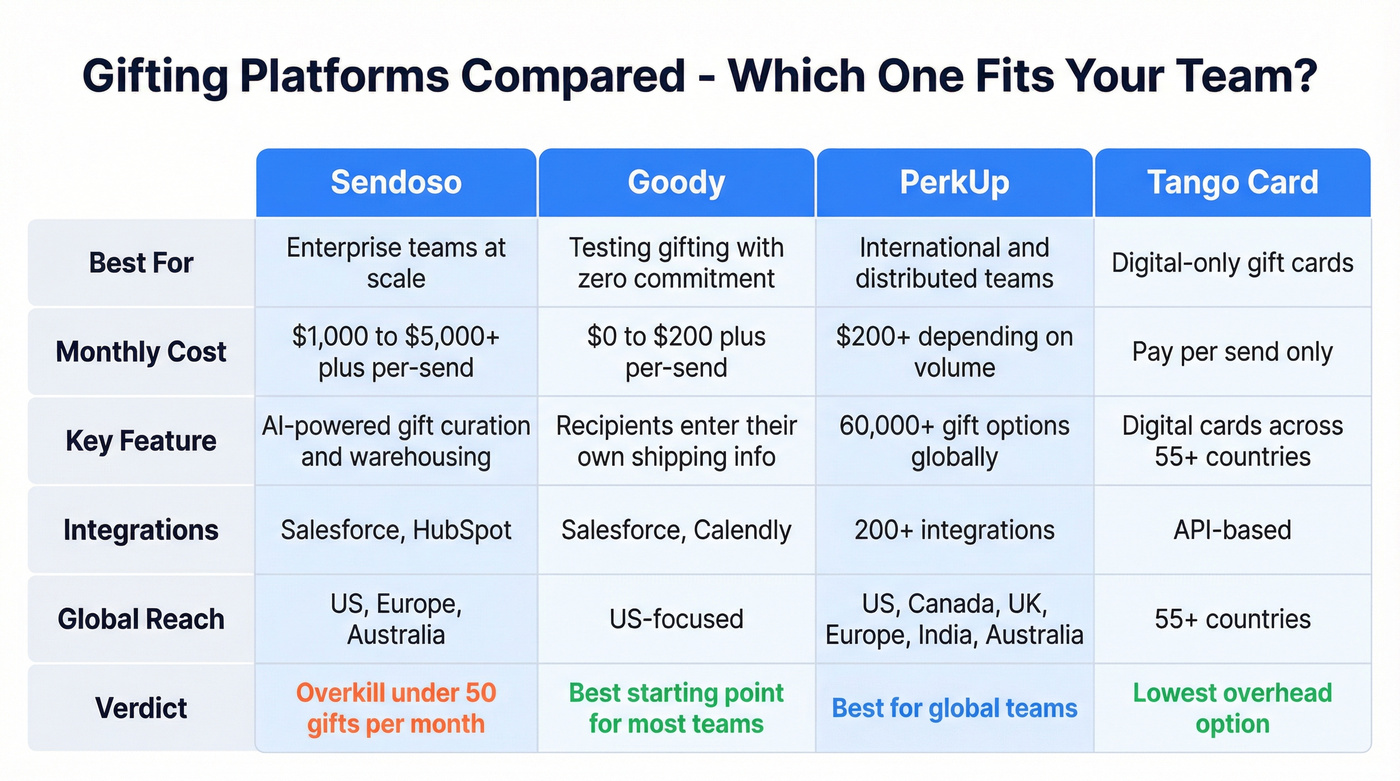
Sendoso is the enterprise play. AI-powered gift curation, warehouses in the US/Europe/Australia, and integrations with Salesforce and HubSpot. Expect around $1,000-$5,000+/month plus per-send costs. Worth it only if corporate gifting is a core pipeline channel - overkill for low-volume teams. Anaplan's $65M pipeline result came from this platform, so the ceiling is real, but so is the price tag. The consensus on r/sales is that Sendoso works brilliantly at scale but isn't worth the overhead for teams sending fewer than 50 gifts a month.
Goody is where you start if you want to test gifting without committing budget. Recipients enter their own shipping info, so you don't need their address. The free tier handles small experiments, and paid plans run around $0-$200/month base plus per-send costs, unlocking integrations like Salesforce and Calendly.
PerkUp makes the most sense for international teams - 60,000+ gift options with global warehouses across the US, Canada, UK, Europe, India, and Australia. Pricing typically starts around $200+/month depending on volume, with 200+ integrations and solid reporting.
Tango Card is the no-commitment option: digital gift cards across 55+ countries on a pay-per-send model. Fees vary by program on top of the face value. Ideal for teams that want digital-only gifting without platform overhead.
FAQ
Is sending gifts to prospects considered bribery?
Not if you stay under corporate policy limits (commonly $25-$100) and avoid regulated recipients like government officials or physicians without proper disclosure. Always check the recipient's company gift policy first. When in doubt, keep it under $25 and document everything.
What's a good budget for prospect gifts?
$15 per prospect is the sweet spot for most B2B sales teams. A personalized coffee or meal card paired with a handwritten note consistently outperforms a $200 generic gift basket. Reserve premium gifts ($50+) for your top 20% of pipeline.
Does gifting work for cold prospects?
Rarely. Gifting works best after initial engagement - a replied email, an attended webinar, a demo booked. For cold outreach, invest in accurate contact data first and save gifts for warm prospects who've shown real buying signals.
How do I avoid wasting gifts on outdated contacts?
Verify every email before you ship. Real-time verification at roughly $0.01 per contact costs far less than a single wasted gift, and free tiers on tools like Prospeo's email finder cover 75 verifications per month - enough for most gifting campaigns.