

150+ Email Subject Line Examples That Drive Clicks in 2026
47% of recipients decide whether to open an email based solely on the subject line. Yet most email subject line examples floating around still treat open rate as the scoreboard. It's not - Apple's servers have been faking your opens since 2021, and the subject lines that actually drive clicks and revenue look different from what worked three years ago.
Here's the short version: front-load your most important words into the first 33 characters (that's the Gmail Android cutoff), stop judging subject lines by open rate, and scroll to your use case below to grab examples you can send today.
Email Benchmarks by Industry
Before we get into examples, here's what "good" actually looks like. Two datasets matter: [Mailchimp's industry benchmarks](https://mailchimp.com/resources/email-marketing-benchmarks/) (billions of emails, last updated December 2023) and [Klaviyo's 2026 ecommerce benchmarks](https://www.klaviyo.com/products/email-marketing/benchmarks) (183,000+ customers).
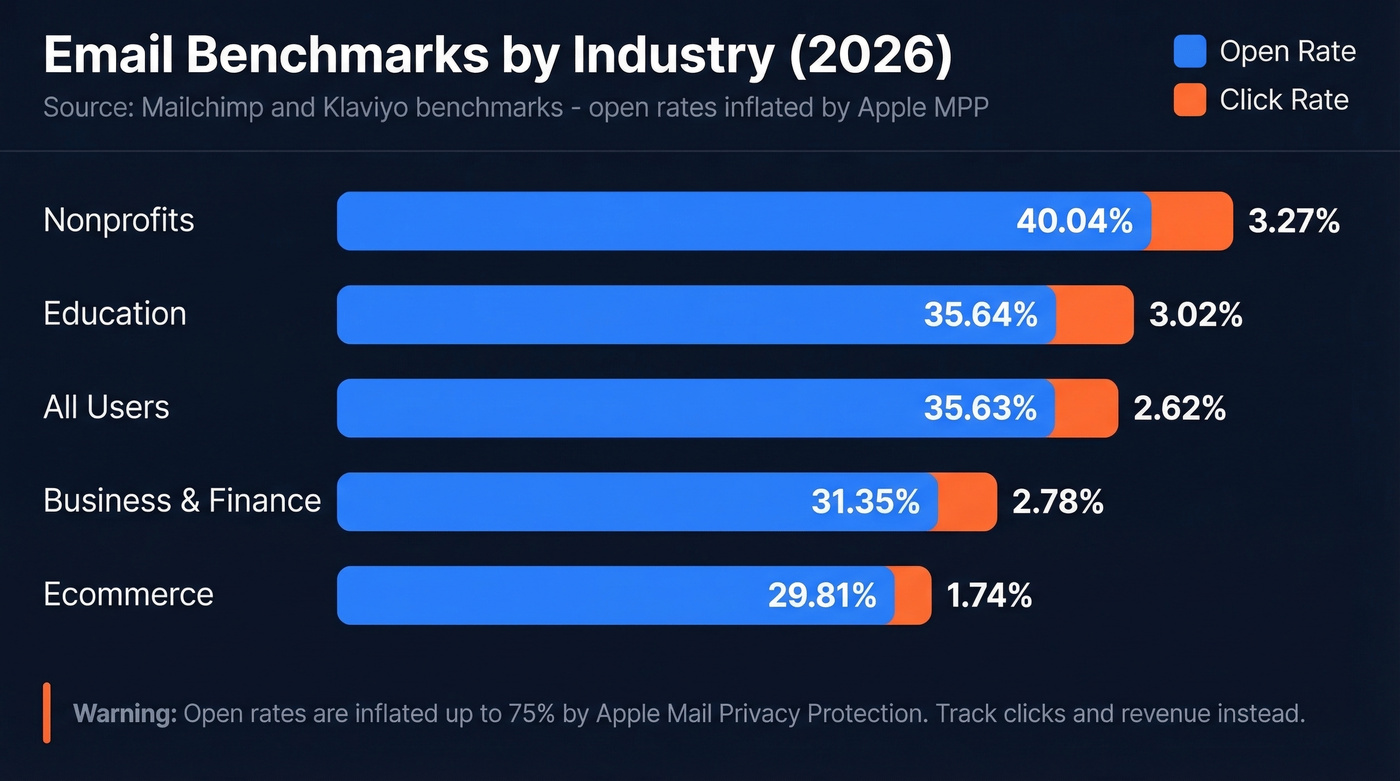
| Industry | Open Rate | Click Rate | Unsub Rate |
|---|---|---|---|
| All users | 35.63% | 2.62% | 0.22% |
| Ecommerce | 29.81% | 1.74% | 0.19% |
| Nonprofits | 40.04% | 3.27% | 0.18% |
| Business & Finance | 31.35% | 2.78% | 0.15% |
| Education | 35.64% | 3.02% | 0.18% |
Every number in that table is inflated by Apple MPP. Treat these as directional, not absolute.
The more interesting data comes from Klaviyo. Automated flows - welcome sequences, cart abandonment, win-back - account for just 5.3% of total sends but generate roughly 41% of email revenue. Flow click rates average 5.58% versus 1.69% for campaigns, and flows deliver 13x higher placed-order rates. Top-performing flows reach revenue-per-recipient of $7.79 and click rates above 10%. Brands using AI-powered product recommendations in those flows see average click rates of 3.75%, with the top 10% hitting 8.79%.
About 48% of flow-driven revenue comes from new buyers, compared to just 16% for campaigns. If you're only optimizing subject lines on your promotional sends, you're optimizing the wrong thing.
Why Open Rates Are Lying to You
Apple Mail Privacy Protection rolled out in 2021, and it fundamentally broke open-rate tracking. When someone enables MPP (which Apple prompts by default), Apple's proxy servers preload every tracking pixel in every email - whether the person reads it or not. Your ESP sees a "pixel fire" and logs an open. The subscriber might've deleted the email without glancing at it.
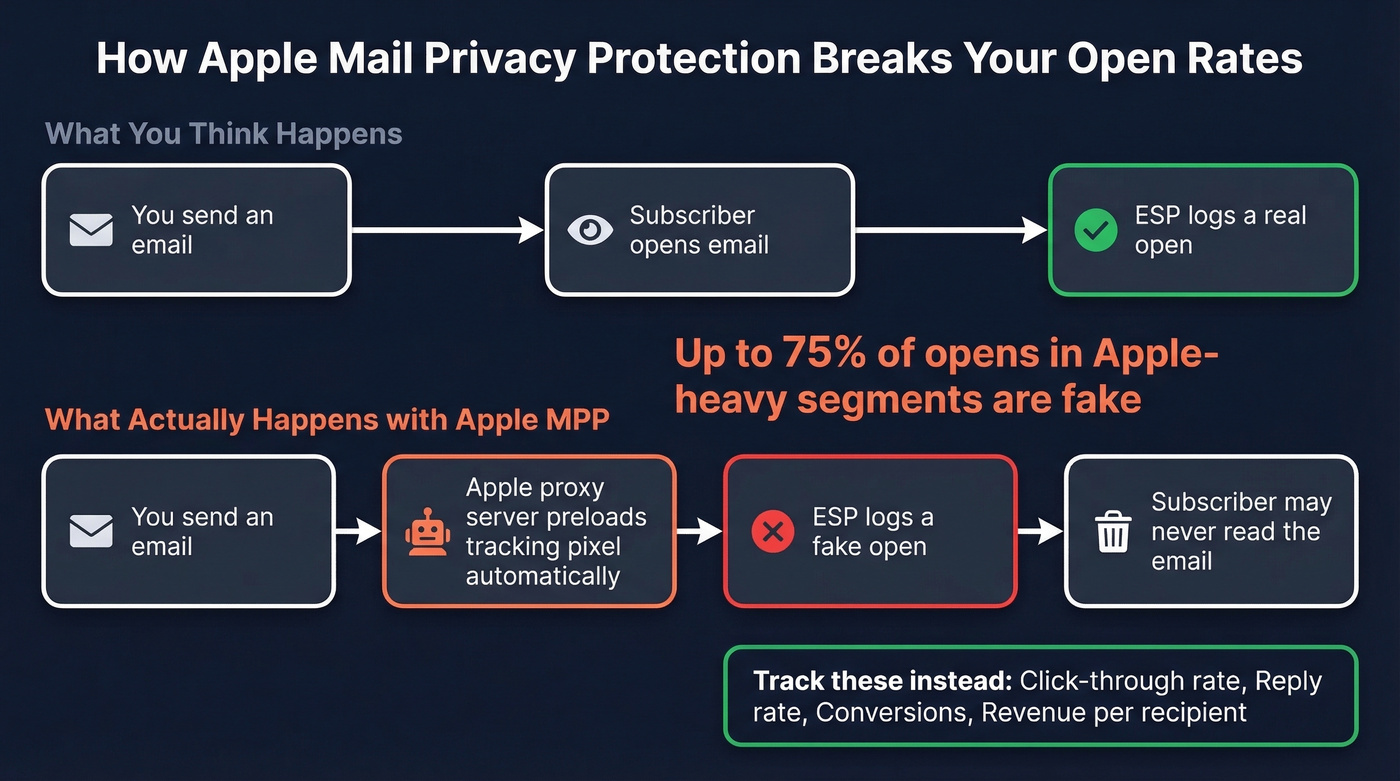
This applies even to Gmail addresses read through Apple Mail. If your VP of Marketing has a company Gmail but reads it on her iPhone's default mail app, every email you send her registers as "opened."
[Up to 75% of reported opens](https://www.litmus.com/blog/apple-mail-privacy-protection-for-marketers) in Apple-heavy segments are artificial. That's not a small margin of error - it makes open rate nearly useless as a subject line metric.
What to track instead: click-through rate, reply rate, conversions, and revenue per recipient. These require intentional action from a real human. Every subject line example and formula in this article should be judged by those metrics, not opens. (If you want to go deeper on the metric itself, see click-through rate.)
Ideal Subject Line Length
The answer depends on where your audience reads email. EmailToolTester ran hands-on truncation tests across major devices and clients:
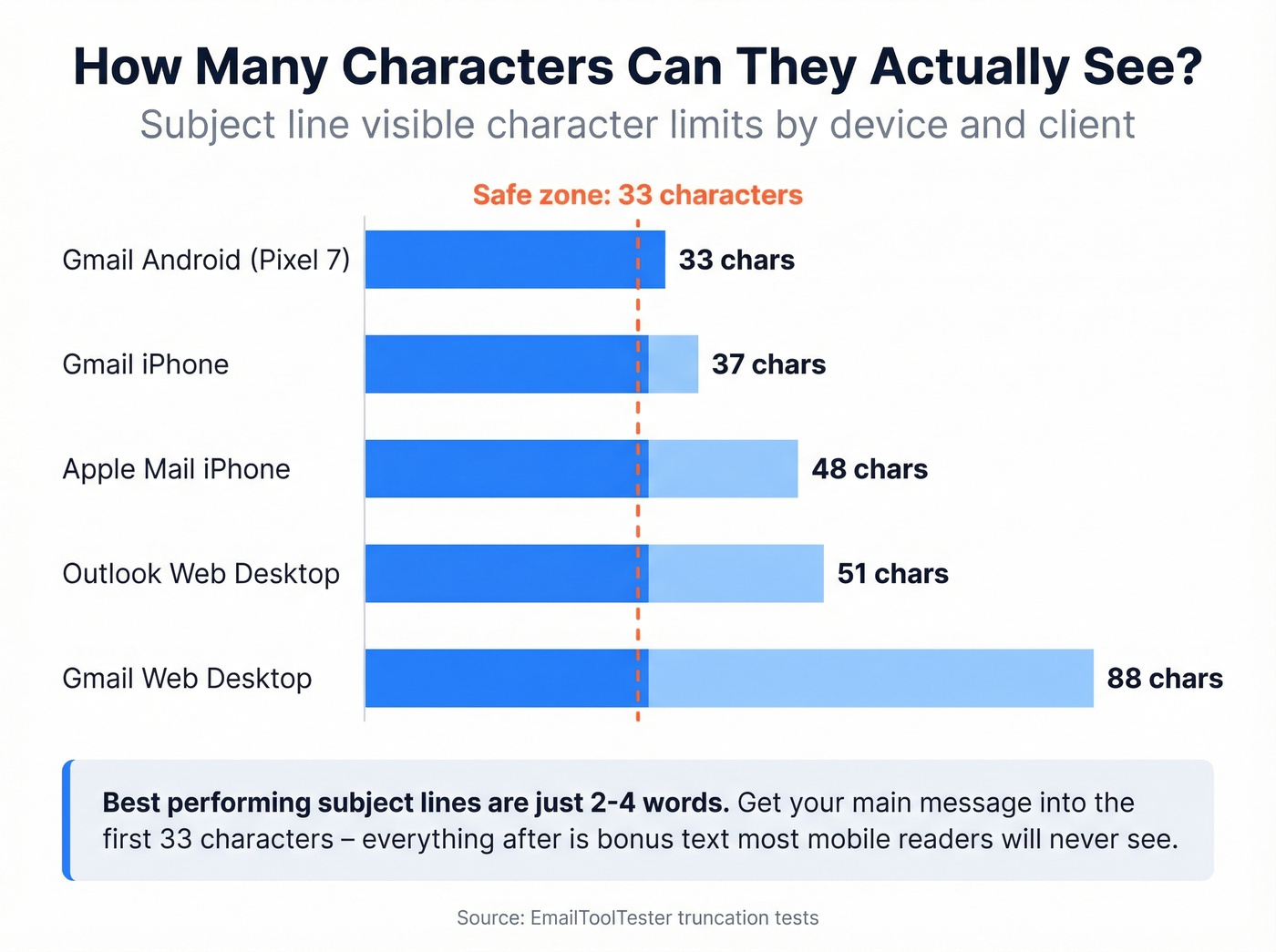
| Client / Device | Visible Characters |
|---|---|
| Gmail Android (Pixel 7) | 33 |
| Gmail iPhone | 37 |
| Apple Mail iPhone | 48 |
| Outlook web (desktop) | ~51 |
| Gmail web (desktop) | ~88 |
Get your main message into the first 33 characters. Everything after that is bonus text most mobile readers won't see.
[Twilio SendGrid's Cyber Week analysis](https://www.twilio.com/en-us/blog/insights/black-friday-cyber-monday-2024) found that the average subject line ran 6 words, but the best-performing ones were just 2-4 words. For promotional and transactional emails, brevity wins consistently. Longer subject lines can work on desktop, but mobile is where most email gets read first.
Don't forget the preheader. That preview text sitting next to or below your subject line needs about 37 characters to show fully in Gmail Android. Treat it as your subject line's wingman - it should extend the hook, not repeat it. (More on this in preview text A/B testing.)
150+ Subject Line Examples by Category
Each category below includes context on when and why to use that style, followed by ready-to-use examples you can adapt. We've drawn these from patterns across Klaviyo's 183,000-customer dataset, cold email frameworks, and what we've seen work in real campaigns.
Power words worth testing in any category: Update, Exclusive, Invite, New, Quick, Free, Confirmed, Inside, Reminder, Your, Now, Limited, Proof, Results, Secret.
Sales & Cold Outreach
Cold email subject lines live or die on specificity. Vague openers like "Quick question" are burned. Average cold email open rates have dropped from 36% to 27.7%, though the top quartile still hits 50%+. The difference is almost always specificity - reference a trigger event, a shared connection, or a concrete pain point, and front-load it before the 33-character cutoff. (For more data-backed patterns, see prospecting email subject lines.)
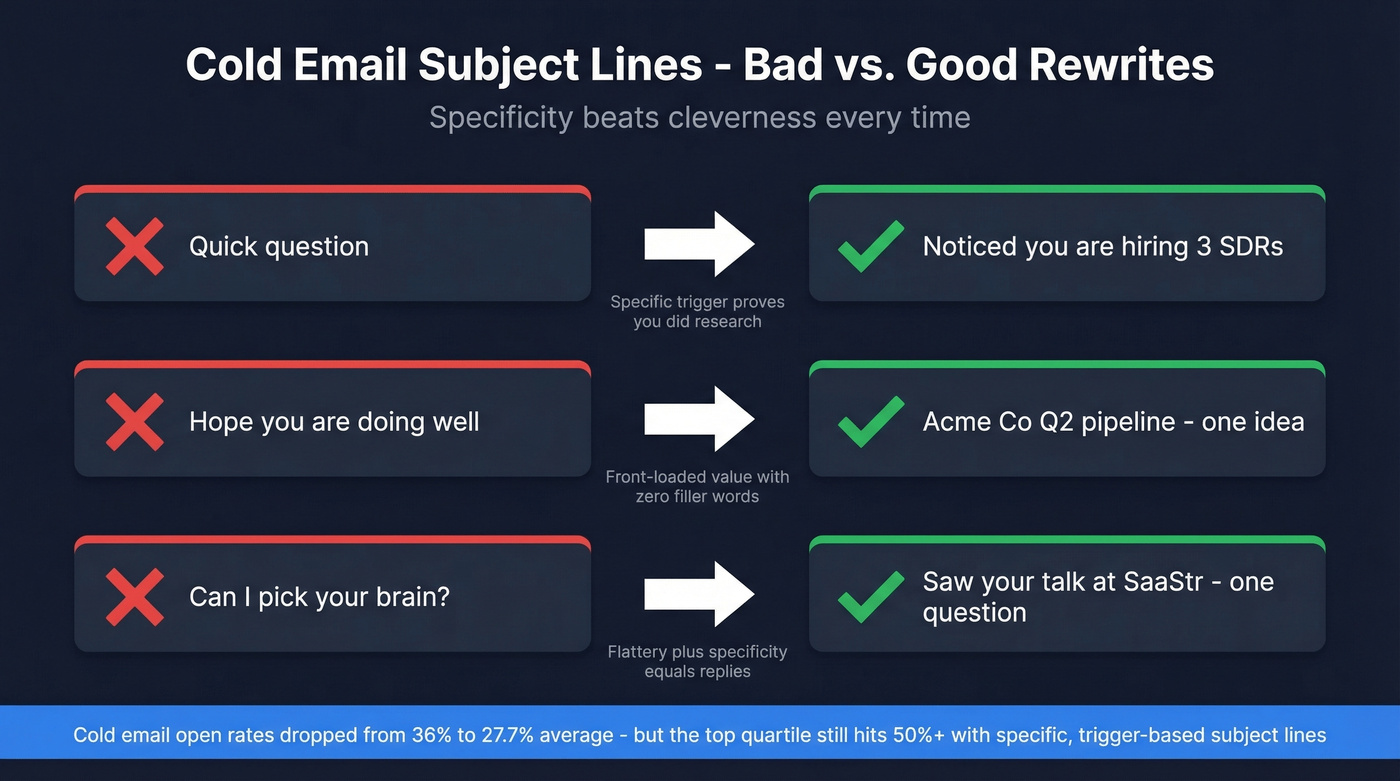
Bad vs. better rewrites:
| Don't send this | Send this instead | Why it works |
|---|---|---|
| Quick question | Noticed you're hiring 3 SDRs | Specific trigger, proves research |
| Hope you're doing well | {{Company}}'s Q2 pipeline - one idea | Front-loaded value, no filler |
| Can I pick your brain? | Saw your talk at {{event}} - one question | Flattery + specificity |
More examples to steal:
- {{Company}} + {{specific trigger}} - saw your Series B
- Cutting {{pain point}} at {{company}} by 40%
- {{Mutual connection}} suggested I reach out
- Your {{competitor}} just switched to us
- One idea for {{specific metric they care about}}
- {{Their tech stack tool}} + our platform
- {{Company}}'s Q2 pipeline - quick thought
- How {{similar company}} solved {{problem}}
- Re: your job post for VP of Sales
- {{First name}}, 15 min this Thursday?
- We helped {{competitor}} cut CAC by 30%
- Your {{product}} reviews mention {{pain}}
- Idea for {{company}}'s outbound motion
- {{Industry}} teams are switching from {{tool}}
- Scaling SDR output without adding headcount
- {{First name}} - saw the acquisition news
- Your team's {{metric}} vs. industry avg
Follow-Up & No Response
Follow-ups need to add new value, not just poke. Reference the previous touchpoint briefly, then give them a reason to care now. (If you need full emails, not just subject lines, use these sales follow-up templates.)
Skip this section if you're just writing "bumping this to the top of your inbox" with nothing new. That's not a follow-up - it's spam with manners.
- Following up - plus a case study
- {{First name}}, still relevant?
- Forgot to mention this
- Quick update since Tuesday
- New data on {{topic from first email}}
- Bumping this - {{new trigger event}}
- Thought of you when I saw this
- 3 min read that answers your question
- {{Company}} update + one idea
- Still exploring {{solution category}}?
- Since we last talked, {{new development}}
- The ROI numbers you asked about
- Closing the loop on {{topic}}
- One more thought on {{pain point}}
- {{First name}} - worth 2 minutes?
Ecommerce: Welcome Sequences
Welcome emails get the highest open rates of any automated flow. Set expectations, deliver immediate value, and let your brand voice shine. These are flow emails, which means they punch far above their weight - remember, flows generate 41% of email revenue from just 5.3% of sends.
- Welcome to {{brand}} - here's 15% off
- You're in. Here's what happens next
- Your first order ships free
- {{Brand}} starter guide (+ a surprise)
- Welcome - 3 things to try first
- Thanks for joining - your code's inside
- You made a great choice
- Meet the team behind {{brand}}
- Your {{brand}} journey starts here
- First look: what our members love most
Ecommerce: Cart Abandonment
Cart abandonment emails are the highest-leverage flow you can optimize. Klaviyo's data shows flows deliver 13x higher placed-order rates than campaigns, and cart abandonment is the crown jewel. These subject lines need to be specific to the product left behind, not generic.
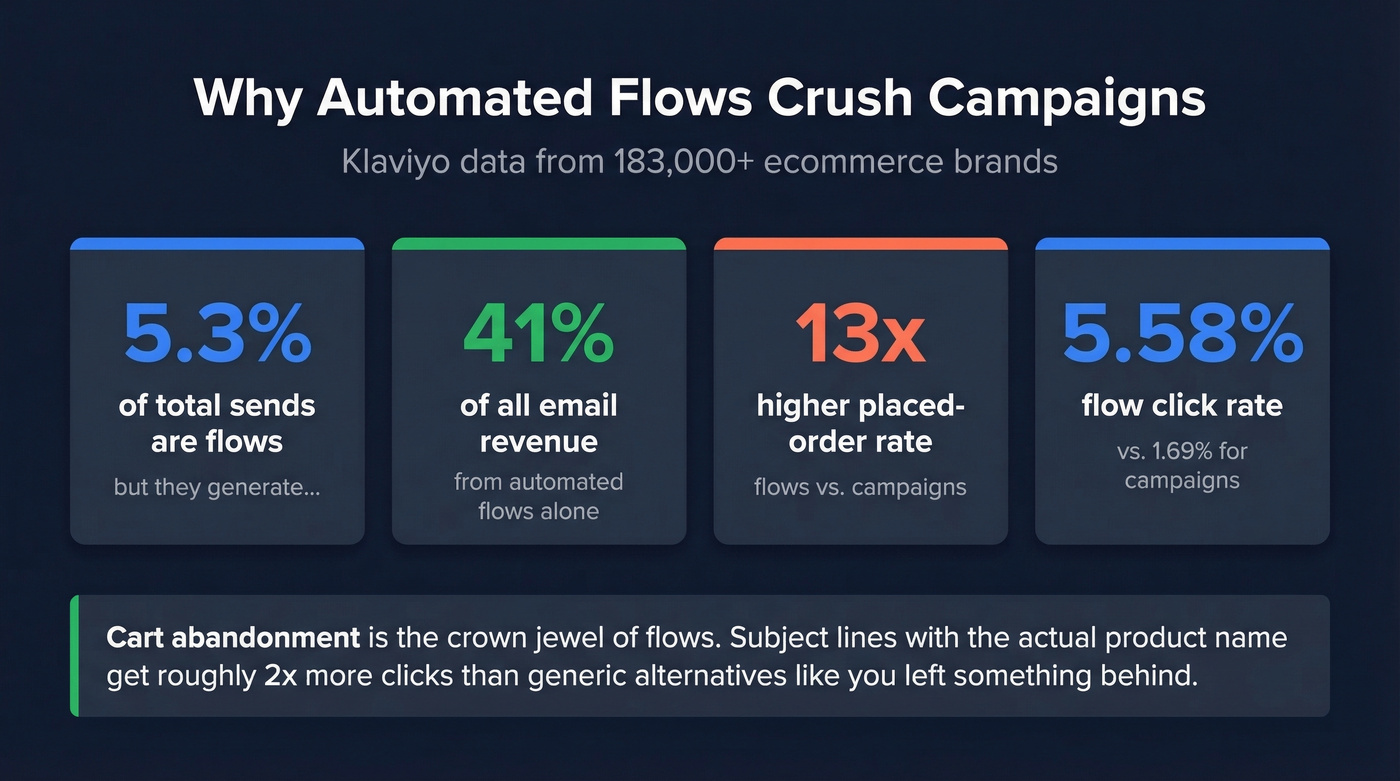
Subject lines that include the actual product name get roughly 2x more clicks than generic "you left something behind" variants. If your ESP supports dynamic product insertion, use it.
- Still thinking about the {{product}}?
- Your cart's waiting (free shipping inside)
- {{Product name}} is selling fast
- Don't let {{product}} slip away
- You left something behind - 10% off
- Your {{product}} - only 3 left
- Finish your order? Here's free shipping
- {{First name}}, your cart expires tonight
- Almost yours: {{product name}}
- That {{product}} looks great on you
Ecommerce: Promotions & Seasonal
This is where the 2-4 word finding from Twilio SendGrid matters most. Short, punchy, urgent. Real deadlines beat manufactured ones - and your audience can tell the difference. Fake countdown timers on evergreen offers erode trust and tank engagement on future sends.
- 40% off. Today only.
- Final hours
- Summer sale: 50% off everything
- Your exclusive early access
- Black Friday starts now
- Flash sale - 6 hours left
- New arrivals just dropped
- Members-only pricing inside
- Buy one, get one free
- Last chance: free shipping ends midnight
- Spring collection is here
- Secret sale - shhh
- 24 hours. 30% off. Go.
- Your VIP code expires tonight
- Holiday gift guide (+ free wrapping)
Ecommerce: Win-Back
Win-back emails walk a fine line between emotional reconnection and incentive. Leading with "we miss you" works, but pairing it with a concrete offer works better. The best win-back subject lines combine a human tone with something tangible - a discount, new products, or expiring rewards. Allbirds nails this with lines like "Your Wool Runners are waiting" - specific product, gentle urgency, no discount needed.
"We miss you - here's 20% off" is the classic for a reason, but "Your account still has $15 in rewards" outperforms it when you have real loyalty data to reference. "A lot's changed since you left" works when you've genuinely launched new products. Other strong options: "Come back? We saved your favorites," "See what's new (you'll like it)," "We want you back - free shipping," "3 new products since your last visit," "It's been a while, {{first name}}," and "One more reason to come back."
Newsletter & Content
Recurring newsletters benefit from a consistent format readers recognize, plus a curiosity hook that makes this issue feel unmissable.
- The 3 links worth your time this week
- Issue #47: Why {{trend}} is overhyped
- This week's best {{topic}} reads
- One chart that explains {{trend}}
- {{Number}} things I learned this month
- The {{topic}} playbook (free)
- What nobody's saying about {{trend}}
- Friday five: {{topic}} edition
- Your weekly {{topic}} briefing
- The data behind {{controversial take}}
Meeting Requests
Vague "Can we chat?" subject lines get ignored. Specificity - time, agenda, mutual connection - signals respect for the recipient's calendar.
- 15 min Thursday - {{specific agenda}}
- {{Mutual connection}} said we should talk
- Quick sync on {{project/topic}}?
- {{First name}}, 10 min to discuss {{topic}}
- Calendar hold: {{date}} at {{time}}
- Coffee chat - {{specific topic}}?
- Re: {{event}} - follow-up meeting
- {{Company}} + {{your company}} alignment
- Agenda for our {{day}} call
- Can we do 15 min on {{specific topic}}?
Professional & Workplace
Internal and professional emails reward clarity over cleverness. Lead with the action required and the deadline.
- Action needed: {{task}} by Friday
- Q2 budget review - your input needed
- Updated timeline for {{project}}
- Team update: {{key change}}
- Please review before EOD Thursday
- New policy: {{topic}} - effective {{date}}
- {{Project}} status: on track / at risk
- Reminder: {{event}} tomorrow at 2pm
- Your feedback on {{document}} requested
- FYI: {{department}} restructure details
Networking & Job Search
Networking emails compete with hundreds of others. A specific ask and a clear value proposition cut through the noise.
- {{Mutual connection}} suggested I reach out
- Fellow {{school/company}} alum - quick ask
- Loved your {{talk/article}} on {{topic}}
- {{Role}} at {{company}} - interested?
- 5 min for a career question?
- Your work on {{project}} caught my eye
- Intro request: {{specific reason}}
- {{First name}}, I'm exploring {{field}}
- Quick question about {{company}} culture
- Would love your perspective on {{topic}}
Event Invitations & Reminders
Front-load the date and the hook. Nobody opens an event email that doesn't tell them when and why in the subject line.
- You're invited: {{event}} on {{date}}
- {{Speaker name}} is keynoting - join us
- RSVP: {{event}} - {{date}} at {{time}}
- Tomorrow: {{event}} starts at 10am
- Last 20 spots: {{event name}}
- Save the date: {{event}} - {{month}}
- Your seat at {{event}} is confirmed
- Reminder: {{event}} is in 3 days
- {{Event}}: agenda + speaker lineup
- Don't miss {{speaker}} on {{topic}}
- Early bird ends Friday - {{event}}
Curiosity, FOMO & Urgency
Curiosity gaps work when there's a genuine payoff behind the click. Deliberate vagueness can work for warm audiences who already trust you - "This changed everything" from a newsletter they love will get opened. From a cold sender, that same line gets deleted. Know your relationship before you lean on mystery.
What NOT to do: "You won't BELIEVE what happened!!!" with three exclamation points and no payoff inside the email. That trains recipients to ignore you, and the behavioral signal compounds across sends.
- This changed how we think about {{topic}}
- The mistake 90% of {{role}} make
- You're not going to believe this metric
- Only 48 hours left to claim this
- What {{competitor}} knows that you don't
- The email I almost didn't send
- 3 things I'd do differently
- Your competitors already know this
- This expires at midnight - no extensions
- I was wrong about {{topic}}
- The #1 reason {{outcome}} fails
- Open this before Thursday
- We're only telling members first
- {{Number}} people already signed up
- Here's what happened when we tried {{thing}}
Personalized Subject Lines
Over 90% of emails still skip personalization entirely. That's a massive missed opportunity - personalization lifts click rates 1-5% when it's done well. But "Hey {{first_name}}" when you clearly don't know the person is worse than no personalization at all. Company-specific and role-based personalization consistently outperforms name tokens. (For a full system, see personalized outreach.)
- {{Company}}'s approach to {{topic}} - thoughts
- For {{role}} managing {{team size}}+ reps
- {{Industry}} teams are seeing this trend
- {{First name}}, based on your {{action}}
- Your {{product they use}} + our {{product}}
- {{Company}} vs. {{competitor}} - one gap
- Tailored for {{company}}'s growth stage
- {{First name}}, this reminded me of you
- Built for {{industry}} teams like yours
- {{City}}-based founders are doing this differently

A perfect subject line sent to a dead inbox is wasted copy. Prospeo's 98% verified emails and 7-day data refresh mean your carefully crafted subject lines actually land in real inboxes - not bounce back and torch your domain reputation.
Stop optimizing subject lines for email addresses that don't exist.
Five Reusable Subject Line Formulas
Don't want to scroll through 150+ examples? Here are five fill-in-the-blank formulas that work across categories.
[Specific number] + [Benefit] + [Timeframe] - "3 ways to cut churn by Q3"
[Their company] + [Relevant trigger] - "{{Company}} + your new VP hire - one idea"
[Question that implies a gap] - "Is your outbound team measuring the wrong metric?"
[Social proof] + [Result] - "How {{similar company}} doubled reply rates"
[One-word hook]: [Specific promise] - "Update: your free shipping code expires tonight"
Each formula front-loads the most important words before the 33-character cutoff. Test them against each other - the winner depends on your audience and context.
Mistakes That Kill Deliverability
Subject lines aren't just a copywriting problem - they're a deliverability problem. ESPs use engagement signals to decide where your future emails land. A pattern of bad subject lines trains Gmail to route you to spam. (If you want the full foundation checklist, start with this email deliverability guide.)
Here's the thing: the best subject line in the world is worthless if your email bounces. We've seen teams obsess over copy and ignore list hygiene for months, then wonder why their domain reputation is in the gutter. Fix the foundation first.
Fake "Re:" and "Fwd:" prefixes. This isn't just sleazy - it's a CAN-SPAM violation. Misleading headers can trigger legal liability and will get you flagged by spam filters.
ALL CAPS and excessive punctuation. "FREE!!! DEAL INSIDE!!!" is a one-way ticket to the junk folder. One exclamation point per email is plenty. Zero is better.
Spam trigger words - with nuance. The word "free" alone won't kill you. But "free" combined with ALL CAPS, multiple exclamation points, and a cold list? That's a pattern ESPs recognize. (You can also run a quick check with an email spam checker.)
Clickbait that tanks future engagement. If your subject line promises something the email doesn't deliver, recipients learn to ignore you. That behavioral signal compounds across sends.
Sending to unverified addresses. Hard bounces, spam traps, and honeypot addresses destroy sender reputation faster than any copy mistake. Verify your list before you send - tools like Prospeo catch invalid addresses in real time with 98% accuracy, protecting your sender reputation before you hit send. (Related: email bounce rate.)
How to A/B Test Subject Lines
Testing subject lines post-MPP requires a different approach than most guides suggest. Here's the framework we recommend after running dozens of tests.
Test one variable at a time. Length vs. length. Emoji vs. no emoji. Question vs. statement. If you change three things, you learn nothing.
Use a 10-20% holdout sample. Send variant A to 10% of your list, variant B to another 10%, then send the winner to the remaining 80%. Many ESPs - Klaviyo, Mailchimp, MailerLite - support this natively.
Wait 1-2 hours before picking a winner. Shorter windows bias toward early openers, who aren't representative of your full list.
Measure clicks and conversions, not opens. This is the critical shift. With MPP inflating open rates, a subject line that "wins" on opens might lose on clicks. Track the metric that matters to your business.
Directional lift ranges to expect: emoji tests lifted open rates up to 10% in pre-MPP studies, but post-MPP you should measure the click-rate delta instead. Personalization typically lifts 1-5%. Length variations swing results up to 5%. Your mileage depends on your audience, your offer, and your sending reputation.
Minimum list size matters too. Aim for 1,000+ subscribers per variant so you're not overreacting to random variance. If your list is small, run the same test across multiple sends and look for consistent patterns rather than declaring a winner from a single send.
Before You Hit Send
You just spent 20 minutes picking the perfect subject line from this list. You've optimized for length, personalization, and curiosity. You hit send - and 12% of your list bounces. Your sender reputation takes a hit, and Gmail starts routing your next campaign to spam.
Every subject line strategy in this article assumes your emails actually reach an inbox. That starts with a verified list. (If you're actively scaling volume, also watch your email velocity.)
Cold outreach subject lines only work when you have the right person's real email. Prospeo gives you 300M+ verified contacts with 30+ filters - buyer intent, job changes, tech stack - so your trigger-based subject lines hit actual decision-makers.
Pair specific subject lines with specific, verified prospects for $0.01 each.
FAQ
How many words should a subject line be?
Two to four words perform best according to Twilio SendGrid's Cyber Week data. Keep total length under 50 characters and put your key message in the first 33 to survive Gmail Android truncation. Longer lines can work on desktop, but mobile is where most email gets read first.
Do emojis improve open rates?
Emojis lifted open rates up to 10% in pre-MPP tests, but post-MPP you should measure click rate instead - the real lift is likely smaller. Emojis render inconsistently across clients and can trigger spam filters if overused. Test a single relevant emoji against a plain version; one per subject line is the safe maximum.
Are open rates still reliable for testing?
No. Apple Mail Privacy Protection preloads tracking pixels via proxy servers, firing "opens" even when emails go unread - including Gmail addresses read through Apple Mail. Measure click-through rate and conversions instead. Those require intentional human action and aren't inflated by MPP.
What makes a great cold outreach subject line?
Specific and relevant beats clever every time. Reference a trigger event - a job change, funding round, new hire - and front-load the value before the 33-character cutoff. "{{Company}}'s Q2 pipeline - one idea" outperforms "Hope you're doing well" by a wide margin. Avoid burned openers like "Quick question."
How do I keep emails out of spam?
Start with a clean, verified list. Then authenticate your domain with SPF, DKIM, and DMARC, warm your sending volume gradually, and avoid misleading subject lines that trigger complaints. The consensus on r/coldemail is that list quality matters more than any copy trick - and in our experience, that's exactly right.