

Best Time to Send Cold Emails (2026 Data + Practical Playbook)
You sent 500 emails last Tuesday. 45% opened, 1.2% replied. Six meetings booked. Not terrible - but you're wondering if nailing the best time to send cold emails could've doubled that reply rate. The honest answer: probably not doubled. Timing matters, but it's the third most important lever in your outbound stack, not the first.
What follows is a synthesis of five real datasets, role-by-industry timing matrices, timezone mechanics, and the deliverability basics that actually determine whether your emails land in the inbox at all.
Quick-Reference Timing Guide
- Default send window: Tuesday or Wednesday, 8-10 AM in your prospect's local timezone.
- Default avoid window: Friday afternoons, weekends, Monday before 7 AM.
- Timing lift vs. other levers: expect a 10-20% improvement from optimizing send time - real, but dwarfed by list quality (200%+ impact) and subject line personalization (40-60% impact).
- Before you optimize timing: bounce rate under 2%, domains warmed, emails under 80 words.
- After you optimize timing: A/B test one variable at a time with ~1,000 recipients per variant.
Timing is worth getting right. It's just not worth getting right first.
Your Prospect's Inbox Reality
Before obsessing over send windows, understand what you're competing against. An EmailToolTester survey of 1,800 people paints a blunt picture: the average professional receives 15 cold emails per week - roughly 780 per year hitting one inbox. Of those, 50.9% never get any engagement at all, 13.7% get deleted immediately, and 10.3% get marked as junk, which actively damages your sender reputation.
That leaves roughly 25% who might read your email. Knowing when to send helps you reach that 25% at the moment they're most likely to act. But if your email is generic, irrelevant, or sitting in spam, the perfect send window won't save you.
Why Timing Is Lever #3
The 2026 benchmark across billions of cold email interactions puts the average reply rate at 3.43%. Top performers hit 5.5%+. Elite campaigns clear 10.7%. The gap between average and elite isn't scheduling - it's list quality and copy.
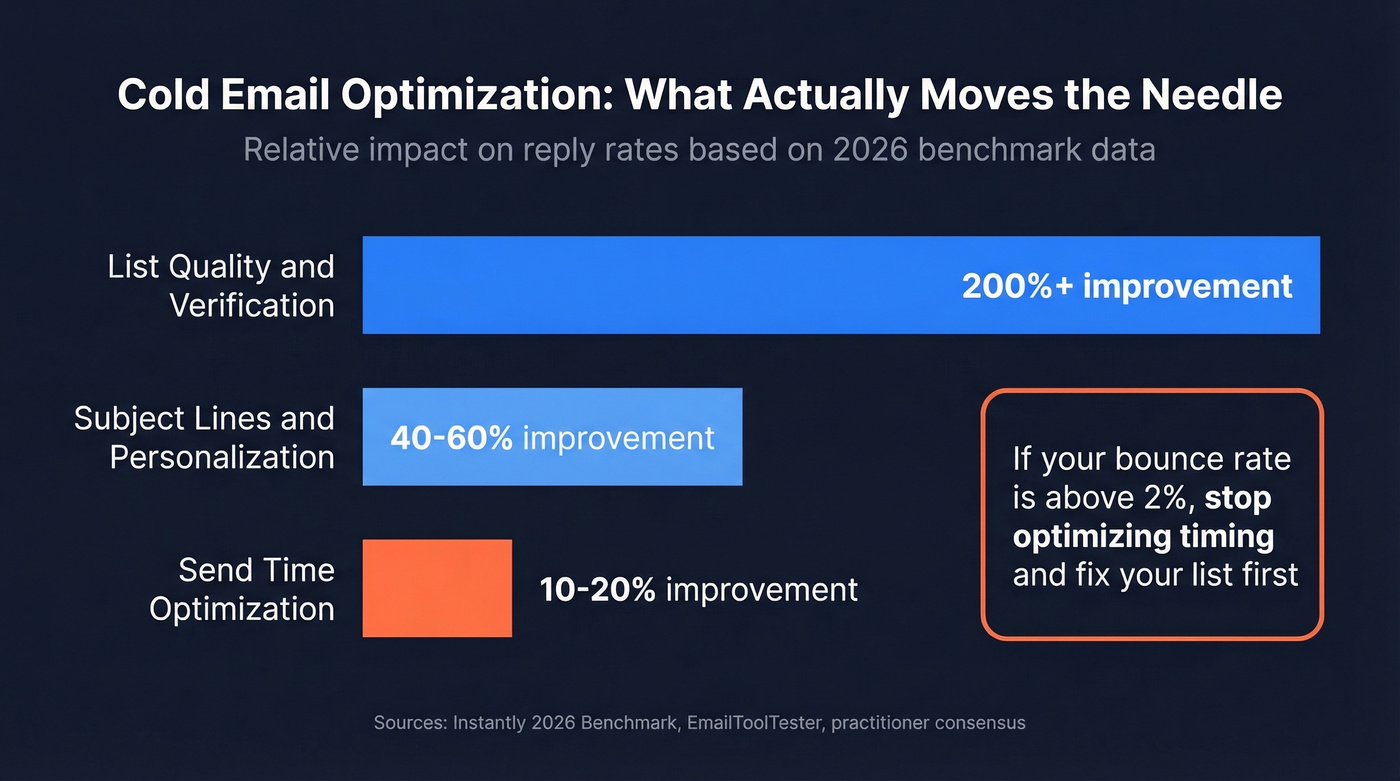
Here's the hierarchy we use when advising outbound teams:
List quality drives the biggest improvement - 200%+ when you move from scraped, unverified lists to targeted, verified contacts matched to your ICP. This isn't a marginal gain. It's the difference between a campaign that books meetings and one that burns your domain. (If you need a system for building cleaner lists, start with sales prospecting techniques.)
Subject lines and personalization account for a 40-60% lift. Personalized subject lines are 26% more likely to be opened. Body copy matters too - emails under 80 words consistently outperform longer ones. For swipeable ideas, see our cold email subject line examples.
Send time optimization delivers a 10-20% improvement. Meaningful, but only after the first two levers are locked in. (If you're building sequences, use a proven B2B cold email sequence structure first.)
Here's the thing: if your bounce rate is above 2%, stop reading about timing and go fix your list. That 2% threshold is the line experienced cold emailers on Reddit consistently flag as the danger zone - cross it, and your domain reputation degrades steadily. Timing optimization on a dirty list is rearranging deck chairs on the Titanic.
Best Days to Send (5 Datasets)
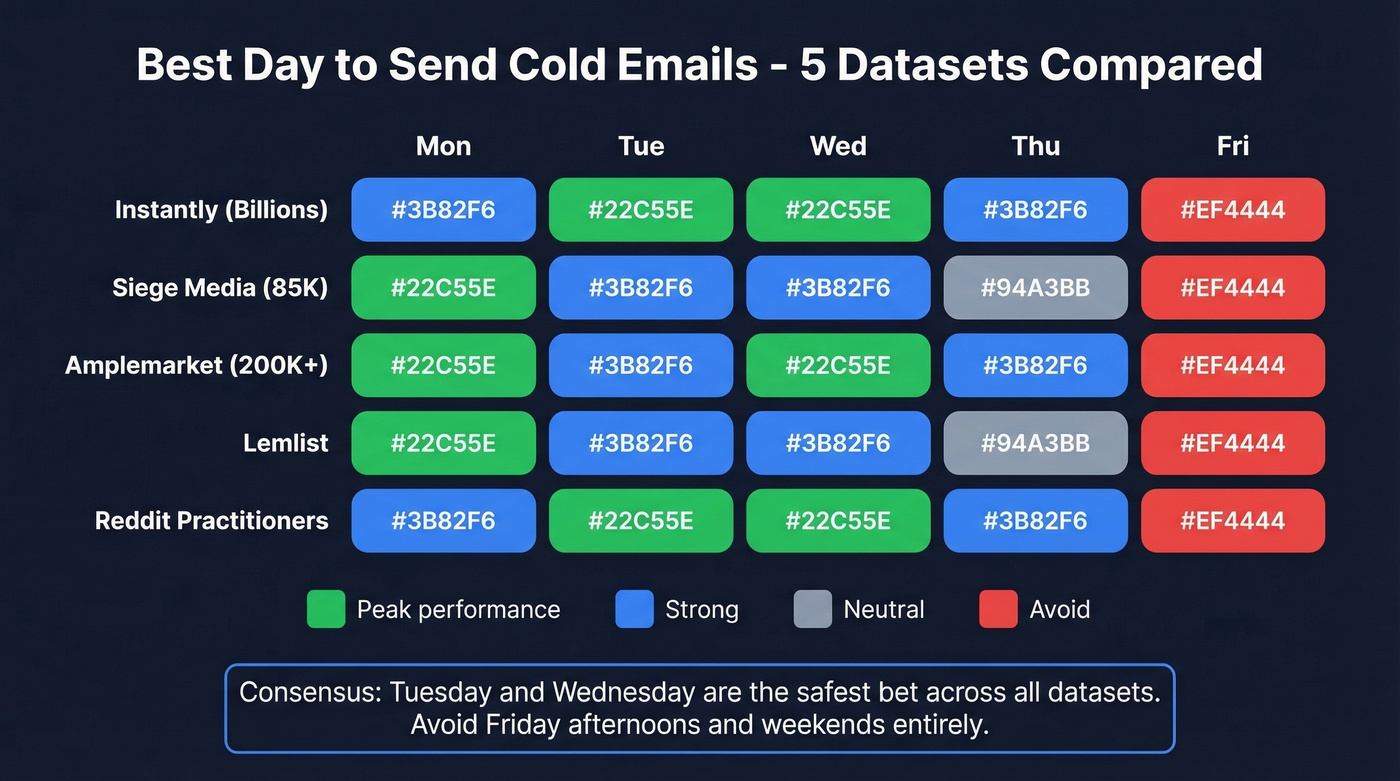
No single dataset tells the whole story. Here's what five different sources found:
| Source | Dataset | Best Day(s) | Metric |
|---|---|---|---|
| Instantly | Billions of interactions | Tue-Wed (Wed peak) | Reply rate |
| Siege Media | 85K personalized emails | Monday | Opens + clicks |
| Amplemarket | 200K+ leads | Mon/Wed (replies), Wed-Thu (opens) | Split metric |
| Lemlist (via EmailToolTester) | Platform data | Mon 5-8 AM (~2.3% reply rate) | Reply rate |
| Reddit r/coldemail | Practitioner heuristics | Tue/Wed; Fri ~half | Anecdotal |
The Consensus (and the Contradiction)
Tuesday and Wednesday show up in almost every dataset. Monday appears strong in Siege Media's and Lemlist's data, but those skew toward highly personalized outreach - not high-volume campaigns. A Hunter.io outreach manager adds a useful counterpoint: Mondays are the worst for cold email at many organizations because recipients are buried in planning meetings and internal catch-ups.
The contradiction isn't really a contradiction. Different audiences and different metrics produce different winners. A Monday email to a marketing director might get opened; a Wednesday email to a VP of Sales might get replied to.
If you can't choose: start with Tuesday and Wednesday. They're the safest bet across datasets and campaign types. Avoid Friday - Reddit practitioners consistently report reply rates dropping to roughly half of midweek numbers. Skip weekends entirely for B2B.
Optimal Time of Day
Here's the stat that makes timing click: 23% of opens happen within the first hour of delivery. After 24 hours, the probability of your email being opened drops below 1%. You get one shot at the top of the inbox.
| Window | Best For | Key Insight |
|---|---|---|
| 7:30-10:30 AM local | Replies | People respond in work mode, first thing |
| 5:00-6:30 PM local | Opens | Evening scanners browse but rarely reply |
| 12:00-1:30 PM local | Skip | Midday often underperforms |
| After 7:00 PM | Skip | Often gets buried by the next morning |
Siege Media found their best performance in the 6-9 AM PST window on Monday, recommending you schedule for 7-8 AM PST to catch the 8-10 AM engagement spike in Eastern and Central timezones. Amplemarket's data shows peak opens between 5:30-6:30 PM but peak replies around 7:30-8:30 AM - which makes intuitive sense. People scan emails in the evening but respond in the morning.
One important nuance: open tracking pixels convert plain-text emails into HTML, which can hurt deliverability. Apple Mail Privacy Protection also pre-fetches tracking pixels, inflating open rates. Reply rate is the only reliable metric for cold email timing optimization. Measure positive replies and ignore open rates entirely. (If you want the technical breakdown, see email tracking pixels.)

You just read it: list quality is lever #1, delivering 200%+ more replies than timing alone. Prospeo's 5-step email verification keeps bounce rates under 2% - the exact threshold this article flags as the danger zone. 98% email accuracy means your perfectly timed Tuesday 8 AM send actually lands in the inbox.
Stop optimizing send times on a dirty list. Fix the data first.
Timing by Prospect Role
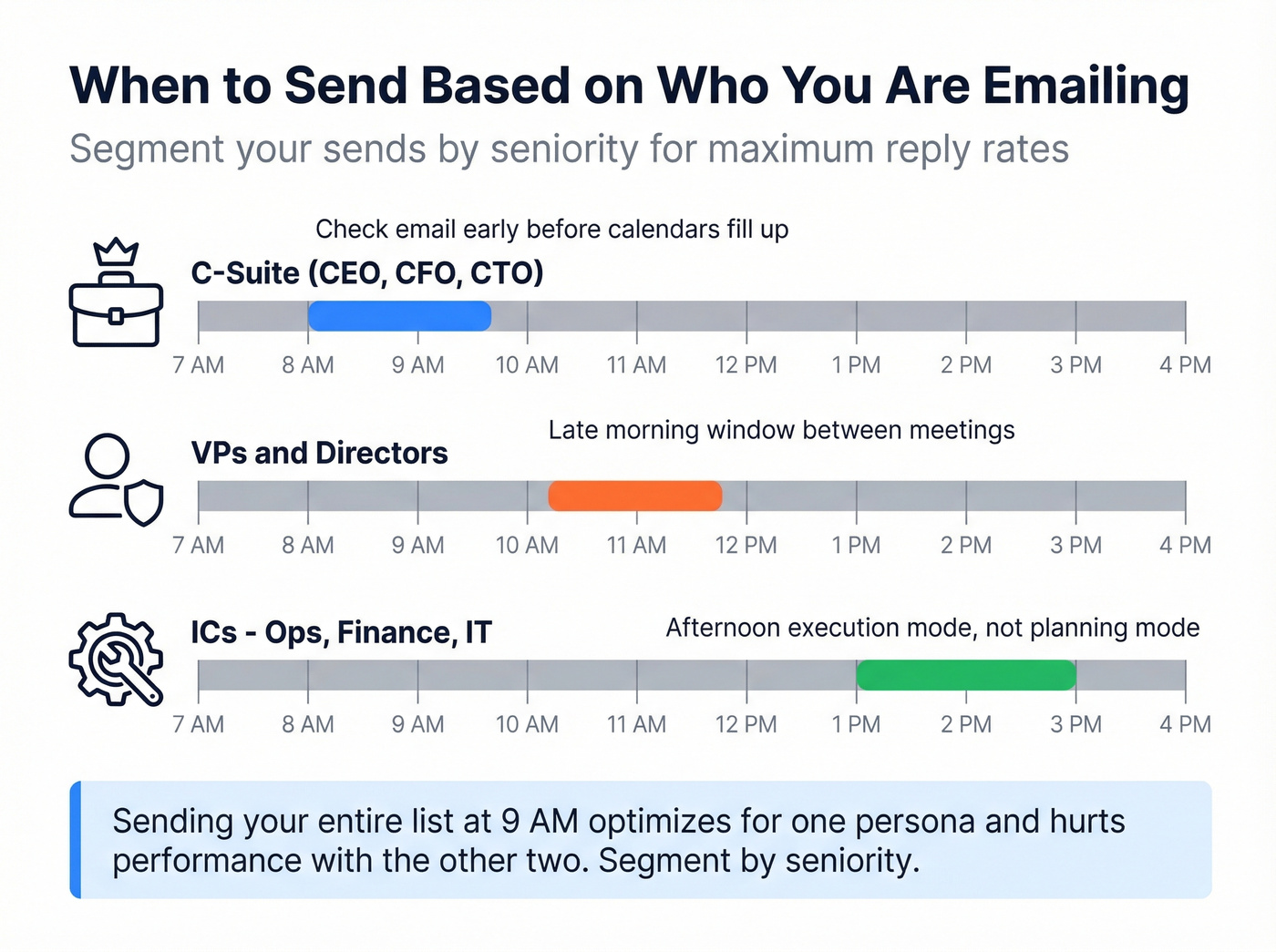
Generic advice ignores that a CEO and an IT manager have completely different schedules. Zeliq's role-based matrix provides more granular guidance:
| Role | Tuesday | Wednesday | Thursday |
|---|---|---|---|
| C-suite | 08:00-09:15 | 07:45-09:15 | 08:00-09:15 |
| VP / Directors | 10:15-11:30 | 10:30-11:45 | 10:15-11:45 |
| Ops / Finance / IT ICs | 13:30-15:00 | 13:45-15:30 | 13:30-15:30 |
The pattern is logical. Executives check email early before their calendars fill up. Mid-level leaders have a late-morning window between meetings. Individual contributors are more reachable in the early afternoon during execution mode, not planning mode.
If you're running multi-persona campaigns and blasting your entire list at 9 AM, you're optimizing for exactly one persona and actively hurting performance with the other two. Segment your sends by seniority. We've seen this single change outperform any day-of-week optimization. (To tighten segmentation, use an ideal customer profile scoring rubric.)
Timing by Industry
Industry matters, though treat these windows as directional starting points rather than gospel:
| Industry | Best Days | Optimal Windows |
|---|---|---|
| Tech / SaaS | Tue-Thu | 8-11 AM or 2-4 PM |
| Finance / Consulting | Tue-Thu | 7:45-9:15 AM |
| Healthcare | Tue-Thu | 4-8 AM or 5-7 PM |
| Manufacturing | Tue-Wed | 3-4 PM |
| Retail / E-commerce | Tue-Thu | Early AM or 7-9 PM |
Healthcare and retail stand out for their non-standard windows. Healthcare professionals check email before clinical hours start or after patient-facing time ends. Retail and e-commerce buyers work irregular hours, making evening sends viable in ways that would bomb in finance. Manufacturing's 3-4 PM sweet spot aligns with the end of production shifts when managers transition to administrative work - we've seen this pattern hold across multiple campaigns targeting plant managers and operations directors.
SaaS inboxes are particularly saturated. Practitioners on r/B2BSaaS report open rates of 30-38% and reply rates of 3-5%, lower than less competitive verticals. If you're selling to SaaS companies, timing alone won't save you - your differentiation needs to be obvious in the first sentence. (For a broader baseline, compare against B2B sales benchmarks.)
Timezone Mechanics
Sending at "9 AM" means nothing if you don't specify whose 9 AM. Detect the timezone using CRM HQ location, phone area code, or profile city from your data provider - in that order of reliability. Then follow three rules:
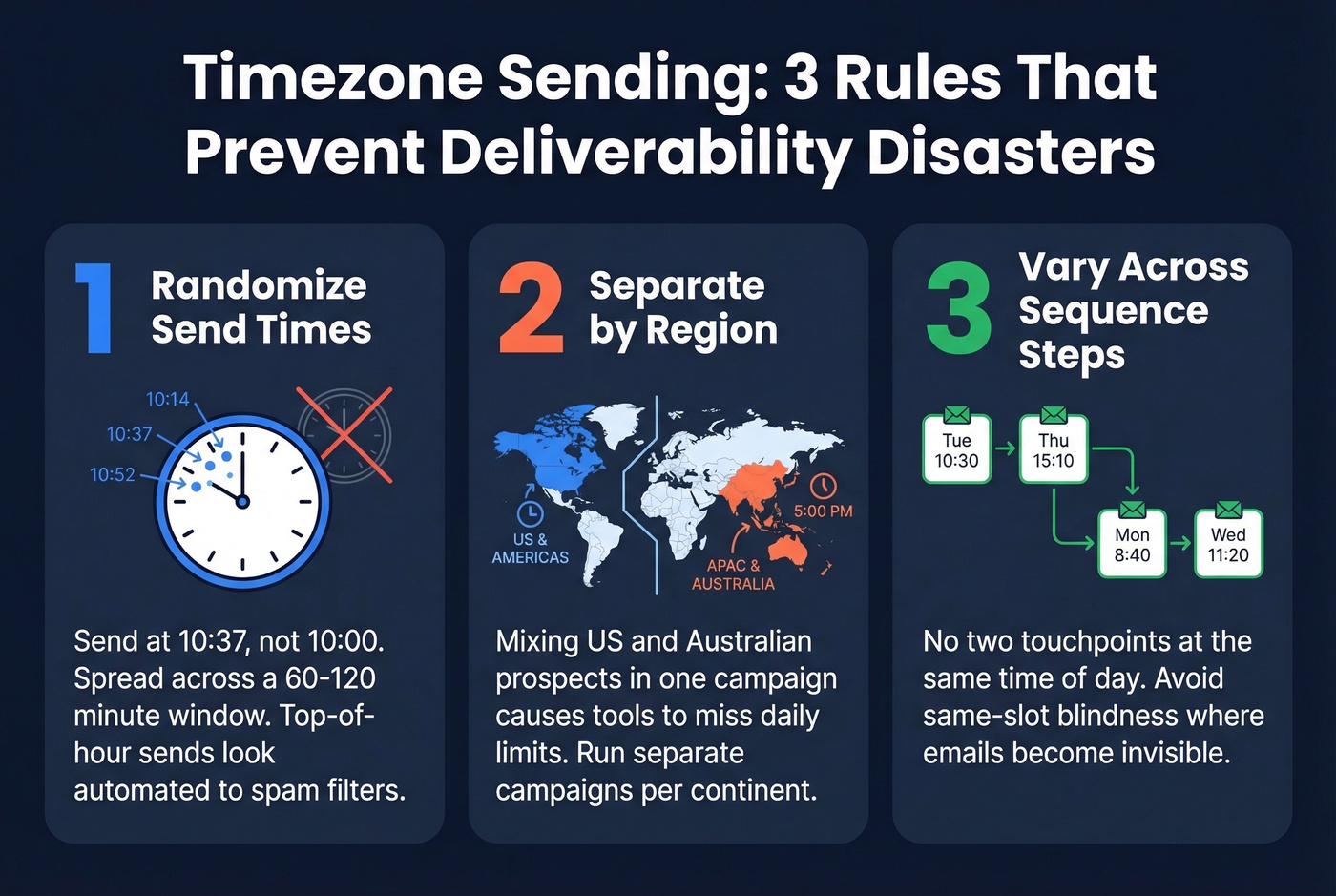
Randomize your send times. Don't send at 10:00 sharp. Send at 10:37, 10:14, 10:52. Zeliq's deliverability research recommends randomized offsets spread across a 60-120 minute window. Batch sends at the top of the hour look automated to spam filters - because they are. (Related: automated cold email scheduling.)
Separate campaigns by region. One Reddit user on r/coldemail reported that mixing US and Australian prospects in a single timezone-based campaign caused their tool to miss daily send limits, slowing throughput. If you're prospecting across continents, run separate campaigns.
Vary timing across sequence steps. A cadence like Tue 10:30 -> Thu 15:10 -> Mon 8:40 -> Wed 11:20 avoids "same-slot blindness" where your emails become invisible because they always arrive at the same moment. No two touchpoints should land at the same time of day. (If you want templates for those steps, use these cold email follow-up templates.)
Tools with native timezone-based sending include SmartReach.io (~$29/mo), Smartlead ($39/mo), and Woodpecker ($29/mo). Instantly and Lemlist also support this; expect around $30-$60/month depending on plan.
Fix Deliverability Before Timing
None of the timing advice above matters if your emails land in spam. The consensus on r/coldemail is clear: beginners over-focus on scheduling and under-invest in infrastructure.
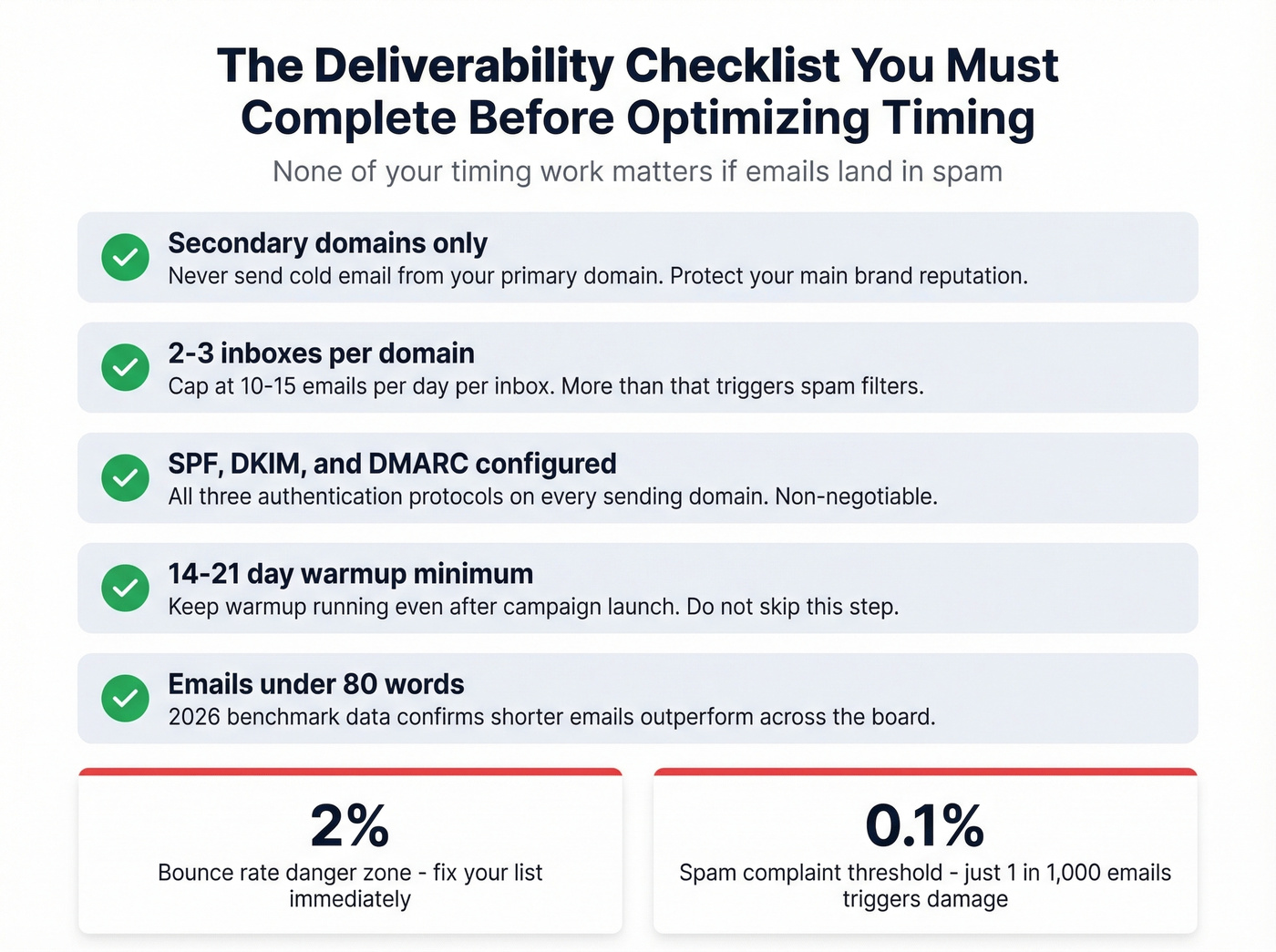
The non-negotiable checklist:
- Secondary domains only. Never send cold email from your primary domain.
- 2-3 inboxes per domain, capped at 10-15 emails per day per inbox.
- SPF, DKIM, and DMARC configured on every sending domain. (If you need to validate setup, start with how to verify DKIM is working.)
- 14-21 day warmup minimum. Keep warmup running even after launch. (More options here: unlimited email warmup tools.)
- Emails under 80 words. The 2026 benchmark data confirms shorter emails outperform across the board. (For copy structure, see email copywriting.)
A spam complaint rate as low as 0.1% - just 1 in 1,000 emails - triggers reputation damage under Google and Microsoft's current enforcement rules.
| Provider | Safe Daily Limit | Ramp-Up Schedule |
|---|---|---|
| Google Workspace | 100-150/day | Wk1: 10-20 -> Wk4: 60-80 |
| Microsoft 365 | 100-150/day | Wk1: 10-20 -> Wk4: 60-80 |
| GoDaddy | 50-75/day | Wk1: 10-15 -> Wk4: 40-50 |
List Verification
If your bounce rate is above 2%, your domain is slowly dying. That's not hyperbole. (Benchmarks and fixes: email bounce rate.)
Prospeo's 5-step verification catches what basic tools miss: spam-trap removal, honeypot filtering, and catch-all domain handling, delivering 98% email accuracy and keeping bounce rates well under that 2% threshold. At ~$0.01 per email with a free tier of 75 emails per month, every bounced email you prevent is a small save to your sender reputation that compounds over time.
Follow-Up Cadence and Timing
The 2026 benchmark data shows 58% of all replies come from the first email. Your initial send carries most of the weight - but the remaining 42% from follow-ups is still significant.
The sweet spot is 4-7 touchpoints spaced 3-4 days apart. Beyond that, returns drop to near zero. One tactic we've found effective: make Step 2 feel like a casual reply rather than a formal follow-up. Benchmark data suggests this approach outperforms structured follow-ups by roughly 30%. (If you want ready-to-send options, use these sales follow-up templates.)
Vary your follow-up timing across the week. If your first email went out Tuesday at 9 AM, shift the follow-up to Thursday at 2 PM or Monday at 10:30 AM. This avoids pattern detection by both spam filters and human recipients.
Finding Your Own Best Window
Generic benchmarks get you 80% of the way there. The last 20% comes from testing your specific audience.
Test one variable at a time. When you're testing send time, keep subject line, copy, and list identical across variants. Changing multiple variables simultaneously makes results uninterpretable.
Sample size matters. Aim for ~1,000 recipients per variant for statistical significance. With 100-200 per variant you'll get directional results, but don't make permanent decisions on small samples.
Measure replies, not opens. Positive reply rate is the metric that correlates with pipeline. Track it religiously.
Run tests for at least two full weeks. One week of data gets skewed by holidays, industry events, or random variation. Two weeks smooths out the noise. Also consider mobile behavior - opens spike during commute hours (7-8 AM and 5-6 PM), which can influence whether your subject line gets a tap or a swipe.
FAQ
Is Tuesday Really the Best Day for Cold Email?
Tuesday is the most consistently recommended day across datasets, but Wednesday performs equally well in several studies. They're the safest defaults for B2B outreach. Test with 1,000+ recipients per variant to confirm what works for your specific audience.
Should I Optimize for Open Rate or Reply Rate?
Reply rate, always. Apple Mail Privacy Protection inflates open rates artificially, and tracking pixels can hurt deliverability. Positive reply rate directly correlates with booked meetings - it's the only metric worth optimizing around.
How Do I Handle Multiple Timezones?
Send between 8-10 AM in your prospect's local timezone. Use CRM data or phone area codes to detect timezone. Run separate campaigns per region and randomize send times within a 60-120 minute window to avoid spam filter triggers.
Does Send Time Matter for Follow-Ups Too?
Yes - vary timing across sequence steps so no two touchpoints land at the same hour. If your first email went out Tuesday at 9 AM, shift the follow-up to Thursday at 2 PM. This prevents pattern detection by spam filters and avoids inbox blindness from recipients.
Sending at 8 AM in your prospect's timezone only works if you're reaching the right person. Prospeo's 30+ filters - including job title, seniority, and buyer intent - let you build role-segmented lists so your C-suite emails land at 8 AM and your IC emails hit at 1:30 PM. All at $0.01 per email.
Build role-targeted lists that make your timing strategy actually work.