

Sales Development Outsourcing: What It Costs, When It Works, and How to Not Waste $50K
Your pipeline is flat. The CEO's asking questions. Your two SDRs are burned out, and the one you hired last quarter just quit. You're searching for "sales development outsourcing" at 10pm on a Tuesday, wondering if paying someone else to fill the top of your funnel is genius or a $50K mistake.
Here's the thing: the outsourced SDR market hit $4.42B in 2026 and is tracking toward $6.98B by 2032 at 7.92% CAGR. That growth isn't happening because outsourcing always works - it's happening because hiring, ramping, and retaining in-house SDRs has become brutally expensive. The question isn't whether outsourcing pipeline generation is legitimate. It's whether it's right for your situation, your budget, and your sales motion.
The Short Version
- Budget reality: Outsourced SDR retainers run $3K-$14K/month, but the cheapest option is almost always the worst. Budget $6K-$10K/month for a dedicated rep who actually knows your product.
- Contract protection: Before signing anything, demand CRM integration, a shared definition of "qualified meeting", and a 60-90 day pilot. Walk away from 12-month contracts without a proof period.
- Fix your data first. Bad prospect data is the #1 reason outsourced campaigns fail - and it's the cheapest problem to solve. Verify emails and phone numbers before any SDR touches a list.
What Does Outsourcing SDRs Actually Mean?
Sales development outsourcing means hiring an external team to handle top-of-funnel work: initial outreach, lead qualification, and appointment setting. These reps work across email, phone, and social channels to book meetings for your account executives.
The critical distinction is scope. Outsourced SDRs handle prospecting through qualification. They don't close deals, manage accounts, or run demos. When vendors blur that line and try to act like a full-cycle sales team without owning closing, forecasting, and account management, things break down fast.
Think of it as renting pipeline capacity. You're paying for a team that already has the infrastructure, the playbooks, and the data to start generating conversations within weeks instead of the months it takes to hire, onboard, and ramp an in-house rep.
The Real Cost: In-House vs. Outsourced
An in-house SDR isn't a $65K line item - it's a $125K-$150K fully loaded commitment once you account for everything that comes with the hire.
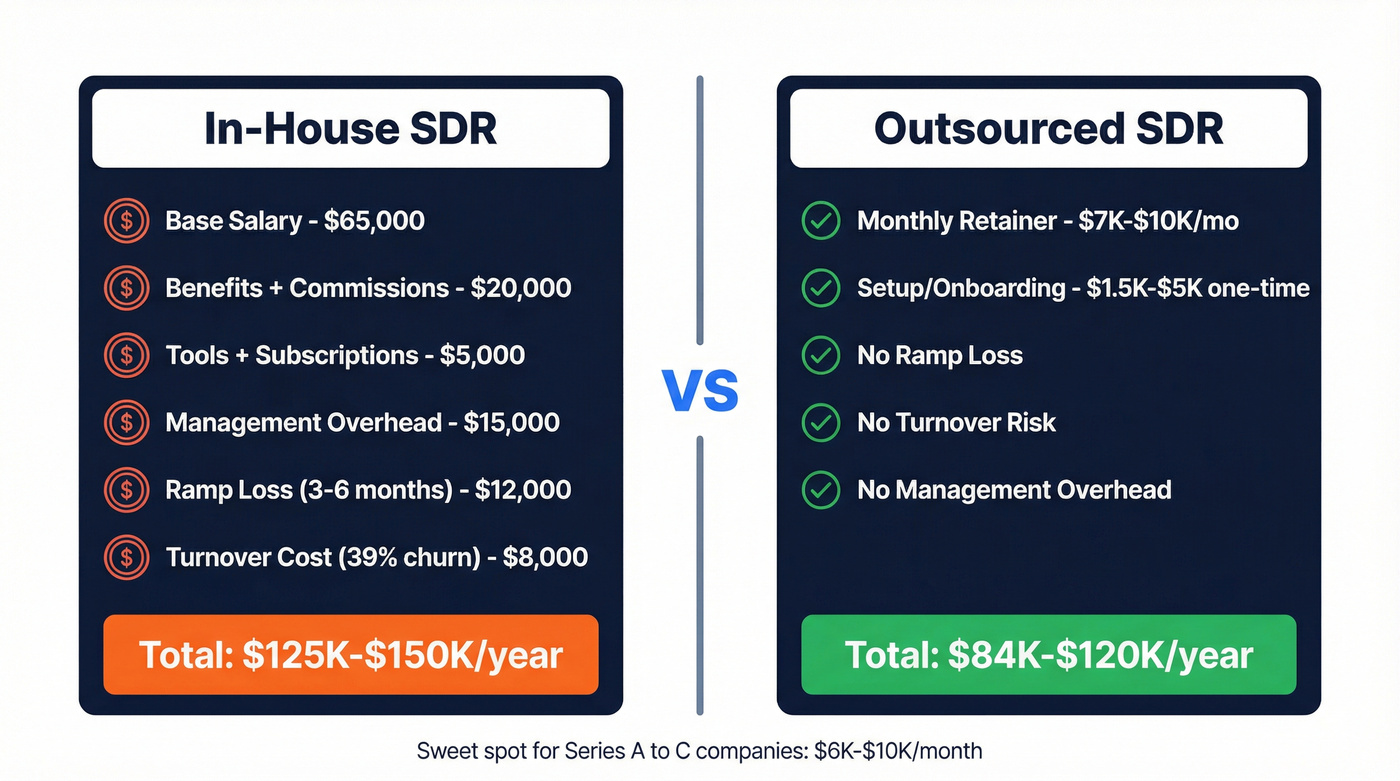
| Component | Annual Cost | |---|---| | Base salary | ~$65,000 | | Benefits + commissions | ~$20,000 | | Tools + subscriptions | ~$5,000 | | Management overhead | ~$15,000 | | Ramp loss (3-6 months) | ~$12,000 | | Turnover cost (~39% annual) | ~$8,000 | | Total fully loaded | $125K-$150K |
That turnover line is the killer. SDR roles churn at 35-40% annually. Every time someone leaves, you're restarting a 3-6 month ramp cycle and eating the recruiting costs again.
Now compare that to outsourced models:
| Model | Range | Notes |
|---|---|---|
| Monthly retainer | $3K-$14K/mo | $3K = shared reps; $7K-$10K = sweet spot |
| Setup/onboarding | $1,500-$5,000 | One-time |
| Pay-per-lead | $50-$200/lead | Varies by ICP complexity |
| Pay-per-meeting | $300-$1,200/meeting | Higher for enterprise ICP |
At $3K/month, you're getting shared reps working your account alongside five others, running recycled lists through generic sequences. For a dedicated rep running phone, email, and social with real ICP knowledge, expect $7K-$12K/month. That's $84K-$144K annually - comparable to in-house when you factor in zero ramp loss, zero turnover risk, and no management overhead.
The sweet spot for most Series A through Series C companies is $6K-$10K/month. Below that, you're cutting corners on data quality and rep dedication. Above that, you should probably be building in-house.
When to Outsource (and When Not To)
When Outsourcing Wins
Speed matters more than perfection. An in-house SDR takes 3-6 months to hire, onboard, and ramp. An outsourced team can run outreach by week four. Responding within an hour can increase conversion likelihood 7x, and outsourced teams with established infrastructure are often set up to hit that window. If your board wants pipeline numbers next quarter, outsourcing buys you time.
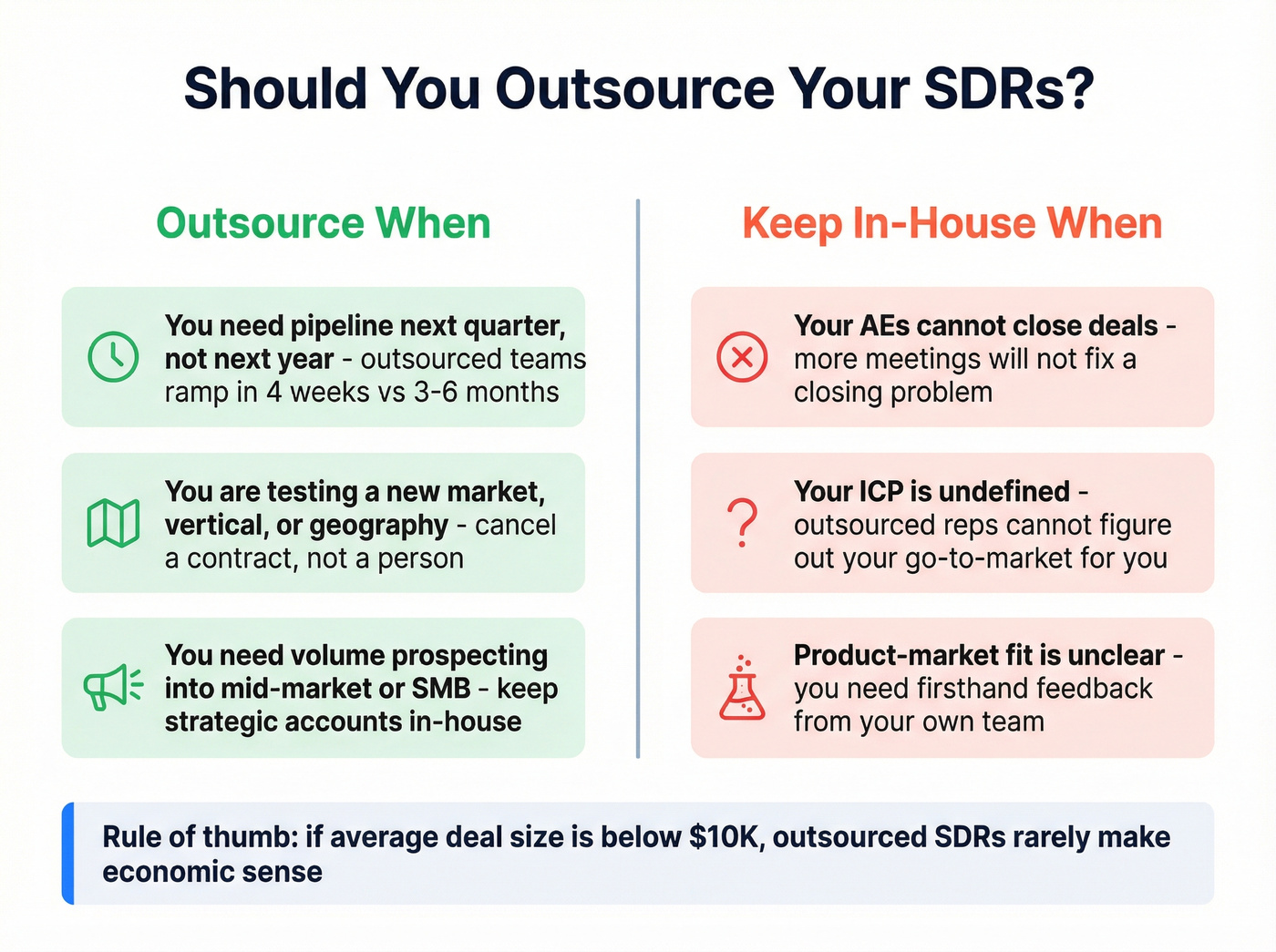
You're testing a new market. Entering a new vertical, geography, or buyer persona? Outsourcing lets you test without committing to headcount. If the market doesn't convert, you cancel a contract instead of laying someone off.
You need volume, not nuance. The hybrid model works best here - keep strategic, high-ACV accounts with your in-house team and outsource the volume prospecting into mid-market or SMB segments. Some agencies split the SDR role into researchers who build lists and identify intent signals and outbounders who make calls and send emails, a model that reduces per-rep tool costs and shortens ramp time. We've seen this pattern work repeatedly for companies selling into both enterprise and commercial segments.
When It Doesn't
Your AEs can't close. Most outsourcing vendors won't tell you this. If your account executives struggle to win deals, pouring more meetings into the top of the funnel won't fix the problem. You'll spend $50K on meetings that go nowhere.
You haven't defined your ICP. Outsourced SDRs need a clear target. If you can't articulate who your ideal buyer is - title, company size, industry, pain point - you're asking a vendor to figure out your go-to-market strategy for you. That's not what they do.
Product-market fit is unclear. If you're still iterating on messaging and value prop, the feedback loops from outsourced reps are too slow and too filtered. You need your own people in those conversations, hearing objections firsthand.
Let's be honest: if your average deal size sits below $10K, you probably don't need outsourced SDRs at all. The unit economics rarely work. Invest in product-led growth or content marketing instead, and save the SDR budget for when deal sizes justify the cost-per-meeting math.
The Data Quality Problem Nobody Talks About
We see this constantly: a company signs a $8K/month outsourced SDR contract, waits the standard 4-6 weeks for ramp, and by month three the meetings are garbage. Show rates are low, half the contacts are wrong-titled, and the vendor is blaming the ICP definition.
The real problem? The data was bad from day one.
Single-source data providers miss 40-60% of prospect information. Contact databases with 6-week refresh cycles mean the VP of Engineering your SDR is calling left that company two months ago. When emails bounce at 20%+ and phone numbers ring dead lines, no amount of SDR talent saves the campaign. The most common failure pattern is simple: volume guarantees plus weak qualification plus weak data equals a calendar full of low-quality meetings. Only 7% of companies in one SaaStr survey said outsourced SDRs "truly worked."
Fix your data layer before signing any SDR contract. Prospeo runs a 7-day refresh cycle with 98% email accuracy across 300M+ professional profiles. When Snyk rolled it into their prospecting workflow, bounce rates dropped from 35-40% to under 5%, and AE-sourced pipeline jumped 180%. At roughly $0.01 per lead, verifying every address before a single SDR touches a list takes minutes, costs almost nothing, and eliminates the biggest failure mode in outsourced engagements.

Outsourced SDR contracts cost $6K-$10K/month. Don't waste that budget on bounced emails and dead phone numbers. Prospeo's 7-day data refresh and 98% email accuracy mean your outsourced reps start with verified contacts - not stale lists that tank deliverability.
Fix the data layer before you sign the SDR contract.
How AI Changes the Economics
81% of sales teams have implemented or are experimenting with AI, and teams using it are 1.3x more likely to see revenue growth. Signal-personalized outreach - where AI identifies buying triggers and tailors messaging in real time - generates 15-25% reply rates versus the 3-5% cold average.
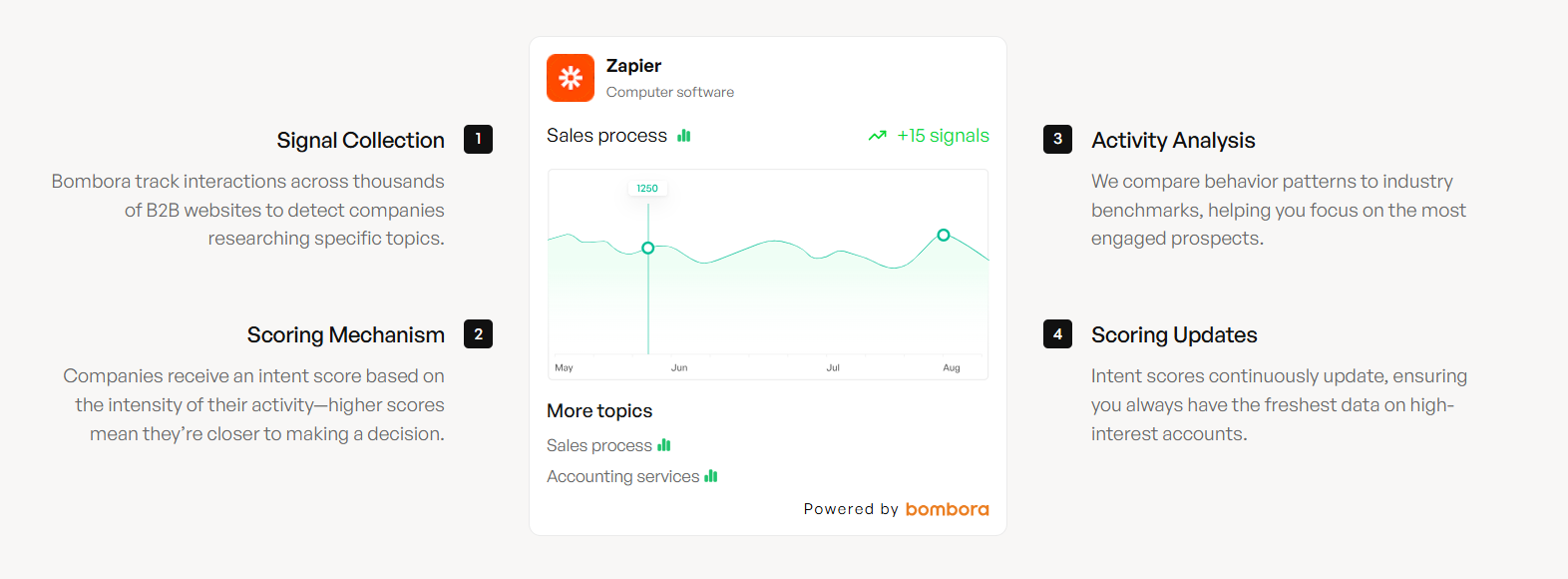
The winning model in 2026 isn't "AI replaces SDRs." It's AI for research and signals, humans for conversations. Good outsourced SDR teams use AI to identify which prospects to call and what to say. Bad ones are still dialing through static lists alphabetically. AI makes the good teams measurably better and renders the bad ones obsolete.
If you're weighing automation vs. agencies, compare the tradeoffs in AI SDR vs Agency.
Red Flags When Choosing a Vendor
Eight warning signs that predict failure:
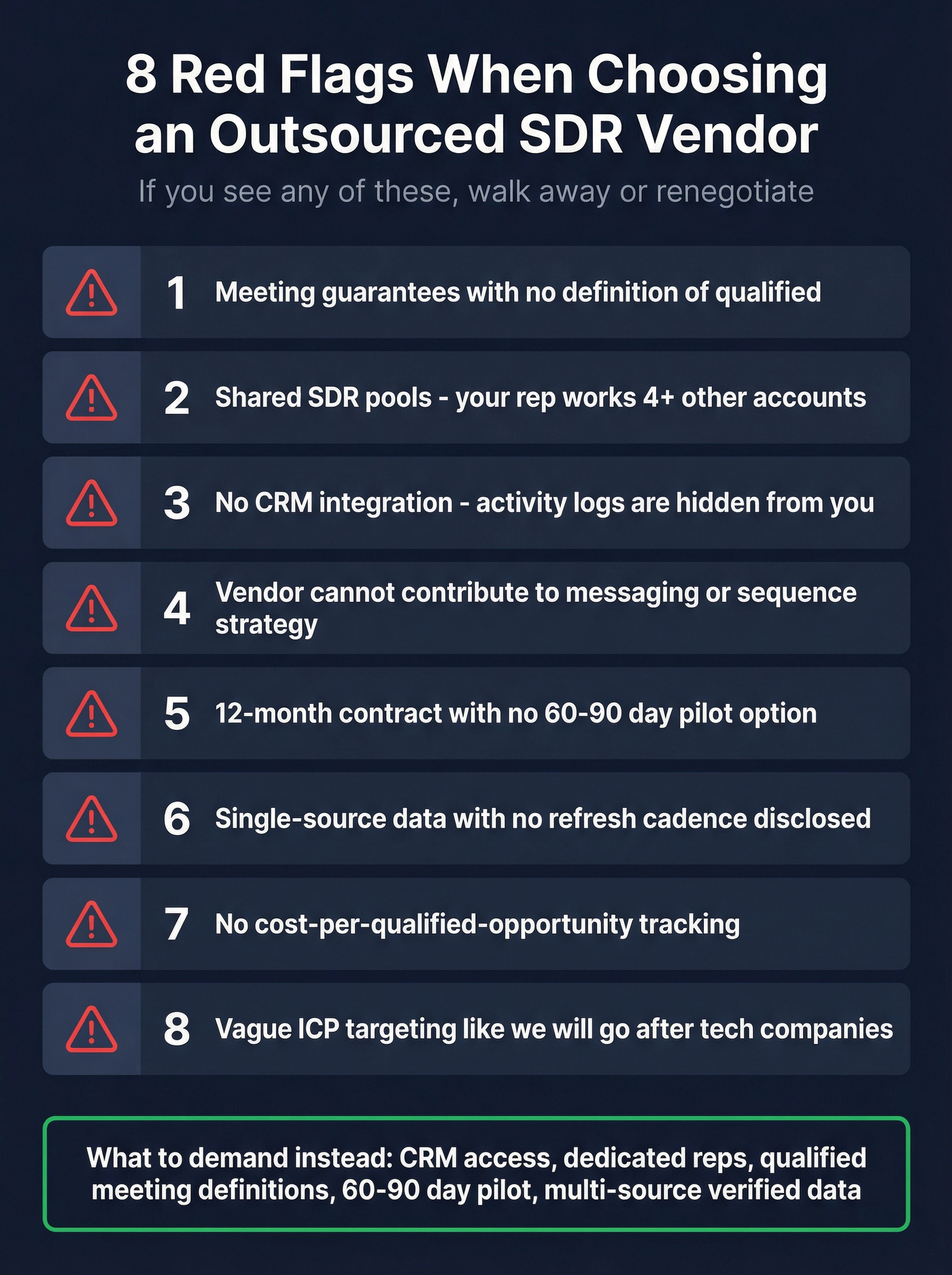
Meeting volume guarantees without a "qualified" definition. If a vendor promises 20 meetings a month but won't define what "qualified" means, they're incentivized to book junk.
Shared SDR pools. Your rep is also working four other accounts. Context switching kills quality. Push for dedicated reps.
"Trust us" reporting with no CRM integration. If activity logs don't live in your Salesforce or HubSpot instance, you're flying blind.
The vendor requires you to supply all messaging. You're hiring expertise, not dialers. If they can't contribute to sequence strategy, they're selling bodies.
12-month contracts without a pilot option. Any vendor confident in their work will offer a 60-90 day proof period.
Single-source data with no refresh cadence disclosed. Ask directly: where does your contact data come from, and how often is it refreshed?
No cost-per-qualified-opportunity tracking. If they only report activity metrics - calls made, emails sent - they're hiding conversion problems.
Vague ICP targeting. "We'll go after tech companies" isn't a targeting strategy. Demand specificity on titles, company size, technographics, and intent signals.
Measuring SDR Performance
"Meetings booked" is a vanity metric. The number that actually matters is cost-per-qualified-opportunity.
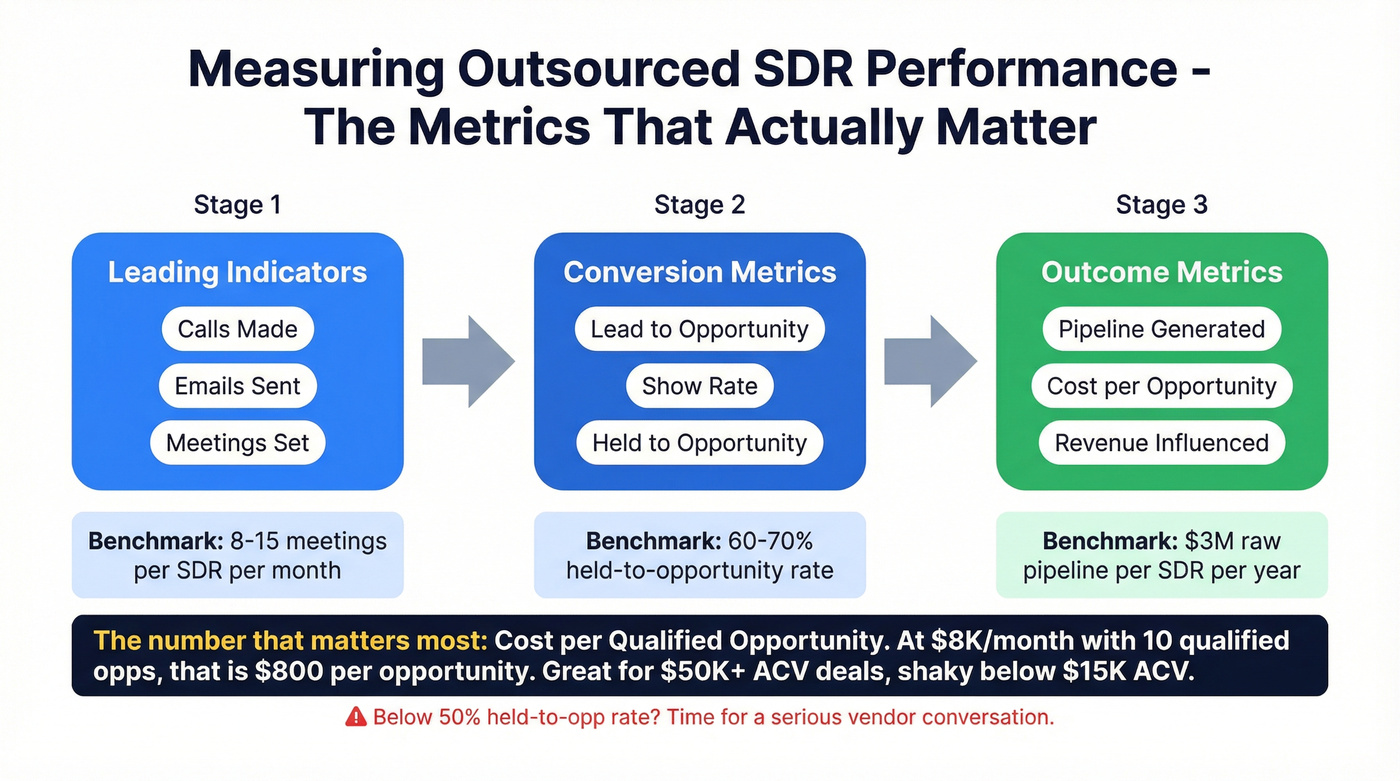
| Category | Metrics | Benchmark |
|---|---|---|
| Leading | Calls, emails, meetings set | 8-15 meetings/mo per SDR |
| Conversion | Lead-to-opp, show rate, held-to-opp | 60-70% held-to-opportunity |
| Outcome | Pipeline, cost-per-opp, revenue | $3M raw pipeline/SDR/year |
The held-to-opportunity conversion rate is your quality barometer. If your outsourced team books 15 meetings a month but only 40% convert to real opportunities, you've got a qualification problem. At 60-70%, you're in healthy territory. Below 50%, it's time for a serious conversation with your vendor.
Track cost-per-qualified-opportunity monthly. If you're paying $8K/month and generating 10 qualified opportunities, that's $800 per opportunity. For $50K+ ACV deals, that's excellent. For deals under $15K, the math gets shaky fast.
To standardize definitions and reporting, align on SQO (Sales Qualified Opportunity) criteria before you scale.
Your First 90 Days
Average SDR ramp time is 3.2 months regardless of whether they're in-house or outsourced. Here's what a well-run engagement looks like.
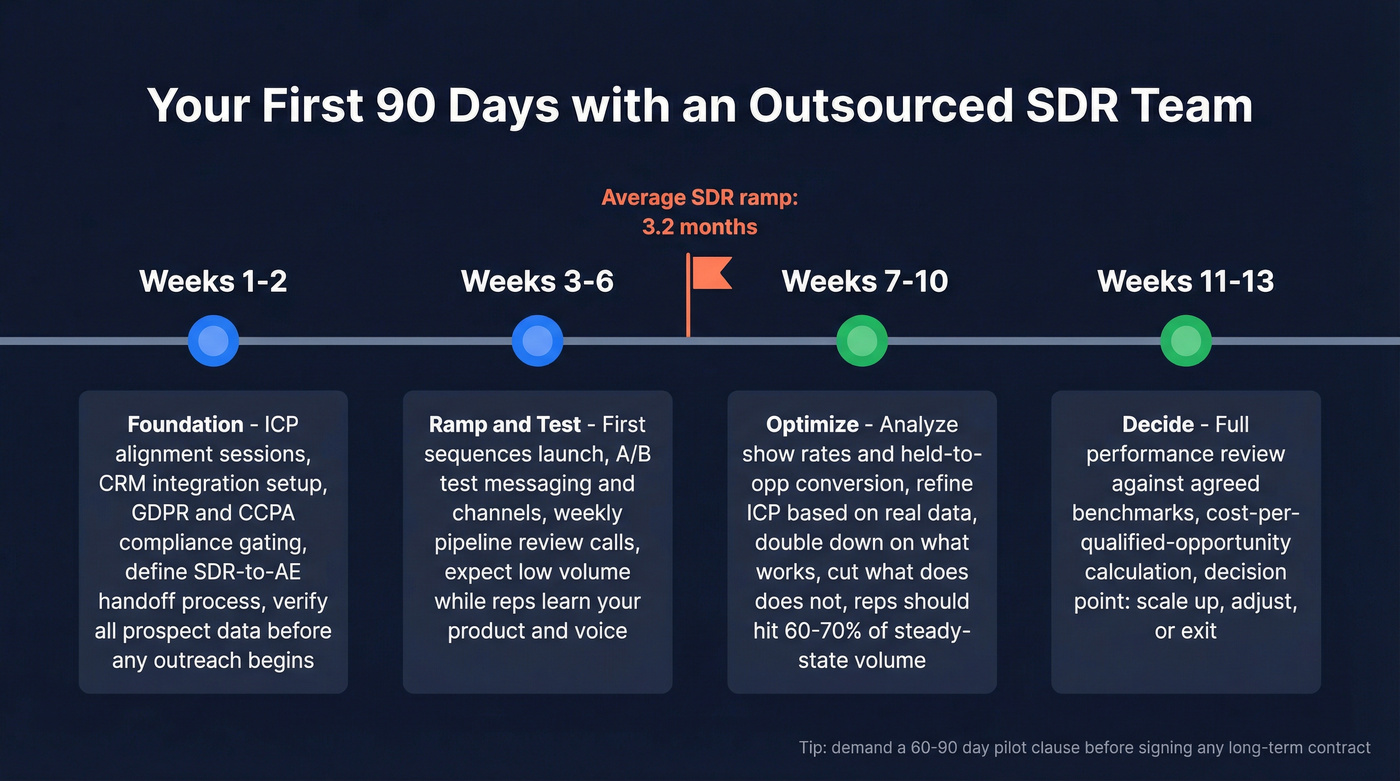
Weeks 1-2: Foundation. ICP alignment sessions. CRM integration provisioned. GDPR/CCPA compliance gating - no outreach until compliance is confirmed. Define formal SDR-to-AE handoff criteria upfront. This step gets skipped constantly, and it causes problems at week eight when nobody agrees on what a "qualified" meeting looks like.
Weeks 3-4: First outreach. Messaging approval and sequence launch. Track activity metrics only. Don't judge conversion yet - the vendor is calibrating targeting and messaging.
Weeks 5-8: Conversion kicks in. First QA review of meeting quality. Show rates and lead-to-opportunity ratios start to matter. Iterate on messaging based on what's working. This is where you'll know if the data layer is solid or if bounces are eating your sender reputation alive.
Weeks 9-12: Go/no-go. Pipeline metrics become meaningful. Calculate cost-per-qualified-opportunity. Compare against your in-house benchmarks or target CAC. If the numbers work, extend. If they don't, you've spent $24K-$36K to learn something valuable - not $150K on a bad hire.
If you're running email-heavy outbound, make sure your email deliverability fundamentals are in place before week 3.
Notable Outsourced SDR Agencies
This isn't an endorsement - use the red flags checklist above to vet any vendor. Pricing is approximate and varies by engagement scope.
| Agency | Positioning | Pricing |
|---|---|---|
| SalesHive | US-based, month-to-month | $7K-$12K/mo |
| SalesBread | Cold email + social, ~20% reply rate | $3K/mo + setup |
| Belkins | Full-stack lead gen + marketing | ~$5K-$15K/mo |
| MemoryBlue | 650+ SDRs, 30 countries | ~$7K-$15K/mo |
| The Sales Factory | 2-week onboarding, NA focus | ~$5K-$10K/mo |
| AltiSales | Assembly Line model | ~$6K-$12K/mo |
| Callbox | APAC strength, multi-channel | ~$3K-$8K/mo |
| Martal Group | Flexible engagement sizes | $2K-$40K/mo |
The range at Martal Group tells you something about this market - pricing varies wildly based on ICP complexity, channel mix, and rep dedication. Always ask for a dedicated rep, always demand a pilot, and always verify the data they're using before outreach begins. The consensus on r/sales is that most outsourced SDR engagements fail not because the reps are bad, but because the setup was rushed and the data was stale.
Skip agencies that won't share their data sourcing methodology. If they can't tell you where their contact information comes from and how often it's refreshed, you're gambling with your domain reputation.
If you're specifically outsourcing the phone channel, start with outsourcing cold calling to understand pricing and QA.
FAQ
How much does outsourced sales development cost?
Monthly retainers range from $3K-$14K depending on shared or dedicated reps. Setup fees run $1.5K-$5K one-time. Per-meeting models cost $300-$1,200. Budget $6K-$10K/month for dedicated multi-channel capability with a single rep who knows your ICP.
How long before an outsourced SDR team delivers results?
Expect 4-6 weeks to first meetings and 90 days to meaningful pipeline data. Average ramp is 3.2 months. Any vendor promising qualified pipeline in week two is either lying or redefining "qualified" to mean "anyone who picked up the phone."
Should I outsource or hire SDRs in-house?
Outsource when you need pipeline within 60 days or you're testing new markets without headcount risk. Build in-house when you need deep product expertise, tight feedback loops with product and marketing, and you've got 6+ months of runway to ramp. According to Forrester's B2B sales research, the hybrid model - outsourced for volume, in-house for strategic accounts - outperforms either approach alone for companies between $5M and $50M ARR.
What's the biggest reason outsourced SDR campaigns fail?
Bad prospect data - specifically, unverified emails and stale phone numbers. Bounce rates above 10% tank sender reputation and waste rep time. Verifying contacts at scale before outreach begins eliminates this failure mode entirely.
Can AI replace outsourced SDRs entirely?
Not in 2026. AI handles research, signal detection, and personalization at scale, but human reps still outperform on complex discovery calls and objection handling. The highest-performing teams combine AI-driven targeting with human conversations - expect 15-25% reply rates versus 3-5% from pure automation. Gartner's 2026 sales technology forecast projects that AI-augmented SDR teams will be the norm by 2028, but full replacement is still years away.
Snyk cut bounce rates from 35% to under 5% and grew AE-sourced pipeline 180% - with 50 reps prospecting on Prospeo data. Whether you outsource or build in-house, 300M+ verified profiles at $0.01/email beats paying your SDR vendor to burn through garbage lists.
Stop paying premium retainers to dial wrong numbers.