

How to Book More Meetings From Cold Calls: What 300M+ Calls Reveal
47 dials. Three conversations. Zero meetings. That's a day every SDR recognizes.
Gong's analysis of 300M+ cold calls shows the average rep books about 2 meetings per month from 800 dials. Top-quartile reps? 18 meetings from the same volume. Cold calling to book meetings is still the highest-ROI activity in outbound - but the gap between average and elite isn't effort or talent. It's technique, timing, and data quality.
The Two-Minute Version
If you're short on time, here's the playbook:
- Fix your data first. Verified mobile numbers are the single biggest lever for connect rate. We've seen teams double their connect rate overnight just by switching from office lines to verified directs.
- Open with a pain point. Mentioning a specific pain in your opener makes you 6.3x more likely to book. Ask an open-ended question and that jumps another 310%.
- Protect the show rate. Book same-week whenever possible and send a day-before confirmation. The meeting you booked is worthless if the prospect ghosts.
Cold Call Benchmarks Worth Knowing
Before optimizing anything, you need to know what "good" actually looks like. Most teams can't diagnose where they're losing because they don't have clear funnel math.
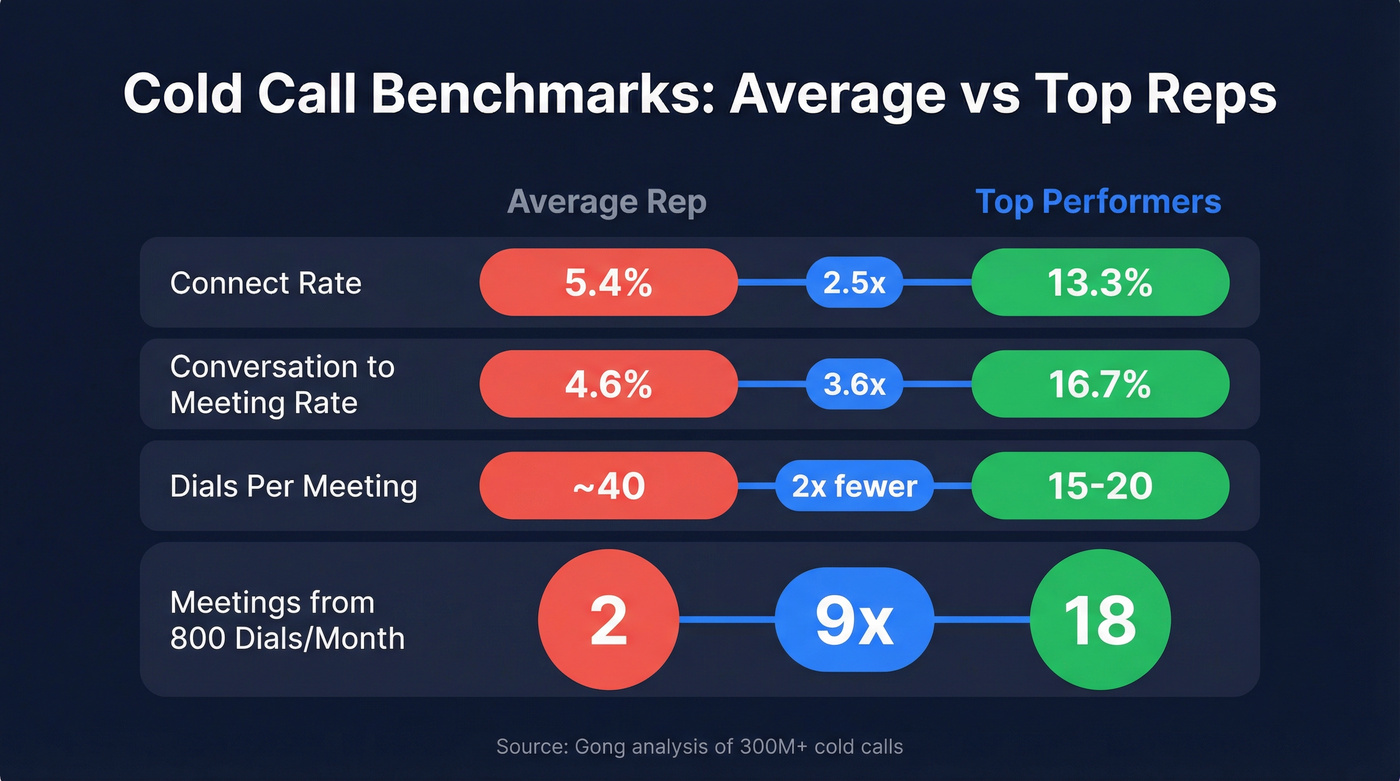
| Metric | Average Rep | Top Performers | Source |
|---|---|---|---|
| Connect rate | 5.4% | 13.3% | Gong, 300M calls |
| Set rate (conv to mtg) | 4.6% | 16.7% | Gong, 300M calls |
| Dials per meeting | ~40 | ~15-20 | Optif.ai benchmark |
| Meetings from 800 dials/mo | ~2 | ~18 | Gong, 300M calls |
The Optif.ai benchmark puts the average dial-to-meeting rate at 2.5%, which aligns. Voicemail callbacks run about 1.5% - live conversations are 6x more effective, which is why connect rate matters more than dial volume.
Conversion also depends heavily on lead temperature. Cold list dials convert at 1.5-2% dial-to-meeting. MQLs hit 4-6%. Warm intros land between 15-25%. A scraped cold list with no verification converts at 0.8-1.2%. The quality of your list isn't a nice-to-have - it's the multiplier on everything else you do.
Before You Dial
Most cold calling advice jumps straight to scripts. That's a mistake. The biggest performance gap between average and top reps isn't what they say - it's who they're calling and whether the number actually works.
Start with the 3x3 research method: spend three minutes finding three relevant facts about each prospect before you dial. Optif.ai's data shows this lifts conversion from 1.8% to 3.3% - an 82% improvement from three minutes of prep. We tested this internally, and the payoff showed up within the first week.
Then prioritize accounts showing buying signals: companies running competitive reviews, recent funding rounds, hiring for the function you sell into, or 10%+ headcount growth. These aren't cold prospects. They're prospects with active problems.
But none of that matters if you're dialing office switchboards. Verified mobile numbers are the fix. Prospeo's Mobile Finder covers 125M+ verified mobile numbers refreshed every 7 days, and the free tier gives you 75 emails and 100 credits per month - enough to test whether better numbers move your connect rate before you commit.
When to Call
Timing won't save a bad script, but it'll amplify a good one. A LeadsAtScale study of 40,000 outbound calls provides one of the clearest breakdowns we've found:
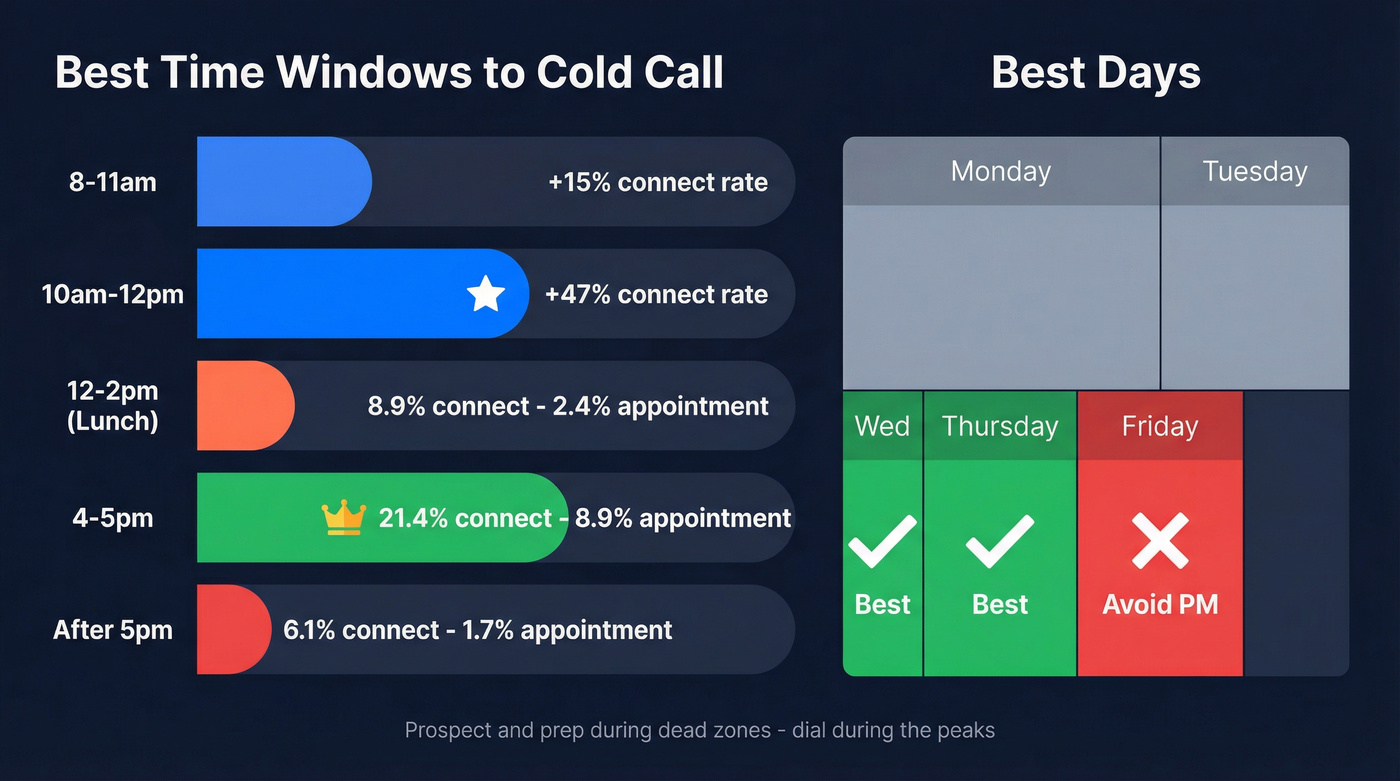
| Time Block | Connection Rate | Appointment Rate |
|---|---|---|
| 8-11am | +15% vs avg | - |
| 10am-12pm | +47% vs avg | - |
| 12-2pm (lunch) | 8.9% | 2.4% |
| 4-5pm | 21.4% | 8.9% |
| After 5pm | 6.1% | 1.7% |
The 4-5pm window is the clear winner for both connection and appointment rate. The 8-11am window is also strong. Midday is consistently weak.
Best days are Wednesday and Thursday. Friday afternoon is where dials go to die.
Build your call blocks around these windows. Prospect and prep during the dead zones, dial during the peaks.
Nailing the First 10 Seconds
Your opener determines whether you get 30 seconds or a dial tone. Analysis of 5 million cold calls found two tactics that dramatically increase booking rates: mentioning a specific pain point (6.3x more likely to book) and asking an open-ended question (+310%).
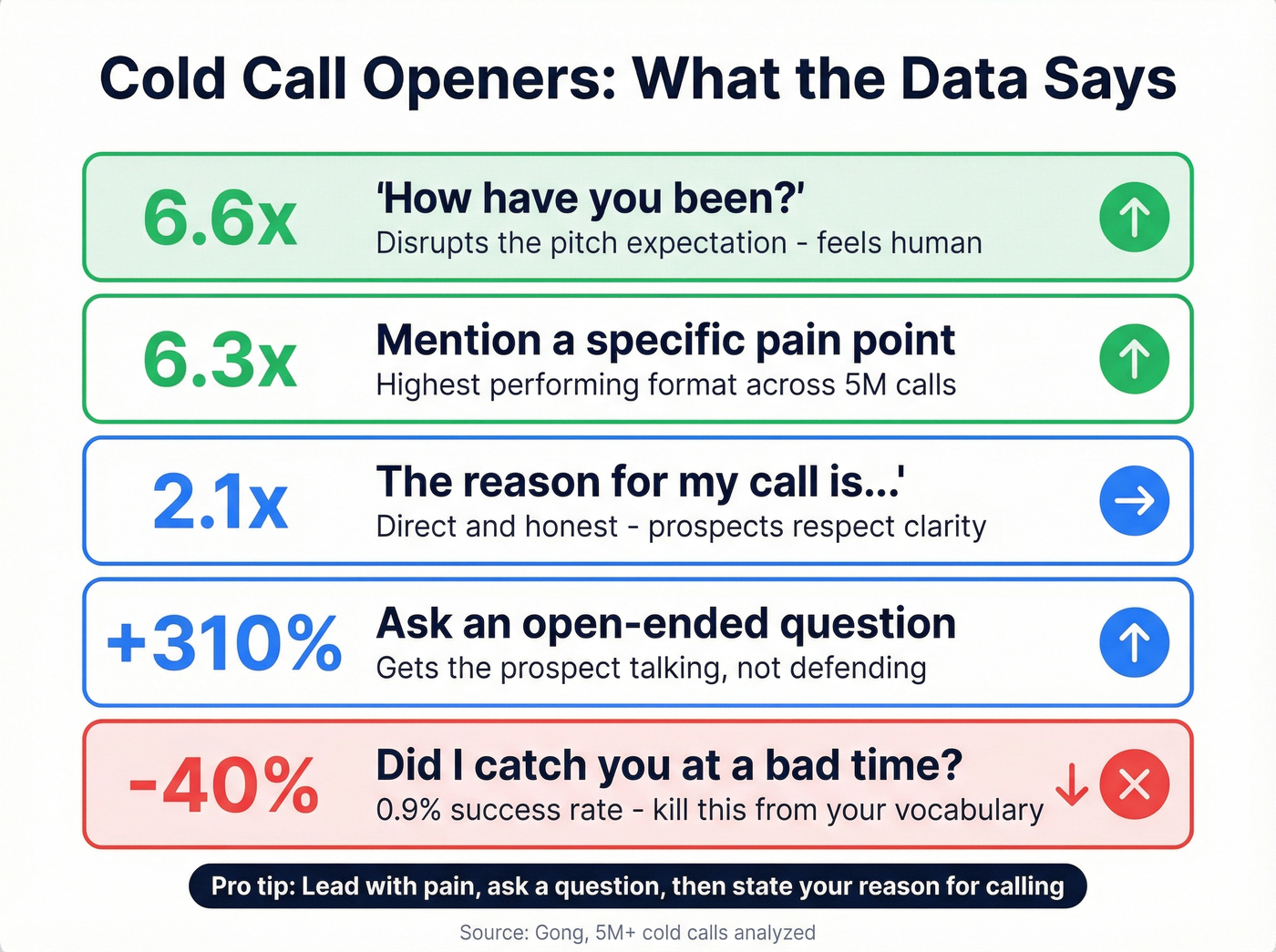
The Gong dataset also shows that "Did I catch you at a bad time?" makes you 40% less likely to book. Calls using that opener had a 0.9% success rate. Kill it from your vocabulary.
What works instead? "The reason for my call is..." is 2.1x more successful. Adding "How have you been?" between your intro and your reason increases odds by 6.6x - it disrupts the pattern because prospects expect a pitch, not a human question.
Three openers worth testing:
Pain-point opener:
"[Name], I talk to [role] every day and the thing I keep hearing is [specific pain]. Is that on your radar too?"
Context-first opener (30MPC style):
"Hey [Name], heard your name tossed around - [context like a competitor, mutual connection, or industry event]. Have you heard of us?"
Permission opener:
"Do you have 30 seconds? Then you can decide if it makes sense to keep talking."
The pain-point version is the highest-performing format in the 5M-call dataset. The permission opener works because it gives the prospect perceived control - they're choosing to listen, not being trapped. In our experience, pain-point consistently outperforms the other two, but the permission opener is a close second for senior buyers who hate being pitched.

The data is clear: connect rate is the #1 lever for booking more meetings from cold calls. Prospeo's Mobile Finder gives you 125M+ verified mobile numbers with a 30% pickup rate - refreshed every 7 days, not every 6 weeks. Teams using verified directs instead of office lines see connect rates jump from 5% to 13%+.
Stop burning dials on switchboards. Start reaching prospects directly.
The Problem Proposition
Once your opener lands, you've got about 30 seconds to deliver what 30MPC calls the "problem proposition." Three parts:
- Triggering problem - describe it with movie-scene specificity. Not "pipeline challenges" but "your reps are spending 4 hours a day prospecting and still missing quota by 30%."
- One-sentence solution - what you do, in plain language.
- Interest-based CTA - not "can we book 30 minutes?" Try: "Would it be worth seeing how we handle that?"
Here's the critical finding: ask for the meeting immediately after you hear any signal of interest. Waiting - even to add more value - drops your odds dramatically. That 11.8x multiplier only works if you pull the trigger fast.
Talk Less, Ask Better
A study of 326,000 sales calls reveals a counterintuitive pattern. Reps who won deals talked 57% of the time. Reps who lost talked 62%. That 5-point gap sounds small, but it represents a fundamentally different conversation dynamic - one where the prospect is engaged versus one where they're waiting for you to stop.
The sweet spot for questions is 15-16 per call. Go above 20 and you're running an interrogation, not a conversation.
Here's the thing: if your deal size sits below five figures, you probably don't need a fancy dialer or AI call coaching. You need 50 verified mobile numbers and a solid opener. The tooling obsession in outbound sales is a distraction from the fundamentals - better data in, better conversations out.
Converting Conversations Into Meetings
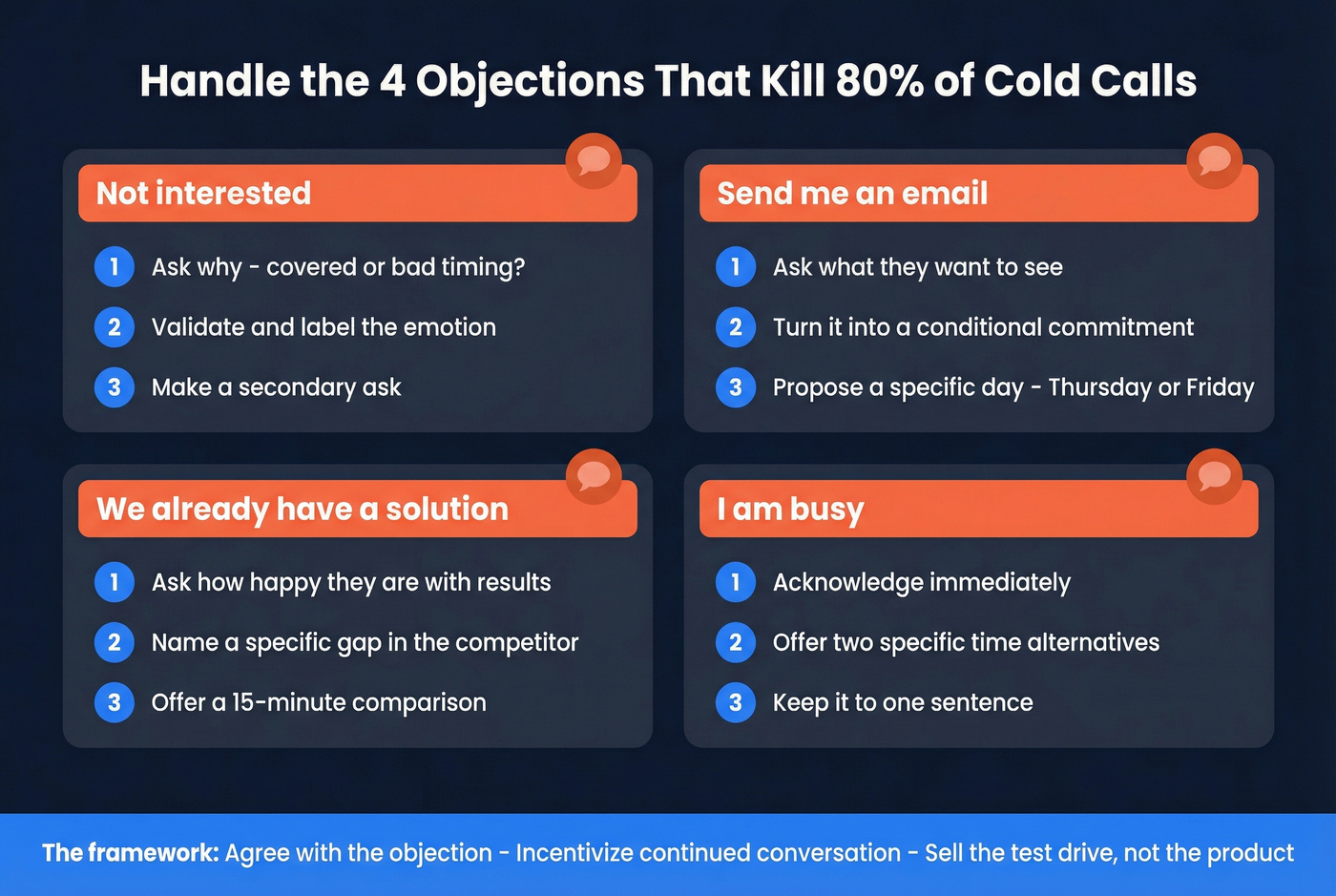
Four objections account for 80%+ of cold call rejections. Knowing how to handle each one is the difference between a dead dial and a booked meeting.
"Not interested."
Say: "Totally fair - is it because you've got this fully covered, or is timing off?" Then validate the objection, label the emotion ("Sounds like you've got a lot on your plate"), and make a secondary ask.
"Send me an email."
Say: "Happy to - what specifically would you want to see? And if it looks interesting, are you open to a quick chat Thursday?" This turns a brush-off into a conditional commitment.
"We already have a solution."
Say: "Good - how happy are you with results? A lot of [competitor] customers switched because [specific gap]. Worth 15 minutes to compare?"
"I'm busy."
Say: "Understood - when's better, Thursday morning or Friday afternoon?"
The 30MPC "Mr. Miyagi" method applies across all four: agree with the objection, incentivize continued conversation ("so no one calls you about this again, can I ask one question?"), then sell the test drive - not the product. Let's be honest - most reps panic at the first objection and either push too hard or fold immediately. Neither works. The move is to stay calm, acknowledge, and redirect.
Spam Prevention and Compliance
Your connect rate doesn't just depend on who you're calling - it depends on whether your number shows up as spam. Skip this section if you're already running number hygiene, but for everyone else, these rules protect your caller reputation:
- Register outbound numbers at freecallerregistry.com
- Rotate numbers regularly - don't burn a single line
- Cap at 5 dials to the same prospect in 4 weeks
- Stop after 2 voicemails to the same person
- Never repeatedly call disconnected numbers - this tanks your reputation fast
- Scrub your list against the National Do Not Call Registry before every campaign
- Call during FTC-compliant hours (8am-9pm local time)
If you're recording calls, know your state laws and disclose when required.
Preventing No-Shows
Booking the meeting is half the battle. Protecting the show rate is the other half.
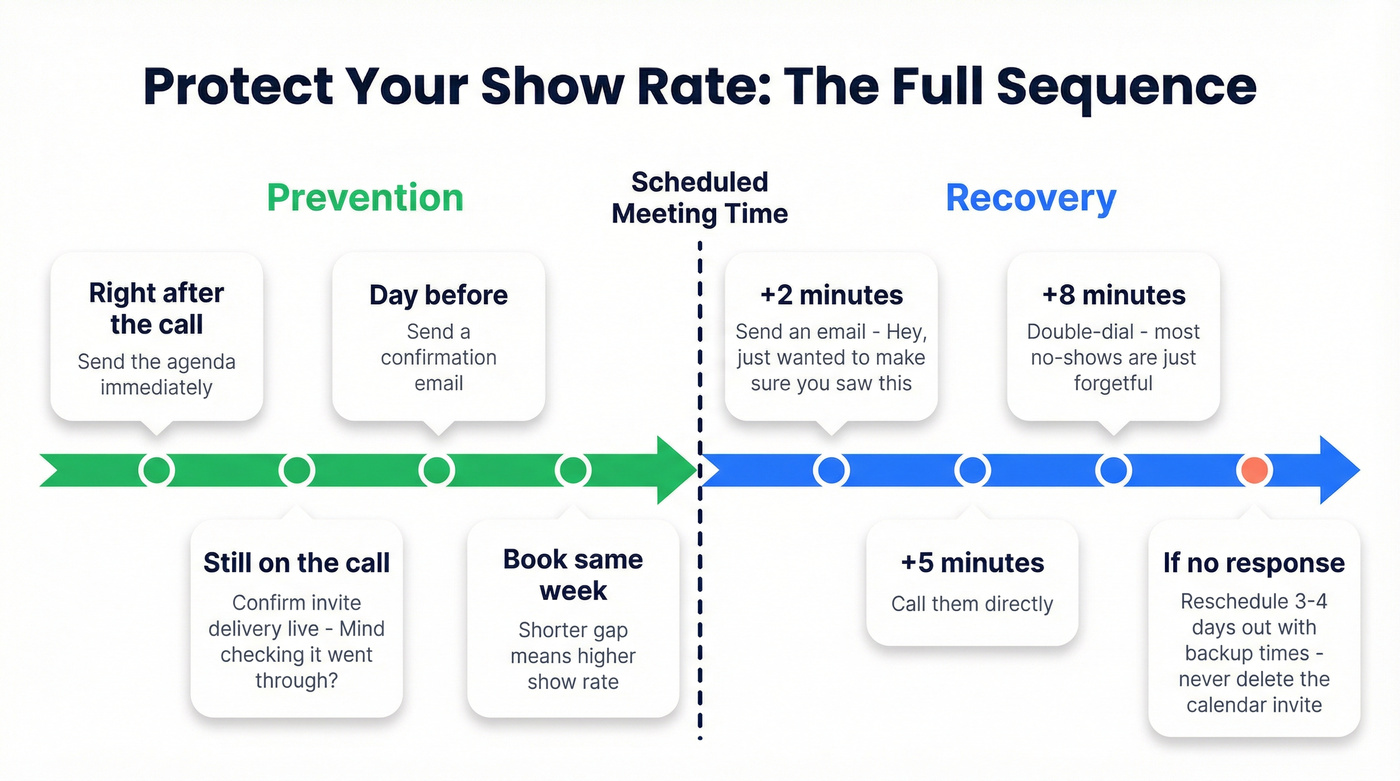
Book same week whenever possible, then run this protocol:
- Send the agenda immediately after the call
- Confirm invite delivery live: "Mind checking it went through?"
- Send a day-before confirmation email
- If they no-show: email at 2 minutes, call at 5 minutes, double-dial at 8 minutes
- Reschedule 3-4 days out with backup times
- Never delete the calendar invite - it's your anchor
This recovery sequence sounds aggressive, but it works. Most no-shows aren't intentional - they're forgetful. I once recovered three no-shows in a single week just by calling at the 5-minute mark. Two of them apologized and jumped on immediately.
Top reps book 18 meetings from 800 dials because every call reaches a real person with a real problem. Prospeo combines 125M+ verified mobiles with buyer intent data across 15,000 topics - so you're dialing prospects who are actively in-market, not just names on a list. At $0.01 per lead, better data costs less than one wasted hour of dialing dead numbers.
Dial fewer numbers. Book more meetings. The math is simple.
Cold Calls Make Emails Work Harder
One data point that changes how you think about outbound: the 300M-call analysis found that cold calling nearly doubles email reply rates - 3.44% vs 1.81% - even when the call doesn't connect. The prospect sees your name, doesn't pick up, then sees your email and recognizes it.
Apollo's internal data shows a 6% meeting lift when calls are combined with automated email sequences. If you're only emailing, you're leaving meetings on the table. Pairing dials with a multi-touch sequence is how the best teams approach cold calling to book meetings at scale - and the consensus on r/sales backs this up. Pure email-only outbound threads consistently get pushback from reps who've tested both.
FAQ
How effective is cold calling to book meetings?
The average is about 40 dials per meeting booked, based on a 2.5% dial-to-meeting conversion rate. Top performers hit 15-20 dials per meeting because they connect more often and convert conversations at roughly 3x the average rate. The gap comes down to data quality and technique, not volume.
What's the best time to make cold calls?
The 4-5pm window delivers a 21.4% connection rate and 8.9% appointment rate - the highest of any time block in the 40,000-call dataset. The 8-11am window is also strong. Avoid lunch hours and Friday afternoons. Wednesday and Thursday are the best days.
Is cold calling still effective in 2026?
Yes. The 300M-call analysis shows top-quartile reps book 18 meetings per month from the same dial volume that gets average reps 2. Cold calling also nearly doubles email reply rates even when the call doesn't connect, making it a force multiplier for your entire outbound motion.
What's a good cold call connect rate?
Average connect rate is 5.4%, while top quartile hits 13.3%. The biggest lever is calling verified mobile numbers instead of office lines. Teams like Meritt tripled their connect rate to 20-25% after switching to verified mobiles.
How do I handle "send me an email" on a cold call?
Ask what they'd specifically want to see, then propose a conditional next step: "If it looks interesting, are you open to a quick chat Thursday?" This converts a brush-off into a soft commitment and gives you a reason to follow up with context instead of a generic pitch deck.