

Kintone vs Odoo: Swiss Army Knife or Full Workshop?
Your ops manager just told the team it needs a better way to track projects, approvals, and client data. Someone poked around online and came back with two names - and now you're stuck comparing Kintone vs Odoo. Here's the thing: these aren't the same kind of tool. Picking between them without understanding that distinction is how teams waste six figures and six months.
30-Second Verdict
Choose Kintone if you need custom workflows, task tracking, and approvals running this week - not this quarter. It's a no-code app builder non-technical teams can actually use.
Choose Odoo if you genuinely need integrated accounting, inventory, and manufacturing in one system - and you have $50K+ earmarked for implementation. Odoo's "one app free" tier works for testing, but real deployments move to paid plans fast.
Skip both if your real problem is contact data quality feeding into your CRM. Bad data upstream breaks every workflow downstream, regardless of platform.
These Aren't Competitors
Let's be honest - stop comparing these two as if they're in the same category. They solve fundamentally different problems. Kintone is a no-code app builder where you drag, drop, and deploy custom workflows in days. Odoo is a modular ERP suite that tries to be your accounting, inventory, manufacturing, CRM, and HR system all at once. Over 37,000 companies use Kintone globally for that workflow layer; Odoo's audience is teams that need the full back-office stack.
The complexity gap shows up fast. Kintone customization means drag-and-drop with optional JavaScript. Odoo customization means hiring Python developers and managing module dependencies across version upgrades. One is a weekend project. The other is a multi-month engagement with a systems integrator.
If you don't need ERP functionality, Odoo is overkill - and most teams searching for this comparison don't actually need ERP functionality. They need better workflows. If you genuinely need double-entry accounting and inventory management, Kintone can't deliver it. The overlap between these two platforms is thinner than most comparison articles suggest.
Side-by-Side Comparison
| Dimension | Kintone | Odoo | Winner |
|---|---|---|---|
| Rating (G2) | 4.6/5 (267 reviews) | 4.5/5 (63 reviews) | Kintone |
| Rating (SoftwareAdvice) | 4.7/5 (153 reviews) | 4.2/5 (1,284 reviews) | Kintone |
| Starting Price | $24/user/mo | ~$31/mo | Kintone |
| Ease of Use | 8.9/10 | 8.4/10 | Kintone |
| Support Quality | 9.3/10 | 8.1/10 | Kintone |
| Implementation | Days to weeks | 3-12 months | Kintone |
| Deployment | Cloud (SaaS) | Cloud / On-prem | Odoo |
| Functional Breadth | Workflows only | Full ERP | Odoo |
Kintone wins six of eight dimensions. Odoo wins on deployment flexibility and functional breadth - but that breadth comes with proportional complexity and cost.
Year-1 TCO for a 10-person team: Kintone runs about $2,880. Odoo paid plans plus implementation typically start in the $50K-$120K range for an MVP rollout and can run $120K-$300K for a mid-size scope.
That's not a typo.
The real Odoo cost conversation starts at implementation, not licensing.

Kintone costs $2,880/year. Odoo implementations start at $50K. Neither investment pays off if your contact data is garbage. Prospeo verifies 300M+ profiles at 98% email accuracy with a 7-day refresh cycle - so every record you import actually connects to a real person.
Clean your data before it touches your platform. Start free with 75 verified emails.
What Each Actually Costs
Kintone: Predictable and Simple
Kintone charges $24/user/month with a 5-user minimum, so your floor is $120/month. One plan with all core features included - no tier confusion. Your ops lead can probably configure the first app over a long lunch.
Skip Kintone if you need native accounting, inventory, or manufacturing modules. It doesn't pretend to be an ERP, and that honesty is actually refreshing.
Odoo: Budget for Implementation
Odoo's "one app free" offer sounds generous - one application, unlimited users, zero license cost on Odoo Online. Most businesses end up on paid plans, with a starting price around $31/month. The Community edition is free and open-source but lacks Odoo Studio and mobile apps, and many advanced finance and operations features are gated to paid editions.
Here's where the real money lives. Implementation costs run $50K-$120K for an MVP rollout, $120K-$300K for mid-size orgs, and $300K-$500K+ for enterprise or multi-region deployments. Annual maintenance adds another 15-25% of your initial investment. We've talked to teams that budgeted $30K for Odoo and ended up spending $180K before going live - it's a pattern, not an exception.
What Users Actually Say
Kintone: Loved for Simplicity
The praise is consistent. On SoftwareAdvice, review tags tell the story - "Ease of Use" appears 31 times, "Customer Support" 28 times. Kintone leads on support (4.6 vs 3.9) and value for money (4.6 vs 4.1).
The pain points are real but manageable. The integration ecosystem is thin - as one TrustRadius reviewer put it, Kintone isn't "well enough known," so connecting to other apps often means routing through Zapier. Reporting and data visualization can hit a ceiling quickly, and table input fields can't connect to other Kintone apps for lookups. For teams that live inside a handful of workflows, though, these limits rarely become blockers.
Odoo: Powerful but Painful
Support quality is the number one complaint, and it gets worse after you start paying. One reviewer described it as "extremely difficult to receive direct and proper customer support" once you're a paying client. TrustRadius users recommend buying a "support pack of hours" and describe implementation as "a bumpy road."
Custom modules can break during version upgrades - the Odoo 16 to 17 migration is a common example teams point to. Review tags reflect this: "Customization Issues" and "Difficult Learning" show up repeatedly. The consensus on Reddit threads about Odoo is similar: powerful if you have the budget and patience, frustrating if you don't.
Platform Limits to Know
Kintone ceilings: 500 fields per app, 150 apps per account, 5GB storage per user, 100 concurrent REST API requests per domain (exceed this and you'll hit HTTP 429 errors), 20 plug-ins per app, and a recommended cap of about 10 fields and 100 rows per table for stable performance.
Odoo ceilings: Python developer required for meaningful customization, custom modules risk breaking during version upgrades, Community edition lacks mobile apps and Odoo Studio, and module dependencies create cascading complexity - changing one thing can break three others.
In our experience, teams underestimate both sets of limits. Kintone's are annoying but predictable. Odoo's are expensive to discover.
Clean Data Before You Build
Whichever platform you choose, your contact data needs to be accurate before it touches the system. Both Kintone and Odoo get used for CRM workflows, client tracking, and outbound follow-ups. Inaccurate contact data means bounced emails, dead follow-ups, and reports you can't trust.
This is where a verification step pays for itself immediately. Prospeo covers 300M+ professional profiles with 98% email accuracy and a 7-day data refresh cycle, with a free tier that gives you 75 verified emails per month. Before you import 10,000 contacts into your new platform, verify them first.
If you're trying to keep your database clean long-term (not just on import day), you’ll want a real CRM hygiene process.
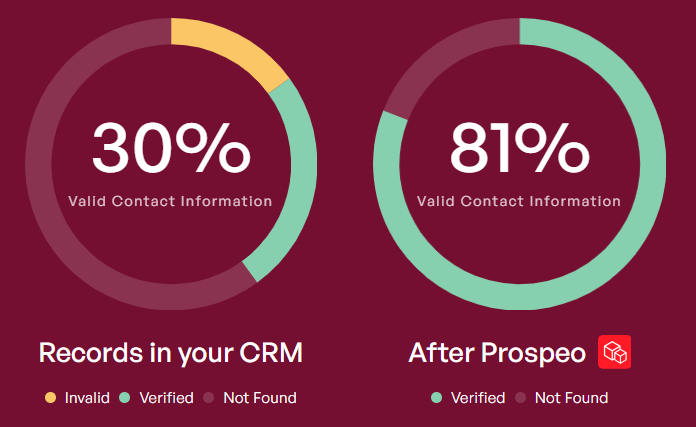
Whether you pick the no-code builder or the full ERP, your CRM workflows are only as good as the contacts feeding them. Prospeo enriches records with 50+ data points at a 92% match rate - for roughly $0.01 per email. That's cheaper than one bad follow-up.
Stop importing dead contacts into your new platform. Enrich them first.
FAQ
Is Odoo really free?
The Community edition is free and open-source, but it lacks mobile apps, Odoo Studio, and many advanced finance features gated to paid editions. Odoo Online also offers one app free with unlimited users. Most businesses that deploy Odoo broadly end up on paid plans - plus $50K-$500K+ in implementation costs depending on scope.
Can Kintone replace an ERP?
No. Kintone is a no-code app builder for custom workflows, not a full ERP. If you need native double-entry accounting, inventory management, or manufacturing modules, you need Odoo or a dedicated ERP. Kintone excels at approvals, task tracking, and project management - the workflow layer sitting on top of your core systems.
What's the best way to clean contact data before importing?
Use a dedicated verification tool before any bulk import. Importing unverified lists into either Kintone or Odoo leads to bounced outreach and unreliable reporting from day one. A tool like Prospeo lets you verify at scale for about $0.01/email, which is a fraction of what bad data costs you in wasted rep time and damaged sender reputation.
Is there a direct migration path between them?
No direct migration exists. Kintone data exports to CSV, and Odoo can import CSV, but custom workflows, automations, and integrations won't transfer. Budget 2-4 weeks for a Kintone-to-Odoo migration on a small team, significantly longer in the other direction given Odoo's implementation complexity.