Outbound Operations: What It Means for Logistics and Sales Teams
"Outbound operations" means completely different things depending on whether you manage a dock schedule or a BDR team. Warehouse ops teams hear pick-pack-ship. Sales ops teams hear sequences and CRM hygiene. We've worked with both sides, and the overlap is bigger than most people realize - so let's break down what actually matters for each.
What Are Outbound Operations?
In logistics, the term covers everything after a customer order hits the system: picking, packing, shipping, last-mile delivery.
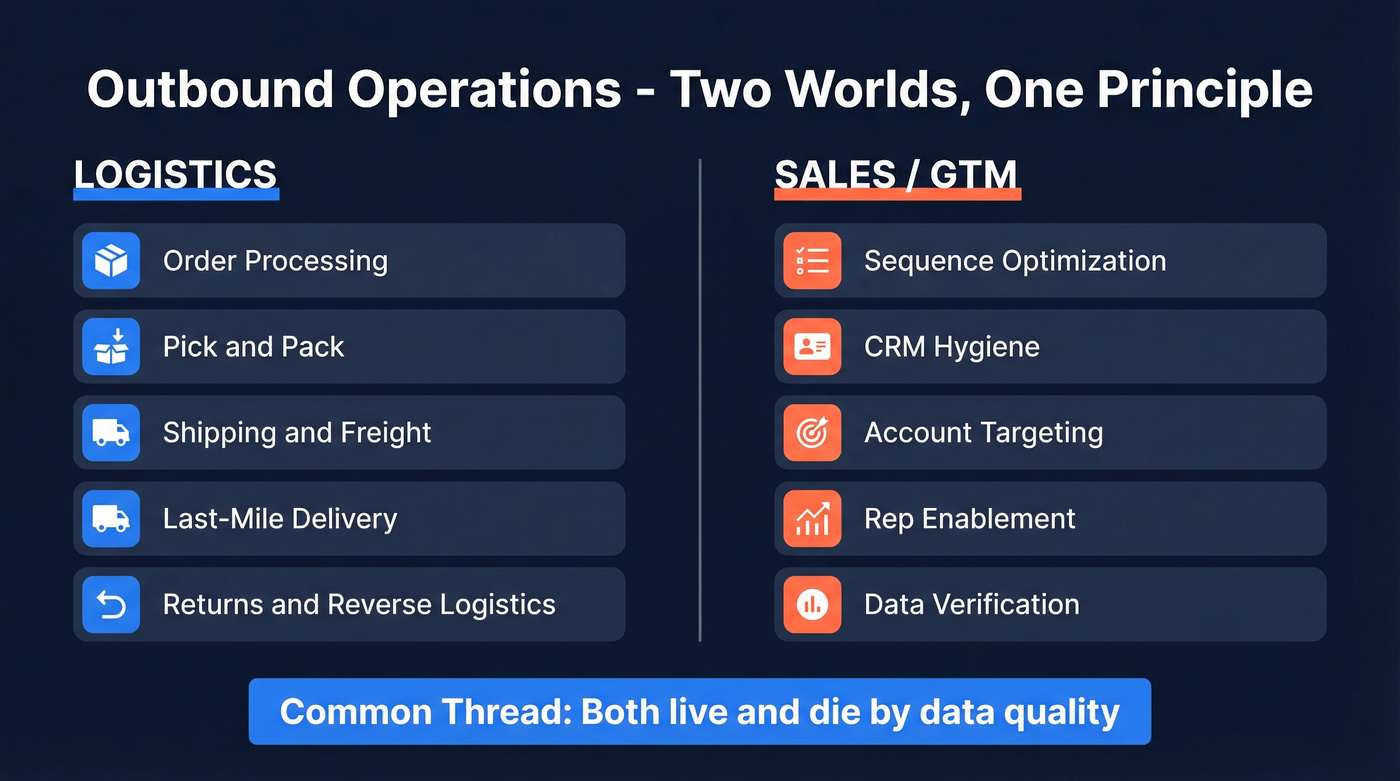
On freight forums like r/FreightBrokers, "outbound" almost always means outbound freight and shipments - which lines up with how most industry definitions frame it.
In sales and GTM, outbound sales operations is the system behind prospecting: sequence optimization, CRM hygiene, account targeting, rep enablement. Job posts like Parsec Education's BDR Manager role explicitly list "oversee daily outbound operations" as a core responsibility. Same phrase, different universe.
Quick Version for Both Teams
Logistics: Track three numbers - on-time delivery, fulfillment cost (keep it under 20% of AOV), and inventory accuracy at 95-98%+. AI-assisted routing and forecast refinement are the automation bets that paid off in 2025. The biggest misses? Fully autonomous forecasting, AI-driven carrier selection on messy data, and chatbots that hallucinated inventory counts.
Sales/GTM: Outbound ops = sequence optimization + CRM hygiene + verified data. If your AEs spend up to 20% of their day researching contacts, fix the data layer first. Everything else is downstream.

If your AEs burn 20% of their day researching contacts, your outbound operations have a data problem - not a rep problem. Prospeo delivers 300M+ profiles at 98% email accuracy on a 7-day refresh cycle, so your team prospects instead of Googles.
Stop losing a day per week to manual research.
Logistics: The Core Process
Order processing, picking, packing, shipping, last-mile delivery. What separates good operations from bad ones is speed and accuracy at each handoff - not any single step in isolation. Flowspace runs a simple SLA: orders before noon ship same-day, afternoon orders ship next-day. That kind of operational discipline compounds over thousands of orders.
For context, U.S. businesses spent $1.63 trillion on logistics in 2019, with transportation and inventory accounting for roughly 72% of that spend. Small efficiency gains at scale translate to enormous dollar savings, which is why the classic "Seven Rs" framework - right product, right quantity, right condition, right place, right time, right customer, right cost - still anchors most logistics operations playbooks.
KPIs That Actually Matter
| KPI | Benchmark | Why It Matters |
|---|---|---|
| Inventory accuracy | 95-98%+ | Mispicks kill throughput |
| Dock utilization | 65-85% | Below 65% = wasted capacity |
| Dwell time | <60-90 min | Longer = dock congestion |
| Fulfillment cost / AOV | ≤20% | Above 20% erodes margin |
| Last-mile share | ~53% of shipping | Biggest cost lever |
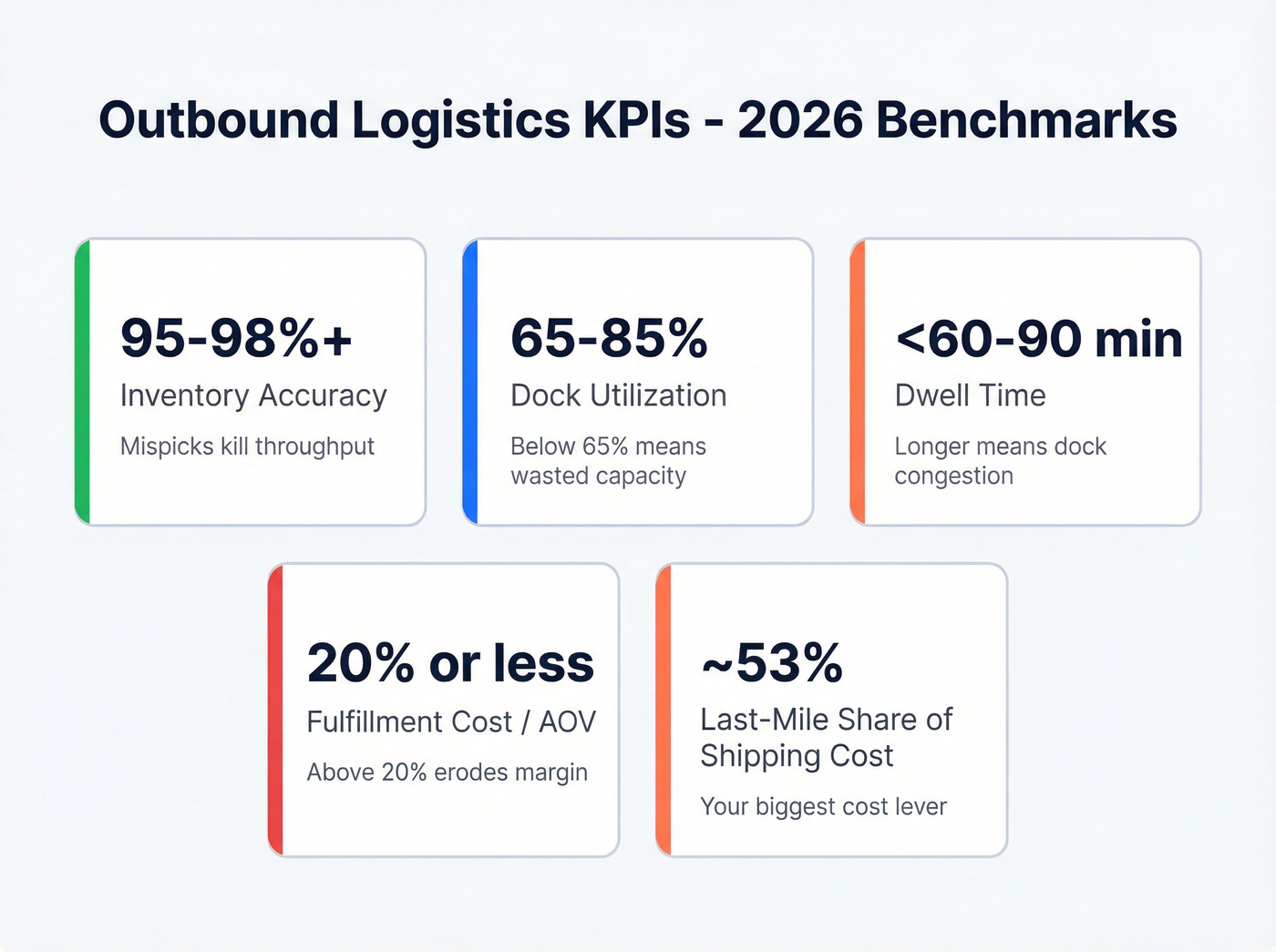
That last-mile number is the one most teams underestimate. Poor last-mile logistics accounts for 53% of total shipping costs, which means route optimization and carrier diversification are the highest-ROI investments you can make.
AI in Logistics: 2026 Reality Check
The AI-in-warehousing market hit $11.22 billion in 2024 and is growing at 26.1% CAGR. But hype and reality are still diverging in ways that matter for budget decisions.
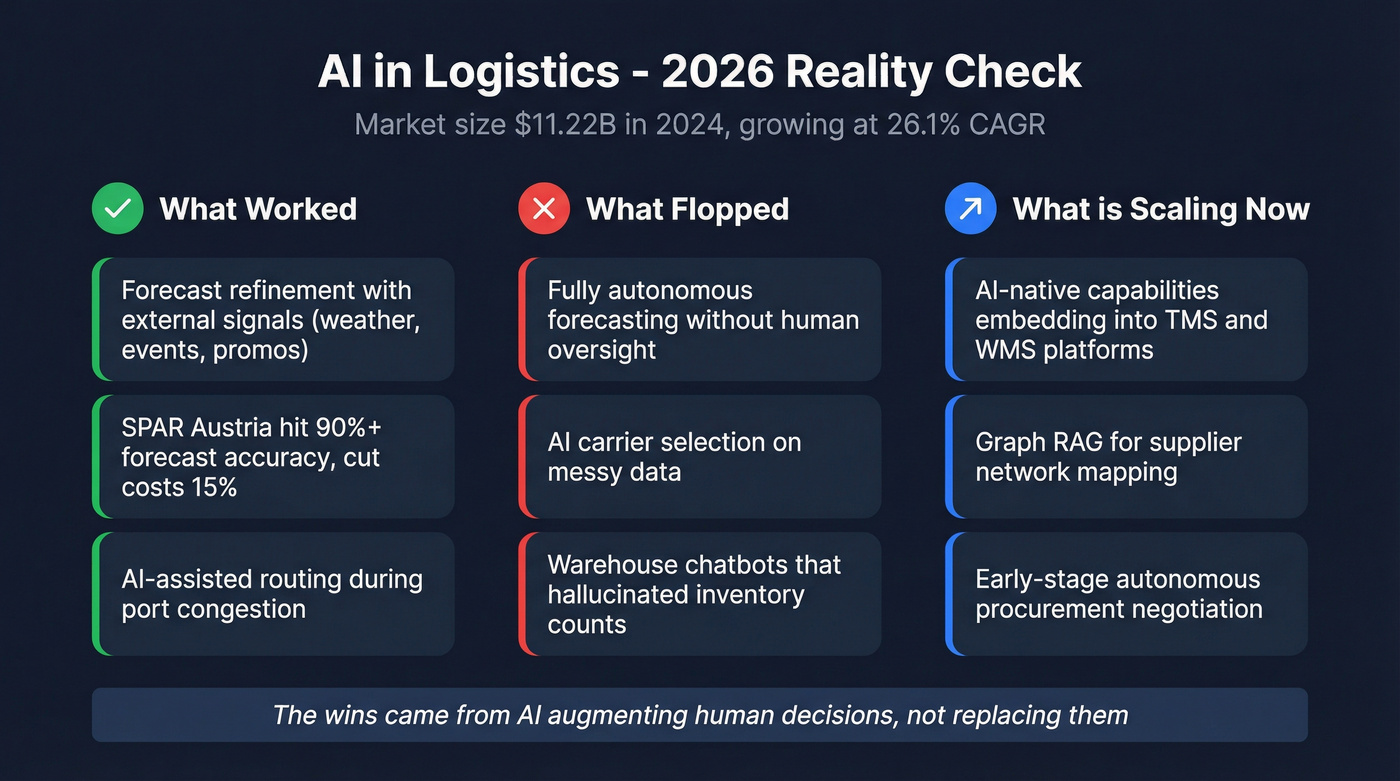
What worked: Forecast refinement using external signals - weather, events, promos - delivered real results. SPAR Austria hit 90%+ forecast accuracy and cut costs 15% through Azure-powered demand prediction. Dow Chemical automated freight invoicing across 4,000 daily shipments. AI-assisted routing during port congestion and carrier variability proved its value too. McKinsey estimates these approaches deliver 5-20% logistics cost savings and 20-30% inventory reduction for teams that implement them well.
What flopped: Fully autonomous forecasting without human oversight. AI-driven carrier selection where data quality wasn't there. Warehouse chatbots that confidently told customers items were in stock when they weren't. The wins came from AI augmenting human decisions, not replacing them.
What's scaling now: AI-native capabilities are embedding directly into TMS and WMS platforms rather than bolting on as separate tools. Graph RAG is enabling supplier network mapping. Early-stage autonomous procurement negotiation is moving from pilot toward production in enterprise shipping teams. I expect the autonomous negotiation piece to remain niche through 2027, but the TMS/WMS integration trend is already reshaping vendor selection.
Outbound Sales Operations
What the Role Looks Like
A sales outbound operations lead owns the machinery behind prospecting. Based on real job descriptions like Parsec Education's BDR Manager posting at $64K-$82K/year, the core responsibilities break down to:
- Optimizing sequences and call scripts
- Defining account targeting criteria and daily KPIs
- Maintaining CRM hygiene and process documentation
- Hiring and onboarding new reps
Here's the thing: the operational drag is brutal. AEs spend up to 20% of their day on manual contact research. That's a full day per week lost to work that should be automated.
The Modern Prospecting Framework
We've seen dozens of outbound teams build and rebuild their prospecting systems, and the ones that consistently generate pipeline share seven elements:
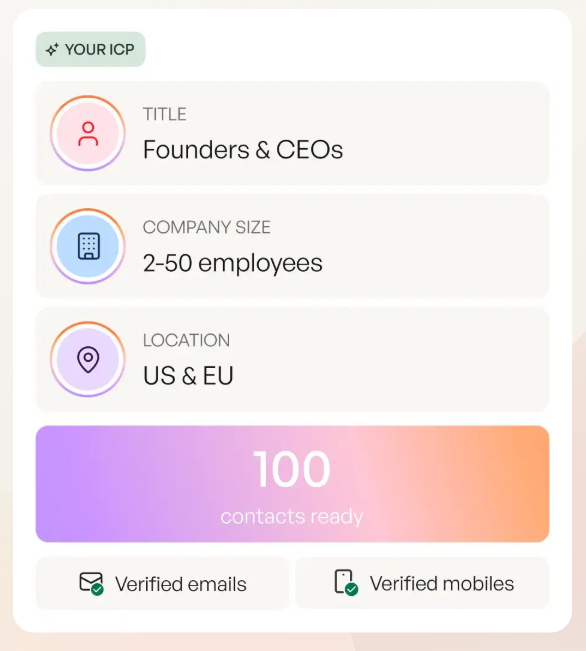
Define your ICP with precision - firmographics, technographics, and buying signals, not just "Series B SaaS companies." Automate lead research because manual prospecting doesn't scale past two reps. Personalize with relevance and timing - triggers beat generic "first lines" every time. Run multichannel sequences across email, phone, and social in coordinated cadence. A/B test everything: subject lines, openers, CTAs, send times, channel mix. Sell as a team with AE + SE + exec assists on strategic accounts. And systemize referrals to turn wins into an engine, not a one-off ask.
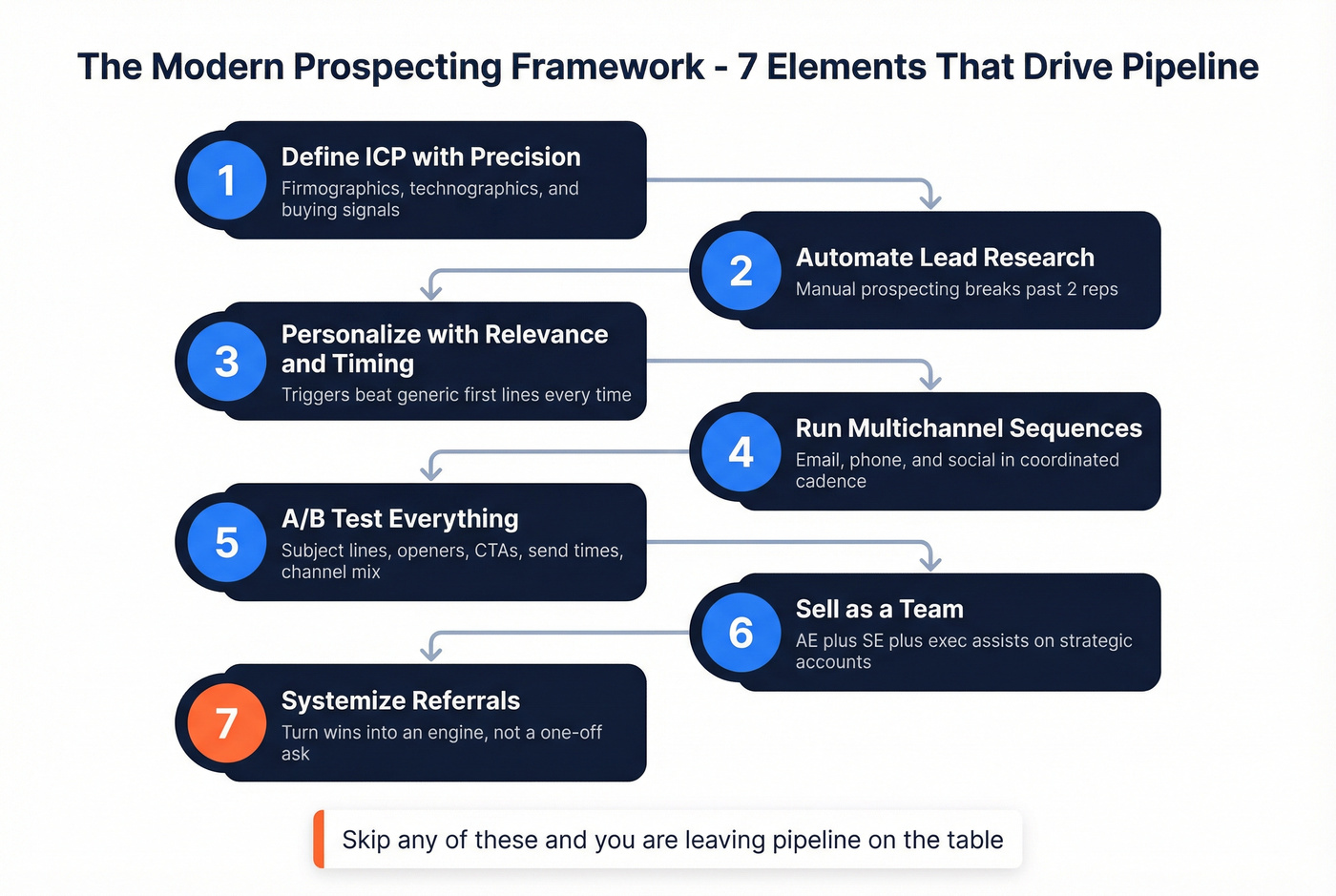
Skip any of these and you're leaving pipeline on the table.
The Tool Stack
Start with verified data, then build the stack around it.

Your data layer matters most. Prospeo gives you 300M+ profiles at 98% email accuracy on a 7-day refresh cycle, with native integrations into HubSpot, Salesforce, Smartlead, and Instantly. A free tier with 75 verified emails per month lets you test before committing, and at roughly $0.01 per email it's the cheapest high-accuracy option we've found. Snyk's 50-person AE team cut bounce rates from 35-40% to under 5% after switching to weekly-refresh data - that's the kind of impact a solid data layer delivers.
For the rest of the stack, match tools to your primary channel:
| Layer | Tool | Approx. Cost |
|---|---|---|
| CRM | HubSpot (free tier for early teams) or Salesforce | $0-$300/user/mo |
| Sequencer | Apollo | ~$49-99/user/mo |
| Parallel dialer | Orum | ~$150-300/mo |
If your deal sizes are under $10K, skip the $300/seat CRM and the parallel dialer. A free HubSpot instance, a solid sequencer, and clean data will outperform an overbuilt stack with bad emails every single time.
The Common Thread: Data Quality
Whether you're shipping pallets or sending cold emails, bad data is the bottleneck. 40% of businesses struggle with supply chain visibility - fundamentally a data problem. On the sales side, when bounce rates hit 35-40%, the problem isn't your copy. It's your data.
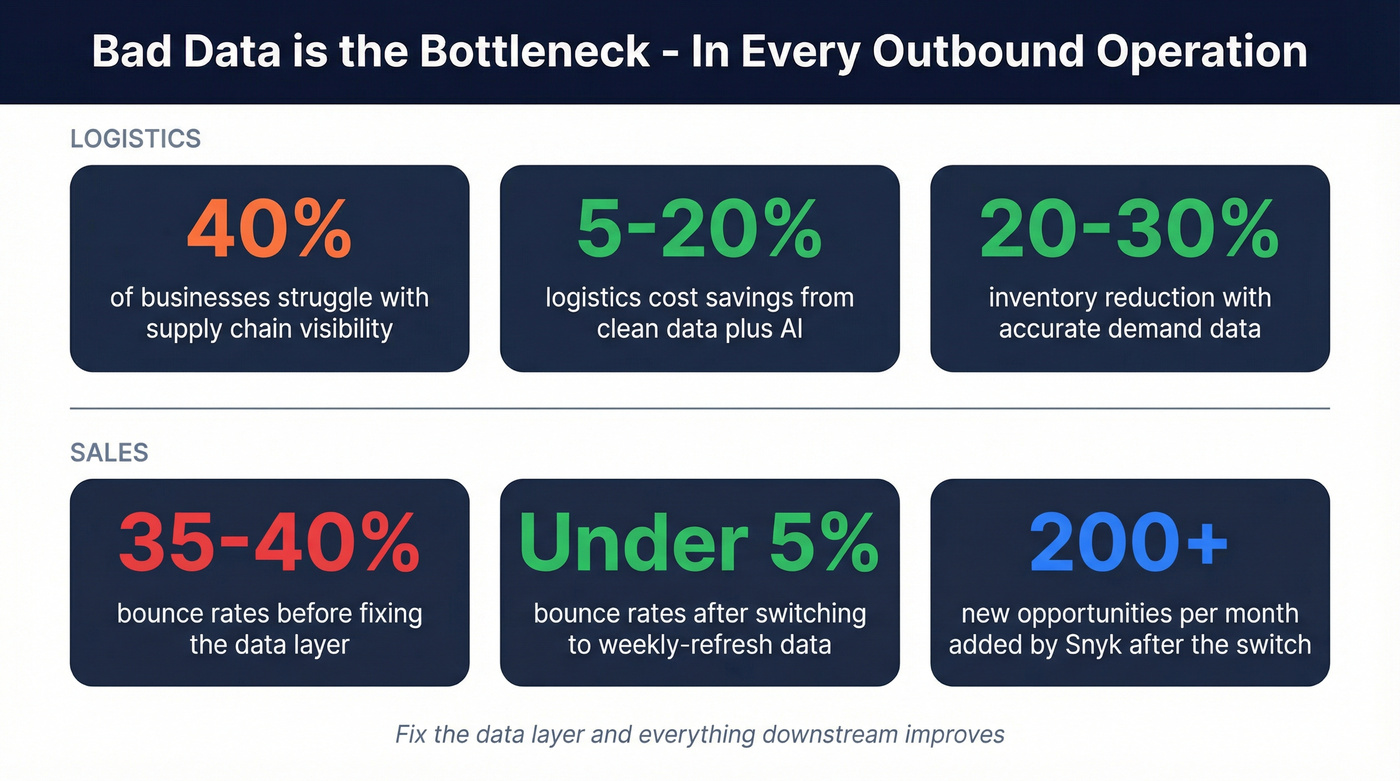
We've seen this pattern across dozens of teams: fix the data quality layer and everything downstream improves - deliverability, reply rates, pipeline velocity. The logistics parallel is identical. Clean inventory data means fewer mispicks, faster fulfillment, happier customers. Different domain, same lesson.

Snyk's 50-person AE team dropped bounce rates from 35-40% to under 5% and added 200+ new opportunities per month after switching to weekly-refresh data. At $0.01 per email with native HubSpot, Salesforce, and Smartlead integrations, Prospeo is the data layer outbound ops teams actually scale on.
Build outbound operations on data that doesn't bounce.
FAQ
What is outbound operations in logistics vs. sales?
In logistics, it's the pick-pack-ship process that moves products from warehouse to customer. In sales, it's the system behind prospecting - sequences, CRM hygiene, data accuracy, and rep productivity. The distinction is direction of flow: logistics ships goods out, sales reaches prospects out. But both live and die by data quality.
What KPIs should I track for outbound logistics?
Track on-time delivery rate, inventory accuracy at 95-98%+, dock utilization between 65-85%, dwell time under 60-90 minutes, and fulfillment cost as a percentage of average order value. Keep that last metric under 20% or you're eroding margin on every shipment.
How do I fix high bounce rates in outbound sales?
Switch to a provider with a weekly refresh cycle and verify every address before sending. Snyk's 50-person AE team dropped bounce rates from 35-40% to under 5% after moving to weekly-refresh data, adding 200+ new opportunities per month. The fix is almost always the data, not the copy.