

Sales Targeting: A Practitioner's Playbook for 2026
Over half of reps on your team missed quota last year. That's not a motivation problem - it's a targeting problem. 84% of sales reps missed quota according to Salesforce research, and the gap between top performers and everyone else keeps widening. Meanwhile, [57% of the buying journey](https://www.linkedin.com/business/sales/blog/b2b-sales/this-popular-stat-is-wasting-your-time - the-57 - engagement-myth) is already done before a prospect ever talks to your team.
The reps who hit number aren't working harder. They're working a tighter list of accounts that actually match their product, with verified contact data and intent signals telling them when to reach out. La Growth Machine measured targeting as responsible for 50% of campaign success - the other 50% is copywriting. Get the targeting wrong and even perfect messaging can't save you.
This playbook covers the framework we use to build targeted lists that convert - from ICP definition through scoring, intent layering, and list verification. No theory-class fluff. Just the operational steps that move pipeline.
The Quick Version
Short on time? Here's the distilled version:
- Start with revenue data, not personas. Cohort your best customers by CLV, sales cycle length, and retention. Your ICP lives in the data, not in a brainstorm session.
- Build a scoring model with real point values. Demo request = 50 points, pricing page visit = 40, blog subscription = 5. Include negative scores for bounced emails and inactivity.
- Layer intent data on top of ICP fit. An account that matches your ICP and is actively researching your category can drive 2-5x higher reply rates once you trigger outreach at the right moment.
- Verify your list before you touch it. Bad data kills targeting ROI faster than bad messaging. Run every list through email verification before a single sequence goes out - high bounce rates can wreck deliverability for months.
What Is Sales Targeting?
Sales targeting is the process of identifying which companies and people your team should pursue - and in what order. It's the strategic layer between "we have a product" and "we're sending emails." With 80% of B2B sales interactions now happening in digital channels per Gartner, targeting isn't just about who to call. It's about which digital touchpoints to prioritize.
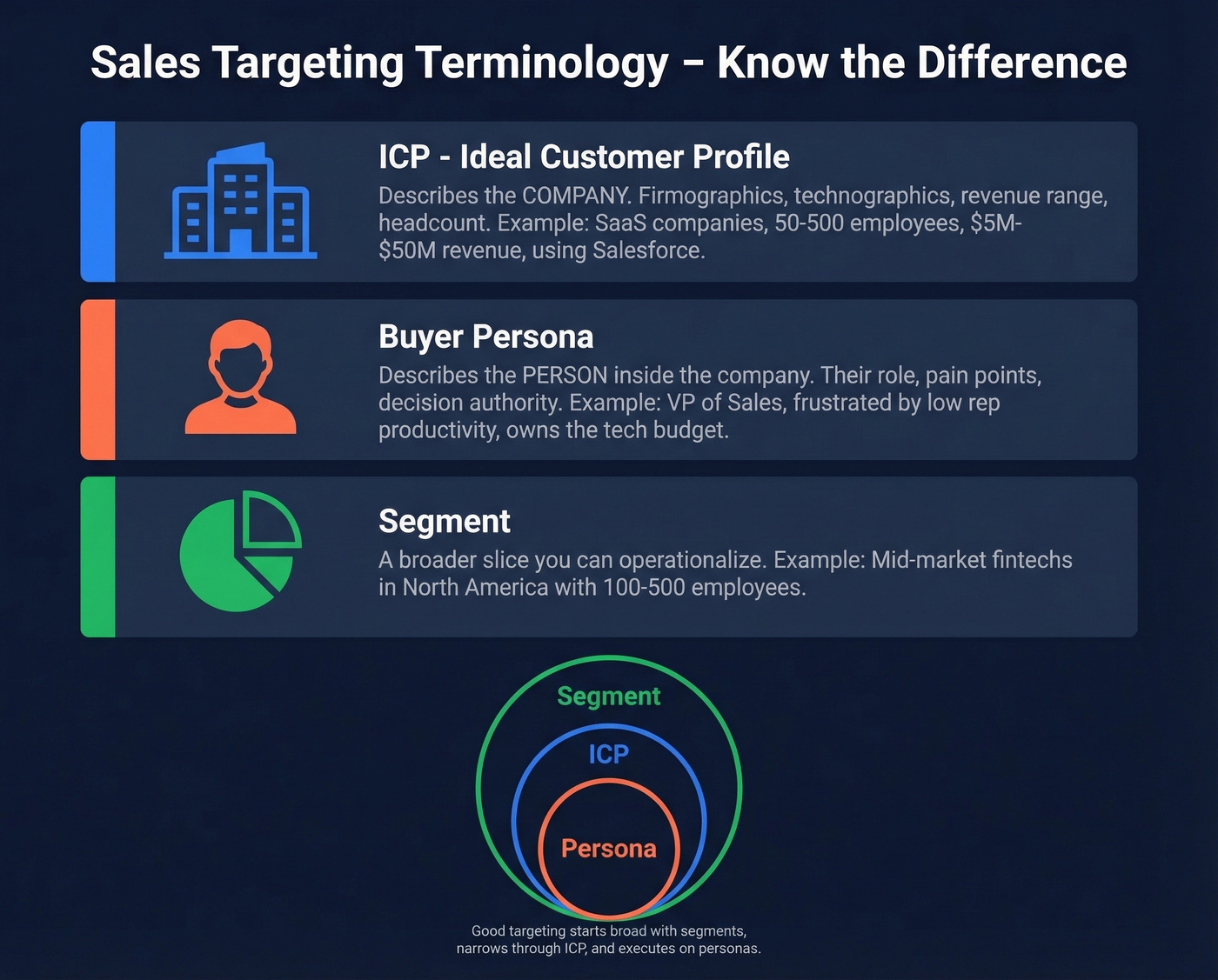
Let's clear up the terminology, because these terms get mixed up constantly. Sales targeting is not sales targets. Targets are quota numbers - revenue goals your VP sets. Targeting is the strategy for how you hit those numbers by focusing on the right accounts.
Your ICP (Ideal Customer Profile) describes the company - firmographics, technographics, revenue range, headcount. Your buyer persona describes the person inside that company - their role, pain points, decision authority. A segment is a broader slice you can operationalize, like "mid-market fintechs in North America." Good targeting starts with ICP, narrows through persona, and executes within segments.
The Framework
Define and Validate Your ICP
Most teams build their ICP in a conference room with sticky notes. That's backwards. Start with your best customers and reverse-engineer what they have in common.
The a16z framework uses five questions that cut through the noise:
- Which customers get the most value from your product?
- What traits do your best customers share?
- What objections keep coming up from churned or lost deals?
- Who's easiest to upsell, and why?
- What do your competitors' customers have in common?
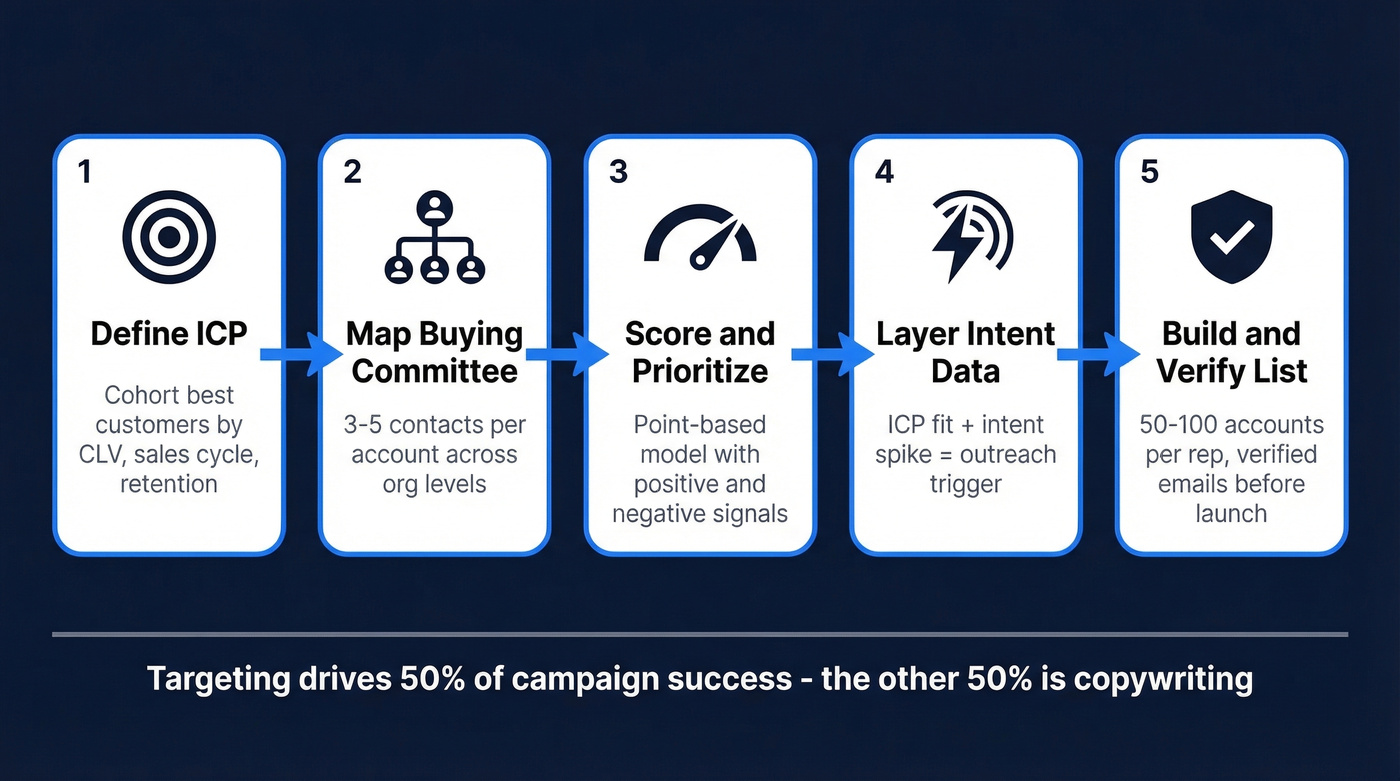
The answers live in your CRM, not in your head. Cohort your closed-won deals and triangulate three dimensions: highest CLV, shortest sales cycles, and best retention. The overlap is your ICP.
Here's the thing: teams that optimize for only the highest-ACV customers end up chasing whales with 9-month sales cycles and 40% churn - that's not an ideal customer, that's an expensive one. And 87% of marketers running account-based programs report higher ROI than other marketing efforts, which means the ICP work pays compounding dividends once you operationalize it.
Once you have a hypothesis, pressure-test it with a granularity check. Can you fill in these fields: company size range, revenue band, specific industries, geography, technologies used, definable problem your product solves, and unique buyer behaviors? If you can't get specific on at least five of those, your ICP is still a guess.
If you want a faster starting point, use an Ideal Customer Profile Template to standardize the fields and scoring rubric.
Map the Buying Committee
Your ICP describes the company. Now you need the people inside it. For mid-sized firms (100-500 employees), the average buying committee runs 7 people. That's not a stat to memorize - it's an operational constraint that changes how you build prospect lists.
Map roles by funnel stage. At the top, you're reaching end users and managers who feel the pain daily. In the middle, technical specialists and department heads evaluate your solution against alternatives. At the bottom, executive sponsors, the CFO, and sometimes the CIO sign off on budget.
Multi-threading isn't optional anymore. If your reps are single-threaded into one champion, they're one reorg away from a dead deal. Build your target list with 3-5 contacts per account across different levels of the org chart.
If you're struggling to identify who to include, start with the technical buyer vs economic buyer split and map messaging accordingly.
Score and Prioritize Leads
A target list without scoring is just a spreadsheet. You need a model that tells reps which accounts to call first.
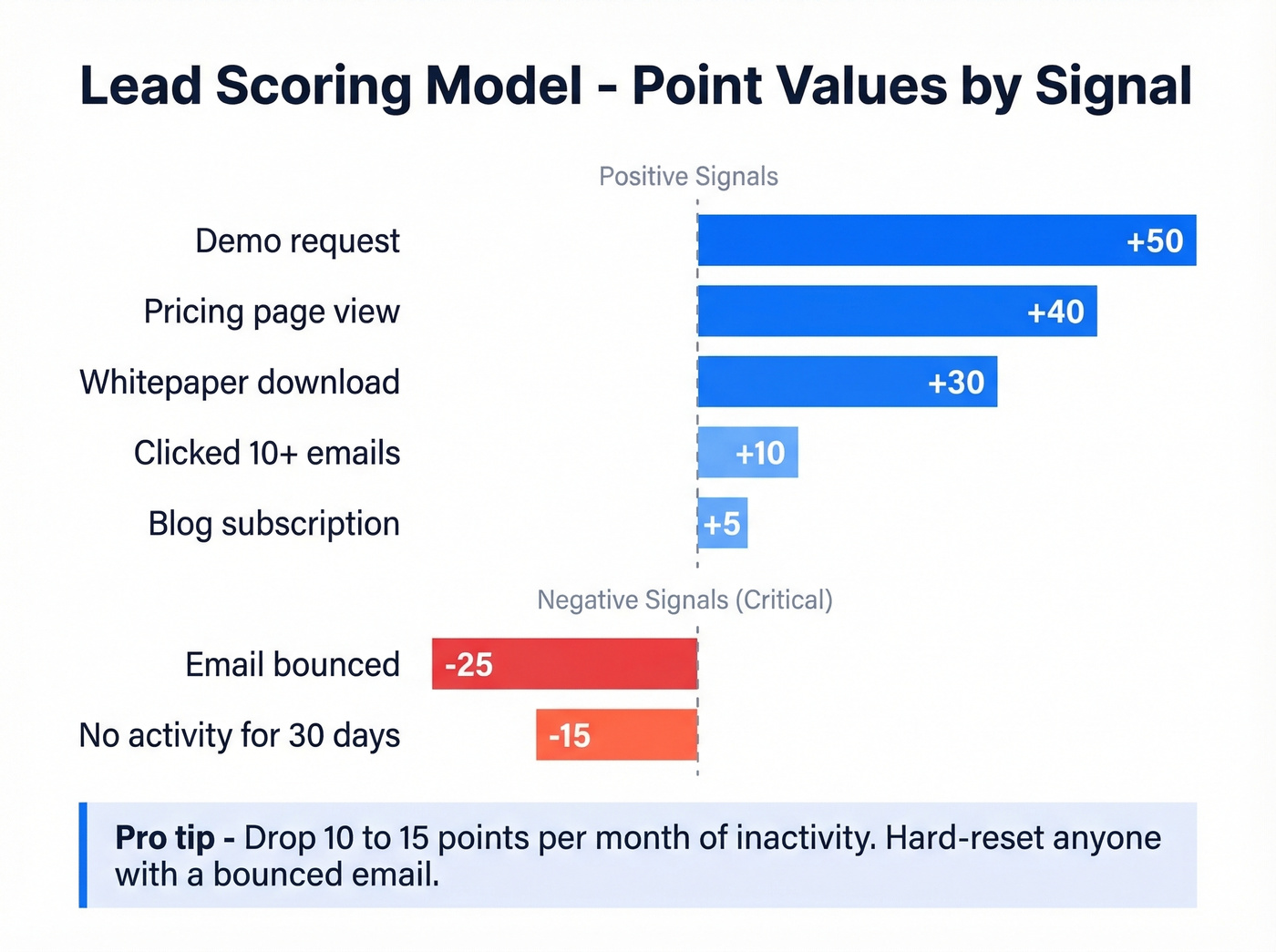
Here's a starting framework we've adapted from scoring models by Demandbase and Belkins:
| Signal | Points |
|---|---|
| Demo request | +50 |
| Pricing page view | +40 |
| Whitepaper download | +30 |
| Clicked 10+ emails | +10 |
| Blog subscription | +5 |
| Email bounced | -25 |
| No activity (30 days) | -15 |
Scoring without negative points is a vanity leaderboard. A contact whose email bounced shouldn't sit at +45 because they downloaded a whitepaper six months ago. Decay rules matter. Drop 10-15 points per month of inactivity, and hard-reset anyone with a bounced email.
One team saw a 13% lift in MQL-to-meeting rate just by tightening title and seniority filters while lowering the activity threshold. Small calibrations compound fast.
Set your MQL threshold based on sales capacity, not an arbitrary number. If your team can handle 50 qualified conversations per month, your threshold should produce roughly that volume.
For a deeper model (and common pitfalls), see our Lead Scoring guide.
Layer Intent Data
Intent data is the single biggest unlock in modern account prioritization. It tells you when a company is actively researching solutions in your category - before they ever fill out a form.
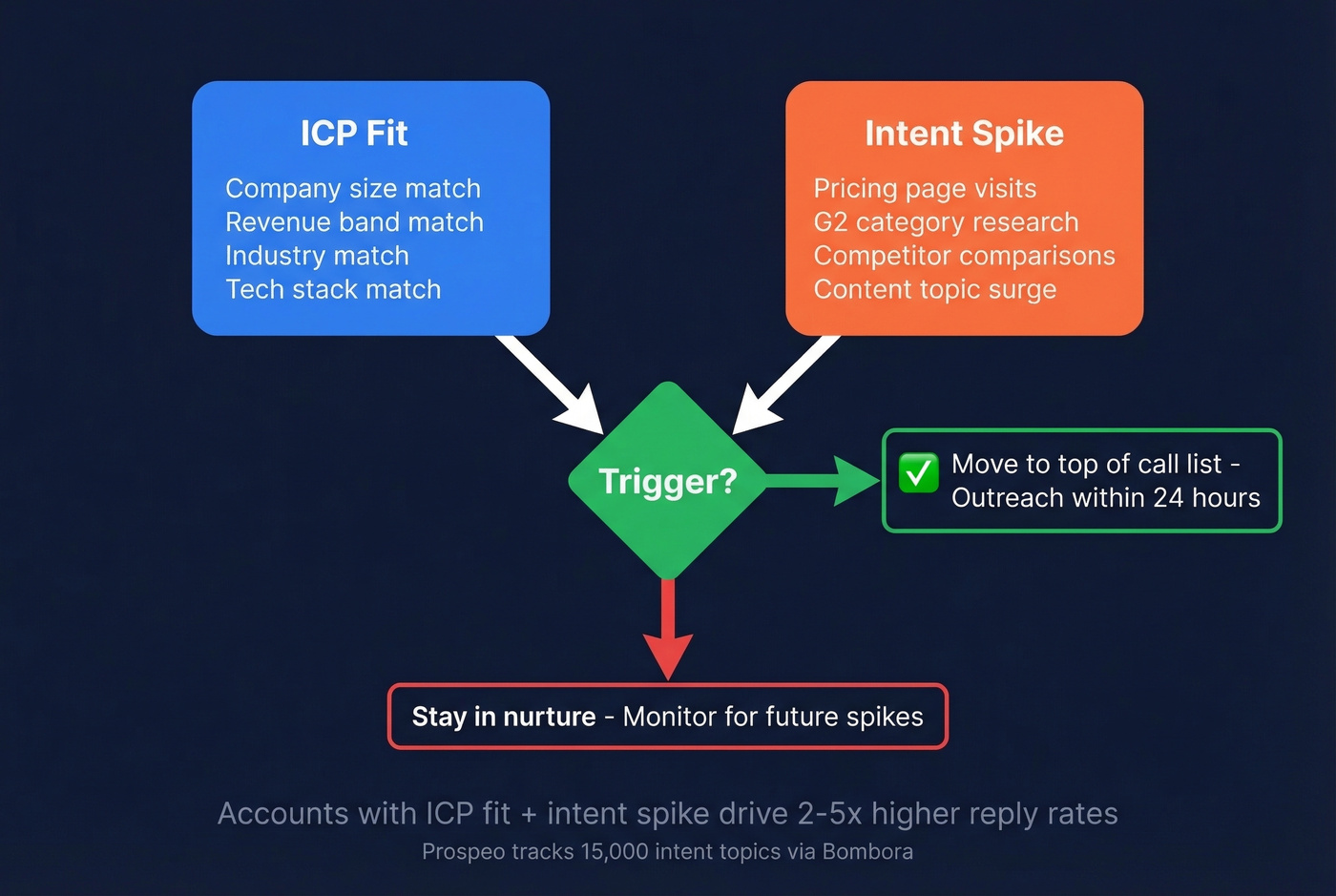
Two flavors matter. First-party intent comes from your own properties: pricing page visits, demo requests, email engagement. Third-party intent comes from external sources - review sites like G2 and TrustRadius, publisher networks, and content syndication platforms. Providers establish a baseline of normal research activity for each account, then flag topic spikes above that baseline.
The activation workflow is simple: ICP fit + intent spike = outreach trigger. An account that matches your ICP and just spiked on three topics related to your category gets moved to the top of the call list. Prospeo tracks 15,000 intent topics via Bombora, so you can combine ICP fit with in-market signals in a single platform rather than managing separate subscriptions for data and intent.
To operationalize this, build a repeatable system for identifying buying signals and routing them into your sequences.
Build and Verify Your List
You've defined your ICP, mapped the buying committee, built a scoring model, and layered intent. Now you need actual names, emails, and phone numbers. This is where most targeting efforts quietly die.
The consensus on r/b2b_sales matches what we've seen firsthand - one sales manager described building a starter list of roughly 100 contacts per rep and focusing them for six weeks to enable deeper research and personalization. We recommend 50-100 accounts per rep per quarter. That's enough to build real pipeline while leaving bandwidth for personalization. Resist the temptation to go wide. A tight, verified list outperforms a massive stale one every time.
The verification step is non-negotiable. We've watched teams spend two weeks building a beautiful framework, pull 1,000 contacts from a database on a 4-6 week refresh cycle, and launch their sequence - only to see emails bounce, phone numbers disconnect, and domain reputation take a hit that takes months to recover from. Fixing poor targeting after the damage is done costs far more than getting it right upfront.
If you're seeing bounces creep up, start with Email Bounce Rate benchmarks and fixes, then work backward into your sourcing and refresh cadence.
Here's what that looks like at scale: Snyk's 50 AEs saw bounce rates running 35-40% before switching to a verified data source with a 7-day refresh cycle. Bounce rates dropped under 5%, AE-sourced pipeline jumped 180%, and the team generated 200+ new opportunities per month.
Use this if: You need a verified target list you can trust on day one, without burning your sender reputation.
Skip this if: You enjoy explaining to your VP why your bounce rate is high and your domain just got flagged.

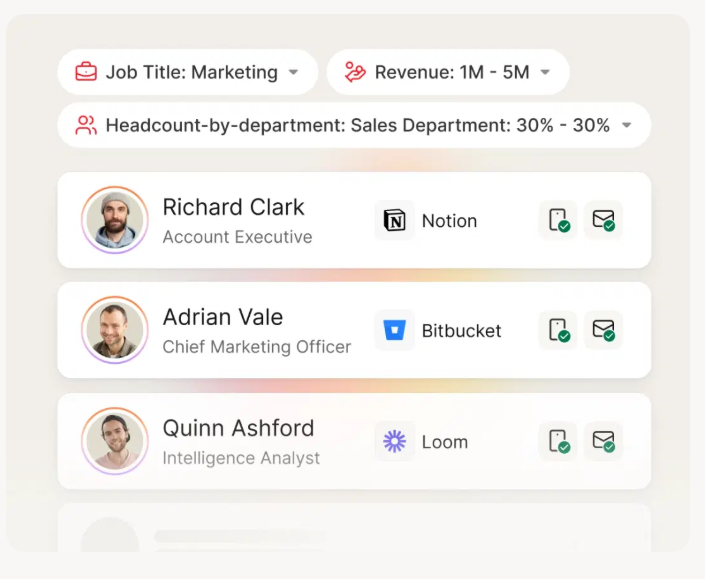
You just built your ICP and mapped the buying committee. Now you need verified contact data for every person on that list. Prospeo's 300M+ profiles with 30+ filters - including buyer intent, technographics, and headcount growth - let you operationalize your ICP in minutes, not days.
Stop targeting the right accounts with the wrong data.
Bad data kills targeting ROI faster than bad messaging - you said it yourself. Prospeo's 5-step verification delivers 98% email accuracy and refreshes every 7 days, so your sequences hit real inboxes. Layer Bombora intent data across 15,000 topics to reach accounts exactly when they're in-market.
Verified emails at $0.01 each - your bounce rate drops below 4%.
Execute Multi-Touch Outreach
Your target list is built and verified. Now you need to actually reach these people - and one email isn't going to cut it.
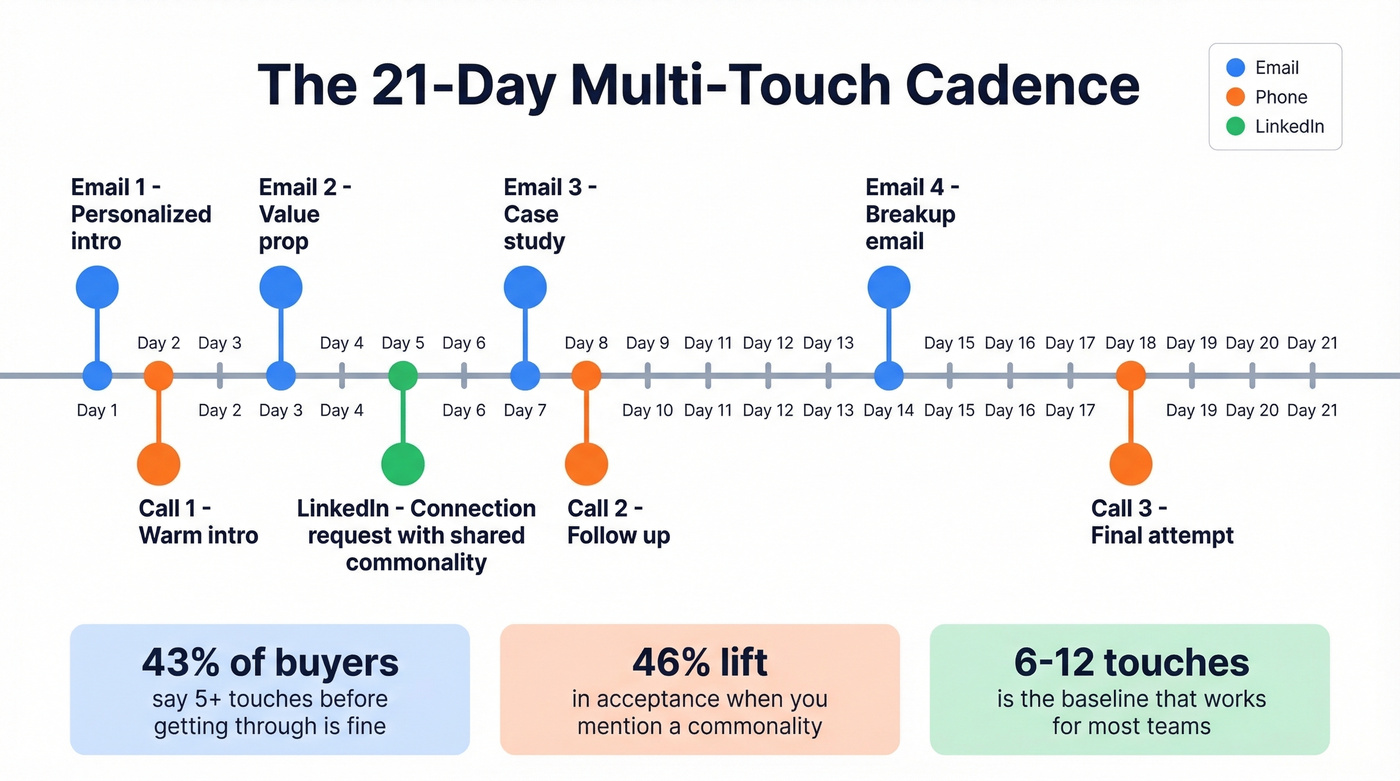
The baseline cadence that works for most outbound teams: 6-12 touches over 14-21 days, mixing email, phone, and social. 43% of buyers say it's fine for sellers to contact them 5+ times before getting through. Most reps give up after two.
58% of sales meetings aren't valuable to buyers - which means the targeting work you did upstream is what separates a welcome call from an annoying one. Personalization produces a 46% lift in acceptance rates on social outreach when you mention a single commonality - shared connection, same school, mutual interest. And when you do get the meeting, shut up more. Top closers speak 43% of the time versus 65% for average performers.
To tighten the actual messaging layer, keep a set of proven sales follow-up templates and a consistent B2B cold email sequence your team can iterate on.
Segment Prioritization Math
Gut feel is a terrible way to rank segments. Make it quantitative.
La Growth Machine's framework uses two formulas worth memorizing:
Potential Customer Segment Value = Average Purchase Value x Average Purchase Frequency x Average Customer Lifetime
Lead Segment Value = Lead Conversion Rate x Potential Customer Segment Value
Run these across your top three segments. The one with the highest lead segment value gets your best reps and your biggest budget. The math usually surprises people - the segment with the highest ACV often isn't the most valuable when you factor in conversion rate and lifetime.
Speed matters too. Deals closed within 50 days have a 47% win rate. After that threshold, win rates drop to 20% or lower. Focusing on the right accounts first isn't just about conversion - it's about velocity. The faster you close, the more at-bats you get per quarter.
If you want to sanity-check your segment math against market size, start with Addressable Market (TAM/SAM/SOM) before you over-invest in a niche.
I'll say it plainly: if your average deal size is under $10K, you probably don't need ZoomInfo-level data infrastructure. A verified database, a sequencing tool, and disciplined ICP work will outperform an expensive tech stack that your reps barely use. The teams we see winning aren't the ones with the most tools - they're the ones with the tightest lists.
Tools That Make It Operational
The right tool stack makes targeting operational instead of theoretical.
| Tool | What It Does | Starting Price | Best For | Typical Email Accuracy |
|---|---|---|---|---|
| Prospeo | Database + email/mobile finder + intent | Free (75 emails/mo); ~$0.01/email | Data accuracy, freshness | 98% |
| Apollo.io | Prospecting + sequencing | Free; $49/user/mo | Budget all-in-one | 70-80% |
| ZoomInfo | Enterprise data + intent + orgs | ~$15K-$40K/yr | Large teams with budget | 85-91% |
| UpLead | SMB data provider | $99/mo | Small teams, simple lists | Not public |
| 6sense | Intent + ABM orchestration | ~$50K+/yr | Enterprise ABM | N/A (intent focus) |
Apollo.io is the obvious starting point for teams that want prospecting and sequencing in one platform without a big contract. The free tier is genuinely useful, and $49/user/month for Pro is hard to argue with. The tradeoff: email accuracy runs 70-80%, which means you'll want a verification layer on top. We've run bake-offs where Apollo's volume advantage disappeared after accounting for bounces and bad numbers.
ZoomInfo is the default for enterprise, and the database depth in North America is still best-in-class. But at $15K-$40K/year, most teams overpay for data that refreshes every 4-6 weeks. The modules add up fast - intent, org charts, and workflow features you'll never activate. If you're under 20 reps, ZoomInfo's ROI math rarely works out.
UpLead works for small teams that need simple list pulls without complexity. At $99/month it's accessible, but the database is smaller. 6sense plays in a different league entirely - it's an ABM orchestration platform at $50K+/year, best suited for enterprise marketing teams running multi-channel account programs. Skip it unless you have a dedicated ABM team to actually use it.
If you're evaluating vendors, start with a shortlist of sales prospecting databases and compare refresh rates, coverage, and verification methodology.
Tips That Actually Move the Needle
A few practical tips distilled from teams that consistently outperform:
Refresh your ICP quarterly. Markets shift, your product evolves, and last quarter's ideal customer isn't always this quarter's. Revisit your closed-won cohort analysis every 90 days.
Audit your list hygiene monthly. Contacts change jobs, companies get acquired, emails go stale. A monthly verification pass prevents slow deliverability decay. In our experience, teams that skip this step lose 3-5% of their list quality every month without realizing it until bounce rates spike.
If deliverability is already slipping, follow an email deliverability guide and fix the root causes before scaling volume.
Let scoring drive rep behavior. If reps are ignoring the score and cherry-picking accounts, your model needs recalibration - or your reps need coaching. Both are fixable.
Match channel to persona. C-suite responds better to phone and social; directors and managers engage more with email sequences. Your targeting strategy should dictate channel mix, not the other way around.
FAQ
What's the difference between sales targeting and sales targets?
Sales targeting is choosing which accounts and people to pursue - it's a strategy. Sales targets are revenue or quota numbers. This guide covers targeting, not target-setting. Confusing the two leads teams to chase volume instead of fit.
How many accounts should each rep target?
Start with 50-100 accounts per rep per quarter. That's enough to build meaningful pipeline while leaving bandwidth for research and personalization. Scale up only after your ICP definition and scoring model are validated with real conversion data - going wider before that just dilutes effort.
What tools do I need for effective targeting?
Three things: a verified data source for accurate contact data and intent signals, a CRM like HubSpot or Salesforce, and a sequencing tool such as Instantly or Lemlist. ABM platforms and conversation intelligence are optimization layers - nail the fundamentals first.
How do I know if my targeting is off?
High bounce rates above 5%, low reply rates under 2%, and elongated sales cycles are the clearest symptoms. If reps book meetings but deals stall at the proposal stage, you're probably reaching the wrong persona inside the right company. Revisit your buying committee map and make sure you're multi-threading into economic buyers, not just end users.