

How to Build an Ideal Customer Profile (ICP) That Actually Drives Revenue
Last quarter, a 50-person fintech closed in three weeks. Same product, same rep - a 2,000-person enterprise went dark after four months of calls. The difference wasn't the pitch. It was ICP fit. The fintech matched every attribute the team had defined as their ideal customer profile; the enterprise was a "maybe" that looked good on paper because someone liked the logo.
Most teams have an ICP somewhere - buried in a slide deck from a strategy offsite, built on vibes and a few anecdotes about "who we think we sell to." Practitioners on r/b2bmarketing call these "fairytale personas": documents built without talking to a single customer, designed to look smart in a board meeting, then left to collect dust. That's not an ideal customer profile. That's creative writing.
What actually works is a data-backed description of the companies most likely to buy, succeed, and stay - operationalized into your CRM, your scoring model, and your outbound workflows so reps reference it every day, not once a quarter.
Quick Summary
Your ICP is a data-driven profile of the accounts where you win fastest, retain longest, and expand easiest. It's not a persona - that describes the person inside the company. It's not your TAM - that's everyone who could theoretically buy. Build it from your best existing customers, score accounts into tiers, then operationalize it with data enrichment tools so your reps actually use it.
If your ideal customer profile lives in a slide deck and nobody references it during prospecting, it's not functional. It's a decoration.
What Does ICP Mean?
ICP stands for ideal customer profile - a detailed description of the type of company that's a perfect fit for your product or service. Not the individual buyer. The company itself. Industry, headcount, revenue, tech stack, business situation, buying triggers. It's the account-level filter that tells your team where to spend time and where to walk away.
This is a B2B concept. In B2C, you're targeting individuals. In B2B, you're targeting organizations, and the people inside them are a separate layer handled by buyer personas. The profile answers "which companies should we pursue?" Personas answer "who inside those companies do we talk to?"
Specificity matters here. Salesforce's guidance warns against ranges like "100 to 700 employees" - that's too broad to message effectively. If your profile describes half the market, it isn't doing its job.
86% of business buyers say they're more likely to buy when a seller understands their goals. Your ideal customer profile is how you ensure your team understands those goals before the first email goes out.
ICP vs. Buyer Persona vs. Target Market
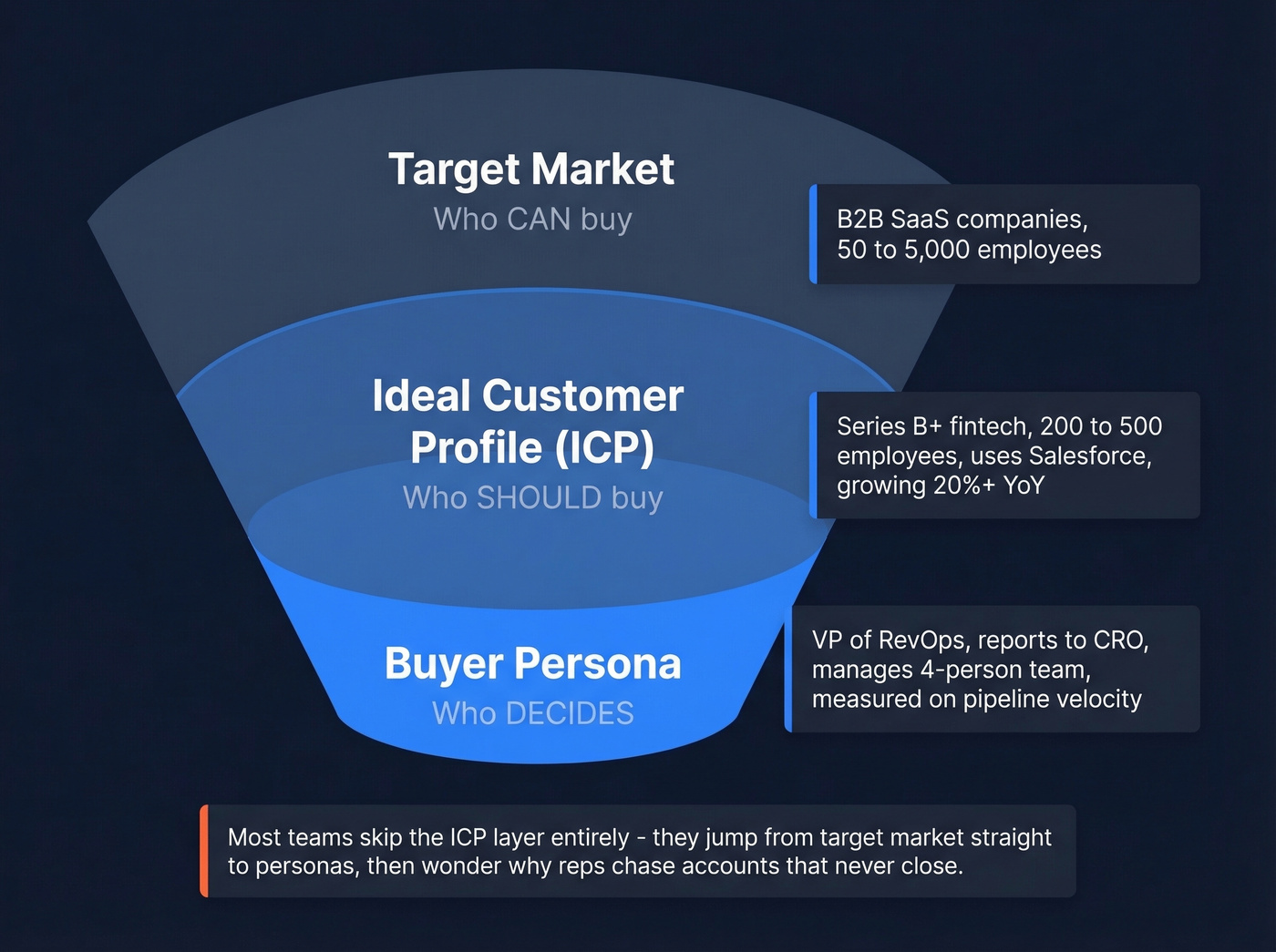
Most teams get this backwards. They build personas first - "Marketing Mary, 35, drinks oat milk, reads Harvard Business Review" - and never define the company-level profile those personas sit inside. The Product Marketing Alliance framework lays out the correct order as a strategic funnel:
| Layer | Definition | Example |
|---|---|---|
| Target Market | Who can buy | B2B SaaS, 50-5,000 employees |
| ICP | Who should buy | Series B+ fintech, 200-500 emp, Salesforce |
| Buyer Persona | Who decides | VP RevOps, reports to CRO |
Your target market is the universe. Your ideal customer profile narrows that universe to the companies where you win fastest, retain longest, and expand easiest. Personas then map the humans inside those companies - and in B2B, that's not one person. Gartner puts the average B2B buying committee at five decision-makers. The profile defines the account; your personas define the five people you need to convince within it.
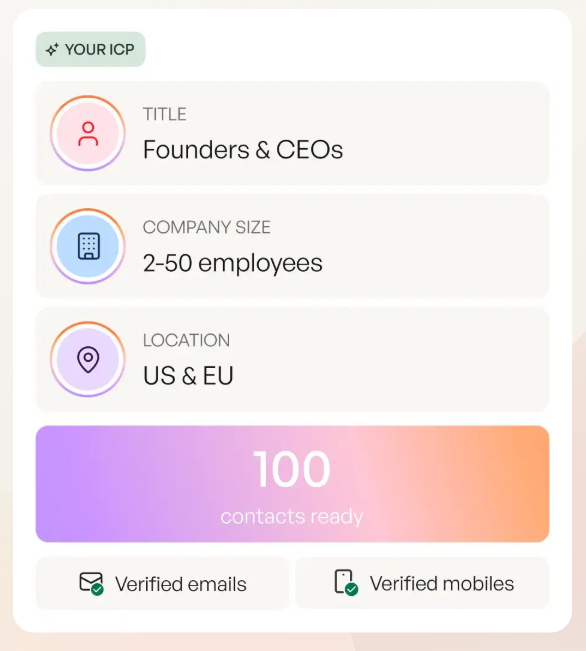
Here's the thing: we see teams skip the account-level layer entirely all the time. They go from "we sell to mid-market companies" straight to persona documents. Then they wonder why reps are chasing accounts that'll never close.
Why Your ICP Matters (With Data)
The business case isn't theoretical.
| Metric | Impact | Source |
|---|---|---|
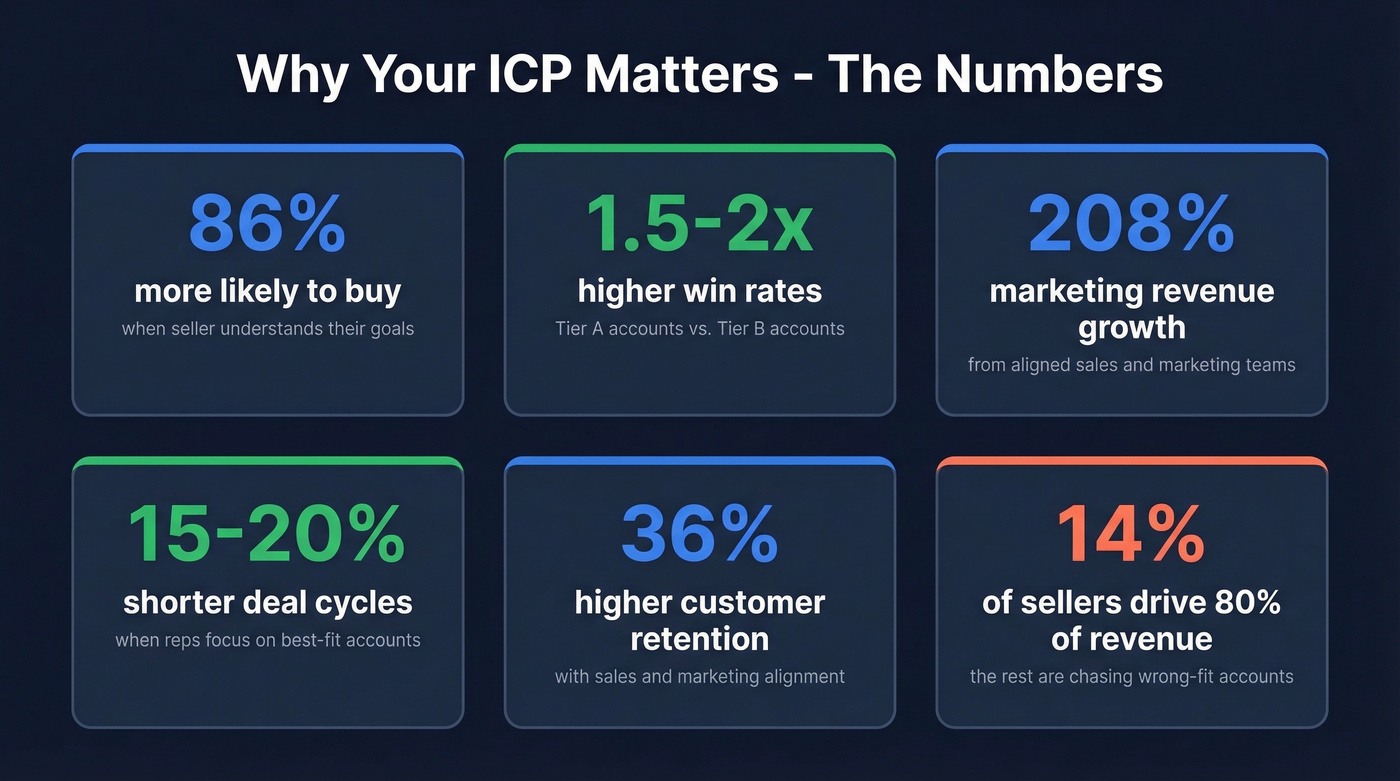
| Buyer likelihood | 86% more likely to buy when goals understood | Salesforce State of Sales |
| Revenue concentration | 14% of sellers drive 80% of new logo revenue | Fullcast benchmarking |
| Customer retention | 36% higher with sales/marketing alignment | Marketo |
| Win rates | 38% higher with alignment | Marketo |
| Marketing revenue | 208% growth from aligned teams | Marketo |
| Tier A vs. Tier B | 1.5-2x win rates, 15-20% shorter cycles | SalesMotion |
That 14% stat from Fullcast should keep sales leaders up at night. A small fraction of your team drives the vast majority of new business - and it's almost always because those reps naturally gravitate toward best-fit accounts. The ideal customer profile codifies what your best reps already know intuitively, then gives that playbook to everyone else.
Let's be honest: if your average deal size is under $10k, you probably don't need a 50-attribute profile with intent data and technographic scoring. A tight firmographic profile and a good list will outperform a fancy model that nobody maintains. Save the complexity for when your deal sizes justify it.
The tier performance data reinforces this. When you score accounts and focus Tier A effort on the best-fit companies, win rates jump 1.5-2x and deal cycles compress by 15-20%. That's the difference between hitting quota and missing it.

Your ICP is only as good as the data behind it. Prospeo gives you 30+ filters - buyer intent, technographics, headcount growth, funding, revenue - to turn your ideal customer profile into a live target list of verified contacts. 98% email accuracy. 7-day refresh cycle.
Stop defining your ICP in slides. Start activating it in Prospeo.
How to Build Your ICP in 5 Steps
Step 1: Identify Your Super Users
Start with data, not assumptions. Pull your top 10 customers - the ones getting the most value, renewing without drama, expanding over time. ChartMogul's framework draws a clear line between assumption-based profiles (necessary when you have fewer than 10 customers) and data-led ones built from real patterns in your base.
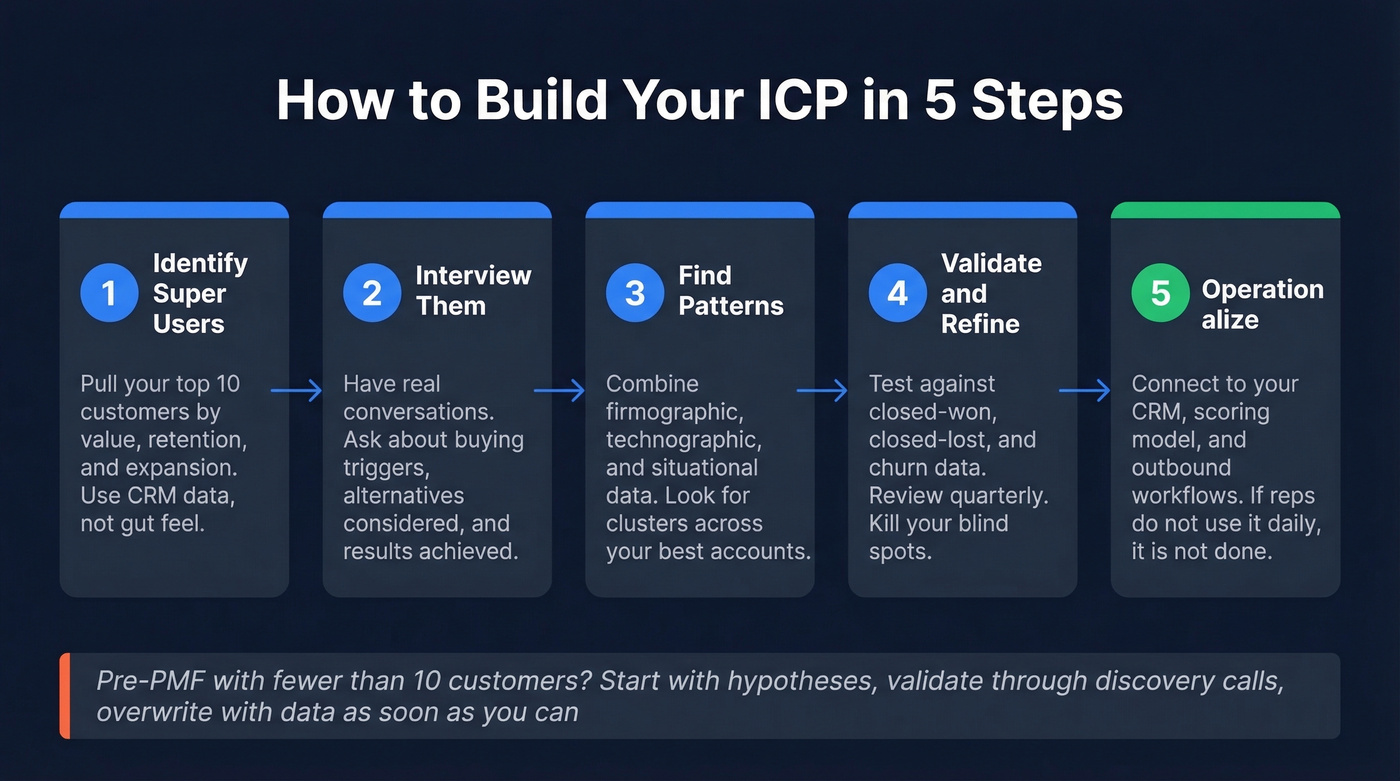
If you're pre-product-market-fit with a handful of customers, start with one or two hypotheses about who you think your ideal customer is. Validate through discovery calls and willingness to pay. But don't treat assumptions as facts - they're starting points you'll overwrite with data as soon as you can.
Step 2: Interview Them
Talk to your super users. Not a survey - actual conversations. You're looking for the story behind the purchase, not just the firmographic data you already have in your CRM.
Five questions that surface real signals (and pair well with a structured set of discovery questions):
- How did you first hear about us?
- What problem were you trying to solve when you bought?
- Who else was involved in the buying decision?
- What would you be using if you hadn't found us?
- What's the biggest result you've gotten since implementation?
These conversations reveal buying triggers, committee dynamics, and use cases that no amount of CRM data analysis will surface. The "what would you be using instead" question is especially powerful - it tells you your real competitive set, which often isn't who you think it is.
Step 3: Find Patterns and Build the Template
Now combine three types of data, following Gartner's recommended approach: quantitative (CRM data - company size, industry, ACV, CLTV), qualitative (interview insights, sales team observations), and predictive (behavioral patterns and trends from historical data).
Look for clusters across firmographic attributes like industry, headcount, revenue, and geography. Layer in technographic signals such as what tools they use and their technical maturity. Then factor in business situation - growth stage, specific challenges, buying triggers. The goal isn't a single "perfect" company. It's a pattern that repeats across your best customers. If 7 of your top 10 customers are Series B+ SaaS companies with 200-500 employees running Salesforce, that's your profile talking.
Once you see the pattern, formalize it into a structured template. Every field should be filterable. If you can't search for it in a database or enrichment tool, it's interesting context but not an operational attribute. (If you want a ready-to-copy version, see our ideal customer profile template.)
Step 4: Validate and Refine
Your ideal customer profile isn't a one-time deliverable. It's a living document that needs validation against real outcomes. Compare your attributes against closed-won deals, closed-lost deals, and - critically - churn.
"Churn is totally governed by the kind of customers that are coming in and whether they're a good fit." - Tom Randle, CEO, Geckoboard
If your highest-churn accounts share attributes that your profile doesn't flag, you have a blind spot. Review quarterly if you're running a scoring model, twice a year at minimum for a static version. (A simple churn analysis pass will usually surface the pattern fast.)
Step 5: Operationalize
A profile that exists only as a document is a strategy deck, not a revenue tool. The final step is connecting it to your CRM, scoring model, and outbound workflows. We cover this in detail in the operationalization section below.
The Complete ICP Template
This is the deliverable. Copy it, fill it in, and put it somewhere your team will actually reference - not buried in a Google Drive folder.
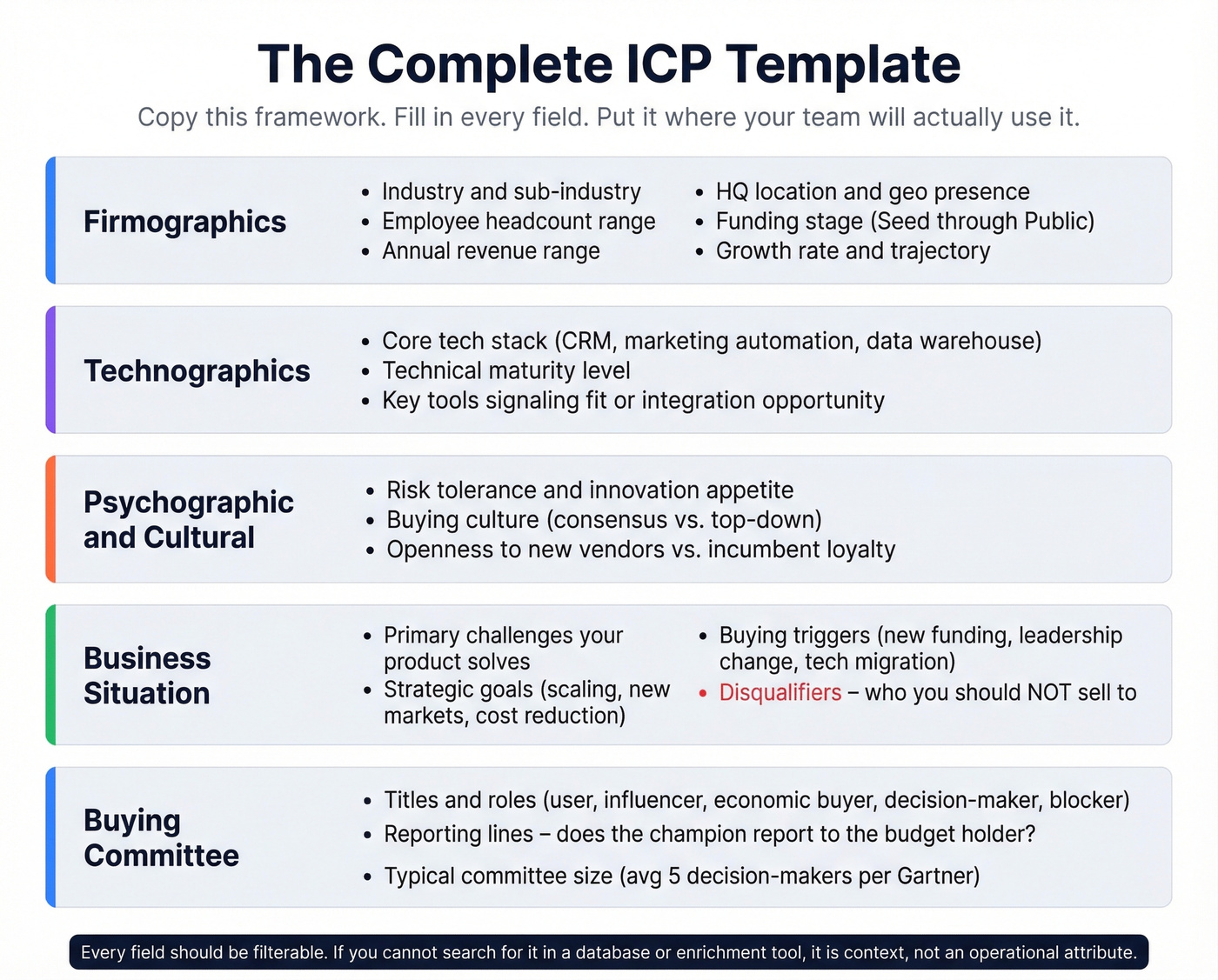
Firmographics
- Industry and sub-industry - "fintech - payments infrastructure," not just "financial services"
- Employee headcount range (e.g., 200-500)
- Annual revenue range
- Headquarters location / geographic presence
- Funding stage: seed, Series A/B/C, public
- Growth rate: headcount growth %, revenue trajectory
Technographics
- Core tech stack: CRM, marketing automation, data warehouse
- Technical maturity level
- Key tools that signal fit or integration opportunity
Psychographic / Cultural
- Risk tolerance and innovation appetite
- Buying culture: consensus-driven vs. top-down
- Openness to new vendors vs. incumbent loyalty
Business Situation
- Primary challenges your product solves
- Strategic goals: scaling, entering new markets, reducing costs
- Buying triggers: new funding, leadership change, tech migration
- Disqualifiers - accounts you can't or shouldn't sell to due to regulatory restrictions, incompatible infrastructure, or insufficient scale to get value
Buying Committee
- Titles and roles: user, influencer, economic buyer, decision-maker, blocker
- Reporting lines - does the champion report to the budget holder?
- Typical committee size
Persona-Level Details
- Jobs-to-be-done for each committee member
- Key responsibilities and KPIs
- Common objections by role
- Channels where they consume content: podcasts, newsletters, conferences, communities
Behavioral Signals
- Hiring patterns that indicate need (e.g., posting for a RevOps role)
- Recent funding events
- Job changes in key roles - a new VP of Sales opens a buying window
- Intent topics they're researching
The behavioral signals category is what separates a modern profile from a static firmographic checklist. Hiring patterns, funding events, and intent data turn your description into a trigger-based targeting system (more on identifying buying signals if you want a scoring-friendly approach).
Example ICP (Filled In)
To make this concrete, here's what a completed profile looks like for a fictional revenue intelligence platform:
Acme RevTech's ICP: Series B+ B2B SaaS companies, 200-500 employees, $20M-$100M ARR, headquartered in North America. Running Salesforce + a marketing automation platform. Currently hiring for RevOps or Sales Ops roles. Primary challenge: forecasting accuracy and pipeline visibility. Economic buyer: VP of Revenue Operations or CRO. Disqualifiers: companies under 100 employees, non-SaaS business models, no CRM in place.
That's specific enough to filter a database, build a target account list, and write messaging that resonates. If your profile can't do all three, it's too vague.
How to Score and Tier Accounts
Having a profile is step one. Scoring accounts against it is what makes it operational. Account scoring evaluates structural fit before outreach; lead scoring tracks individual engagement over time. They're complementary, not interchangeable.
A practical rubric based on SalesMotion's framework:
Phase 1: Analyze 50-100 closed-won deals from the last 12 months. Tag every attribute for each deal.
Phase 2: Define scoring categories - typically firmographics, technographics, behavioral signals, and trigger events.
Phase 3: Assign point values on a 100-point scale. Weight categories by their correlation with closed-won outcomes. If industry is a stronger predictor than headcount, it gets more points.
Phase 4: Set tier thresholds:
| Tier | Score | Treatment |
|---|---|---|
| A | 80-100 | Full outbound sequence, multi-threaded |
| B | 50-79 | Targeted outreach, lower priority |
| C | 0-49 | Nurture only or disqualify |
Phase 5: Validate quarterly. Pull your last quarter's closed-won and closed-lost deals, score them retroactively, and check whether Tier A accounts actually converted at higher rates.
Teams running tiered scoring see Tier A win rates at 1.5-2x Tier B, with deal cycles 15-20% shorter. That's the result of better targeting - reps spend time on accounts that close faster and stick longer.
Mistakes That Kill Your Pipeline
Building fairytale personas without customer input. If nobody on your team has talked to an actual customer in the last 90 days, your profile is fiction. Reddit threads are full of practitioners frustrated by profiles built in a conference room by people who've never run a discovery call.
Over-filtering real demand. One founder on r/SaaS reported that only 12 of their first 100 customers matched their "polished ICP." The other 88 - consultants, agencies, ecom brands - paid faster, implemented easier, and complained less. Your profile should guide prioritization, not become a permission structure to ignore revenue. This is one of the most underrated mistakes in B2B, and it's worth revisiting whenever you notice unexpected wins outside your defined parameters.
Relying only on firmographics. Industry and headcount aren't enough. You need technographics, behavioral signals, and intent data. A 300-person SaaS company actively researching your category is a better prospect than a 300-person SaaS company that isn't - and without those signals, they look identical.
Not involving sales and CS in development. Your profile shouldn't be built by marketing alone. Sales knows which deals close fastest and which objections kill momentum. CS knows which accounts churn and why. If those teams aren't in the room when you define your ideal customer profile, you're working with an incomplete picture.
Creating a profile and never using it. If it doesn't connect to your CRM filters, your outbound sequences, and your scoring model, it's a document, not a strategy.
Failing to update. Markets shift. Your product evolves. Your best-fit customer two years ago isn't necessarily your best-fit customer in 2026. Review at minimum twice a year, and any major product or pricing change should trigger an immediate refresh.
Ignoring the data quality gap. You can nail every attribute, export 5,000 perfectly matched accounts, and still watch 40% of your emails bounce. The profile was right. The data was wrong. Your targeting is only as good as the contact data behind it - which is why pairing your profile with a verified data source matters more than most teams realize (see email bounce rate benchmarks and fixes).
How to Operationalize Your ICP
The operational workflow looks like this: profile attributes -> search filters in an enrichment tool -> verified contact list -> CRM -> outbound sequences. Every step needs to be automated or at least repeatable.
Most teams stall at the first arrow. They have the document but no systematic way to translate it into a target account list with verified contacts.
| Tool | Best For | Typical Starting Price |
|---|---|---|
| Prospeo | Verified emails + ICP filters | Free (75 emails/mo); ~$0.01/lead |
| ZoomInfo | Enterprise teams, large budgets | ~$15,000-40,000/yr |
| Apollo | Free-tier prospecting + sequences | Free; paid from ~$49/mo per user |
| Clearbit | Real-time CRM enrichment | Custom; typically ~$12,000-50,000/yr |
| Lusha | Quick phone lookups | Free; paid from ~$36/mo per user |
| Clay | Automated enrichment workflows | Free; paid from ~$149/mo |
ZoomInfo is the default for enterprise teams, but a 10-seat contract with intent data can run $40-60k/year. For Series A and B companies, that's a massive budget line for a tool where reps often only use the search bar. Apollo's free tier is generous for getting started, but email accuracy drops off compared to dedicated verification platforms. Clay is powerful for workflow automation but adds complexity - it's built for RevOps teams who want custom enrichment chains, not for reps who just need a list.
Skip ZoomInfo if you're under 50 reps and don't need intent data bundled into a single contract. Skip Clay if you don't have a dedicated RevOps person to maintain the workflows.

In our experience, the gap between "I know my ICP" and "I have verified contacts at ICP-fit companies" is where most teams lose momentum. Prospeo's 30+ search filters map directly to standard profile attributes - industry, headcount, tech stack, funding stage, headcount growth, intent signals across 15,000 topics, and job changes - so you're translating your template into a live search query. With 98% email accuracy and a 7-day data refresh cycle, the list you export today is still accurate next week. After adopting Prospeo, Snyk saw bounce rates drop from 35-40% to under 5% across 50 AEs, with AE-sourced pipeline jumping 180%.
You've tiered your accounts. Now reach the buying committee inside them. Prospeo's 300M+ profiles and intent data across 15,000 topics let you filter by ICP attributes and surface the five decision-makers Gartner says you need to convince - with verified emails and direct dials.
Turn your Tier A list into booked meetings at $0.01 per email.
FAQ
What is an ICP in sales and marketing?
An ideal customer profile is a data-backed description of the company type most likely to buy your product, get value from it, and stay long-term. It covers firmographics, technographics, behavioral signals, and buying triggers at the account level - not the individual level. Sales, marketing, and RevOps teams use it to align on which accounts deserve the most attention.
Is an ICP the same as a buyer persona?
No. An ideal customer profile describes the company - firmographics, technographics, business situation. A buyer persona describes the individual decision-maker within that company. Build your account-level profile first, then create personas for the people inside those accounts.
How often should I update my ICP?
Review twice per year at minimum, and validate quarterly against closed-won/lost data and churn if you run a scoring model. Any major product launch, pricing change, or market shift should trigger an immediate refresh - your best-fit customer from a year or two ago may look different today.
How do I find contacts at ICP-fit companies?
Use a B2B data platform with filters that match your profile attributes - industry, headcount, tech stack, intent signals, funding stage. Export the list, push it to your CRM or sequencer, and start outreach with confidence the data is fresh. Prospeo's filters map directly to standard ICP fields, and every email is verified at 98% accuracy.
Can I have multiple ICPs?
Yes - most companies with multiple products maintain two to three distinct profiles. More than five usually means your segments aren't differentiated enough. Each profile should map to a genuinely different product line or go-to-market motion, with its own scoring model and outbound playbook.