

How to Build an AI SDR Objection Handling System That Actually Works
A RevOps lead we know deployed an autonomous AI SDR last quarter. It handled pricing objections by inventing a discount tier that didn't exist, then emailed it to 200 prospects before anyone noticed. The tool worked exactly as configured - the team just skipped the part where you actually build the system.
61% of B2B buyers now prefer a rep-free buying experience, and the AI SDR market is projected to hit $15.01B by 2030. The money's flowing in. But AI SDR tools churn at 50-70% annually - most teams buy, misconfigure, and abandon. Here's how to be the exception.
Why AI Handles Objections Differently
Great human reps share specific behaviors. A Gong study analyzing 67,149 sales conversations found that top performers pause 3+ seconds after hearing an objection, ask clarifying questions before responding 74% of the time, and use specific numbers in 63% of successful responses.
AI doesn't naturally do any of this. Left unconfigured, it responds instantly, skips clarification, and generates generic rebuttals. CRM systems capture only about 1% of customer interactions, so AI tools working off CRM data alone are flying blind (and it’s worth understanding common CRM limitations before you automate around them).
Unconstrained AI also tends to "freestyle" - long, generic marketing copy, invented details, zero escalation instincts - unless you put hard guardrails in the prompt and workflow. Without any grasp of conversation psychology, the system treats every reply the same regardless of the buyer's emotional state or conversational context.
The advantage AI does have is speed. Responding within 5 minutes yields 21x higher qualification rates than waiting 30 minutes. Frontify saw a 30% lead conversion increase after implementing AI-assisted objection workflows. The trick is combining that speed with the behavioral patterns that actually work (especially in AI in sales cadences, where timing and sequencing matter more than copy).
The LAER Framework for AI SDRs
LAER - Listen, Acknowledge, Explore, Respond - was developed by Carew International in 1976. It's survived five decades because it maps cleanly to what AI can do when configured properly.
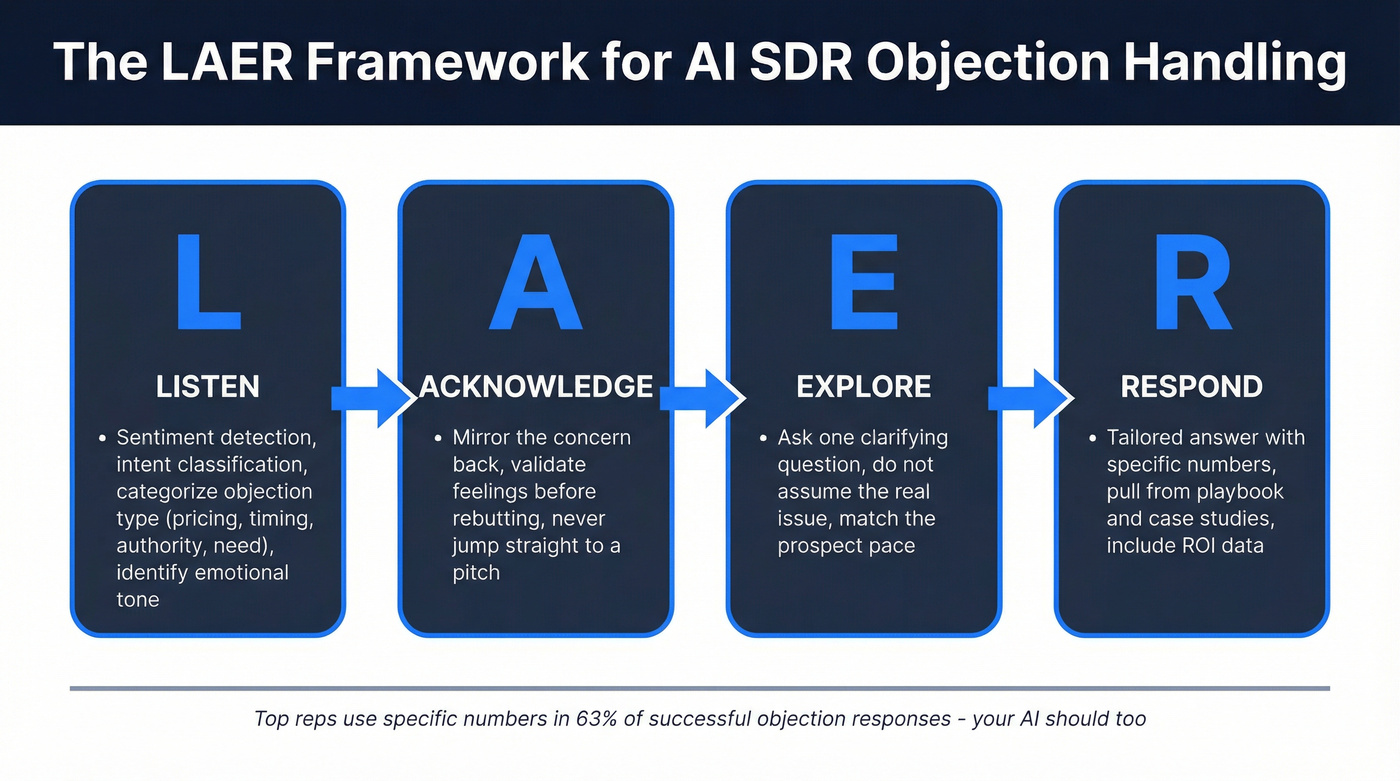
Listen translates to sentiment detection and intent classification. Your AI reads the objection, categorizes it (pricing, timing, authority, need), and identifies emotional tone. Some modern NLP approaches can detect 32 emotional indicators in text - far more than a rep catches in a fast-paced email thread. This is where AI-driven emotional intelligence begins: the system's ability to read what a prospect is feeling, not just what they're saying (and you can operationalize this with email sentiment tracking).
Acknowledge means the AI doesn't jump straight to a rebuttal. It mirrors the concern back. "I hear you - $X is a real investment" beats "Let me explain our ROI." This is a template layer, and it's where most implementations fall apart. We've watched teams skip this step entirely, then wonder why their AI sounds like a chatbot.
Explore is where AI asks a clarifying question instead of assuming. "Is it the total cost or the per-seat pricing that's the concern?" This single behavior - asking before answering - separates effective AI SDR objection handling from robotic rebuttals. It also reflects sound conversation psychology: matching the prospect's pace and letting them feel heard before you pivot to a solution (useful context: best open-ended sales questions).
Respond is the tailored answer, pulling from your playbook, case studies, and pricing data. The response should include specific numbers - remember, top reps use data in 63% of successful objection responses.
LAARC (Listen, Acknowledge, Assess, Respond, Confirm) adds an explicit confirmation step. Either works. LAER is simpler to implement in automated workflows, and that's what I'd recommend for a first deployment.
Fix Your Data Before Your Responses
Here's the uncomfortable truth most AI SDR vendors won't tell you: roughly 20-30% of outbound objections are phantom objections. They aren't real buying concerns. They're artifacts of bad data. You emailed someone who left the company six months ago. You pitched a VP of Engineering on an HR product because the role data was stale.
No objection handling framework fixes this. You fix it upstream (start with B2B contact data decay and build a repeatable CRM hygiene process).
Prospeo's database covers 300M+ professional profiles, including 143M+ verified emails and 125M+ verified mobile numbers, with 98% email accuracy on a 7-day refresh cycle - compared to the industry average of six weeks. Meritt cut their bounce rate from 35% to under 4% after switching, and their pipeline tripled from $100K to $300K per week. When your data's that clean, the objections you do get are real ones your AI can actually address (and if you’re auditing vendors, compare approaches in email ID validators and email checker tools).
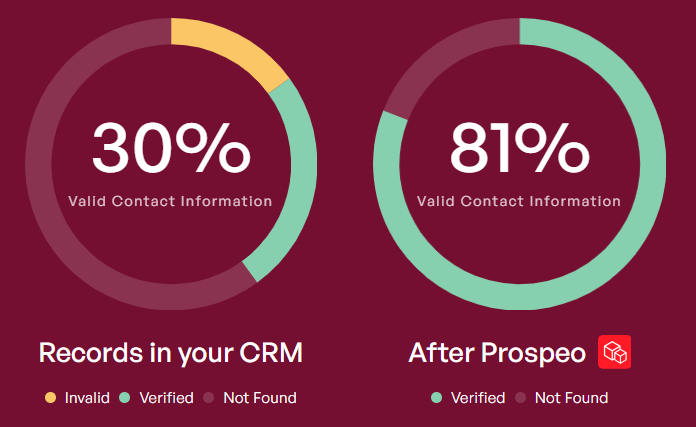

20-30% of outbound objections are phantom objections caused by stale data. Prospeo's 7-day refresh cycle and 98% email accuracy eliminate the noise so your AI SDR only handles real buying concerns - not bounced emails and wrong contacts.
Stop training your AI on objections that never should have happened.
Your AI prompts are only as good as the context you feed them. Prospeo enriches every contact with 50+ data points - job title, company size, tech stack, funding - so your AI SDR crafts responses with the specific numbers top reps use 63% of the time.
Give your AI SDR the context it needs to actually convert.
Prompt Templates That Work
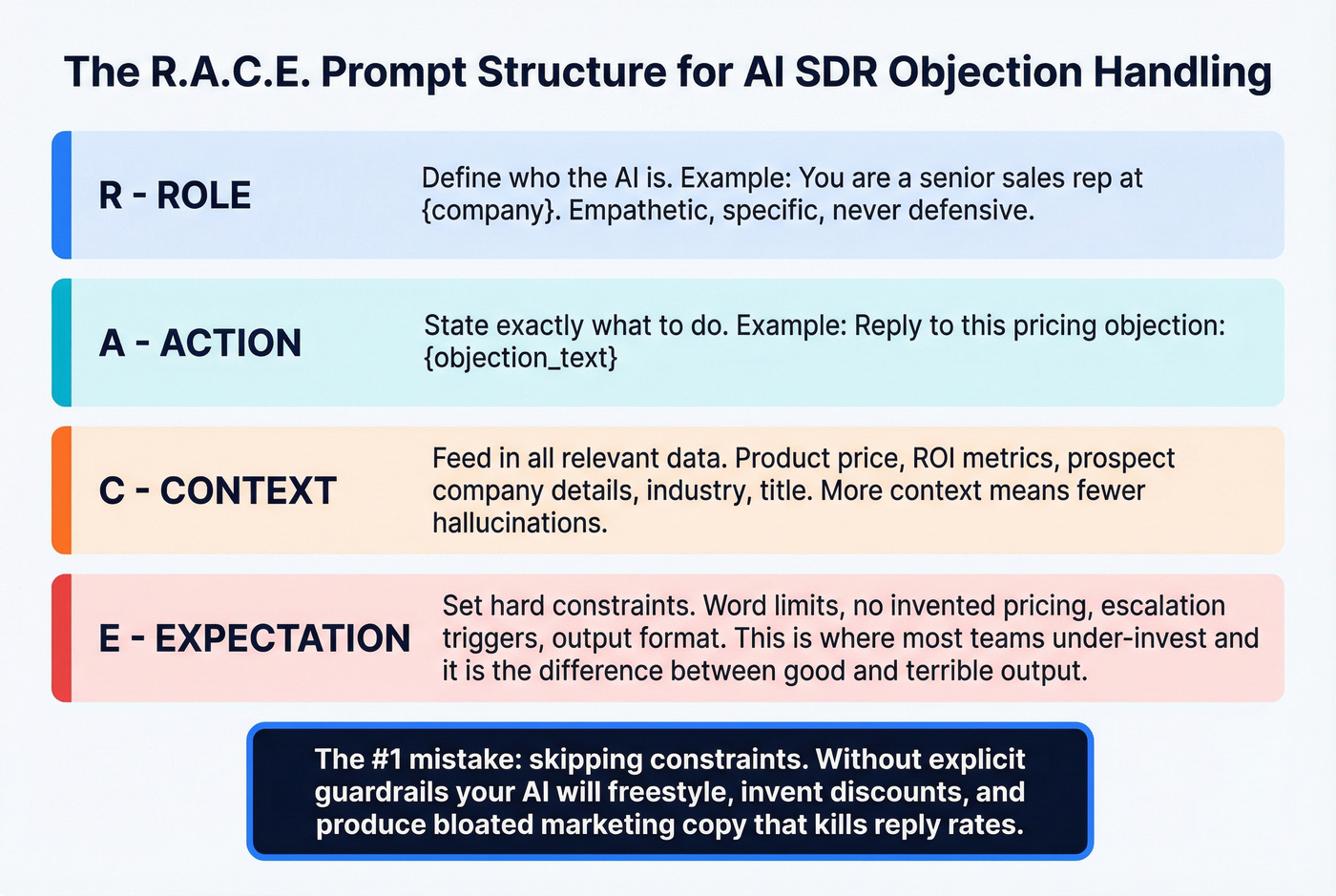
Most AI SDR objection handling fails because the system prompt is either too vague or nonexistent. Here are two production-grade templates using the R.A.C.E. structure (Role, Action, Context, Expectation) (if you want a deeper playbook, see prompt engineering for salespeople).
Price Objection Email Response
ROLE: You are a senior sales rep at {company_name}. Empathetic, specific, never defensive.

ACTION: Reply to this pricing objection: "{objection_text}"

CONTEXT: Product costs {price_point}. ROI metrics: {roi_metrics}. Prospect's company ({prospect_company}) has {company_context}.

CONSTRAINTS:
- Acknowledge the concern in the first sentence
- Include at least one specific number or ROI calculation
- Never invent pricing, discounts, or terms not in the context
- Max 90 words

OUTPUT: Email reply only. No subject line.
"Not Interested" Follow-Up
ROLE: You are a consultative SDR. Curious, not pushy.

ACTION: Write a follow-up to: "{objection_text}"

CONTEXT: Original outreach was about {value_prop}. Prospect is {prospect_title} at {prospect_company} in {industry}.

CONSTRAINTS:
- Do NOT repeat the original pitch
- Ask exactly one clarifying question about their current approach
- Under 50 words
- If prospect said "remove me" or "unsubscribe," output only: "ESCALATE: opt-out request"

OUTPUT: Email body only.
The constraints section is where most teams under-invest. Without explicit guardrails - no invented pricing, word limits, escalation triggers - AI will freestyle and produce the kind of bloated marketing copy that kills reply rates. We've tested prompts with and without hard constraints, and the difference in response quality isn't subtle. It's night and day.
When AI Should Hand Off
Not every objection belongs to a machine. Escalate to a human when:
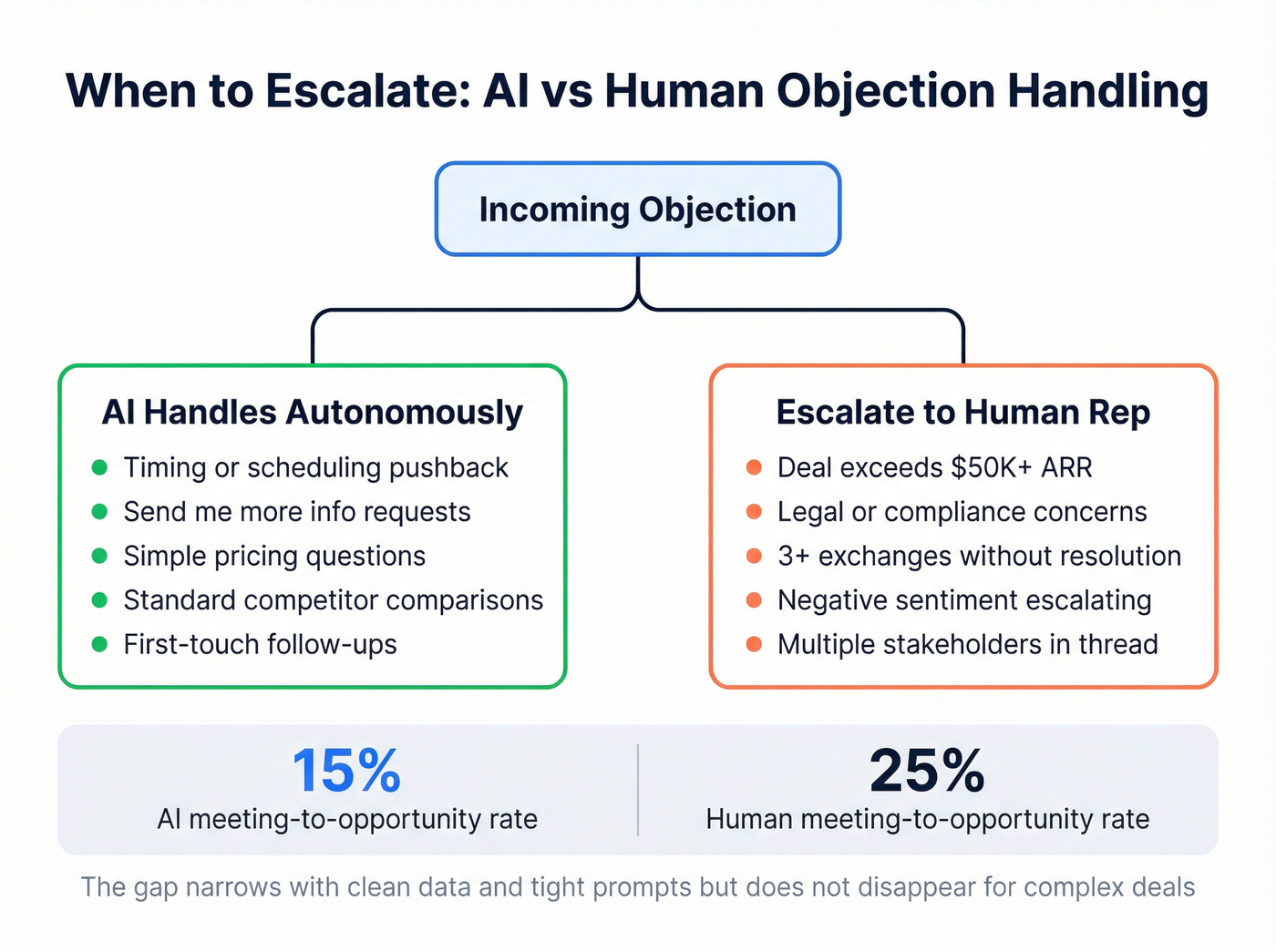
- The deal exceeds $50K+ ARR
- Legal or compliance objections surface (AI hallucinating here is a liability)
- Three exchanges pass without resolution
- Negative sentiment escalates
- Multiple stakeholders enter the thread
Let's be honest: if your average deal size stays in the SMB range, you probably don't need a human in the loop for standard objections at all. Autonomous AI handles predictable pushback - timing, "send more info," simple pricing questions - reliably at scale. But the moment a deal gets complex or high-value, hand it off. AI SDRs convert meetings to opportunities at about 15% versus 25% for human reps. That gap narrows with clean data and tight prompts, but it doesn't disappear, especially in conversations that demand real emotional intelligence like navigating a frustrated champion or a skeptical CFO.
One more thing: over-reliance on live AI assist during calls can atrophy reps' objection handling skills. If your reps never practice without a crutch, they won't develop the muscle memory for high-stakes conversations where AI can't help. The consensus on r/sales backs this up - threads about AI coaching tools consistently warn against letting reps become dependent on real-time prompts.
Tools and What They Cost
| Tool | Category | Starting Price | Best For |
|---|---|---|---|
| Prospeo | Data quality | Free tier; ~$0.01/email | Preventing bad-data objections |
| AiSDR | Autonomous AI SDR | $900/mo | Full autopilot at scale |
| Gong | Conversation intel | ~$1,600/user/yr + ~$50K platform | Analyzing objection patterns |
| Hyperbound | AI roleplay | Free (9 bots); custom pricing | Safe objection practice |
| Dialpad | Real-time coaching | ~$15-$95/user/mo | Live call assist |
| Ruh.ai | Autonomous AI SDR | Custom pricing | AI-first outbound |
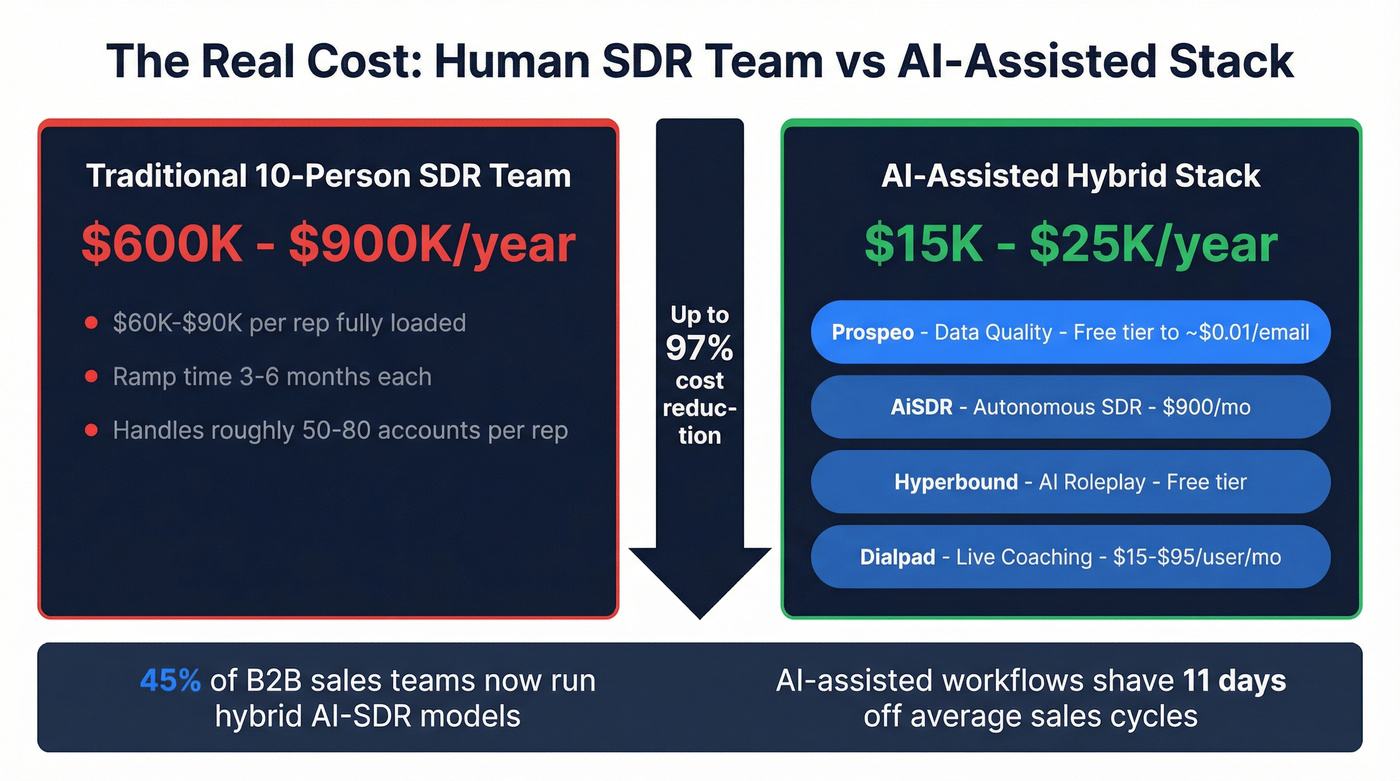
Skip Gong if you're under 20 reps - the platform fee dominates the economics for small teams. Hyperbound's free tier is genuinely useful for onboarding new SDRs without burning real prospects.
A fully-loaded human SDR costs $60K-$90K per year. An autonomous AI SDR like AiSDR runs $10,800/year on its $900/mo plan. For a 10-person team, a clean-data tool plus roleplay practice plus your CRM often lands around $15K-$25K/year depending on seats and what you already pay for your stack. In our experience, that lighter configuration outperforms the big "platform + autopilot" setup because the data going in is cleaner (more on building a lean stack: B2B sales stack).
About 45% of B2B sales teams now run hybrid AI-SDR models - AI handles first-touch objections, humans take over for complex deals. Outreach data shows that deals closed within 50 days hit a 47% win rate, and AI-assisted workflows shave 11 days off average sales cycles. The hybrid approach isn't a compromise. It's the configuration that's actually winning.
FAQ
Can AI SDRs handle complex objections?
For predictable objections - timing, "send more info," simple pricing - yes, reliably at scale. For budget authority, legal concerns, or multi-stakeholder dynamics, escalate to a human. Autonomous AI converts meetings at roughly 15% versus 25% for humans, so the handoff point matters.
What's the biggest mistake in AI SDR objection handling?
Optimizing responses before fixing data. If 20-30% of your outbound hits wrong contacts or dead emails, you're generating objections no framework can solve. Clean your contact data first, then configure prompts and escalation rules.
How long does setup take?
Two to four weeks for a production-ready system. Week one: audit data quality and clean contact lists. Week two: choose a framework like LAER and write system prompts. Weeks three and four: deploy, monitor AI responses, and refine based on reply rates and escalation frequency.