

Revenue Management AI: What It Is, Whether It Works, and Which Tools to Use in 2026
A RevOps lead at a 200-room boutique hotel told us last year that their revenue manager spent more time pulling STR reports than making pricing decisions. They bought an AI RMS, and within 90 days their RevPAR climbed 17%. The tool didn't replace the revenue manager - it replaced the busywork. That's revenue management AI in practice: less spreadsheet wrangling, more strategic pricing.
The Short Version
AI-driven pricing optimization works. Hotels typically see a 15-20% lift in RevPAR, apartments can deliver up to 7% outperformance versus market, and airlines are sitting on a $30B optimization opportunity. Independent hotels should start with RoomPriceGenie (EUR198-EUR440/mo) or Pricepoint ($129-$199/mo); enterprise portfolios need IDeaS or Duetto. The #1 implementation mistake isn't picking the wrong tool - it's building on bad data.
What AI-Powered Pricing Optimization Actually Is
Revenue management AI uses machine learning to set, adjust, and optimize pricing in real time across hotels, airlines, rental properties, and any business with perishable inventory. Classical AI means regression models forecasting demand from historical booking data. GenAI adds unstructured signals - event calendars, weather, social sentiment - and translates complex pricing logic into plain-language explanations a GM can act on without a statistics degree.
Agentic AI, the newest wave, can autonomously execute rate changes and inventory controls based on policy guardrails you define. Here's the thing: revenue managers currently spend 51% of their time on activities that don't directly generate revenue. AI doesn't just price better. It gives revenue managers their time back.
The ROI Case
With U.S. RevPAR growth running at just 1.2% organically, a 15-20% AI-driven lift isn't incremental - it changes the math entirely. A Cornell study found a 7.2% average revenue increase for hotels using AI-based pricing versus traditional methods. In airlines, Skift Research estimates AI-driven optimization represents a $30B revenue opportunity today, scaling to $100B+ by 2030.
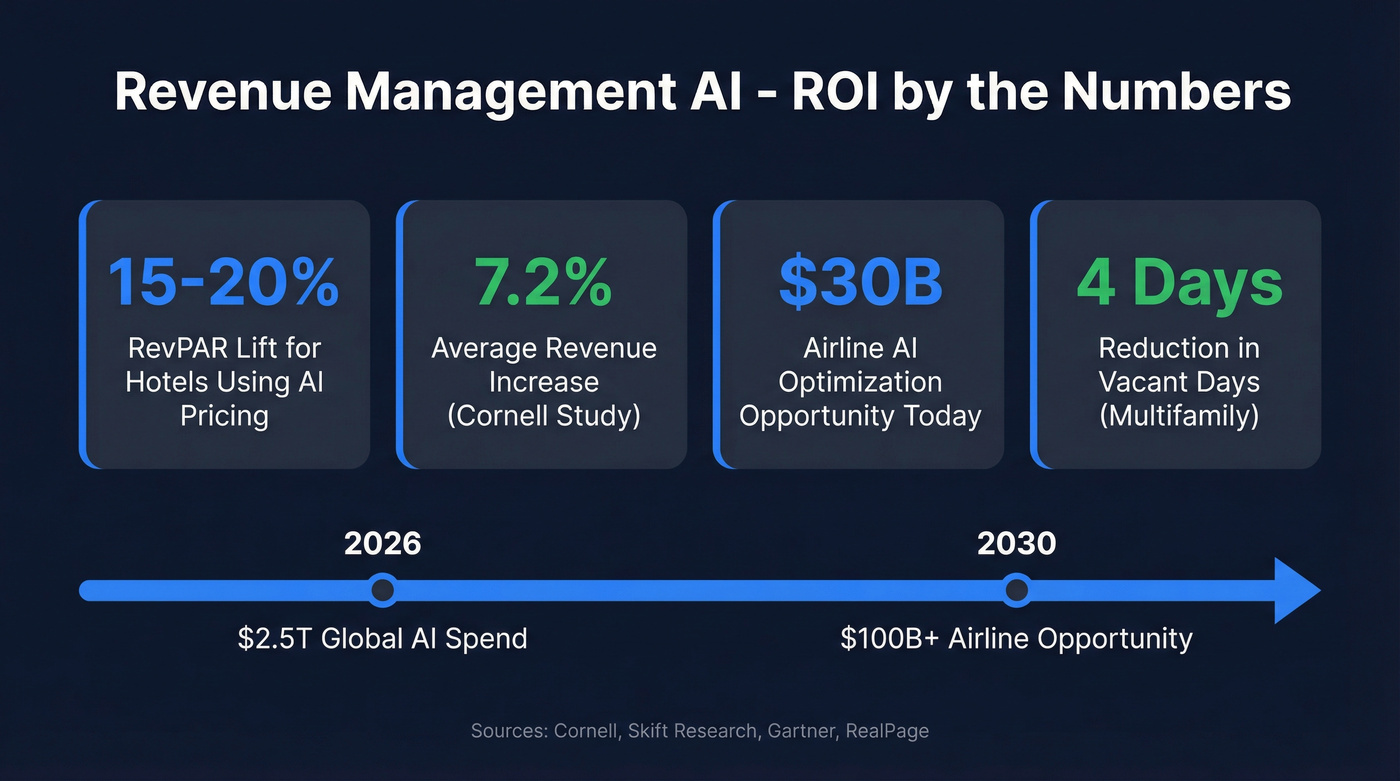
Against Gartner's projection of $2.5 trillion in global AI spending in 2026, pricing optimization is one of the clearest ROI stories in enterprise AI. It's measurable within a quarter, and the payback period for most tools is weeks, not years.
How It Works
Every AI RMS runs on four core capabilities:
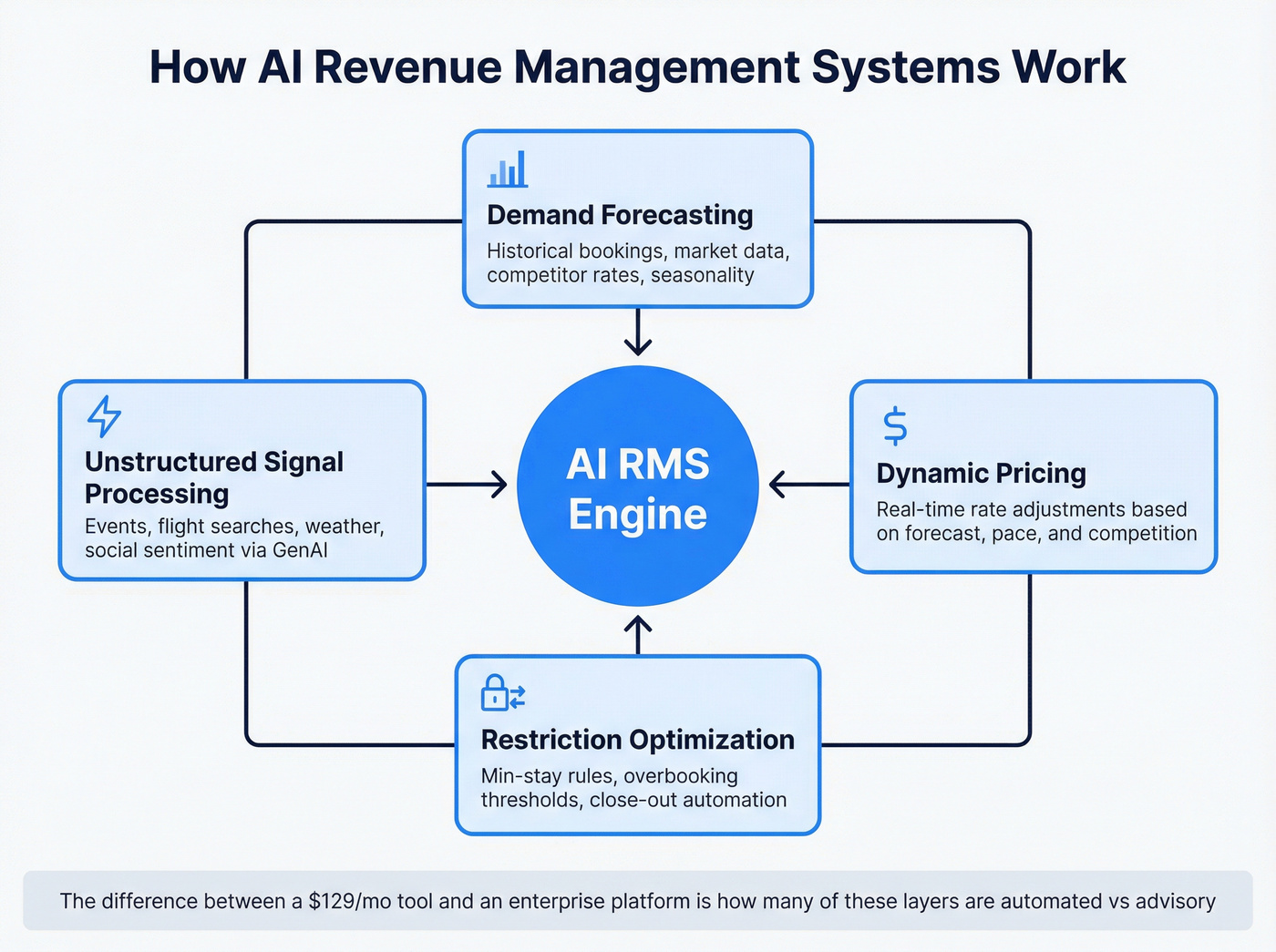
- Demand forecasting - ingesting historical bookings, market data, competitor rates, and seasonality to predict future demand by segment, channel, and date.
- Dynamic pricing - adjusting rates in real time based on forecast changes, booking pace, and competitive positioning.
- Restriction optimization - automating minimum-stay requirements, overbooking thresholds, and close-out rules that most revenue managers still handle manually.
- Unstructured signal processing - the GenAI layer that reads event announcements, flight search trends, and weather forecasts to catch demand shifts before they show up in booking data.
The difference between a $129/mo tool and an enterprise platform is mostly how many of these layers are automated versus advisory.

Revenue management AI fixes your pricing. But even perfect rates won't help if your sales team is pitching the wrong buyers. Prospeo gives you 300M+ profiles with 98% email accuracy and intent data across 15,000 topics - so you reach decision-makers who are actively in-market.
Stop optimizing rates for leads you can't reach.
AI Pricing by Industry
Hotels
This is where the market is deepest. HotelTechReport's 2026 guide evaluated 74 products based on feedback from 4,578 hoteliers across 109 countries. IDeaS scores 92% among 355 luxury hotels, while Duetto hits 93% across 332 boutiques. RoomPriceGenie dominates the small-property segment at 97% from 251 B&Bs and 98% from 85 motels.
Your property type narrows the shortlist fast.
Airlines
Airlines pioneered dynamic pricing decades ago, but AI is pushing into personalized pricing - two passengers seeing different fares for the same flight based on browsing history and loyalty status. Transat's Elevation program with Scale AI is a notable example, using machine-learning models to optimize branded fares, ancillary pricing, and no-show predictions to refine overbooking strategies. The FTC is already studying "surveillance pricing" across industries. The technology exists. The regulatory framework doesn't - yet.
Multifamily Apartments
RealPage's AI platform delivers up to 7% outperformance versus market and an average 4-day reduction in vacant days. Given the antitrust scrutiny around algorithmic rent pricing - several class-action lawsuits are active as of early 2026 - any apartment operator evaluating AI-based pricing should prioritize vendors with transparent, auditable decision logic.
Top Revenue Management AI Tools
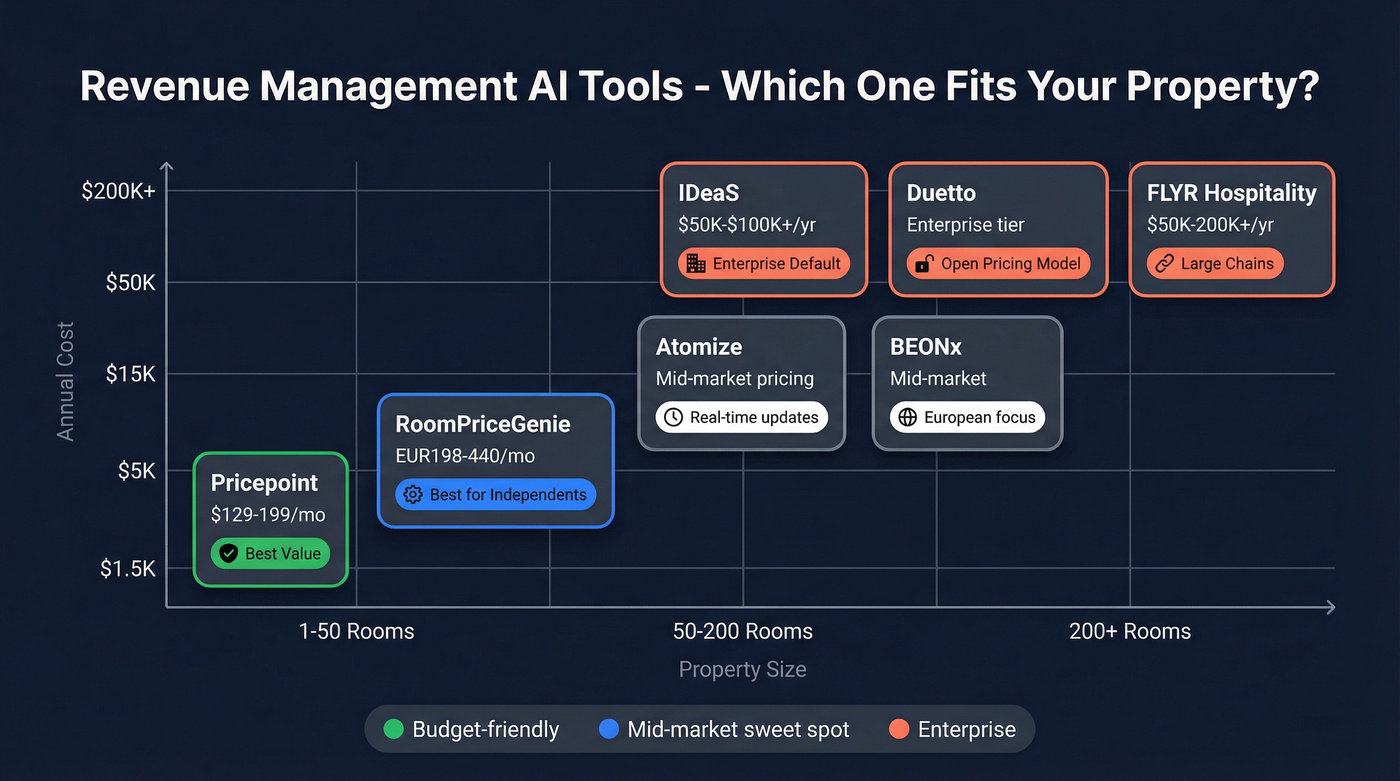
| Tool | Best For | Pricing | Property Size | Key Differentiator |
|---|---|---|---|---|
| RoomPriceGenie | Independent hotels | EUR198-440/mo | 1-50 rooms | Ease of use + support |
| Pricepoint | Budget-conscious hotels | $129-199/mo | 1-100 rooms | No setup fee |
| IDeaS | Enterprise portfolios | Mid five-figures to low six-figures/yr | 100+ rooms | G3 market data + automation |
| Duetto | Multi-segment pricing | Enterprise (comparable to IDeaS) | 100+ rooms | Open pricing model |
| FLYR Hospitality | Large chains | $50K-200K+/yr | 200+ rooms | Deep learning forecasting |
| Atomize | Mid-market hotels | Mid-market | 50-200 rooms | Real-time rate updates |
| BEONx | European properties | Mid-market | 50-300 rooms | Profit-focused strategy |
RoomPriceGenie - Best for Independents
Use this if you're running an independent hotel, B&B, or hostel and want a system that works out of the box. Pricing runs EUR198/mo (Core) to EUR440/mo (Professional) per property, with annual plans saving 17%. The 4.8/5 score from 623 hotelier reviews holds up - hoteliers on review platforms consistently praise the setup speed and responsive support. We've heard from multiple operators who had it running within a day of signing up, which is rare for any RMS.
Skip this if you manage a 50+ property portfolio needing cross-property optimization or deep segment-level controls.
Pricepoint - Best Value
Pricepoint starts at $129/mo with no setup fee - the cheapest credible AI RMS we've found. The 4.9/5 score from 51 reviews is impressive, though the smaller review base means less signal. The most common complaint? Thin reporting and no A/B testing. For a hotel that just needs smart pricing without overhead, it's the right starting point.
IDeaS - Enterprise Default
IDeaS is the incumbent. I've talked to revenue directors at branded chains who treat it like oxygen - they can't imagine operating without it. Pricing isn't publicly listed and depends on room count, integrations, and location, but enterprise contracts typically land in the mid five-figures to low six-figures per year.
The G3 system pulls market data alongside internal hotel data and can autonomously manage overbooking thresholds and minimum-stay restrictions. The integration ecosystem spans Mews, SiteMinder, Agilysys, Infor, Shiji, STR, and Lighthouse - one of the broadest in the category. For large portfolios, it's the safe bet, and there's a reason it keeps winning enterprise deals year after year.
Duetto
Duetto's open pricing model independently optimizes every segment, channel, and stay date rather than anchoring to a BAR. For multi-segment hotels running group, corporate, and OTA business simultaneously, this flexibility matters. Expect enterprise-tier contracts comparable to IDeaS.
Will AI Replace Revenue Managers?
No - but it'll replace revenue managers who don't use AI.
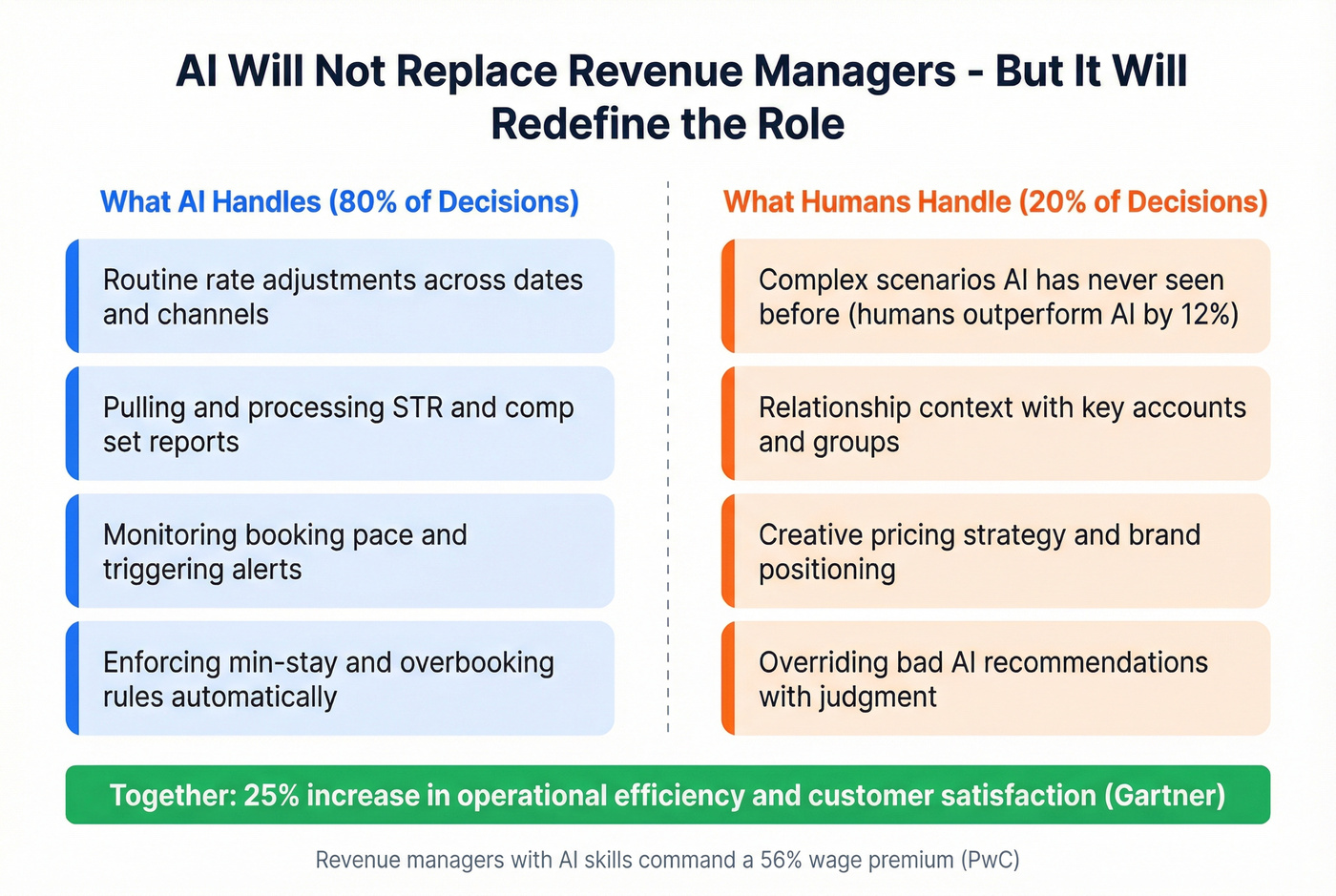
An IJHM study found humans outperformed AI by 12% in complex, unexpected scenarios. Gartner projects that blending humans with AI yields a 25% increase in operational efficiency and customer satisfaction. AI handles the 80% of decisions that are routine; humans handle the 20% that require judgment, relationship context, and creative strategy.
Let's be honest: if your average daily rate is under $150, you probably don't need an enterprise RMS. A $129/mo tool capturing even half the potential RevPAR lift pays for itself in a single weekend. The enterprise platforms justify their cost at scale, but we've seen too many 80-room properties sign six-figure contracts they'll never fully utilize.
The career implications are real, too. PwC's AI Jobs Barometer shows skills are changing 66% faster in AI-exposed roles, and workers with AI skills command a 56% wage premium. Revenue managers who learn to interpret outputs, override bad recommendations, and tune strategy will be worth significantly more than those who don't.
Common Implementation Mistakes
Four pitfalls kill AI pricing projects before they deliver ROI:
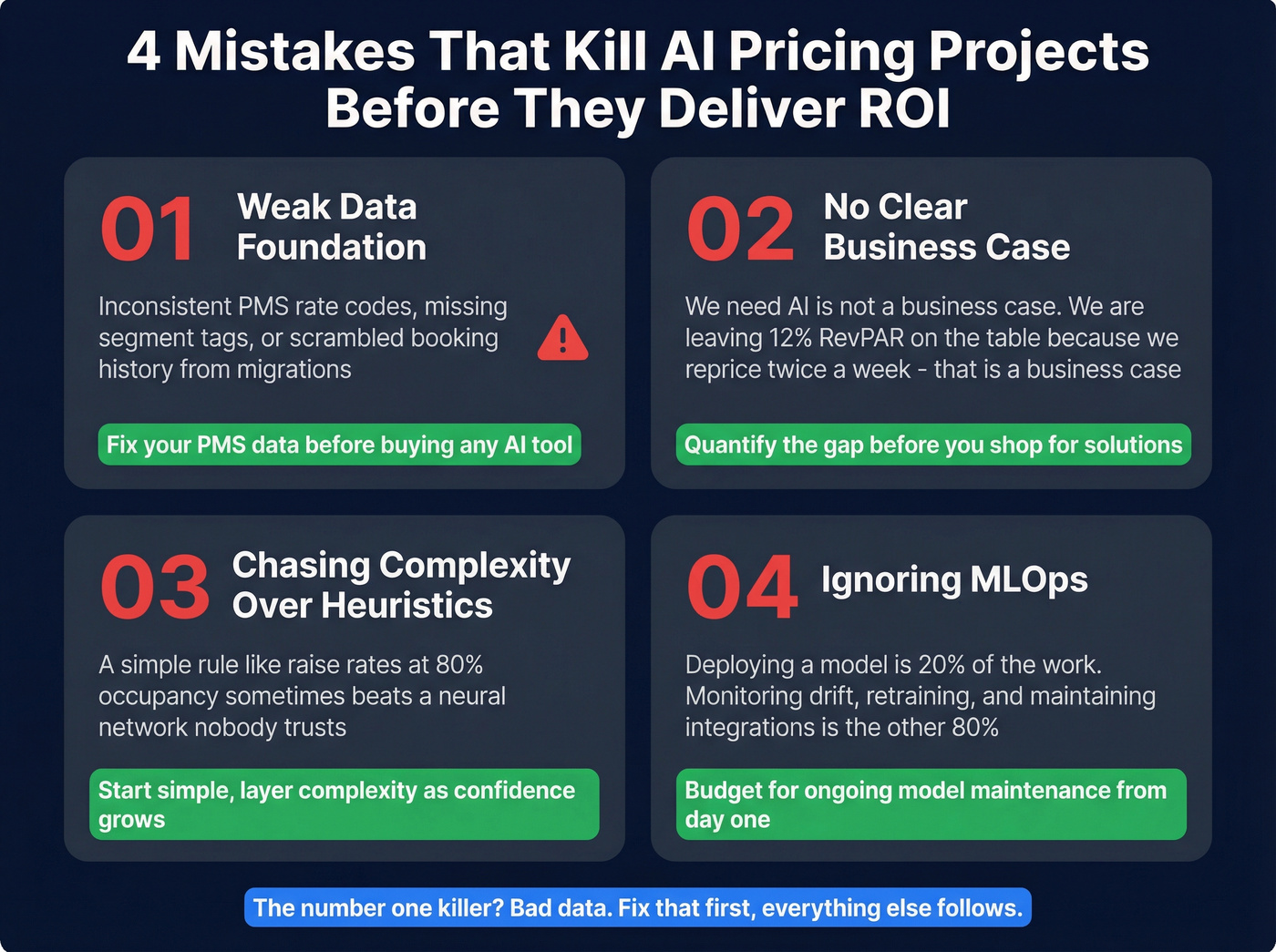
Weak data foundation. Your AI RMS is only as good as your PMS data, comp set feeds, and historical booking records. If your PMS has inconsistent rate codes or missing segment tags, fix that first. No tool can compensate for garbage inputs, and we've watched teams burn three months troubleshooting an AI system when the real problem was a PMS migration that scrambled two years of booking history.
No clear business case. "We need AI" isn't a business case. "We're leaving 12% RevPAR on the table because our revenue manager can only reprice twice a week" is.
Chasing complexity over heuristics. Sometimes a simple rule - "raise rates when occupancy hits 80%" - outperforms a neural network that nobody trusts. Start with the simplest model that works, then layer on complexity as your team builds confidence in the outputs.
Ignoring MLOps. Deploying a model is 20% of the work. Monitoring drift, retraining on new data, and maintaining integrations is the other 80%. The data quality lesson extends beyond hotel operations. If you're selling B2B revenue AI tools into hospitality, your prospect data needs the same hygiene standard as the booking data feeding the AI. Prospeo's 98% email accuracy on a 7-day refresh cycle is clean enough to protect your domain reputation while reaching GMs and VPs of revenue at scale.
FAQ
What's the difference between revenue management AI and revenue cycle management?
Revenue management AI is pricing optimization for hotels, airlines, and rentals. Revenue cycle management is healthcare billing - a $25.15B market with zero overlap. Different industry, different tools, different article.
How long until AI pricing optimization shows ROI?
Most hotels see measurable RevPAR lift within 60-90 days once PMS integrations are stable and the system has enough booking data to forecast confidently. Budget tools like Pricepoint can pay for themselves in a single weekend at properties above 50% occupancy.
Can small hotels afford AI revenue management?
Yes. Pricepoint starts at $129/mo with no setup fee. RoomPriceGenie starts at EUR198/mo with free trials on every plan. Sub-200-room properties have affordable, proven options that deliver 15-20% RevPAR lifts without enterprise contracts.
What's the best way to find decision-makers at hotel groups?
Use a B2B data platform with hospitality filters. Prospeo's database covers 300M+ professional profiles with 30+ search filters - including company size, job title, and technographics - so you can target revenue directors and GMs directly. The free tier includes 75 verified emails per month, enough to test outreach before committing.
RevOps teams using AI pricing tools still lose deals to bad contact data - 35%+ bounce rates kill pipeline. Prospeo's 7-day data refresh and 5-step verification cut bounce rates under 4%, just like Snyk did across 50 AEs.
Your revenue stack is only as good as the data feeding it.