Sales Closing Questions That Actually Work - Backed by 1 Million Calls
If your deal stalled after the proposal, no amount of "assumptive close" language is going to fix it. The problem happened three calls ago. An analysis of over one million B2B sales calls found something uncomfortable: winning and losing closing calls look almost identical on every seller-behavior metric - talk-to-listen ratio, interactivity, even the number of questions asked. The close isn't a moment. It's a series of micro-agreements you either built or didn't.
Most sales closing questions lists hand you 20 generic lines and tell you to "create urgency." We're doing something different here: mapping specific questions to specific deal stages, backing them with data, and giving you the language patterns that actually correlate with winning.
3 Questions That Work at Every Stage
If you read nothing else, use these three. They work in discovery, post-demo, negotiation, and procurement because they surface the information that actually moves deals forward.
- "What would need to be true for you to move forward?" - Forces the prospect to articulate their own buying criteria instead of you guessing. Most experienced reps have some version of this in their toolkit, and it works at any stage because the answer changes as the deal progresses.
- "Who else needs to weigh in before this gets approved?" - Reveals the buying committee early. The earlier you know, the less likely you get blindsided at the finish line.
- "What's your timeline for solving this?" - Anchors urgency to their problem, not your quota. If they don't have a timeline, you don't have a deal. You have a conversation.
The Reality of Closing Deals in 2026
The average B2B win rate hovers around 21%. Four out of five opportunities end closed-lost. And 84% of sales reps missed quota in recent years.
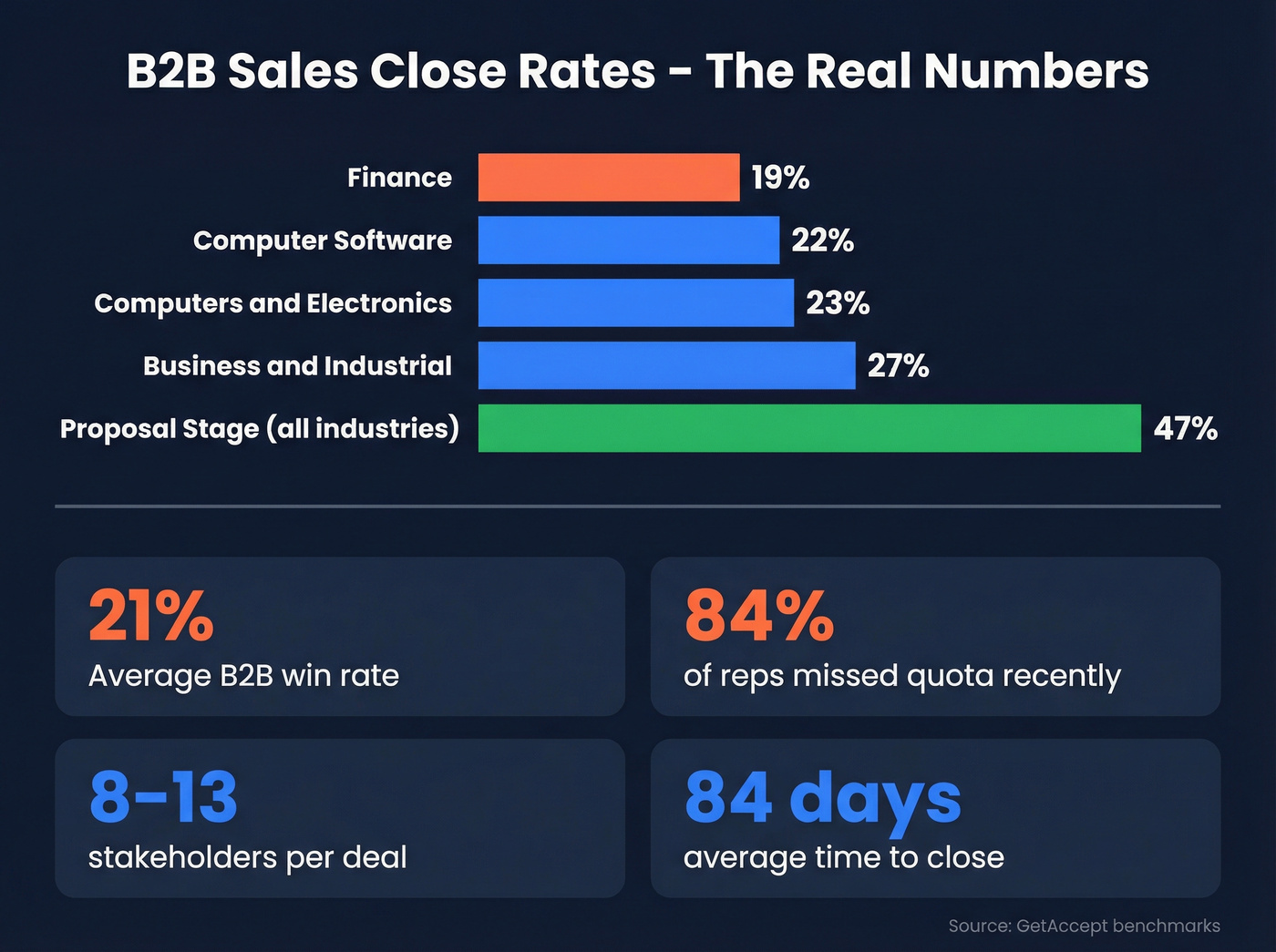
Here's what industry close rates actually look like:
| Industry | Close Rate |
|---|---|
| Finance | 19% |
| Computer Software | 22% |
| Computers & Electronics | 23% |
| Business & Industrial | 27% |
| Proposal-Stage (all) | 47% |
Source: GetAccept benchmarks
That proposal-stage number is the one worth staring at. Nearly half of deals that reach the proposal stage still die. The gap between 47% and 100% is where the right questions earn their keep - but only if you've done the work in earlier stages.
Modern B2B deals involve 8-13 stakeholders, average about 84 days to close, and require roughly eight meaningful touchpoints. Meanwhile, 96% of prospects research your product before they ever talk to a rep. You're not convincing anyone from scratch. You're confirming what they've already started to believe - or you're losing to someone who did that better.
25+ Questions to Close a Sale by Deal Stage
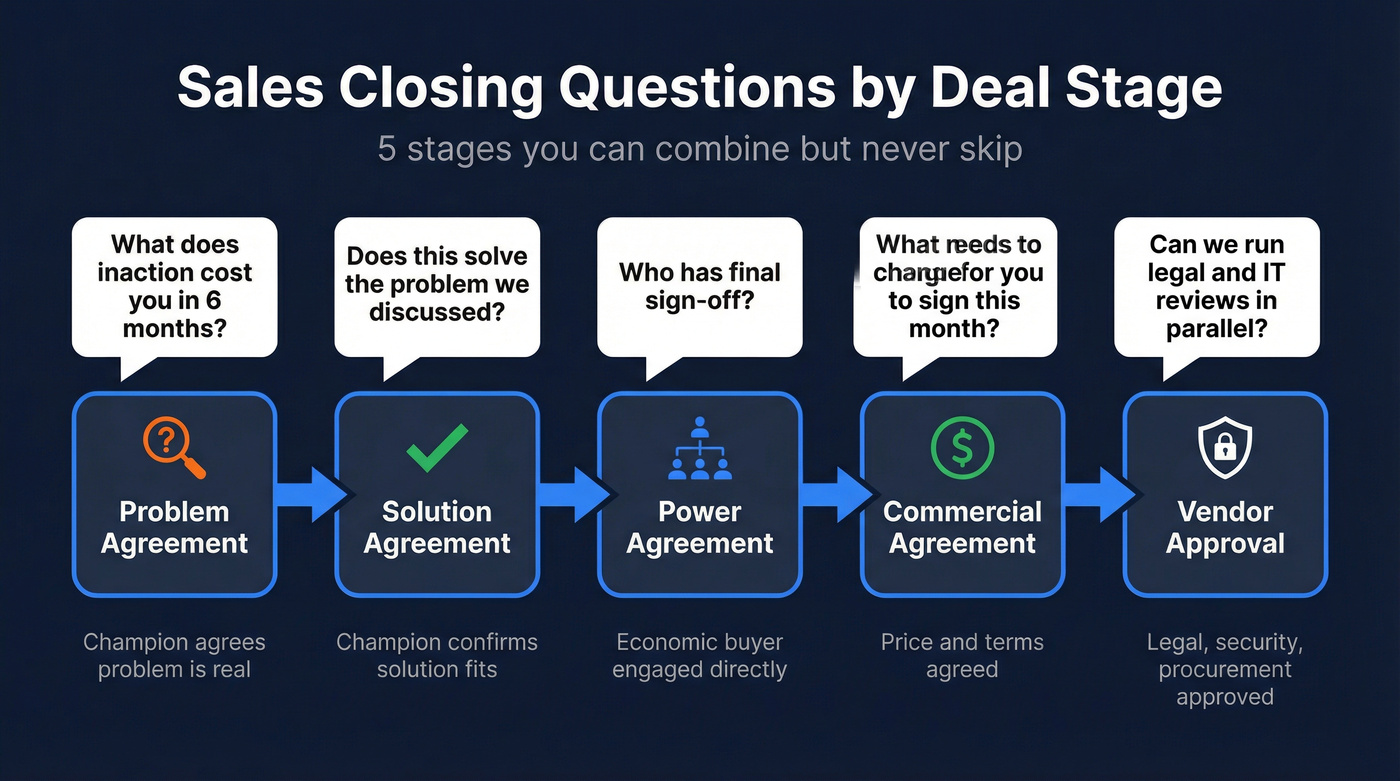
"Closing" isn't one stage. It's five. The framework below comes from 30 Minutes to President's Club, and it's the cleanest stage model we've seen for mapping closing questions to real deal progression. You can combine stages in fewer meetings, but you can't skip them.
Problem Agreement
These are your discovery-stage micro-closes. The prospect needs to explicitly acknowledge the problem before anything else matters. If they don't agree there's a problem worth solving, every subsequent question is premature.
Start by tying their pain to a measurable outcome: "You mentioned [specific pain]. How is that affecting your team's ability to hit [goal]?" Then quantify inaction - "If nothing changes in the next 6 months, what does that cost you?" - which puts a number on doing nothing without being pushy. From there, test organizational gravity with "Is this something your leadership team has flagged, or is it more on your radar right now?" and force a priority ranking: "On a scale of 1-10, how urgent is solving this compared to your other priorities?" Anything below a 7 means you don't have a real opportunity yet. Finally, ask "What's already been tried to fix this?" to reveal failed solutions and set the bar for what "better" looks like.
Exit criteria: The champion explicitly agrees the problem is real and worth solving. If you don't have this, you have a polite conversation, not a deal.
Solution Agreement
Post-demo, post-POC. The prospect needs to confirm your solution actually fits their problem. This is where most reps skip ahead to pricing and lose - and knowing the right questions to ask at this stage prevents that premature leap.
- "Based on what you've seen, does this solve the [specific problem] we discussed?" - Direct confirmation. Don't assume the demo spoke for itself.
- "Which part of what we showed would have the biggest impact on your team?" - Identifies their priority feature, which becomes your anchor for the rest of the deal.
- "What concerns do you still have about whether this would work in your environment?" - Invites objections while you still have time to address them.
- "If we could get this implemented by [date], would that align with your timeline?"
- "How does this compare to the other approaches you've evaluated?" - Reveals competitive positioning without sounding defensive.
Exit criteria: The champion confirms the solution fits and can articulate why to their team.
Power Agreement
This is where deals go to die. You crushed the demo, got "Looks great, let me loop in my team" - and never heard back. Power Agreement means the actual decision-maker has bought in, not just your champion.
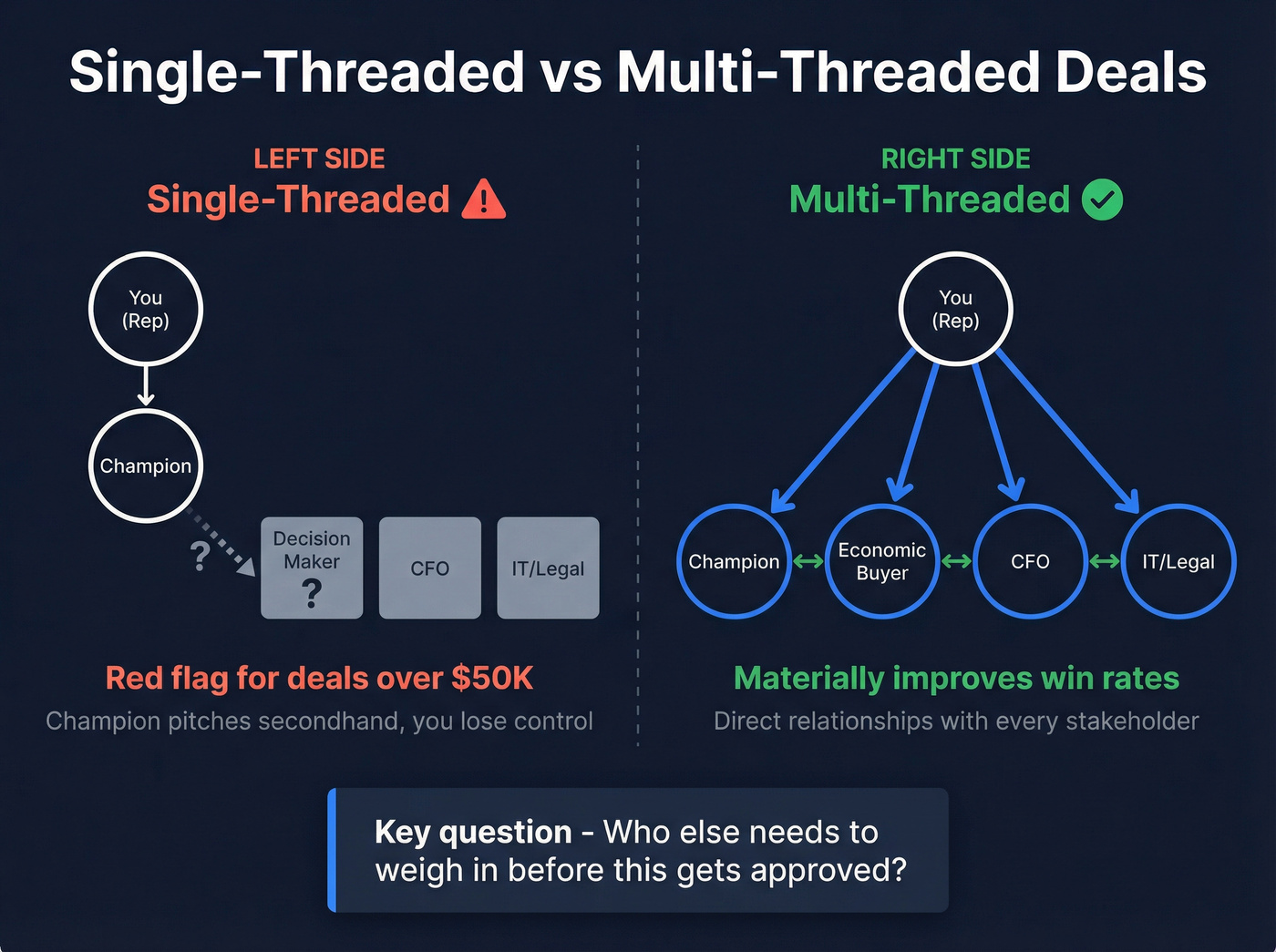
Here's the thing: reps treat "I'll share this with my boss" as progress. It's not. It's a handoff to someone you've never spoken to, armed with a secondhand pitch. Multi-threading materially improves your odds, and single-threaded deals over $50K are a red flag - HubSpot's call analysis data confirms this. Commitment questions are essential here because you need the economic buyer to verbally invest, not just nod along.
| Question | What It Reveals |
|---|---|
| "Who has final sign-off on a decision like this?" | Whether you're talking to the right person |
| "What does your decision-making process look like for a purchase in this range?" | The internal workflow and timeline |
| "Would it help if we set up a brief call with [VP/C-level] to address their specific concerns?" | Whether the exec is accessible or shielded |
| "What would [decision-maker's name] need to see to feel confident?" | How to sell upward through your champion |
| "Has your team aligned on the budget, or is that still in discussion?" | Whether budget authority exists at all |
Exit criteria: The economic buyer has engaged directly and expressed support.
Commercial Agreement
Pricing and terms. This is where 30MPC's "concrete framing" approach shines - instead of asking "What's your budget?", you anchor with a specific number and let them react.
- "Based on what we've scoped, we're looking at $75K on a two-year agreement. Does that land in the range your team has approved?" - Concrete framing. Gives them something to react to instead of asking them to volunteer a number.
- "If we could structure the payment as [quarterly/annual], would that make the approval process smoother?"
- "What would need to change about this proposal for you to sign this month?" - Direct. Uncovers the real blocker.
- "Is there a specific ROI threshold your CFO needs to see before approving?"
- "We've seen similar teams get [X result] within [timeframe]. Would documenting that expected ROI help move this through approval?" (If you need help quantifying, use a simple sales ROI calculator.)
Exit criteria: Both sides agree on price, terms, and payment structure.
Vendor Approval
Legal, procurement, security, IT. The deal is "won" emotionally but not contractually. This is where enterprise deals stall for weeks if you don't run workstreams in parallel.
The key move here is asking "Can we run the legal review and IT security assessment in parallel, or does one need to finish first?" Serial reviews add weeks; parallel reviews compress them. Pair that with "What does your procurement process look like, and who should I be working with directly?" to get a name and a process map. Then pre-empt friction: "Do you have a standard security questionnaire we should complete?" and "Is there anything in our standard terms that's been a sticking point with similar vendors?"
One signal worth watching: when the buyer raises topics like implementation, SLAs, and customer success on the closing call, that's a positive signal. They're risk-checking because they've already decided. If your prospect is asking about onboarding timelines, don't panic - close.
Exit criteria: Legal, security, and procurement have all reviewed and approved.
How Top Performers Phrase Questions
The questions above are the skeleton. The language you wrap around them is the muscle. Analysis of 500,000+ sales calls by Gong found specific language patterns that separate top performers from everyone else.
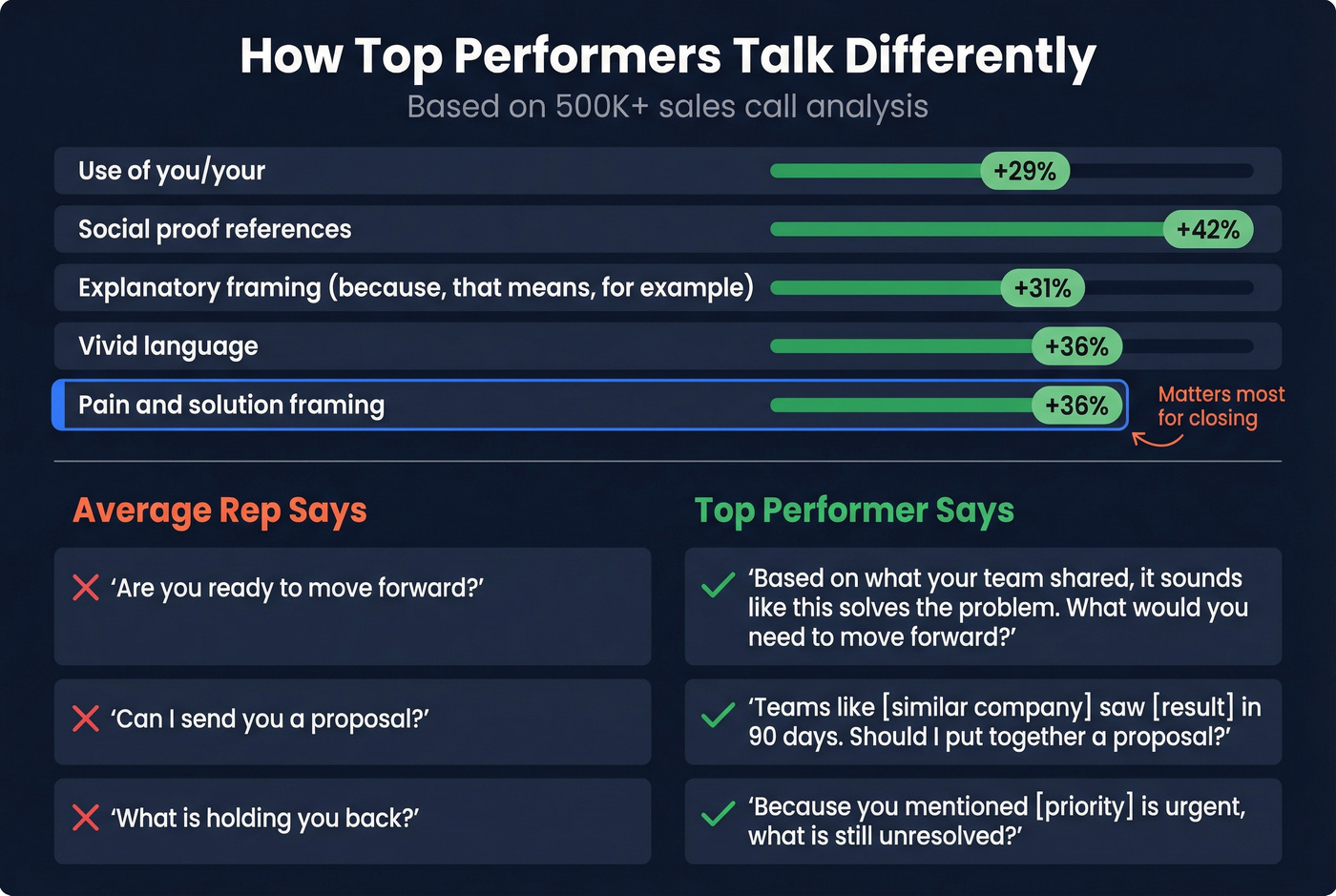
The deltas are significant. Top reps use "you/your" 29% more often, bring in social proof 42% more, use explanatory framing like "because," "that means," and "for example" 31% more, deploy vivid language 36% more, and lean into pain/solution framing 36% more. That last one matters most for closing: top performers don't describe features - they paint what changes.
In practice:
Instead of "Are you ready to move forward?" Try "Based on what your team shared, it sounds like this solves the [problem]. What would you need to move forward?"
Instead of "Can I send you a proposal?" Try "Teams like [similar company] saw [result] within 90 days. Should I put together a proposal showing what that looks like for your team?"
Instead of "What's holding you back?" Try "Because you mentioned [priority] is urgent, I want to make sure we've addressed everything. What's still unresolved?"
Instead of "Do you want to sign today?" Try "Your team flagged [deadline]. To hit that, we'd need signatures by [date]. Does that timeline work on your end?"
Every rewrite is more specific, more "you"-focused, and anchored to something the prospect already said. That's not a closing trick. It's just good communication.

You can't close a deal with 8-13 stakeholders if you only have one contact's email. Prospeo gives you verified emails and direct dials for every member of the buying committee - 300M+ profiles, 98% email accuracy, 125M+ mobile numbers.
Multi-thread every deal with contact data that actually connects.
Reviving Deals That Have Stalled
You sent the proposal two weeks ago. The champion said they loved it. Now they're ghosting you.
Most reps either panic-follow-up with "just checking in" or give up entirely. Gong's post-proposal framework organizes recovery around three diagnostic questions: what changed, where they stand, and what steps remain. Speed matters too - 35-50% of deals go to the vendor that responds first, so every day of silence is a day your competitor gains ground.
If you need a tighter cadence, borrow a proven prospect follow up sequence and pair it with re-engagement email subject lines that actually get opens.
- "Last time we spoke, you were planning to present this to [decision-maker] on [date]. How did that go?"
- "Has anything changed on your end since we sent the proposal?"
- "If we could resolve [specific concern they raised], would you be in a position to move forward this month?"
- "I want to be direct - are you still actively evaluating this, or has the priority shifted?" - Gives them permission to say no. Counterintuitively, this often re-engages them.
- "What specific steps would need to happen between now and a signed agreement?"
One critical finding from call analysis: moving close dates hurts deals. Name the planned close date explicitly and hold it.
Closing the Buying Committee
We've seen this pattern over and over: a rep builds a great relationship with one champion, runs a flawless demo, and then loses the deal to a committee they never engaged. Multi-threading - building relationships with multiple stakeholders - lifts win rates by roughly 130%. Teams that reach consensus are 2.5x more likely to report a high-quality deal. And yet most reps stay single-threaded because finding and reaching the full committee feels like a separate project entirely, one that eats hours they don't have.
Different stakeholders need different questions:
Use with your champion: "Who on your team would be most affected by this change, and what would they need to hear?"
Use with the CFO: "What ROI metrics does your team use to evaluate investments like this?"
Use with procurement/legal: "What's your standard vendor evaluation timeline, and can we start the security review now while the business team finalizes scope?"
Skip with the champion: Procurement questions. They don't know the answers and it makes you look like you've never sold into an enterprise.
Skip with the CFO: Feature demos. They care about cost, risk, and payback period. Nothing else.
You can't multi-thread a deal if you only have one contact. Tools like Prospeo let you pull the entire buying committee's contact data in minutes - filter by job title and department across 300M+ profiles, then push verified emails and direct dials straight into Smartlead, Instantly, Lemlist, or your outbound stack via Zapier or Make. (If you're cleaning lists first, use an email checker tool or a dedicated email ID validator.)

84% of reps miss quota - often because deals stall at Power Agreement with no way to reach the economic buyer. Prospeo's 30+ search filters let you find the VP or C-level directly, skip the gatekeeper, and land the meeting that closes the deal.
Stop waiting for your champion to forward your deck. Reach the decision-maker yourself.
Objection-to-Reclose Scripts
When a prospect objects, most reps either cave or argue. Neither closes deals. The framework is simple: Listen, empathize, clarify, prove, re-close.
"It's too expensive." "I hear you - budget matters. Can I ask what you're comparing this to? ... Teams like [similar company] found the cost of [problem] was actually 3x what they spent on the solution. If I could show you that math for your situation, would that change the conversation?"
"The timing isn't right." "What would need to change for the timing to work? ... You mentioned [deadline/pain point] earlier - if we pushed implementation to [date], would that align better with your team's bandwidth?"
"I need to check with my team." "Who specifically needs to weigh in, and what questions do you think they'll have? ... Would it help if I put together a one-page summary with the ROI projections we discussed?"
The re-close question at the end of each script isn't aggressive - it's diagnostic. You're testing whether the objection is real or reflexive. (For a deeper breakdown, see types of objections.)
5 Closing Mistakes That Kill Deals
1. Pitching too early. Sending the deck five minutes into the first call is the fastest way to lose engagement. The "good doctor" doesn't write a prescription before examining the patient. (This is also the core failure behind a pitch slap.)
2. Faking urgency. Bryan Vasquez, Head of Sales at LinkBuilder.io, replaced urgency-based CTAs with data-backed proposals and tailored value maps - and saw a 20% increase in win rate over two quarters. Reps close 3x more deals at end-of-month, but deal size drops 34.5%. The urgency discount eats your margin. If your best closing technique is "this price expires Friday," you don't have a closing technique.
3. Ignoring the buying committee. 74% of buying teams experience unhealthy internal conflict during the purchase process. If you're only talking to one person, you're hoping that person wins every internal argument. Hope isn't a strategy.
4. Giving up too early. 80% of successful sales require 5+ follow-ups, yet 44% of reps quit after one attempt. The math is brutal and obvious: most reps abandon deals right before they'd close.
5. Selling the product instead of the outcome. Nobody buys software. They buy fewer hours wasted, more pipeline generated, less revenue leaked. Frame every closing question around what changes for them, not what your product does.
Let's be honest about something: most teams obsess over closing technique when their real problem is pipeline quality. If you're running deals under $15K with a sub-30-day cycle, you probably don't need a five-stage closing framework - you need more at-bats with better-qualified prospects. The questions in this article matter most for complex, multi-stakeholder deals where losing a single opportunity costs tens of thousands.
FAQ
What's the difference between a closing question and a discovery question?
Discovery questions uncover problems; closing questions confirm agreement and advance the deal to the next stage. The best closers use both throughout the cycle - discovery doesn't stop after the first call, and closing starts long before the final one.
How many closing questions should I ask per call?
Call analysis shows the number of questions on closing calls is identical for wins and losses - quality and timing matter more than quantity. Focus on one well-placed question per stage transition rather than rapid-firing a checklist.
Do closing questions work differently in B2B vs. B2C?
B2C closes are faster and more emotionally driven, while B2B closes involve 8-13 stakeholders, longer cycles, and ROI justification. B2B closing questions need to address committee consensus and multi-threaded engagement, not just individual buy-in.
What's the best question to ask on a cold call?
A cold call closing question isn't about asking for the deal - it's about closing for the next step. The highest-converting version is some form of "I'd love to show you how [similar company] solved this - do you have 20 minutes on Thursday?" You're closing for a meeting, not a contract.