How to Write a Follow-Up Email After Sending a Proposal (Templates + Data)
You sent the proposal on Monday. It's Thursday. Your inbox is empty.
That silence doesn't mean "no" - it means "busy." But the window between "interested" and "forgot about you" closes fast, and most salespeople blow it by waiting too long or following up with a limp "just checking in." We've watched deals die this way dozens of times, and it's always the same pattern: great proposal, terrible follow-through.
Here's what actually works for a follow-up email after sending a proposal: send your first follow-up 2-3 business days after the proposal, cap your sequence at 3 follow-ups (after 4+ emails, unsubscribe and spam complaint rates more than triple), and verify the email address before you hit send. A bounced follow-up is worse than no follow-up at all.
When to Send Your First Follow-Up
Two to three business days. Not the next morning (desperate), not next week (they've moved on).
A study of 16.5M cold emails by Belkins found the first follow-up pulls an 8.4% reply rate, with steady decline on every subsequent touch. PandaDoc's guidance lands in the same zone - "around three days" gives the prospect time to review without letting momentum die. If you sent the proposal Tuesday, your first follow-up goes out Thursday or Friday morning.
The Three-Email Proposal Follow-Up Sequence
Three emails over roughly 14 days. Each serves a different purpose. Keep each one around 75-100 words - short enough to read on a phone between meetings.
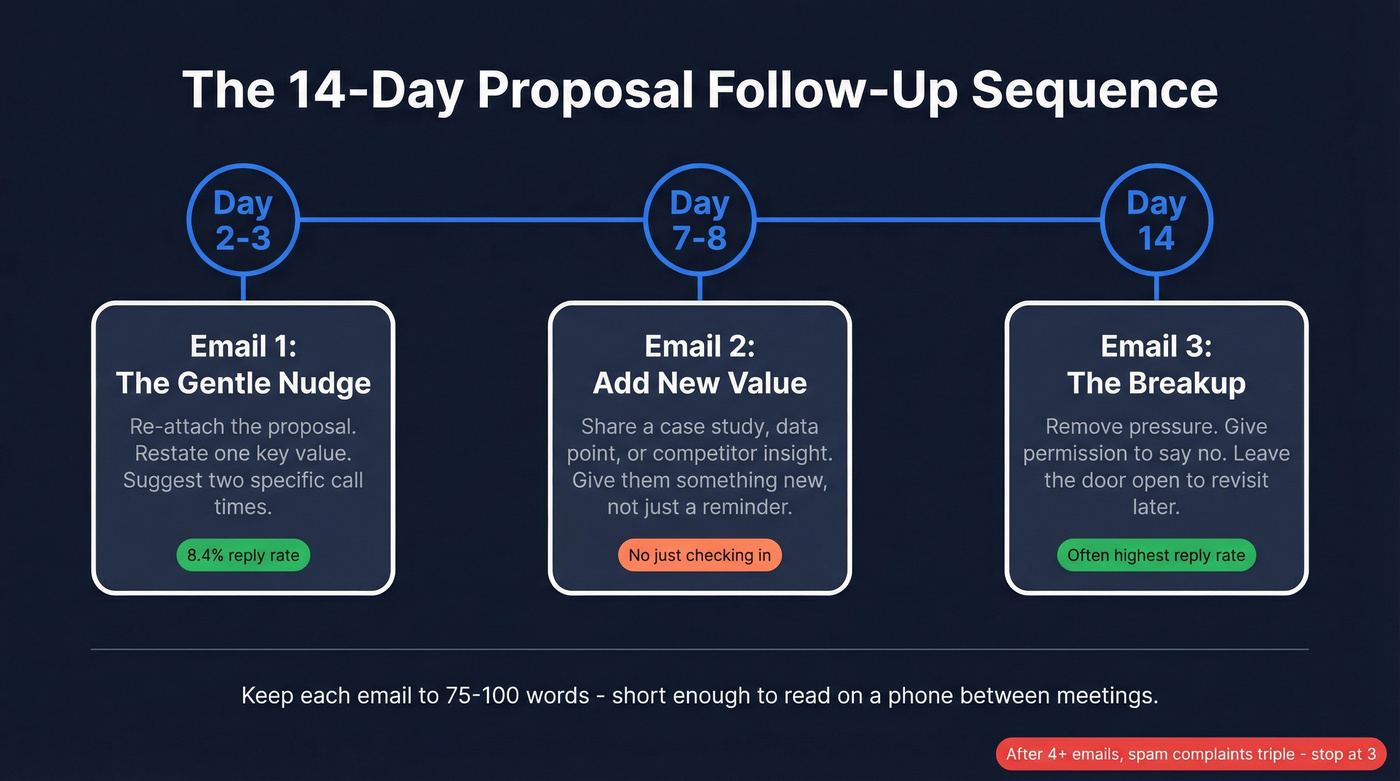
Cognism's cadence research recommends sequences spanning 17-21 days, but for proposal follow-ups specifically, we've found a tighter 14-day window works better. After two weeks of silence, you need a new angle, not another nudge.
Email 1: The Gentle Nudge (Day 2-3)
Subject line: Quick question on the [project name] proposal
Hi [First Name],
I wanted to make sure the proposal I sent on [date] came through clearly. I've attached it again here for easy reference.
The core of what we're proposing is [one sentence restating the key value - e.g., "cutting your onboarding time from 6 weeks to 2"]. If anything needs adjusting to fit your team's priorities, I'm happy to revise.
Would [Tuesday or Wednesday] work for a 15-minute call to walk through it?
Best, [Your name]
Re-attaching the proposal matters more than you'd think. People lose attachments, forget which thread had the PDF, or opened it on their phone and never came back to it on desktop.
If you want more variations on a light-touch opener, pull from a follow-up email template library and adapt the tone to your deal size.
Email 2: Add New Value (Day 7-8)
Subject line: [Company name] + [relevant result]
Hi [First Name],
Since I sent the proposal, I came across [a case study / benchmark / article] that's relevant to what you're solving - [one sentence summary with link if applicable].
I think it reinforces why [specific element of your proposal] would accelerate [their goal] for [their company]. Happy to walk through the numbers if that's useful.
Worth a quick chat this week?
[Your name]
This email works because it gives something new. A case study, a data point, a competitor insight - anything that makes the prospect smarter, not just reminded. "Just checking in" is the fastest way to get ignored - use these alternatives to "just checking in" instead. The best follow-up email after sending a proposal adds something the prospect didn't have before.
Email 3: The Breakup (Day 14)
Subject line: Should I close this out?
Hi [First Name],
I haven't heard back, so I want to respect your time. I'll close out my notes on this for now.
If priorities shifted or the budget moved, no hard feelings at all. If you'd like to revisit the proposal down the road, just reply to this thread - everything will still be here.
Wishing you a great [quarter/season], [Your name]
The breakup email removes pressure. Giving someone permission to say no often gets them to say "actually, let's talk." I've personally seen breakup emails pull higher reply rates than the first two touches combined. If you want more breakup variations, see our breakup email guide.
Subject Lines That Get Opened
An analysis of 5.5M emails found personalized subject lines hit a 46% open rate versus 35% without - a 31% lift. Question-format subject lines matched that 46% mark. One-word subject lines underperform at 38%, and ALL CAPS drops opens to 30%.
If you want plug-and-play options, use these email subject line formulas and tailor them to the proposal context.
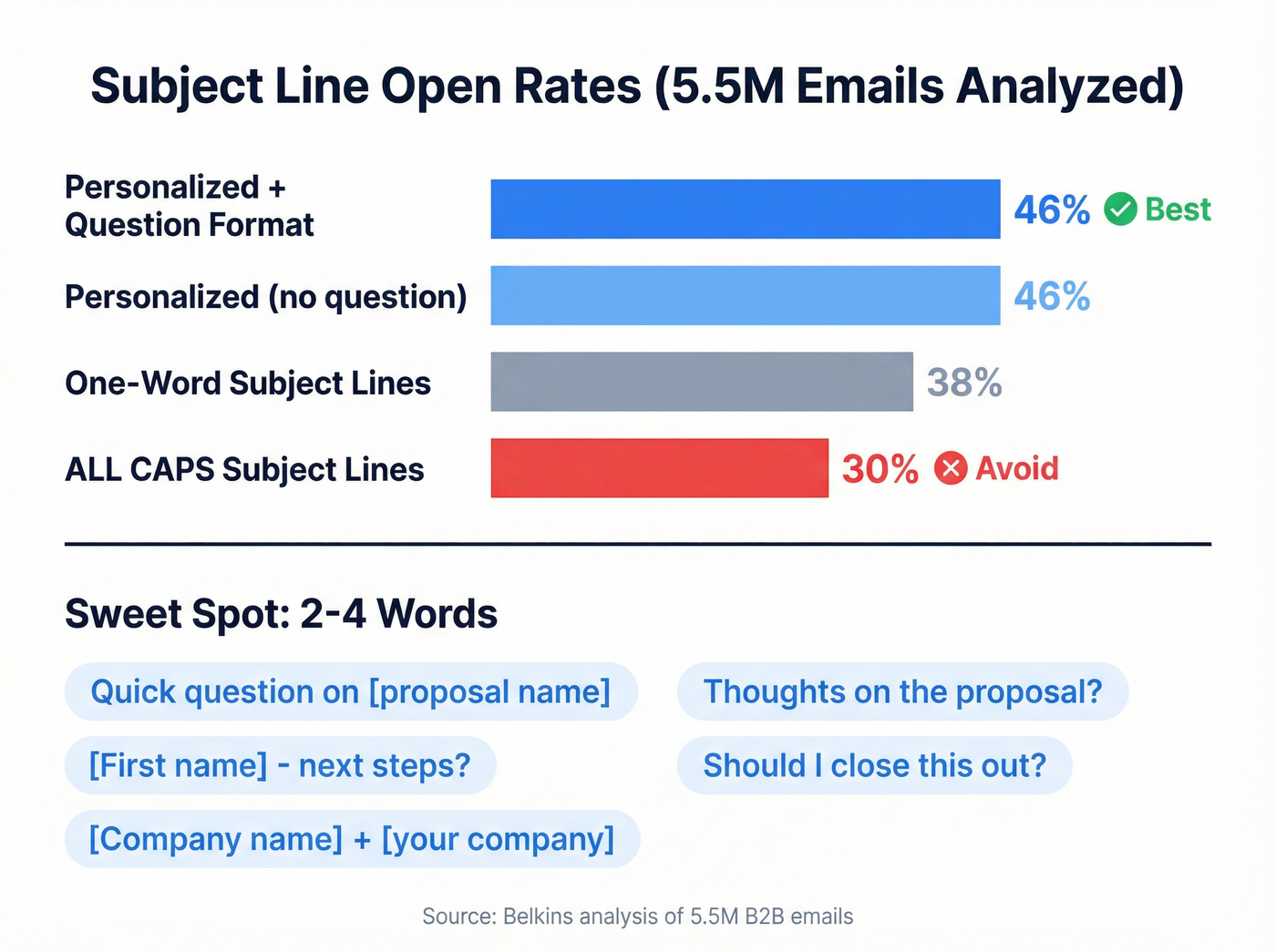
The sweet spot is 2-4 words:
- Quick question on [proposal name]
- [First name] - next steps?
- Thoughts on the proposal?
- Should I close this out?
- [Company name] + [your company]
Short, personalized, framed as a question. For more examples, browse our email subject line examples.

Your follow-up sequence is only as good as the email address it lands on. Prospeo verifies contacts with 98% accuracy on a 7-day refresh cycle - so your proposal follow-ups reach real inboxes, not dead ends. At ~$0.01 per email, one verified follow-up costs less than the coffee you're drinking while waiting for a reply.
Verify every proposal recipient before you hit send.
When to Stop Following Up
Three to four follow-ups is the ceiling. The data is clear: 4+ emails in a sequence more than triples unsubscribe and spam complaint rates. You aren't just wasting time - you're damaging your sender reputation.
Here's the thing most people won't tell you: if three well-crafted follow-ups get nothing, the problem usually isn't your cadence. It's your offer. Or your pricing. Or you're talking to the wrong person.
After three attempts with no response, pause entirely. Circle back in 3-6 months with a fresh angle - a relevant industry shift, a new case study, or a change in your offering. Don't just resend the original proposal. If you need a structure for that later touch, use a re-engagement emails framework.
Go Beyond Email
Omnichannel outreach converts up to 250% better than email alone. A message on a professional network paired with a profile visit pulls an 11.87% reply rate - higher than any email follow-up in the same dataset. And leads contacted within 5 minutes of engagement are 21x more likely to qualify.
If you're building a multi-touch plan, it helps to map it like a types of email campaigns sequence (even if you add calls/social touches).
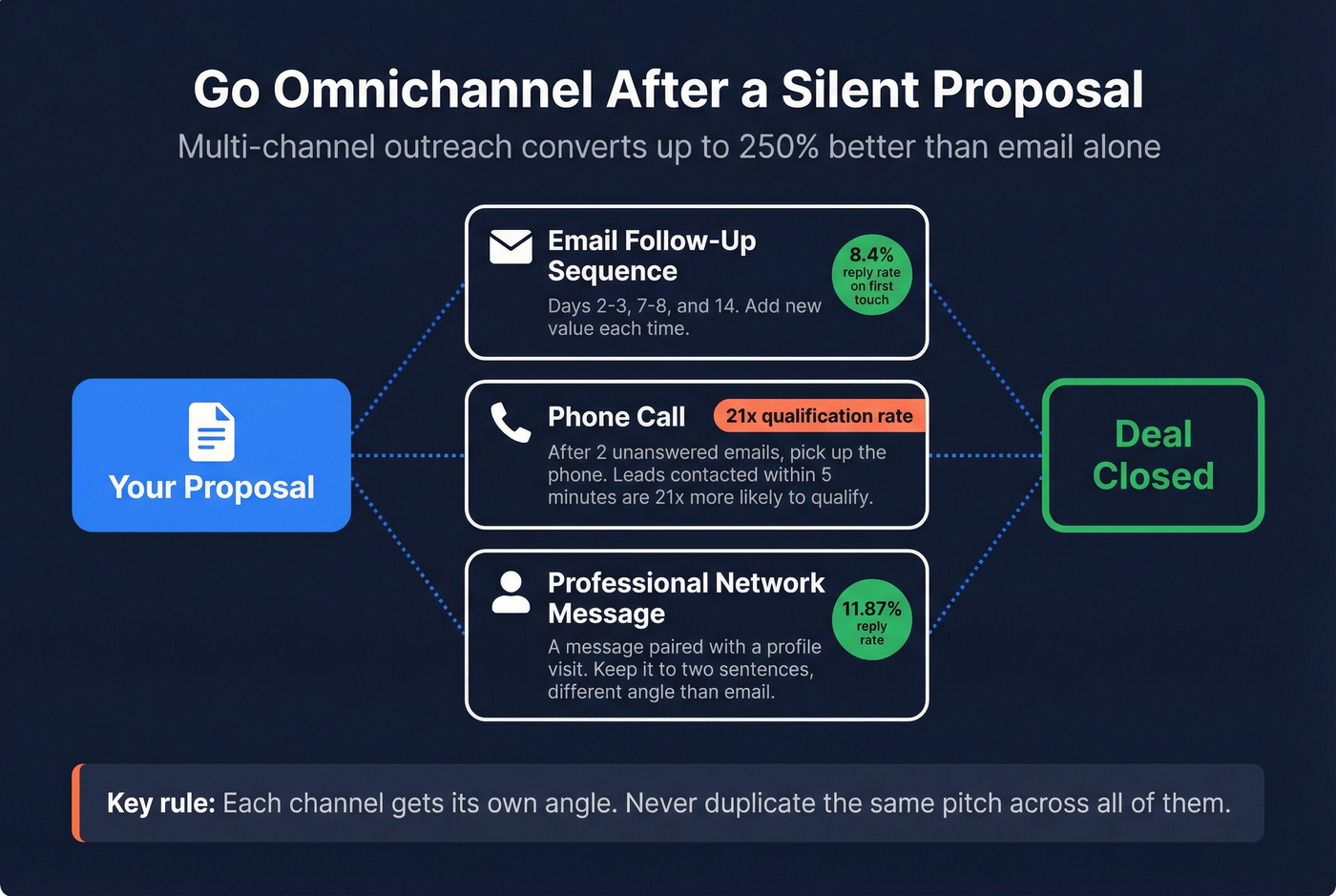
If your second email gets no response, pick up the phone or send a two-sentence message on a professional network. Each channel earns its own angle - don't duplicate the same pitch across all of them.
Make Sure Your Follow-Up Actually Lands
Your perfectly crafted follow-up means nothing if it bounces. Email addresses go stale fast - someone changes roles, a company switches domains, an alias gets deactivated. We've seen proposals go cold simply because the follow-up bounced and the sender never knew.
Before sending any follow-up sequence, run the recipient's address through a real-time verification tool. If you want a broader comparison of options, start with our list of email checker tools. Prospeo handles this with 98% accuracy on a 7-day data refresh cycle, and the free tier gives you 75 verifications per month - more than enough to check every proposal recipient before you hit send.

Going omnichannel after a silent proposal? You need more than an email address. Prospeo gives you verified direct dials (125M+ mobile numbers, 30% pickup rate) so your Day 10 phone follow-up actually connects. Find the decision-maker's mobile in one click with the Chrome extension - no guessing, no gatekeepers.
Turn silent proposals into live conversations with verified direct dials.
Mistakes That Kill Your Follow-Up
Look, nobody enjoys writing follow-up emails. But these mistakes will guarantee yours get ignored:
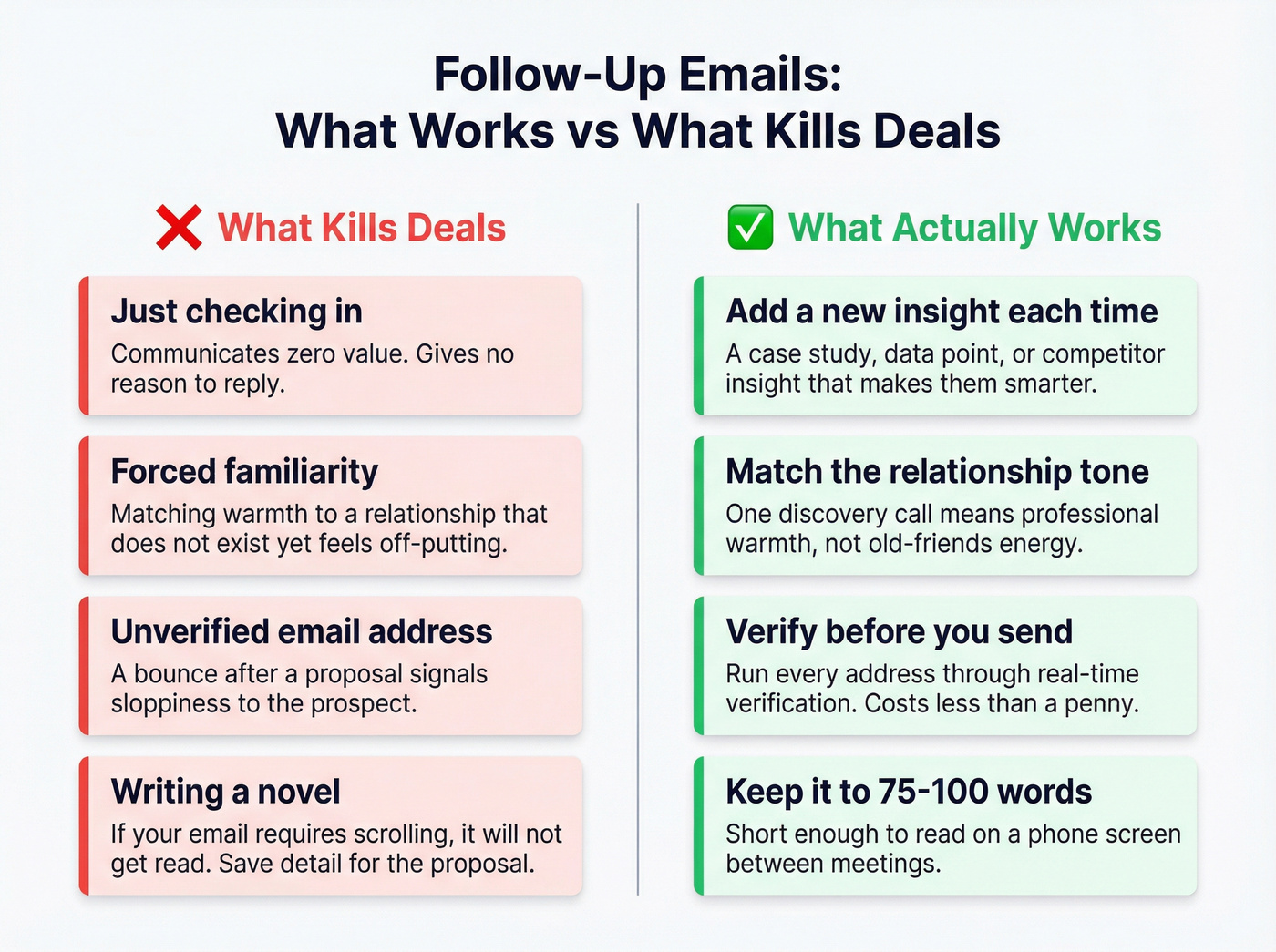
"Just checking in" as your opener. It communicates zero value. Every follow-up needs a reason to respond - a new insight, a specific question, a deadline. If you can't articulate why you're emailing beyond "I want a reply," don't send it yet. (More phrasing options: following up on my previous email.)
Forced familiarity with someone you barely know. Match the warmth level of your existing relationship. Overdo it and you come across as, frankly, a bit off-putting. If you've had one 30-minute discovery call, you aren't old friends.
Sending to the wrong person or an unverified address. A bounce after a proposal signals sloppiness. And if your contact can't approve the deal alone, ask who else should review it - that's a perfectly natural follow-up question. If you need wording, use a how to ask for a point of contact in email template.
Writing a novel. Keep each follow-up to 75-100 words. If your email requires scrolling, it won't get read. Save the detail for the proposal itself.
FAQ
How long should I wait to follow up after sending a proposal?
Wait 2-3 business days. The first follow-up email captures the highest reply rates - an 8.4% response rate in a study of 16.5M emails. Following up sooner feels pushy; waiting longer than a week risks being forgotten entirely.
How many follow-up emails is too many?
Cap it at three, four at the absolute most. After 4+ emails in a sequence, unsubscribes and spam complaints more than triple. If three follow-ups get silence, pause and revisit in 3-6 months with a completely fresh angle.
What should I say instead of "just checking in"?
Restate the proposal's core value in one sentence, re-attach the document, and ask a specific question - like suggesting two times for a call. Better yet, share a relevant case study or data point that adds new context to your proposal.
Should I call instead of emailing?
Yes, especially after two unanswered emails. Multi-channel outreach converts up to 250% better than email alone. A brief call shows commitment without being pushy, and it breaks through inbox clutter in a way that a fourth email never will.
How do I make sure my follow-up doesn't bounce?
Verify the recipient's email address before sending using a real-time verification tool. Thread your reply to the original proposal email so it lands in the same conversation, and avoid spam-trigger words and ALL CAPS in subject lines.