

15 Types of Email Campaigns (and Which to Set Up First)
Email isn't dying. Bad campaigns are. Email still returns $36-$40 for every $1 spent, and 361.6 billion messages get sent daily - a number that keeps climbing. The problem isn't reach. It's that most teams blast the same generic newsletter to their entire list and wonder why engagement flatlines.
One marketer on r/Emailmarketing described being expected to produce 24 campaigns across brands in a single eight-hour shift. That's the reality for stretched teams, which is exactly why prioritization matters more than volume. Here are fifteen types of email campaigns, ranked by impact, with 2026 benchmarks and the tactical details that actually move numbers.
The 4 Campaigns to Build First
If you're building from zero, set up these four before anything else:
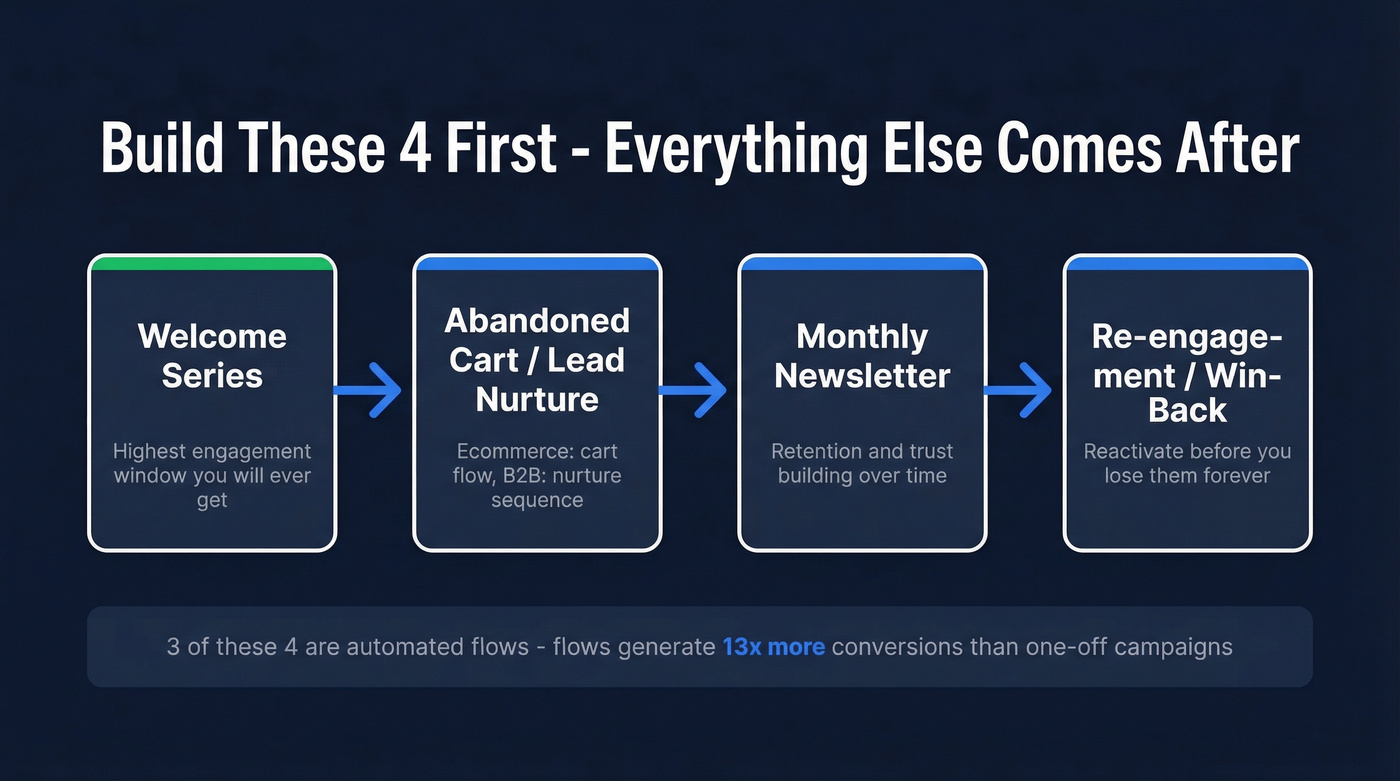
- Welcome series - your highest-engagement window, ever
- Abandoned cart flow for ecommerce or lead nurture sequence for B2B
- Monthly newsletter - retention and trust-building
- Re-engagement / win-back - reactivate before you lose them
Why these four? Automated flows generate 3.3x the clicks and 13x the conversions of one-off campaigns, based on Klaviyo's analysis of 183,000+ brands. Some analyses put the gap even higher - up to 30x more revenue per recipient from flows. Three of the four items above are flows. Get them running, then layer in the rest.
Campaigns vs. Flows
This distinction trips up more people than it should. A campaign is a one-off send you schedule manually - a product launch, a holiday sale, a monthly newsletter. A flow (sometimes called an automation) triggers automatically based on user behavior: someone abandons a cart, a flow fires; someone signs up, a welcome series starts.
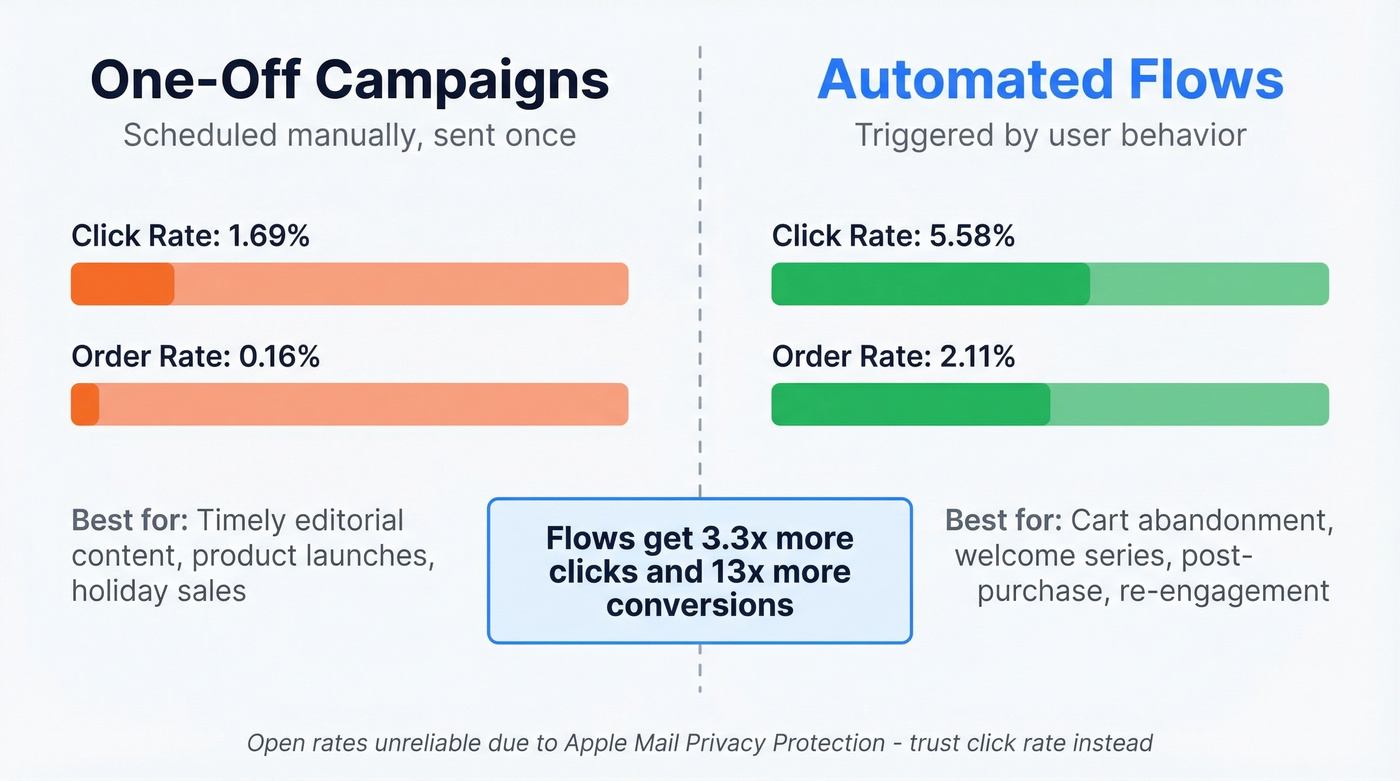
The performance gap between them is massive.
| Metric | One-Off Campaigns | Automated Flows | Top 10% Flows |
|---|---|---|---|
| Open Rate | 31% | Not reported separately | - |
| Click Rate | 1.69% | 5.58% | 10.48% |
| Order Rate | 0.16% | 2.11% | 4.3% |
One caveat: open rates are inflated by Apple Mail Privacy Protection, which pre-loads tracking pixels. Click rate is the metric you can actually trust. Flows crush campaigns on clicks by more than 3x.
Use campaigns for timely, editorial content. Use flows for everything behavioral. Most of your revenue will come from flows.
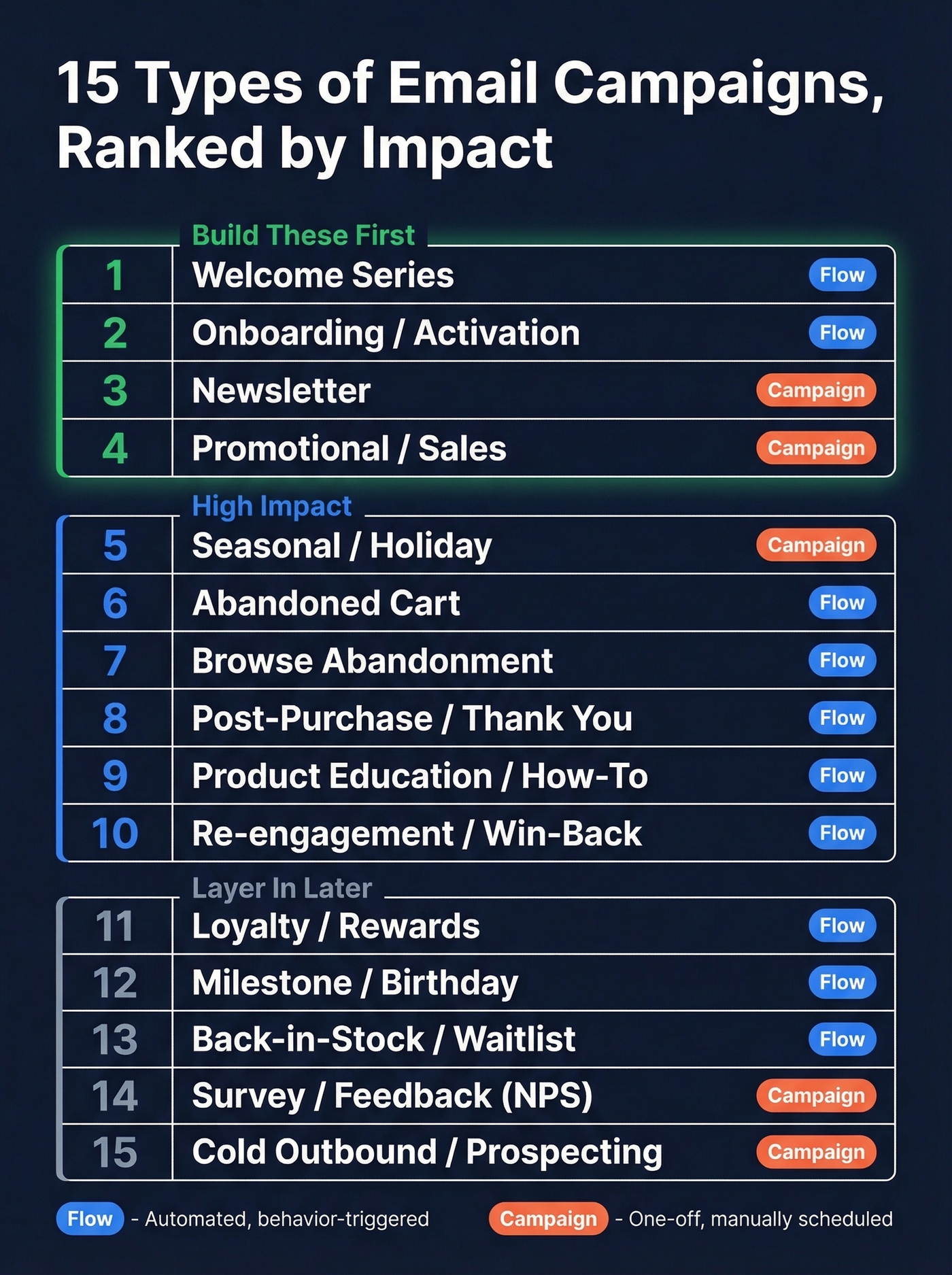
The 15 Campaign Types, Ranked
1. Welcome Series
Your subscriber's attention peaks in the first 48 hours. A 3-5 email welcome series should introduce your brand immediately, deliver a value hook on day 1-2, share social proof on day 3-4, and make a soft offer on day 5-7. This is the highest-ROI flow you'll ever build. Don't overthink it - just ship it.
2. Onboarding / Activation
Different from welcome. Onboarding emails guide a user toward a specific activation milestone - completing a profile, using a core feature, finishing setup. Coinbase does this well: each email focuses on one action, like verifying identity or making a first trade. SaaS companies live and die by this flow. Trigger it on signup and branch based on whether the user hits the milestone or stalls.
3. Newsletter
The workhorse. Newsletters build trust over time and keep your brand top-of-mind between purchases or deals. The key is consistency and segmentation - a monthly cadence works for most B2B teams, weekly for media and ecommerce.
Pick one theme per issue instead of cramming everything into a single send. A/B test subject lines regularly and keep them under 50 characters so they don't get clipped on mobile, where 60%+ of emails are opened. If you need ideas fast, pull from proven subject lines and iterate.
4. Promotional / Sales
Flash sales, limited-time offers, discount codes. The tactical tip that matters most: emails with a single CTA increase click-through rates by up to 371% compared to multiple competing CTAs. One offer, one button, one action. Send-time optimization is worth using when your ESP supports it.
5. Seasonal / Holiday
Black Friday, back-to-school, end-of-quarter - whatever your audience's calendar looks like. Plan these 4-6 weeks out. The mistake we see repeatedly is treating seasonal campaigns as one-off blasts instead of 3-4 email sequences. JetBlue runs seasonal campaigns as multi-touch sequences: teaser, launch, reminder, last chance. Copy that structure.
6. Abandoned Cart
This is the money flow - and the one most teams get wrong.
Three emails, timed at roughly 3 hours, 24 hours, and 72 hours after abandonment. Email 1 is a gentle reminder with the exact items left behind. Email 2 adds social proof or answers objections. Email 3 introduces urgency or a small incentive.
Here's the contrarian take worth internalizing: avoid leading with discounts in emails 1 or 2. You'll train customers to abandon carts just to trigger a coupon. Save incentives for email 3, if you use them at all. Dynamic product blocks showing abandoned items are standard practice now - include a direct add-to-cart link.
7. Browse Abandonment
Lighter touch than cart abandonment - the user browsed but didn't add to cart. Trigger within a few hours of inactivity. Show the products they viewed, suggest similar items. Keep the copy casual; they weren't as far down the funnel.
8. Post-Purchase / Thank You
Confirmation, shipping updates, and a genuine thank-you. This is also your best window for cross-sell recommendations and review requests. Time the review ask about a week after delivery, not immediately.
For consumable products, add replenishment reminders based on average purchase cycles - these quietly become one of your highest-converting flows.
9. Product Education / How-To
Teach your customers how to get more value from what they already bought. SaaS companies use these to drive feature adoption. Ecommerce brands use them for styling guides, recipes, or use-case inspiration. These reduce churn and support tickets at the same time.
10. Re-Engagement / Win-Back
For established lists: target subscribers who haven't opened or clicked in 60-90 days. A 2-3 email sequence works: "We miss you," then a value reminder, then a final "should we remove you?" That last email is the most important - it creates urgency and cleans your list simultaneously.
11. Loyalty / Rewards
Points balance updates, tier upgrades, exclusive early access. These work best when triggered by real milestones - hitting a spend threshold, anniversary of first purchase - rather than sent on arbitrary schedules.
12. Milestone / Birthday
Birthday discounts, account anniversaries, usage milestones ("You've completed 100 workouts!"). Simple to set up, surprisingly high engagement. The personalization feels genuine because it's tied to real dates, not marketing calendars.
13. Back-in-Stock / Waitlist
If someone wanted a product that was unavailable, telling them it's back is one of the highest-intent emails you can send. Trigger immediately on restock. Include a direct add-to-cart link - don't make them browse again.
14. Survey / Feedback (NPS)
Send NPS or CSAT surveys 7-14 days after a key interaction: purchase, onboarding completion, support ticket resolution. Keep the email short - one question, one click. The follow-up matters more than the initial ask: route promoters to review sites, detractors to support.
15. Cold Outbound / Prospecting
Most marketing guides skip cold outbound because it lives in the sales org. But it's one of the highest-impact email campaign types for B2B teams, and it has a prerequisite the others don't - verified contact data. If you're building sequences, start with a solid B2B cold email sequence and tighten your sales prospecting techniques before scaling volume.

Bad data means bounces, and bounces destroy your sender reputation for every other campaign on this list. We've seen this firsthand: Meritt's team was running at a 35% bounce rate before switching to Prospeo's verified data, which dropped it under 4%. That's the difference between a functioning email program and one that's slowly killing your domain. Prospeo's 5-step verification catches spam traps and honeypots before they hit your sending infrastructure, and the free tier gives you 75 verified emails per month - enough to test a small outbound sequence. If you're troubleshooting, use a proper email bounce rate playbook and keep an eye on email velocity as you ramp.

Automated flows crush one-off campaigns - but only if your emails actually land. Prospeo's 98% verified emails and 7-day data refresh keep your welcome series, cart flows, and nurture sequences out of the bounce folder.
Stop building flows on bad data. Start with emails that actually arrive.
B2B vs. B2C: Different Playbooks
Not every campaign type matters equally for every business. 79% of B2B marketers say email is their top content distribution channel, but the campaigns they run look nothing like what an ecommerce brand sends.
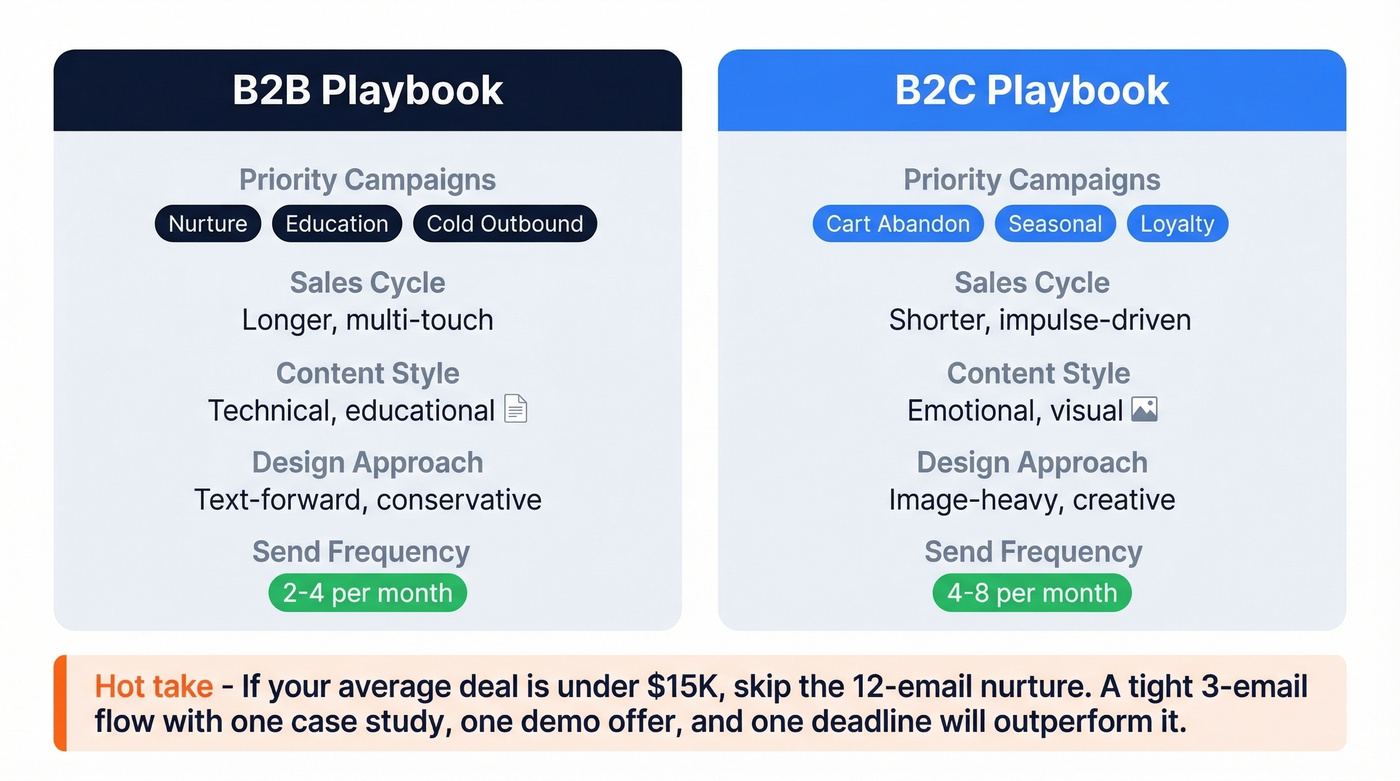
| Dimension | B2B | B2C |
|---|---|---|
| Top campaigns | Nurture, education, cold outbound | Cart abandon, seasonal, loyalty |
| Sales cycle | Longer, multi-touch | Shorter, impulse-driven |
| Content style | Technical, educational | Emotional, visual |
| Design | Text-forward, conservative | Image-heavy, creative |
| Frequency | 2-4/month | 4-8/month for retail |
B2B teams should prioritize lead nurture sequences, product education flows, and cold outbound before worrying about seasonal promotions. B2C teams should nail cart abandonment and browse abandonment before building a loyalty program. Start with what matches your sales cycle.
Here's our hot take: if your average deal size is under $15K, you probably don't need a 12-email nurture sequence. A tight 3-email flow with one case study, one demo offer, and one deadline will outperform a drawn-out drip that loses momentum by email 6.
How Often to Send
69% of users unsubscribe because they receive too many emails. But sending more isn't actually the problem - sending unsegmented emails is. A daily email to an engaged buyer segment performs fine. A weekly blast to your entire list will bleed subscribers.
| Business Type | Recommended Frequency |
|---|---|
| B2B | 2-4 emails/month |
| B2C Retail | 4-8 emails/month |
| Ecommerce | 4-5/week if segmented |
| Service businesses | 2-3 emails/month |
The real fix is a preference center. Let subscribers choose their frequency. Then respect it.
Segmentation Powers Every Campaign
Every campaign type on this list performs better with segmentation. AI-driven segmentation and predictive modeling are now built into most major ESPs - use them for send-time optimization and engagement scoring at minimum. Here's a practical framework organized by data source:
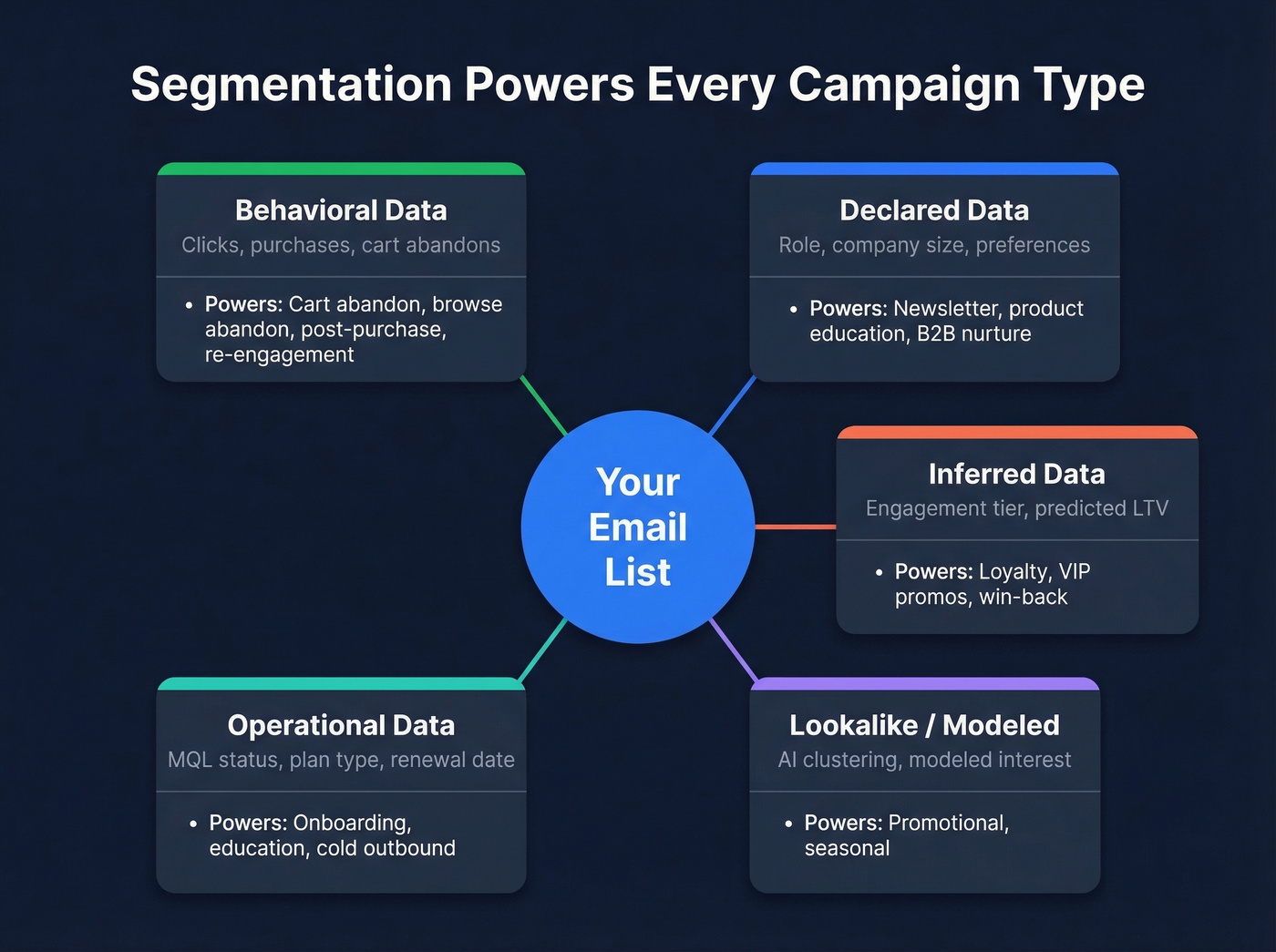
| Data Source | Example Signals | Powers These Campaigns |
|---|---|---|
| Behavioral | Clicks, purchases, cart abandons | Cart/browse abandon, post-purchase, re-engagement |
| Declared | Role, company size, preferences | Newsletter, product education, B2B nurture |
| Inferred | Engagement tier, predicted LTV | Loyalty, VIP promos, win-back |
| Lookalike/Modeled | AI clustering, modeled interest | Promotional, seasonal |
| Operational | MQL status, plan type, renewal date | Onboarding, education, cold outbound |
Most teams start with behavioral and declared data. That's enough to meaningfully segment your first four campaign types. Inferred and modeled segments come later, once you have enough data to make the models useful. If you want a deeper framework, build around intent based segmentation and track performance with a clean click rate formula.
Deliverability - The Campaign Killer
None of this matters if your emails land in spam. When Litmus analyzed thousands of emails, 70% showed at least one spam-related issue. ActiveCampaign reports a 94.2% deliverability rate across their platform - meaning even on a well-regarded ESP, nearly 6% of emails miss the inbox entirely.
The non-negotiable checklist:
- Authenticate everything. SPF, DKIM, and DMARC are baseline. If you haven't set these up, stop reading and go do it now. (If you need a walkthrough, start with DMARC alignment and a working SPF record example.)
- Watch your weight. Gmail clips emails after 100KB. Keep your HTML lean.
- Clean your list every 3-6 months. Remove hard bounces immediately. After 3-5 non-engaged sends, sunset subscribers who stay inactive.
- Monitor with tools. Google Postmaster for domain reputation, Litmus for spam testing.
Let's be honest: the fastest way to tank deliverability is sending to bad email addresses. Bounces and spam complaints compound quickly, and once your domain reputation drops, every campaign on this list suffers - not just outbound. For a full remediation checklist, follow an email deliverability guide and use dedicated email reputation tools as you scale.
Your re-engagement and win-back campaigns can't save contacts you never reached in the first place. Prospeo gives you 143M+ verified emails and 125M+ direct dials so every campaign type hits real inboxes - at $0.01 per email.
Great campaigns deserve great data. Get both for free.
FAQ
What is an email campaign?
A planned email or series sent to a specific audience segment to achieve a defined goal - welcoming new subscribers, recovering abandoned carts, driving a seasonal promotion, or nurturing leads toward a purchase. Campaigns can be one-off manual sends or automated flows triggered by user behavior.
How many email campaign types should I use?
Most programs use 10-15 distinct types, but you don't need all of them at once. Start with 3-4 core campaigns - welcome series, cart abandonment or lead nurture, newsletter, and re-engagement - then expand as your list and segmentation data mature.
What's the difference between a campaign and a flow?
A campaign is a one-off send you schedule manually; a flow triggers automatically based on user behavior. Flows generate 3.3x the clicks and 13x the conversions of manual campaigns across 183,000+ brands, making them the higher-ROI investment for most teams.
What's a good open rate in 2026?
The average is 31% across 183K+ brands, with the top 10% hitting 45%+. But open rates are inflated by Apple Mail Privacy Protection. Focus on click rate instead - 1.69% average, 3.38% for top performers - as a more reliable engagement metric.
How do I keep emails out of spam?
Authenticate your domain with SPF, DKIM, and DMARC. Clean your list every 3-6 months. Monitor sender reputation through Google Postmaster. And verify every email address before sending - bounces compound fast, and once your domain reputation drops, recovery takes weeks.