

Follow-Up Email Templates: 15 That Get Replies in 2026
Every follow-up email template you find online tells you the same thing: send five, six, seven follow-ups - persistence wins. That advice is wrong, and the data proves it.
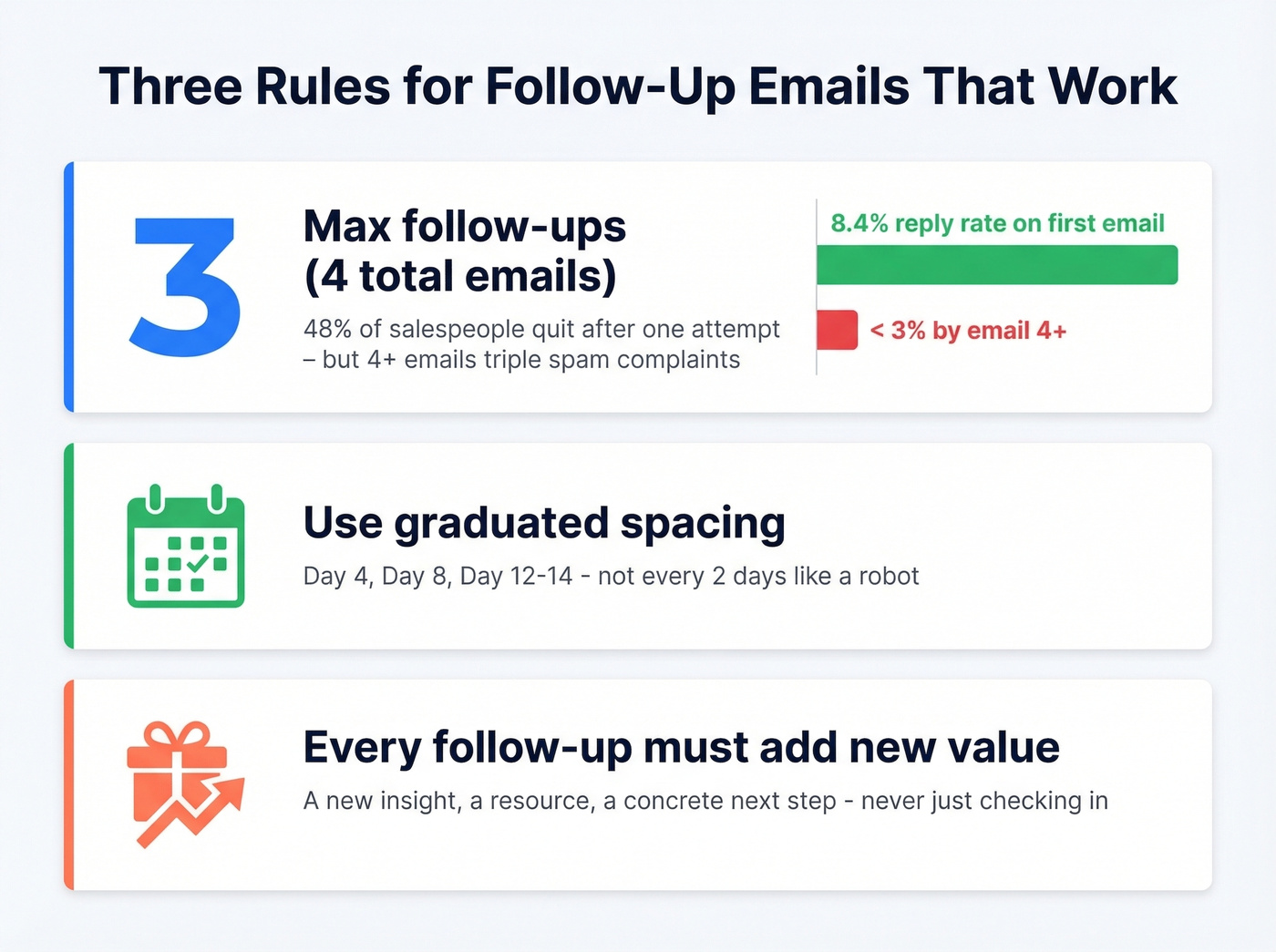
A Belkins study of 16.5M cold emails found the highest reply rate - 8.4% - came from the first email. Every additional follow-up saw diminishing returns, and sending four or more emails in a sequence more than tripled spam complaints and unsubscribe rates. The "always be following up" mantra isn't persistence. It's a deliverability risk.
Fewer follow-ups, smarter spacing, and new value every time you hit send. That's the approach that actually works.
Three Rules Before You Copy Any Template
- Send 3 follow-ups max (4 total emails). That's the sweet spot where you capture replies without triggering spam flags - and it matters, because 48% of salespeople give up after one attempt, which is the opposite extreme.
- Use graduated spacing: Day 4, then Day 8, then Day 12-14. Not every two days like a robot.
- Every follow-up must add new value. A new insight, a relevant resource, a concrete next step. Never just "checking in."
How to Write a Great Follow-Up Email
The structure that works: Intent/Recap → Value Add → CTA. Write the subject line last, after you know what the email actually says.
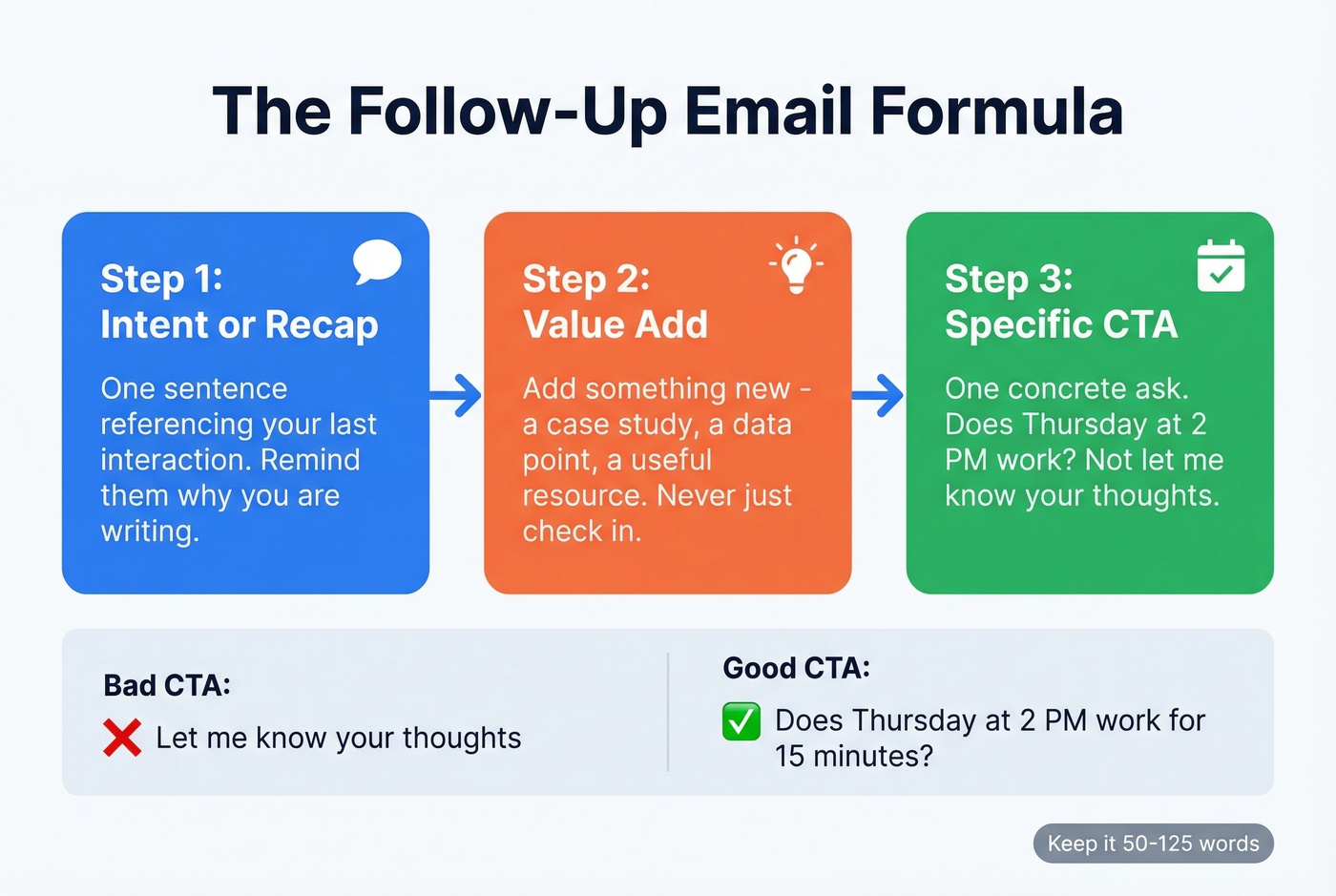
Start by reminding them why you're writing - one sentence referencing your last interaction. Then add something new: a case study, a data point, a resource. Close with a single, specific ask. Not "let me know your thoughts" (that's a CTA graveyard), but something concrete like "Does Thursday at 2 PM work for a 15-minute call?"
Keep the whole thing between 50 and 125 words. Salesforce's sales blog calls out "Just wanted to check in..." as an opener that often goes straight to the trash - and they're right. If your message doesn't give the reader a reason to care, the writing doesn't matter.
If you want more examples beyond this post, start with these sales follow-up templates and adapt them to your deal stage.
When to Send Your Follow-Ups
Static spacing - every two days, like clockwork - looks automated because it is. Graduated spacing feels human and gives the recipient breathing room.
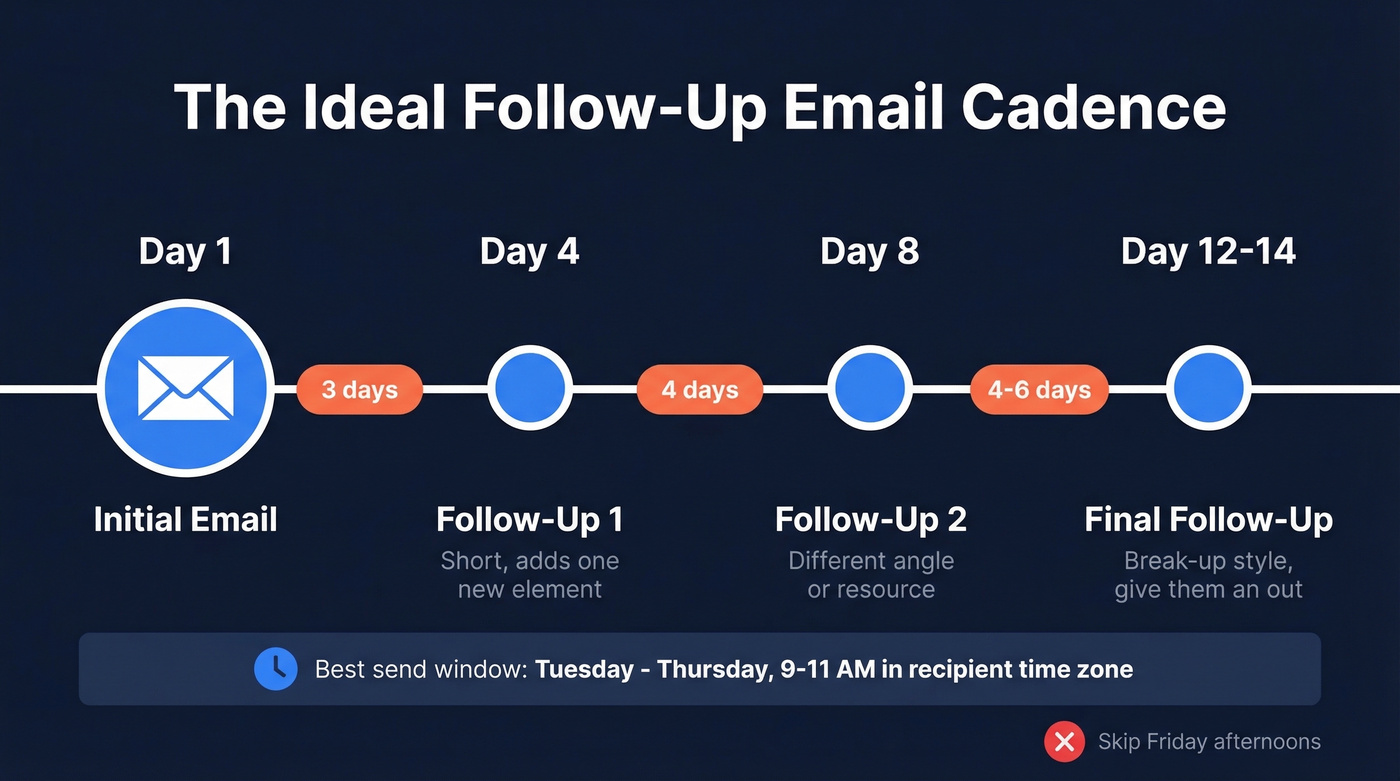
Here's the cadence we've found works best:
- Day 1: Initial email
- Day 4: First follow-up (short, adds one new element)
- Day 8: Second follow-up (different angle or resource)
- Day 12-14: Final follow-up (break-up style, gives them an out)
Send Tuesday through Thursday, 9-11 AM in the recipient's time zone. That window consistently outperforms other slots across both cold outreach data and marketing email benchmarks. MailerLite's analysis of 12B emails found daily senders averaged a 30.04% open rate versus 35.11% for the least-frequent senders - more isn't better. Skip Friday afternoons entirely.
55% of cold email replies come from follow-ups - but that doesn't mean more is better. One nuance from the Belkins data: small businesses can still respond well deeper into a sequence, while enterprise prospects drop off faster. If you're selling into large accounts, 1-2 follow-ups is usually your ceiling.
For a deeper breakdown of timing, see our guide on the best time to send cold emails.
Sales Follow-Up Templates
After No Response
This is the most common scenario and the one where most people default to "just bumping this to the top of your inbox." Don't. The scheduling nudge - a tactic that shows up constantly in r/sales threads - works because it gives the recipient something concrete to respond to.
Subject: Quick question about next week
Hi Sarah,
I'm finalizing my calendar for next week and wanted to see if Tuesday at 10 AM or Wednesday at 2 PM works for a quick call about the pipeline reporting gaps you mentioned.
If neither works, just name a time - happy to flex.
Best, Marcus
Two real time slots are easier to respond to than "let me know when you're free." This is one of the highest-performing templates in our outbound campaigns.
If you’re building a full sequence, use a simple sequence management checklist so each touch has a purpose.
After a Demo or Call
Most reps send a generic "great chatting today" recap. Here's one that actually moves deals forward:
Subject: Next steps on [specific topic discussed]
Hi {{first_name}},
Thanks for walking me through how your team handles {{specific process}} today. The part about {{specific pain point}} stood out - we've helped similar teams cut that from {{X hours}} to {{Y hours}}.
I've attached the case study I mentioned. Want to loop in {{stakeholder}} for a 20-minute follow-up next week?
The magic is in the specificity. Referencing the exact pain point proves you were listening and gives the prospect a reason to forward your email internally. Generic recaps get filed away; specific ones get acted on.
If you need a tighter post-call workflow, borrow a sales meeting follow-up email structure and plug in your details.
After Sending a Proposal
Subject: {{Their company}} proposal - one thing I missed
Hi {{first_name}},
Wanted to flag one thing I didn't cover in the proposal: {{specific ROI point or implementation detail}}. Based on what you told me about {{their situation}}, this could mean {{concrete outcome}}.
I've penciled in implementation for {{timeframe}} - does that still align with your timeline?
The "one thing I missed" framing gives you a legitimate reason to follow up while reinforcing value. It also creates a small open loop the recipient feels compelled to close.
Trigger Event vs. Cold Follow-Up
Here's the thing: a cold follow-up to someone who never responded is fundamentally different from one tied to a real event. Let's compare.
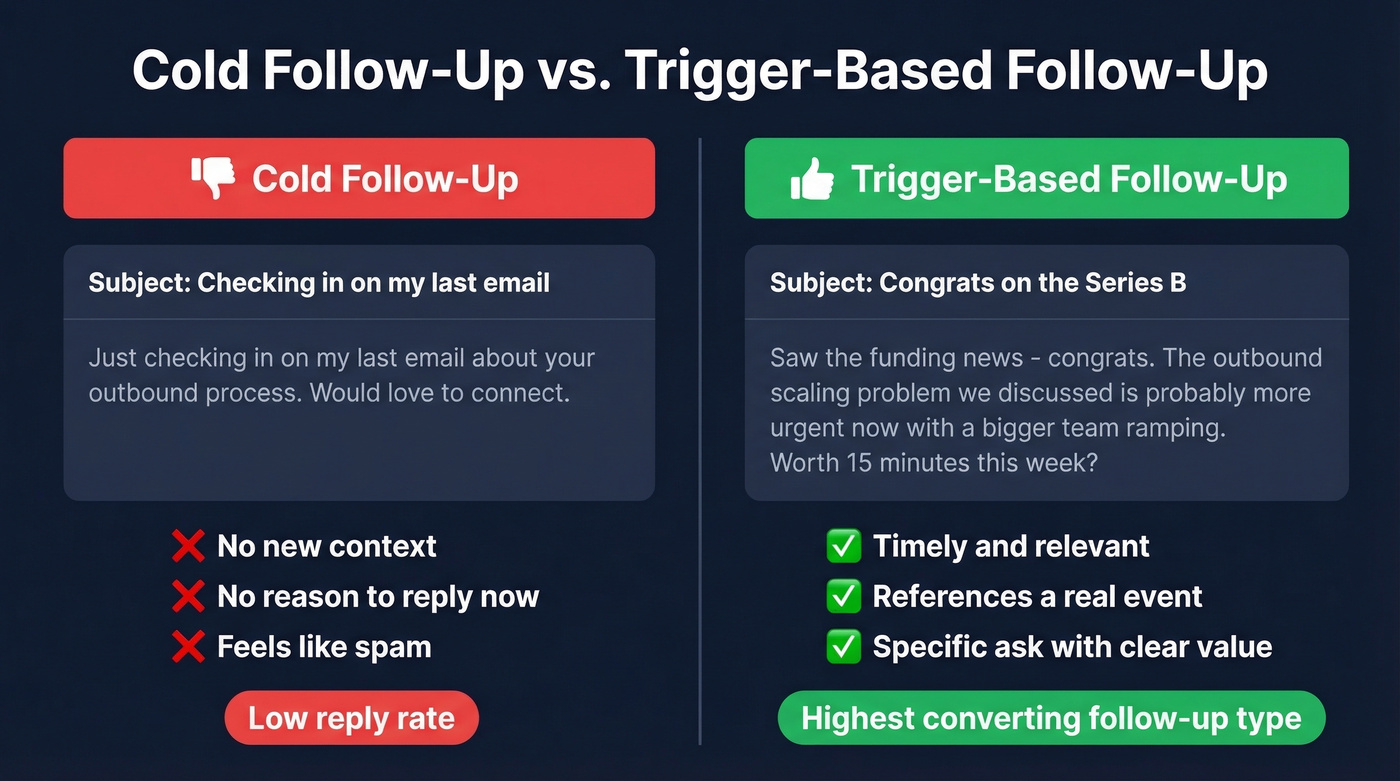
Cold (weak): "Just checking in on my last email about your outbound process."
Trigger-based (strong):
Subject: Congrats on the Series B
Hi {{first_name}},
Saw the funding news - congrats. When we spoke in Q3, scaling the outbound team was on hold until you had budget. Now that's changed, and the {{specific problem}} we discussed is probably more urgent with a bigger team ramping.
Worth a 15-minute catch-up this week?
Trigger events - job changes, funding rounds, expansions - are one of the highest-converting follow-up contexts because the timing is genuinely relevant. If you're not monitoring triggers, you're guessing when to reach out instead of knowing.
To operationalize this, build a lightweight process for how to track sales triggers.
Break-Up Email
Subject: Should I close your file?
Hi {{first_name}},
I've reached out a few times and haven't heard back, so I'll assume the timing isn't right. I won't reach out again, but feel free to get in touch whenever {{their pain point}} moves up the priority list.
Wishing you and the team a great Q2.
The "permission to close" style - featured in Hunter's template library - works because it removes pressure. Counterintuitively, it often gets the reply your previous emails didn't. This is the one template where brevity matters more than value-add.
If you want more “break-up” variations, our polite chaser email guide has additional angles.
Wrong Contact Redirect
Subject: Quick ask - who handles {{function}}?
Hi {{first_name}},
I may have the wrong person - would you mind pointing me to whoever handles {{specific function}} at {{company}}? Happy to take the intro from here.
Thanks either way.
Short, respectful, and easy to forward. Most people will redirect you if you make it effortless for them.

Every follow-up that bounces is a wasted touchpoint - and a hit to your domain reputation. Prospeo's 98% email accuracy means your carefully crafted templates actually reach the inbox. At $0.01 per verified email, bad data stops being the reason your sequences fail.
Stop writing perfect follow-ups to invalid email addresses.
Interview Follow-Up Templates
Thank-You (Same Day)
Yale SOM's career office identifies three ingredients for the perfect interview follow-up: Gratitude + Specificity + Brevity. Send it as soon as possible after the interview - interviewers often upload feedback to the ATS within hours.
Subject: Thank you - enjoyed our conversation about {{specific topic}}
Hi {{interviewer name}},
Thank you for taking the time today. I especially enjoyed discussing {{specific topic from the interview}} - your point about {{their insight}} gave me a new way to think about {{related challenge}}.
I'm excited about the opportunity and confident I can contribute to {{specific team goal}}. Looking forward to next steps.
Generic thank-yous blend into the pile. Specificity is proof you were listening.
Status Check (After 1 Week)
Subject: Following up - {{role title}} interview
Hi {{interviewer name}},
Wanted to check in on the timeline for the {{role title}} position. I remain very interested and happy to provide any additional information that would be helpful.
Three sentences. That's all you need. You're checking on your candidacy, not writing a second cover letter.
Post-Rejection Graceful Close
Subject: Thank you for the update
Hi {{interviewer name}},
I appreciate you letting me know. While I'm disappointed, I genuinely enjoyed learning about {{specific aspect of the company}}. If a similar role opens up in the future, I'd welcome the chance to reconnect.
Hiring managers remember candidates who handle rejection well. Leave the door open - it pays off more often than you'd expect.
Networking & Professional Templates
After a Conference or Event
Subject: Great meeting you at {{event}} - {{resource}} you might like
Hi {{first_name}},
Really enjoyed our conversation about {{specific topic}} at {{event}}. It reminded me of {{resource/article/tool}} - thought you might find it useful: {{link}}.
Would love to continue the conversation. Coffee or a call sometime next week?
The Hunter networking template principles are right: add value, reference something specific, and never "just touch base."
Meeting Recap
Subject: Recap + action items from today
Hi all,
Quick summary from today's call:
- {{Action item 1}} - {{owner}}, by {{date}}
- {{Action item 2}} - {{owner}}, by {{date}}
- Next meeting: {{date/time}}
Let me know if I missed anything.
Simple, useful, and it positions you as the organized person in the room.
Overdue Invoice
Subject: Invoice #{{number}} - now 15 days past due
Hi {{first_name}},
Invoice #{{number}} for {{amount}} was due on {{date}} and is now 15 days overdue. I'd appreciate an update on when we can expect payment.
If there's an issue with the invoice, let me know and I'll sort it out today. Otherwise, please process at your earliest convenience.
The r/Accounting crowd is right - being too polite about overdue payments trains clients to deprioritize you. State the facts, set a clear expectation, and skip the apologetic tone.
Subject Lines That Get Opens
47% of recipients decide whether to open based on the subject line alone. Even worse, 69% mark emails as spam based solely on the subject line. Get this wrong and your perfectly crafted follow-up never gets read.
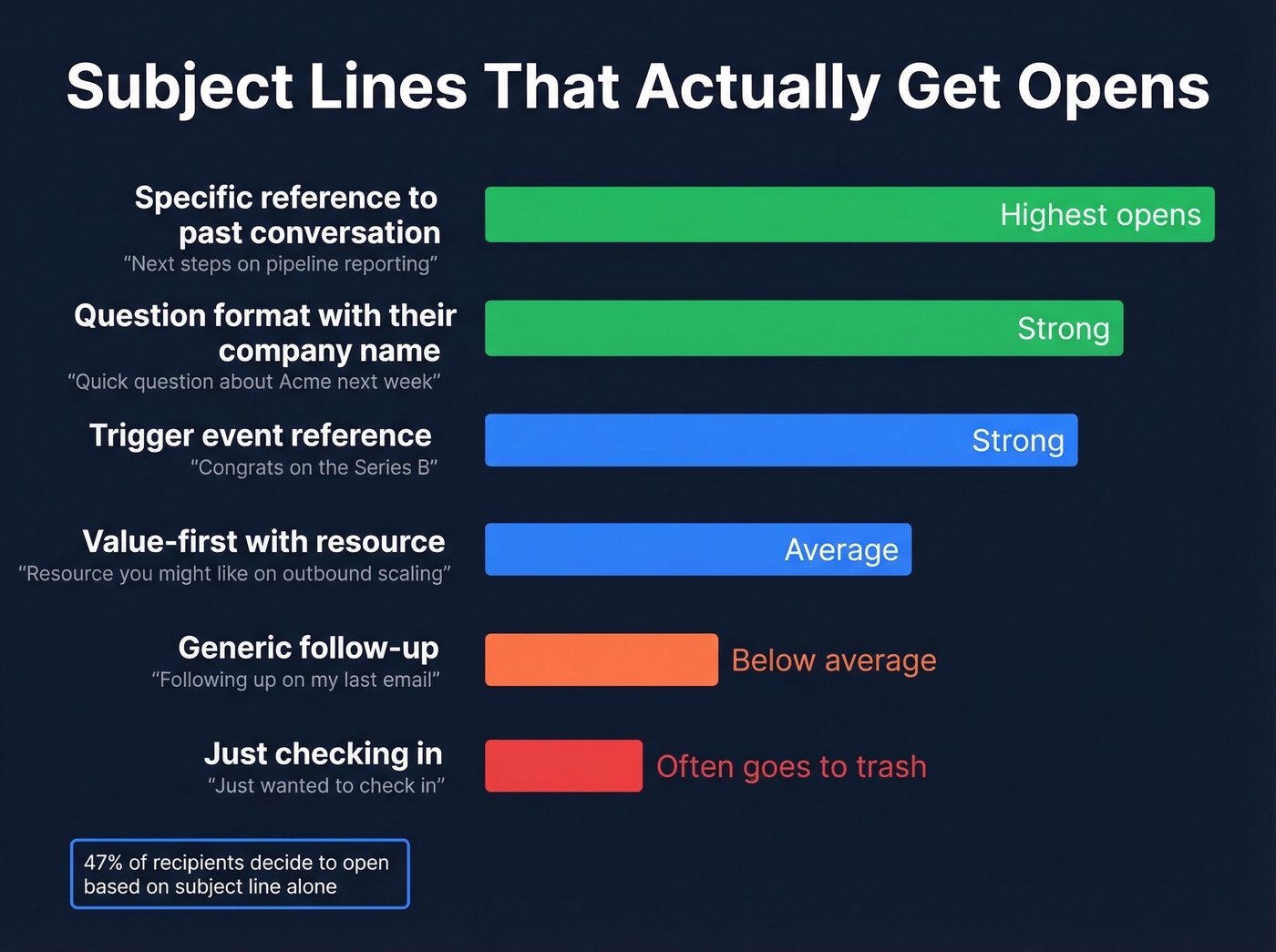
Short and personal wins. Subjects of 2-4 words hit a 46% open rate. Personalization lifts open rates from 35% to 46%. Stay under 70 characters to avoid mobile truncation, and use sentence case - ALL CAPS triggers spam filters.
If you want a swipe file, use these email subject line examples to test variations fast.
Prompt-style (creates urgency without pressure):
- "Quick question about Thursday"
- "15 min this week?"
- "{{First name}} - next steps?"
Value-driven (gives a reason to open):
- "One thing I forgot to mention"
- "Saw your funding news"
- "{{Their company}} <> {{Your company}}"
Permission-based (works for break-up emails):
- "Should I close your file?"
- "Re: {{original subject}}" (use sparingly - it works but feels manipulative if overused)
Mistakes That Kill Follow-Ups
Don't send 4+ emails in a sequence. The Belkins data is clear - spam complaints more than triple past that point. Cap at 3 follow-ups. After that, you're not persistent; you're a nuisance.
Don't recycle the same message. Every follow-up should earn its place in someone's inbox. If you can't articulate what's new, don't send it. Swap in a fresh angle, a different resource, or a new template rather than resending the same copy with a slightly different opening line.
If you’re stuck on “what’s new,” this playbook on how to add value in sales helps you generate real value-adds by stage.
Don't use vague CTAs. "Let me know your thoughts" is where deals go to die. Ask for something specific - a date, a yes/no, a referral to the right person.
For more CTA patterns, see our email call to action guide.
Don't open with "just checking in." It signals you have nothing to say. Lead with a reason for writing - a trigger event, a new resource, a concrete question.
If you need alternatives that don’t sound robotic, use this guide on how to say just checking in professionally.
Don't send to unverified addresses. This is the mistake that kills everything else. We've watched SDR teams send 500 follow-ups, see 47 bounce, and tank their domain reputation in a single afternoon. Once your sender score drops, even your good emails to valid addresses start landing in spam. Prospeo catches bounces, spam traps, and dead addresses before they damage your domain - 98% accuracy with a 7-day data refresh cycle, so you're not following up with someone who left the company six months ago. Verify before you send. Every time.
If you’re troubleshooting deliverability, start with our email deliverability guide and then tighten your email bounce rate controls.
Real talk: if your deal size is under $10k, you probably don't need a seven-email drip sequence or a $30k/year sales engagement platform. You need three good templates sent to verified addresses. The teams we see booking the most meetings aren't the ones with the longest sequences - they're the ones with the cleanest data and the best timing.
Trigger-based follow-ups convert because the timing is real. Prospeo tracks job changes, funding rounds, and buyer intent across 15,000 topics - so you know exactly when to send that follow-up and who to send it to. 300M+ profiles, refreshed every 7 days.
Find the trigger event before your competitor does.
FAQ
How many follow-up emails should I send?
Three follow-ups after your initial email (four total touches). Beyond that, spam complaints triple and reply rates decline. Cap your sequence at three and make each one count.
How long should I wait before following up?
Wait 3-4 days after your initial email, then use graduated spacing: Day 8 for the second, Day 12-14 for the final. Avoid rigid two-day intervals - they look automated and annoy recipients.
What's the best subject line for a follow-up email?
Keep it 2-4 words, personalized, and in sentence case. Lines like "Quick question about Thursday" hit 46% open rates. Avoid ALL CAPS and generic phrases like "Following up" - 69% of recipients flag spam based on the subject alone.
Should I follow up after an interview if I haven't heard back?
Yes - send a thank-you the same day, then one status check after a week. Two follow-ups max. Reference something specific from the conversation to stand out from generic candidates.
How do I stop follow-ups from landing in spam?
Verify every address before sending, keep bounce rates under 3%, and avoid spam-trigger words in subject lines. Prospeo's 5-step verification - including catch-all handling and spam-trap removal - catches invalid addresses before they damage your sender reputation. Free tier includes 75 verifications per month.