

How to Write a Sales Meeting Follow-Up Email That Moves the Deal Forward
You just wrapped a 45-minute discovery call. You've got messy notes, half-cold coffee, and 12 minutes before your next meeting. The sales meeting follow-up email you send in that window matters more than anything you said on the call - and yet 41% of sales reps' time goes to non-revenue activities exactly like this one.
Most follow-up guides hand you 16 templates and zero framework. That's backwards. You need one framework and five variations.
Quick version: Every post-meeting follow-up needs four elements: a thank-you, a summary of what you discussed, answers to open questions, and one clear next step. Send it within 24 hours.
Why Post-Meeting Follow-Ups Matter
42% of all replies come from follow-up emails, not the first touch. That stat is from cold outreach data, where the average reply rate sits at just 3.43%. Follow-ups after an actual sales conversation blow those numbers away because you already have context and rapport.
Knowing how to follow up after a sales meeting is one of the highest-leverage skills an AE can develop. Your recipient knows your name, so the question isn't whether they'll open it - it's whether what's inside moves the deal forward.
The 4-Element Framework
Every follow-up email after a sales meeting should hit these four elements:
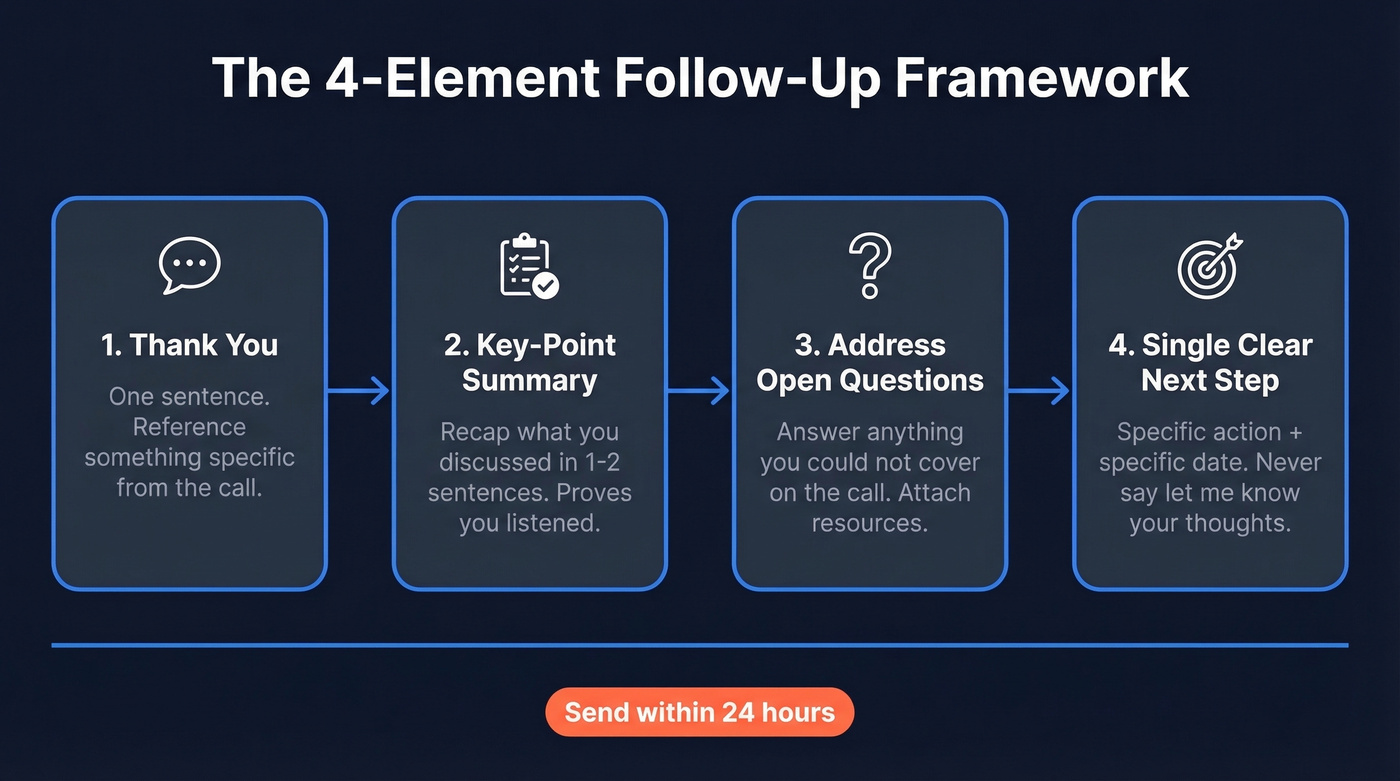
- Thank you - One sentence. Reference something specific from the conversation so it doesn't read like a template.
- Key-point summary - 1-2 sentences recapping what you discussed. This proves you listened and creates a shared record both sides can point back to.
- Address open questions - If you couldn't answer something on the call, answer it here. If there was an objection, acknowledge it with supporting material.
- Single clear next step - Not "let me know your thoughts." A specific action with a specific date.
This framework replaces the ad-hoc "rewrite my notes into an email" process that every AE quietly hates. It also works as a follow-up email prompt - paste the four elements into ChatGPT with your call notes and you'll get a solid first draft in seconds.
If you want more plug-and-play options, start with these follow-up templates that are built to get replies.
5 Templates by Deal Stage
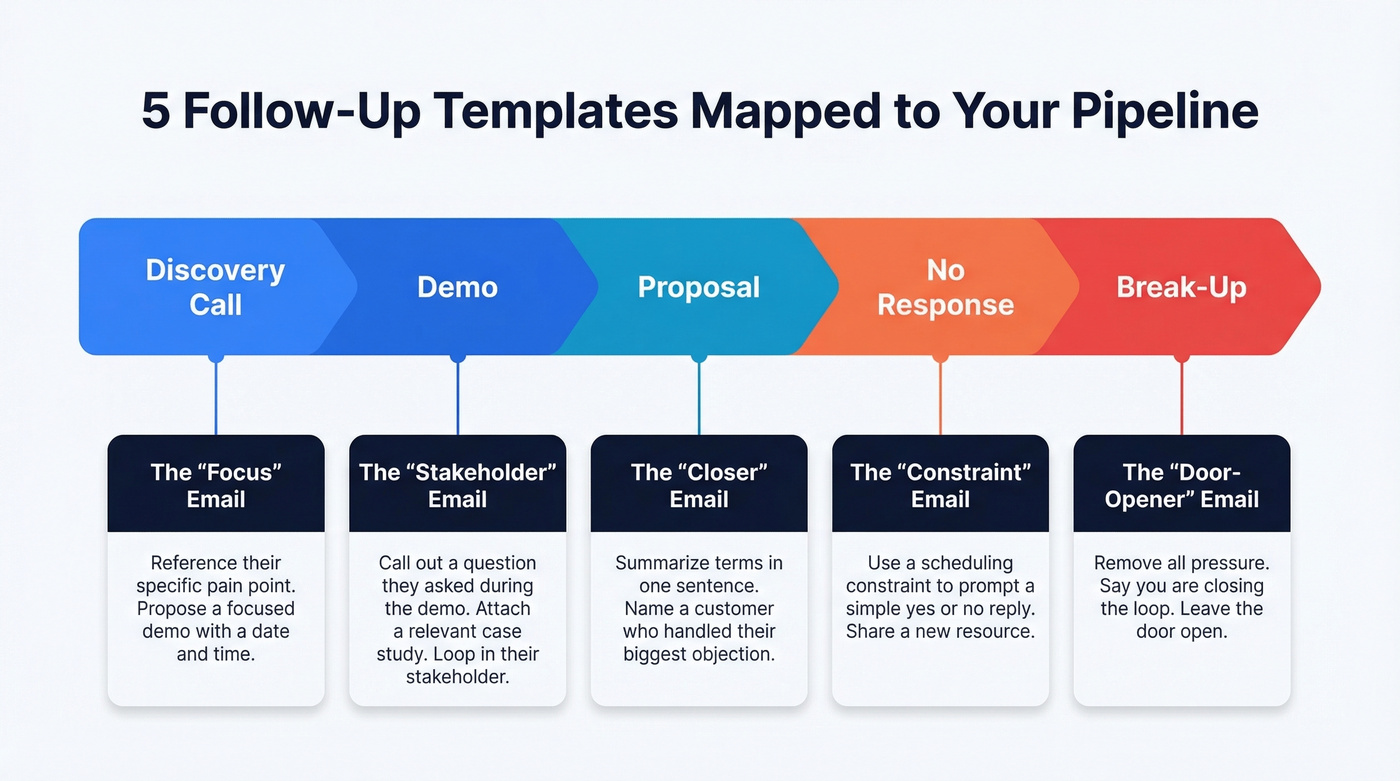
The right follow-up looks different at discovery than it does after a proposal review. Here are five templates covering the full pipeline.
After a Discovery Call
Hi [Name], thanks for walking me through [specific pain point] today - really helpful context. Based on what you shared about [challenge], I think a focused demo on [feature/solution] would be the fastest way to show how this works. Does [day] at [time] work for a 30-minute walkthrough?
If you need a tighter structure for what to ask on that first call, use a set of discovery questions that map to qualification.
After a Demo
Hi [Name], appreciate you and [colleague] taking the time today. The moment you asked about [specific feature/use case] told me a lot about your priorities - I've attached the [case study/resource] that covers exactly that scenario. Next step: I'd love to loop in [their stakeholder] for a quick technical review. Would [day] work?
This one's worth spending extra time on because demos are where deals either accelerate or stall. We've found that referencing a specific question the prospect asked - not just a feature you showed - signals that you were actually listening, not running through a script. If you can tie that question to a case study where a similar company solved the same problem, you're giving them ammunition to sell internally, which is half the battle with multi-stakeholder deals.
For a tighter meeting flow, borrow a product demo checklist so your follow-up aligns to what you showed.
After a Proposal
Hi [Name], thanks for the candid conversation around pricing. To recap: [1-sentence summary of terms/scope]. I know [biggest objection] came up - here's how [customer name] handled the same concern: [one-liner or link]. Can we aim for a decision by [date]?
Naming a specific customer who faced the same objection is more persuasive than generic reassurance.
If objections keep resurfacing at this stage, it may help to revisit how you reduce sales objection rate across the cycle.
No Response (Nudge)
Hi [Name], I'm finalizing my calendar for next week - does [day] at [time] work for a quick check-in? I also came across [new resource relevant to their pain point] that's worth sharing. Let me know either way.
This scheduling-constraint framing nudges a simple yes/no reply - a tactic that comes up constantly on r/sales.
If you want more options for this exact scenario, use a follow-up email to a busy person playbook.
Break-Up (Last Touch)
Hi [Name], I haven't heard back, so I'll assume the timing isn't right. I'm going to close this out on my end - but if things change, I'm a quick reply away. In the meantime, here's [resource] in case it's useful down the road.
This "closing the loop" email often gets replies because it removes pressure and makes responding feel low-stakes.
If you want a few more variations, these polite chaser email templates work well as a final touch.

You just nailed the framework, wrote the perfect follow-up, and hit send - only for it to bounce. 98% of Prospeo emails land because every address runs through 5-step verification on a 7-day refresh cycle. At $0.01 per email, bad data is no longer an excuse for stalled deals.
Stop losing deals to bounced follow-ups. Verify before you send.
Subject Lines That Get Opened
| Subject Line | Why It Works |
|---|---|
| Re: Your [pain point] - the [resource] I mentioned | Pain-based + delivers on a promise |
| Quick follow-up + the playbook I promised | Commitment/credibility trigger |
| Circling back with an idea I didn't get to share | Curiosity + unfinished business |
| [Their company] x [your company] - next steps | Professional, scannable, clear |
| Closing the loop on [topic from call] | Signals finality, prompts action |
The pattern: reference something specific from the meeting. If your subject line could apply to any meeting with any prospect, it's too generic.
For more ideas you can swipe, pull from these email subject line examples.
Timing and When to Stop
Send your first follow-up within 24 hours. Space subsequent touches 3-4 days apart, aiming for 4-7 touches total. Tuesday and Wednesday are peak reply days - avoid Monday mornings when inboxes are fullest.
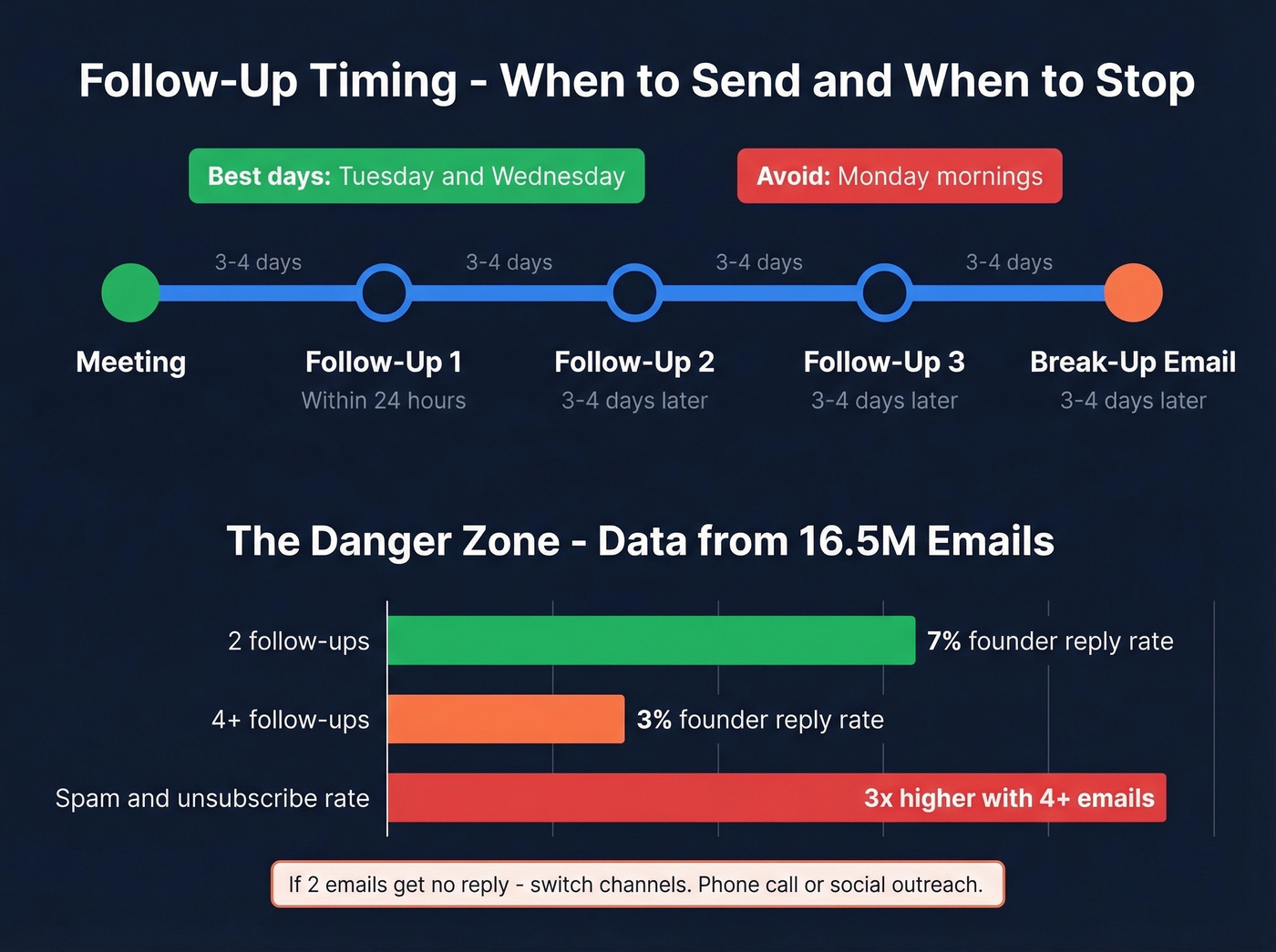
Here's the thing: the "80% of sales require 5+ follow-ups" stat that every blog quotes is misleading. Belkins analyzed 16.5 million emails and found that 4+ emails in a sequence more than triples unsubscribe and spam complaint rates. They tracked founder reply rates dropping from roughly 7% after two follow-ups to just 3% after four.
Enterprise prospects tend to ghost faster and tolerate fewer follow-ups. When you're dealing with a large buying committee, consider switching to a phone call after just one unanswered email.
If two emails get no reply, switch channels. Pick up the phone or engage on social. Belkins found that a message-plus-profile-visit combo drove an 11.87% reply rate - far above email alone.
Mistakes That Kill Your Follow-Up
Add new information with every touch - a case study, a competitive insight, an answer to something from the call. Don't just "bump this to the top of your inbox." If your follow-up doesn't contain new value, don't send it.
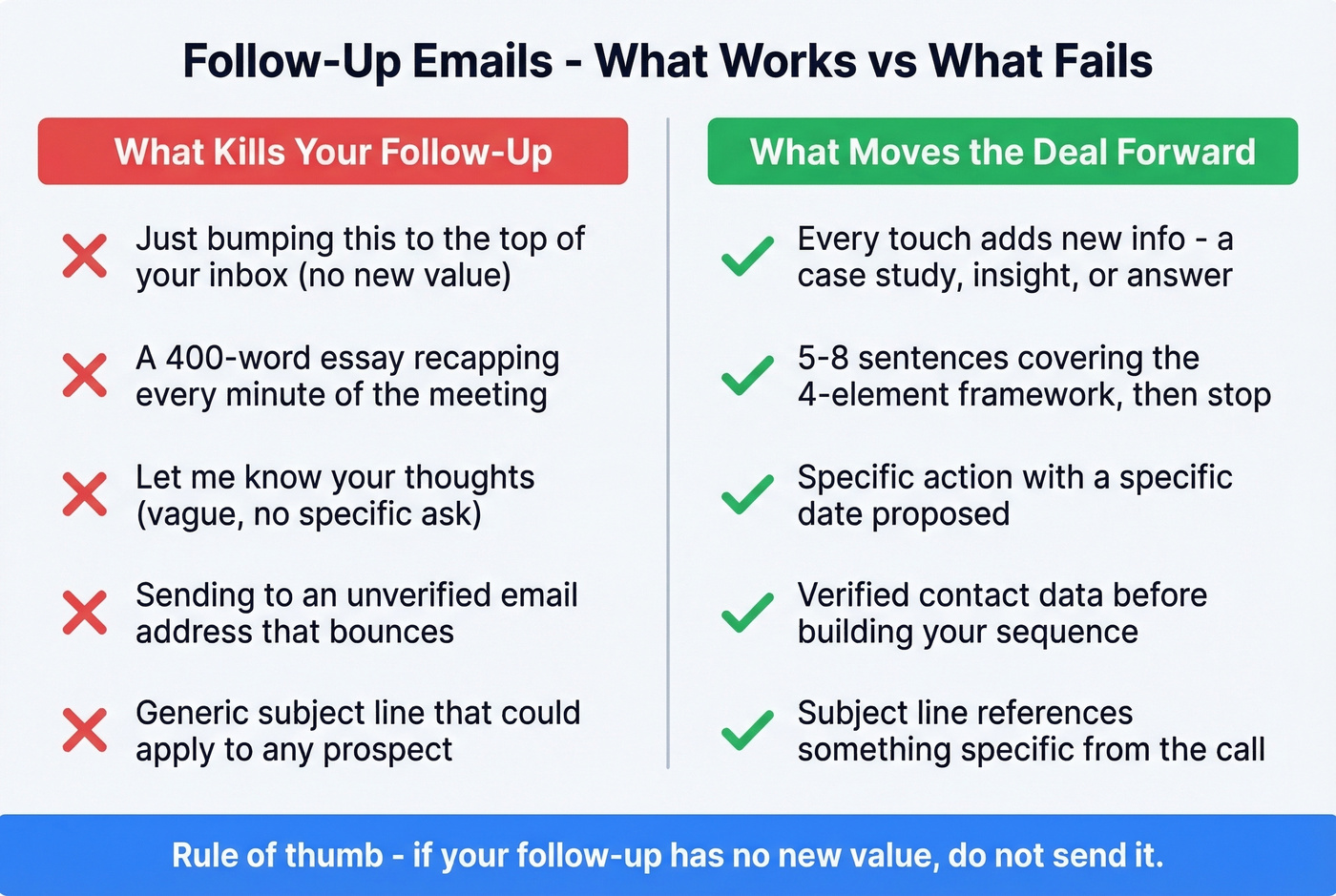
Keep it to 5-8 sentences. Cover the four framework elements and stop. Nobody wants a 400-word essay recapping every minute of the meeting.
Verify your contact data before building your sequence. Look, a perfectly crafted follow-up to a dead email address is worse than no follow-up at all. A bounced message kills deal momentum and signals to your email provider that your list quality is poor. We use Prospeo's Chrome extension to pull verified emails from any professional profile in one click - it runs on a 7-day refresh cycle with 98% accuracy, so you're never emailing a stale address. Especially useful when you need to loop in a stakeholder you met on the call but don't have direct contact info for.
If deliverability is a recurring issue, start with an email deliverability guide and track your email bounce rate before scaling sequences.
Multi-stakeholder deals stall when you can't reach the right people. Prospeo's Chrome extension lets you pull verified emails and direct dials for every contact in the buying committee - straight from their profile or company site. 40,000+ users already prospect this way.
Reach every stakeholder in the deal, not just your champion.
FAQ
How long should a follow-up email be?
Five to eight sentences covering the four elements - thank you, summary, open questions, next step. Research consistently shows shorter emails get more replies; anything beyond 150 words sees declining response rates.
How do I follow up if I don't have a clear next step?
Propose one. Even a vague call can produce a concrete follow-up: suggest a specific date for a second conversation, offer to send a relevant resource, or ask a clarifying question that advances the deal. A generic "great chatting" email with no ask is the worst option.
How many follow-ups should I send after a meeting?
Aim for 4-7 touches total, spaced 3-4 days apart. Belkins' study of 16.5 million emails shows 4+ emails triples unsubscribe and spam complaints - stop after the break-up email unless the prospect re-engages.
What if my follow-up email bounces?
Your CRM data is probably stale. Verify the address before sending - tools like Prospeo's email finder catch bad addresses before they damage your sender reputation. A bounced follow-up doesn't just waste your cadence slot; it tells inbox providers your list quality is suspect, which hurts deliverability on every future send.