

How to Reduce Sales Objection Rate in 2026
Your SDR team says every prospect is "not interested." Your pipeline is thin. Your sales manager responds by scheduling another objection-handling workshop. Meanwhile, the real problem - why prospects object in the first place - goes unaddressed.
If you want to reduce your sales objection rate, you need to start upstream. Analysis of 300M+ cold calls found that just five objections account for 74% of all pushback. That concentration means objections are predictable and preventable.
The Short Version
Three moves eliminate more objections than any script binder:
- Fix targeting and contact data quality. Dismissive objections - "not interested," "take me off your list" - make up 49.5% of all pushback. That's a wrong-person problem, not a wrong-words problem. (If you need a tighter upstream system, start with account qualification.)
- Sequence pricing after value. Price objections form when buyers see a number before they understand ROI. (Use a repeatable B2B sales process so pricing shows up at the right moment.)
- Multi-thread every deal over $50K by end of week two. Authority objections die when you've already engaged the decision-maker's peers. (If your team needs a definition + playbook, see multithreading in sales.)
Here's the contrarian take: stop collecting 20 objection scripts. You need one measurement system and five prevention assets. Scripts are the last 10%.
What "Objection Rate" Actually Means
Most teams can quote their win rate to the decimal but can't tell you which objections kill deals. Three ways to measure:
| Metric | Formula | What It Tells You |
|---|---|---|
| Call objection % | Calls with 1+ objection / total calls | How often reps hit resistance |
| Objections per call | Total objections / total calls | Intensity of resistance |
| Stage objection rate | Objections at stage X / deals entering stage X | Where friction concentrates |
A practical baseline: 60-80% of first outbound calls contain at least one objection. That number should drop sharply by discovery and demo stages. If it doesn't, your qualification process has a leak. (A simple way to tighten this is a consistent lead qualification framework.)
Why Prevention Beats Handling
Objections don't just slow deals. They kill them.
Deals closed within 50 days carry a 47% win rate. Push past that threshold and win rates collapse to 20% or lower. Every unresolved objection adds days - sometimes weeks - to your cycle. Win rates across industries sit around 21%, and 34% of revenue teams report cycles stretching one to two full quarters. Fewer objections means shorter cycles means higher win rates. Prevention compounds. (If you’re trying to shorten time-to-close, pair this with a sales cycle acceleration plan.)

Nearly half of all sales objections are dismissive brush-offs caused by bad data - wrong person, wrong number, outdated title. Prospeo's 300M+ profiles refresh every 7 days with 98% email accuracy, so your reps stop burning dials on dead leads and start conversations with actual decision-makers.
Cut your dismissive objection rate by fixing the list, not the script.
The Objection Taxonomy
Not all objections are equal. Lumping them together guarantees you'll misallocate your fix.
| Category | Share | What It Sounds Like | Prevention Lever |
|---|---|---|---|
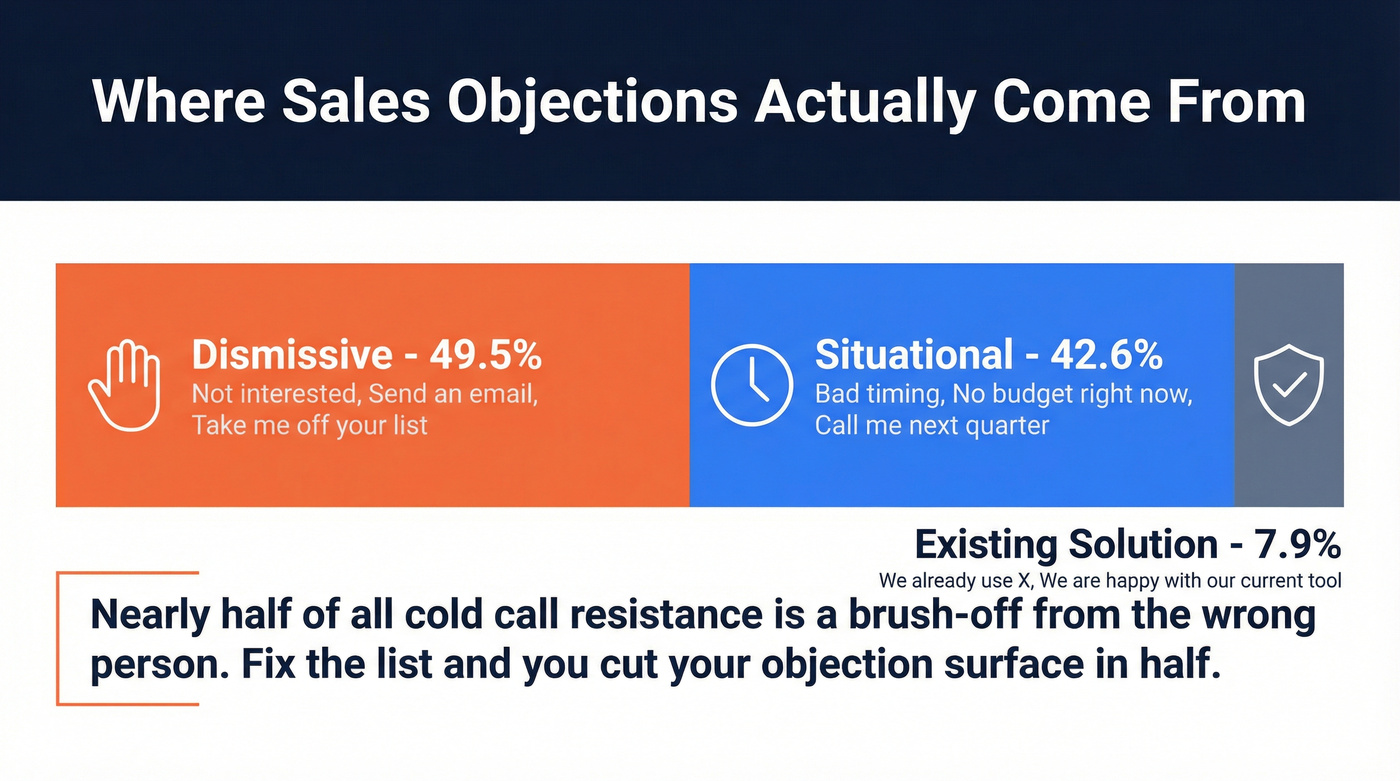
| Dismissive | 49.5% | "Not interested," "Send an email" | Targeting and relevance |
| Situational | 42.6% | "Bad timing," "No budget right now" | Timing and intent signals |
| Existing solution | 7.9% | "We already use X" | Competitive positioning |
Look at that first row. Nearly half of all cold-call resistance is a knee-jerk brush-off from someone who was never the right person, never had the right pain, or never should've been on the list. Fix the list, and you've cut your objection surface in half before a single rep picks up the phone. (This is also where B2B contact data decay quietly wrecks outbound.)
Five Levers to Lower Objection Rates
1. Fix Targeting and Data Quality
Lead qualification is the #1 seller challenge, directly tied to that 49.5% dismissive objection rate. Wrong person, wrong number, outdated title - every bad record is a wasted dial that ends in a brush-off. Responding to inbound leads within five minutes increases engagement likelihood by 9x, but speed is useless if you're calling a disconnected number. (If you’re cleaning lists at scale, a dedicated CRM hygiene routine helps.)
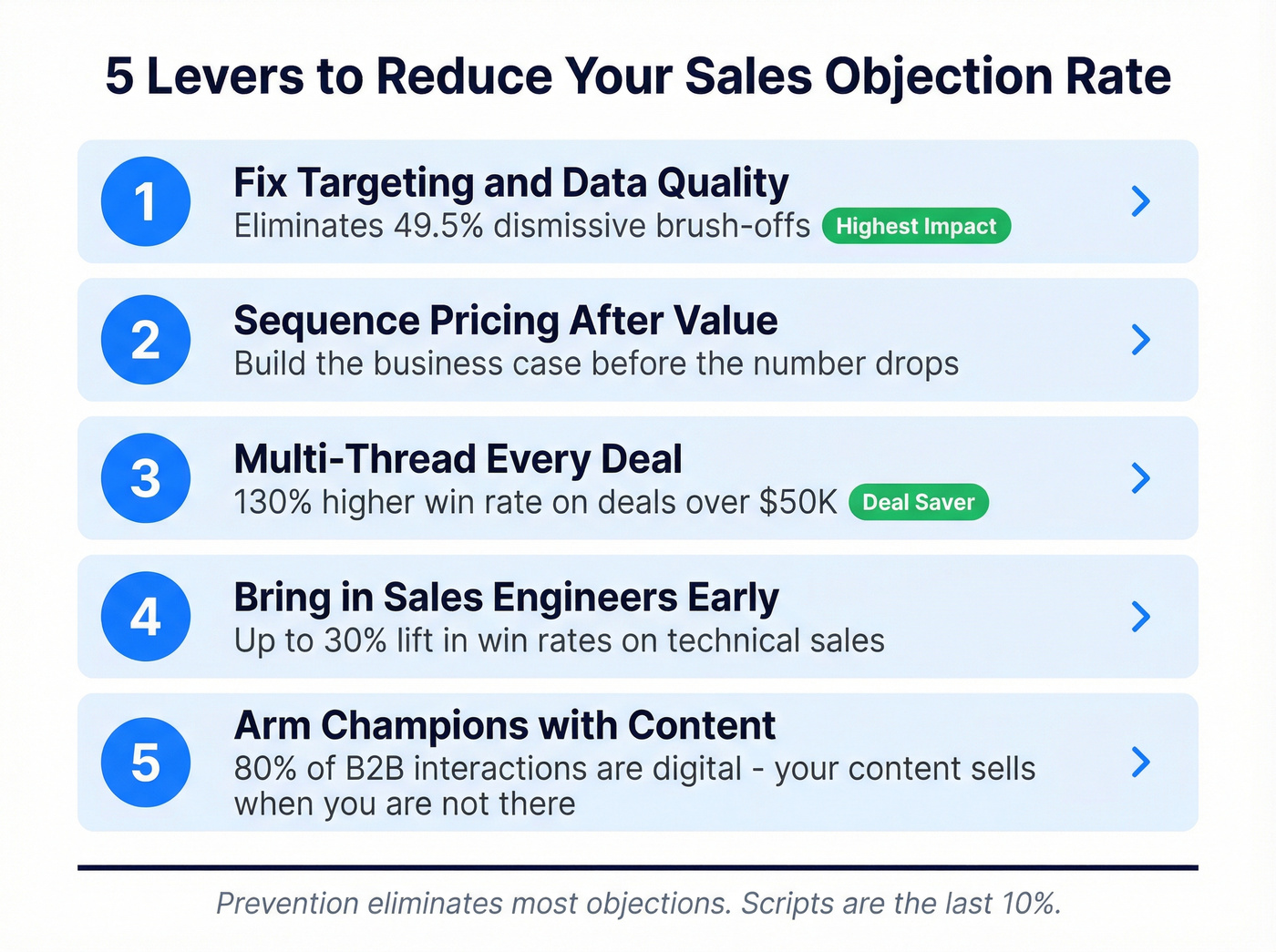
We've seen teams cut dismissive objections by 30%+ within a quarter just by fixing their data. Prospeo's 300M+ professional profiles with 98% email accuracy and a 7-day refresh cycle mean reps spend time on real buyers, not wrong numbers. When your data is fresh and verified, brush-offs drop because you're actually reaching the right person at the right company.
Real talk: if your bounce rate is above 10%, your objection problem is really a data problem wearing a disguise. (If you need a workflow, start with email verification for outreach.)
2. Sequence Pricing After Value
Here's the thing - if your only move when a prospect pushes back on price is discounting, you've trained buyers to object. HubSpot's strategic delay framework lays out the right sequence: deep discovery, business case creation, and decision-maker alignment all happen before pricing enters the conversation. (To make ROI concrete, build a simple sales ROI calculator.)
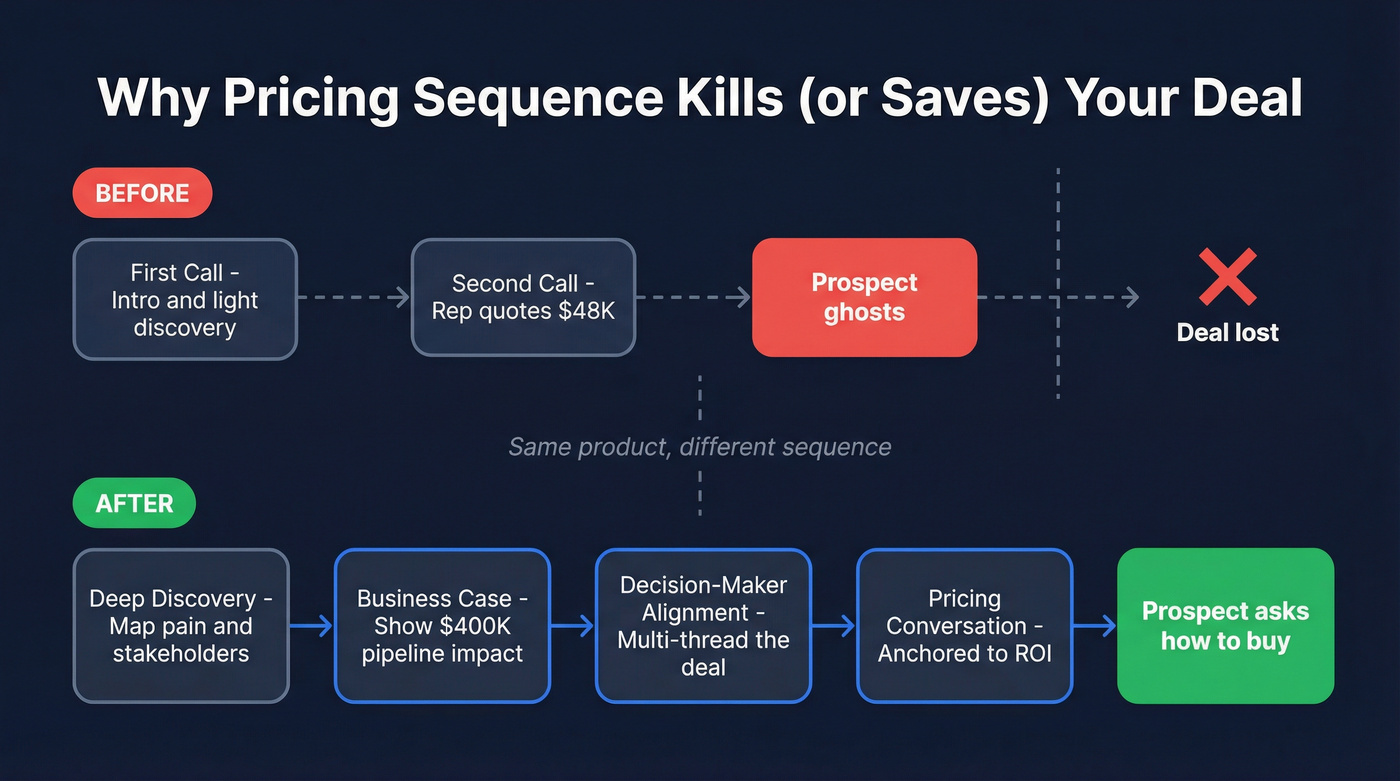
When a prospect pushes for a number early, give a wide range and pivot back to scope. "It depends on what we're solving" isn't evasive - it's honest. You genuinely can't price a solution you haven't scoped.
Before: Rep quotes $48K on the second call. Prospect ghosts. After: Rep builds a business case showing $400K in pipeline impact. Prospect asks how to buy.
3. Multi-Thread Every Deal
You keep getting to demo, then procurement shows up and the deal dies. That's single-threading - the most common way to lose deals you should've won. (If you’re running ABM motions, this pairs well with an ABM account plan.)
Analysis of 1.8M opportunities found that closed-won deals have twice as many buyer contacts as closed-lost, and winning selling teams are 67% larger than losing ones. Multi-threading boosts win rates by 130% on deals over $50K. In our experience, deals that stall after demo almost always trace back to a single-threading problem - one champion, zero internal momentum, and nobody else in the account who even knows the evaluation is happening.
4. Bring in Sales Engineers Early
SE involvement lifts win rates by up to 30%. Yet most teams treat SEs as a last resort, brought in only when the prospect raises a technical objection the rep can't handle.
Flip the sequence. Bring your SE into the first technical conversation, not the third. Security, implementation, and integration objections evaporate when someone credible addresses them proactively.
Skip this lever if your product is simple enough that reps can demo it fully on their own. Double down on it if technical or security objections are a top-3 category in your CRM.
5. Arm Champions with Content
Your champion has to sell internally to six or seven other people on the buying committee. With 80% of B2B interactions now happening digitally, your content does the selling when you're not in the room. Buyer enablement content gets ahead of objections before they reach your rep - and buyer's guides are 46% more likely to drive short-term buying decisions than webinars.
Build these five assets and make them easy to forward:
- Buyer's guide
- "Do I really need this?" fact sheet
- ROI calculator
- Use case guide with industry-specific numbers
- Self-serve demo or interactive walkthrough
Your champion shouldn't have to re-pitch your product from memory. Give them ammunition that answers the CFO's questions before the CFO asks them.
Instrument It: CRM Tagging Schema
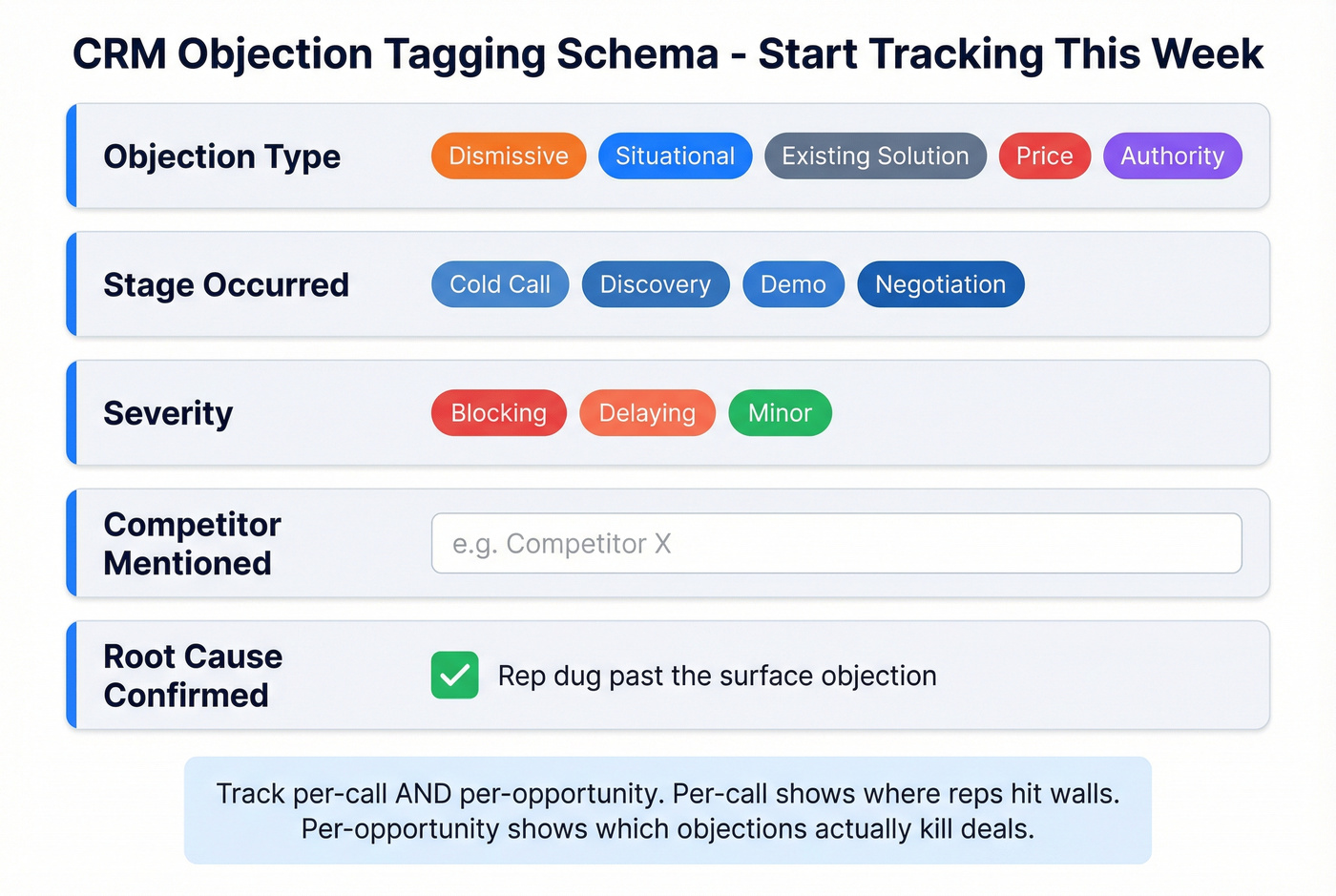
You can't reduce what you don't measure. Here's a schema to start tracking objection rate this week: (If you want to automate the busywork, look at AI CRM data entry automation.)
| Field Name | Type | Purpose |
|---|---|---|
| Objection type | Picklist: Dismissive / Situational / Existing Solution / Price / Authority | Categorize for pattern analysis |
| Stage occurred | Picklist: Cold call / Discovery / Demo / Negotiation | Pinpoint where friction concentrates |
| Severity | Picklist: Blocking / Delaying / Minor | Prioritize which objections actually kill deals |
| Competitor mentioned | Text | Track competitive displacement patterns |
| Root cause confirmed | Checkbox | Flag whether rep dug past the surface objection |
Track these per-call and per-opportunity. The per-call view shows where reps hit walls. The per-opportunity view shows which objections kill deals versus which ones are noise.
With 45% of teams now running hybrid AI-SDR models, conversation intelligence tools can auto-tag objection moments from recordings and surface patterns no manager could spot manually. Enterprise CI platforms typically run $15K-$100K+/year, but even a manual picklist gets you 80% of the insight. Don't let perfect tooling be the excuse for zero measurement.
Handle What's Left
Prevention eliminates most objections. For the survivors, three rules:
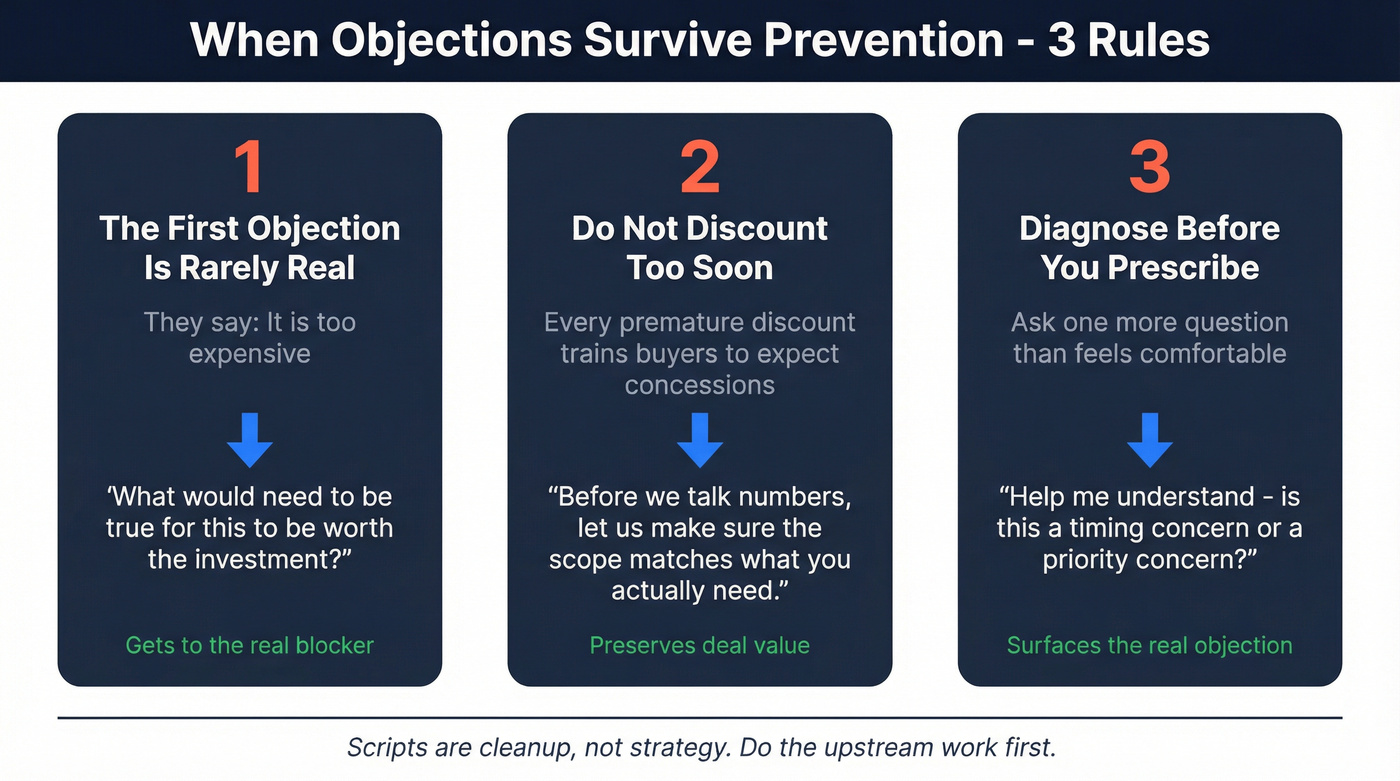
The first objection is rarely the real one. When a prospect says "it's too expensive," they often mean "I can't justify this to my boss." Instead of "I understand budget is tight," try: "What would need to be true for this to be worth the investment?" HubSpot's research on objection-handling mistakes confirms rushing to address the surface concern is the #1 error reps make.
Don't discount too soon. Every premature discount trains your market to expect concessions. Try: "Before we talk numbers, let's make sure the scope matches what you actually need."
Diagnose before you prescribe. Ask one more question than feels comfortable. Try: "Help me understand - is this a timing concern or a priority concern?" The real objection usually surfaces on the second or third exchange, not the first.
Let's be honest: scripts are cleanup, not strategy. If you've done the upstream work - clean data, proper sequencing, multi-threaded deals - there's a lot less to clean up. That's how you actually reduce your sales objection rate instead of just getting better at arguing.
Multi-threading wins deals, but you can't engage a buying committee you can't find. Prospeo gives you verified emails and direct dials for every stakeholder - 125M+ mobile numbers with a 30% pickup rate - so you map the full committee before procurement ever blindsides you.
Reach every stakeholder in the deal, not just one champion.
FAQ
When should I talk about pricing?
After discovery, business case creation, and decision-maker alignment - typically the third or fourth meeting. If a prospect pushes early, give a wide range and pivot back to scope and outcomes. Premature pricing is the #1 cause of price objections.
What's a realistic objection rate benchmark?
Outbound teams see objections on 60-80% of first cold calls. By discovery stage, that should drop below 30%. Track by stage to find where prevention has the most impact - if demo-stage objection rates exceed 40%, your qualification criteria need tightening.
Can better data actually reduce objections?
Yes - nearly half of all cold-call objections are dismissive brush-offs from reaching the wrong person. Verified data with a short refresh cycle eliminates stale contacts, cutting the largest objection category before reps ever dial. Teams using clean, current data typically see 30%+ fewer dismissive responses within one quarter.
How do I get my team to track objections consistently?
Start with a simple CRM picklist - five objection categories, one required field per logged call. Reps who see their own objection patterns shift behavior faster than reps who attend handling workshops. Conversation intelligence tools can automate tagging, but even manual tracking delivers 80% of the insight.