

How to Write a Polite Chaser Email That Gets a Response
"Just checking in" is the email equivalent of a shrug. It signals you've got nothing new to say, and the recipient treats it accordingly - straight to archive. We've seen it hundreds of times across our own outreach and in the campaigns our users run: the chasers that actually get replies follow a repeatable structure. Four sentences, one clear ask, and something the recipient didn't have before.
Here's the structure, the timing data, and 10 templates you can steal.
What You Need (Quick Version)
Every effective chaser has four parts: a meaningful connection to your last interaction, a value statement (not a guilt trip), a credibility signal, and a soft invitation to respond.
Send your first chase up email 3-5 business days after the original message, ideally Monday morning between 6-9am PST. Second chaser at 7-10 days. Final attempt at 14 days. The biggest mistake? Sending the exact same message with "bumping this to the top" tacked on. If you're not adding new value, you're adding noise.
What Is a Chaser Email?
In UK business, "chaser" is the standard term for follow-ups - especially invoice reminders - while "follow-up email" is the more common catch-all in North America. Functionally, they're the same thing: a message sent to prompt a specific next step.
There's a useful distinction worth internalizing, though. A follow-up happens when there's ongoing engagement - you had a meeting, agreed on next steps, and you're circling back. Chasing starts when the other person has gone silent. The moment you catch yourself writing "I just thought I would touch base... have you made a decision yet?" you've crossed the line into weak language that signals you've got nothing new to offer. One r/Accounting thread called overly polite follow-ups "doormat-ish," and honestly, they're not wrong.
The goal of a polite chaser is to stay on the follow-up side of that line, even when you're technically chasing. One practical trick: set your next follow-up time during the conversation itself. "I'll check back Thursday" removes guesswork and gives you permission to follow up without the awkward dance.
When to Send a Chaser Email
Timing matters more than most people think. An 85,000-email dataset from Siege Media found clear winners for day and time:
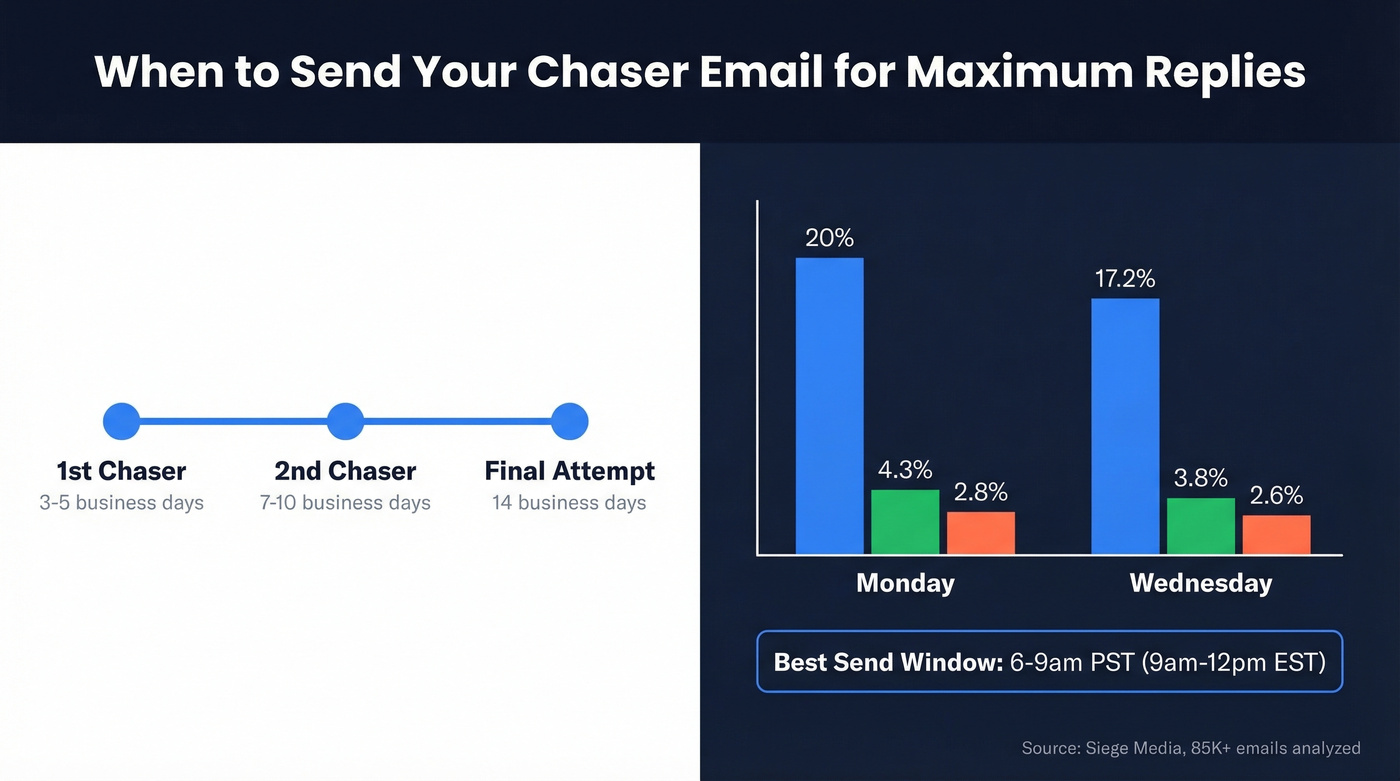
| Day | Open Rate | Click Rate | Reply Rate |
|---|---|---|---|
| Monday | ~20% | 4.3% | 2.8% |
| Wednesday | 17.2% | 3.8% | 2.6% |
The best send window is 6-9am PST (9am-12pm EST) - early enough to land at the top of the inbox, late enough that it doesn't get buried in overnight notifications.
For your first chase up email, wait 3-5 business days. But audience matters: an analysis of 16.5 million cold emails by Belkins shows small businesses (2-50 employees) stay responsive through a second follow-up (9.2% to 8% to 8.4% reply rates across touches), while enterprise audiences are far less tolerant of persistence. Make your first two touches count.
How to Write One That Gets Replies
Ed Gandia's four-part framework, outlined via Daylite, is the most effective structure we've found:
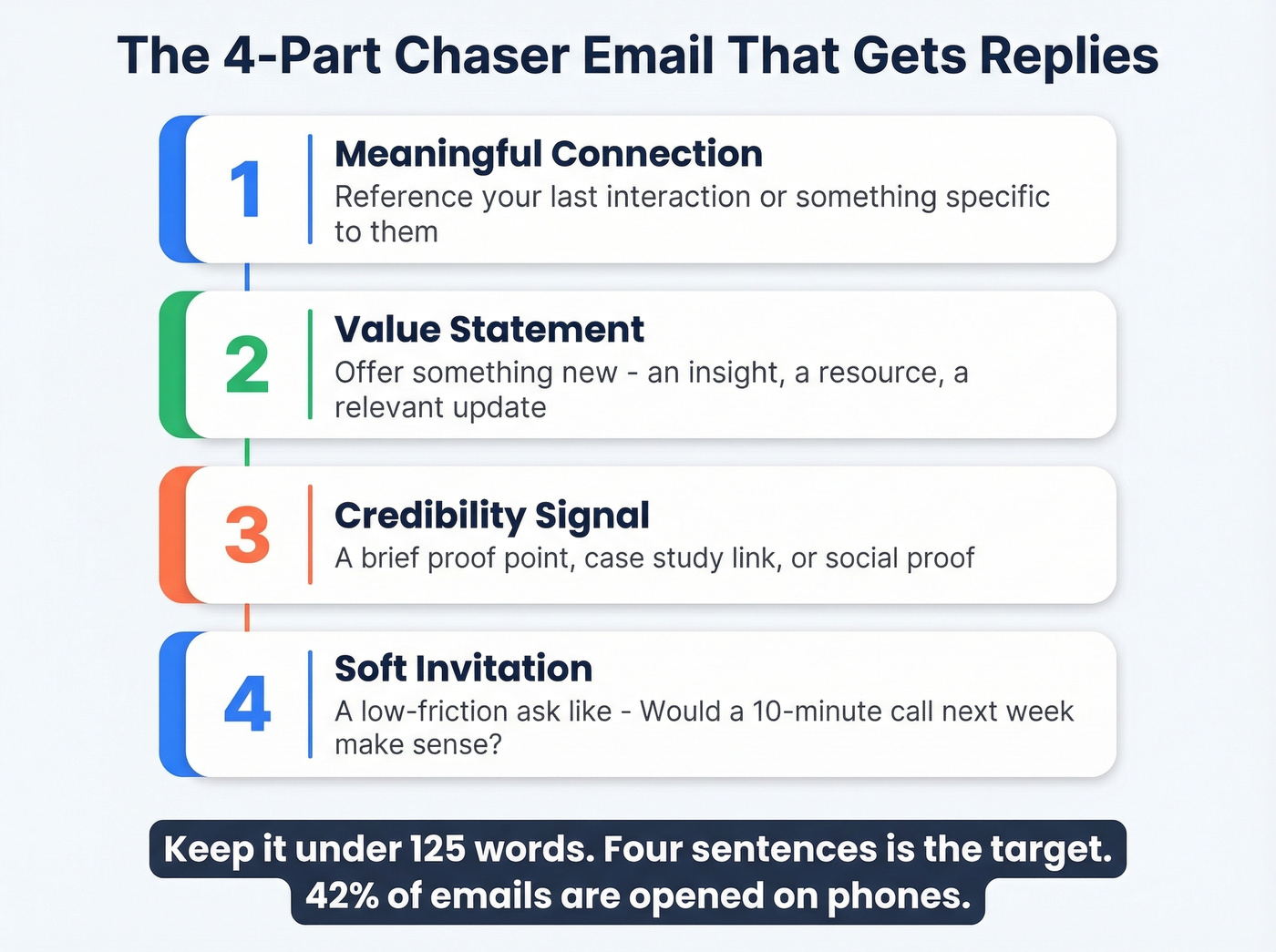
- Meaningful connection - reference your last interaction or something specific to them
- Value statement - offer something new (an insight, a resource, a relevant update)
- Credibility signal - a brief proof point, case study link, or social proof
- Soft invitation - a low-friction ask ("Would a 10-minute call next week make sense?")
Keep the whole thing under 125 words. Four sentences is the target. With 42% of emails opened on phones, nobody's scrolling through three paragraphs of pleasantries on a 6-inch screen.
If you need more variations, pull from these sales follow-up templates and adapt the same four-part structure.

A perfectly written chaser email is worthless if it bounces. Prospeo's 98% email accuracy and 5-step verification mean your follow-ups actually reach the inbox - not a dead address. At $0.01 per email, one reply pays for thousands of verified contacts.
Stop chasing ghosts. Start chasing verified decision-makers.
10 Templates You Can Steal
No Response to Initial Outreach
Template 1 (Warm):
Subject: Quick thought on [specific topic from first email]
Hi [Name],
I shared [specific resource/idea] last [day] - wanted to add one thing. [New insight or data point relevant to their role]. [One-sentence credibility signal]. Would it make sense to grab 15 minutes this week?
Best, [Your name]
Template 2 (Direct):
Subject: [Their company] + [your company] - still relevant?
Hi [Name],
Sent a note last week about [specific topic]. No worries if the timing's off - just want to make sure it didn't get buried. If [specific outcome] is still a priority, I'd love 10 minutes. If not, happy to close the loop.
[Your name]
The "happy to close the loop" line gives them an easy out, which paradoxically increases replies. People respond when they don't feel trapped.
After a Proposal or Quote
Template 3:
Subject: [Project name] proposal - any questions?
Hi [Name],
Following up on the [project name] proposal from [date]. I've since [added a relevant detail / seen a competitor case study] that changes the picture. Happy to walk through the numbers. What works for a quick call?
[Your name]
After a Meeting With No Follow-Through
Template 4:
Subject: Next steps from our [date] call
Hi [Name],
Really enjoyed our conversation about [specific topic]. Wanted to check whether [agreed action item] is still on your radar. Would rescheduling for [suggest two dates] work better?
[Your name]
Job Application Follow-Up
This one's different - you've got less leverage and more competition. Skip the blockquote format and think of it as a micro cover letter.
Subject: [Role title] application - [Your name]
Open with your name and the role. State one thing that's changed since you applied - a completed project, a certification, something you noticed about their company. Close with availability. Three sentences, max. Hiring managers skim hundreds of these; density beats length every time.
Internal Request to a Colleague
Template 6:
Subject: [Deliverable] - need by [date]
Hey [Name],
Circling back on the [deliverable] from last [day]. I need it by [specific date] to hit our [deadline/milestone] - is that still doable? If something's blocking it, let me know and I'll help clear the path.
Networking / Warm Introduction
Template 7:
Subject: [Mutual connection] suggested I reach out
Hi [Name],
[Mutual connection] mentioned you're doing great work on [specific topic]. I recently [relevant credibility signal]. Would love to swap notes over a quick coffee or call. No agenda - just curious minds.
[Your name]
Client Gone Quiet Mid-Project
Template 8 works best sent as a reply in the original thread - not a new email. Keep it blunt:
We're at the [specific milestone] stage on [project name] and need [specific input] to keep things on track. If priorities shifted, let's realign the timeline. A 5-minute call would sort it.
No subject line gymnastics. No greeting. Just the ask, in the existing thread. This signals urgency without drama.
The "Final" Chaser
Template 9 (Permission-Based Close):
Subject: Should I close your file?
Hi [Name],
I've reached out a few times about [topic] and haven't heard back - totally understand. Should I check back in [specific timeframe, e.g., Q3], or close this out? Either way, no hard feelings.
[Your name]
Permission-based "close the loop" subject lines tend to earn replies because they reduce pressure. People are more willing to respond when the options are "yes," "no," or "later" - not "here's why you should buy."
Template 10 (Breakup Email):
Subject: Closing the loop
Hi [Name],
This'll be my last note on [topic]. If [specific outcome] becomes a priority down the road, I'm easy to find. Wishing you and the team a strong [quarter/year].
P.S. [One-line value add - a relevant article, stat, or resource. Leave them with something useful.]
[Your name]
Payment Chaser Email Templates
Invoice chasing is a completely different skill from sales follow-up. The tone escalates on a schedule, the stakes are contractual, and you need a paper trail. Here's a four-stage framework anchored to the staged approach in SolidGigs' payment-chasing templates.
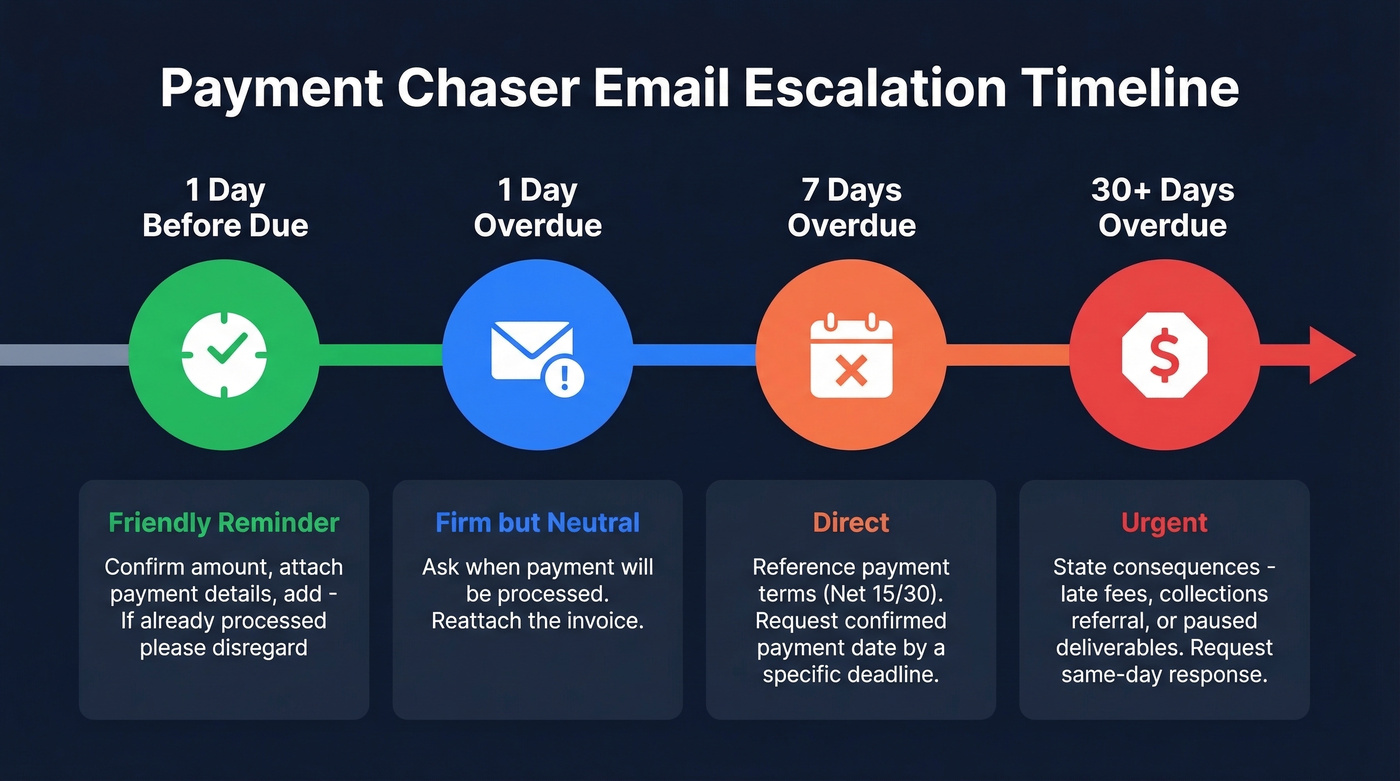
1 Day Before Due Date - Friendly reminder. Subject: "Invoice #[number] due [date]." Confirm the amount, attach payment details, and add "If already processed, please disregard."
1 Day Overdue - Firm but neutral. Subject: "Invoice #[number] - now past due." Ask when payment will be processed. Reattach the invoice.
7 Days Overdue - Direct. Subject: "Overdue: Invoice #[number] - action needed." Reference your agreed payment terms (Net 15/30). Request a confirmed payment date by a specific deadline.
30+ Days Overdue - Urgent. Subject: "Urgent - Invoice #[number], 30 days overdue." State consequences: late fees per contract terms, collections referral, or paused deliverables. Request a same-day response with a payment timeline.
If you want to systematize this, track invoice follow-ups in a simple contact management software workflow so nothing slips.
Subject Lines That Get Opened
Data shows subject lines around 7 words (~41 characters) generate the highest engagement. With 42% of emails opened on mobile, shorter is almost always better.
Drop "Follow-up" from your subject lines - it screams "you ignored me." And drop "kindly" while you're at it. It reads as condescending or passive-aggressive to a lot of recipients.
For more options, borrow from these email subject line examples and keep them tight.
Sales follow-up: "Quick thought on [topic]" · "[Their company] + [your company]" · "One thing I forgot to mention" · "Still relevant?"
Payment reminder: "Invoice #[number] - due [date]" · "Payment reminder: [amount] outstanding" · "Overdue: Invoice #[number]"
Post-meeting: "Next steps from [date]" · "[Topic] - one more idea" · "Following up on [specific deliverable]"
Final attempt: "Should I close your file?" · "Closing the loop" · "Permission to move on?"
5 Mistakes That Kill Your Reply Rate
1. Bumping with no new information. "Just checking in" isn't a strategy. Every chaser must contain one thing the recipient didn't have before - a stat, a resource, a new angle. That's it.
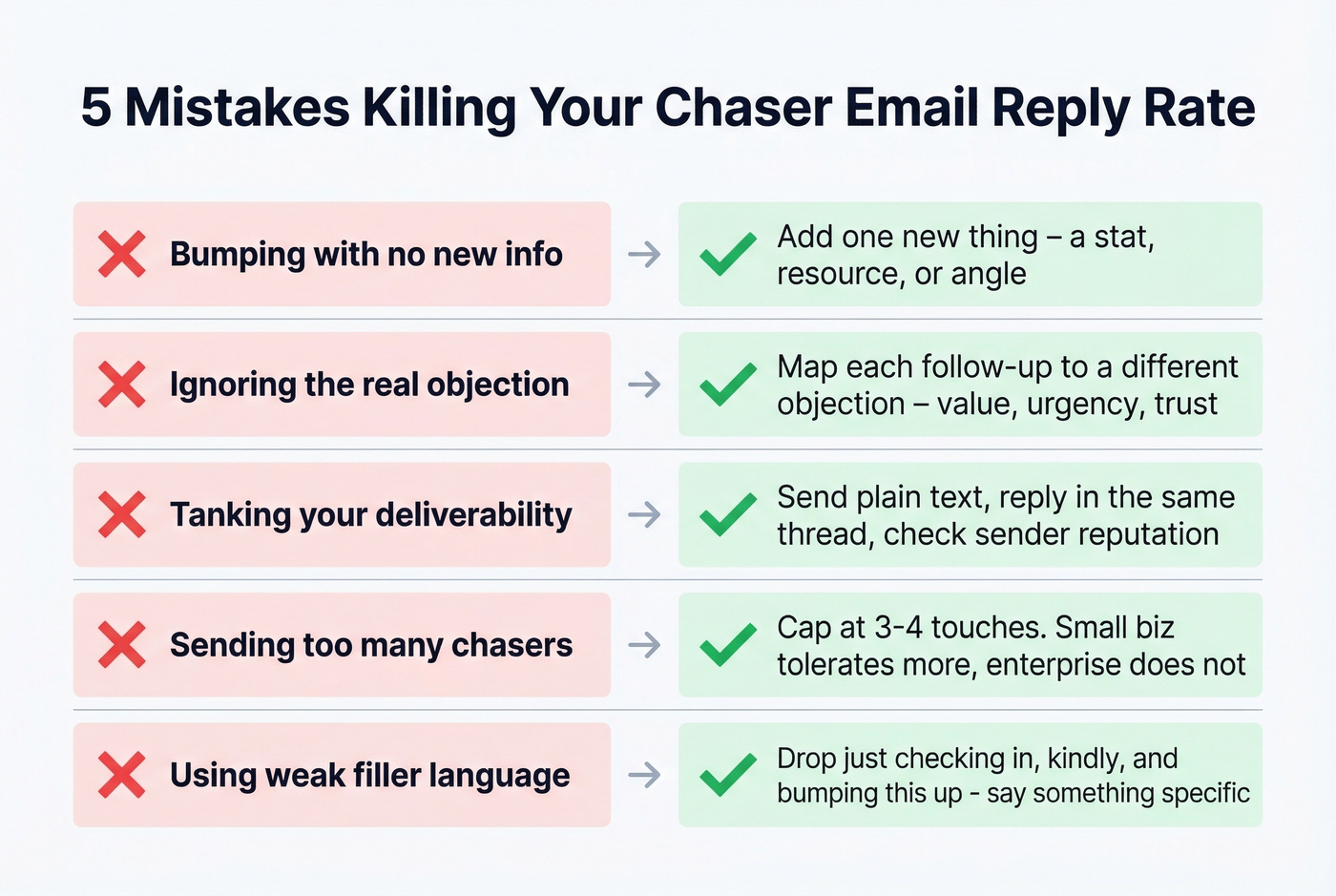
2. Ignoring the real objection. GMass identifies five objection categories: need, value, urgency, want, and trust. If your chaser doesn't address why they're silent, you're just getting louder in the wrong direction. Map each follow-up to a different objection - your first chaser tackles value, your second tackles urgency, your third offers a graceful exit.
If you want a deeper playbook for value-first messaging, see how to add value in sales.
3. Tanking your deliverability. Follow-ups that don't look like 1:1 email tend to perform worse. Send plain text, as a reply in the same thread. If you're running sequences, check your sender reputation and avoid spam-trigger words like "act now," "limited time," and "guaranteed."
If you're troubleshooting, this email deliverability guide covers the root causes, and these email reputation tools help you monitor issues before they tank performance.
4. Sending too many. The 16.5-million-email dataset is clear: 4+ emails in a sequence triples your unsubscribe rate and more than triples spam complaints. Cap at 2-3 chasers, then switch channels.
If you're sequencing at scale, get clear on email velocity so you don't burn the domain.
5. Using "kindly" or "gentle reminder." Both phrases have become corporate code for "I'm annoyed you haven't responded." Be direct instead. "Following up on X - is [date] still realistic?" beats "Just a gentle reminder about X" every single time.
If you catch yourself defaulting to "checking in," use these alternatives for how to say just checking in professionally.
Here's the thing: you don't need 19 templates. You need three frameworks - warm, direct, and breakup - and the judgment to know which one fits. If your average deal is under $15K, a single well-timed chaser with a clear ask will outperform a seven-touch automated sequence.
When Chasers Don't Work
You've sent three well-crafted chasers. Nothing. You've got three options: switch channels, wait 30-60 days and try again, or stop entirely.
The Stack Exchange consensus is right: if email isn't working, try a different medium. A 30-second phone call often resolves what four emails couldn't. The same 16.5-million-email analysis found that a message on a professional network paired with a profile visit hit an 11.87% reply rate - higher than any email follow-up in the study.
But before you rewrite your follow-up for the fifth time, ask a harder question: are you reaching the right person? People change jobs, email addresses go stale, and that "verified" list you bought six months ago has decayed more than you think. We've seen teams rewrite their chaser sequences three times before realizing the problem wasn't copy - it was data. Tools like Prospeo, with a 7-day data refresh cycle and 98% email accuracy across 300M+ profiles, exist specifically to solve that problem. If your chasers are bouncing or landing in dead inboxes, better wording won't help.
If you're diagnosing bounces, start with email bounce rate and then confirm how to check if an email exists before you send the next follow-up.

Sent three chasers and still no reply? The problem might not be your copy - it might be the email address. Prospeo refreshes 300M+ contacts every 7 days, so you're never following up with outdated data that other providers haven't updated in weeks.
Your follow-up deserves a real inbox. Verify before you send.
FAQ
How many chaser emails should you send before giving up?
Two to three, max. A 16.5-million-email analysis found that 4+ emails in a sequence triples unsubscribe rates and spam complaints. After three chasers with no response, switch to phone, direct message, or a mutual connection. Verify you've got the right contact before trying again.
What's the difference between a chaser email and a follow-up email?
They're functionally identical - "chaser" is the standard UK business term, especially for invoice reminders, while "follow-up" is the broader North American default. Use whichever your recipient expects; when in doubt, "follow-up" reads as more neutral across regions.
How do you chase someone politely without sounding pushy?
Lead with new value instead of guilt - every message should contain something the recipient didn't have before, like a relevant stat or resource. Use a soft invitation ("Would a 10-minute call make sense?") rather than a demand, and always give them an easy out. If you're not sure you're emailing the right person, verify the address first with a tool like Prospeo's Chrome extension before you chase.
How long should a polite chaser email be?
Aim for 50-125 words, roughly four sentences. Ed Gandia's framework - meaningful connection, value statement, credibility signal, soft invitation - fits comfortably in that range. With 42% of emails opened on mobile, if your chaser requires scrolling, it's too long.