

How to Follow Up With a Busy Person (Without Being Annoying)
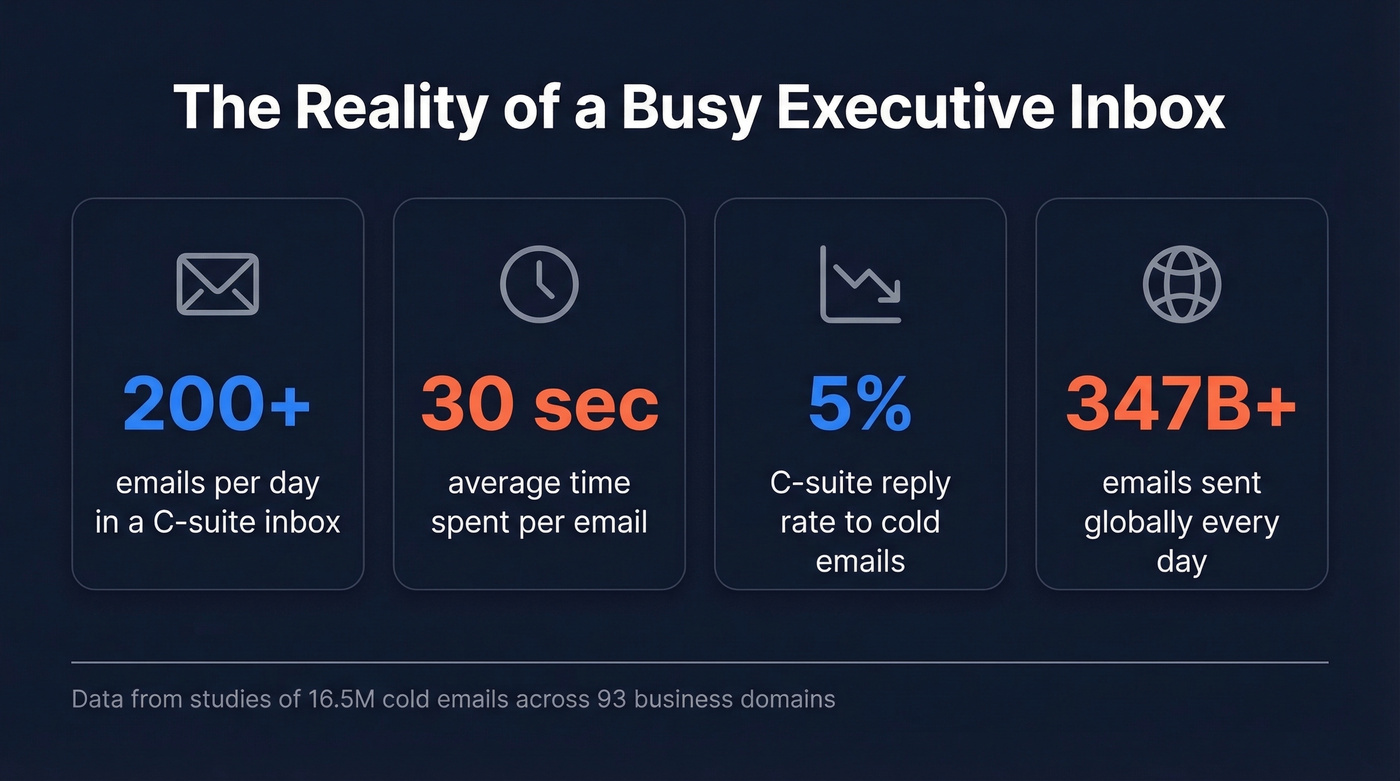
One executive-writing benchmark puts C-suite inbox volume at 200+ emails a day with roughly 30 seconds per email. C-suite reply rates sit around 5% - compared to about 8% for entry-level contacts, per a study of 16.5M cold emails across 93 business domains.
Your follow-up email to a busy person isn't competing with other sales emails. It's competing with board decks, investor updates, and a Slack channel that never stops pinging.
That doesn't mean follow-ups are pointless. It means most are written wrong for the audience.
Three Rules Before Anything Else
- Lead with the ask, not the backstory. Executives scan action-first: request, then credibility, then context.
- Cap it at three follow-ups. Sending 4+ emails in a sequence more than triples spam complaint risk across that same 16.5M-email dataset.
- Every follow-up earns its inbox space with new information. "Just following up" is the fastest way to get archived.
Why Busy People Ignore You
With 347B+ emails sent daily, your follow-up is a needle in a haystack. When someone processes 200+ of those before lunch, they aren't reading - they're triaging.
People are primed to notice their own name, which is why adding it to a subject line cuts through noise that generic ones can't. But even personalization has limits when the medium itself works against you. A 2020 study in Heliyon showed how asynchronous written communication distorts trust and connection because it strips out nonverbal cues - tone, facial expression, pacing - making misinterpretation far more likely than in a face-to-face conversation. Your helpful follow-up might land as pressure.
Brevity and explicit clarity aren't nice-to-haves. They're insurance against misreads. Structure your email so the ask is visible in a 30-second scan. If they have to scroll or re-read to figure out what you want, you've already lost.
Five Rules That Get Replies
1. Lead with the ask. A busy VP doesn't need three sentences of setup before you get to the point. Open with what you need, then give them just enough context to say yes.
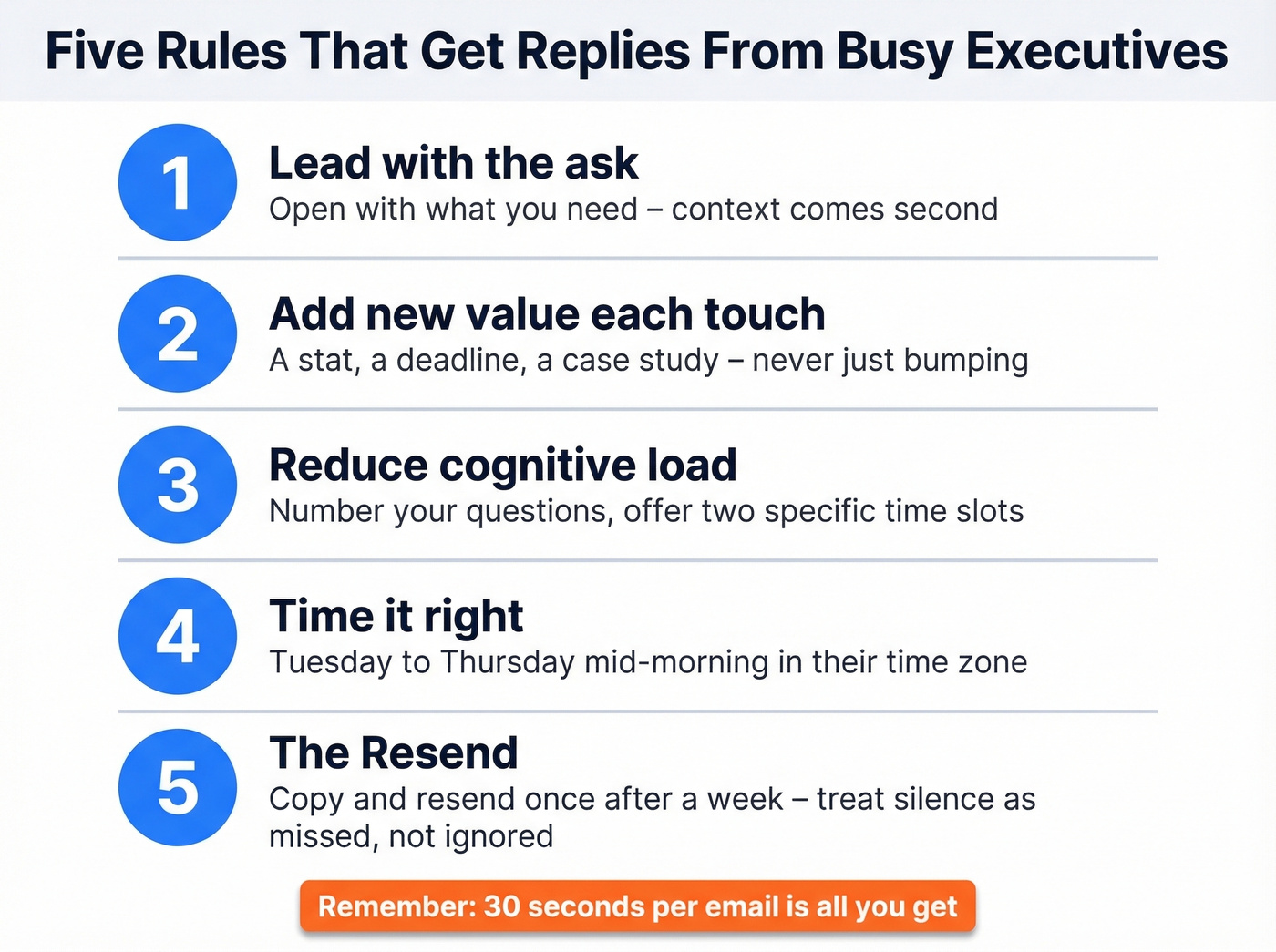
2. Add new value each touch. Every follow-up should contain something the previous one didn't - a relevant stat, a deadline, a case study. Bumping with no new information doesn't work. It just trains them to ignore your name. (If you want more swipeable options, see our follow-up templates.)
3. Reduce cognitive load. Number your questions so they can reply "1 - yes, 2 - Thursday." Offer two specific time slots instead of "let me know when works." This comes straight from practitioner playbooks: reduce the decisions they have to make and you reduce the friction to reply.
4. Time it right. Avoid Monday mornings and Friday afternoons. Tuesday through Thursday mid-morning catches busy people during their planning windows, before the day's fires start. (More data here: best time to send cold emails.)
5. The Resend. If more than a week passes with no reply, copy your original email and resend it with a tighter subject line. This tactic from Tobias van Schneider works because it treats silence as "I missed it," not "I'm ignoring you." One guardrail: only resend once, and only if the original ask is still relevant.

You only get three shots with a busy executive. Don't burn one on a bounced email. Prospeo's 7-day data refresh and 98% email accuracy mean every follow-up lands in a real inbox - not the void.
Stop perfecting emails that never arrive. Verify first.
Three Templates You Can Steal
If you need a ready-to-use sample for reaching a busy executive, start with Template 1 - it's the most versatile.
Template 1 - The "New Information" Follow-Up Use when you have a deadline, data point, or update to add.
Hi [Name], quick update - [new insight or deadline]. Does it make sense to connect before [date]? Happy to send a one-pager first if that's easier.
Template 2 - The "Scheduling" Follow-Up Use when you need a meeting and want to kill the back-and-forth.
Hi [Name], trying to finalize my calendar for next week. Would Tuesday at 2pm or Thursday at 10am work for a 15-minute call? If neither fits, just say the word and I'll adjust.
P.S. My direct line is [number] if a call is easier.
Template 3 - The "Breakup" Email Your final touch. Low pressure, leaves the door open.
Hi [Name], I know timing isn't always right. I'll leave this here - if [problem you solve] becomes a priority, I'm easy to find. No need to reply otherwise.
Here's the thing about templates: they're starting points, not scripts. We've seen the best results when reps take the structure but rewrite the specifics for each prospect. A template that reads like a template defeats the purpose. (If you're building sequences at scale, AI sales follow-up can help with personalization without bloating the copy.)
The 4-Touch Cadence
In Belkins' dataset, the founder segment shows the pattern clearly: 6.64% reply rate after the first follow-up, 6.94% after the second, 5.75% after the third, then a sharp drop to 3.01% by the fourth. There's a brief lift from the mere exposure effect on early touches, then annoyance kicks in.
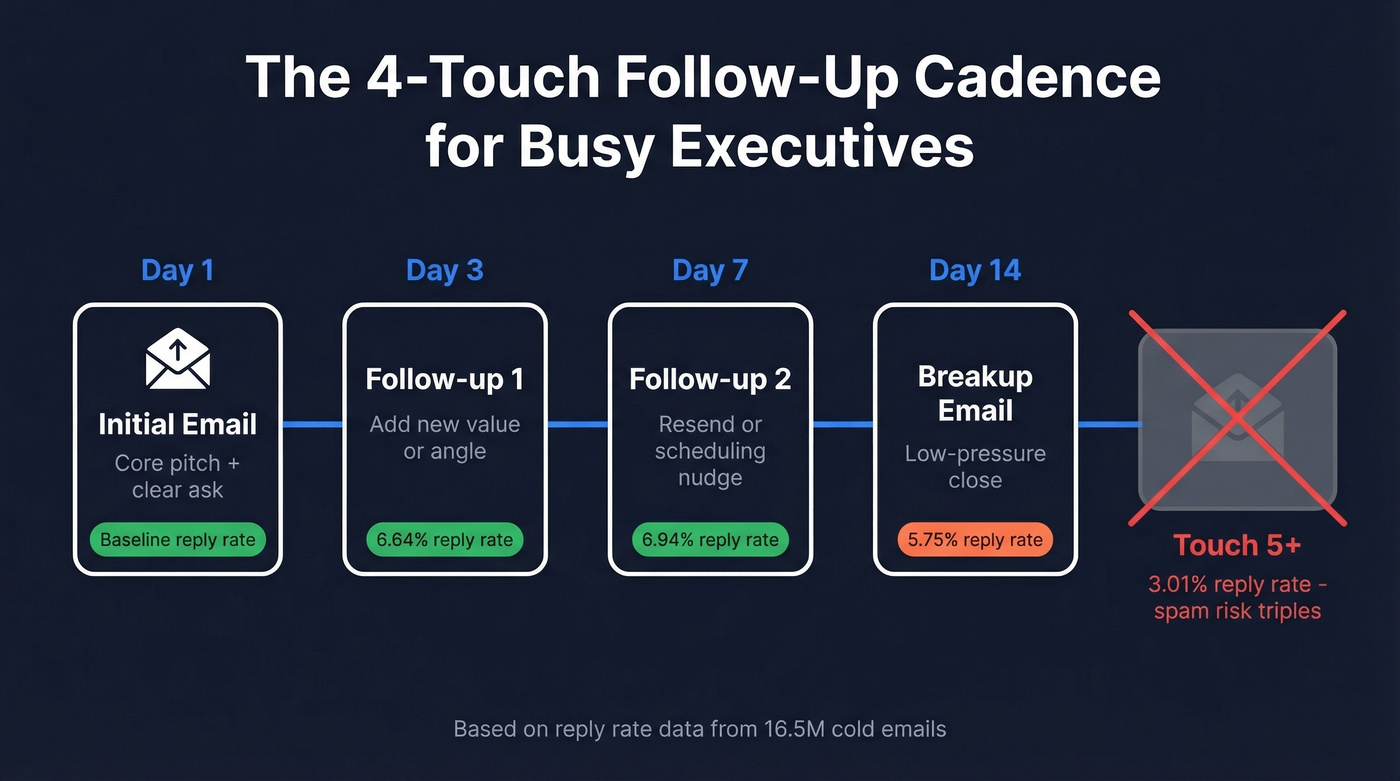
| Touch | Day | Purpose |
|---|---|---|
| Initial | Day 1 | Core pitch + clear ask |
| Follow-up 1 | Day 3 | Add new value or angle |
| Follow-up 2 | Day 7 | Resend or scheduling nudge |
| Breakup | Day 14 | Low-pressure close |
Four touches, not five. The 5th email is where unsubscribe rates triple and spam risk spikes - enterprises in particular ghost quickly and punish persistence. (If you're diagnosing why sequences underperform, start with follow-up email reply rate benchmarks.)
One r/salestechniques user shared that their prospect finally replied on the third follow-up: "Timing was just bad earlier." The deal closed. Persistence within the three-touch window works, but only when each message earns its place.
Subject Lines That Get Opened
47% of recipients decide whether to open based on the subject line alone. Worse: 69% mark emails as spam based on the subject line before reading a word of body copy.
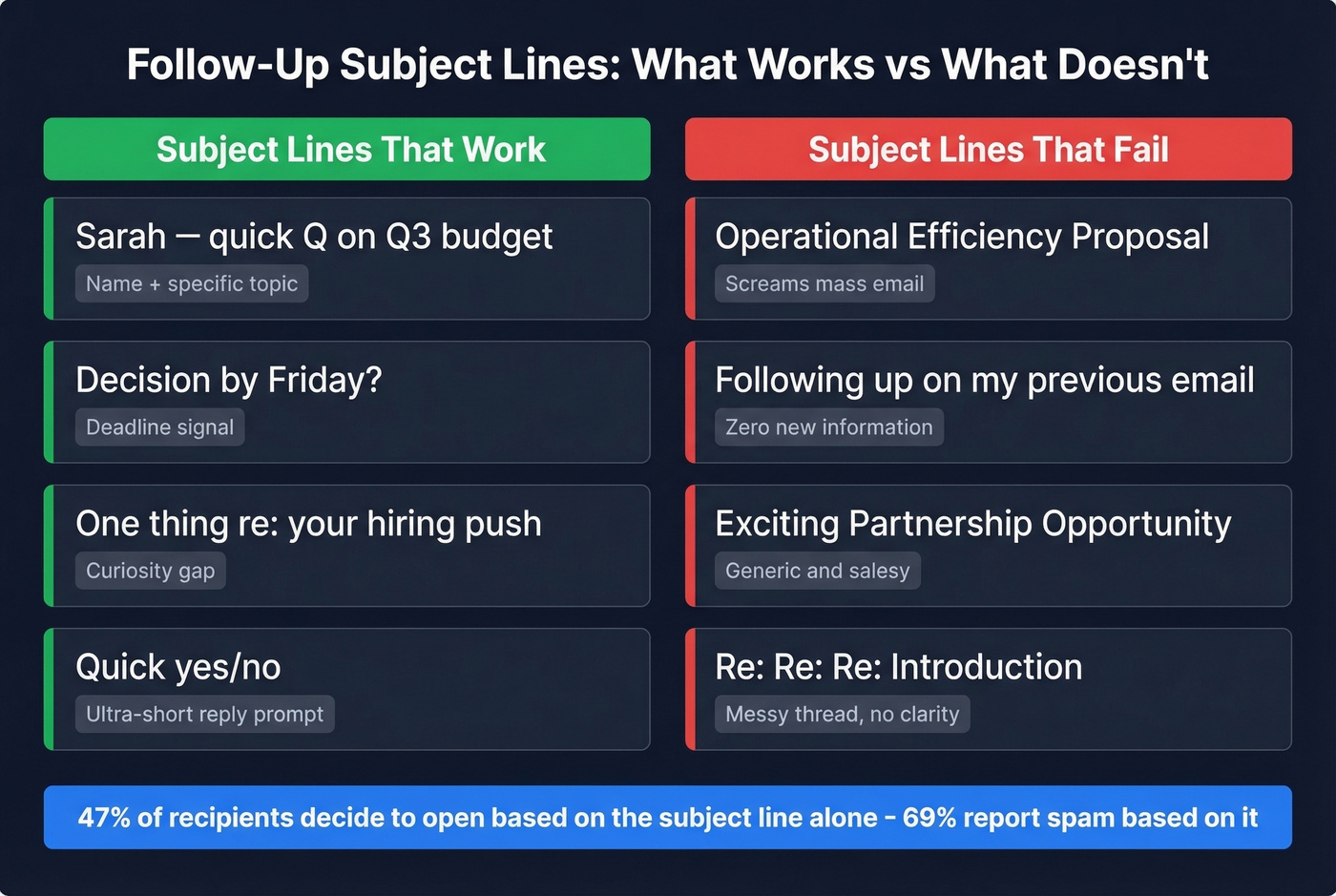
Four formulas that work:
- Name + specific topic: "Sarah - quick Q on Q3 budget"
- Deadline signal: "Decision by Friday?"
- Curiosity gap: "One thing re: [their initiative]"
- Ultra-short reply prompt: "Quick yes/no"
Compare those to "Operational Efficiency Proposal" - a subject line that screams mass email. Keep follow-up subject lines to 2-4 words when possible, and include the recipient's name when you can. (For more ideas, browse these email subject line examples.)
When to Stop
Three follow-ups is the ceiling for busy recipients. If someone hasn't replied after three well-crafted touches spread over two weeks, the issue probably isn't your copy. It's timing, relevance, or - more common than people think - a bad email address.
Before you assume silence means disinterest, check that your email actually arrived. Contacts change roles and addresses constantly. Prospeo verifies emails in real time with 98% accuracy on a 7-day refresh cycle, so you're not perfecting a message that bounces into the void. (If you're troubleshooting bounces, see email bounce rate and email deliverability.)
If three emails get no reply, try a different channel. Even a well-written follow-up email to a busy person can fall flat if email isn't where they're paying attention. For context, a message paired with a profile visit on a professional platform pulls an 11.87% reply rate - more than double the average cold email. A brief phone call or direct message can break through where email can't. (You can also tighten your overall approach with sales prospecting techniques.)
Let's be honest: most "no replies" aren't rejection. They're bad data and bad timing masquerading as disinterest. In our experience, teams that verify contact data before sending stop wasting touches on dead inboxes entirely. Fix the foundation first, then worry about the words.
Skip the follow-up entirely if you can't confirm the address is live. You're burning domain reputation for nothing. (If you're protecting deliverability long-term, read how to improve sender reputation.)
Reframe stopping as strategic. You protect your sender reputation, keep the door open for future outreach, and avoid the spam-complaint spiral that tanks deliverability for your entire team.
Bad data is the silent killer of follow-up sequences. Before you rewrite that subject line, check that your contact's email is still valid. Prospeo refreshes 300M+ profiles every 7 days - at $0.01 per email.
Fix the data before you fix the copy.
FAQ
How many follow-ups should you send a busy executive?
Three. A study of 16.5M emails found that 4+ emails in a sequence more than triples spam complaint risk. After three well-spaced touches over two weeks, switch channels or pause until you have a genuinely new reason to reach out.
Should I reply in the same thread or start a new one?
Same thread for touches two and three - it preserves context and saves the recipient from re-reading. For a resend after a week of silence, start fresh with a tighter subject line so it doesn't look buried.
What's the best day and time to send a follow-up?
Tuesday through Thursday, mid-morning in the recipient's time zone. Avoid Monday mornings when inboxes are overflowing from the weekend, and Friday afternoons when people have mentally checked out. If you're reaching someone across time zones, schedule sends so the email arrives during their local work hours - not yours.
How do I know my follow-up actually reached them?
Verify the address before you send. Bad data is the silent killer of reply rates, and it's fixable in seconds. If your bounce rate is above 3-4%, your list hygiene needs work before your copywriting does.