

AI Sales Follow-Up: What Actually Works in 2026
Your SDR just sent 200 AI-generated follow-ups. 34 bounced. 12 went to people who changed jobs last quarter. The rest landed with all the personality of a form letter. That's not an AI follow-up problem - it's a data and process problem wearing an AI costume.
About 95% of cold emails fail to generate replies, and 48% of reps never send a second message. AI-powered follow-up promises to fix both numbers. Sometimes it does. Here's what separates the teams getting results from the ones burning their sender reputation.
Quick version: Verify your contact data first. Pick one sequencing tool. Start with 100-200 test accounts, 4-7 touchpoints spaced 3-4 days apart, emails under 80 words.
Why AI Follow-Up Works (When the Data Is Right)
Speed matters more than most teams realize. Companies responding to a lead within 5 minutes are 100x more likely to connect and 21x more likely to qualify them compared to waiting 30 minutes. No human SDR can consistently hit that window across dozens of inbound leads. AI can.
The productivity gains are real - 40% of teams using AI SDR tools save 4-7 hours per week on prospecting alone. But here's the number that should reshape your entire follow-up strategy: 42% of total replies come from follow-up messages, not the initial send. If you're only sending one email, you're leaving almost half your replies on the table.
Three Levels of Automated Follow-Up
| Assistive | Automated | Agentic | |
|---|---|---|---|
| What AI does | Drafts messages, you edit and send | Sends on rules, you review exceptions | Acts within guardrails, escalates edge cases |
| Best for | High-value ABM, post-demo | Cold sequences at scale | Inbound qualification, meeting booking |
| Human involvement | High | Medium | Low (but not zero) |
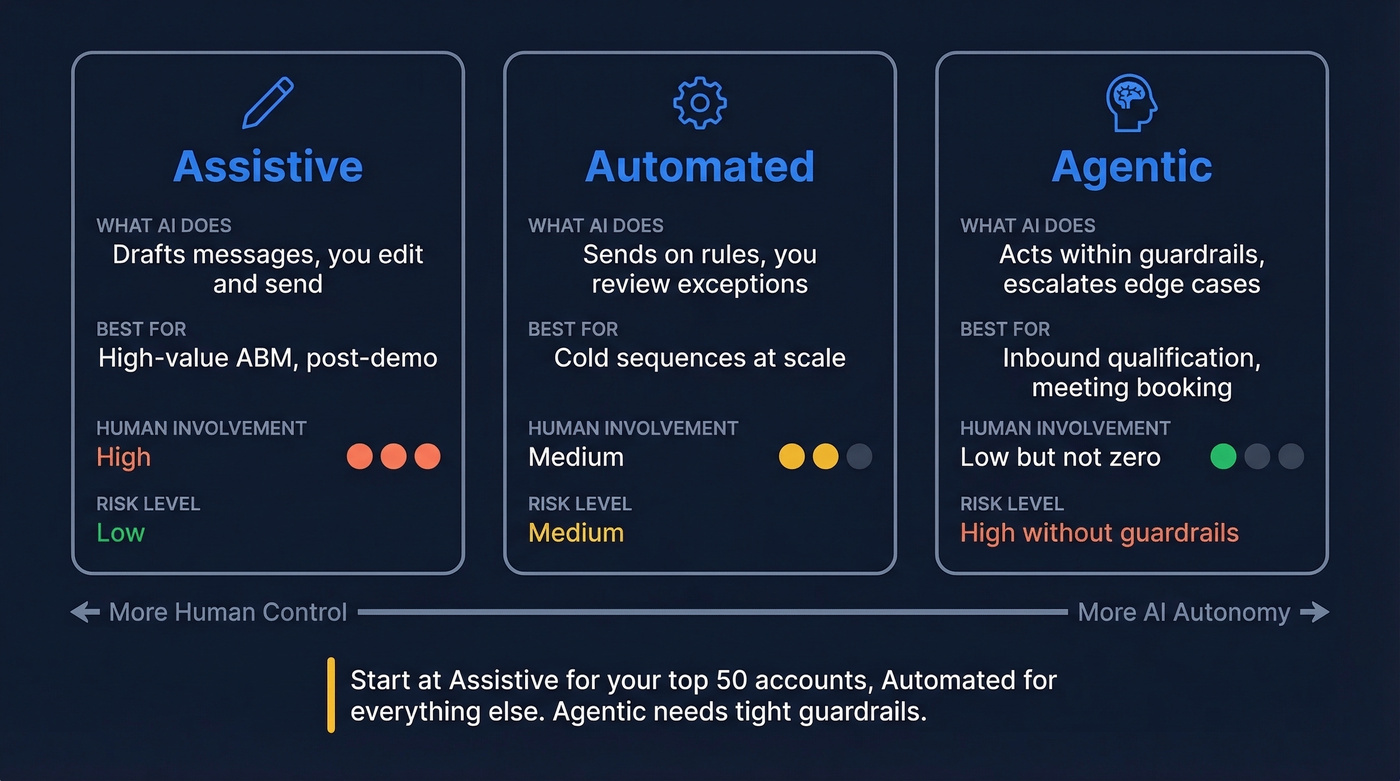
Static sequences send the same emails on the same schedule regardless of engagement. AI-powered follow-up adapts timing, channel, and message based on prospect behavior - and that's where the real gains come from.
Start at Assistive for your top 50 accounts and Automated for everything else. Agentic sounds exciting, but most "AI SDR" setups still need tight guardrails and clear escalation rules. We've seen teams rush into fully autonomous mode and torch their domain reputation within weeks because nobody reviewed the edge cases - pricing questions answered wrong, product claims that were flat-out inaccurate, casual replies to C-suite contacts that read like they were written by an intern. Keep a human in the loop for anything involving pricing, product claims, or executive-level outreach.
The Data Quality Problem Nobody Talks About
17% of cold emails never reach the inbox. AI can write a perfect follow-up - personalized, well-timed, value-driven - and send it to someone who left the company six months ago. The email bounces. Your domain reputation takes a hit. Gmail's spam complaint threshold sits at 0.1%. Exceed that and you're fighting deliverability issues for weeks.
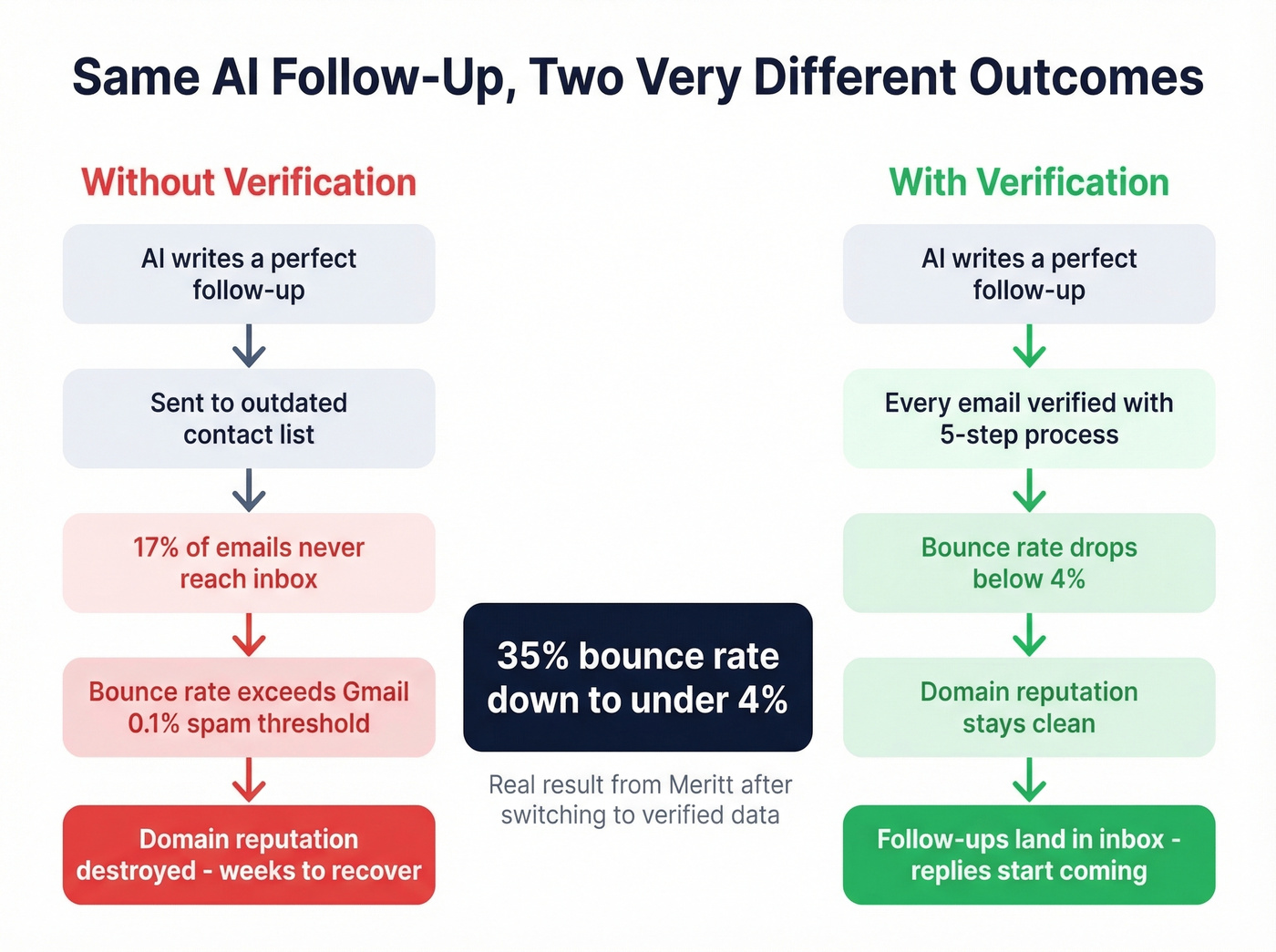
Before you automate a single follow-up, verify your list. Prospeo runs every email through a 5-step verification process with catch-all handling, spam-trap removal, and honeypot filtering - delivering 98% email accuracy across 143M+ verified addresses refreshed every 7 days. One customer, Meritt, dropped their bounce rate from 35% to under 4% after switching. That's the difference between a working outbound engine and a domain reputation death spiral.
If you want a broader view of providers, start with our guide to B2B databases and prioritize accuracy over raw volume.

AI follow-up tools can't fix bad data. Prospeo verifies every email through a 5-step process - catch-all handling, spam-trap removal, honeypot filtering - refreshed every 7 days. 98% accuracy across 143M+ emails. Start with 75 free verifications.
Clean your list before your next sequence goes out.
Best Tools for AI Sales Follow-Up
You don't need a 10-tool stack. You need two, maybe three tools that work together.
Most teams get the biggest lift by pairing a sequencer with an email verifier and light data enrichment.
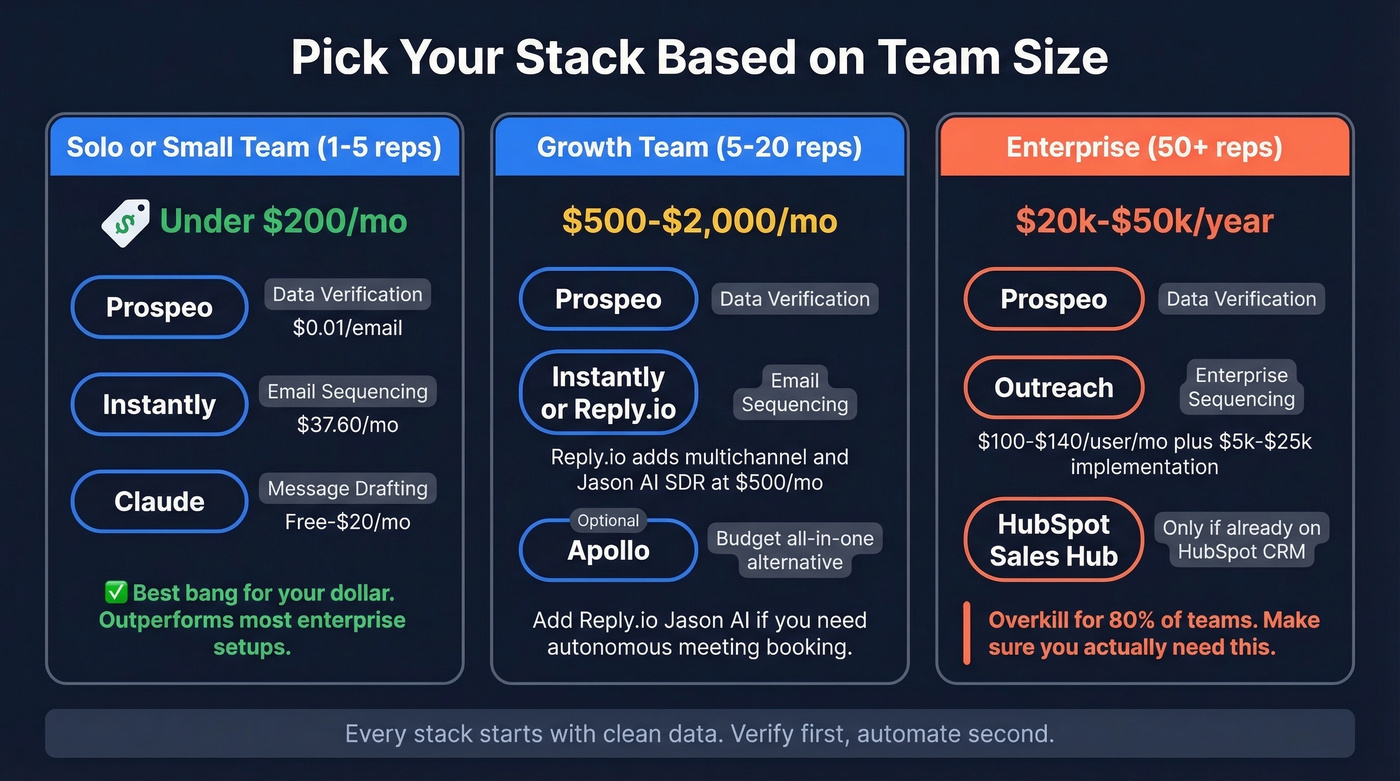
| Tool | Category | Starting Price | Best For |
|---|---|---|---|
| Prospeo | Data & Verification | Free (75 emails/mo); ~$0.01/email | Clean data before you automate |
| Instantly | AI Sequencing | ~$37.60/mo (annual) | Volume + deliverability |
| Reply.io | AI Sequencing + SDR | $89/user/mo; Jason AI from $500/mo | Multichannel + AI autonomy |
| Apollo | All-in-One | Free (100 credits); $49-$119/user/mo | Budget teams wanting data + sequences |
| HubSpot Sales Hub | CRM-Native | Free (2 seats); $90/seat/mo Pro | Teams already on HubSpot |
| Outreach | Enterprise | ~$100-$140/user/mo | 50+ seat deployments |
Instantly is our top pick for pure sequencing on teams under 20 reps. Solid deliverability infrastructure, clean UI, and the benchmark data they publish is genuinely useful for calibrating campaigns. We've used their reports to set baseline expectations for clients and they hold up well.
Reply.io goes further with Jason AI SDR - an agentic layer that handles replies, books meetings, and runs multichannel sequences across email, calls, and social touches from a single workflow. At $500/mo for the AI SDR tier, it isn't cheap, but it's one of the closest things to a real autonomous follow-up agent we've tested. Worth a trial if you're evaluating automated follow-up at scale.
Apollo works for budget-conscious teams who want data and sequences in one platform. The free tier is generous, and for early-stage teams it's a reasonable starting point. Skip it if you need high email accuracy - in our experience, their verification doesn't match dedicated tools.
HubSpot Sales Hub makes sense if you're already running HubSpot CRM. Don't buy it just for sequences.
Outreach is overkill for 80% of teams. At $20k-$50k/year with implementation costs on top (often $5,000-$25,000), it's built for 50+ seat orgs with dedicated RevOps. Powerful platform, painful pricing - the consensus on r/sales matches.
Here's the thing: most teams under 20 reps don't need anything beyond Prospeo for data verification, Instantly for sequencing, and Claude for drafting custom angles. That stack runs under $200/month and outperforms most enterprise setups we've seen. Feed Claude your best-performing templates, MEDDIC notes, and company research - generic prompts produce generic output.
Five Mistakes That Kill Results
Treating volume as strategy. Sending 5,000 emails isn't a strategy. Sending 500 well-targeted, verified emails is. We've watched teams cut their send volume by 80% and double their reply rate just by tightening targeting and verifying every address before it enters a sequence. (If you're scaling outbound, use an outbound email automation setup that protects deliverability.)
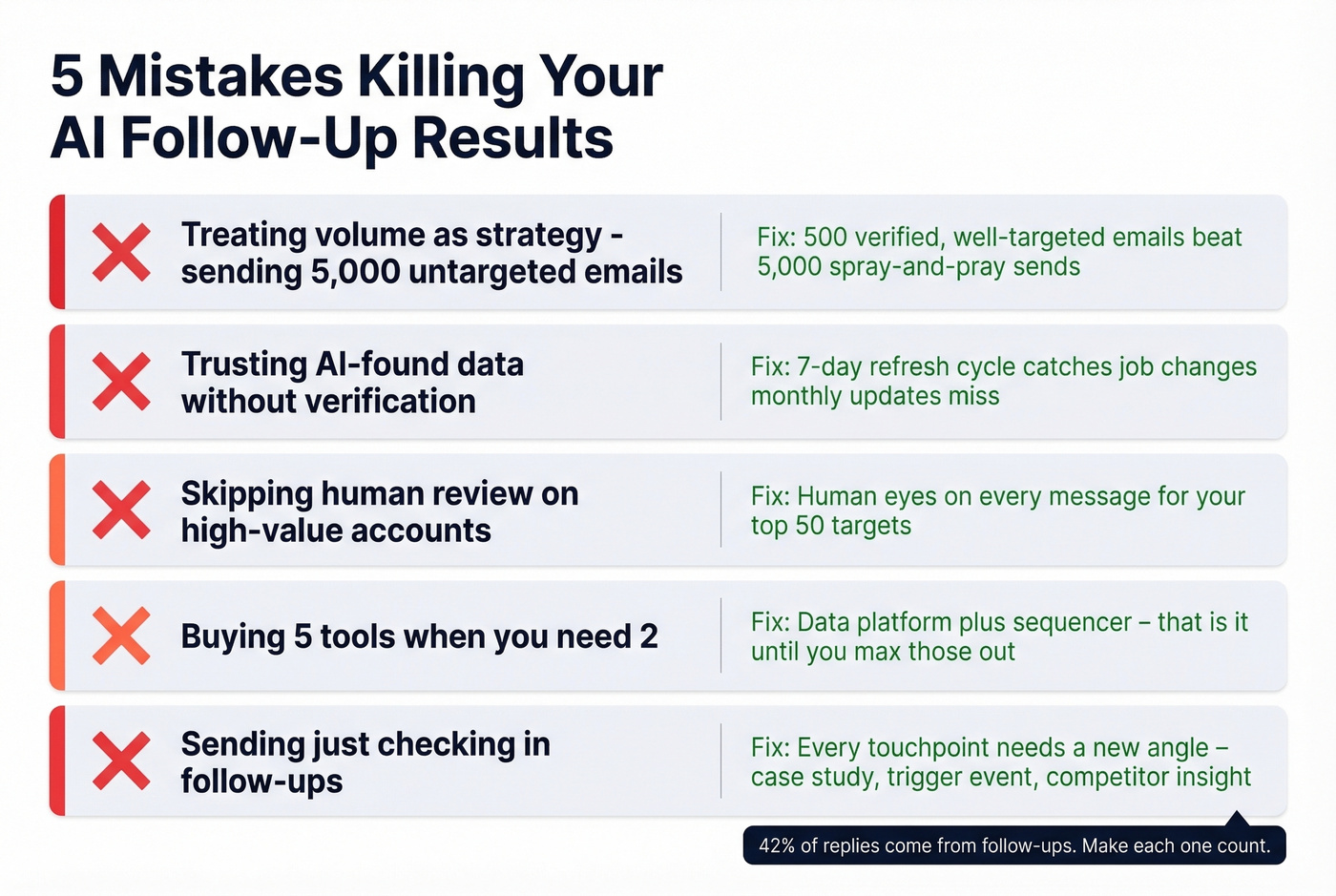
Trusting AI-found data without verification. AI can surface contacts. It can't guarantee those contacts still work at that company. A 7-day data refresh cycle catches job changes that monthly or quarterly refreshes miss entirely.
Skipping human review on high-value accounts. Your top 50 targets deserve a human eye on every message. Use AI for the long tail. (For tighter targeting, start with a clear ideal customer profile.)
Buying 5 tools when you need 2. Data platform plus sequencer. That's it for most teams until you've maxed out those two. Every additional tool adds integration complexity, another login, another bill, and another thing that breaks at 2 AM before a big launch.
"Just checking in" follow-ups. Each touchpoint needs a new angle or piece of value. If your automated follow-up doesn't give the prospect a reason to care, it's noise. Share a relevant case study, reference a trigger event, surface a competitor insight - anything except "bumping this to the top of your inbox." (If you need a cadence blueprint, use a follow up email sequence strategy.)
What It Actually Costs
A fully loaded human SDR runs $75k-$100k/year. An AI-assisted follow-up stack costs $500-$2,000/month. The math looks obvious, but expect 40-60 hours of data cleaning, segmentation, and workflow setup before launch.
If you're measuring impact, track it like a pipeline system, not a vanity-metric dashboard - see sales engagement analytics for the core metrics that actually correlate with revenue.
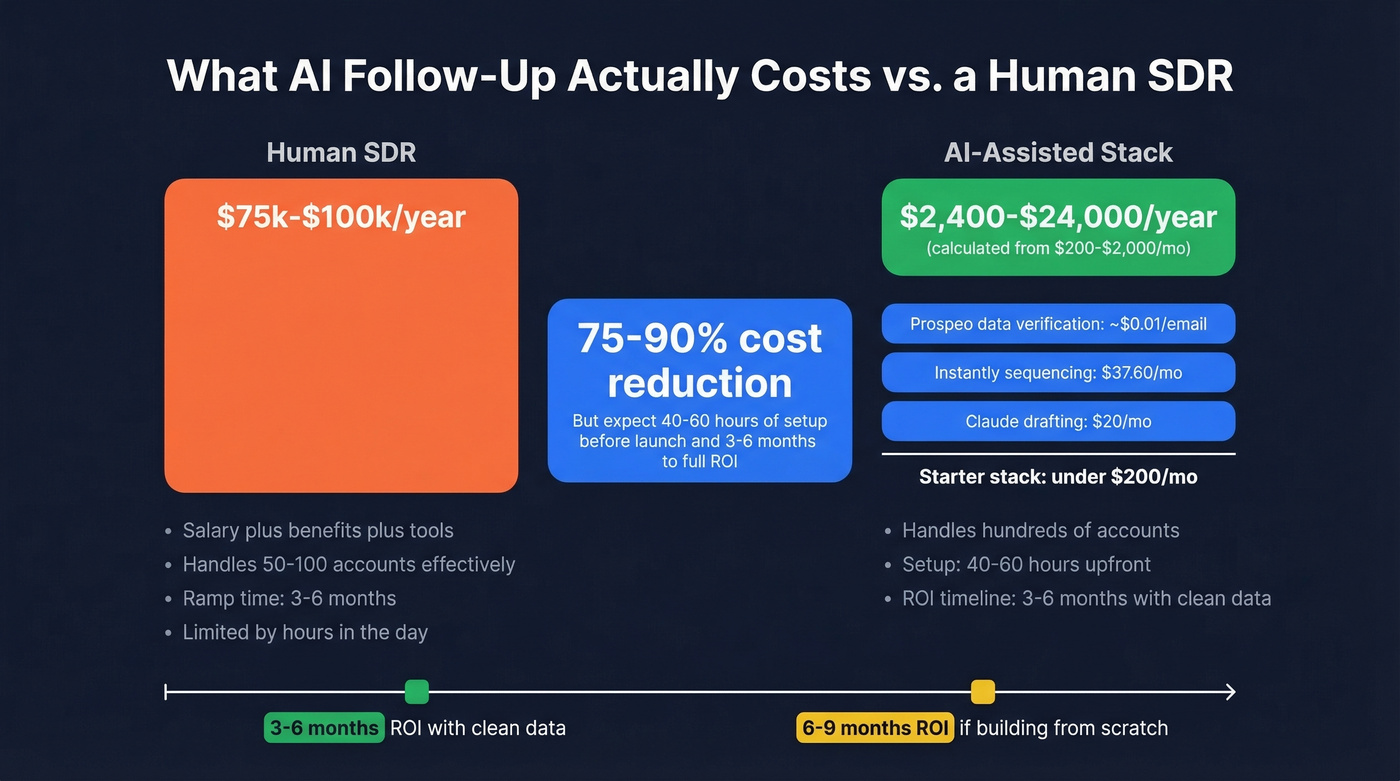
ROI timeline is 3-6 months with clean data, 6-9 months if you're building from scratch. Teams that invest in data quality upfront recoup setup costs faster because they avoid the domain reputation damage that comes from launching on dirty lists. Let's be honest - if your first 1,000 sends bounce at 15%, you've already dug yourself a hole that takes months to climb out of.
The best AI follow-up stack starts at $200/mo - but only if your data doesn't bounce. Prospeo delivers verified emails at $0.01 each with 98% accuracy. Meritt cut their bounce rate from 35% to under 4% and tripled pipeline.
Stop feeding your AI sequencer dead addresses.
FAQ
Does AI follow-up actually improve reply rates?
Teams using AI SDR tools save 4-7 hours per week and see up to 35% higher engagement compared to manual sequences. Results depend entirely on data quality - verify contacts first, automate second.
How many follow-ups should I send?
Four to seven touchpoints spaced 3-4 days apart, each adding a new angle or piece of value. Keep emails under 80 words. "Just checking in" messages actively hurt reply rates and train prospects to ignore you.
What's the cheapest way to start?
Prospeo's free tier (75 verified emails/month) for data hygiene, Instantly at ~$37.60/mo for sequencing, and Claude for drafting personalized angles. Under $200/month total. Start with 100-200 test accounts and scale once metrics prove out.
Can AI handle multichannel follow-up beyond email?
Reply.io's Jason AI SDR runs sequences across email, calls, and social touches from a single workflow. Instantly focuses on email only. For most teams, start with email-only sequences and layer in additional channels once your baseline deliverability and reply rates are stable.