Follow-Up Email Reply Rate: What the Data Actually Says in 2026
You send 500 cold emails. By follow-up three, 47 have bounced, your domain reputation is sliding, and the rest are landing in spam. The sequence looks fine on paper - the infrastructure underneath it is broken.
That's the story behind most "low reply rate" complaints, and it's the one most guides skip entirely. 42% of all cold email replies come from follow-ups, not the initial send. If your follow-up email reply rate is flat, the problem is almost never the copy.
The Short Version
- The average cold email reply rate sits at 3-8%. Belkins' 16.5 million cold emails dataset shows 8.4% on the first email alone. Instantly's dataset shows a split - 58% of replies come from the first email, 42% from follow-ups - but only if they actually reach the inbox.
- The sweet spot is 3-5 total emails with graduated spacing (2, 4, 7, then 14 days). Sending 4+ emails in a sequence more than triples unsubscribe and spam complaint rates.
- Below 3%? Stop rewriting subject lines. Audit your data quality and deliverability first - that's where most campaigns actually break.
2026 Reply Rate Benchmarks
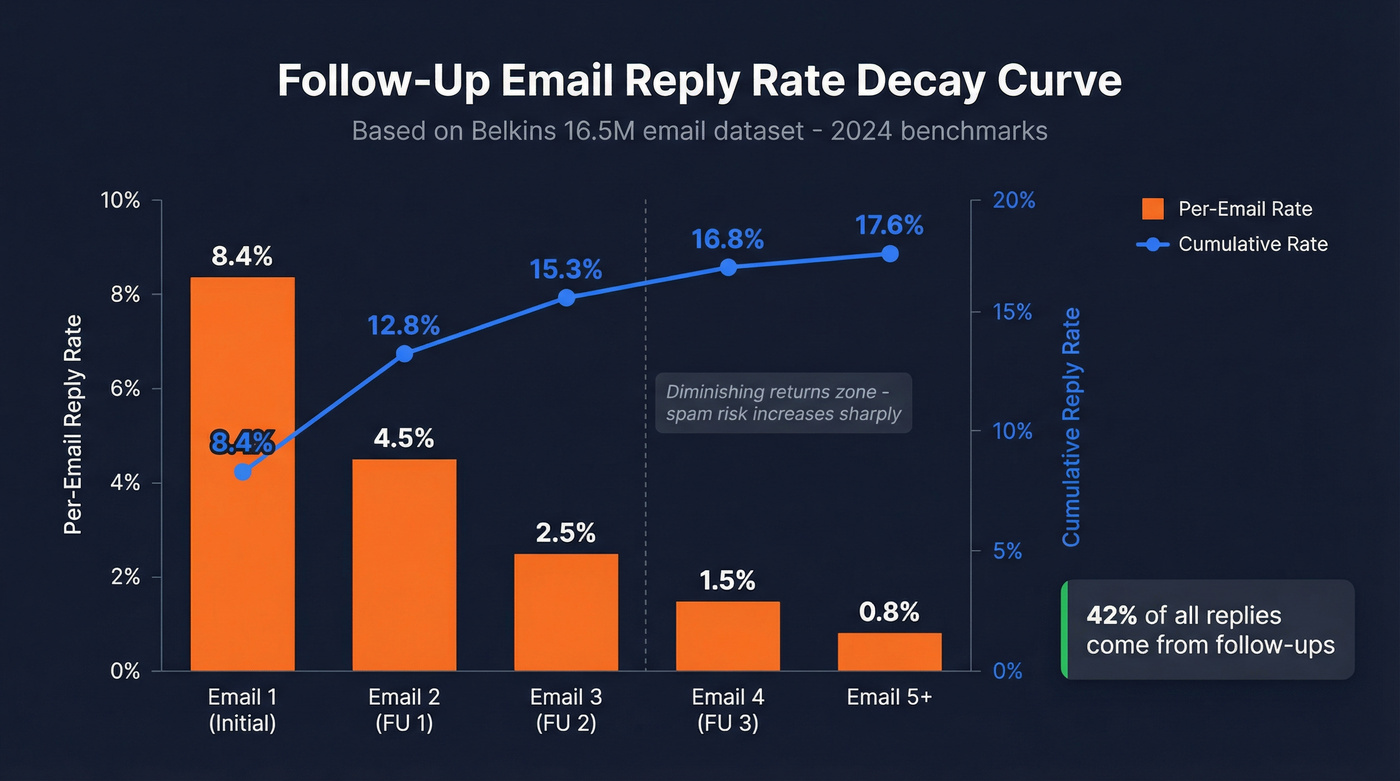
Belkins analyzed 16.5 million cold emails across 93 business domains from January 2024 through December 2024. The headline number: 8.4% reply rate on the first email. Every subsequent touch declines from there, but the cumulative total keeps climbing.
Instantly's data puts the overall average at 3.43%, with top performers exceeding 10%. Snov.io's dataset lands at 5.1% across all cold outreach.
Here's a distinction most articles blur: per-email reply rate versus cumulative reply rate. Each individual follow-up gets fewer replies than the one before it, but your cumulative rate - total replies divided by total prospects - keeps climbing with each touch, just at a diminishing pace. Understanding this is what separates teams that optimize effectively from those chasing vanity metrics.
Here's an estimated decay curve consistent with Belkins' "step-level decline" pattern, anchored to their 8.4% first-email benchmark:
| Per-Email Reply Rate | Cumulative Reply Rate | |
|---|---|---|
| Email 1 (initial) | ~8.4% | ~8.4% |
| Email 2 (FU 1) | ~4-5% | ~12-13% |
| Email 3 (FU 2) | ~2-3% | ~14-16% |
| Email 4 (FU 3) | ~1-2% | ~15-18% |
| Email 5+ | <1% | ~15-19% |
Emails two and three do real work. After that, you're chasing diminishing returns while accumulating spam risk.
In practice, send to 500 verified prospects and you can expect roughly 42 replies from the initial email. Follow-ups two and three add another 20-30. Push to email five and you squeeze out a few more - but you've also increased your spam-complaint and unsubscribe exposure sharply.
Benchmarks by Industry, Company Size, and Seniority
Not all prospects respond at the same rate.
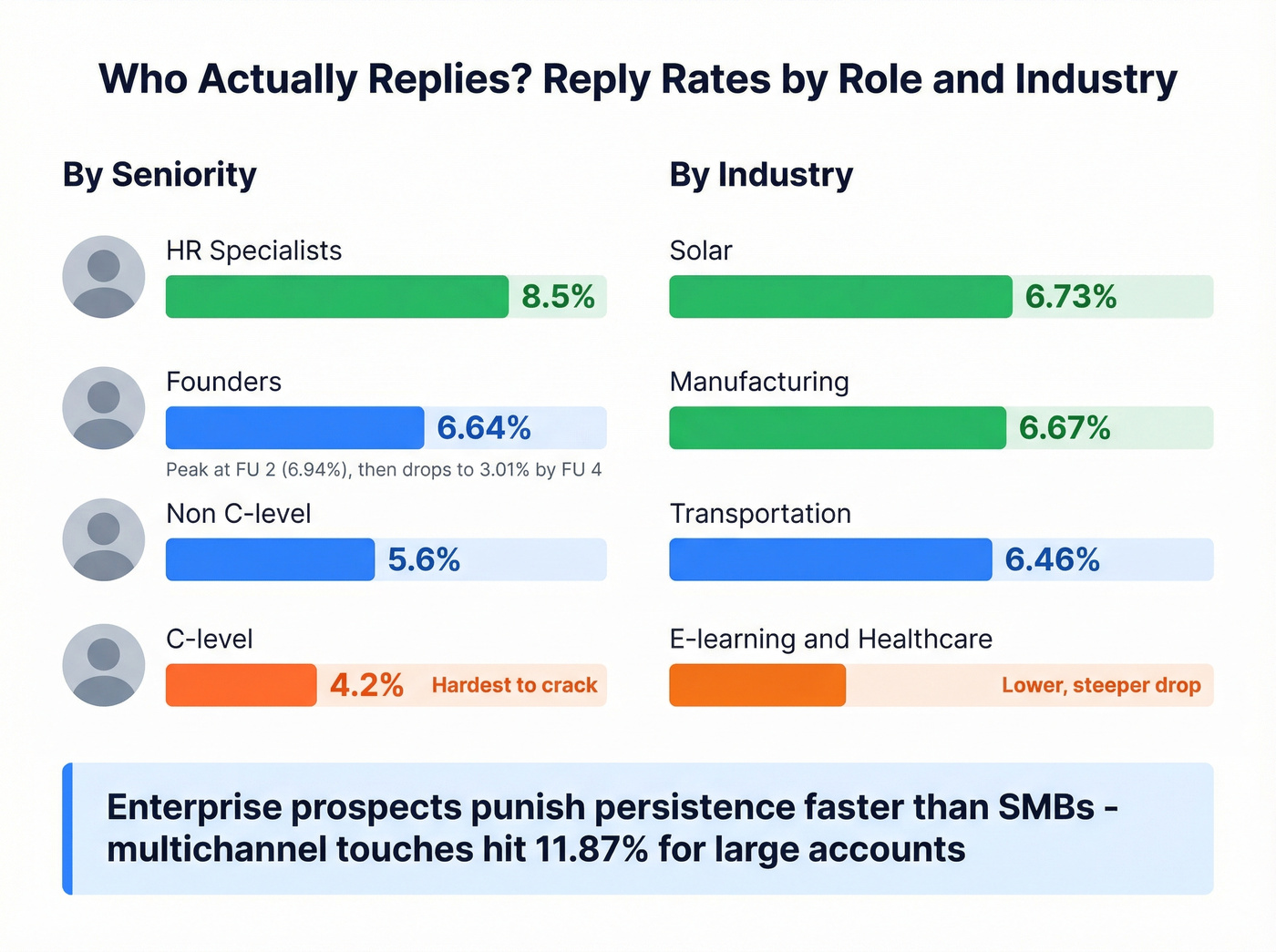
Industry benchmarks:
| Industry | Initial Email | After 1 Follow-Up |
|---|---|---|
| Manufacturing | 6.67% | 6.77% |
| Solar | 6.73% | 6.83% |
| Transportation | 6.46% | 6.66% |
| E-learning | Lower | Steeper drop |
| Healthcare | Lower | Steeper drop |
Solar and manufacturing hold up well through the first follow-up - reply rates actually tick up slightly before declining. E-learning and healthcare see steeper drops earlier.
Seniority breakdown:
| Role | Initial | Peak | Drop-off |
|---|---|---|---|
| Founders | 6.64% | 6.94% (FU 2) | 3.01% (FU 4) |
| C-level | 4.2% | - | Faster decline |
| Non-C-level | 5.6% | - | Gradual |
| HR specialists | 8.5% | - | Gradual |
Founders show a fascinating curve. They'll engage if you're persistent, peaking after the second follow-up, then dropping hard. HR specialists are the most responsive segment at 8.5%, while C-level prospects are the hardest to crack at 4.2%.
One pattern we see repeatedly: enterprise prospects punish persistence faster than SMBs. A five-email sequence that works on 50-person companies will get you flagged as spam at a Fortune 500. For those targets, a message plus profile-visit combo hit 11.87% in the same dataset - suggesting multichannel touches outperform email-only sequences for enterprise.
The Optimal Follow-Up Cadence
Seventy percent of cold email chains stop after the first message. That's a massive missed opportunity when follow-ups generate 42% of replies.
Mailpool's analysis of one million cold emails reinforces this: multi-touch sequences of 3-5 emails over two weeks doubled reply rates compared to single-touch campaigns. The data is unambiguous.
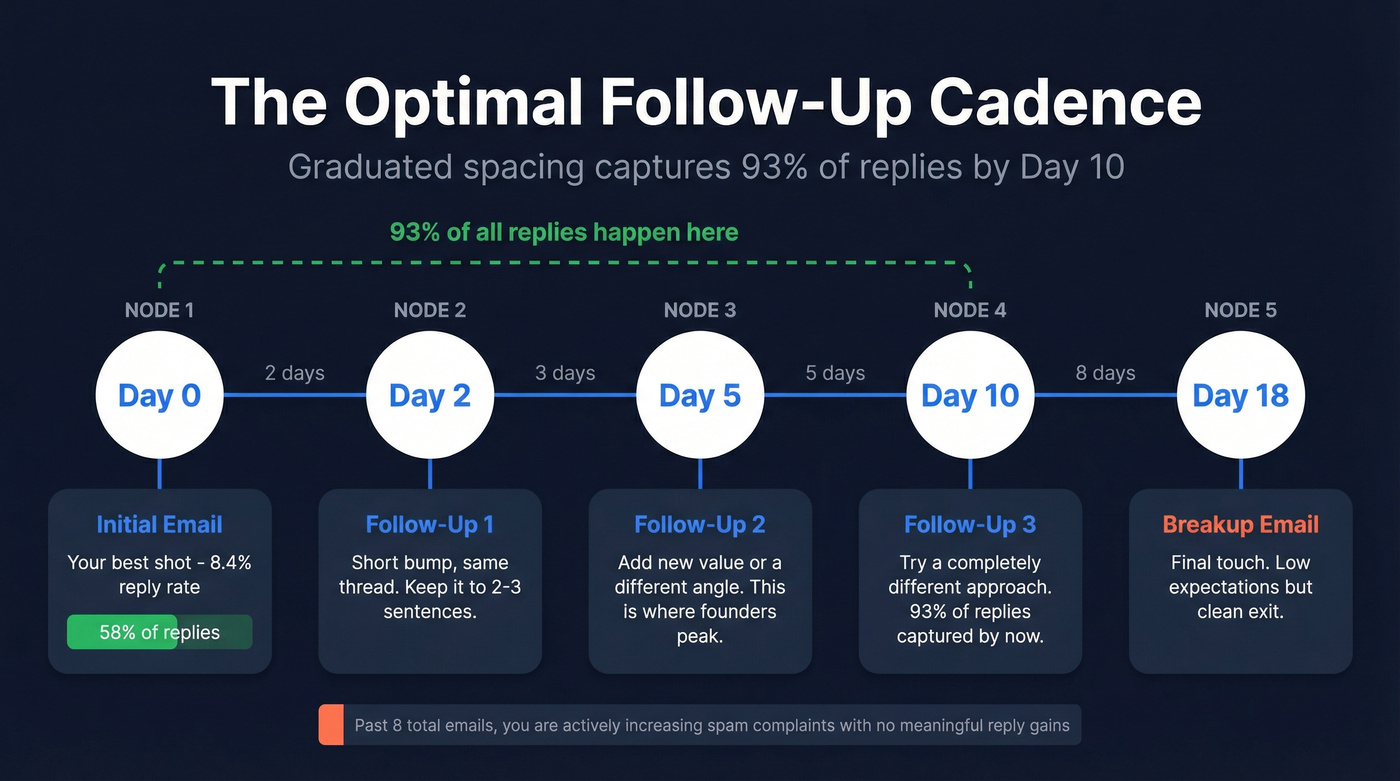
Here's the cadence that captures the most replies with the least risk:
| Day | Action | Notes |
|---|---|---|
| Day 0 | Initial email | - |
| Day 2 | Follow-up 1 | Short bump, same thread |
| Day 5 | Follow-up 2 | Add new value or angle |
| Day 10 | Follow-up 3 | Different approach |
| Day 18 | Breakup email | Final touch |
This framework captures roughly 93% of all replies by Day 10. The key principle is graduated spacing - not static "every 3 days" intervals, which look automated and trigger spam filters.
Each email after the third sees approximately a 30% drop in effectiveness versus the previous one. Push past eight total emails and you're actively increasing spam complaints without meaningful reply gains.

Your cadence is dialed in. Your copy is sharp. But none of it matters if 1 in 6 emails never hits the inbox. Prospeo's 5-step verification and 98% email accuracy keep bounce rates under 4% - so every follow-up in your sequence actually has a chance to get a reply.
Stop optimizing sequences built on bad data.
When to Send
The data converges on a tight window: Tuesday through Thursday, 9-11 AM in the recipient's local time zone.
Timing between emails matters more than most teams realize. Next-day follow-ups reduce replies by 11%. Waiting three days increases replies by 31%. That's not a marginal difference - it's the gap between a sequence that works and one that doesn't. If you want a deeper breakdown, see our guide on the best time to send prospecting emails.
Why Your Follow-Ups Aren't Landing
Here's the thing: most follow-up guides tell you to rewrite your subject line, add personalization, try a different CTA. That advice isn't wrong. It's just treating the symptom.
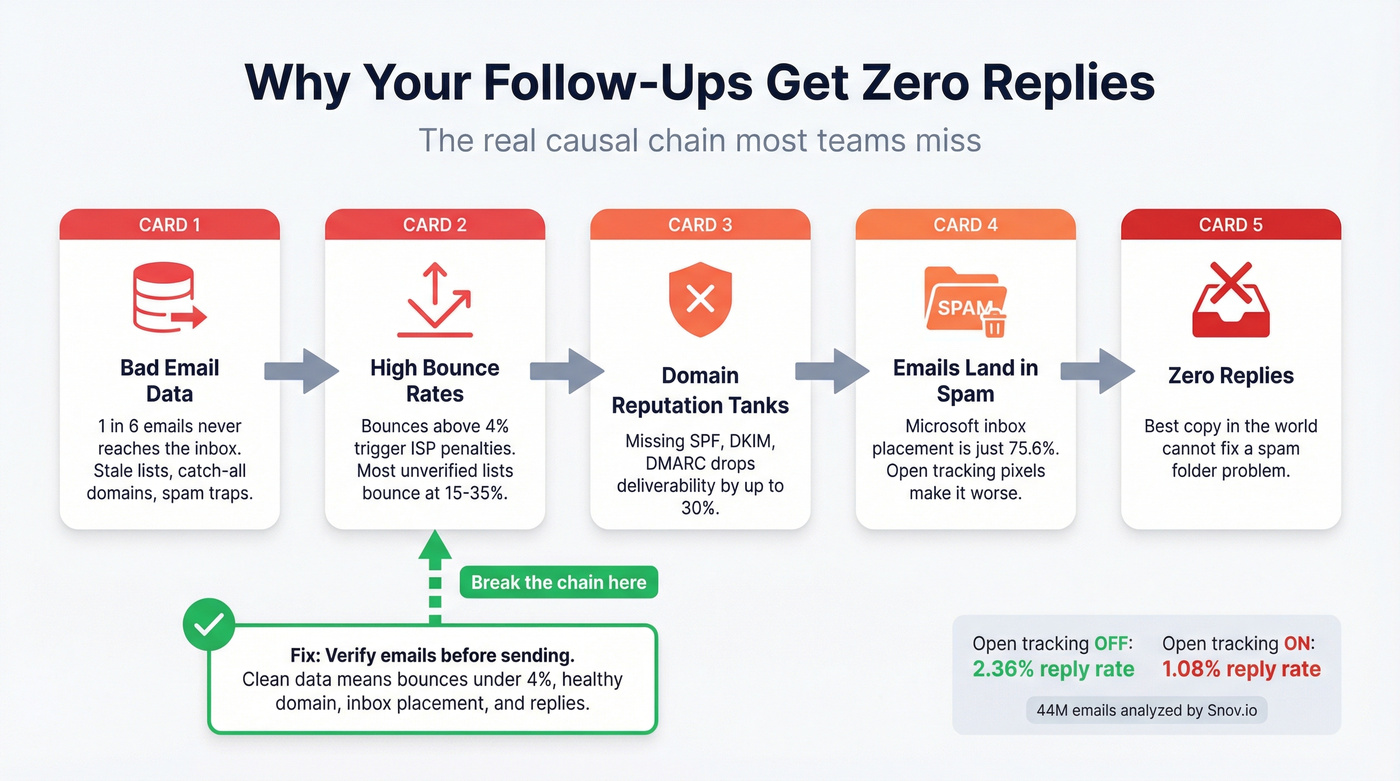
The actual causal chain runs like this: bad email data leads to high bounce rates, which damage domain reputation, which routes emails to spam, which produces zero replies. You could write the best follow-up email in history, and it won't matter if it's sitting in a spam folder.
The numbers are stark. Roughly 1 in 6 emails never reaches the inbox, putting global inbox placement around 84%. Microsoft is the worst offender at just 75.6%. Missing or misconfigured SPF/DKIM/DMARC records can drop deliverability by up to 30%. (If you need the technical checklist, start with our email deliverability checklist.)
Even your tracking setup matters. Snov.io analyzed 44 million emails and found that turning off open tracking more than doubled reply rates - from 1.08% to 2.36%. Open-tracking pixels are a known spam trigger, and most teams leave them on by default. That single toggle is worth more than any subject line rewrite. If you want the deliverability angle, read does open tracking hurt cold email.
Alex Berman documented a case where fixing infrastructure alone - domains, warmup, bounce handling - produced a 76% open rate and 25% positive reply rate without changing a single word of copy. The copy wasn't the problem. It never was.

This is where data quality becomes the highest-leverage fix in your entire outbound stack. Prospeo's 98% email accuracy and 5-step verification process breaks this chain at the source - before a single email sends. The platform runs catch-all domain verification, spam-trap removal, and honeypot filtering on a 7-day refresh cycle, so you're not sending to addresses that went stale three weeks ago.
The customer results back this up: Meritt saw bounce rates drop from 35% to under 4%, with connect rates tripling. GreyScout went from 38% bounce to under 4%, with pipeline up 140%. When your data is clean, your domain stays healthy, your follow-ups land in the inbox, and reply rates take care of themselves.
The causal chain is clear: bad data → bounces → reputation damage → spam folder → zero replies. Prospeo breaks that chain at the source with 143M+ verified emails refreshed every 7 days - not the 6-week industry average. At $0.01 per email, fixing your data costs less than one more rewrite.
Your follow-up reply rate is a data quality problem. Solve it.
Same Thread or New Subject Line?
Most operators default to separate threads for follow-ups. Threaded "Re:" bumps work best when the recipient opened the first email and you follow up quickly, because it feels like a natural continuation instead of a brand-new cold pitch.
If you're changing your angle or value proposition - say, pivoting from a pain-point opener to a case study - a new subject line makes the message easier to parse. The "just checking in" email response rate is notoriously low. Vague bumps without new value give recipients no reason to respond. (If you need examples, pull from these subject lines for follow-up emails.)
Let's be honest: there's no controlled A/B data on this. It's practitioner consensus from HubSpot community threads and r/coldemail discussions. But the logic is sound, and it's what most experienced outbound operators default to.
Five Fixes That Move Reply Rates
1. Verify your contact list before launching. Run every list through verification before it touches a sequence. We've seen teams double reply rates by cleaning their list alone, without touching a word of copy. This is the single highest-ROI fix. If you're comparing vendors, start with our roundup of the best email ID validators.
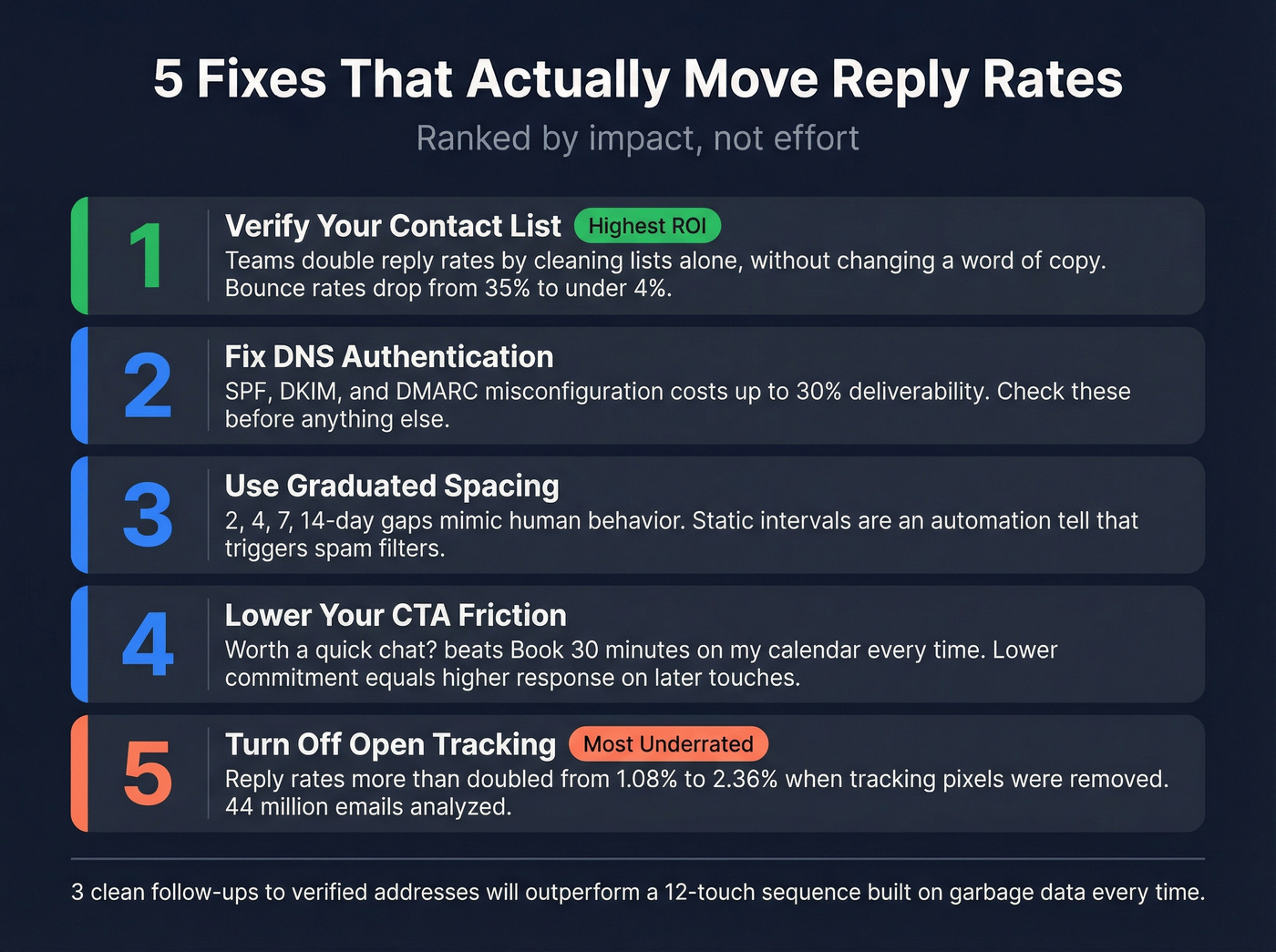
2. Fix your DNS authentication. SPF, DKIM, and DMARC aren't optional. Misconfiguration alone can cost you 30% of your deliverability. Google's sender guidelines spell out the requirements - check these before you troubleshoot anything else. If you want the full setup walkthrough, use our SPF DKIM DMARC setup for cold email.
3. Use graduated spacing. Stop sending follow-ups every two days like a robot. The 2, 4, 7, 14-day progression mimics human behavior and avoids spam filters. Static intervals are an automation tell. For more sequence patterns, see our sales cadence example.
4. Lower your CTA friction. "Worth a quick chat?" outperforms "Book 30 minutes on my calendar." The lower the commitment you ask for, the higher the response rate on later touches. This is one of the most consistent findings across practitioner data. If your goal is to turn replies into booked calls, use this guide to convert cold email replies to meetings.
5. Turn off open tracking. This is the most underrated fix in cold email. That 44-million-email dataset showed reply rates more than doubling when open-tracking pixels were removed. Snov.io's research details the finding - the deliverability hit from tracking pixels quietly kills more campaigns than bad subject lines ever will.
Here's our hot take: if your average deal size is under five figures, you probably don't need a seven-email sequence with AI-personalized openers. Three clean follow-ups sent to verified addresses will outperform a twelve-touch sequence built on garbage data every single time. The industry's obsession with sequence length and copy optimization is a distraction from the boring work that actually moves numbers - data hygiene and deliverability. If you want more levers beyond follow-ups, start with these cold email tactics.
Skip the fancy tools if your list is dirty. Fix the foundation first.
FAQ
What's a good follow-up email reply rate?
3-8% is average for cold outreach; strong campaigns with verified data hit 10%+. Consistently below 3% signals a data quality or infrastructure problem - audit bounces and inbox placement before rewriting emails.
How many follow-up emails should I send?
Two to four follow-ups (3-5 total emails) is the sweet spot. The 16.5-million-email study shows sending 4+ emails in a sequence more than triples unsubscribe and spam complaint rates, so pushing beyond that rarely justifies the domain risk.
Does follow-up timing really matter?
Yes. Tuesday through Thursday, 9-11 AM in the recipient's time zone consistently outperforms other windows. Waiting three days between touches increases replies by 31% versus next-day follow-ups, making spacing one of the easiest levers to pull.