Hyper-Personalization Email: The Practitioner's Playbook for 2026
A RevOps lead we know sent 500 "personalized" cold emails last quarter. Every one started with "Hi {{FirstName}}, I noticed {{CompanyName}} is growing fast." Forty-three bounced. The rest got ignored. The problem wasn't the copy - it was the data underneath it, and the assumption that a first name and a company name count as a hyper-personalization email strategy.
71% of consumers expect personalized interactions, and 76% get frustrated when it doesn't happen. But most personalization fails at the data layer, not the copy layer. Stop obsessing over AI-generated subject lines and start obsessing over whether your contact data is accurate, enriched, and current.
The Short Version
Hyper-personalization isn't mail merge. It requires behavioral and contextual data - not just first names and company logos. Data quality is the foundation, because a hyper-personalized email that bounces is worse than a generic one that lands.
There's a 5-level maturity model we'll walk through below, and most teams are stuck at Level 1-2 while calling it "hyper-personalization." It isn't. The good news: you don't need a $35K personalization engine. An ESP, a data tool, and conditional logic get most teams to Level 4 for under $200/month. And cold outbound - the angle every other guide skips - is where personalization ROI is highest.
Personalization vs. Hyper-Personalization
These terms get used interchangeably, but they describe fundamentally different approaches.
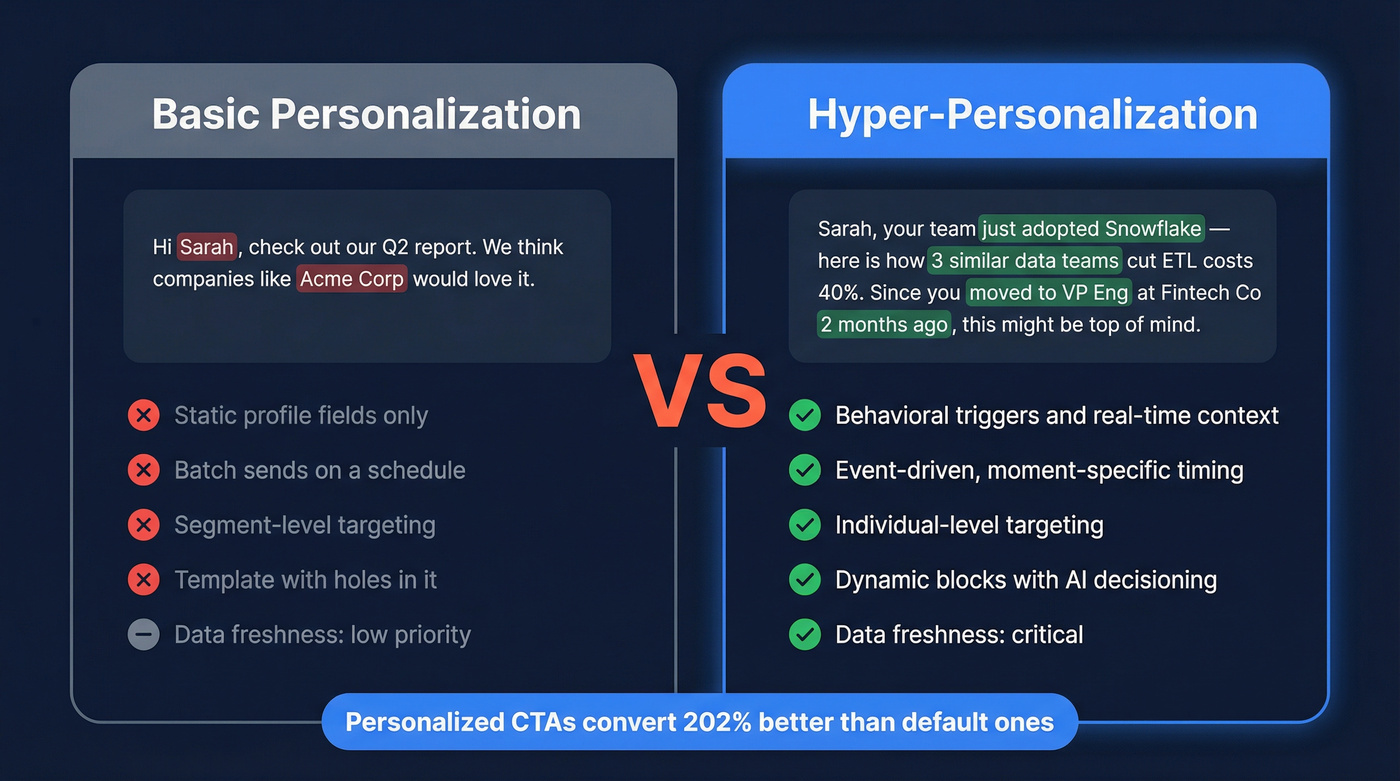
| Dimension | Basic Personalization | Hyper-Personalization |
|---|---|---|
| Data used | Name, company, segment | Behavioral triggers, real-time context |
| Timing | Batch sends | Event-driven, moment-specific |
| Content logic | Static templates | Dynamic blocks, AI decisioning |
| Granularity | Segment-level | Individual-level |
| Data freshness | Low (static profiles) | Critical (real-time signals decay fast) |
| Example | "Hi Sarah, check out our Q2 report" | "Sarah, your team just adopted Snowflake - here's how 3 similar data teams cut ETL costs 40%" |
Basic personalization swaps in profile fields. Hyper-personalization uses what someone did - pages browsed, products abandoned, job changes, funding events, tech stack shifts - to tailor every element of the email to that individual at the moment they receive it. Personalized CTAs convert 202% better than default ones, and that gap widens dramatically when you move from static fields to behavioral signals.
If you're building this for outbound, the mechanics overlap heavily with personalization in outbound sales: the signal matters more than the prose.
Why It Works - The Benchmarks
MoEngage's 2025 benchmark report - covering 17.3B emails sent across its platform - analyzed 312.4M emails across the U.S. and Canada, breaking performance into broadcast, attribute-based, behavior-based, and journey-based categories.
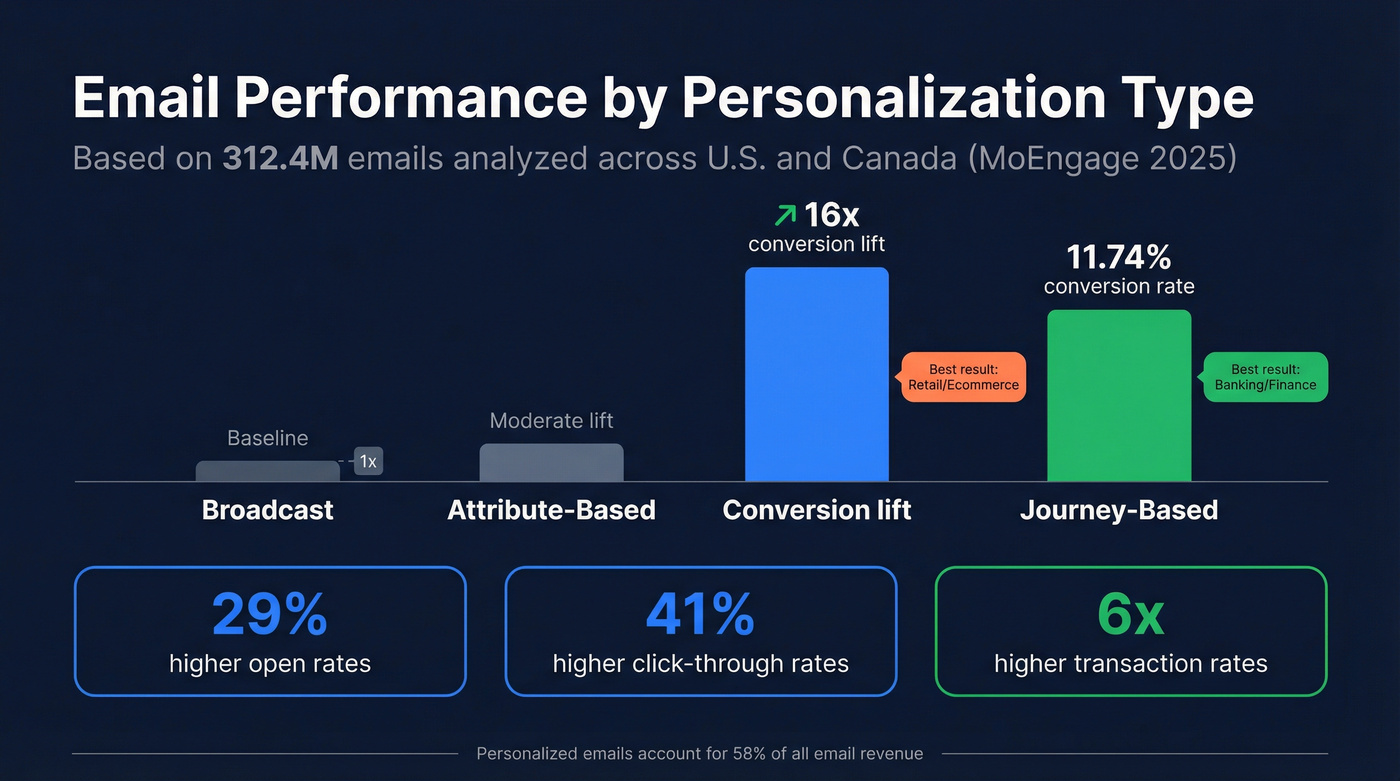
| Email Type | Relative Conversion Lift | Best Industry Result |
|---|---|---|
| Broadcast | Baseline | - |
| Attribute-based | Moderate | - |
| Behavior-based | Up to 16x vs broadcast | Retail/ecommerce |
| Journey-based | 11.74% conversion rate | Banking/finance |
Behavior-based campaigns in retail showed a 16x conversion lift over broadcast. Journey-based emails in banking hit an 11.74% conversion rate. These aren't marginal improvements - they're order-of-magnitude differences that should make anyone rethink their batch-and-blast approach.
The broader stats reinforce the pattern: personalized emails deliver 29% higher open rates and 41% higher click-through rates, generate 6x higher transaction rates, and account for 58% of all email revenue. Companies that excel at this generate 40% more revenue from those activities than average players. McKinsey pegs the impact at 1-2% sales lift and 1-3% margin improvement - numbers that compound fast at scale.
The question isn't whether to personalize. It's how fast you can move from Level 1 to Level 4.
The 5 Levels of Email Personalization
Most teams think they're doing hyper-personalization. They're not.
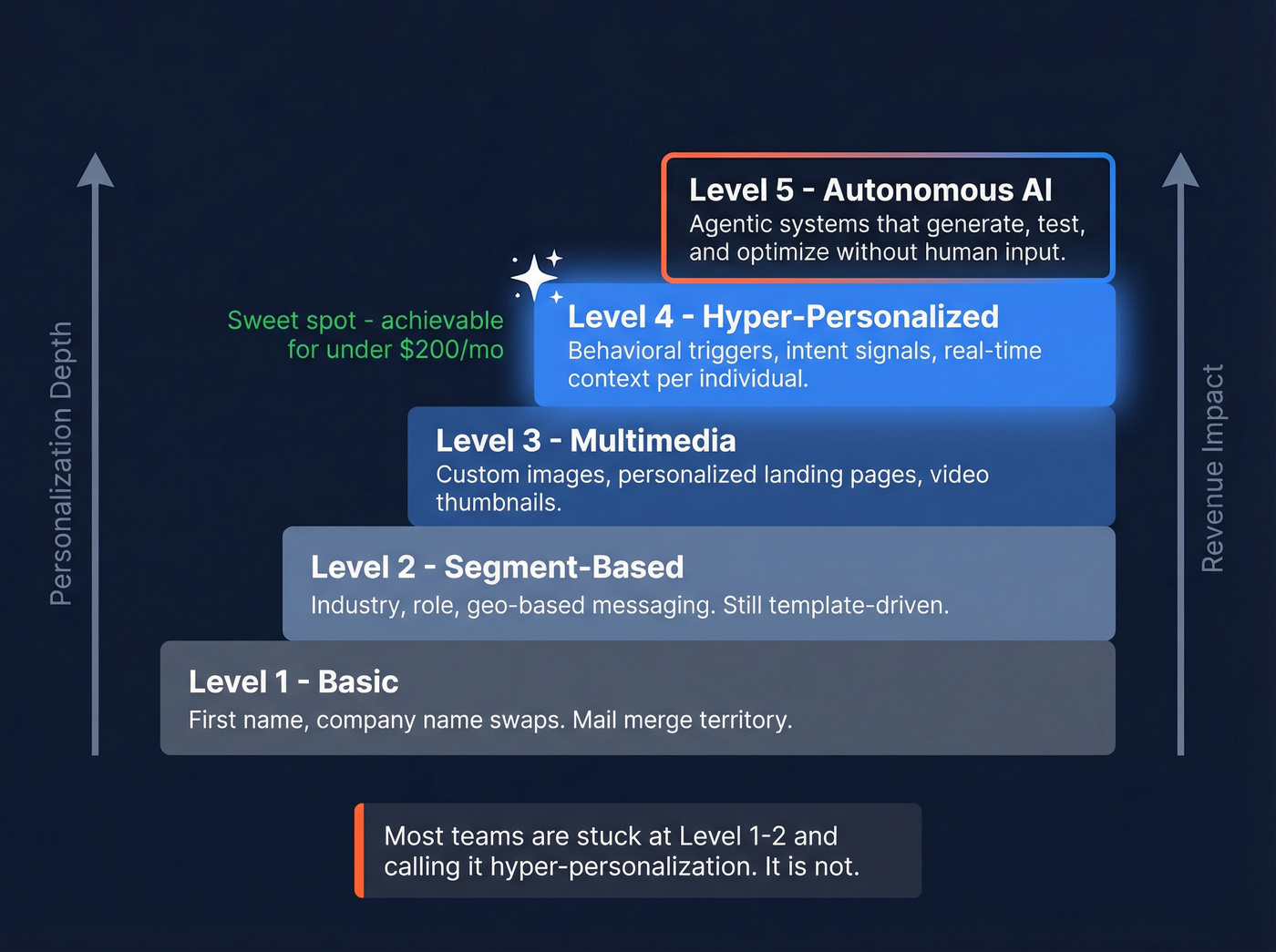
| Level | Name | What It Looks Like |
|---|---|---|
| 1 | Basic | First name, company name in subject/body |
| 2 | Segment-based | Industry, role, geo-based messaging |
| 3 | Multimedia | Custom images, personalized landing pages |
| 4 | Hyper-personalized | Individual behavioral + contextual data |
| 5 | Autonomous AI | Agentic systems that generate, test, optimize |
Level 1 is mail merge. If your "hyper-personalized" email still starts with "Hi {{FirstName}}" and a generic value prop, you're here. That's not individualized outreach - it's a template with holes in it.
Level 2 adds segmentation: different messages to CMOs vs. SDR managers, or tailoring by industry vertical. Better, but still template-driven. Level 3 introduces visual personalization - custom images with the recipient's name, personalized video thumbnails, dynamic landing pages. This is where most marketing teams plateau.
Level 4 is true email hyper-personalization. You're using browsing behavior, purchase history, intent signals, job changes, and real-time context to tailor every element. The email a VP of Engineering at a Series B fintech receives is fundamentally different from what a CRO at an enterprise retailer gets - not just in copy, but in offer, timing, and content blocks.
Level 5 is the emerging frontier: autonomous AI systems that generate, A/B test, and optimize emails without human input. Early days, but the direction is unmistakable.
If you want a parallel framework for account-based programs, the ABM maturity model maps cleanly to these levels.

You can't hyper-personalize an email that bounces. Prospeo's 5-step verification delivers 98% email accuracy with a 7-day refresh cycle - so your behavioral triggers, intent signals, and dynamic content actually reach real inboxes. 300M+ profiles enriched with 50+ data points give you the contextual layer hyper-personalization demands.
Fix the data layer first. Everything else compounds from there.
12 Hyper-Personalized Email Templates
These patterns span marketing and outbound. Each goes beyond basic personalization into behavioral or contextual territory.
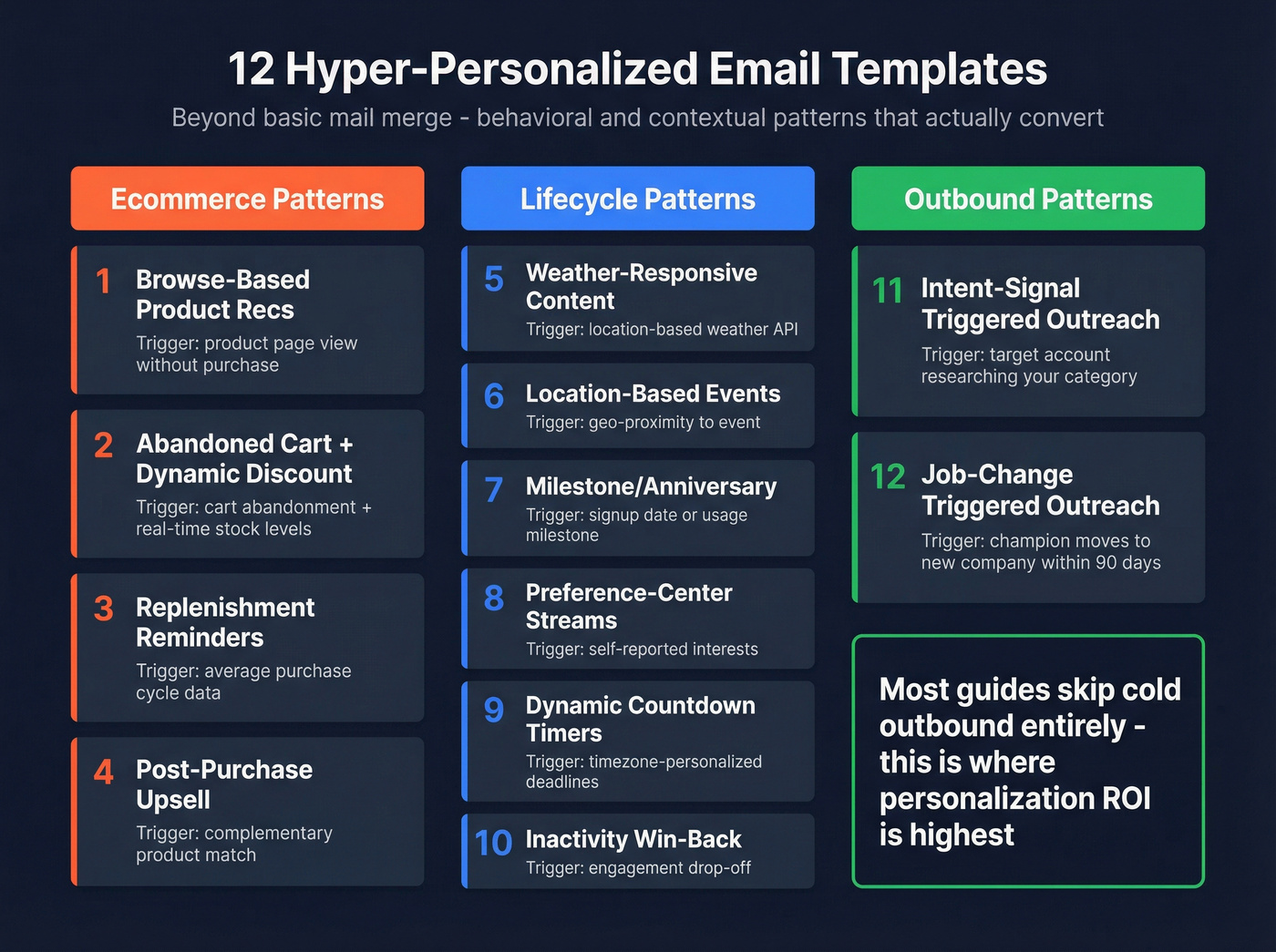
Ecommerce Patterns
- Browse-based product recs. Triggered by product page views without purchase. Subject: "That chair's still waiting for you, {{FirstName}}."
- Abandoned cart with dynamic discount + inventory. Real-time stock levels create urgency. Subject: "Only 3 left - and here's 10% off."
- Replenishment reminders. Triggered by average purchase cycle data. Subject: "Time to restock? Your last order was 47 days ago."
- Post-purchase upsell. Complementary product recommendations based on what they bought. Subject: "Pairs perfectly with your new standing desk." (More patterns: upsell email examples.)
Lifecycle Patterns
- Weather-responsive content. Location-based weather data drives product selection. Subject: "Rain all week in Portland - gear up."
- Location-based events. Geo-targeted invitations to local meetups. Subject: "We're in Austin next Thursday. Coffee?"
- Milestone/anniversary messages. Triggered by signup date or usage milestones. Subject: "1 year in - here's what you've built."
- Preference-center driven streams. Content tailored to self-reported interests. Subject: "Your weekly digest (just the categories you picked)."
- Dynamic countdown timers. Live timers personalized to the recipient's timezone. Subject: "Your offer expires in 4 hours."
- Inactivity win-back. Triggered by engagement drop-off with escalating incentives. Subject: "We miss you - and we brought a 20% discount." (If you need subject ideas, see re-engagement email subject lines.)
Outbound Patterns
Here's the thing: most guides on hyper-personalization email treat it purely as a marketing concept - abandoned carts, product recs, lifecycle campaigns. They skip cold outbound entirely, which is where personalization ROI is highest because recipients have zero prior relationship with you.
- Intent-signal triggered outreach. When a target account starts researching your category via intent data, trigger a cold email referencing the specific topic. Subject: "Noticed your team's evaluating CDPs - here's what we learned migrating off Segment." (More on signals: intent signals.)
- Job-change triggered outreach. When a champion moves to a new company, reach out within the first 90 days. Subject: "Congrats on the new role at {{NewCompany}} - quick thought." (Templates: job change outreach email.)
How to Implement Hyper-Personalization
Start with Clean, Enriched Data
Poor data quality costs organizations $12.9M per year on average. Gartner's 2024 prediction that 30% of genAI projects would be abandoned due to poor data quality has largely played out. CRM data decays roughly 35% annually - people change jobs, companies rebrand, emails go stale. (If you want the underlying mechanics, see B2B contact data decay.)
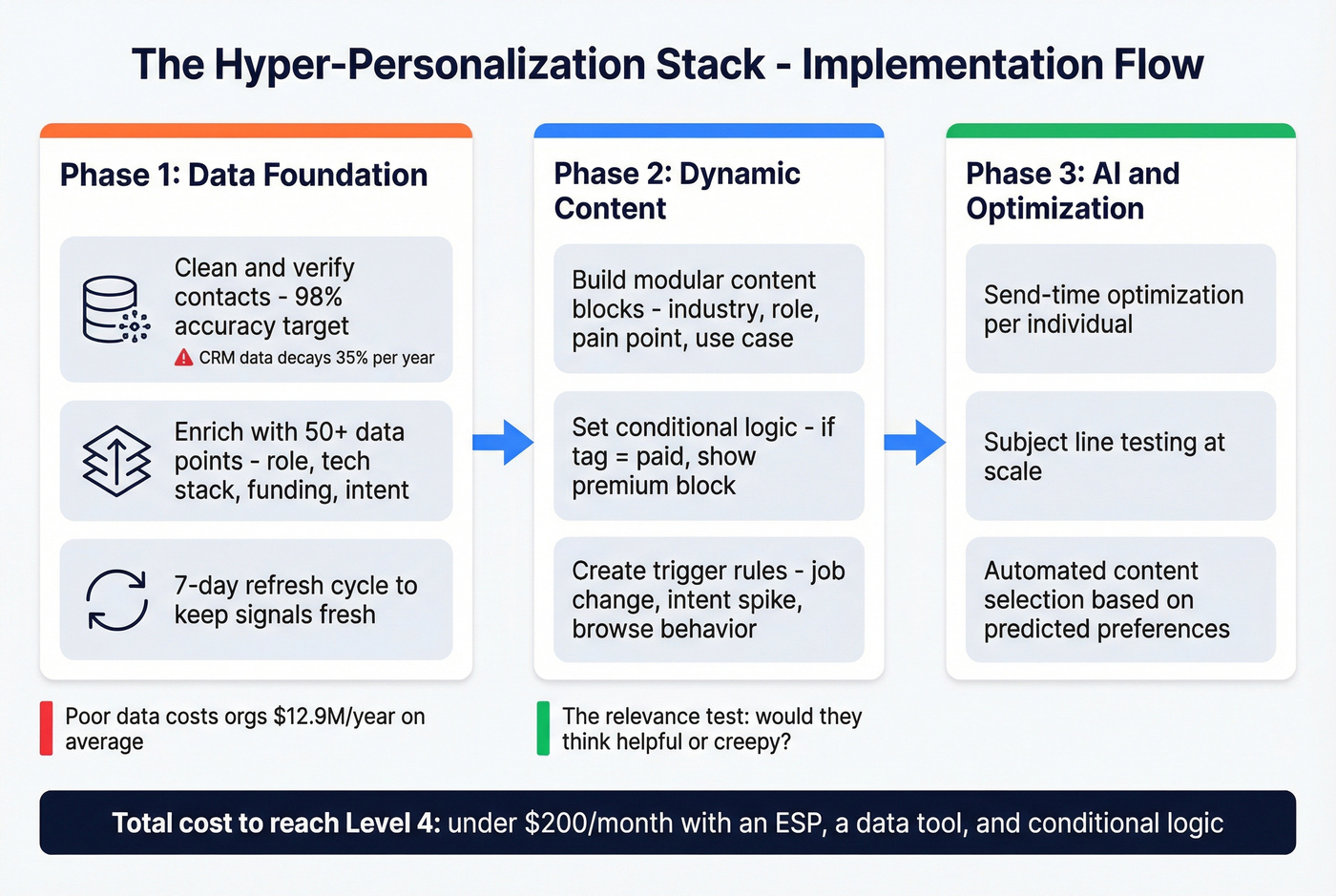
This is where personalization programs die. Not at the AI layer. Not at the copy layer. At the data layer.
We've seen this firsthand. Prospeo's database covers 300M+ professional profiles with 98% email accuracy, verified through a proprietary 5-step process that catches spam traps and honeypots. The 7-day data refresh cycle means you're working with current information - not stale records that poison your deliverability. When Meritt switched, their bounce rate dropped from 35% to under 4%, and pipeline tripled from $100K to $300K per week. (Related: CRM hygiene and email verification for outreach.)
Build Dynamic Content Blocks
Dynamic content uses conditional logic to swap email blocks based on subscriber data: if tag = paid, show premium content block; if location = Canada, display CAD pricing; if clicked last promo, show related recommendations. 67% of consumers expect dynamic content in their online shopping experiences.
The key to templatizing personalized email at scale is building modular content blocks that can be mixed and matched based on recipient attributes. Create a library of templates with swappable sections for industry, role, pain point, and use case, then let your conditional logic assemble the right combination per recipient. Don't write a unique email for every contact - that doesn't scale and it doesn't need to. (If you're doing this for outbound, start with a proven sales email structure.)
There's a line between relevant and creepy. Referencing a product someone browsed? Relevant. Referencing the exact time they browsed it? Creepy. When in doubt, ask whether the recipient would think "that's helpful" or "how do they know that?"
On compliance: GDPR and CCPA require clear notice, lawful basis, and a real opt-out mechanism when you use personal data for marketing. Build these into your workflow from day one, not as an afterthought. (Practical guide: GDPR for Sales and Marketing.)
Layer AI Decisioning
AI adds three capabilities on top of clean data and dynamic blocks: send-time optimization for each individual, subject-line testing at scale, and automated content selection based on predicted preferences. Autonomous systems that generate and optimize entire sequences without human input are getting closer, but the critical caveat remains - AI running on stale, unverified contact data just produces personalized spam faster. (More: AI in Email Marketing.)
Sending Personalized Emails at Scale
Let's be honest about cold outbound. A generic cold email gets deleted. A behaviorally-tailored message that references a specific, timely signal gets read. Well-targeted hyper-personalized cold emails typically see 20-80% higher reply rates than generic blasts, depending on signal quality and list accuracy. The consensus on r/coldemail is consistent: data quality - not AI copywriting - is the #1 factor in reply rates.
The deliverability guardrails are non-negotiable: keep bounce rates under 1%, warm up new sending accounts over ~30 days, and always include fallback content for merge tags. Segmented campaigns deliver 50% better click-through rates than non-segmented, and that gap compounds when you layer in behavioral signals. (Deep dive: email deliverability checklist.)
If your deal size sits below $10K ACV, you probably don't need a $35K personalization engine. A verified data source, a sending tool with conditional logic, and 20 minutes of research per account will outperform any AI-generated template running on garbage data. I've watched teams burn months configuring enterprise platforms when the real problem was a 30% bounce rate.
The recommended stack for most teams: Prospeo for data and verification, Instantly or Smartlead for sending infrastructure, and Clay for enrichment workflows. Total cost for a small team: under $300/month.
Tools and Budget
| Use Case | Recommended Tools | Starting Price |
|---|---|---|
| Marketing email | Klaviyo, Mailchimp, HubSpot | Free-$20/mo |
| Cold outbound data | Prospeo | Free (75/mo); ~$0.01/email on paid plans |
| Cold outbound sending | Instantly, Smartlead | ~$30/mo |
| Outbound enrichment | Apollo, Clay | $49-$149/mo |
| Enterprise engines | Dynamic Yield, Optimizely | $30K-$250K+/yr |
Enterprise personalization platforms like Dynamic Yield (~$35K/year), Optimizely (~$36K/year, with full DXP running $120K-$200K+), and Bloomreach (~$19K/year per module plus $4K+ setup) make sense when you're running omnichannel personalization at scale across millions of customers. For everyone else, the stack above covers it.
Skip the enterprise tier if you're running fewer than 50K contacts. We've seen teams spend $50K on a personalization engine and still send emails to contacts who left the company six months ago. Fix the data first. Everything else follows.
Level 4 personalization requires intent signals, job changes, and tech stack data - not just first names. Prospeo tracks 15,000 intent topics via Bombora, flags job changes in real time, and layers in technographic filters so every email is contextually relevant. All at $0.01 per email, no contracts.
Stop calling mail merge hyper-personalization. Start with real signals.
FAQ
What's the difference between personalization and hyper-personalization?
Personalization uses static profile data like name, company, and industry segment. Hyper-personalization layers in real-time behavioral and contextual signals - browsing history, intent data, job changes - to tailor every element to the individual at the exact moment they receive it. The conversion gap between the two can reach 16x.
Does hyper-personalization work for cold email?
Yes - and the lift is often higher than marketing email because recipients have no prior relationship with you. Behavior-based signals like job changes and funding events let you reference something specific and timely. Verified data is the prerequisite: keeping bounce rates under 1% protects domain reputation while you scale.
What tools do I need to get started?
At minimum: a data tool for verified contacts, an email platform with dynamic content support (Klaviyo or HubSpot for marketing, Instantly or Smartlead for cold outbound), and a way to enrich profiles with behavioral signals like Clay or Apollo. Most teams reach Level 4 maturity for under $300/month total.
How do I scale without sounding robotic?
Build modular templates with interchangeable content blocks - one for each industry, pain point, and use case - then use conditional logic to assemble the right combination per recipient. This lets you maintain a human voice while reaching thousands of contacts per week without writing each message individually.
How do I avoid being creepy with personalization data?
Stick to professional and behavioral data - job title, company news, product usage patterns. Avoid referencing inferred sensitive attributes or exact timestamps. The test: would the recipient think "that's relevant" or "how do they know that?" Always ensure GDPR/CCPA compliance with clear notice, lawful basis, and working unsubscribe links.