

The ABM Maturity Model: 5 Stages From Ad-Hoc to Optimized
One in five firms practice ABM in name only - they don't have any real processes behind the label. And the best maturity model content? Gated behind the exact lead forms that signal an immature program. Let's skip the form and give you the actual framework.
Here's our take after watching dozens of teams attempt this: maturity isn't about sophistication - it's about consistency. A Stage 3 team that executes the same playbook every quarter beats a Stage 5 team that's constantly rebuilding. Keep that in mind as you read through each level.
What Is an ABM Maturity Model?
An ABM maturity model maps where your account-based marketing program sits across four dimensions - Strategy, Data & Technology, Execution, and Measurement - and gives you a roadmap for what to fix next. Many teams know this progression as the crawl-walk-run framework: start with basic targeting, build repeatable processes, then scale into full orchestration.
It also helps you calibrate which ABM motion fits your stage. 1:many programs work at Stage 2, 1:few campaigns require Stage 3 infrastructure, and true 1:1 ABM only makes sense at Stage 4. Demandbase's readiness framework uses the same four indicators and is a solid starting point for any maturity assessment.
The 5 ABM Maturity Levels
For every stage below, you get a diagnostic signal and the single next action that moves you forward.
Stage 1: Foundational
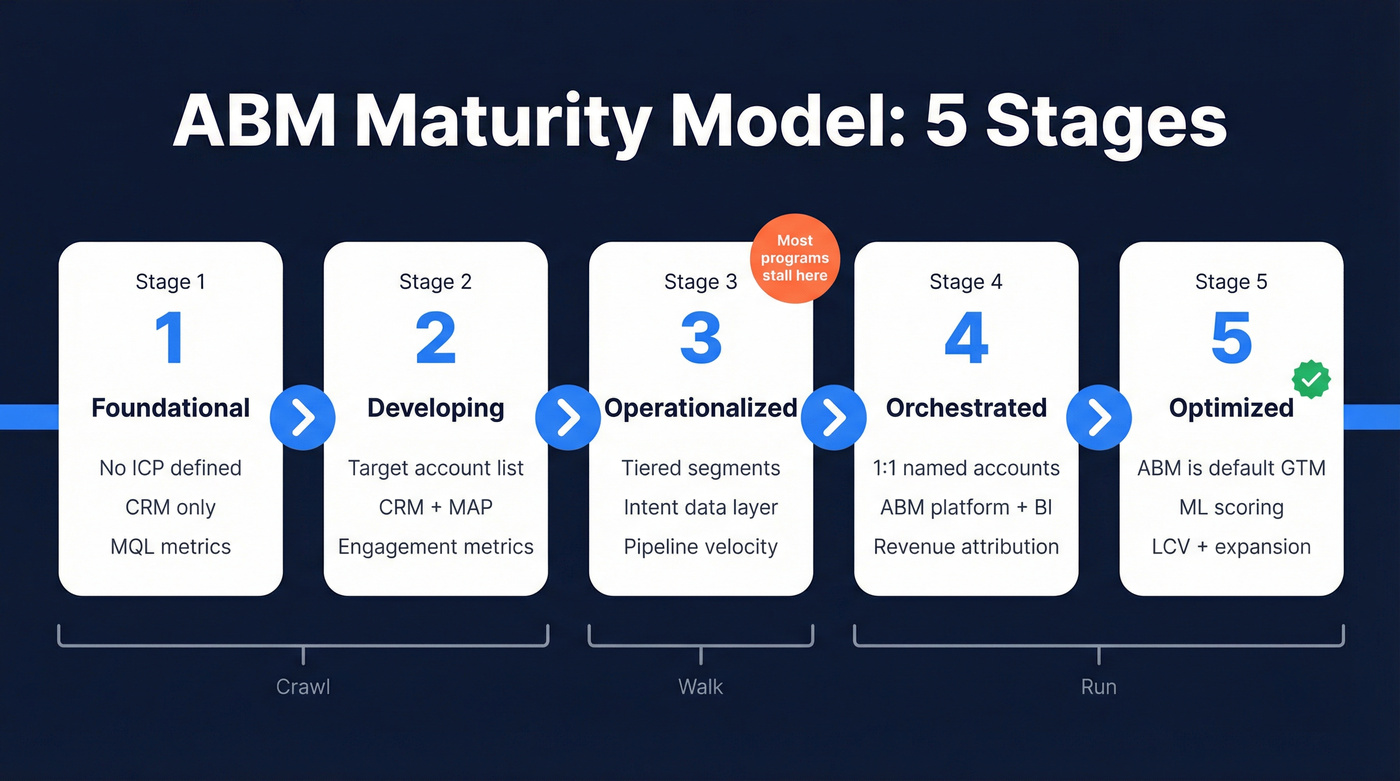
You're here if your "ABM" is really just sales picking accounts they like, with no shared ICP definition. Your stack is a CRM - Salesforce, HubSpot - and maybe a spreadsheet. Metrics are MQLs and vanity engagement numbers.
Next action: Define your ICP with sales. Write it down. Get both teams to sign it. Without this, nothing else matters.
Stage 2: Developing
You're here if you've got a defined target account list and a sales-marketing SLA, but campaigns are still one-off. Your MAP is integrated with your CRM, and you're tracking account-level engagement. The problem is consistency - you run a great 1:many campaign, then nothing for six weeks. In the crawl-walk-run approach, this is the "crawl" phase where you're proving the motion works before investing further.
Next action: Build a quarterly campaign calendar with always-on nurture tracks. Lock in standard UTMs and naming conventions so you can actually measure what's working.
Stage 3: Operationalized
This is where we've seen the most programs stall.
You've got repeatable playbooks, you're running 1:few campaigns against tiered segments, and intent data from providers like Bombora is surfacing buyer signals. Pipeline velocity replaces MQLs as your north star. But data quality becomes the make-or-break dimension here. Ask any ABM practitioner what kills their program and you'll hear the same thing: bad data and no sales buy-in.
A 40% bounce rate means your carefully built playbooks execute against dead addresses. Data enrichment tools with real-time verification and weekly refresh cycles - like Prospeo, which verifies emails at 98% accuracy across 300M+ profiles - give your playbooks the verified contact layer they need at roughly $0.01/email. That's the difference between a playbook that works on paper and one that actually generates pipeline.
Next action: Instrument pipeline velocity tracking by account tier. Measure time-to-opportunity, not just MQLs created.
Stage 4: Orchestrated
You're running multi-channel 1:1 campaigns with cross-functional pods assigned to named accounts. Revenue attribution is real - you can tie marketing touches to closed-won deals. Sales engagement tools like Salesloft and Outreach round out the stack alongside an ABM platform such as Demandbase or 6sense and BI dashboards for reporting.
Budget allocation follows N.Rich's ACV-based benchmarks: 1% of ACV for $50-150K deals, 3% for $150-300K, and 5% for $300K+ accounts. Direct mail and gifting via Sendoso enter the mix for high-value targets.
Here's the thing: only half of ABM teams measure marketing lift, and just 20% track lifetime customer value. If you're doing both, you're genuinely at Stage 4.
Stage 5: Optimized
If you're truly here, you probably don't need this article. ABM isn't a program - it's your default GTM motion. ML-driven scoring surfaces next-best-action recommendations. Personalization extends to on-site experiences, not just ads and emails. You're tracking customer lifetime value and using it to inform account selection.
Focus on governance: document decision trees, audit scoring models quarterly, and maintain a human override layer so the automation doesn't become fragile.

Bad data is the silent killer at Stage 3. Prospeo's 300M+ profiles with 98% email accuracy and 7-day refresh cycles give your ABM playbooks the verified contact layer they need - at $0.01/email instead of $1 with legacy providers.
Stop losing 40% of your ABM outreach to bounces.
ABM Maturity Assessment Table
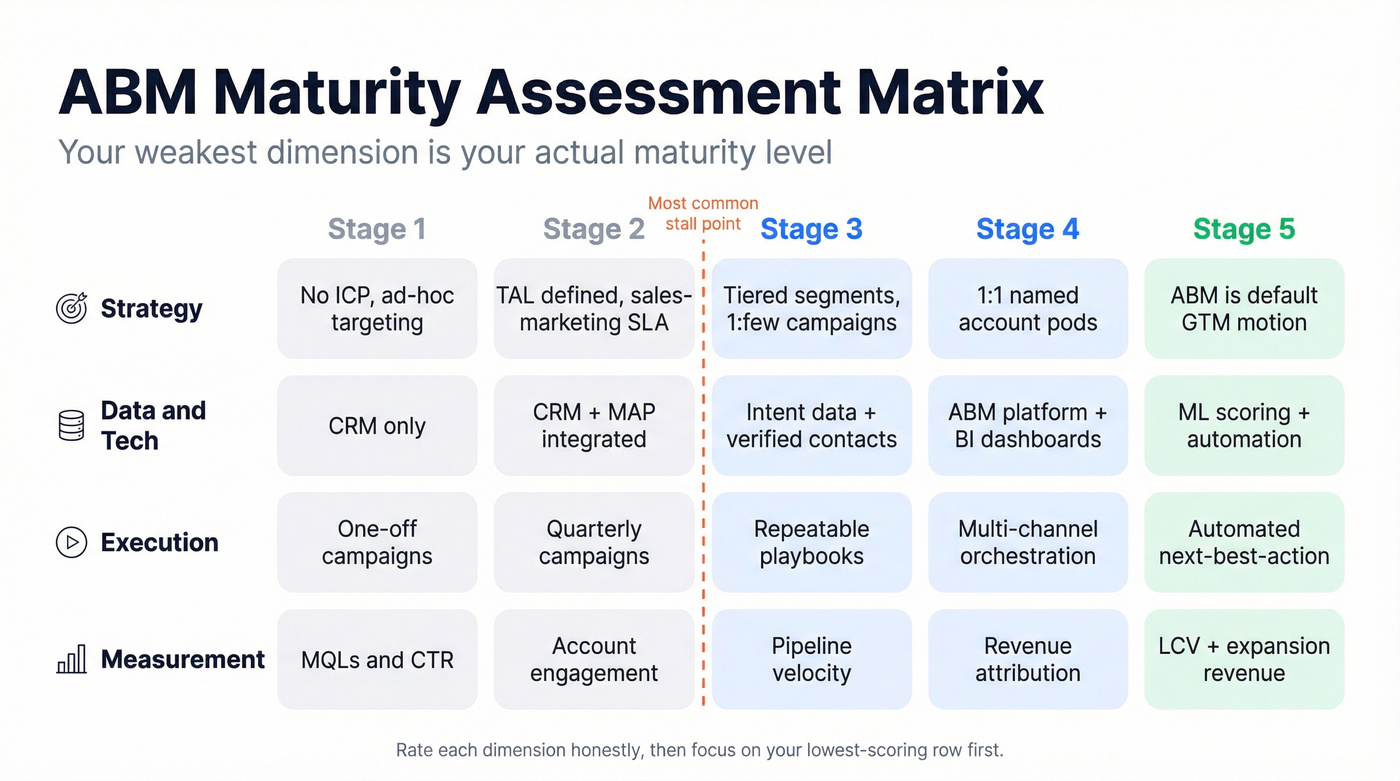
Use this matrix to run your own assessment. Your weakest dimension is your actual maturity level - most teams aren't at the same stage across every column, and that's normal.
Stages 1-3: Building the Foundation
| Dimension | Stage 1: Foundational | Stage 2: Developing | Stage 3: Operationalized |
|---|---|---|---|
| Strategy | No ICP; ad-hoc | TAL defined; SLA | Tiered segments |
| Data & Tech | CRM only | CRM + MAP | + intent + verified data |
| Execution | One-off campaigns | Quarterly campaigns | Repeatable playbooks |
| Measurement | MQLs, CTR | Engagement metrics | Pipeline velocity |
Stages 4-5: Scaling and Optimizing
| Dimension | Stage 4: Orchestrated | Stage 5: Optimized | |---|---| | Strategy | 1:1 named accounts | ABM = default GTM | | Data & Tech | ABM platform + BI | ML scoring + automation | | Execution | Multi-channel pods | Automated next-best-action | | Measurement | Revenue attribution | LCV + expansion |
Common Blockers by Stage
Forrester's State of ABM survey maps the blockers that stall programs. In our experience, the staffing gap hits hardest at the Stage 2-to-3 transition - and it's the one nobody budgets for.
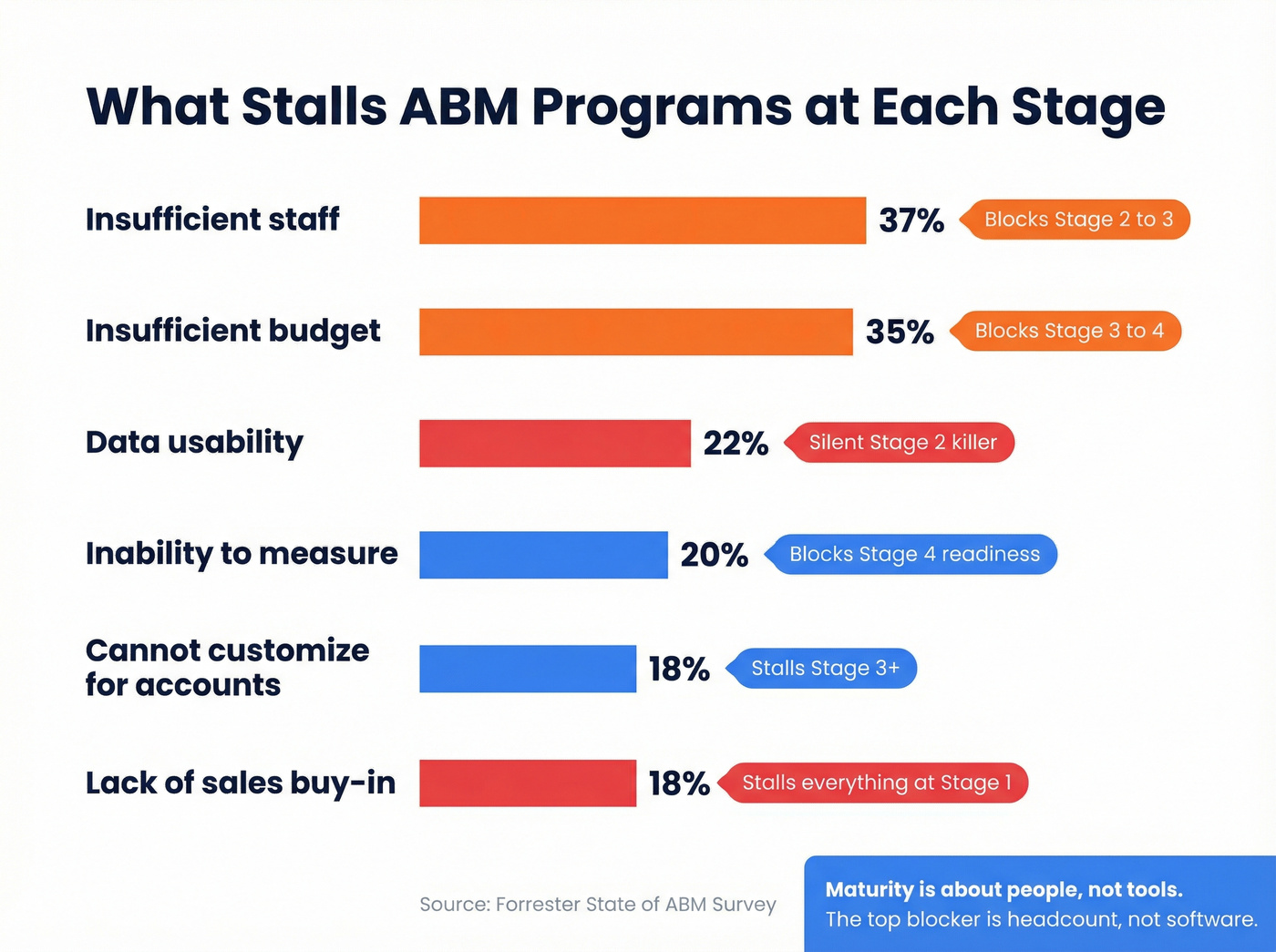
- Insufficient staff (37%) - kills Stage 2-to-3. You can't operationalize playbooks without dedicated headcount.
- Insufficient budget (35%) - blocks Stage 3-to-4.
- Data usability (22%) - the silent Stage 2 killer. Teams have data but can't trust it enough to act on it.
- Inability to measure (20%) - prevents Stage 4 readiness. Without attribution, you can't prove ABM works.
- Inability to customize for accounts (18%) - stalls personalization at Stage 3 and beyond.
- Lack of sales buy-in (18%) - stalls everything at Stage 1. No SLA means no alignment means no ABM.
That 37% staffing figure tells you something important: account-based marketing maturity isn't about buying more tools. It's about having people who can run them. ABM best practices in 2026 start with headcount, not software.
And yes - orchestration platforms like Demandbase and 6sense are a real budget line item. Expect $30-100K+/year once you're buying an ABM platform plus the data, activation, and reporting layers around it. If you're comparing platforms, start with ABM software fit and total cost.
The Data Gap Most Models Miss
Most frameworks treat "data" as a checkbox. Do you have a CRM? Great, move on.
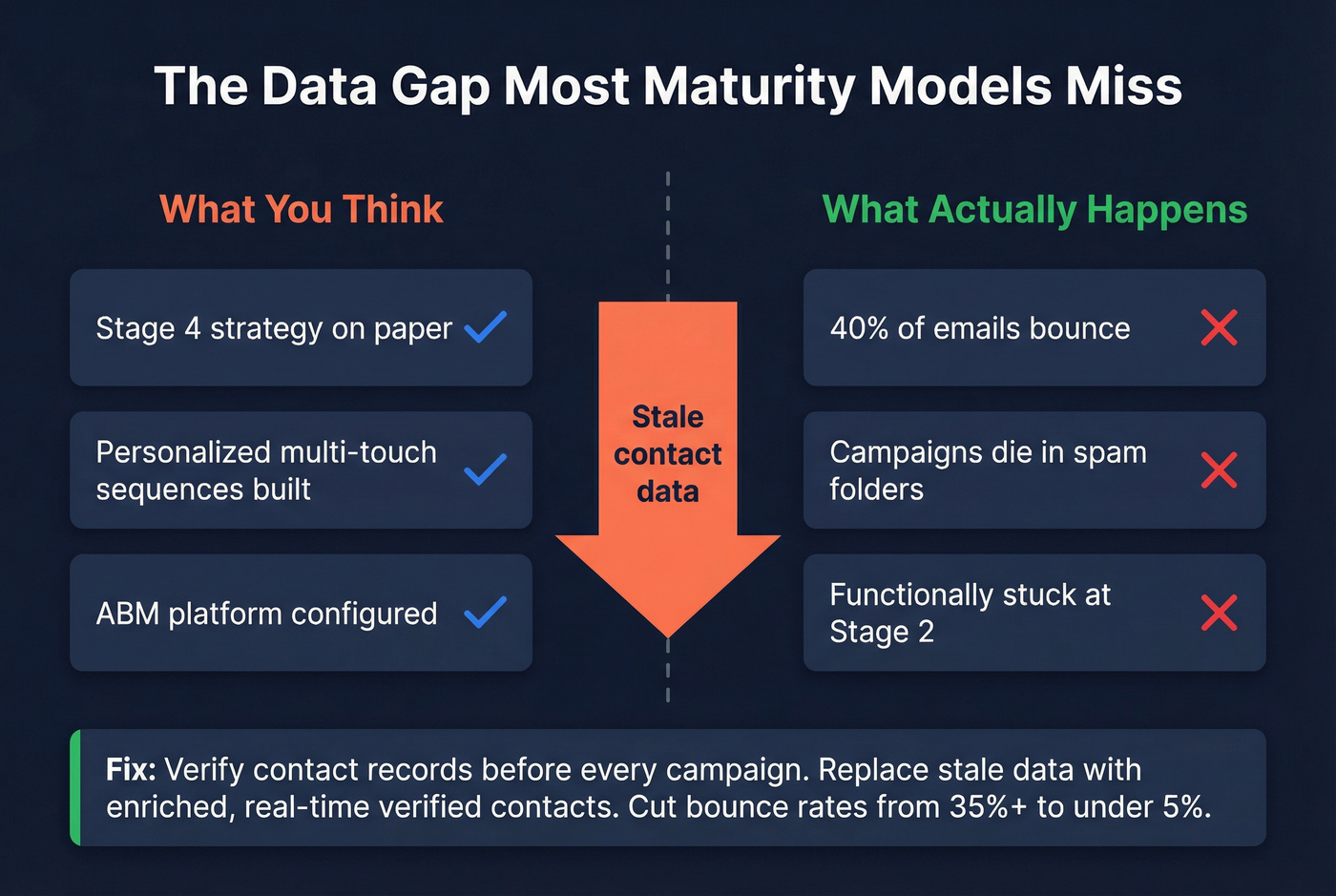
That's not how it works in practice. We've seen teams with great strategy lose 40% of their outreach to bounces - their carefully segmented campaigns, personalized messaging, and multi-touch sequences all dying in the spam folder before a single buyer signal gets captured. One team we worked with had a Stage 4 strategy on paper but was functionally stuck at Stage 2 because their contact records were stale.

You don't need a $50K platform to fix this. Fixing ABM readiness at Stage 2-3 often comes down to one thing: verifying your contact records before you hit send. If you're building a process around this, use a CRM hygiene checklist and a dedicated email verification step. Acquia's maturity guidance makes the bigger point most teams learn the hard way - maturity takes time, and scaling means replacing manual segmentation with automation, stronger workflows, and real governance. But none of that matters if the data underneath is rotten.
Moving from Stage 2 to Stage 3 requires data you can actually trust. Prospeo enriches your target account lists with 50+ data points per contact, intent signals across 15,000 Bombora topics, and verified direct dials - so your ABM pods reach real buyers.
Enrich your target account list and start executing real playbooks.
FAQ
How long does it take to advance between stages?
Six to twelve months per stage is typical. The Stage 2-to-3 jump takes longest because it demands both process discipline and tech investment. A consistent Stage 3 program outperforms a shaky Stage 5 attempt every time.
What's the minimum tech stack to start ABM?
A CRM, a marketing automation platform, and a verified contact data source. You don't need a $50K ABM platform at Stage 1-2 - get your ICP defined and your data clean first. Free tiers from data providers can cover early-stage contact validation without adding budget pressure.
How do I fix bad contact data stalling my program?
Start with a data enrichment provider that verifies in real time and refreshes regularly - weekly, not monthly. Upload your existing list, flag invalid records, and replace them before your next campaign launches. Teams that do this routinely cut bounce rates from 35%+ to under 5%.
Is crawl-walk-run still relevant for ABM in 2026?
Absolutely. The crawl-walk-run philosophy maps directly to the five stages above: crawl at Stages 1-2 where you're proving fundamentals, walk at Stage 3 where playbooks become repeatable, and run at Stages 4-5 where orchestration takes over. Trying to skip phases is the most common reason programs collapse - skip this temptation even if leadership is pushing for "1:1 ABM" on day one.