

Buyer Intent Marketing: Frameworks, Costs, and Mistakes Nobody Talks About
Most buyer intent marketing vendors hide pricing behind "request a demo." Meanwhile, 64% of teams that actually buy intent data struggle to do anything useful with it. That's a lot of expensive annual contracts collecting dust.
Here's the thing: the problem isn't the data. It's the gap between buying signals and acting on them. We've watched teams spend six figures on intent platforms, pipe the data into a Slack channel, and then ignore it for weeks. This guide covers the scoring models, activation workflows, and real pricing that separate the 24% getting exceptional ROI from everyone else.
What Is Intent-Based Marketing?
Buyers spend just 17% of their time meeting suppliers. The rest is independent research across an average of 10 channels, leaving behavioral breadcrumbs everywhere - content downloads, topic searches, competitor comparisons, pricing page visits.
Buyer intent marketing captures those breadcrumbs and uses them to prioritize accounts already in a buying cycle. Instead of spraying outbound at cold lists, you focus on accounts that are raising their hand. The shift from volume-based outreach to signal-based outreach isn't new, but the tooling has finally caught up. In 2026, you can track topic-level research activity across thousands of publisher sites and match it to specific companies within hours.
Types of Intent Data
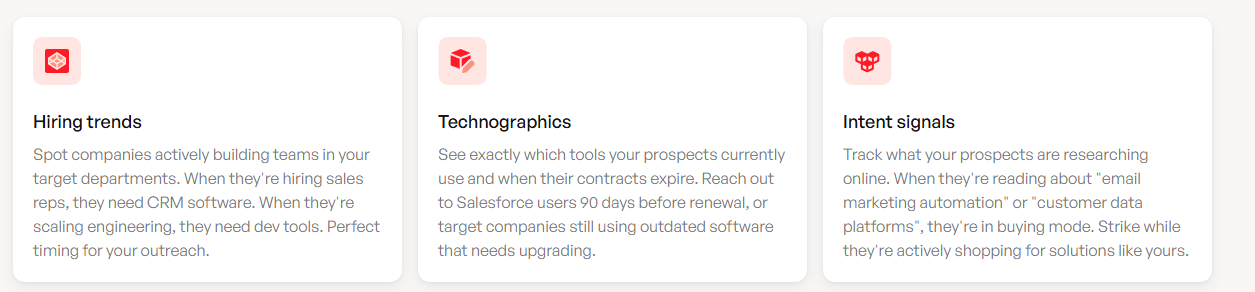
First-party intent covers signals from your own properties: website visits, email engagement, CRM activity, product usage. It's free, high-signal, and criminally underused by most teams.
Third-party intent is behavioral data collected across external publisher networks. This is what Bombora, 6sense, and Demandbase sell. Within third-party, sourcing matters a lot. Co-op data (Bombora's model) aggregates behavior across 5,000+ publisher sites within consent frameworks - 86% of those sites are exclusive to Bombora. Bidstream data comes from programmatic ad exchanges; it's cheaper but carries higher compliance risk. Know which one your vendor uses before you sign.
Derived intent combines multiple signal types into buying-stage predictions using AI models. 6sense's "predicted buying stage" is the clearest example - it doesn't just tell you an account is active, it estimates where they sit in the funnel.
How to Score Intent Signals
A scoring model turns raw signals into prioritized action. Without one, you're just staring at dashboards.
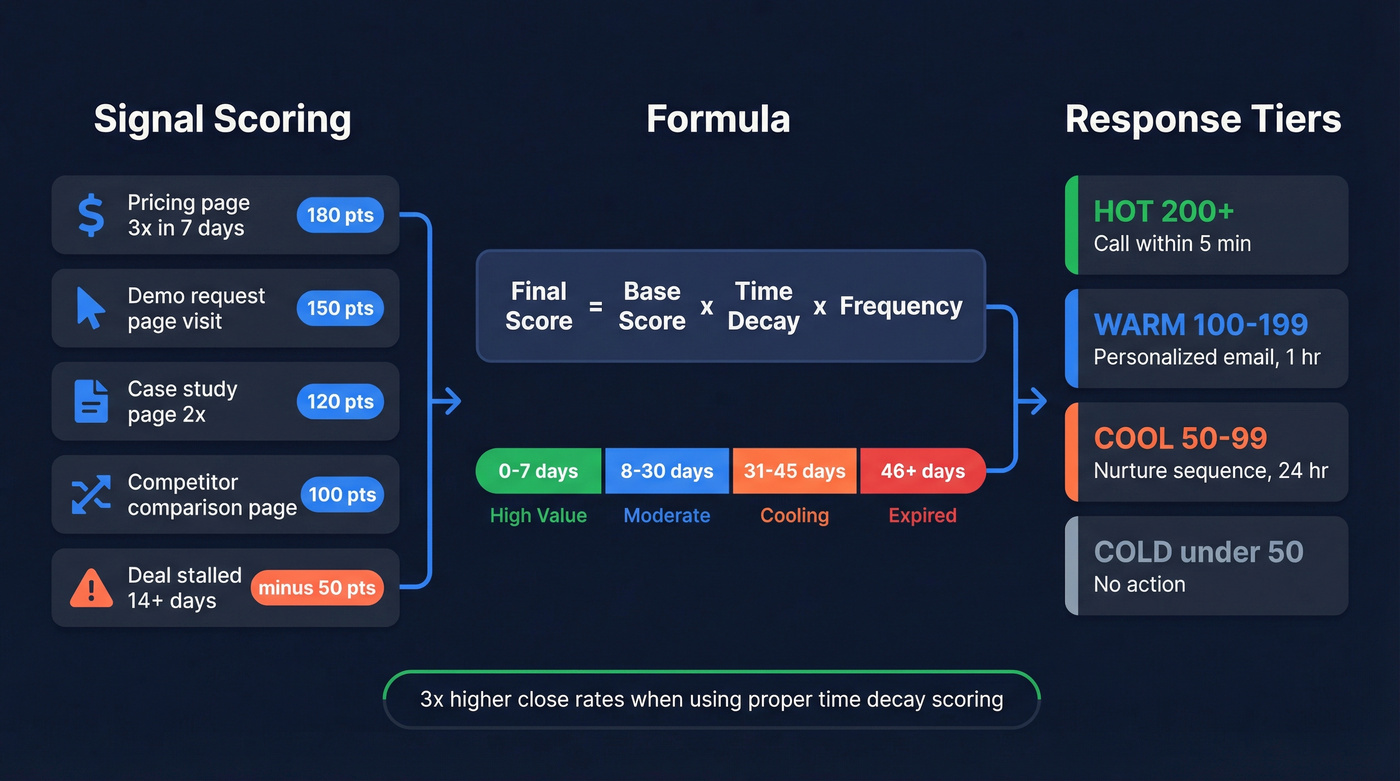
Final Score = Base Score x Time Decay x Frequency Coefficient
| Signal | Base Points |
|---|---|
| Pricing page 3x in 7 days | 180 |
| Demo request page visit | 150 |
| Case study page 2x | 120 |
| Competitor comparison page | 100 |
| Deal stalled 14+ days | -50 |
Tier those scores into response buckets:
| Tier | Score | Response SLA |
|---|---|---|
| Hot | 200+ | Call within 5 min |
| Warm | 100-199 | Personalized email, 1 hr |
| Cool | 50-99 | Nurture sequence, 24 hr |
| Cold | <50 | No action |
Time decay is critical - a signal from 3 days ago is gold, but the same signal from 6 weeks ago is noise. Use this heuristic: 0-7 days is high-value, 8-30 moderate, 31-45 cooling, 46+ expired. Weight signals by seniority too. A CFO downloading your pricing guide three times carries far more weight than a junior analyst skimming a blog post, and teams that build signal-based outreach with proper decay consistently see 3x higher close rates and 27% conversion lift.

Your intent scoring model is only as good as the contact data behind it. Prospeo layers 15,000 Bombora intent topics over 300M+ profiles with 98% email accuracy and a 7-day refresh cycle - so when an account hits "Hot," you reach the right person with a verified email, not a bounced one.
Stop scoring accounts you can't actually reach.
Activating Intent Data Across Marketing and Sales
Buying intent data without an activation plan is like buying a gym membership and never going. We've seen it happen at company after company.
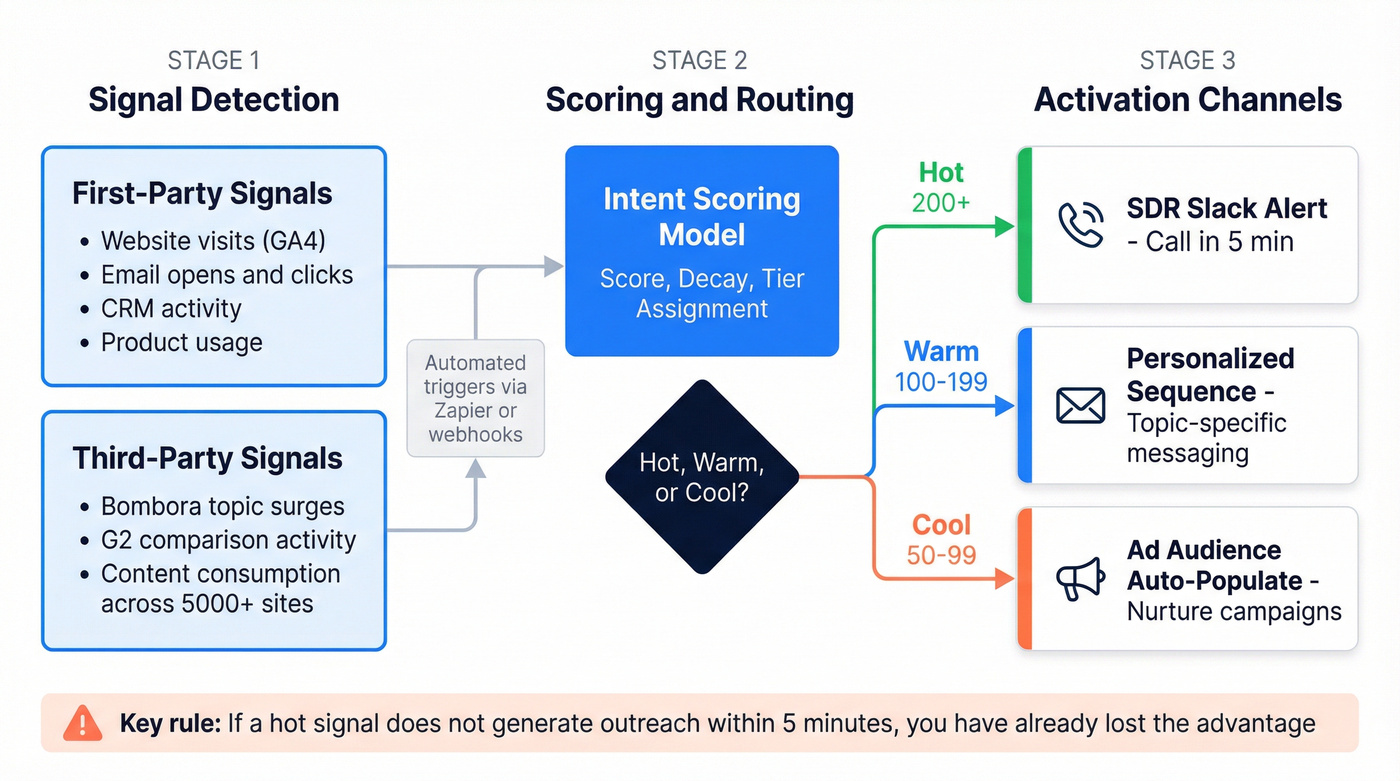
Third-party intent works far better when you combine it with first-party signals and act within 48 hours. Set up automated workflows that fire when intent spikes: Slack alerts to SDRs when a target account hits "Hot," ad audiences that auto-populate with surging accounts, outbound sequences triggered with messaging based on the specific topics an account is researching.
"I noticed your team's been evaluating data residency solutions" hits differently than a generic cold email.
Don't send weekly intent reports to reps and hope they act on them. They won't. Build the plumbing first - Zapier or webhook triggers from your scoring model into your CRM, sequencer, and ad platform. Then layer in personalization. The consensus on r/sales is pretty clear: intent data without automated routing is just expensive noise.
What Intent Marketing Tools Actually Cost
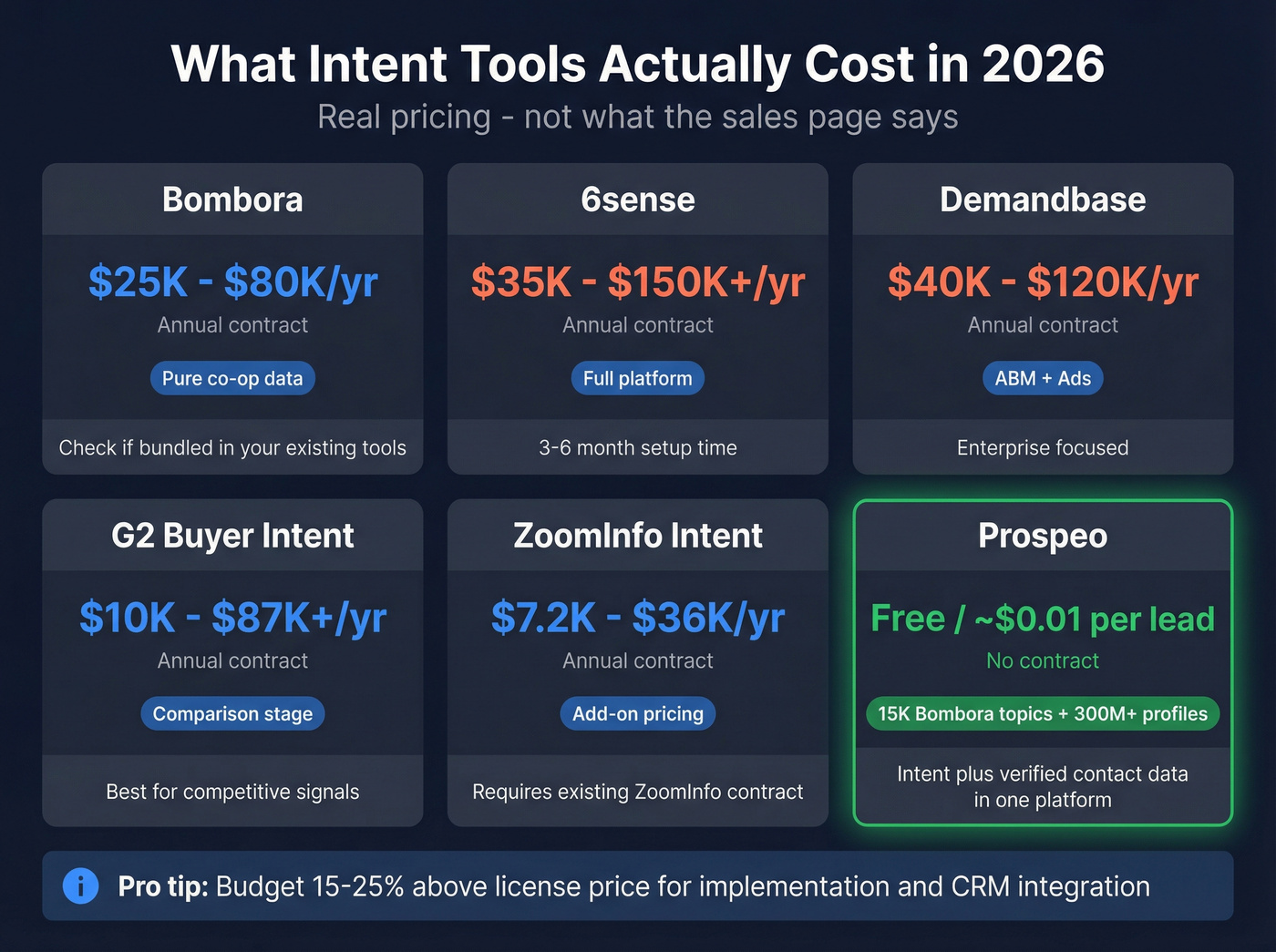
Every vendor makes you "request a demo" for pricing. Here are the actual numbers we've gathered for 2026:
| Tool | Annual Cost | Contract | Notes |
|---|---|---|---|
| Bombora | $25K-$80K | Annual | Pure-play co-op; check bundling |
| 6sense | $35K-$150K+ | Annual | Full platform; 3-6 mo. setup |
| Demandbase | $40K-$120K | Annual | ABM + advertising; enterprise |
| G2 Buyer Intent | $10K-$87K+ | Annual | Comparison-stage signals |
| ZoomInfo Intent | $7.2K-$36K | Annual | Add-on to existing contract |
| Prospeo | Free / ~$0.01/lead | No contract | 15K topics + 300M+ verified profiles |
Budget 15-25% above license price for implementation, CRM integration, and topic configuration. If you're using 6sense or Demandbase, check whether Bombora data is already bundled - we've seen teams double-pay for the same underlying intent feed.
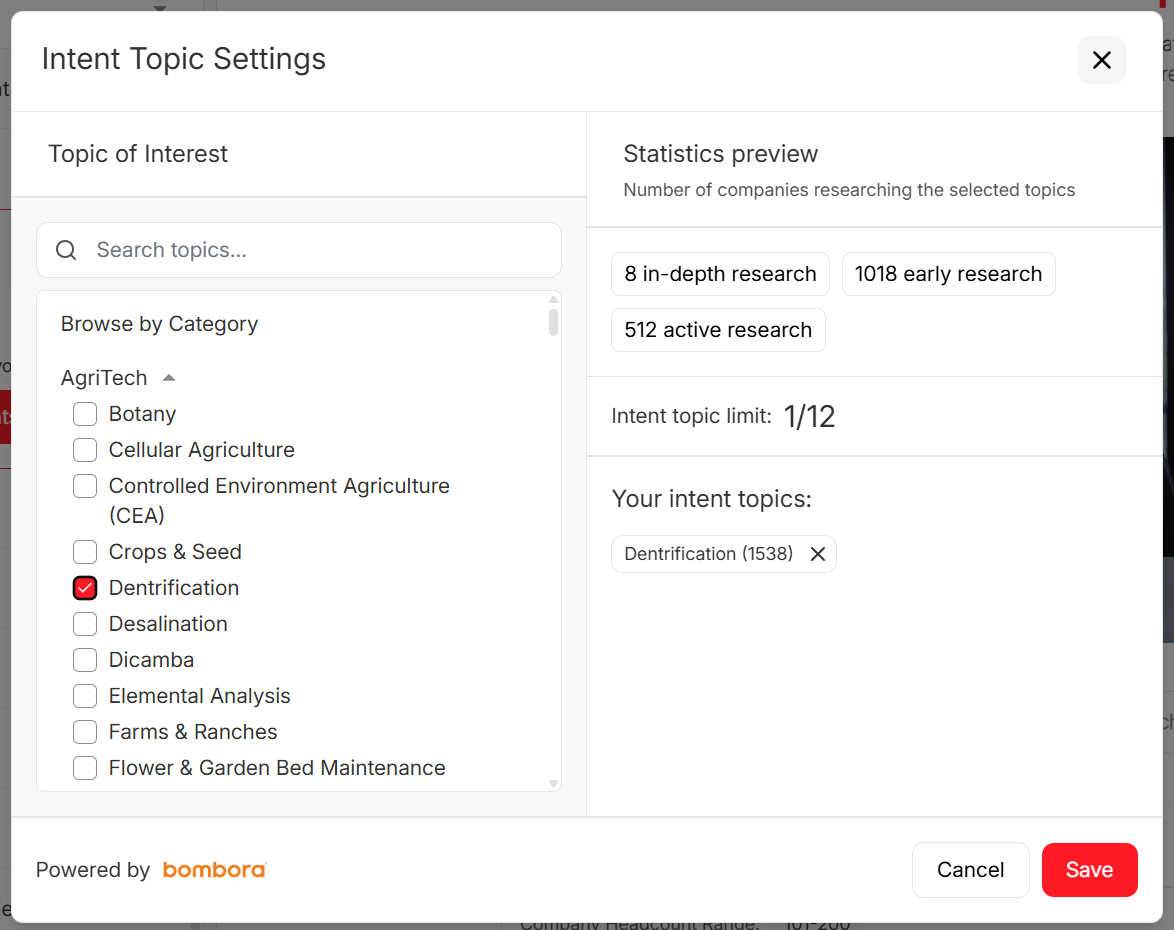
Let's be honest: most teams under 50 reps don't need a six-figure orchestration platform. They need accurate contact data and a fast response process. Prospeo tracks 15,000 Bombora intent topics alongside 143M+ verified emails and 125M+ verified mobile numbers, all on a 7-day refresh cycle. You go from "this account is in-market" to "here's the VP of Engineering's verified email" in one platform - and at roughly $0.01 per lead, it outperforms tools that cost 90x more.
Teams spend $35K-$150K/year on intent platforms and still can't act fast enough. Prospeo gives you the same Bombora intent signals plus 143M+ verified emails and 125M+ direct dials at ~$0.01/lead - no annual contract, no six-month implementation. Go from surge alert to personalized outreach in minutes.
Replace your six-figure intent stack with one that actually connects you to buyers.
Why Most Teams Fail
70% of teams cite data quality as their top challenge. Only 24% report exceptional ROI. Three mistakes explain the gap.
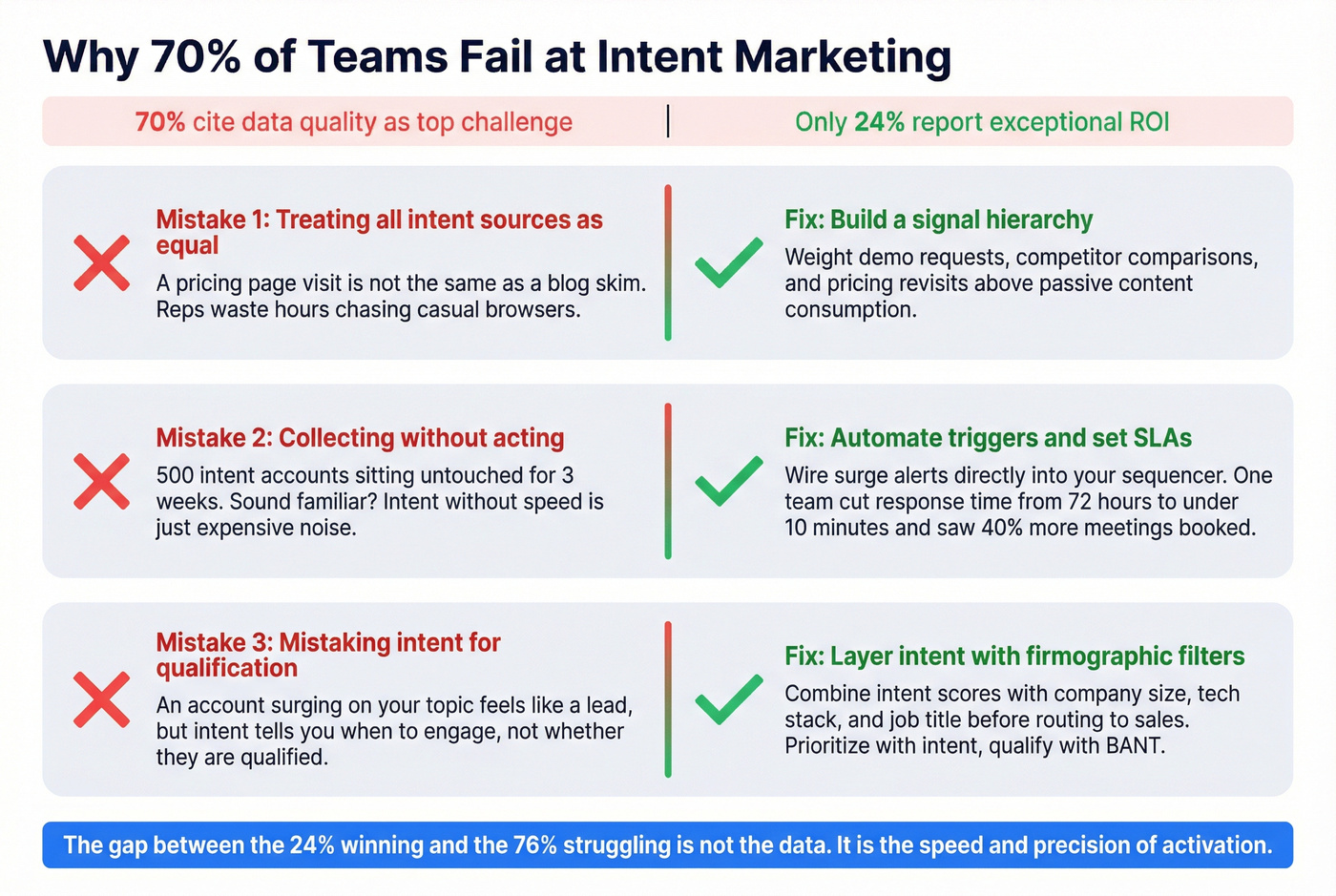
Treating all intent sources as equal. A pricing page visit isn't the same as a blog skim. Build a signal hierarchy that weights high-intent actions - demo requests, competitor comparisons, pricing page revisits - above passive content consumption. Skip this step and your reps will waste hours chasing accounts that were casually browsing.
Collecting without acting. The SDR team that got 500 intent accounts three weeks ago and hasn't contacted any of them - we've all seen it. Set SLAs and automate triggers. If a hot signal doesn't generate outreach within 5 minutes, you've already lost the advantage. One team we spoke with cut their response time from 72 hours to under 10 minutes just by wiring Bombora surge alerts directly into their sequencer, and their meeting-booked rate jumped 40%.
Mistaking intent for qualification. An account surging on your topic feels like a lead, but intent tells you when to engage - not whether they're qualified. Layer intent with company size, tech stack, and job title filters before routing to sales. Otherwise your reps burn hours on accounts that were never going to close. Prioritize with intent, qualify with BANT or whatever framework your team runs.
Where to Start If You're New to This
For teams that haven't touched intent data before, skip the enterprise platforms. Seriously. Start with first-party signals in GA4 and your CRM. Track which accounts visit your pricing page, open emails multiple times, or return to your site within a 7-day window. Build a basic scoring model in a spreadsheet. Get your response SLAs in place.
Once that foundation is solid, layer in third-party intent. You'll know you're ready when your team is consistently acting on first-party signals within the SLA windows you've set. If they can't do that with free data, throwing $50K at Bombora won't fix the problem.
FAQ
Is buyer intent data GDPR compliant?
Co-op providers like Bombora collect within consent frameworks and are typically the safer path. Confirm your vendor has a DPA, enforces opt-outs, and uses a lawful basis for processing. Bidstream data carries higher compliance risk due to its ad-exchange sourcing. The ICO's guidance on legitimate interest is worth reviewing if you're evaluating vendors.
Should I start with first-party or third-party intent data?
First-party. Always. Track website behavior in GA4 and CRM engagement before spending a dollar on third-party data. They're free and higher-signal. Layer third-party intent on top only after you have a scoring model and response SLAs in place. HubSpot's guide to behavioral tracking covers the basics well.
Can I run buyer intent marketing without a $30K+ annual budget?
Yes. Prospeo offers intent tracking across 15,000 Bombora topics starting on a free tier with no contracts, alongside 143M+ verified emails for immediate outreach. Pair that with GA4 first-party signals and a basic scoring model, and you have a working intent program for under $100/month. Bombora's own research on intent data ROI shows the value isn't in the platform price - it's in how fast you act on the signals.