

Email Sequence Best Practices: What the Data Says in 2026
Email marketing returns $36 for every $1 spent - but only if your sequences actually reach the inbox. Reply rates have dropped more than 50% since 2019, based on Outreach's analysis of millions of sales interactions. The average office worker now receives 120+ emails a day. Your sequence isn't competing with other cold emails. It's competing with everything.
Most articles on this topic obsess over copy. The real problem is infrastructure. Here's what works, based on current data.
The Short Version
- Fix deliverability first. Authentication (SPF, DKIM, DMARC) and warm-up aren't optional. Your sequence is dead if emails hit spam.
- Keep it tight. 4-7 touches, 3-4 days apart, under 80 words per email, sent Tuesday-Wednesday.
- Verify your list before you send. Bounce rates above 3% wreck your domain reputation. This is the step most teams skip - and the one that costs them the most.
Why Most Sequences Underperform
Teams spend hours crafting subject lines while sending to lists full of dead addresses, skipping authentication, and blasting unsegmented contacts on brand-new domains. That's not an outreach strategy. That's a deliverability death spiral.
The required number of touches across cold communications increased 17% year-over-year to nearly five. Sales cycles are 21% longer with win rates 2% lower than 2020. The bar is higher, and the margin for error on deliverability and data quality is razor-thin.
2026 Benchmarks
| Metric | Cold Outreach | Marketing Sequences |
|---|---|---|
| Reply rate | 3.43% avg / 10%+ elite | - |
| Open rate | 30-60% (unreliable - use reply rate instead) | 39-43% avg |
| Click rate | - | 2.09% median / 6.21% avg |
| Unsubscribe | - | ~0.22% median |
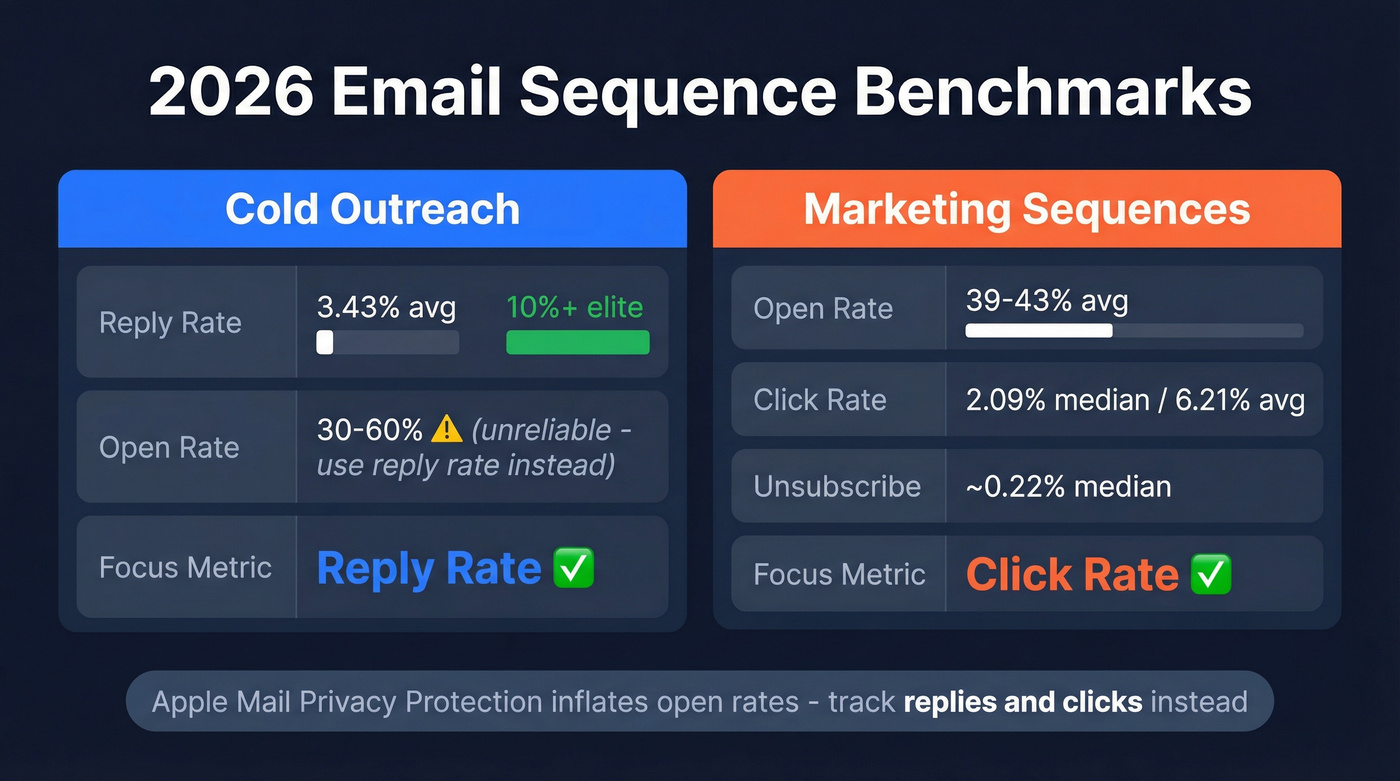
Apple Mail Privacy Protection inflates open rates across the board, which is why dashboards often show numbers that look too good. Focus on reply rate and click rate - those can't be faked.
Deliverability Setup
This is the step everyone skips. It's also the one that determines whether your sequence even reaches an inbox.
If you want the full playbook, start with an email deliverability checklist and make sure your email sending infrastructure is set up correctly.
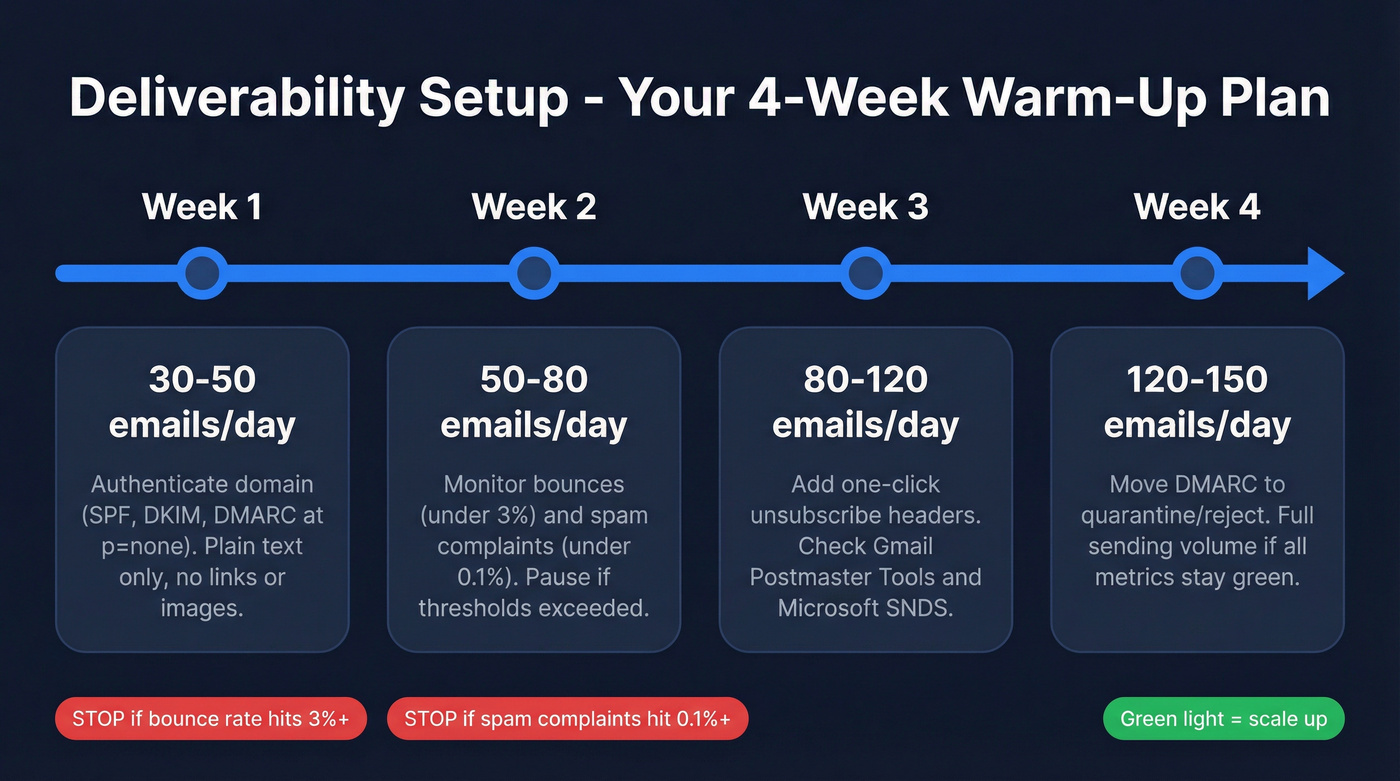
- Authenticate your domain. Publish one SPF record, use DKIM with 2048-bit keys, and start DMARC at
p=nonewith reporting enabled. Move to quarantine/reject once alignment is clean. (If you need a step-by-step, see SPF, DKIM, DMARC and SMTP authentication.) - Warm up gradually. Week 1: 30-50 emails/day. Week 2: 50-80. Week 3: 80-120. Week 4: 120-150. Only increase if metrics stay green. (More detail: automated email warmup.)
- Monitor thresholds. Bounce rate under 3%. Spam complaints under 0.1% per mailbox. Exceed either and pause immediately. (Related: hard bounce.)
- One-click unsubscribe. Gmail and Yahoo bulk-sender requirements include one-click unsubscribe via List-Unsubscribe headers. Non-negotiable.
- Avoid links and images in your first email. They trigger spam filters on new domains. Plain text with a 2-5 word subject line performs best on Day 1.
- Track reputation. Gmail Postmaster Tools and Microsoft SNDS show you exactly where you stand.

Bounce rates above 3% wreck your domain - and your sequence. Prospeo's 5-step verification catches invalid addresses, spam traps, and honeypots before they touch your sending infrastructure. 143M+ verified emails at 98% accuracy, refreshed every 7 days.
Stop writing perfect emails to dead addresses.
Your List Is the Foundation
Here's a scenario we've seen play out dozens of times: an SDR launches a 500-contact sequence, 180 bounce, and domain reputation tanks overnight. Now every email from that domain - including the ones to valid addresses - lands in spam. One bad send can destroy an outbound program in a single week.
The fix is upstream. Verify before you send. Prospeo's 5-step verification catches invalid addresses, catch-all domains, spam traps, and honeypots before they ever touch your sending infrastructure - delivering 98% email accuracy on 143M+ verified emails. Snyk's team saw bounce rates drop from 35-40% to under 5% after switching their verification workflow. (If you're comparing tools, see email ID validators and email checker tools.)
No amount of copywriting skill compensates for a dirty list.
Copy, Cadence, and Structure
Nail Your First Email
58% of all replies come from the first email. Spend 80% of your optimization time on email #1 - subject line, opening line, and CTA. Everything else is follow-up insurance. (For examples, use these outreach email templates.)
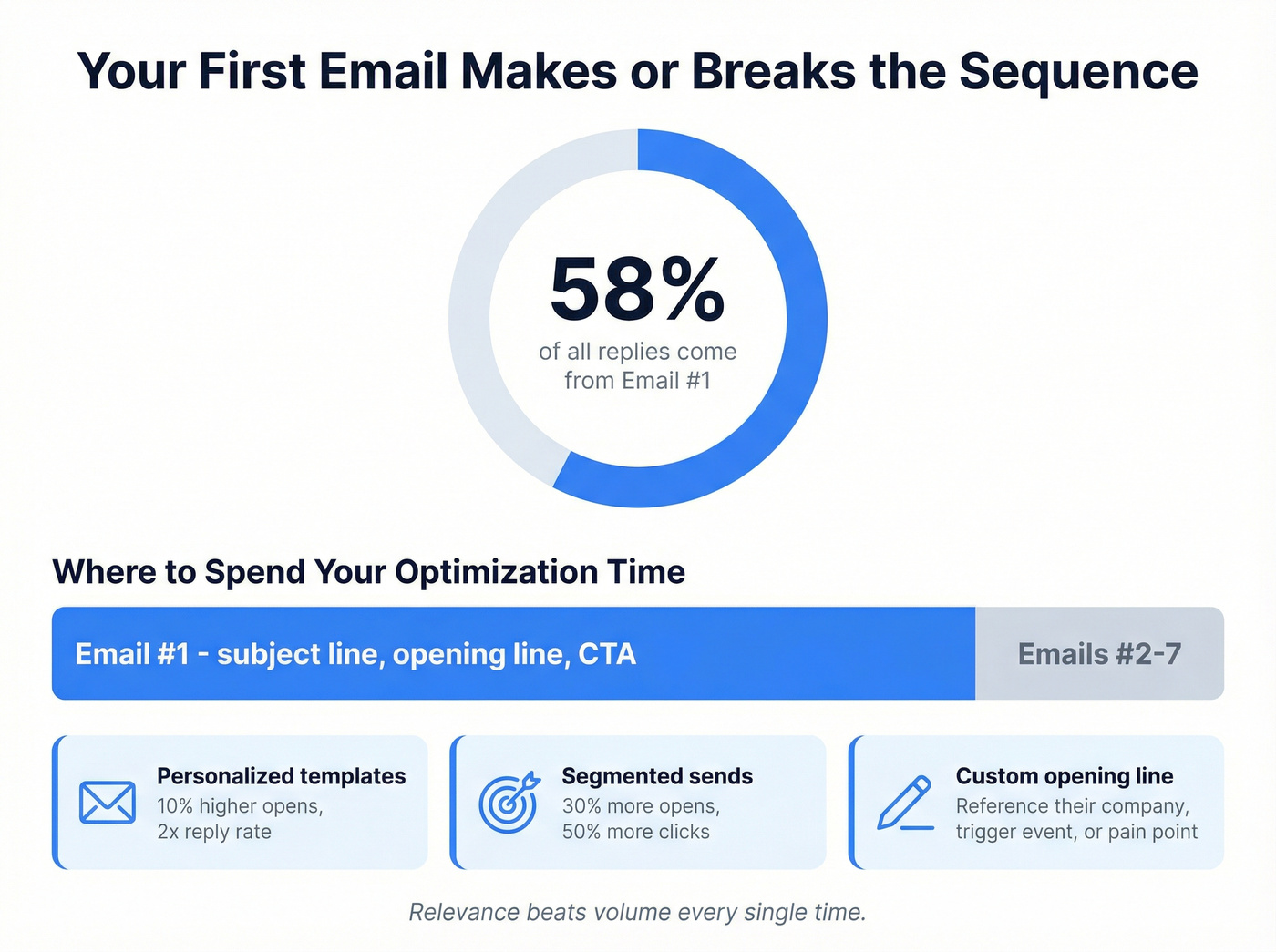
Customized cold email templates get 10% higher open rates and more than double the reply rate compared to standard sends. Segmented emails drive 30% more opens and 50% more clickthroughs. The principle is simple: relevance beats volume every time. If you're only going to personalize one thing, make it the opening line - a specific reference to the prospect's company, a recent trigger event, or a pain point you know their role deals with.
Cadence and Length
The sweet spot is 4-7 touchpoints spaced 3-4 business days apart. Under four and you're giving up too early. Beyond seven, diminishing returns kick in hard unless each touch adds genuinely new value. (More templates: sales cadence example.)
Keep emails under 80 words. Step 2 emails styled as casual replies outperform formal follow-ups by roughly 30% - drop the headers and formatting, and write like you're responding to a thread. Tuesday and Wednesday are peak reply days, with Wednesday edging ahead. A practical weekly cadence: launch Monday, follow up Wednesday, triage auto-replies Friday.
Personalization That Actually Moves the Needle
Personalization doesn't mean {{first_name}}. It means segmenting by industry, role, company stage, or pain point - then writing copy that speaks to that specific context. A/B test weekly with at least 100-200 prospects per variant to get statistically meaningful results. (Deep dive: personalization in outbound sales.)
Let's be honest: if you're closing deals under $10k, you probably don't need a 12-touch, multi-channel sequence. Four well-researched emails to a verified list will outperform a bloated cadence to unverified contacts every single time. Complexity isn't a strategy.
Sequence Templates You Can Steal
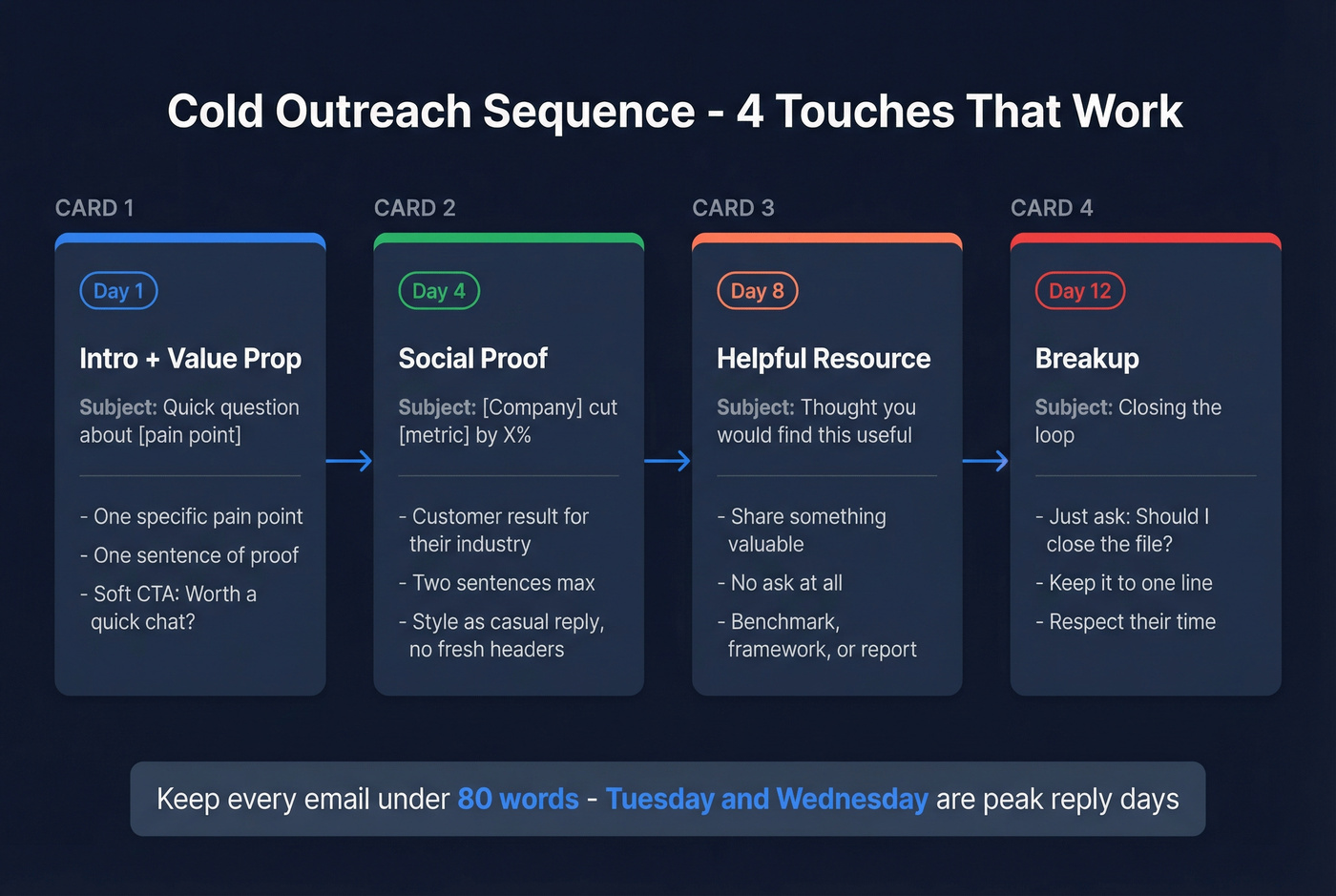
Cold Outreach (4-Touch)
- Day 1 - Intro + value prop. Subject: "Quick question about [pain point]." One specific pain point, one sentence of proof, one soft CTA ("Worth a quick chat?").
- Day 4 - Social proof. Subject: "[Similar company] cut [metric] by X%." Customer result relevant to their industry. Two sentences max. Style it as a casual reply - no fresh headers.
- Day 8 - Helpful resource. Subject: "Thought you'd find this useful." Share something valuable with no ask. A benchmark, a framework, a relevant industry report.
- Day 12 - Breakup. Subject: "Closing the loop." Just ask: "Should I close the file?"
Welcome/Nurture Flow
- Day 0 - Welcome + expectations + first resource.
- Day 2 - Recommended next steps or modules.
- Day 5 - Social proof with customer stories and quick wins.
- Day 10 - Re-engagement with a specific next-step CTA.
Win-Back (3-Touch)
Win-back sequences deserve a mention even though cold outreach and welcome flows are the highest-ROI starting points. Send a "We miss you" email at Day 1, a limited-time incentive at Day 4, and a final "last chance" at Day 8. If three emails don't re-engage them, more won't either. Skip this sequence entirely if your list hasn't been active in over 12 months - you're better off starting fresh.
Mistakes That Kill Sequences
Blasting unsegmented lists. You're leaving 30% open-rate lift on the table. In our experience, list hygiene and segmentation issues cause more sequence failures than bad copy - by a wide margin. (Related: data quality.)
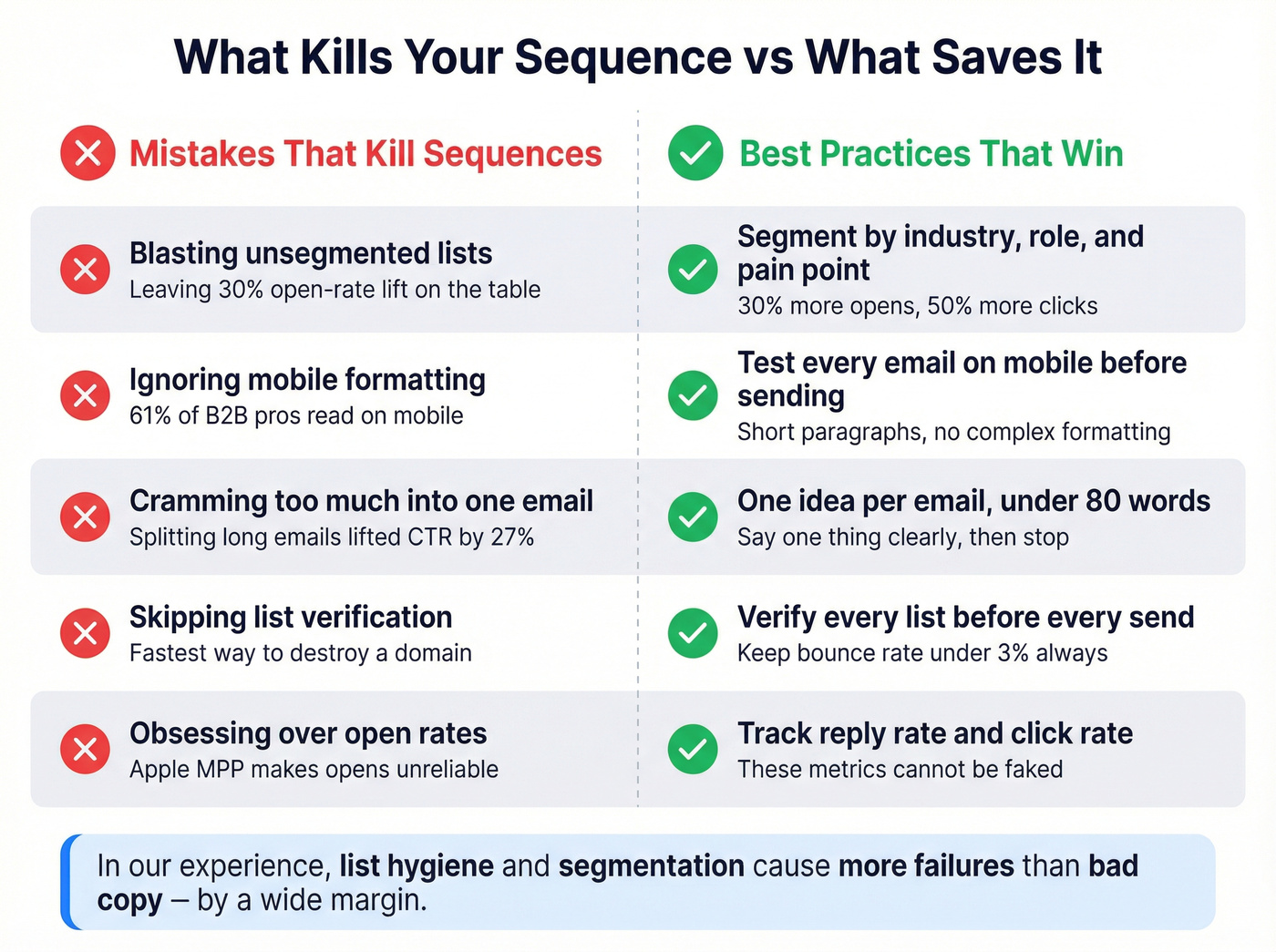
Ignoring mobile. 61% of B2B professionals read emails on mobile. If your formatting breaks on a phone, you've lost them before they read a word.
Cramming too much into one email. Splitting a long email into a shorter series lifted CTR by 27% in one documented test. Say one thing per email.
Skipping list verification. Sending to unverified addresses is the fastest way to destroy a domain. Clean your list before every send. (More: email verification for outreach.)
Obsessing over open rates. Apple MPP has made opens unreliable. Track replies and clicks instead. If your tool only reports opens, you're flying blind.
Snyk's 50 AEs dropped bounce rates from 35-40% to under 5% and generated 200+ new opportunities per month - because every email in their sequences hit a real inbox. Prospeo delivers 98% email accuracy at $0.01 per lead, no contracts required.
Fix the foundation and watch your reply rates climb.
FAQ
How many emails should be in a sequence?
For cold outreach, 4-7 emails spaced 3-4 business days apart. 58% of replies come from the first touch, and returns diminish sharply past seven. Nurture sequences can run 7-10 emails spaced every 1-2 weeks.
What's a good cold email reply rate in 2026?
The average sits at 3.43%. Top-quartile campaigns hit 5.5%+, and elite campaigns exceed 10%. If you're below 3%, fix list quality and deliverability before rewriting copy.
How do I stop sequence emails from landing in spam?
Authenticate your domain with SPF, DKIM, and DMARC. Warm up from 30-50 emails/day to 120-150 over four weeks. Keep bounce rates under 3% and spam complaints under 0.1%. Verify your contact list before every send.
What are follow-up email best practices?
Space follow-ups 3-4 business days apart, keep each under 80 words, and add new value in every message - a case study, a useful resource, or a fresh angle on their pain point. Style them as casual replies to your original thread, and stop at seven touches unless you have a strong reason to continue.