

Oracle NetSuite Alternatives Worth Evaluating in 2026
Your CFO just forwarded the renewal quote, and it's $40k more than last year. NetSuite serves 37,000+ customers for good reason - it's a genuinely capable cloud ERP. But 15-30% renewal increases, module creep, and implementation costs that rival the software itself are pushing finance teams to ask a harder question: do we actually need all of this?
Most lists of Oracle NetSuite alternatives include 15 tools, and half aren't ERPs. Workday shows up constantly - it's an HR platform, not a NetSuite replacement. We kept this to 9 actual options, segmented by who they're really for, with real pricing on every one.
Our Top Picks
Sage Intacct - Best if your pain is financial reporting and you don't need inventory or manufacturing. Median annual contract around $60k per Vendr's procurement data.
Acumatica - Best true ERP replacement without per-user pricing. Unlimited users, consumption-based model, mid-market sweet spot of $25k-$75k/year.
Odoo - Best for small teams willing to self-configure. Free tier with one app and unlimited users. Paid plans start around $10-$20/user/month.
What NetSuite Actually Costs
NetSuite's base platform starts around $999/month. Full user licenses run $99-$199/user/month. Then you add modules - Advanced Financials ($500-$1,500/mo), Advanced Inventory ($500-$2,000/mo), Manufacturing ($1,000-$3,000/mo) - and the number climbs fast. Implementation typically costs 1-2x your annual license fee.
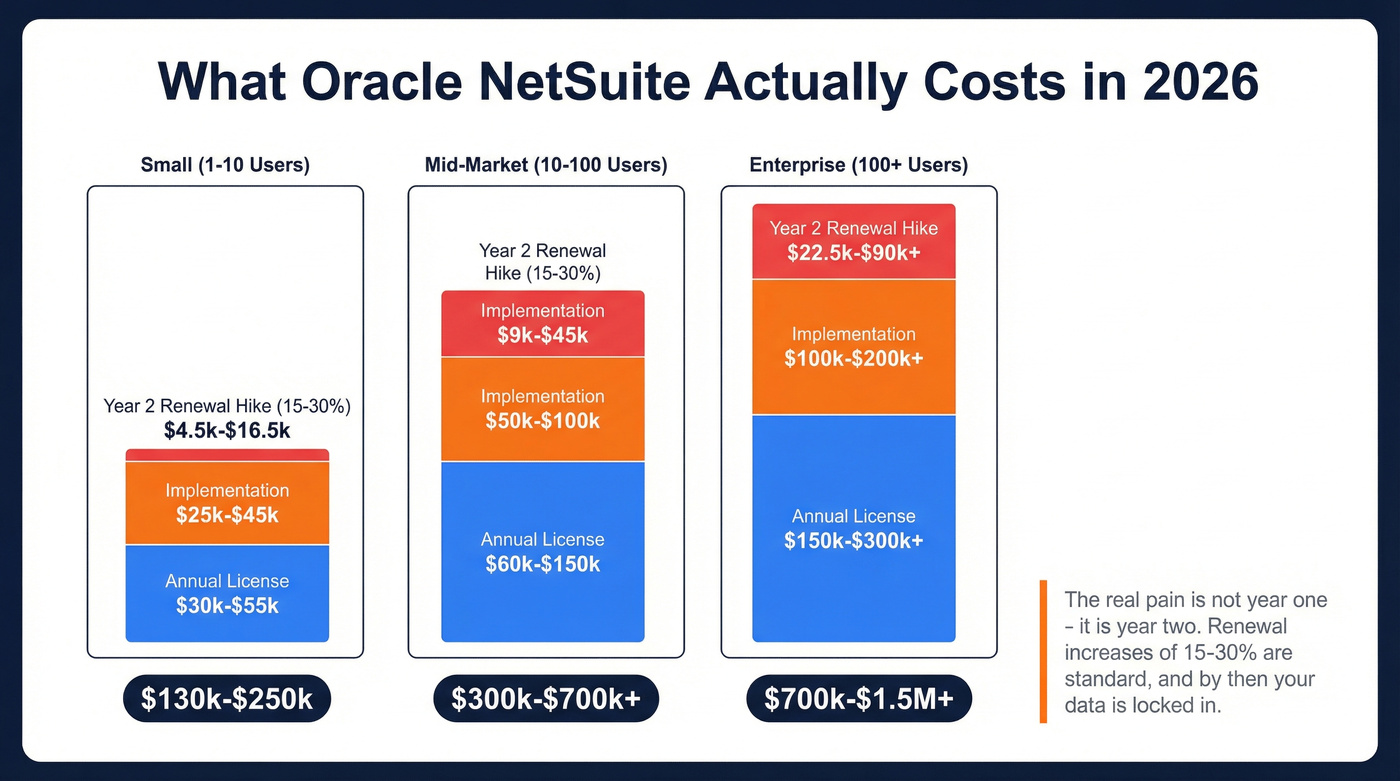
| Company Size | Users | Annual License | Implementation |
|---|---|---|---|
| Small | 1-10 | $30k-$55k | $25k-$45k |
| Mid-market | 10-100 | $60k-$150k+ | $50k-$100k |
| Enterprise | 100+ | $150k-$300k+ | $100k-$200k+ |
The real frustration isn't the initial contract - it's year two. Renewal increases of 15-30% are standard, and by then your data is locked in and migration feels impossible. That's the leverage Oracle knows it has.
9 Best ERP Alternatives to NetSuite
Sage Intacct
$400-$800/user/month | TCO: $50k-$200k | Implementation: 3-6 months
Intacct is best-in-class financial management for finance-led organizations - professional services, SaaS, nonprofits. If your primary pain with NetSuite is reporting, multi-entity consolidation, or dimensional GL, this is where you start. Finance teams on G2 consistently rate Intacct's dimensional reporting above NetSuite's, and the median annual contract sits around $60k, competitive with a small NetSuite deployment.
Skip this if: You need inventory management, manufacturing, or order management. Intacct is a financial management platform that integrates with operational tools - not a full ERP. Running a warehouse or production floor? It'll replace the finance piece and leave you shopping for the rest.
Acumatica
~$6,400/year (small) to $25k-$75k/year (mid-market) | Implementation: $20k-$500k | Timeline: 4-8 months
Acumatica's consumption-based model is the single biggest reason mid-market companies switch from NetSuite. You pay based on resources consumed, not headcount - unlimited users included. For companies with 50+ people touching the ERP (even read-only), this changes the math dramatically.
The tradeoff is the partner ecosystem. NetSuite generally has a broader partner network, and in niche verticals or specific geographies, finding an experienced Acumatica implementer can take longer than you'd expect. We've seen teams underestimate this and end up with a generalist partner who learns on their dime. Budget extra time for partner vetting - it's worth it.
Odoo
Free (one app, unlimited users) | Paid: ~$10-$20/user/month | Custom: ~$15-$25/user/month
Here's the math that makes Odoo compelling. Odoo's free tier gives you one app with unlimited users. The paid Standard plan unlocks everything: Sales, Accounting, Inventory, HR, Projects, POS.
A 10-person team typically pays around $1,200-$2,400/year versus $30,000+ on NetSuite. That's roughly a 90% cost reduction. The Custom plan adds Studio, multi-company support, and external API access for ~$15-$25/user/month, but at that point you're building your own ERP experience. Odoo is powerful but modular - you'll spend real time configuring workflows, and complex deployments need implementation partners. Right tool for teams under 25 people willing to invest setup time to slash ERP costs.
Microsoft Dynamics 365 Business Central
Essentials runs $80/user/month, Premium $110/user/month, and Team Members just $8/user/month. Implementation typically lands between $40k-$100k+. This is the obvious pick if you're already deep in the Microsoft ecosystem - Azure, 365, Power BI. The native integration is tighter than anything a third-party connector can replicate.
The catch: manufacturing capabilities require the Premium tier, and the jump from Essentials to Premium across 50 users adds $18,000/year. That adds up fast.
Epicor Kinetic
Base platform fee of $1,500/month plus $100-$200/user/month. A 25-user manufacturer pays roughly $5,000-$8,000/month total. Implementation runs $50k-$1M over 5-10 months. Epicor is the manufacturing specialist - if you're running discrete or mixed-mode manufacturing, this is purpose-built for your world. Don't evaluate it unless manufacturing is your core business.
Certinia
Starts around $100/user/month, and many teams pay ~$175/user/month for core users, with Executive read-only access at $125/month. Certinia is built natively on Salesforce, which means you need Salesforce licenses on top. Total project cost runs $100k-$500k. It's the right choice for professional services firms already running Salesforce who want financials and PSA in the same platform. The Salesforce dependency doubles your licensing complexity - and your vendor lock-in.
SAP S/4HANA
No public pricing, and the 3-year TCO runs well over $100k. Enterprise-only territory. If you're an SMB looking at SAP, look at SAP Business One instead - it starts around $410/user/year and targets smaller organizations.
Oracle Fusion Cloud ERP
Custom quotes only, enterprise-priced. For small deployments, it typically lands in the $75k+/year range before implementation. Think of it as NetSuite's enterprise sibling - the natural graduation path if you're scaling past NetSuite's ceiling but want to stay in Oracle's ecosystem.
IFS Cloud
Custom quotes only, with a 100-user minimum, targeting companies in the ~$100M-$1B revenue range. First-year estimates run $250k-$2M+ depending on scope. Best known for manufacturing and asset-heavy industries. If that's not you, move on.

Evaluating a six-figure ERP migration? You need buy-in from finance, ops, and IT leaders - fast. Prospeo gives you 98% accurate emails and 125M+ verified mobile numbers for the exact decision-makers driving ERP purchases, all at $0.01 per email.
Reach the CFOs and CIOs behind every ERP decision - with data that actually connects.
Pricing Comparison
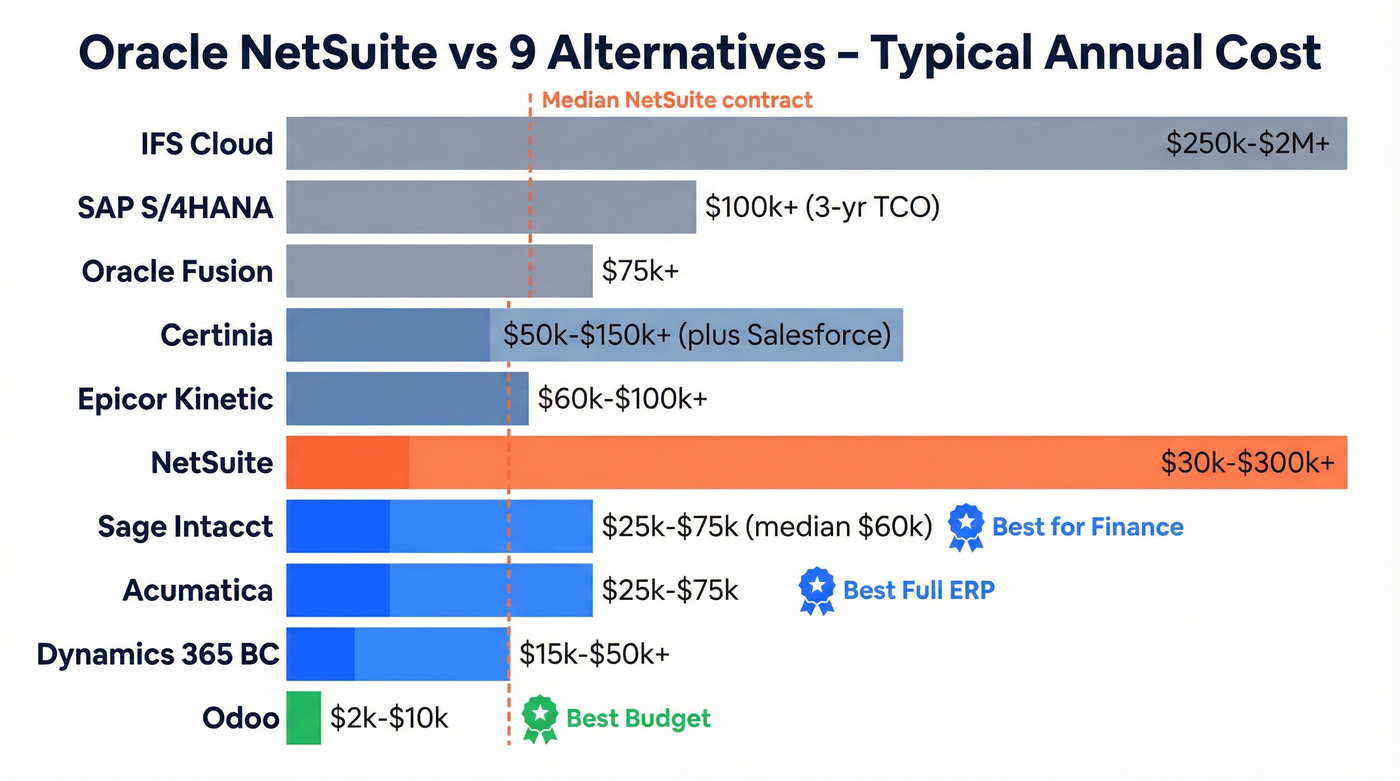
| Tool | Starting Price | Typical Annual | Implementation | Model |
|---|---|---|---|---|
| NetSuite | $999/mo + $99/user | $30k-$300k+ | $25k-$200k+ | Per-user + modules |
| Sage Intacct | $400/user/mo | $25k-$75k (median $60k) | $10k-$200k | Per-user + modules |
| Acumatica | ~$6,400/yr | $25k-$75k | $20k-$500k | Consumption-based |
| Odoo | Free (one app) | $2k-$10k | DIY or $5k-$50k+ | Per-user, all apps |
| Dynamics 365 BC | $80/user/mo | $15k-$50k+ | $40k-$100k+ | Per-user |
| Epicor Kinetic | $1,500/mo + $100/user | $60k-$100k+ | $50k-$1M | Base + per-user |
| Certinia | $100-$175/user/mo | $50k-$150k+ (+ Salesforce) | $100k-$500k | Per-user (+ Salesforce) |
| SAP S/4HANA | Custom | $100k+ (3-yr TCO) | $100k+ | Custom |
| Oracle Fusion | Custom | $75k+ | Custom | Per-user + modules |
| IFS Cloud | Custom (100-user min) | $250k-$2M+ | Included | Custom |
Which Alternative Fits You?
Company size determines your starting shortlist. Under 25 employees, look at Odoo or Dynamics 365 BC. Mid-market (25-500), Sage Intacct or Acumatica. Enterprise means SAP, Oracle Fusion, or IFS. Only about 26% of employees typically use an ERP, so your "full access" user count is probably lower than your headcount.
For teams where 50+ users need access, Acumatica's unlimited-user model saves serious money versus per-seat alternatives.
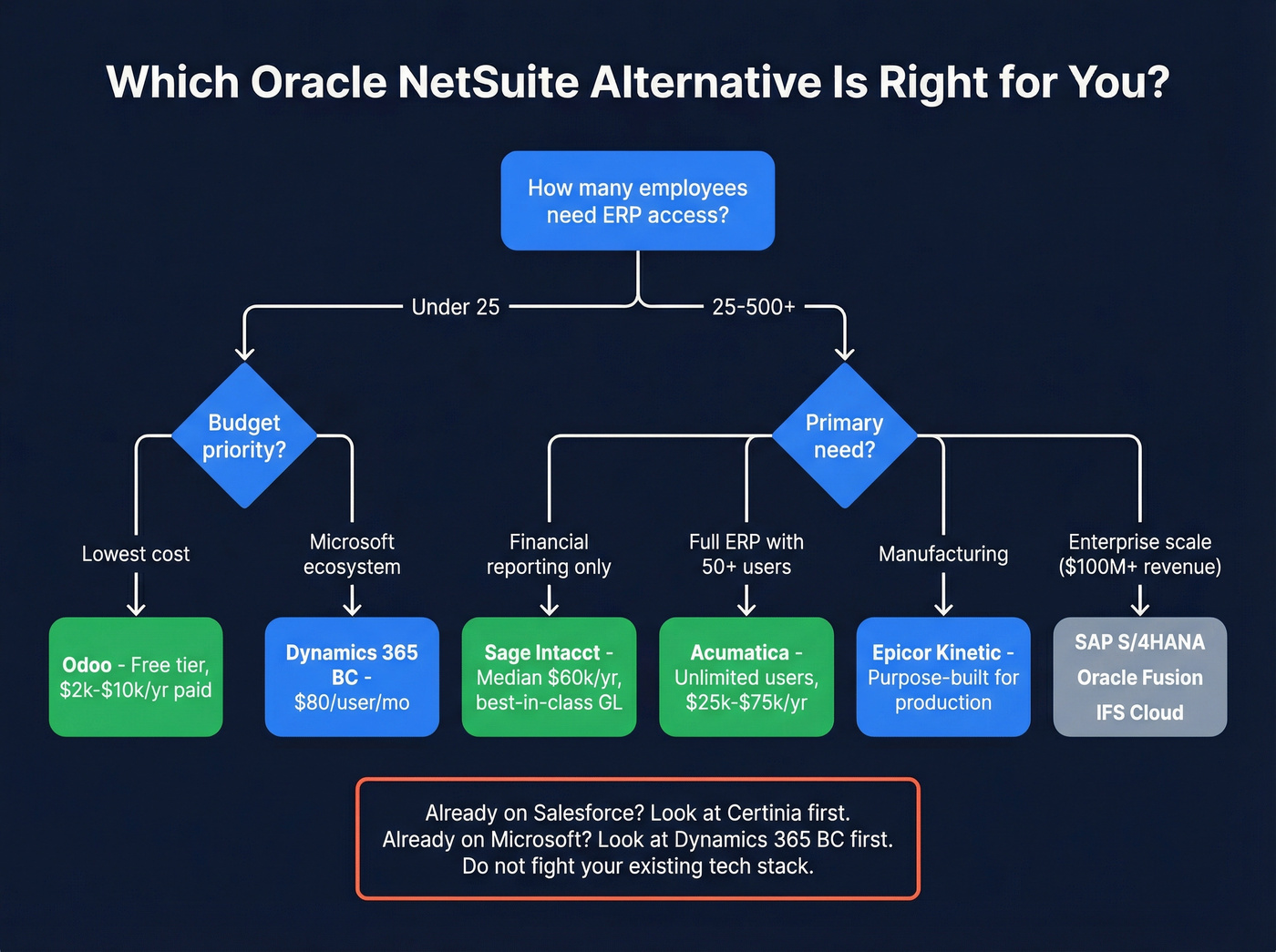
The sharpest dividing line is financials-only vs. full operations. Finance teams should evaluate Sage Intacct first. Manufacturing shops should look at Epicor Kinetic or Acumatica.
Don't fight your existing ecosystem. Microsoft shops go with Dynamics 365 BC. Salesforce shops go with Certinia. Oracle shops go with Fusion. Fighting your existing tech stack is expensive and rarely worth it.
Let's be honest about something: most mid-market companies evaluating NetSuite replacements don't actually need a full ERP swap. They need better financials and a handful of integrations. If your annual contract is under $50k and you're not running a warehouse, Sage Intacct plus best-of-breed tools will outperform any monolithic ERP - and cost less.
Before You Switch
ERP migrations are expensive. The average project cost runs about $9,000 per user, and among projects that go over budget, 38% blame underestimated staffing and 35% blame scope creep. Request sandbox or trial access from any vendor before committing - you'll catch deal-breakers early.
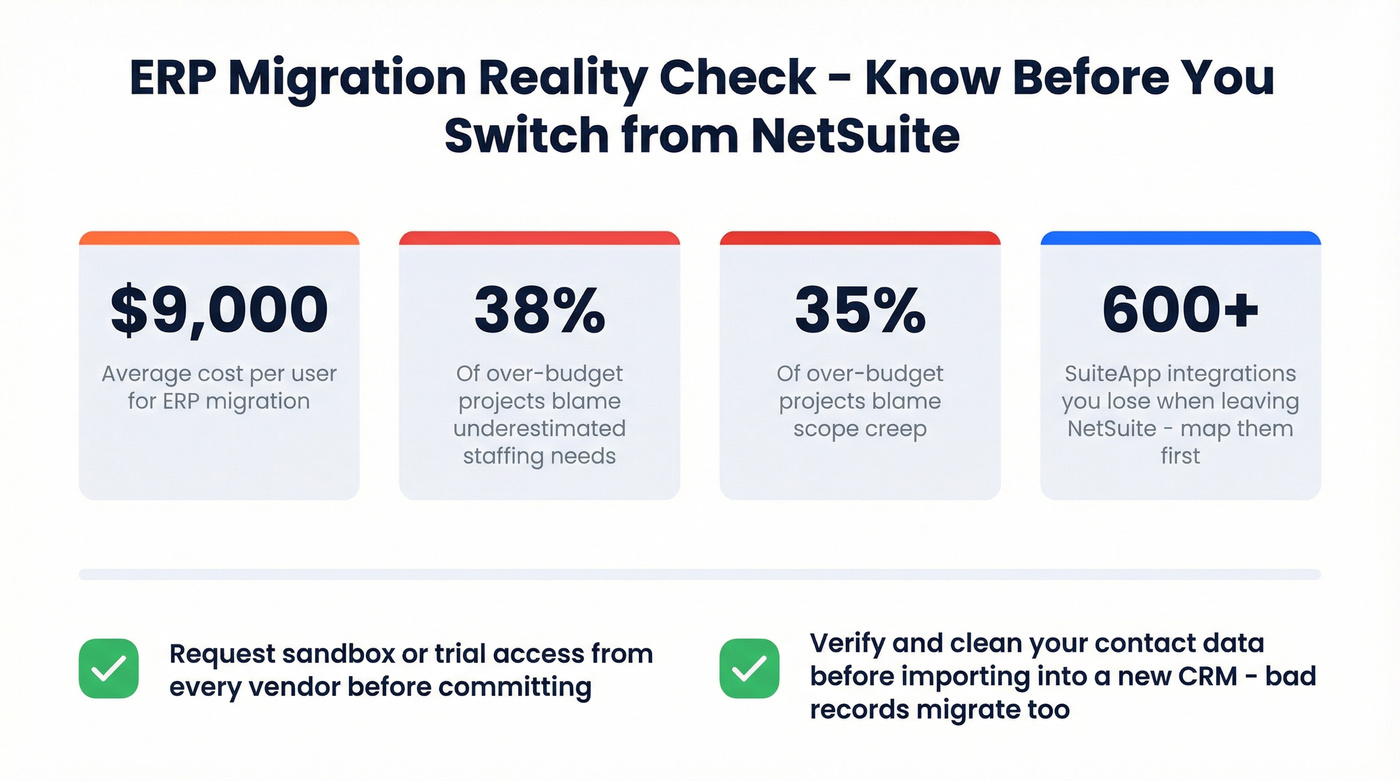
You'll also lose access to NetSuite's 600+ SuiteApp integrations. Map which ones you actually use before evaluating replacements.
Companies leaving NetSuite often ditch its built-in CRM too - it's one of the platform's weaker modules. That migration moment is when your contact data either gets cleaned up or gets worse. Bad emails, stale phone numbers, and duplicate records migrate right into your shiny new system if you don't catch them first. Before you import contacts into a new CRM, run them through Prospeo's verification - 98% email accuracy and a 7-day data refresh cycle that keeps records current. At ~$0.01 per email, verifying your entire database before migration costs less than one hour of an implementation consultant's time.
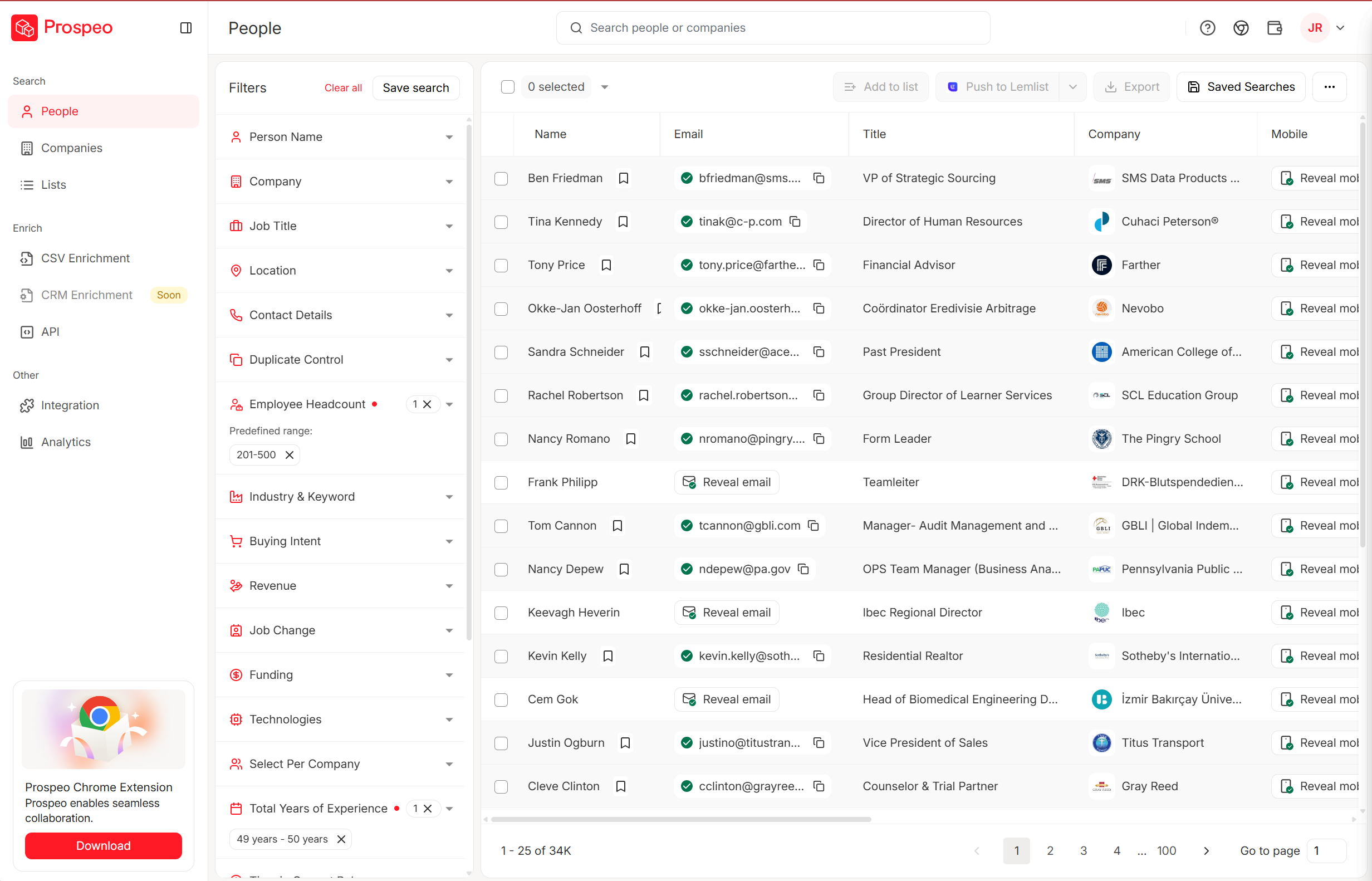
If 15-30% renewal hikes taught you anything, it's that vendor lock-in kills budgets. Prospeo has no contracts, no sales gates, and transparent credit-based pricing. 300M+ profiles with 30+ filters to target companies actively evaluating ERP solutions.
Stop overpaying for data the same way you overpaid for NetSuite.
FAQ
Is Oracle NetSuite worth the cost?
For mid-market companies actively using financials, inventory, and order management together, NetSuite delivers real value. The problem is pricing unpredictability - 15-30% annual renewal increases and module creep inflate costs faster than headcount grows. If you're using less than half the platform's modules, you're almost certainly overpaying.
What's the cheapest alternative to NetSuite?
Odoo, by a wide margin. Its free tier gives you one app with unlimited users, and paid plans start around $10-$20/user/month. A 10-person team typically pays $1,200-$2,400/year versus $30,000+ on NetSuite - roughly a 90% cost reduction.
What happens to my CRM data when I leave NetSuite?
Most companies switching ERPs also rebuild their sales data stack, since NetSuite's CRM is widely considered one of its weaker modules. Export your contacts, deduplicate records, and verify emails before importing into a new system. Bulk verification at ~$0.01/email is far cheaper than migrating bad data and dealing with bounces later.