

Cold Pitch Email: A Deliverability-First Framework + Templates (2026)
Great copy won't save a cold pitch email that lands in spam. In 2026, the "secret" is boring and operational: authenticate your domain, keep complaints and bounces low, and stop hammering the same companies with too many touches. Then - and only then - your words get a fair shot.
Here's the thing: if your offer needs a 300-word explanation, it isn't a cold pitch email. It's a proposal you're forcing into someone's inbox.
I've seen teams rewrite templates for weeks while their domains quietly slid into spam because they were sending unverified lists and "following up" five times like it was a personality trait. Fix the plumbing first.
What a cold pitch email is (and how it differs from cold sales email)
A cold pitch email is unsolicited outreach where you're offering something specific (a service, a collaboration, a piece of work, a partnership) to someone who didn't ask for it. The "product" is often you: your craft, your time, your judgment.
A cold sales email is the B2B cousin: you're selling a product to a buyer at a company, usually with a defined ICP, a sequencer, and a pipeline goal. It's still cold outreach, but the motion is more systemized and the ask is usually tied to a buying process.
Definition callout: Cold pitch email (freelancer-style) You're pitching your work (writing, design, dev, consulting) to earn a project. This is the classic "cold pitch" angle - and it works when you lead with relevance, not your portfolio.
Definition callout: Cold pitch email (B2B-style) You're pitching a business outcome (reduce churn, speed up onboarding, cut cloud spend) and the "work" is your product or service. This overlaps heavily with "cold email," but the bar for proof and clarity is higher because you're interrupting a busy operator.
Cold outreach flips inbound on its head. In inbound, they already have attention and intent; you're converting it. In cold, you're manufacturing attention and belief without permission, so relevance and timing beat credentials.
One strong opinion: leading with what you want ("I'm available this month," "I'm looking for work," "Here's my portfolio") is the fastest way to get ignored. Nobody wakes up hoping to fund your calendar.
What you need (quick version)
A large 2026 dataset of 16.5M cold emails found the average reply rate was 5.8%. Treat that as your baseline: if you're at 1-2%, you don't have a "template problem." You've got an inbox placement, list quality, or targeting problem.
Baseline KPIs (so you know what's "good")
Use these as default guardrails:

- Spam complaint rate: <0.3% (non-negotiable; this is where inbox placement falls off a cliff)
- Total bounce rate: <2%
- Hard bounce rate: <1%
- Unsubscribe rate: watch it if it's >1% (targeting or volume is sloppy)
- Reply rate: ~5-6% is healthy for broad outbound; higher is normal with tight targeting and a small ask
Default timing (when you don't want to overthink it)
That same research shows Thursday performs best for replies (6.87% vs 5.29% on Monday). If you want a simple schedule: send Tuesday-Thursday, and put your best segment on Thursday.
There's also a counterintuitive peak: 8-11 PM had the highest reply rate (6.52%). I don't recommend midnight blasting, but I do recommend testing one evening send per week for your best-fit prospects, especially if you sell to operators who live in their inbox after meetings.
3-step action plan
Step 1: Make inbox placement non-negotiable. Set up SPF, DKIM, and DMARC. Add One-click unsubscribe. Keep complaints low.
Step 2: Tighten targeting before you touch copy. Email 1-2 people per company, not 10. Pick one pain, one persona, one reason now.
Step 3: Write short, specific, low-friction asks. Write 2-4 word subject lines. Keep the body 6-8 sentences, under 200 words, and use one CTA.
Mini decision tree (diagnose fast)
- If you got 0 replies: you're not landing in inboxes or your list is wrong. Fix authentication, verify emails, narrow your ICP.
- If you got opens but no replies: your offer/CTA is too heavy, too vague, or too self-focused. Tighten "why you / why now" and lower the ask.
- If you got replies but they're negative: you're over-emailing companies or you sound automated. Reduce volume, add specificity, and stop after a clear no.

Non-negotiable deliverability rules (post-Feb 2024)
- SPF + DKIM + DMARC on the sending domain
- One-click unsubscribe (List-Unsubscribe)
- Keep spam complaint rate under 0.3%
- Honor unsubscribes fast (within 2 days for Yahoo's requirement)
If you only fix 3 things
- SPF/DKIM/DMARC + one-click unsubscribe
- 2-4 word subject lines
- 1-2 contacts per company + verified emails (verify before you send - don't "find out" via bounce rates)
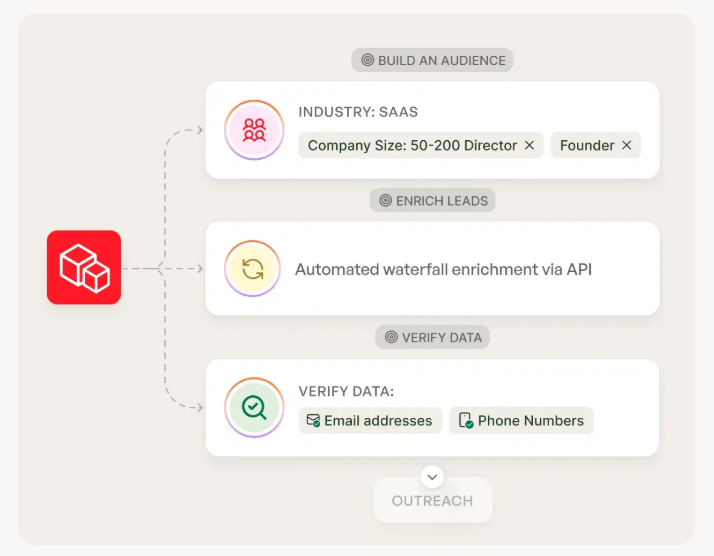
The 2-part model: inbox placement first, then copy
Most teams treat outreach like a writing problem. It's not. It's a systems problem with a writing layer.

Email deliverability has two realities that matter:
- Delivery = the recipient server accepted the email.
- Deliverability = the email landed where a human will see it (inbox vs spam vs promotions).
You can have "delivered" emails and still be dead in the water.
A common failure mode looks like this: you send 500 emails, your tool shows 98% delivered, but replies are near zero. You assume the copy is bad. In reality, you're landing in spam/promotions because your domain reputation is weak, your complaint rate is creeping up, or your list is dirty. "Delivered" is a receipt. It's not success.
Litmus also found 70% of emails have at least one spam-related issue. That's why deliverability work pays off fast: most senders are leaking reputation through small, fixable mistakes.
Part 1: Inbox placement (the gate). Authentication, complaint rate, bounce rate, list hygiene, sending patterns.
Part 2: Copy (the lever). Relevance, clarity, credibility, and a CTA that matches the relationship (which is: none).
Monitoring = what winning teams actually do
Teams that call their email programs successful are 22% more likely to monitor deliverability/inbox placement. Monitoring isn't a dashboard screenshot. It's five habits:
- Inbox placement tests (seed list across Gmail/Yahoo/Outlook; check inbox vs spam)
- Bounce codes (not just bounce rate - why it bounced)
- Complaint rate trend (daily/weekly; spikes matter more than averages)
- Domain reputation trend (you want stable, not "good this week, bad next week")
- DMARC aggregate anomalies (new sending sources, alignment failures, sudden volume changes)
What to monitor weekly (and what "good" looks like)
Check these once a week - same day, same time - so you catch drift early:
- Spam complaints: <0.3%. If you hit 0.3%, stop scaling and fix targeting immediately.
- Hard bounces: <1%. If it's higher, your list source or verification step is broken.
- Total bounces: <2%. Over 2% is a deliverability tax you don't need to pay.
- Unsubscribes: if it's >1%, your message is misaligned or you're emailing the wrong persona.
- Inbox placement spot-check: run a small seed test (even 10 emails) after any major change (new domain, new tool, new copy style).
- Reply rate by segment: if one segment is dragging, cut it. Don't "average" your way into spam.
Use this if:
- You're sending more than a handful of cold emails per week.
- You're seeing "delivered" but no replies.
- You're scaling across multiple senders/domains.
Skip this if: You're sending 5 hyper-personalized pitches a month from a single inbox and getting replies. Don't over-engineer what's working.

You just read why bounces and spam complaints kill cold pitch campaigns before copy ever matters. Prospeo's 5-step email verification keeps your hard bounce rate under 1% - because 98% of our emails are verified accurate, refreshed every 7 days. Stop "finding out" your list is dirty through bounce rates.
Fix the plumbing first. Verify every email before you hit send.
Subject lines that get opened in 2026
Subject lines aren't magic. They're a micro-commitment: "Is this worth 3 seconds?"

A large 2026 subject line dataset (5.5M emails) gives unusually actionable guidance:
- 2-4 words performs best at about 46% opens.
- Personalization lifts opens (46% vs 35%) and replies (7% vs 3%).
- Question-style subjects are top performers (also around 46% opens).
- Numbers don't help (slightly worse than no numbers).
There's also a practical constraint everyone ignores: mobile truncation. On phones, you often get 33-50 characters before the subject cuts off. If it doesn't fit on mobile, rewrite it.
Rules that actually hold up
Rule 1: Write 2-4 words. If it can't fit on mobile, rewrite it.
Rule 2: Personalize with something real. "Quick question, Sarah" is fake personalization. "About your onboarding flow" is real.
Rule 3: Avoid hype words that trigger skepticism. "ASAP," "guaranteed," "limited time." You're not running a promo.
Rule 4: Match the subject to the first line. If the subject is "Quick question," the first line must be a quick question. Misalignment drives deletes and spam clicks.
Do / don't examples
Do
- "Quick question"
- "Right contact?"
- "About {{initiative}}"
- "Idea for {{company}}"
- "{{competitor}} -> {{outcome}}?"
Don't
- "Re: our conversation" (you didn't have one)
- "Following up" (on what?)
- "10x your pipeline ASAP" (spam energy)
- "Partnership opportunity for {{company}}" (too broad, too salesy)
The 6-8 sentence cold pitch email framework (under 200 words)
In that same large 2026 dataset, the best-performing emails are 6-8 sentences and under 200 words. That's not a style preference. It's an attention constraint, and it also keeps you from stuffing emails with links, tracking, and fluff that tends to correlate with lower trust and worse placement.

We've tested this across services and SaaS: shorter emails don't just get read more, they get forwarded more, because they're easy for a busy person to pass to the right owner without adding "what is this?" context.
The framework (copy/paste this structure)
- Context opener (1 sentence): why you're reaching out to them specifically.
- Observation (1 sentence): something you noticed that's relevant.
- Problem (1 sentence): the cost of that gap (time, money, risk, missed growth).
- Proof (1 sentence): one credibility anchor (result, niche, comparable client, artifact).
- Offer (1 sentence): what you do in plain language.
- Low-friction CTA (1 sentence): a yes/no or a tiny next step.
- Optional "solve for free" sentence: one actionable tip or mini-audit insight.
- Close (1 sentence): polite, professional, easy out.
That's it.
Don't ask for a call in sentence #2.
Do this this week (a Monday-morning plan)
- Day 1: Fix SPF/DKIM/DMARC, add one-click unsubscribe, and turn off open tracking for cold outreach.
- Day 2: Verify your list, remove invalids, and split catch-alls into a low-volume segment.
- Day 3: Write one core template + two follow-ups (new angle each time).
- Day 4: Send to 20 prospects max, 1-2 per company, plain text, one link or none.
- Day 7: Review hard bounces, complaints, unsubscribes, and replies. Cut the worst segment and tighten the offer.
Annotated example (line-by-line)
Subject: "Right contact?" Short, low-pressure, and it sets up a simple reply.
Hi {{FirstName}} - quick question. Conversational without pretending you know them.
Are you the right person for {{area}} at {{Company}}? This is the "permission" move. It lowers resistance.
I noticed {{specific observation}} and it leads to {{specific cost}}. Observation + consequence, not a vague compliment.
We helped {{peer company / niche}} get {{result}} by {{mechanism}}. One proof point. No case study essay.
If it's useful, I can send a 5-bullet teardown of {{thing}} with 2 quick wins you can implement this week. Value-first, not needy.
Worth sending that over, or should I talk to someone else? A yes/no CTA that doesn't demand a meeting.
-- {{Name}} {{Title}} | {{Company}} {{Website}} | {{Address or city}} | Unsubscribe
Cold pitch email templates (real scenarios, not generic outreach)
These templates map to real situations. Use them as scaffolding, then swap in specifics.
Guardrails (from watching too many sequences crash and burn):
- Don't assume they're evaluating vendors.
- Don't push a call before you've earned relevance.
- Don't pitch five things. Pitch one outcome.
- Use whitespace: 1-2 sentence paragraphs; no blocks over 3 lines on mobile.
Quick question (find the right person)
When to use: you're not sure who owns the problem, and you want a reply even if it's a redirect.
Subject: Right contact? Hi {{FirstName}} - quick question.
Who owns {{problem area}} at {{Company}}?
I'm reaching out because we help {{industry}} teams {{specific outcome}} (ex: "reduce onboarding drop-off by fixing the first 7-day journey").
If you can point me to the right person, I'll send a 4-sentence summary and a relevant example.
Thanks, {{Name}} {{Title}} | {{Company}} {{Website}} | {{Physical address}} | Unsubscribe
Freelancer: value-first mini-audit
When to use: you're selling a high-trust service (writing, design, dev) and you need to prove you get it without dumping a portfolio.
Subject: Idea for {{Company}} Hi {{FirstName}} - I've been following {{Company}}'s work on {{specific thing}}.
One quick win: {{specific observation}}. Fixing {{specific change}} gets you {{benefit}}.
Reply "yes" and I'll send a 6-point mini-audit for {{asset}} (no deck - just practical notes). If it's not useful, tell me and I'll close the loop.
-- {{Name}} {{Role}} | {{Website}} | {{Location}} | Unsubscribe
B2B: problem -> proof -> low-friction CTA
When to use: you have a clear ICP and a measurable pain, and you can back it with one proof point.
Subject: About {{pain}} Hi {{FirstName}} - reaching out because {{trigger}} (ex: "you're hiring AEs" / "you just launched in EMEA").
Teams in {{their space}} hit {{problem}} which shows up as {{symptom}} and costs {{impact}}.
We helped {{peer}} reduce {{metric}} by {{result}} in {{timeframe}} by {{mechanism}}.
Quick check: is {{problem}} on your radar this quarter?
If yes, I'll send a short teardown of what we'd look at first. -- {{Name}} {{Title}} | {{Company}} | {{Website}} | {{Address}} | Unsubscribe
Warm-ish: third-party connection
When to use: you have a legitimate shared context (event, community, customer overlap). Don't fake this.
Subject: {{Mutual}} intro Hi {{FirstName}} - {{MutualName}} suggested I reach out.
They mentioned you're working on {{initiative}}. We've supported teams in {{space}} with {{outcome}} and I have one idea that fits what you're doing.
Want the quick version here, or should I loop in someone else?
Thanks, {{Name}} {{Title}} | {{Company}} | {{Website}} | {{Address}} | Unsubscribe
Follow-up bump (adds value, not guilt)
When to use: you sent a solid first email and you're following up with new information, not "just checking in."
Subject: Re: {{short subject}} Hi {{FirstName}} - one more thought on {{topic}}.
If {{Company}} is seeing {{symptom}}, a fast diagnostic is {{simple test}}. Reply "checklist" and I'll send the 5-minute version we use to spot {{problem}}.
Still the right person for this?
-- {{Name}} {{Title}} | {{Company}} | {{Website}} | {{Address}} | Unsubscribe
Breakup email (polite stop rule)
When to use: you've sent 2-4 total emails and got nothing.
Subject: Close the loop Hi {{FirstName}} - I'm going to close this out.
If {{problem}} becomes a priority later, reply "later" and I'll send the short teardown. Otherwise, I won't follow up again.
Thanks, {{Name}} {{Title}} | {{Company}} | {{Website}} | {{Address}} | Unsubscribe
Humor/pattern interrupt (with guardrails)
When to use: only if your brand voice can carry it. If you're selling security, legal, finance, or anything regulated, skip it.
Subject: Tiny favor Hi {{FirstName}} - quick one.
If you had to pick: is {{pain}} more "annoying" or "expensive" at {{Company}} right now?
Reply with one word and I'll send one idea that's worked for {{peer group}} teams.
-- {{Name}} {{Title}} | {{Company}} | {{Website}} | {{Address}} | Unsubscribe
Cold pitch email follow-ups that increase replies without burning your domain
Follow-ups work. They're also where teams torch deliverability by turning a good first email into a week-long annoyance.
A large 2026 dataset found follow-up #1 can lift replies up to 49%. The curve turns fast: by email #3, reply rates drop up to 20%, and by email #5 they drop 55% versus earlier touches.
Risk climbs as you keep poking:
- Spam rate rises from 0.5% (email 1) to 1.6% (round 4)
- Unsub rate rises from 0.1% (round 1) to 2% (round 4)
Real talk: if you need 7 follow-ups to get a reply, you aren't "persistent." You're mis-targeted, you're not reaching the inbox, or your offer isn't sharp.
Sequencing rules that keep you out of trouble
- Total emails per prospect: 3-5 max (including the first).
- Spacing: 2-4 business days between touches.
- Change something each time: new proof, new angle, new artifact, or a smaller ask.
- Keep it plain: heavy HTML, images, and link-stuffing are deliverability taxes.
- Turn off open tracking for cold outreach.
- Stop rules:
- Stop immediately on "no," "not interested," or "remove me."
- Stop after the breakup email.
- Stop if you see bounces or repeated spam complaints in that segment.
Cold pitch email deliverability rules since Feb 2024 (the non-negotiables)
Mailbox providers stopped tolerating spray-and-pray. Yahoo's bulk sender requirements are the cleanest checklist because they're explicit and measurable.
Here's the bridge people miss: Gmail and Yahoo aligned on the same bulk-sender baseline in 2024, and Microsoft followed for high-volume senders on May 5, 2026. If you meet Yahoo's checklist, you're meeting the practical standard across major inboxes.
Also, "bulk sender" is a threshold, not a moral label. The cutoff used in provider guidance is 5,000 messages/day into Gmail or Yahoo. Plenty of B2B teams hit that faster than they think once they add multiple reps and sequences.
The checklist
Complaint rate: keep spam complaint rate below 0.3%.
Why it matters: complaint rate is a direct reputation signal. Once it spikes, inbox placement drops hard.
Unsubscribe: support List-Unsubscribe with one-click unsubscribe (RFC 8058).
Why it matters: providers want recipients to unsubscribe, not hit "spam."
Honor unsub fast: process unsubscribes within 2 days.
Why it matters: slow opt-outs create complaints and regulatory exposure.
Authentication for bulk senders: SPF + DKIM + DMARC, and DMARC must pass (relaxed alignment is fine).
Why it matters: authentication is table stakes for inbox placement at scale.
DNS basics: valid forward and reverse DNS.
Why it matters: broken DNS is a spammer smell.
Yahoo keeps the canonical checklist updated here: Yahoo sender best practices.
Technical deliverability checklist (SPF/DKIM/DMARC + alignment) you can implement today
DNS feels scary because it's picky. It's still the highest-impact 30 minutes you can spend on deliverability.
SPF (Sender Policy Framework)
- Have exactly one SPF record per hostname. Two SPF TXT records breaks evaluation in unpredictable ways.
- Keep SPF DNS lookups <=10. Every include/redirect counts. Too many lookups = SPF fail.
- Include only the services that actually send mail for you (workspace, sequencer, helpdesk, etc.).
DKIM (DomainKeys Identified Mail)
- Use 2048-bit DKIM keys when your provider supports it.
- Make sure your sending platform is signing with DKIM on the domain you're using in the visible From.
- If you rotate providers, rotate DKIM too. Messy DNS is how mistakes happen.
DMARC (Domain-based Message Authentication, Reporting & Conformance)
- Publish DMARC at
_dmarc.yourdomain.comas a TXT record. - Roll out in phases:
p=none->p=quarantine->p=reject - Start with
p=nonelong enough to see all legitimate sources in reports, then tighten.
DMARC alignment (the part that trips teams)
DMARC passes when either:
- DKIM passes and the DKIM domain (
d=) aligns with the visible From domain, or - SPF passes and the SPF domain (MailFrom/Return-Path) aligns with the visible From domain
If your sequencer sends with a different bounce domain and you didn't configure alignment, you can have SPF "pass" but DMARC still fail. That's the classic "we have SPF/DKIM/DMARC but deliverability tanked" situation.
dmarcian has a clean explainer on the 5,000/day scope and alignment mechanics: DMARC required for bulk senders.
How to validate it's working (fast)
- Send a test email to a Gmail inbox, open it, click "Show original", and confirm SPF: PASS, DKIM: PASS, DMARC: PASS.
- Read your DMARC aggregate reports (via your provider or DMARC reporting). Look for new sources and alignment failures.
- Watch bounce messages: authentication-related rejects and policy blocks show up in the SMTP response text. Fix the root cause.
List hygiene & targeting (the hidden lever for deliverability + replies)
If deliverability is the gate, list hygiene is the bouncer.
A large targeting analysis shows emailing 1-2 people per company yields 7.8% replies, while blasting 10+ people at the same company drops to 3.8%. Over-targeting a single domain looks like harassment to recipients and like spam to providers.
Also: tracking hurts you. Turning off open tracking pixels increased response rates by 3% in that dataset. My operator rule: turn off open tracking for cold outreach. Measure replies, meetings, and pipeline.
Credibility signals that reduce "spam" clicks (recipient perspective)
Deliverability isn't just SPF/DKIM/DMARC. It's also whether a human trusts you in the first two seconds:
- Real sender name (not "Sales Team") and a real role
- Company domain that matches your website
- Full signature (title, company, website)
- Physical address (also compliance; it signals you're a real business)
- Plain-text formatting (no banners, no heavy HTML)
- One link max (or none) in the first email
- No open tracking pixel for cold outreach
- Optional: one professional profile link if it helps credibility (skip the badge pile)
These reduce deletes and spam clicks, which protects reputation, which protects inbox placement.
Why bounces and spam traps wreck you
- Hard bounces tell providers you're sending to bad addresses. Enough of them and your reputation drops.
- Spam traps/honeypots catch senders with sloppy list practices. Hit them and you can get throttled or filtered fast.
- Catch-all domains aren't "valid." They're "maybe." Treat them as a separate segment.
A practical workflow that keeps you out of trouble
Quick scenario from last quarter: a small agency we worked with was getting "98% delivered" and basically no replies. The fix wasn't clever copy. They verified the list, stopped emailing 8 people at the same company, and cut their sequence from 6 touches to 4. Replies came back within a week, and the spam complaints stopped spiking.
Here's the workflow:
Build a tight list. One persona, one trigger, one reason now.
Verify every email before it touches your sequencer. Tools like Prospeo (the B2B data platform built for accuracy) are built for this exact job: 98% email accuracy, catch-all handling, and spam-trap plus honeypot filtering, with data refreshed every 7 days so you aren't sending to stale inboxes.
Segment risky results.
- Send "valid" normally.
- Treat "catch-all" as a separate, lower-volume segment.
- Drop "invalid" completely.
Enrich to personalize without creeping. You only need 1-2 relevant details (role, initiative, tech stack, hiring signal). Over-personalization reads like surveillance and gets spam-clicked.
Cap per-domain volume. Stick to 1-2 contacts per company in a given 2-3 week window.
Here's what it looks like in practice: you upload a CSV, you get clear statuses (valid/invalid/catch-all), and you export only the safe segment into your sending tool.
If you want one more benchmark lens for sanity-checking KPIs, Gong's cold email research is a useful cross-reference: cold email stats from Gong.
Is cold pitching legal? US CAN-SPAM + UK PECR in plain English
Yes, cold pitching can be legal. But "legal" doesn't mean "anything goes," and compliance is operational, not theoretical.
In the US, CAN-SPAM applies to B2B too. The FTC is explicit: there's no business-to-business exception, and penalties can reach $53,088 per email in violation.
In the UK, PECR and UK GDPR create a stricter environment. PECR's email marketing rules don't apply to corporate subscribers in the same way they apply to individuals, but UK GDPR still applies when you process personal data. If you're emailing a named person at a company, treat it as personal data under UK GDPR.
US vs UK compliance table (practical view)
| Topic | US (CAN-SPAM) | UK (PECR + UK GDPR) |
|---|---|---|
| Who you can email | B2B + B2C allowed (with rules) | Corporate subscribers: PECR email marketing rules don't apply the same way; individuals (sole traders/some partnerships): consent required unless an exception fits. UK GDPR still applies to personal data. |
| Headers/subject | Must be truthful | Must not conceal identity |
| Must include | Address + opt-out | Identity + valid contact address + opt-out |
| Opt-out timeline | <=10 business days | Honor objections promptly |
| Unsubscribe | Clear mechanism | Clear opt-out in every email |
CAN-SPAM checklist (US)
- Truthful headers and subject lines
- Don't deceive recipients about who you are or why you're emailing
- Include a valid physical postal address
- Include a clear opt-out mechanism
- Honor opt-outs within 10 business days
- Maintain a suppression list and never re-add opted-out addresses (except for compliance support)
- Don't transfer/sell opted-out addresses (except for compliance support)
- You're responsible even if an agency sends on your behalf
Official reference: FTC CAN-SPAM compliance guide.
PECR/ICO checklist (UK)
- Corporate subscribers: you can email, but you must identify yourself, include a valid contact address, and include an opt-out.
- Sole traders/some partnerships: treated like individuals, so consent rules apply unless an exception fits.
- UK GDPR: direct marketing involves personal data processing; people can object at any time.
- Maintain a suppression list for opt-outs/objections and never re-add them.
If you operate in the UK, align your process to the ICO's guidance: ICO guidance on B2B marketing.
Practical compliance examples (copy/paste)
A compliant footer (simple, effective):
-- Name, TitleCompanyWebsiteCity, State (or full postal address)Unsubscribe(one click)
Suppression list rule (non-negotiable): When someone unsubscribes or objects, add them to a suppression list and keep it forever. Don't "clean your CRM" and accidentally re-import them next quarter.
UK lawful basis (one sentence you should internalize): If you're processing personal data for B2B outreach in the UK, you need a lawful basis (often legitimate interests) and you must honor objections immediately.
This guide says email 1-2 people per company with verified contacts. Prospeo's 300M+ profiles and 30+ filters let you pinpoint the exact decision-maker - by role, intent signals, even tech stack - so every cold pitch lands in the right inbox at $0.01 per email.
Tight targeting starts with data you can trust. Get 100 free credits now.
FAQ
What's the difference between a cold pitch email and a cold sales email?
A cold pitch email sells your work or a specific service (often freelancer-style), while a cold sales email sells a product to a defined buyer at a company. In practice, expect the sales version to be more ICP-driven and sequenced, and the pitch version to win on relevance + proof in under 200 words.
How long should a cold pitch email be?
It should be 6-8 sentences and under 200 words, with one clear CTA and plenty of whitespace for mobile. If you can't fit context, proof, and a tiny next step in that space, tighten the offer before you rewrite the template.
How many follow-ups should I send before stopping?
Send 1-3 follow-ups (so 3-5 total emails including the first), then stop with a polite breakup message. Follow-up #1 can lift replies by up to 49%, but by email #5 reply rates drop by ~55% and spam/unsub risk climbs fast.
What deliverability settings are non-negotiable after 2024?
You need SPF, DKIM, and DMARC, plus one-click unsubscribe (List-Unsubscribe) and fast unsubscribe processing (within 2 days for Yahoo's requirement). Keep spam complaints under 0.3% and total bounces under 2% or your inbox placement will degrade even if your tool says "delivered."
How do I verify emails before sending a cold pitch list?
Verify before you send by removing invalid addresses and segmenting catch-all domains into lower-volume sends, aiming for <1% hard bounces and <2% total bounces. Prospeo verifies in bulk with 98% email accuracy, catch-all handling, and spam-trap plus honeypot filtering so you only export safe addresses.
Summary: the boring stuff makes your cold pitch email work
If you want better replies, stop treating this like a template hunt. A cold pitch email works when inbox placement is solid (SPF/DKIM/DMARC, low complaints, clean lists), targeting is tight (1-2 contacts per company), and the message is short (6-8 sentences) with a low-friction ask. Do the boring operational work first, then your copy finally gets a fair shot.